PROTOTYPE OF VEHICLES POTHOLES DETECTION
BASED BLOB DETECTION METHOD
1
DEWIANI DJAMALUDDIN, 2ANDANI ACHMAD, 3RIVANTO PARUNG
1,2
Electrical Engineering Lecture, Hasanuddin University, Indonesia
3
Electrical Engineering, Hasanuddin University, Indonesia
E-mail: [email protected], [email protected], [email protected]
ABSTRACT
Potholes on road causes majority of traffic incidents. It happens with driver’s unawareness to potholes on the road, while potholes location data mining is still performed manually by technician nowadays. This issues drives these following research and prototyping to be performed. This paper presents a prototype of a pothole detection system using image processing. The system will detect the potholes by assuming potholes as a blob, using blob detection. Live feed from a camera module will be processed by the algorithm that is embedded to a microcontroller simultaneously to determine the potholes. Every detected potholes and its location will be recorded and displayed on a webpage. The prototype will be an embedded system Linux-based running on a Raspberry Pi, featured with camera and a computer program utilizing OpenCV. Several blob parameter such as shape, including circularity, convexity, and inertia value is utilized to optimize the pothole detection. The prototype is tested on actual road with different pothole shapes and size, and the result has 82.5% accuracy.
Keywords: Blob Detection, OpenCV, Potholes, Raspberry Pi
1. INTRODUCTION
One of the main cause of traffic accidents happened on road is the presence of potholes. Potholes, appear to be hard to recognize, make a daze responds to a driver who is passing by that road, especially drivers with a high speed velocity condition. Besides traffic accidents, pothole presence could make vehicles broken [1]. Many studies have been conducted to develop system or device that able to detect potholes on the road. Several methods on how to perform pothole detection is being developed such as vibration-based detection, 3D reconstruction-vibration-based detection, and visual-based detection. In this paper, a prototype is created that detects potholes using visual-based method.
From visual appearance, a pothole has three characteristics to distinguish it with another object on the road. First, potholes are darker than the surrounding area. Second, a pothole shape is approximately like ellipse to a circle viewed from the driver perspective. Third, surface of the surrounding area near potholes is smoother than the texture inside the pothole itself which is much
coarser and grainier [2]. Based on this
characteristic, a vision based algorithm is developed and utilized into the device.
The main idea of this prototype is a device that mounted on the passenger vehicles that has capability of capturing image continuously, where every frame taken by the camera is analyzed, determined whether potholes are present on the frame or not. When a pothole detected on frame, the system will record the GPS coordinate of where it gets detected. Therefore, a device that has a capability to log position such as GPS module [1] and has internet connection are required. Data of the detected potholes can be made available to other users, displayed on webpage, so that other drivers would have been alerted before they reach the pothole. Buzzer is utilized on this system as the alert. When a pothole detected, besides having its location recorded, a buzzer is turned on so the driver can reduce the speed to avoid the potholes or at least minimize the effect that could happen because of the potholes.
or brightness compared to surrounding area. The blob detection parameters that is used in this system are circularity value, convexity value, and the inertia of the shape. Several filter method is also utilized to reduce noise on the image especially the salt-and-pepper noise caused by analog to digital converters errors from the camera sensors from the prototype itself.
OpenCV (Open Source Computer Vision) is a computer vision open source library and machine learning software library [3]. It supports several programming language such as C++, C, Python, and Java interfaces and run on several operating system such as Windows, Linux, Mac OS, and Android. OpenCV is designed for an effective computational image and focusing on real time application. Therefore, OpenCV has a better acquisition function on processing image or video.
Customized software is embedded on ARM based processor that runs a UNIX based operating system. In this study, Raspberry Pi is used as the main processor. Raspberry Pi is a low cost Single Board Circuit computer [4]. Beside its cost that relative affordable, this development board is compatible and could be integrated easily with other interfaces such as display, communication either serial interfaces, PPP protocol, and WiFi module. Raspberry Pi 2 has 1 GB of RAM which is sufficient to run a graphics processing application and doing communication simultaneously. A Linux based operating system (OS) that is called Raspbian running on it with software that is developed using Python programming language.
2. RELATED WORK
Some existing methods to detect pothole, such as; vibration-based methods, 3D reconstruction-based
methods, and vision-based methods [5].
Varadharajadan et al. [6] introduces potholes inspection system using vision-based methods. Smart camera from a smart phone captures road images for segmentation. For detecting cracks on road or other road damage, Superpixel SLIC variation algorithm is utilized. Road damages are confirmed using Multiple Instance Learning Algorithm. The result shows the system is able to detect road cracks, and has potential to detect potholes, patches, etc.
Koch and Ioannis [5] classifying a road based on its defect and non-defect regions for potholes detection. The algorithm consists of three stages which is image segmentation, shape extraction, and
texture extraction and comparison. Image
segmentation accomplished by using histogram shape-based thresholding algorithm. There are two procedure to detect a pothole in elliptical shape based on the detected shades. First is morphological thinning to minimize the cracks effect from the potholes. The second one is elliptic regression to approximate an ellipse. A remote-controlled robot was used to collect the data and simulate a high speed vehicle. The data is classify by a high variety potholes such as by shapes and sizes, non-defect asphalt pavements and other defect such as cracking and patching, and shadows that caused by lighting condition. This method has 85.9% accuracy and 81.6% precision. Although it is inefficient for the computation due the redetected pothole from processing every single image of the road pavement videos [7].
Buza et al. [8] provides another option for pothole detection by utilize image analysis and spectral clustering. Data is collected by mounting the system on passenger vehicles. The defects region are detected from every frame, then being analyzed later. Spectral clustering is used on the shape extraction process. This method adds Otsu Image Thresholding to automatically decide threshold values every image with internal algorithms either. The estimation accuracy of potholes detection by this algorithm is around 81%.
Pawade et al. [9] have presented a low-cost
potholes detection method with Field
Programmable Gate Arrays (FPGA). FPGA is a digital devices with simply design [10]. The main algorithms to detect potholes by using three edge detection technique which is Sobel, Prewitt, and Canny. The pre-processing using canny method as it is one of the best efficient noise removal technique. The three edge detection technique is processed in parallel threads by FPGA, which caused real-time detection is hard to be achieved. Nevertheless, this system has good result of the amount of potholes on the pavement road and can also alert the driver about location of the potholes via GPS technology.
camera placed to the front windscreen of a car and tested with vehicle speed about 40 km/h. The result by using this method is about 81.8% precision. However, this method still difficult to detect potholes with no visible edges.
It is also possible to detect potholes by using variety of physical properties such as InfraRed sensors that embedded into Microsoft Kinect devices [11]. This system was attached to the back of vehicle which will saving time and reduce the cost due to pothole maintenance [12]. However, using this method on a sunny day is proven to be difficult because the overwhelming of InfraRed radiation caused by the sun [1].
Road condition detection by using sensors such as accelerometers sensors [13] like android smartphones [14] is also performed. Moreover, vibration-based method using accelerometer sensor has shortages. The pothole is detected when the vehicle steps on the potholes which is could distress the driver. Moreover, shocks from speed bumps or bridge expansion joints and sunken manhole could be detected as a potholes either [15].
Another study shows potholes detection using ultrasonic sensors [16,17] has good accuracy, however vehicles vibration disrupt the detection process. 3D reconstruction-based methods like study that is performed by Zhang et al. [18] has a high accuracy and even could detect pothole’s volume. Still, the system requires high cost to build one [5].
3. MATERIALS AND METHODS
3.1 Hardware Design
The prototype utilizes a Raspberry Pi, as the main processor for performing the image processing and determining potholes. A Raspberry Pi is a development board embedded with ARM processor and capable running UNIX based operating system. It has an on-board 512 MB of RAM, which will make it capable of performing the image processing along with the detection. It also has interface which supports the raspberry pi to connect to a camera module.
An additional 3G USB modem is utilized as the network interface so that Raspberry Pi is get connected to the internet. This modem is attached to Raspberry Pi, therefore it can make the Raspberry Pi is able to transmit any defects or potholes presence on road in real-time.
3.2 Software Development
An open-source library of image processing called OpenCV is utilized as the framework for the image processing development. OpenCV is a library which is designed for a computational efficiency for image processing and manipulation. OpenCV supports Linux operating system which is suitable to be developed inside the raspberry Pi. It also has interfaces to python, C, C++, and Java.
The pothole detection is utilizing blob detection technique. The proposed blob detection technique is a method to scan an entire digital image on searching blob shapes. Blob detection works based on edge detection using Laplacian of Gaussian (LoG). LoG works by convolving 2-D value of the input image with a Laplacian Gaussian function (kernel). The Laplacian operator is a second derivative of Gaussian function. The blob detection works as Figure 1.
Figure 1: (a) Signal, edge in f is the value of the image which indicates there is an edge on it(b) Kemel which is second derivative of Gaussian (Laplacian , result ripples on every detected edge (c) Convolution where edge=zero
crossing of second derivative.
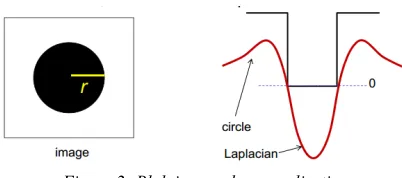
[image:3.612.318.520.306.440.2]Using a scale normalization, the blob is considered as a superposition of two ripples.
Figure 2: Blob in a scale normalization
The blob detection has some threshold parameter on this blob detection algorithm, such as size, circularity, convexity, and inertia value.
Size Threshold, by utilizing this parameter,
[image:3.612.315.516.537.626.2]size of a considered pothole shape. This parameter is set using pixel values.
Circularity Threshold, by utilizing this parameter,
detected blobs are filtered based on its circularity. It is defined as the ratio between its area and its perimeter. This ratio can be defined as:
(1)
Where A is the area of the closed shape and L is the
perimeter of the closed shape. Using this equation, a full circle results circularity value of 1, and a square results circularity value of 0.785, and so on.
Convexity Threshold, by utilizing this parameter,
detected blobs are filtered based on its convexity value. It is defined as value of ratio of circle area and the convex area. This convexity value is spanned from 0 to 1, where value 1 means the circle has the most convex hull, while 0.5 means the circle has a more concave hull.
Inertia Threshold, by utilizing this parameter,
[image:4.612.314.513.194.633.2]detected blobs are filtered based on its inertia value. This value also known as elongation value as shown in Figure 3.
Figure 3: Inertia ratio is defined as ratio between maximum inertia of a shape and minimum inertia of a
shape from its center of mass.
When image is captured, noise is possible to occur. Noises, especially the salt-and-pepper noise, could be considered as the blob either on the blob detection process. Salt-and-pepper noise is one of the impulse noise categories caused by many
natural and unnatural reasons such as
electromagnetic interference [19] from camera or other electronic devices from the prototype. Therefore, a filter is utilized to overcome this issue. Median filter is used as this filter is well known as an effective method to reduce the salt-and-pepper noise [20]. This filter is expressed as:
(2)
Where g(x,y) is image produced by the f(x,y)
image with w as the filter which contains a group of
odd amount pixels and is shifted point to point on the entire image area (window) that is placed on
image plane and (i,j) as the element of windows.
3.3 Method
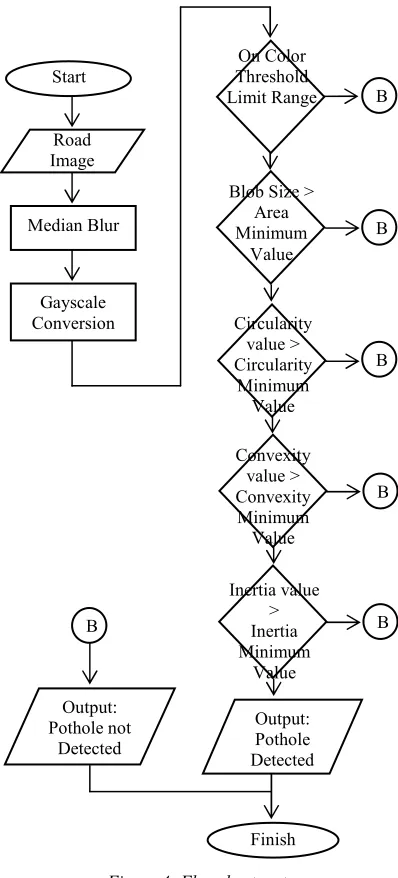
[image:4.612.94.294.396.527.2]The system works like a flowchart on Figure 4.
Figure 4: Flowchart system
When the program is running, the camera taking pictures of the road. Then, the picture is processed using median blur to overcome any unwanted noise. After that, the picture is converted to grayscale level so that the processing will be faster to determine which one is a hole which one is not. As the pictures on the grayscale level, any potholes
Finish Output: Pothole Detected
B B B B B
Gayscale Conversion Median Blur
Start
Road Image
On Color Threshold Limit Range
Blob Size > Area Minimum
Value
Circularity value > Circularity
Minimum Value
Convexity value > Convexity Minimum Value
Inertia value > Inertia Minimum
Value Output:
Pothole not Detected
B Mayor Axis
Minor Axis
Rotation of the Principal Axis
Center of mass
will be determined as a dark colored blob shaped. This comes to the first parameter, color threshold limit. This color threshold parameter will ignore any level color brighter than given value. The next parameter is related to the shape of the blob, including circularity, convexity, and its inertia value. Pothole’s shape is varied from a full circle shape to a square shape. This comes to conclusion to have a minimum circularity value of a square which is 0.785. The program assumes a detected pothole when a shape meet values that inside the threshold on every parameter mentioned before. Whenever, a blob does not meet one of the parameter values, it will be discarded and will considered as “not a pothole”. The prototype is shown in Figure 5.
Figure 5: The prototype of pothole detection based blop detection system using OpenCV application and
Raspberry Pi
4. IMPLEMENTATION AND RESULT
4.1 Implementation
Testing is performed in Tamalanrea, Makassar, Indonesia. It is tested several times on the same potholes to see the accuracy of the pothole detection. There are 40 potholes had been being tested with different shape and size. As illustrated in Figure 6, the prototype is mounted on a motorbike with altitude of 2,6 feet (H ≈ 0,8 m) above the pavement surface and the camera is pointed down that follow Koch and Ioannis test [5] with 45° angle view. The vehicle velocity is around 20-50 km/h. This prototype produce a 640 × 480 image resolution and rescaled to 200 × 150 pixels resolution for the detection image.
The test scenarios follow Nienaber, et al. [1] test, that the test included various scenarios such as driving whilst towards the sun, having the sun on
[image:5.612.90.301.283.446.2]the right and the left of the vehicle, and potholes that has shadows from building or trees.
Figure 6: The prototype is tested on a motorbike vehicles with H ≈ 0.8 m and α ≈ 45°.
4.2 Result
Accuracy of the pothole detection is about 82.5%, based on the test performed with various pothole’s shape and size. From 40 potholes, there 33 is detected and 7 is failed to detect. Figure 7 presents some example of detected potholes from the test performed (detected pothole is shown with blue circle). The undetected pothole is generally undetected because the pothole is not deep enough to create shadows, so there are no color difference between the road and the pothole itself.
[image:5.612.317.515.474.704.2]One of this pothole detection system main step is thresholding, which generate a unique region based on images that have been made grayscale between the potholes and the surrounding area. Potholes that having a less color difference between the pothole and the road, which caused the undetected potholes. Sometimes flooded potholes during the daylight could cause an undetected potholes either, since the water inside the potholes reflect the sunlight to the camera, and the thresholding step will consider it as bright as the surrounding road. The detection process could be interrupted by potholes that covered by shadows of tree or building. Furthermore, the thresholding process result by shadows that too dark could be detected as a pothole. The sample of undetected potholes is shown in Figure 8.
Figure 8: Example of non-detected pothole.
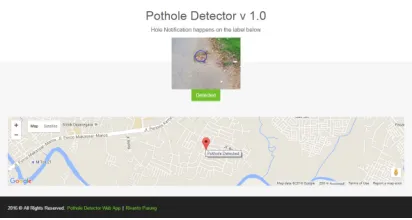
However with the average good accuracy, this method can be used for rough estimation for planning of repairs and maintenance of the road for local road development authorities. Example of webpage with google API integation to point detected pothole location shown in Figure 9.
Figure 9: Sample of webpage with google maps integration sceenshot.
This prototype can be developed as an early detection for the driver, though the potholes is detected with a relatively short distance between the vehicle and the potholes, make it not quite right for the application for now. For a greater distance
detection, by increasing the α angle, means it the
camera would be pointed more upward, but objects outside the road that has same visual appearance characteristic with the potholes could be detected as
a pothole either. An example for this case is shown
[image:6.612.94.296.298.375.2]in Figure 10, with α ≈ 90°.
Figure 10: Pothole detection results by increasing α ≈ 90°. By increasing the α angle, means it the camera
would be pointed more upward, but objects outside the road that has same visual characteristic with the potholes
could be detected as a pothole either.
5. CONCLUSION
The potholes presents a negative effects to the public, besides it is one of the main reason of most traffic accident, also could cause damage on vehicles. Nowadays, potholes location data mining is still performed manually by technician of the road maintenance officer [8] or reported by the citizen. Till it is a high time and cost consuming, an automatic pothole detection system can be a good solution.
This paper presents a prototype of pothole detection system based on image using blob detection for automatic detection and recording of potholes by mounting the device into a passenger vehicles. This prototype utilizes Raspberry Pi, due to its compatibility to other interfaces and a low cost perspective for a big number production. Tests are performed to see the system accuracy. The result of the test show this prototype can be developed further with 82.5% successful pothole detection.
This prototype is still in a further development to add a more effective algorithm which could detect potholes that not depends on the color difference and a more adaptive thresholding method, so the system will run more accurate on reading potholes on road even on a flooded potholes, on potholes with same color as the road, or potholes that covered by the shadows of trees or buildings. Another important future task is potholes detection that able to detect depth and area of the potholes which could be done using a 3D camera or implementing a distance sensor near the camera.
REFRENCES:
[1] Nienaber S, Booysen M and Kroon R, “Detecting Potholes Using Simple Image
[image:6.612.91.297.478.588.2]Footage”, 34th Southern African Transport
Conference (SATC 2015), Pretoria (South
Africa), July 9th, 2015, pp. 153-164.
[2] I. Brilakis, S. German, and Z. Zhu, “Visual Pattern Recognition Models for Remote Sensing
of Civil Infrastructure”, Journal of Computing
in Civil Engineering, Vol. 25, No. 5, 2011, pp. 388–393.
[3] The OpenCV Reference Manual, release 3.0.0-dev, June 25, 2014.
[4] G. Halfacree, E. Upton, “Raspberry Pi User
Guide”, John Wiley & Sons (United Kingdom),
2012.
[5] C. Koch, I. Brilakis, “Pothole Detection in
Asphalt Pavement Images”, Advanced
Engineering Informatics, Vol. 25, 2011, pp. 507–515.
[6] S. Varadharajan, S. Jose, K. Sharma, L.
Wander, C. Mertz, “Vision for Road
Inspection”, Applications of Computer Vision,
IEEE Winter Conference (USA), 24–26 March, 2014; pp. 115–122.
[7] C. Koch, I. Brilakis, “Improving Pothole Recognition Through Vision Tracking for
Automated Pavement Assessment”,
Proceedings of the 18th EG-ICE Workshop on Intelligent Computing in Engineering, European Group for Intelligent Computing in Engineering (Netherlands), 6-8 July, 2011, pp.1–8.
[8] E. Buza, S. Omanovic, A. Huseinovic, “Pothole detection with image processing and spectral
clustering”, Proceedings of the 2nd
International Conference on Information
Technology and Computer Networks, World
Scientific and Engineering Academy and Society (Turki), October, 2013, pp. 48–53. [9] S. Pawade, B. P. Fuladi, L. A. Hundikar,
“FPGA Based Intelligent Potholes Detection”, International Journal of Innovative Research in
Computer and Communication Engineering,
Vol. 3, No. 3, 2015, pp. 2285–2290.
[10] A. Şentürk and M. Gӧk, “Single and Multiple Precision Sequential Large Multipliers for
Field-Programmable Gate Arrays”, Turkish
Journal of Electrical Engineering and
Computer Sciences, Tubitak (Turkey), Vol. 24, 2016, pp. 2961–2973.
[11] I. Moazzam, K. Kamal, S. Mathavan, S. Usman, M. Rahman, “Metrology and Visualization of Potholes Using the Microsoft Kinect Sensor”, 16th International IEEE Conference on Intelligent Transportation Systems (ITSC 2013), IEEE ITSC (Netherlands), 6-9 October, 2013, pp. 1284–1291.
[12] D. Joubert, A. Tyatyantsi, J. Mphahlehle, V.
Manchidi, “Pothole Tagging System”,
Proceedings of the 4th Robotics and
Mechatronics Conference of South Africa, CSIR
International Conference Centre (South Africa), 23–25 November, 2011, pp. 1–4.
[13] G. D. De Silva, R. S. Parera, N. M. Laxman, K. M. Thilakarathna, C. I. Keppitiyagama, K. De Zoysa, “Automated Pothole Detection System”, 2013 International Conference on Advances in ICT for Emerging Regions (ICTer), IEEE Sri Lanka Section C Chapter (Sri Lanka), 11–15 December, 2013.
[14] A. Mednis, G. Strazdins, R. Zviedris, G. Kanonirs, L. Selavo, “Real Time Pothole Detection Using Android Smartphones With
Accelerometers”, 2011 International
Conference on Distributed Computing in Sensor
Systems and Workshops (DCOSS), IEEE
(Spain), 27–29 June, 2011, pp. 1–6.
[15] J. Eriksson, L. Girod, B. Hull, R. Newton, S. Madden, H. Balakrishnan, “The Pothole Patrol: Using a Mobile Sensor Network for Road
Surface Monitoring” Proceeding of the 6th
International Conference on Mobile Systems,
Applications, and Services, MobiSys 2008
(USA), 17–20 June, 2008, pp. 29–39.
[16] R. Madli, S. Hebbar, P. Pattar, V. Golla, “Automatic Detection and Notification of Potholes and Humps on Roads to Aid Drivers”, IEEE Sensors Journal, Vol. 15, No. 8, 2015, pp. 4313–4318.
[17] S. Hegde, H. Mekali, V. Golla, “Pothole Detection and Inter Vehicular Communication”, 2014 IEEE International Conference on Vehicular Electronics and Safety (ICVES), India (IEEE), 16–17 December, 2014, pp. 84– 87.
[18] Z. Zhang, X. Ai, C. K. Chan, N. Dahnoun, “An Efficient Algorithm for Pothole Detection Using
Stereo Vision”, 2014 IEEE International
Conference on Acoustics, Speech and Signal Processing (ICASSP), IEEE (Italy), 4-9 May, 2014, pp. 564–568.
[19] C. Budak, M. Türk, and A. Toprak, “Removal of Impulse Noise in Digital Images With
Na\"ıve Bayes Classifier Method”, Turkish
Journal of Electrical Engineering and
Computer Sciences, Tubitak (Turkey), Vol. 24, 2016, pp. 2717–2729.
[20] H.-L. Eng, K.-K. Ma, “Noise Adaptive
Soft-Switching Median Filter”, IEEE Transactions