ScholarWorks @ Georgia State University
Anthropology Theses Department of Anthropology
8-11-2015
Both Ends of the Leash: Pit Bull Ownership and
Activism in Atlanta, Georgia
Sarah Goss
Follow this and additional works at:https://scholarworks.gsu.edu/anthro_theses
This Thesis is brought to you for free and open access by the Department of Anthropology at ScholarWorks @ Georgia State University. It has been accepted for inclusion in Anthropology Theses by an authorized administrator of ScholarWorks @ Georgia State University. For more information, please [email protected].
Recommended Citation
GEORGIA
by
SARAH GOSS
Under the Direction of Steven Black (PhD)
ABSTRACT
This thesis follows and examines the lives of people in Atlanta, Georgia who own and advocate for the controversial group of dog breeds and mixed breeds known as “pit bulls.” The greater meaning of pit bulls within the United States is also considered from a historical and anthropological lens. This thesis uses pit bulls as a medium to explore issues of race, gender, and stigma in the United States and to consider how pit bull owners and activists use their understanding of the public around them to change ideas surrounding their dogs.
GEORGIA
by
SARAH GOSS
A Thesis Submitted in Partial Fulfillment of the Requirements for the Degree of Master of Arts
in the College of Arts and Sciences Georgia State University
Copyright by Sarah Elizabeth Goss
GEORGIA
by
SARAH GOSS
Committee Chair: Steven Black
Committee: Faidra Papavisiliou Cassandra White
Electronic Version Approved:
DEDICATION
ACKNOWLEDGEMENTS
TABLE OF CONTENTS
ACKNOWLEDGEMENTS ... v
LIST OF FIGURES ... viii
1 INTRODUCTION... 1
2 METHODS ... 5
3 LITERATURE REVIEW ... 9
4 BACKGROUND: THE HISTORY AND ECONOMICS OF PIT BULLS ... 16
4.1 The History of Pit Bulls ... 16
4.2 The Pit Bull Market ... 19
4.3 Recent History: The Vick Question ... 20
5 THE IMPORTANCE AND PREVELANCE OF REFLEXIVITY ... 22
5.1 Mirrors and Windows: The Human, the Animal, and the Space(?) Between .. ... 22
5.2 “My Dog Won’t Fight, But I Will Fight For My Dog” ... 25
5.3 “What Are You Afraid Of?” Reactions to Pit Bull Ownership and the Ideas Behind Them ... 27
5.4 Alone, Together: Stigmatized Dogs, their People, and their Community ... 29
6 STIGMA ... 31
6.1 Reflexivity Vs. Stigma In Pit Bull Ownership ... 31
6.3 Pass-a-Bull... 37
7 PIT BULL PUBLICS ... 40
7.1 Don’t Bully My Breed: Standing Up For Ownership ... 40
7.2 The Media and the Mark ... 42
7.3 Too Much of a Good Thing: Pit Bull Overpopulation ... 44
7.4 Breed/Race ... 46
7.5 “Gangsters and Thugs:” Racialization of the Pit Bull ... 47
7.6 “She’s a Good Mama, and He’s So Protective:” Regendering the Pit Bull .. 49
8 CONCLUSION ... 52
LIST OF FIGURES
Figure 1 Pit Bull Owner Cartoon ... 26
Figure 2 Pit Bull Merchandise ... 30
Figure 4 Announcement for National Kill A Pitbull Day. ... 45
1 INTRODUCTION
Beyond being “man’s best friend”, dogs are also man’s oldest friend, being recorded in human material culture before any other animal or plant (Braude 2013:1). Humans use dogs across the world as companions, guards, food, and therapists among many other roles. The dog holds a particularly dear place in the heart of American culture. Some people consider a dog’s role minimal while for others, the role of the dog and its place in American society is invaluable. In this study, I focus on the latter group of people, specifically in relation to the types of dogs known as pit bulls. Dogs and other companion animals play a central role in many peoples’ lives. I study how owners of the dog breeds known as “pit bulls” confront and work to change the public face of their dogs and by proxy, themselves. I explore the public created around pit bulls and the reasons for this public’s various reactions to the breed. I use Molly Mullin’s assertion that the gaze with which we view animals acts as “mirrors and windows” on society (Mullin 2000). The way a society views animals can act as a reconstitution of greater themes in society, and the discussion of animals in society can play a role in ongoing understanding, reproduction, and even transformation of social relationships.
For many people, animals are central to their vitality, both physically and emotionally. Animals are ever present in human lives and consciousness. Some are directly present in the form of pets or service animals, and others in the instantly recognizable images invoked by calling someone a black sheep, a dirty rat, or a stud. Others are important sources of nutrition and labor. Many people recognize elements of themselves in the animals that they raise, whether as companion animals or service and farming animals. The success of the Animal Planet
established channels such as VH1 and MSNBC (Lee 2010: 107). The success of nationwide pet supply stores like Petco, Petsmart, and Pet Supermarket show the importance that companion animals in the lives of many Americans.
People may see within animals parts of themselves and their society that go unexpressed in their dealings with other people. Animals, always near us but never of us, give people a perfect platform on which to place great metaphors for our hopes, fears, comforts and deepest insecurities. It has been suggested that the only way humans have found to successfully define what it is to be human is to define what it is to not be human. Giorgio Agamben calls humanity an “anthropomorphous animal…who must recognize himself in a non-man in order to be human” (Agamben 2003: 26-7). What Carolus Linnaeus first called Homo nosce te ipsum—
‘human know thyself’ and is now known similarly as homo sapien is differentiated by its name as the species that knows (or at least feels) that it is separate from others (Boddice 2011: 2). In the same way that groups form around human concerns, a great diversity of groups also form around animals, both wild and domesticated. Some groups fight for animals’ right to exist peacefully and in their own environments. For pit bulls, advocates at the rawest nerves of the argument fight for the dogs’ rights to exist at all, banding together to form a protective
community that fights the idea that the dogs are man-made monsters that cannot be conditioned away from the violence of their history.
are unable to identify a pit bull, giving owners an opportunity to change the uninitiated person’s opinion of the dog through a visual representation that does not match what the non-owner has previously learned about the dogs.
In the next section of this paper, I discuss the methods that I use to conduct this study. Within this methods section, I briefly detail various events that I have attended, the interviews I have conducted, and the way in which I have chosen literature to review. I also discuss ethical considerations in my study and the limitations of my study, including the limitation created by my ownership of a pit bull breed. I follow my methods section with a review of pertinent literature relating to human-animal issues. I draw from a diverse swath of literature in social sciences, law, and animal studies to better understand how the American zeitgeist around issues of gender, race, class, and animals in general braids itself together into the current gaze on pit bull breeds. I focus different conceptualizations of stigma and the creation of a public around stigmatized individuals and animals. I argue that when an individual is marked, the discourse around their marking creates an interested public around the idea of that marking. The attention that the public gives to that party in turn forces the party to make conscious decisions around the performance of their identity based upon how they see themselves through the lens of society. This performance happens on an individual level as well as on the level of advocacy groups.
My ethnography follows pit bull owners as they manage their dog’s identity as well as their own and examines how they see themselves and their fellow owners. The pit bull
2 METHODS
To conduct my original research, I recruited 17 owners of pit bull breeds and asked them to participate in an hour-long interview, explaining that the interview may last more or less time, depending on how much they have to say. I recruited my participants through a flyer that I placed at dog parks and handed out at dog-related events. They were given informed consent in which they were told that they could stop the interview at any time or decide at any time that they did not wish to participate in the study. There would be no consequences following a decision not to participate. Their information was audio taped and handled only by me, and they were asked to choose pseudonyms for themselves and their dogs if they wished to do so.
I also conducted participant observation by going to adoption events, dog-related events, and dog parks to watch how people interact with pit bull breeds and how owners interact with other people. This participant observation was important to exploring the ways in which people truly interact around these dogs when they are not being formally questioned about their feelings toward the dog. I often brought my own pit bull breed with me. In this way, I was an observing participant, which H. Russell Bernard defines as “insiders who observe and record some aspects of life around them” (Bernard 2011:260). In some ways, this status made it easier to elicit and record knowledge, because I had some ideas about other owners’ experiences through my own and because owners had a clear indication through my own dog that I was not eliciting
moved on. My pit bull also made it harder to objectively put into anthropological context what I was told and not to be shaped by my personal experience of ownership.
My participants were heavily skewed toward Caucasian females. Of my 17 participants, 14 were female. 16 were white, and one woman was Korean-American. A couple participants did mention race and were quite aware of racial undertones in others’ views on pit bulls as well as within the pit bull community. Other participants had no apparent explicit ideas about an association between minority communities and pit bulls but showed underlying ideas through distancing themselves from their idea of a typical pit bull owner. One participant opposed herself from what she considers to be seen as typical pit bull ownership by explicitly identifying herself as “a little white girl.”
It was important to come up with operational definitions for certain terms, including “pit bull”. The definition of pit bull can be difficult because various actors in the public
be a mix of any number of other breeds. I use the idea that “dogs labeled as pit bulls experience breed as a formulation that lies in the eye of the beholder, a variation of ‘I know it when I see it’” (Weaver 2013: 692). This perception of a dog as a pit bull marks the dog as dangerous and on the owner as at least reckless and at most a potential danger to society.
Another important term to define is “responsibility”. It is a concept thrown around a great deal in pit bull activism. It is a term often thrown out by rescue groups and owners alike—that the pit bull’s image problems require more “responsible” owners to step forward. However, it is never really defined, especially in light of the many controversies in the dog ownership world— ear and tail docking, chaining (versus fencing/other containments), diet, vaccinations (very similar to the human debate), and spaying/neutering, also known as alteration. Particularly, I found that rescue and advocacy organizations focused on proper containment and on alteration when defining responsibility. Containment includes not only ability to keep the dog contained but also the comfort of the dog in its containment, such as having a proper temperature within the dog’s environment, providing adequate food and water within the dog’s reach, and having
adequate space and comfort to rest or lie down. Alteration is absolutely encouraged by rescue organizations and non-alteration of dogs brings forth allusions to backyard breeding and severe overpopulation problems for pit bulls.
3 LITERATURE REVIEW
This thesis focuses heavily on how people react to living with stigma and how they interact with public ideas about them. In everyday life, each person goes through a ritualized, culturally specific performance of their own identity based upon their understanding of
expectations of how they should act. Many of us take these daily presentations for granted until something exposes the fragility of our supposed normalcy, such as illness, injury, or even being amongst a group with different cultural expectations. Marie Ilac summarizes the sudden change in personal reality created by stigma as an “identity threat” that must be resolved (Ilac 2011). For many of the pit bull owners who participated in my research, owning a pit bull became this latter kind of surprise, shaking those who were previous dog owners from the normalcy of walking a dog, boarding a dog, or even having a dog at home. In order to lessen the impact of stereotypes and discrimination, many owners begin the process of identity management, often informed by experiences in the larger community of pit bull ownership.
and the distinctions that lead to markedness are constantly reinforced (Brekhus 1996: 500). An unmarked identity is separated from a marked identity in part by the presence or absence of anonymity. The ability to go through one’s world without constant reflection of how one’s actions are viewed is a privilege not universally afforded. Some are able to pass as “normal,” but even this ability creates a fragile state in which being uncovered is an ever-present possibility. It also affords less opportunity to meet supportive people and increases the likelihood of self-stigma as the person “passing” may internalize negative views and stereotypes that they hear from others (Corrigan 2013: e1). Between the two identities, the marked is considered a more specific element of a nonspecific and unmarked whole; marked identities occur less frequently in text and media than unmarked; elements of the unmarked identity are ignored when they occur in the marked (Brekhus 1996:500).
stigma falls into social irrelevance with any number of other differences in humanity (Goffman 1963: 3, Link 2001: 367).
One can also conceptualize stigma purely from society’s standpoint and ask how a society classifies its responses to what it views as deviancy. In an analysis of social responses to deviance, Anton J.M. Dijker and Willem Koomen find stigma to be a form of “social control”, along with tolerance and repair (Dijker2007). In contrast to tolerance, believing that it is good to allow others to behave in ways which one disapproves of, and repair, seeking to “fix” disturbed groups or individuals, stigma does not distinguish between a person’s actions and the individual. Other forms of social control may coincide or become a stigma if “a deviant condition is
increasingly perceived and responded to as a defining or essential attribute of a ‘whole’ person or social group” (Dijker 2007: 4-6). The person’s (or being’s) identity is “marked” as being an exception to a certain rule of normalcy in society, and they are constantly aware of their own presence within the company of “normals.”
experience, and it certainly does parallel the idea of marking creating deep and constant self-awareness, one can also view daily interaction as a performance of cultural knowledge as outlined in the second definition. Pit bull owners combine both forms when telling stories about their ownership. They tell stories of their dogs within the bounds of what they understand to be acceptable, responsible ownership so that the telling becomes a ritual, a rite of passage into the protective community of fellow owners. The telling and retelling of these stories of both triumphs and traumas within ownership forms bonds between owners and facilitates activism through a shared understanding of the cause, as Steven Robins has studied in the HIV/AIDS activist community in South Africa and the Alcoholics Anonymous movement (Robins 2006). The discourse around how to understand pit bulls is ongoing among many different actors. The notoriety of the breed in the American zeitgeist has elevated it above the bare recognition of being a breed of dog, and has created a public centered on the breed.
The idea of a public and its part in stigma is important to understanding the stigma surrounding pit bulls. A public is different than the public. The public is assumed to be a totality, but it can be made up of an infinite number of publics (Warner 2002: 49-51). A public brings back the idea of reflexivity, because in order to exist, a public must be involved in the dialogue surrounding an “addressable object,” and the addressable object must have a public to be
public, means having “the constant threat of being precipitously reduced from the abstract, substitutable public participant, like the anonymous member of a rally, to the concrete, embodied object of the gaze of precisely those institutions whose power is their capacity to render the otherwise anonymous private individual visible within the public sphere” (Wittenberg 2002: 429). Many pit bull owners seek visibility in the public sphere insofar as being seen with one’s dog is important to exhibiting the love, pride, and control that is possible within ownership (and perhaps not seen as possible). However, there is also a fear that if any small incident occurs, such as their dog jumping toward or nipping at someone else, the owner and the dog will become visible in an unsavory way and might undergo scrutiny even within the pit bull community as an irresponsible owner. This fall from the community’s grace loses for them the support of
participation within a sympathetic public.
The creation of a sympathetic public is one of the main driving factors for new social movements (Lee 2007, Melucci 1985, Touraine 1974, Vahabzadeh 2001: 612). Central to the theory of new social movements are the ideas of identity assertion and the distancing of the movements from direct political contact with the state. Su H. Lee writes that these movements “display diffused extra-institutional or semi-institutional nucleuses and support bases irreducible to class locations, and…are value-ridden, issue-oriented, identity-specific, and focused on influencing public opinions” (2007:9). These movements shift away from many individuals rallying behind a specific candidate or cause and focus more on a group of individuals
The community of activism can be highly important for individuals with a stigma. The need to organize is a conscious realization by people with a stigma that their difference is not just a personal inconvenience or shame. Organizing creates a network of people experiencing the same stereotypes and misunderstandings, which makes up the greater understanding of the stigma. The discrimination faced by a certain group can have de facto and de jure consequences: the narratives of the public consciousness and the passage of legislation. In spite of, or maybe because of the informality of public opinion, and because of its ubiquity, it can be more difficult to sway the public’s opinion than to change laws. Awareness of legislation is crucial for
advocacy groups in order to combat “legislative inertia…[the phenomenon in which] once a law is passed, it generally remains on the books unless legislatures actively vote to expunge it” (Corrigan 2005a: 558). Once and if the law is expunged, however, the marking and the feeling of being marked remains.
a “system of social relationships” (Melucci 1985: 793). The emphasis on relationships is seen in other studies of social movements (Latour 2005, Scott 1991: 32, Touraine 1974). Instead of a focus on the inner-movements and plurality of a social movement, there is a dynamic view of social movements and greater society, with an emphasis on the word movement, being opposed to a social system by its constant activity (Touraine 1974). Bruno Latour adds that groups should be considered less than the dynamics of the actors involved, and that the “central intuition” of the researcher on group identity should be that “at any given moment, actors are made to fit in a group—often more than one” (Latour 2005). As the stigmatized cannot be holistically defined by their stigma, members in a group at any given moment cannot be defined by that group, and only a brief snapshot of a group can even be attempted, as it shifts and changes as members and actors arrive, leave, change involvement, and react to new challenges presented.
Each day people negotiate themselves with others. Constant interactions in person and through media create a series of evaluations and comparison. One must consider a seemingly endless web of attributes and appearances to perform a culturally appropriate identity (Goffman 1959). There are certain characteristics that require more constant alertness than others.
4 BACKGROUND: THE HISTORY AND ECONOMICS OF PIT BULLS
4.1 The History of Pit Bulls
The image that pit bull owners most frequently confront about their dogs is that of the dog fight. None of the owners I with whom I spoke were involved in dog fighting, but my respondents frequently brought up dog fighting and football player Michael Vick, who was convicted of involvement in a dog-fighting ring, without my prompting. By voicing their
knowledge of this image, they were able to simultaneously voice their disapproval of this use of pit bulls and oppose their style ownership to that of dog fighters. Many other owners and advocates for the breed emphasize other pieces of history; the idea of pit bulls as a “nanny dog,” or Petey, the pit bull breed featured on the children’s show The Little Rascals. Becca, an owner in East Atlanta, says, “I saw a British woman in the park one day, walking [my dog], and she ran up and said, ‘Oh look! We call those a nanny dog. I can tell by the water spout tail.’” By
emphasizing an attribute opposite that of the mark, owners and activists work to change the idea of their dogs.
At some point in the not-so-distant past, the nanny dog and fighting dog images lived side-by-side. Diana, an owner who has done extensive research on the history of the breed, surmises that this change in attitude toward the dogs is related to a change in the perceived ownership of the dogs:
things, and I was like, “Well here’s an image too,” and I showed him this picture of men in coattails and everything, and he was like, “Oh, well that’s not what I picture.” Yeah, it’s not what you picture! People think of the gangbangers with their dogs, or younger people would say, you know, the hip hop people with their dogs.
This owner used what she already knew about perceptions about pit bull ownership, particularly fighting in this case, to make the man to whom she was talking think about pit bull ownership. She had a strong feeling that he would mention certain groups of people in discussing pit bulls, and she had a different example ready to counterpoint his feeling. The history of pit bulls, although difficult to completely piece out because of changes in breed names and the already vague notion of the definition of a pit bull, certainly includes a heavily royal and wealthy element.
English dogs” (Anon 1699). 19th century activists in England later used this idea of national pride to oppose bull baiting by emphasizing the bull as symbolic of England and its national character, John Bull (Ferguson 1998: 35). Dog-on-dog fighting might be more attributable to a 17th century way of testing dogs for their performance as protectors of human life and property (Evans 1998: 827).
People involved in dogfighting emphasize the “long and royal history” (Lee 2010: 108) of their sport. Dogfighters, or dogmen as they sometimes call themselves, are not incorrect in saying that dogfighting has a rich royal history. During the 19th century, attending a dogfight was considered a rite of passage into manhood for wealthy young men (Evans 1998:828). Rhonda Evans quotes Veblen’s theory of the leisure (or upper) class in affirming that if something (in this case dogfighting) is practiced or upheld by the upper classes, its practice or ideal will spread throughout all classes. Following this theory, the “lower” classes began to dogfight “as an attempt at emulation, in which the traits of honor and reputability (as proscribed by the leisure class of the time) could be aspired to by the lower classes of society” (Evans 1998: 828). This emulation tends to sour the upper class’s enjoyment.
Dogfighting, for some dogmen, presents a secondary gain as a business venture. Dogfighters can profit not only from the bets placed on the actual fight, but on selling memorabilia such as videos or pictures of the fight. An anti-animal cruelty law making it
fight or being caught by law enforcement and fined or arrested, but the rewards for fighters can not only balance out the risk but outweigh it. It also creates industry for sellers of the items used to train pit bulls for the ring, such as those mentioned earlier, and for pit bulls themselves (Pacelle 2011: 159).
4.2 The Pit Bull Market
The pit bull industry often involves illegal or unregulated activities, the most infamous of which is dogfighting. Dogfighting, like other underground economies, offers a chance for
advancement and status to men “from lower-class backgrounds, who lack opportunities for expression of masculinity through occupational success” (Evans 1998: 829). Phillipe Bourgois documents similar attempts by young Puerto Rican crack dealers in the El Barrio neighborhood of New York City. In describing the career path of Ray, the leader of a ring of crack dealerships, Bourgois pointedly contrasts Ray’s “consistent failures at establishing viable, legal business ventures…versus his notable success at running a complex franchise of retail crack outlets, highlight the different “cultural capitals” needed to operate as a private entrepreneur in the legal economy versus the underground economy” (Bourgois 2003: 135.)
In particular, Bourgois’ informants have a disdain for being subordinate to women. They frequently refer to their bosses as “bitches” and “hoes”, with one informant criticizing the labor market as a place where he had to “take a lot of shit from fat, ugly bitches and be a wimp” (146). Like crack dealership, dogfighting runs in parallel with the market economy, involving strict and specific rules, skills, and codes of conduct that don’t need to be written in a policy book or procedure manual. While Erving Goffman researches how the stigmatized interact with normals to correct their spoiled identity (Goffman 1963), the study of underground or “deviant”
socioeconomic status by turning to powerful codes of honor and respect. Craig Forsyth’s interviews with dogmen in Louisiana and Mississippi reveal that the ways that they speak of “old-timers” in the sport and ways of advancement are not dissimilar from someone talking about a mentor at a corporate job. One dog man told Forsyth, “In dogfighting you start at the bottom and…work your way up to be an old-timer. If they accept you, an old-timer will take you on like an apprentice. An old-timer…got me started…He saw dogfighting was important to me, and brought me into his insider circle. I would not have made it without him” (Forsyth
1998:210).
The economic factor of pit bulls does not end in fighting. Pit bulls are also a popular dog in a form of breeding known by detractors as “backyard breeding.” One owner told me that she was grateful that she was able to save her “baby” from “being a backyard breeder ATM.” Backyard breeders frequently do not have formal licensure for breeding dogs and as an unlicensed facility, they do not have regulations for conditions at their facility. The name “backyard breeding” might be slightly misleading, and breeders do not necessarily keep their dogs in the yard or in squalid conditions, as is often suggested. However, there is a large
spectrum of ideas in the pit bull (as well as the greater dog rescue) community as to whether any breeding, no matter how humanely handled, can ever be considered responsible.
4.3 Recent History: The Vick Question
purposely chose not to mention dog fighting in my interview, but it consistently came up,
particularly through its most famous public face, professional football player Michael Vick. Vick was convicted in 2007 of being involved in a dogfighting enterprise known as “Bad Newz
Kennels” run from his property (Pacelle 2011: 137). Witnesses against Vick told the court that they had personally seen him kill eight pit bulls by various methods, including shooting, hanging, manually drowning (holding a dog’s head under water) and “slamming at least one dog’s body to the ground” (Pacelle 2011: 141). Vick served almost two years in prison, apologized profusely, and even worked with the Humane Society of the United States to encourage people not to dog fight, but the damage to his public image has been done for many people who own pit bulls.
Rachel, an owner in East Atlanta, did say that she thinks the Vick case turned around the image of the dogs in some ways:
You know, before Vick, before all that happened, they were just—those bad dogs that bite people. I think when the Vick thing came out, when people started to kind of see the context of—why some people own pit bulls and maybe why some dogs that are pit bulls bite? Like what these dogs have been through before? I think that was a turning point where people started to kind of see them differently.
Another owner credited ignorance of the Michael Vick case with her original ability to own a pit bull:
I think when the Michael Vick thing happened down here, we were living in Brooklyn, so it wasn’t part of the local news, so I don’t think I had any sense of the cultural baggage that went with the breed at all. So we just saw [our dog] and said, “Alright. He’s the one.”
Sports Illustrated has had two editions devoted to pit bulls, in 1987 and 2008. One see a vast difference in the slant of the articles by looking at the front cover. The 1987 cover shows a brindle pit bull close up with its teeth out, its eyes half closed and looking almost
problem called the American Pit Bull Terrier. And the pit bull…has a two-legged problem called Man(sic)” (Sports Illustrated 1987:74). The 2008 cover features Sweet Jasmine, one of the dogs taken from Michael Vick’s home, sitting calmly with her head slightly cocked. The cover title is “Vick’s Dogs: The Good News Out of Bad Newz Kennels.” Sports Illustrated softens their view of pit bulls in this article, but it still has its flaws, one glaring flaw being racially charged
language in referring to pit bull owners and admirers:
[The former Sports Illustrated cover] cemented the dogs’ badass cred, and as rappers affected the gangster ethos, pit bulls became cool. Suddenly, any thug or
wannabe thug knew what kind of dog to own. Many of these people didn’t know how to train or socialize or control the dogs, and the cycle fed itself (Sports Illustrated 2008). Michael Vick gave pit bull admirers a central villain and gave detractors a face of proof for the true motives of those that would harbor these inherently vicious beasts. Since then, owners have used Vick as an example of what they want to disidentify their dogs with and someone with whom they themselves refuse to identify.
5 THE IMPORTANCE AND PREVELANCE OF REFLEXIVITY
5.1 Mirrors and Windows: The Human, the Animal, and the Space(?) Between
Finding human characteristics in animals and animal characteristics in humans is not uncommon. However distinct we as humans consider ourselves, we share our experience with animals. The ways in which we respond to and interact with our non-human partners on earth tells us as much about ourselves as how we interact with fellow humans. One disturbing example of this phenomenon is psychology’s often cited relationship between the abuse of animals as a child or teenager and the transition to later violence against humans. Through their slight
For this study’s purposes, I focus on the animals chosen as pets as opposed to those used for other purposes. Human companionship with animals is nothing new, but it is only a small, culturally specific understanding of what animals and humans offer to each other. Archaeology is rich with examples of animals’ relationships to humans. The famous cave drawings of Altamira, Spain and Lascaux, France are two of the earliest drawings by humanity documented, and they depict vibrant scenes of hunting bison, mammoth, lions, and deer (Ambrose 2006: 137). Around 10,000 B.C., a major feature of the Neolithic Revolution is the domestication of animals. Cattle have been studied as symbols of rank and power, as well as gender (Mullin 1999: 210). Michel Foucault mentions a Chinese Encyclopedia in which animals are hierarchically ranked from “belonging to the Emperor” to the lowly beasts that “from a long way off look like flies” (Foucault 1970: xv).
Animals can also be platforms for performing and projecting the roles and identies of other humans. Sometimes these surrogacies involve positive roles—friends, mates, children. The positive role surrogacy is easy to find in everyday conversation. People frequently refer to their pet as their “buddies”, “helpers”, or “babies” and are usually very aware of the surrogacy itself. Owners that I interviewed frequently anthropomorphize their dogs in these ways, with one even referring to her dog as her “external soul.” This translation is not the only way in which owners understand the lines between their species and that of their dog. Many owners with multiple dogs referred to their dogs as their “pack”, an allusion to the canine system of grouping. In this way, the owners not only put their dogs in a position usually reserved for humans, but they put themselves in a system usually seen as reserved for canines.
dogs at home and what their names are. He opens up a notebook to illustrate the quality of his wares, showing me pictures of a large smoker and pictures of big slabs of meat. He assures me that he is a master chef and that all the jerky that he sells is “a high quality, human grade meat.” He continuously praises the meat’s quality, emphasizing that it’s not just “bits of this and that”, but of a high enough class that a human can eat it. I find this quality a little bit unnecessary, thinking of all the times that my dogs have raided the trash can and cat’s litter box for treats, but I also see that people around me are shaking their heads approvingly at this notion, so I feel a certain pressure to expect this high quality out of the treats that I feed my dogs. I wonder how many of these other owners are looking around with a similar thought process and watching my head, also nodding in agreement. I buy two boxes of jerky. If I am to be one of the pack, I suppose, the rest of my pack should snack on par with me.
Clifford Geertz discusses how Balinese cock fighters use reflexivity to perform male identity through their animals, and how they identify with their animals. Geertz writes of cockfighting that in Bali “the deep psychological identification of Balinese men to their cocks is unmistakable…the fact that [the cocks] are masculine symbols par excellence is about as
While the roosters in Geertz’s account of a Balinese cockfight are “symbolic expressions of…the narcissistic male ego” (Geertz 1973: 3), pit bulls associated with dogfighting represent
something more similar to a violent male id. Multiple academic articles advocate further inquiry into the correlation between pit bull ownership and “antisocial behaviors” or “social deviance” (Barnes 2006, Ragatz 2009). The term “pit bull” has become a metaphor for a tenacious person, someone ready to fight without backing down. Pit bull owners frequently use this image as a parallel for their own tenacity in the struggle to win public consciousness surrounding their dog.
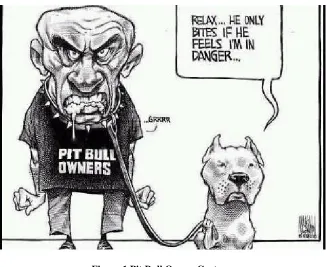
5.2 “My Dog Won’t Fight, But I Will Fight For My Dog”
Figure 1 Pit Bull Owner Cartoon
While owners fall short of saying that they will bite someone who gets between them and their dogs, they are quick to assert that they carefully weigh their options in human relationships to prioritize their dog. One owner reported:
Sometimes a guy [that I’m dating] will find out about my pack and he won’t want to come over to my house. I’m just like, “Sorry, buddy, but they were here before you. They come before you. And if you can’t respect them, them…I really don’t think I want to pursue this [relationship] further.
Another owner, the mother of two small children, said that she had reached a milestone in her human-dog parenthood continuum. She smiles and holds a finger up in a “one” position as she says, “I’ve finally had the first cancelled play date. They weren’t rude or
5.3 “What Are You Afraid Of?” Reactions to Pit Bull Ownership and the Ideas Behind
Them
“Are we bringing the dogs?” My husband asks. We are getting ready to trek to Douglasville, Georgia, about half an hour west of Atlanta, to attend an art show benefitting Friends to the Forlorn, a pit bull rescue and advocacy organization.
“No dogs tonight. It’s a humans-only event.”
He gives me a look, “No dogs at a dog event? Will they have rescue dogs there?” “I don’t know,” I answer, “It’s an art gallery. They’re raising money.”
popular culture enjoys the analogy of the misunderstood dog and the misunderstood human that goes together with it.
The popular television channel “Animal Planet” has two shows following the activities of pit bull rescue, both playing the idea of pit bulls and the stigmatized humans who understand their plight. “Pit Bulls and Parolees” follows the tattooed, flaming red-haired Tia Torres and her unique pit bull rescue, Villalobos. At Villalobos, Torres hires people on parole to work with her as a way to “give second chances to those who need it most” (Pit Bulls and Parolees 2014). In the introduction to the show, Torres’ voice plays over a video montage of pit bulls. “My name is Tia Maria Torres,” she says, “For 20 years, I’ve been giving second chances to those who need it most. I run a sanctuary. It’s for over 300 pit bulls, the world’s most misunderstood breed of dogs. And it’s for parolees—the guys I hire because no one else will…My mission is to rescue, but my hope is that one day I won’t have to” (Pit Bulls and Parolees 2014). Another show, “Pit Boss,” follows Shorty Rossi and his “crew” through their Pit Bull rescues. Shorty, a little person, also runs a casting agency for little people. Like “Pit Bulls and Parolees,” two stigmatized
5.4 Alone, Together: Stigmatized Dogs, their People, and their Community
6 STIGMA
6.1 Reflexivity Vs. Stigma In Pit Bull Ownership
The idea of stigma has been conceptualized in many ways by different social scientists. It is an idea familiar to most people as the mark of differentness upon another person or group. Stigma must be addressed in the social sciences because of its centrality to human lived experience. Marginalized communities have a central place within the academic study of the human condition. Social science does not find its interest in the unquestioned, uninterrupted parts of life but in the parts that threaten unrest and disquiet. It is a Tolstoyesque idea that every happy person is alike but every unhappy person is unhappy in their own way. The stigma that a person carries can affect both their happiness and unhappiness. Stigmatized individuals frequently find ways to minimize the daily impact of their mark. Some actively work to hide what Erving
Goffman calls their “shameful differentness” while others flaunt their stigma to show people that it is not something shameful at all (Goffman 1963: 16-17). There is a price to be paid for both paths, whether it is being discovered or suffering direct consequences of one’s bold disregard for social norms. Goffman finds that there are similarities in people’s understanding of the stigma that affects them. People tend to “to have similar learning experiences regarding their plight, and similar changes in conception of self—a similar “moral career” that is both cause and effect of commitment to a similar sequence of personal adjustment” (Goffman 1963:32).
and understand the contemporary world” (Corrigan 2005). Many of the heteroglossic texts that lead to a person’s idea of various subjects begin with what news and entertainment media
produces and trickles down. In the age of the internet, people frequently discuss ideas, fears, and problems with each other in a manner free from the bounds of visualization or even geography. The internet is increasingly used and studied as a mass communication network worthy of study as a way that narratives are spread, from creating new forms of community to creating new ways for news to be spread and analyzed (Cavanagh 2007, Cross 2011). The internet can also be an excellent way to disseminate and discuss ideas with people who are not normally connected. An internet site can convey to people, in the comfort of their own home, what a person or a group aspires to be. Before going into the nebulous reality of human study, a website can give a clear, linear picture of how someone sees themselves, and how they want the world to understand them. One respondent, telling me about her knowledge of local pit bull-related organizations, even told me, “I haven’t really done anything with them, but I’ve looked at [one organization’s] website and I feel like I like what they do. They have a good message and all.”
Forlorn Pit Bull, has a mission to “promote responsible Pit Bull ownership, provide breed education, combat pet overpopulation, fight unfair legislation, and find qualified homes for sound Pit Bull dogs in Georgia and around the country” (Friends to the Forlorn Pit Bull 2013). Both organizations, in their mission statements, recognize owner education and overpopulation as two major issues faced by the pit bull community. Underlying these problems is the call for “responsible ownership.” Friends to the Forlorn Pit Bull puts it in the organization’s mission statement, and Pitties in the City has, in an increased font at the bottom of their website, “An Educated Owner…Is a Responsible Owner” (Pitties in the City 2013).
Friends to the Forlorn Pit Bull has a more neutral appearance, using less of the hypermasculine balanced by femininity and more of the idea of the dogs seen as aggressors actually being victims. The name of the organization, describing pit bulls as “forlorn”, gives people a first point of reference for the organization’s idea of itself. The website’s opening image is a drawing of a pit bull looking stoically into the distance with angel’s wings. The top of the website is framed with the quote, “I always thought someone should do something about that…then I realized, I am that someone” (Friends to the Forlorn 2013). Along the bottom in a large red font is the statistic, “964,637 sheltered pit bulls euthanized in 2009” (Friends to the Forlorn 2014). Friends to the Forlorn focuses on the pit bull being a victim who needs strength, action, and courage. On the organization’s website, most, if not all of the pictures of people are of men holding the dogs, petting the dogs, or standing protectively over the dogs. This actively confronts the idea that the strength bound up in ideals of masculinity must be used for evil and reminds the pit bull’s public that this strength can also be used to defend the weak. It also confronts the idea that the pit bull is the aggressor or protector to humans and turns the idea upside down, showing people protecting the dogs from what other people have done to them.
6.2 The Mark of the Beast
The person at the end of the leash can affect how others see the dog at the beginning. Harlan Weaver, who became the owner of a pit bull named Haley shortly after transitioning from female to male, notes the mutual benefits that pit bull and owner can have for one another:
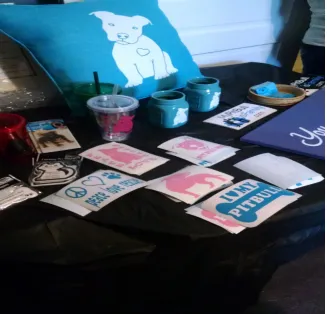
While the social is always part of the personal in trans, transgender, and transsexual experiences, in my case, Haley’s presence deeply shapes my world. In moments when my appearance has been at its most liminal, when I have felt vulnerable as a visibly transgender person, she has ensured my safety. Concurrently, my whiteness, my queer identity, and middle-class status encourage other humans to perceive Haley as less threatening; in my presence, she is perceived as less dangerous (Weaver 2013:689) Being seen in public with one’s dog is an important part of pit bull activism. Stubby’s Heroes, a local activism organization named after Sargeant Stubby, a World War One canine soldier who was a pit bull breed, has independent “bully breed walks” in multiple Metro Atlanta counties, in which owners can get together and walk with their dog. These walks frequently have a theme, allowing the owners to dress their dogs up. At a December walk that was holiday themed. Santa Paws was there, as was a little pit bull elf, and one red-nosed bull who was wearing an Atlanta Falcons outfit matching his owner’s shirt. Walks in March have promised a St. Patrick’s Day theme. These events show that owners want to be seen with their pit bulls doing what they know is unexpected; being silly, being friendly, and showing the public that their dogs are part of their middle class, non-threatening identity. One owner remarked:
Previous research on stigma has focused on human actors and the marks on their own identity. Unlike other marks on an identity, pit bulls are detachable. One focus of this study is to model and theorize how a human-animal connection can expand anthropological understandings of stigma. Owners can go through their public lives apart from their dog in many instances, and navigate how to respond to inquiries about their dogs. Brook, the owner of an American Bulldog mix, says “I’ll say ‘pit’, but sometimes I’ll say American Bulldog if I think they won’t like pits.” Owners can also drop the mark once they no longer have a pit bull, although most of the owners I spoke to avowed that they were now devoted to pit bulls. One young woman said, “I didn’t think I’d be a pit bull owner for whatever reason, but now, when she’s gone, well, you better have another pit for me.” When not with their dog, an owner must make the decision in mixed company of whether to begin the debate that pit bull ownership is wont to start or pass their dog quietly as a mutt or mixed breed. This need to make quick decisions can lead owners toward a certain kind of profiling. In particular, three owners mentioned age as a factor toward whether they believe someone will accept their dog or not, tending to feel that older people less accepting than younger ones. Like all stereotypes, this one can easily be broken. Brook describes being at a wedding reception when an older lady asked her about her dog:
[She] was at least 80…I was talking about my dog, and she said what kind of dog do you have? And I said, “Well, he’s a pit mix.” And she scooted over and she said, “Well, my mother used to raise pit bulls they’re great dogs. I noticed when you said you had a pit bull you were a little bit apologetic Don’t be.”
She clarified that while she believes that people were becoming more positive about pit bulls, she saw the elderly as less likely to be positive, so this interaction pleasantly surprised her.
Goffman refers to as the wise. The wise are “persons who are normal but whose special situation has made them intimately privy to the secret life of the stigmatized individual and sympathetic with it” (Goffman 1963:28). It is possible that they are pit bull owners whose dogs are not with them, so they are only a normal by virtue of their dog’s absence. In the greater dog community, there are many who sympathize with the plight of pit bulls. Any mention of the breed will garner a response of, “They are so misunderstood”, or “I’m more afraid of [a small dog breed] than a pit bull.” In these statements, people tell the owner that they know what a pit bull’s image is, and they feel that there is more to the story. The story of the breed is no more clear cut than the exact definition of a pit bull “breed” of dog.
6.3 Pass-a-Bull
For adoption agencies, identifying a dog as a breed other than a pit bull can raise its likelihood of adoption. By the time adopters figure out that the little puppy they own is a pit bull, many times they have already incorporated the dog into their family. For owners, passing their dog can be important for housing and insurance purposes. Many landlords refuse to rent to people who own pit bulls, or they charge exorbitant fees. Even homeowners can feel the burden of this discrimination if their neighborhood has a homeowner’s association or condo board that does not allow certain breeds. While many people are familiar with the idea of a pit bull from the news, and may have even seen images of a snarling pit bull or a pit bull behind bars after an attack, many people are also relatively unfamiliar with what a pit bull looks like outside of those contexts. Drawing on this unfamiliarity, many owners pass their dogs either as other breeds or pass through directly stating the dog’s actual breed (Staffordshire terrier, American Bulldog, terrier mix, etc) and not mentioning that the dog belongs to a breed considered to be a pit bull. Jessie, a young pit bull owner who works in apartment leasing, remembered bringing her dog into the leasing office and telling her manager that the dog was a pit bull.
She got real uncomfortable, and she was like, ‘Oh, well someone came in last week with a dog that looked just like that, but they said it was a lab mix. I was like, I mean, probably was somewhere down the line. But you’re afraid of this dog, but you don’t even know what it looks like? Well, you’re stupid.
The owners of the dog that looked “just like” Jessie’s dog had passed their dog as a lab, when Jessie felt that there was a good chance that the dog was a pit bull, like her own dog. The strange intersections of this interaction are that by showing pride in her own dog, Jessie
potentially exposed other pit bull owners to scrutiny for concealing their dog’s breed.
dog was huge, brindle in color, with a pit bull’s strong jaw and small eyes, and a Chow’s thick coat, cut back to a manageable length. The woman rolled her eyes:
Oh God, my mom tried to pretend [that Bear was another breed] for insurance one time, I guess home insurance. Because they asked her, you know, what kind of dogs do have in the house? And she was like, oh, we have one. And they asked her what kind, and she said a beagle! Who says that? So then they asked her to send a picture, and of course she was caught. She went to a different company.
7 PIT BULL PUBLICS
7.1 Don’t Bully My Breed: Standing Up For Ownership
Making a change to existing laws can seem an insurmountable obstacle to an individual, as can standing alone for a cause. For these reasons and more, the community of activism can be highly important for individuals with a stigma. The need to organize is a conscious realization by people with a stigma that their difference is not just a personal inconvenience or shame. Organizing creates a network of people experiencing the same stereotypes and
misunderstandings, which makes up the greater understanding of the stigma. The discrimination faced by a certain group can have de facto and de jure consequences: the narratives of the public consciousness and the passage of legislation. In spite of, or maybe because of the informality of the former, and because of its ubiquity, it can be more difficult to sway the public’s opinion than to change laws. Although Atlanta does not have strict laws in place restricting the ownership of pit bulls like some metropolitan areas, pit bull owners frequently feel the effects of de facto discrimination. Pit bull owners frequently have trouble finding affordable housing when landlords refuse to rent to the owners of “vicious” dog breeds or charge exorbitant penalties for ownership of these breeds. Other owners feel that their neighbors dislike or discriminate against their dog. One owner even reported that her neighbor told her that if he saw her pit bull walking in its own (fenced) backyard, he would shoot it. When another person told her that this statement had to be worthy of a terroristic threat or assault charge, she said, “I’m just going to make sure I’m always out in the yard with [the dog] for now.”
stewardship of another life makes it necessary for owners to triangulate their decision for action between what will be most beneficial both for themselves and for their dog. It is important to understand that even within identity-based social movements, there are different ideas about what the ultimate “identity” of the group should be. In particular, the concept of how much “normality” or “assimilationist” advocacy strategy can be controversial. This contention is illustrated in gay and lesbian movements in the 1970s. Many gay and lesbian movements attempted to gain mainstream power by minimizing differences between themselves and heteronormative culture. The violent urgency of the AIDS epidemic in the 1980s led the movement to a crisis in which they had to address and ally themselves to a wider range of
marginalized populations. This push led to a greater acknowledgement of the plurality of gay and lesbian identities as “socially constructed and inflected by race, class, and national origin”
(Edelman 2001: 299). The crisis therefore took the movement not so much through a linear process of assimilating versus not assimilating, but onto a new, plural level of understanding the itself and what it spoke for.
Similarly, pit bull activism is a very plural movement whose only true agreement is that owners should be able to own pit bulls, just as every other dog owner should be able to have a dog. It is not uncommon at events to overhear people bemoaning some drama within the
is, they plan to leave the group. The discussion shifts to the best way to address the incident itself, in which an unknown man apparently used a machete on the dog in front of the dog’s owner.
First, people begin to question whether the owner had the dog on its leash. Others
criticize this approach, saying that the owner should be supported. People begin to blame anti-pit bull sites, saying that the information that they release promotes fear, hatred, and violence against pit bulls. Another person says to ignore these sites, as they are just wastes of time that do not deserve attention. A debate begins as to whether looking into these sites is just a waste of time or whether the awareness that they create of the breed in a negative light counters work being done to promote the breed. There is little mention of law enforcement. Many pit bull owners have a feeling that current laws will not help their dogs and that crimes against their dogs will only go unpunished or minimally punished. The contest is not one of law, it is a contest of the impact of awareness on the life of a marked identity.
7.2 The Media and the Mark
Owners frequently reference the media, particularly local media, and a constant unease about the possibility of seeing pit bulls who have bitten or attacked somebody. Owners are not only uneasy about seeing a bad representation of their breed. They also tend to be incredulous about the news’ slant on the story. Kristine, the owner of a Staffordshire Terrier Mix, says that before getting a pit bull breed:
Amanda, who has an American Bulldog mix, was angry when talking about a recent story she had seen in which a family’s pit bulls attacked a toddler who climbed through a doggie door to the back yard. She fumed, “I mean nine dogs? Nine of any dog? And you aren’t watching your toddler enough that it can get out the dog door? [It makes] people think that everyone who owns a pit bull is a moron like those [idiots].” Another owner laughingly said, “When the news doesn’t say the breed [after an attack], you know it’s not a pit bull, because they love talking about pit bulls, even if it only kind of looks like one.”
Ray, the same jovial owner with his own special name for Breed Specific Legislation, said “You know, you see the dog on the news. It’s a pit bull, they say, and I see it, and I look at [my dog] and I look at that dog. I kind of go, ‘Ehhh…Well, if it was a mutt before the bite, it’s a pit bull now I guess.” Days later, I was attending a presentation by a member of the National Alliance for the Mentally Ill, and the speaker expressed a similar sentiment in regard to mental illness and violent acts in the media.
“Have you ever noticed,” She asked the group, “That when you’re watching the news, and some guy has shot everyone—there’s been a school shooting, or public shooting, or even shoots somebody and himself—he may have never had a mental health diagnosis before. But as soon as the media hears about it, what is he? Paranoid Schizophrenic. He’s suddenly gotten that mental health diagnosis.” Like the transformation of a mutt to a pit bull, a violent act can
7.3 Too Much of a Good Thing: Pit Bull Overpopulation
A saying in the dog rescue community goes, “Don’t breed and buy while shelter dogs die.” Many pit bull owners are acutely aware that a large percentage of the dogs euthanized in Atlanta shelters bear a striking resemblance to the dogs that greet them every night.
“I went to Dekalb [County shelter] the other day,” a woman says at a pit bull benefit party in Decatur, a suburb of Atlanta. She pauses and looks around knowingly, “All pits. Full of pits. Could’ve been full bred I thought.”
“It’s always like that,” a woman next to her agrees. “Sad. That could have been [my dog].”
“Oh, mine too,” says the first woman, “I got her within 24 hours of—“she points one finger and makes a slicing motion across her throat. Everyone groans.
A participant told me that one thing that attracted her to the breed was the sheer numbers of homeless pit bulls that she saw on a rescue site. “There were just so many of them,” she said, “I guess, that I felt like maybe I could make a difference.”
Interviewees who had worked in dog rescue conflated general adoption organizations (such as shelters and humane societies) with pit bull rescue organizations. One interviewee said that she had “worked with Fulton County [Animal Services], which I mean, is mostly pit bull, so it’s basically a pit bull organization.” One interviewee, who like many of my participants got her dog through being a temporary-turned-permanent, or as owners call it a “failed” foster parent, said of pit bull owners:
same thing, so that original eight puppies might turn into 80 dogs who aren’t pets for the right reason.
[image:55.612.218.432.417.624.2]The subjects of overpopulation, pit bulls dying in shelters, and the evils of pit bull breeding come up frequently in talking with owners and advocates. Both advocates and detractors of the breed agree that there are too many pit bulls and that is a problem. Among owners, there are plenty of urban myths about people who adopt bully breeds from shelters for the sole purpose of killing them and even groups of people who simply look for pit bulls and shoot them on the spot. A long-running hoax in the community was that every Halloween a group of people would celebrate “National Kill-a-Pit-Bull Day” in which people use the convenience of already being hidden in Halloween costumes to find pit bulls and kill them. Owners in online forums were repeatedly warned not to take their dogs out with them for fear that their dog would meet its fate at the hands of one of these boogeymen, but eventually it was determined that this threat was just another scary Halloween story.
7.4 Breed/Race
The idea of race can often create deep discrimination. Pit bull activists sometimes use the term “canine racism” to allude to dog breeds being comparable to human races and to imply that discrimination based on dog breed is similar to discrimination against a person based on their perceived race. This claim is not without merit. In some languages, including Spanish, French, and Portuguese, the words for a breed of dog and for a human race are the same. In many ways, dog breeds are as much a social construct as human races. There is both archaeological and written evidence from the Greek and Roman empires of various “categories” (falling short of calling these breeds) of dog, with certain categories being associated with work and certain others, namely small dogs, being associated with the wealthy classes (MacKinnon 2010: 291). Before the Victorian Era of England, dogs were bred for what they could do rather than any overt aesthetic considerations. In Victorian England, more affluent people began to own dogs, and it became more and more trendy to show one’s dogs off for their breeding potential (Ewing 2011: 8). This trend led to the formation in 1873 of the Kennel Club in the United Kingdom, followed by the American Kennel Club (AKC) in 1884 and the United Kennel Club (UKC) in 1898. Chauncy Bennet, the founder of the UKC, founded the organization in part so that he would have a place to register his Pit Bull Terriers, which were avoided by the AKC in favor of the similar if not identical Staffordshire Bull Terrier (Ewing 2011: 8).
Today, even with emphasis on a pit bull “breed” of dog, some owners are skeptical as to whether any solid evidence for a breed can be drawn:
However, the “breed” of pit bull has life breathed into it with every image of a pit bull introduced into public consciousness. People feel that the dog’s appearance dictates its
personality. Pit bull owners emphasize that individual dogs, regardless of breed, have individual personality quirks that should be respected. The dogs are frequently compared to people. Says one owner of the differences between pit bulls and other breeds:
I’ve found at least with my [pit bull breed] dog and some of the others, and this isn’t just the pits, it’s the boxers, the bull terriers, they seem to like to be held tighter, and they roughhouse harder, and honestly they do perfectly for play, but a lot of it is, in my opinion, potentially, just the fact that they are a sturdy breed. It’s a context issue. If you have a very delicate animal like a greyhound, or an Italian greyhound, they are essentially little pretzel dogs. They’re not going to really gain to do any power play, you know, toppling each other over, and so it’s the same as with us. If you’re a 300 pound football player, and you want to play with your buddies, youre not necessarily going to play very lightly. Does it mean it’s bad? No, it’s context.
Another owner says that she encountered someone believed that her dog’s sweet
demeanor came from being a mixed breed. She told me incredulously, “This lady said, oh, well, she’s sweet. That must be the [Labrador Retriever] in her. I was like, uh no. That’s the owner in her.”
7.5 “Gangsters and Thugs:” Racialization of the Pit Bull
feel that the predominantly Muslim, ethnically Malay government conflates them and the pigs who they raise and imposes unfair fines and sanctions on them because of the mandate against pigs in Islam (Neo 2011). Racialization related to animal association or animal husbandry
practices has been studied in a variety of settings. A study of perceptions of dog-eating practices (that may or may not actually be true) among Filipino-Americans in Los Angeles had as its objective to seek to understand how “diverse cultural practices involving animals might serve to strengthen a pre-existing condition rooted in colonialism, post-colonial imperialism, or
homegrown power struggles between dominate and subordinate groups, deepening racialization” (Griffith 2002: 223). The authors found through a focus group of Filipinas in the Los Angeles area that the women were very aware of the prejudice against Phillipine-Americans, especially in regard to dog-eating practices, and knew that “controversial animal practices of their homeland are attributed to Filipinos living in the United States” (Griffith 2002: 235). The owners of pit bulls believe that pit bull ownership is racialized and that their dogs’ actions are seen as inherently suspicious.
of a pit bull is a non-white male. Another white owner says that she feels that the pit bull has become a
status symbol, I would say, among white middle class people, so it’s a different kind of status symbol, whereas it has been a status symbol among…poor communities, or communities of color, where it’s like, a symbol of toughness. Whereas now, it’s kind of, almost a joke now, like ‘Oh, it’s my shelter dog. Oh, he was in a fighting ring.’ You know? Every [adopted] pit bull is always in a fighting ring. It’s like, no. [My dog] was found in some…subdivision. It was raining and he was in someone’s carport…So I think it’s this…do-gooder, white liberal thing to do.
Seeing the pit bull as a dog to be rescued by white middle class owners differentiates all owners of color from the white, middle class life that some owners see as synonymous with good dog parenting. While owners did not explicitly state this feeling in relation to race, many alluded to the change toward charitable, conscious pit bull ownership as a positive change in the
direction of pit bull ownership. There is also a move toward changing the pit bull’s hypermasculine image through showing the pit bull in images usually seen as inhabiting a feminine realm.
7.6 “She’s a Good Mama, and He’s So Protective:” Regendering the Pit Bull
when the constructed status of gender is theorized as radically independent of sex, gender itself becomes a free-floating artifice, with the consequence that man and
masculine might just as easily signify a female body as a male one, and woman and
feminine a male body as easily as a female one (Butler 1999:10).
Pit bulls bear many traits, both physically and in their (perceived) personalities, that are considered very masculine to many Americans. They are muscular, they have broad shoulders that tend to narrow into a slender haunch, they are short-haired, and they have a strong jaw and small eyes. People see them as aggressive, overprotective, and unpredictable. Some
modifications seen in pit bulls, such as cropped ears and tails, are holdovers from fighting, which associates them with violence. The masculine world with which pit bulls are associated is not one of controlled strength or chivalry; it is a violent, out-of-control world of masculine unpredictability and rage.
Drawing on knowledge of how their dogs are viewed, pit bull owners make an attempt to regulate and regender the image of the dogs. One way respondents did this is through using gender ideas based on the dog’s actual sex to place American ideals of gender roles onto the dog’s personality. This transference can be as simple as calling their male dog “a handsome man” and their female dog a “pretty little lady” or more complex. Jennifer is an owner with a small child and two pit bulls, a male and a female. She talks about her dogs’ reactions to the baby:
They both know how to play with [the baby]. People said they wouldn’t but they do…Belle is a good mama to her. She gives [the baby] kisses and cleans her face, and Zeus wouldn’t let anything happen to [the baby]. He’s real protective over her…That’s the only reason he’d hurt someone. Everyone said we should get rid of [the dogs] when I was pregnant, but they’re just…I can’t get rid of them. They’re my babies too.
into a gentle world seen by many as unavailable to a pit bull, and potential adopters see that they can be comfortable with a pit bull in their world.
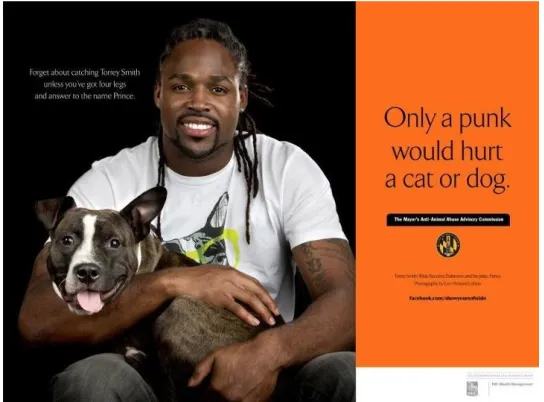
[image:61.612.189.461.375.576.2]Owners have also actively confronted the idea that the strength bound up in ideals of masculinity must be used for evil and reminds the pit bull’s public that this strength can also be used to defend the weak. In this scenario, the pit bull is a victim, a strong body weakened in the face of an impossible, non-bare life opponent called humans, and it takes strength to defend it. This use of masculinity has been the source of an anti-abuse ad campaign in the Baltimore area aimed at men called “Show Your Soft Side”, in which male celebrities pose with animals next to the slogan, “Only a punk would hurt a cat or dog,” as shown in the ad below, featuring Torrey Smith of the Baltimore Ravens with one of two pit bulls that he owns (Show Your Soft Side 2014).