https://doi.org/10.5194/hess-22-6257-2018 © Author(s) 2018. This work is distributed under the Creative Commons Attribution 4.0 License.
Evaluating post-processing approaches for monthly
and seasonal streamflow forecasts
Fitsum Woldemeskel1, David McInerney2, Julien Lerat3, Mark Thyer2, Dmitri Kavetski2,4, Daehyok Shin1, Narendra Tuteja3, and George Kuczera4
1Bureau of Meteorology, VIC, Melbourne, Australia
2School of Civil, Environmental and Mining Engineering, University of Adelaide, SA, Australia 3Bureau of Meteorology, ACT, Canberra, Australia
4School of Engineering, University of Newcastle, Callaghan, NSW, Australia Correspondence:Fitsum Woldemeskel ([email protected]) Received: 18 April 2018 – Discussion started: 26 April 2018
Revised: 7 November 2018 – Accepted: 9 November 2018 – Published: 6 December 2018
Abstract. Streamflow forecasting is prone to substantial uncertainty due to errors in meteorological forecasts, hy-drological model structure, and parameterization, as well as in the observed rainfall and streamflow data used to calibrate the models. Statistical streamflow post-processing is an important technique available to improve the prob-abilistic properties of the forecasts. This study evaluates post-processing approaches based on three transformations – logarithmic (Log), log-sinh (Log-Sinh), and Box–Cox with
λ=0.2 (BC0.2) – and identifies the best-performing scheme for post-processing monthly and seasonal (3-months-ahead) streamflow forecasts, such as those produced by the Australian Bureau of Meteorology. Using the Bureau’s op-erational dynamic streamflow forecasting system, we carry out comprehensive analysis of the three post-processing schemes across 300 Australian catchments with a wide range of hydro-climatic conditions. Forecast verification is assessed using reliability and sharpness metrics, as well as the Continuous Ranked Probability Skill Score (CRPSS). Results show that the uncorrected forecasts (i.e. without post-processing) are unreliable at half of the catchments. Post-processing of forecasts substantially improves reliabil-ity, with more than 90 % of forecasts classified as reliable. In terms of sharpness, the BC0.2 scheme substantially outper-forms the Log and Log-Sinh schemes. Overall, the BC0.2 scheme achieves reliable and sharper-than-climatology forecasts at a larger number of catchments than the Log and Log-Sinh schemes. The improvements in forecast reliability and sharpness achieved using the BC0.2 post-processing
scheme will help water managers and users of the forecast-ing service make better-informed decisions in plannforecast-ing and management of water resources.
Highlights. Uncorrected and post-processed stream-flow forecasts (using three transformations, namely Log, Log-Sinh, and BC0.2) are evaluated over 300 diverse Aus-tralian catchments. Post-processing enhances streamflow forecast reliability, increasing the percentage of catchments with reliable predictions from 50 % to over 90 %. The BC0.2 transformation achieves substantially better forecast sharpness than the Log-Sinh and Log transformations, particularly in dry catchments.
1 Introduction
Hydrological forecasts provide crucial supporting infor-mation on a range of water resource management deci-sions, including (depending on the forecast lead time) flood emergency response, water allocation for various uses, and drought risk management (Li et al., 2016; Turner et al., 2017). The forecasts, however, should be thoroughly verified and proved to be of sufficient quality to support decision-making and to meaningfully benefit the economy, environ-ment, and society.
a hydrological model is usually developed at a daily time step and calibrated against observed streamflow using his-torical rainfall and potential evaporation data. Rainfall fore-casts from a numerical climate model are then used as an input to produce daily streamflow forecasts, which are then aggregated to the timescale of interest and post-processed us-ing statistical models (e.g. Bennett et al., 2017; Schick et al., 2018). In statistical modelling systems, a statistical model based on relevant predictors, such as antecedent rainfall and streamflow, is developed and applied directly at the timescale of interest (Robertson and Wang, 2009, 2011; Lü et al., 2016; Zhao et al., 2016). Hybrid systems that combine aspects of dynamic and statistical approaches have also been investi-gated (Humphrey et al., 2016; Robertson et al., 2013a).
Examples of operational services based on the dynamic approach include the Australian Bureau of Meteorology’s dynamic modelling system (Laugesen et al., 2011; Tuteja et al., 2011; Lerat et al., 2015); the Hydrological Ensemble Forecast Service (HEFS) of the US National Weather Service (NWS) (Brown et al., 2014; Demargne et al., 2014); the Hy-drological Outlook UK (HOUK) (Prudhomme et al., 2017); and the short-term forecasting European Flood Alert System (EFAS) (Cloke et al., 2013). Examples of operational ser-vices based on a statistical approach include the Bureau of Meteorology’s Bayesian Joint Probability (BJP) forecasting system (Senlin et al., 2017).
Dynamic and statistical approaches have distinct advan-tages and limitations. Dynamic systems can potentially pro-vide more realistic responses in unfamiliar climate situations, as it is possible to impose physical constraints in such situ-ations (Wood and Schaake, 2008). In comparison, statistical models have the flexibility to include features that may lead to more reliable predictions. For example, the BJP model uses climate indices (e.g. NINO3.4), which are typically not used in dynamic approaches. That said, the suitability of sta-tistical models for the analysis of non-stationary catchment and climate conditions is questionable (Wood and Schaake, 2008).
Streamflow forecasts obtained using hydrological mod-els are affected by uncertainties in rainfall forecasts, ob-served rainfall and streamflow data, as well as by uncertain-ties in the model structure and parameters. Progress has been made towards reducing biases and characterizing the sources of uncertainty in streamflow forecasts. These advances in-clude improving rainfall forecasts through post-processing (Robertson et al., 2013b; Crochemore et al., 2016), ac-counting for input, parametric, and/or structural uncertainty (Kavetski et al., 2006; Kuczera et al., 2006; Renard et al., 2011; Tyralla and Schumann, 2016), and using data assimila-tion techniques (Dechant and Moradkhani, 2011). Although these steps may improve some aspects of the forecasting sys-tem, a predictive bias may nonetheless remain. Such bias can only be reduced via post-processing, which, if successful, will improve forecast accuracy and reliability (Madadgar et al., 2014; Lerat et al., 2015).
This study focuses on improving streamflow forecast-ing at monthly and seasonal timescales usforecast-ing dynamic ap-proaches, more specifically, by evaluating several forecast post-processing approaches. Post-processing of streamflow forecasts is intended to remove systemic biases in the mean, variability, and persistence of uncorrected forecasts, which arise due to inaccuracies in the downscaled rainfall forecasts (e.g. errors in downscaling forecast rainfall from a grid with ≈250 km resolution to the catchment scale) and in the hy-drological model (e.g. due to the effects of data errors in the model calibration and due to structural errors in the model itself).
A number of post-processing approaches have been inves-tigated in the literature, including quantile mapping (Hashino et al., 2007) and Bayesian frameworks (Pokhrel et al., 2013; Robertson et al., 2013a), as well as methods based on state-space models and wavelet transformations (Bogner and Kalas, 2008). Wood and Schaake (2008) used the correlation between forecast ensemble means and observations to gener-ate a conditional forecast. Compared with the traditional ap-proach of correcting individual forecast ensembles, the corre-lation approach improved forecast skill and reliability. In an-other study, Pokhrel et al. (2013) implemented a BJP method to correct biases, update predictions, and quantify uncer-tainty in monthly hydrological model predictions in 18 Aus-tralian catchments. The study found that the accuracy and reliability of forecasts improved. More recently, Mendoza et al. (2017) evaluated a number of seasonal streamflow fore-casting approaches, including purely statistical, purely dy-namical, and hybrid approaches. Based on analysis of catch-ments contributing to five reservoirs, the study concluded that incorporating catchment and climate information into post-processing improves forecast skill. While the above re-view mainly focused on post-processing of sub-seasonal and seasonal forecasts (as it is the main focus of the current study), post-processing is also commonly applied to short-range forecasts (e.g. Li et al., 2016) and to long-short-range fore-casts up to 12 months ahead (Bennett et al., 2016).
An important aspect of this work is its focus on general findings applicable over diverse hydro-climatological con-ditions. Most of the studies in the published literature use a limited number of catchments and case studies to test prospective methods. Dry catchments, characterized by in-termittent flows and frequent low flows, pose the greatest challenge to hydrological models (Ye et al., 1997; Knoche et al., 2014). Yet the provision of good-quality forecasts across a large number of catchments is an essential attribute of national-scale operational forecasting services, especially in large countries with diverse climatic and catchment condi-tions, such as Australia.
This paper develops streamflow post-processing ap-proaches suitable for use in an operational streamflow fore-casting service. We pose the following aims.
– Aim 1: evaluate the value of streamflow forecast processing by comparing forecasts with no post-processing (hereafter called “uncorrected” forecasts) against post-processed forecasts.
– Aim 2: evaluate three post-processing schemes based on residual error models with data transformations recom-mended in recent publications, namely the Log, Box– Cox (McInerney et al., 2017), and Log-Sinh (Wang et al., 2012) schemes, for monthly and seasonal stream-flow post-processing.
– Aim 3: evaluate the generality of results over a diverse range of hydro-climatic conditions, in order to ensure the recommendations are robust in the context of an op-erational streamflow forecasting service.
To achieve these aims, we use the operational monthly and seasonal (3-months-ahead) dynamic streamflow forecasting system of the Australian Bureau of Meteorology (Lerat et al., 2015). We evaluate the post-processing approaches for 300 catchments across Australia, with detailed analysis of dry and wet catchments. Forecast verification is carried out us-ing the Continuous Ranked Probability Skill Score (CRPSS) as well as metrics measuring reliability and sharpness, which are important aspects of a probabilistic forecast (Wilks, 2011). These metrics are used by the Bureau of Meteorol-ogy to describe the streamflow forecast performance of the operational service.
The rest of the paper is organized as follows. The forecast-ing methodology is described in Sect. 2 and application stud-ies are described in Sect. 3. Results are presented in Sect. 4, followed by discussions and conclusions in Sects. 5 and 6 respectively.
2 Seasonal streamflow forecasting methodology 2.1 Overview
The streamflow forecasting system adopted in this study is based on the Bureau of Meteorology’s dynamic modelling
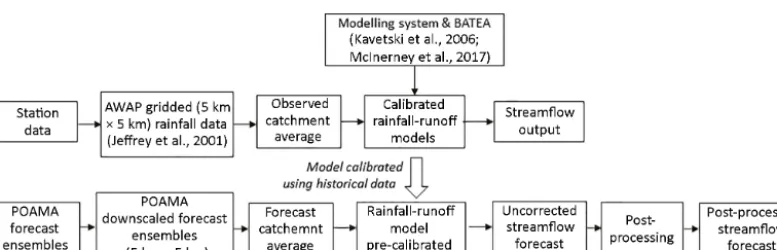
system (Fig. 1). Daily rainfall forecasts are input into a daily rainfall–runoff model to produce “uncorrected” daily streamflow forecasts. These streamflow forecasts are then aggregated in time and post-processed to produce monthly and seasonal streamflow forecasts, which are issued each month. Two steps are involved: calibration and forecasting, discussed below.
2.2 Uncorrected streamflow forecast procedure 2.2.1 Rainfall–runoff model
The GR4J rainfall–runoff model (Perrin et al., 2003) is used as it has been proven to provide (on average) good perfor-mance across a large number of catchments ranging from semi-arid to temperate and tropical humid (Perrin et al., 2003; Tuteja et al., 2011). GR4J is a lumped conceptual model with four calibration parameters: maximum capac-ity of the production storex1(mm); ground water exchange coefficientx2 (mm); 1-day-ahead maximum capacity of the routing storex3(mm); and time base of unit hydrographx4 (days).
2.2.2 Rainfall–runoff model calibration
In the calibration step, the daily rainfall–runoff model is cal-ibrated to observed daily streamflow using observed rainfall (Jeffrey et al., 2001) as forcing. The calibration of the param-eters is based on the weighted least squares likelihood func-tion, similar to that outlined in Evin et al. (2014). Markov chain Monte Carlo (MCMC) analysis is used to estimate pos-terior parametric uncertainty (Tuteja et al., 2011). Following MCMC analysis, 40 random sets of GR4J parameters are re-tained and used in the forecast step. A cross-validation pro-cedure is implemented to verify the forecasts, as described in Sect. 3.4. The calibration and cross-validation are compu-tationally intensive; therefore, we use the High Performance Computing (HPC) facility at the National Computing Infras-tructure (NCI) in Australia.
re-Figure 1.Schematic of the dynamic streamflow forecasting system used in this study. A similar approach is used by the Australian Bureau of Meteorology for its monthly and seasonal streamflow forecasting service.
quired to calibrate and cross-validate the hydrological model, and is easily achieved in an operational setting using HPC. Note that in this study the forecasting system does not use a data assimilation technique to update the GR4J state vari-ables. This choice is based on the limited effect of initial con-ditions after a number of days, which generally reduces the benefit of state updating in the context of seasonal stream-flow forecasting.
2.3 Streamflow post-processing procedure 2.3.1 Post-processing model
The streamflow post-processing method used in this work consists of fitting a statistical model to the streamflow fore-cast residual errors, defined by the differences between the observed and forecast streamflow time series over a cal-ibration period. Typically these errors are heteroscedastic, skewed, and persistent. Heteroscedasticity and skew are han-dled using data transformations (e.g. the Box–Cox trans-formation), whereas persistence is represented using au-toregressive models (e.g. the lag-one auau-toregressive model, AR(1); Wang et al., 2012; McInerney et al., 2017). We begin by describing the two major steps of the streamflow post-processing procedure (Sect. 2.3.2 and 2.3.3), and then de-scribe the transformations under consideration (Sect. 2.4). 2.3.2 Post-processing model calibration
The parameters of the streamflow post-processing model are calibrated as follows.
– Step 1: compute the transformed forecast residuals for month or seasontof the calibration period:
ηt=Z Qft−Z
QFt , (1)
where ηt is the normalized residual, Qft is the
ob-served streamflow,QFt is the median of the uncorrected streamflow forecast ensemble, and Z is a transforma-tion functransforma-tion. The transformatransforma-tion functransforma-tions considered in this work are detailed in Sect. 2.4.
– Step 2: compute the standardized residuals:
νt=
ηt−µmη(t )
σηm(t ), (2)
whereµmη(t )andσηm(t )are the monthly mean and
stan-dard deviation of the residuals in the calibration period for the month m(t).
The standardization process in Eq. (2) aims to account for seasonal variations in the distribution of residu-als. The quantitiesµmη(t ) andσηm(t ) are calculated
in-dependently as the sample mean and standard devia-tion of residuals for each monthly period (for a monthly forecast) or 3-monthly period (for seasonal forecasts). Based on Eq. (2), the standardized residualsvt are
as-sumed to have a zero mean and unit standard deviation. – Step 3: assume the standardized residuals are described by a first-order autoregressive (AR(1)) model with Gaussian innovations:
νt+1=ρνt+yt+1, (3)
whereρis the AR(1) coefficient andyt+1∼N (0, σy)is
the innovation.
The parametersρandσyare estimated using the method of moments (Hazelton, 2011): ρ is estimated as the sample auto-correlation of the standardized residualsν, andσy is estimated as the sample standard deviation of the observed innovationsy, which in turn are calcu-lated from the standardized residualsνby re-arranging Eq. (3).
2.3.3 Producing post-processed streamflow forecasts Once the streamflow post-processing scheme is calibrated, the post-processed streamflow forecasts for a given period are computed. For a given ensemble memberj, the following steps are applied.
[image:4.612.106.495.62.187.2]– Step 2: generate the standardized residualsvt+1,j using
Eq. (3). Hereνt,jis computed using Eq. (2) andηt,j is computed using Eq. (1), using the streamflow forecasts and observations from the previous time stept. – Step 3: compute the normalized residualsηt+1,jby
“de-standardizing”vt+1,j:
ηt+1,j=σηm(t )vt+1,j+µmη(t ). (4)
– Step 4: back-transform each normalized residualηt+1,j
to obtain the post-processed streamflow forecast:
QPPt+1,j=Z−1hZQFt+1+ηt+1,j i
. (5)
Steps 1–4 are repeated for all ensemble members (6640 in our case).
Note that the above algorithm may occasionally generate negative streamflow predictions, which we reset to zero. In addition, the algorithm can generate predictions that exceed historical maxima; such predictions could in principle also be “adjusted” a posteriori, though we do not attempt such an adjustment in this study. These aspects are discussed further in Sect. 5.6.
2.4 Transformations used in the post-processing model The observed streamflow and median streamflow forecasts are transformed in Step 1 of streamflow post-processing (Sect. 2.3.2), to account for the heteroscedasticity and skew-ness of the forecast residuals. We consider three transforma-tions, namely the logarithmic, Log-Sinh, and Box–Cox trans-formations.
2.4.1 Logarithmic (Log) transformation The logarithmic (Log) transformation is
Z(Q)=log(Q+c). (6)
The offsetcensures the transformed flows are defined when
Q=0. Here we setc=0.01×(Q)eave, where(Q)eave is the average observed streamflow over the calibration period. The use of a small fixed value for cis common in the literature for coping with zero flow events (Wang et al., 2012). 2.4.2 Log-Sinh transformation
The Log-Sinh transformation (Wang et al., 2012) is
Z(Q)=1
blog [sinh (a+bQ)]. (7)
The parameters a and b are calibrated for each month by maximizing the p-value of the Shapiro–Wilk test (Shapiro and Wilk, 1965) for normality of the residuals,v. This prag-matic approach is part of the existing Bureau’s operational dynamic streamflow forecasting system (Lerat et al., 2015).
2.4.3 Box–Cox transformation
The Box–Cox (BC) transformation (Box and Cox, 1964) is
Z(Q;λ, c)=(Q+c) λ−1
λ , (8)
whereλis a power parameter and c=0.01×(Q)eave. Fol-lowing the recommendations of McInerney et al. (2017), the parameterλis fixed to 0.2.
2.4.4 Rationale for selecting transformational approaches
The Log transformation is a simple and widely used transfor-mation; McInerney et al. (2017) reported that in daily scale modelling it produced the best reliability in perennial catch-ments (from a set of eight residual error schemes, including standard least squares, weighted least squares, BC, Log-Sinh, and reciprocal transformations). However, the Log transfor-mation performed poorly in ephemeral catchments, where its precision was far worse than in perennial ones.
The Log-Sinh transformation is an alternative to the Log and BC transformations, and was proposed by Wang et al. (2012) to improve precision at higher flows. The Log-Sinh approach has been extensively applied to water fore-casting problems (see for example, Del Giudice et al., 2013; Robertson et al., 2013b, Bennett et al., 2016). However, in daily scale streamflow modelling of perennial catchments us-ing observed rainfall, the Log-Sinh scheme did not improve on the Log transformation: its parameters tend to calibrate to values for which the Log-Sinh transformation effectively reduces to the Log transformation (McInerney et al., 2017).
Finally, the BC transformation with fixedλ=0.2 is rec-ommended by McInerney et al. (2017) as one of only two schemes (from the set of eight schemes listed earlier in this section) that achieve Pareto-optimal performance in terms of reliability, precision and bias, across both perennial and ephemeral catchments. McInerney et al. (2017) also found that calibratingλdid not generally improve predictive per-formance, due to the inferred value being dominated by the fit to the low flows at the expense of the high flows.
2.5 Summary of key terms
Figure 2. Locations of the 300 catchments used in this study. The catchments are classified as dry or wet based on the aridity index. The Köppen climate classifications for Australia are shown. The Dieckmans Bridge catchment (site id: 145010A), used as a representative catchment in Fig. 8, is indicated by the red circle.
3 Application 3.1 Study catchments
The empirical case study is carried out over a comprehensive set of 300 catchments with locations shown in Fig. 2. The fig-ure also shows the Köppen climate zones. These catchments are selected as representative of the diverse hydro-climatic conditions across Australia. The catchment areas range from as small as 6 km2to as large as 230 000 km2, with 90 % of the catchments having areas below 6000 km2. The seasonal streamflow forecasting service of the Bureau of Meteorology is currently evaluating these 300 catchments as part of an ex-pansion of their dynamic modelling system.
3.2 Catchment data
In each catchment, data from 1980 to 2008 are used. Ob-served daily rainfall data were obtained from the Australian Water Availability Project (AWAP) (Jeffrey et al., 2001). Po-tential evaporation and observed streamflow data were ob-tained from the Bureau of Meteorology.
Catchment-scale rainfall forecasts are estimated from daily downscaled rainfall forecasts produced by the Bu-reau of Meteorology’s global climate model, namely the Predictive Ocean Atmosphere Model for Australia
(POAMA-2) (Hudson et al., 2013). The atmospheric com-ponent of POAMA-2 uses a spatial scale of approximately 250×250 km (Charles et al., 2013). To estimate catchment-scale rainfall, a statistical downscaling model based on an analogue approach (which could also be considered as rain-fall forecast post-processing) was applied (Timbal and McA-vaney, 2001). In the analogue approach, local climate infor-mation is obtained by matching analogous previous situa-tions to the predicted climate. To this end, an ensemble of 166 rainfall forecast time series (33 POAMA ensembles×5 replicates from downscaling+1 ensemble mean) were gen-erated. In operation, POAMA-2 forecasts are generated ev-ery week by running 33 member ensembles out to 270 days. In this study we use rainfall forecasts up to 3 months ahead and produce 166 rainfall forecast ensembles through the ana-logue downscaling procedure described above.
3.3 Catchment classification
The performance of the post-processing schemes is evaluated separately in dry versus wet catchments. In this work, the classification of catchments into dry and wet is based on the aridity index (AI) according to the following equation:
AI= P
Figure 3. Schematic of the cross-validation framework used for forecast verification, applied with the 1-year validation period cor-responding to the year 1990 (following Tuteja et al., 2016).
whereP is the total rainfall volume and PET is the total po-tential evapotranspiration volume. The aridity index has been used extensively to identify and classify drought and wetness conditions of hydrological regimes (Zhang et al., 2009; Car-rillo et al., 2011; Sawicz et al., 2014).
Catchments with AI<0.5 are categorized as “dry”, which corresponds to hyper-arid, arid, and semi-arid classifica-tions suggested by the United Naclassifica-tions Environment Pro-gramme (Middleton et al., 1997). Conversely, catchments with AI≥0.5 are classified as “wet”. Overall, about 28 % of catchments used in this work are classified as dry.
3.4 Cross-validation procedure
The forecast verification is carried out using a moving-window cross-validation framework, as shown in Fig. 3. We use 5 years of data (1975–1979) to warm up the model and apply data from 1980 to 2008 for calibration in a cross-validation framework based on a 5-year moving window. Suppose we are validating the streamflow forecasts in year
j (e.g.j =1990 in Fig. 3). In this case the calibration is car-ried out using all years except yearsj,j+1,j+2,j+3, and
j+4. The 4-year period after yearj is excluded to prevent the memory of the hydrological model from affecting model performance in the validation window period. The process is then repeated for each year during 1980–2008. Once the validation has been carried out for each year, the results are concatenated to produce a single “validation” time series, for which the performance metrics are calculated.
3.5 Forecast performance (verification) metrics
The performance of uncorrected and post-processed stream-flow forecasts is evaluated using reliability and sharpness metrics, as well as the CRPSS (see Sect. 3.5.3). Note that the Bureau of Meteorology uses Root Mean Squared Er-ror (RMSE) and Root Mean Squared ErEr-ror in Probability (RMSEP) scores in the operational service in addition to CRPSS; however, these metrics have not been considered in this study.
Forecast performance (verification) metrics are computed separately for each forecast month. To facilitate the compar-ison and evaluation of streamflow forecast performance in different streamflow regimes, the high- and low-flow months are defined using long-term average streamflow data calcu-lated for each month. The 6 months with the highest av-erage streamflow are classified as “high-flow” months, and
the remaining 6 months are classified as “low-flow” months. The performance metrics listed below are computed for each month separately; the indices denoting the month are ex-cluded from Eqs. (10), (11), and (12) below to avoid clut-tering the notation.
3.5.1 Reliability
The reliability of forecasts is evaluated using the probabil-ity integral transform (PIT) (Dawid, 1984; Laio and Tamea, 2007). To evaluate and compare reliability across 300 catch-ments, thep-value of the Kolmogorov–Smirnov (KS) test applied to the PIT is used. In this study, forecasts with PIT plots where the KS test yields ap-value≥5 % are classified as “reliable”.
3.5.2 Sharpness
The sharpness of forecasts is evaluated using the ratio of inter-quantile ranges (IQRs) of streamflow forecasts and a historical reference (Tuteja et al., 2016). The following defi-nition is used:
IQRq=
1
N N X
i=1
Fi(100−q)−Fi(q) Ci(100−q)−Ci(q)
×100 %, (10)
where IQRq is the IQR value corresponding to percentileq,
andFi(q)andCi(q)are respectively theqth percentiles of
forecast and the historical reference for yeari.
An IQRq of 100 % indicates a forecast with the same
sharpness as the reference, an IQRq below 100 % indicates
forecasts that are sharper (tighter predictive limits) than the reference, and an IQRq above 100 % indicates forecasts that
are less sharp (wider predictive limits) than the reference. We report IQR99, i.e. the IQR at the 99th percentile, in order to detect forecasts with unreasonably long tails in their predic-tive distributions.
3.5.3 CRPS skill score (CRPSS)
The CRPS metric quantifies the difference between a forecast distribution and observations, as follows (Hersbach, 2000):
CRPS= 1
N × N X i=1 ∞ Z −∞
Fi(y)−Hi{y≥yo} 2
dy, (11)
where Fi is the cumulative distribution function (cdf) of the forecast for year i, y is the forecast variable (here streamflow) and yo is the corresponding observed value. Hi{y≥yo}is the Heaviside step function, which equals 1
when the forecast values are greater than the observed value and equals 0 otherwise.
of the predicted quantity – has CRPSP =0. In this work, we use the CRPS skill score, CRPSS, defined by
CRPSS=CRPS
F−CRPSC
CRPSP−CRPSC
×100 %, (12)
where CRPSF, CRPSC and CRPSP represent the CRPS value for model forecast, climatology and “perfect” forecast respectively. A higher CRPSS indicates better performance, with a value of 0 representing the same performance as cli-matology.
3.5.4 Historical reference
The IQR and CRPSS metrics are defined as skill scores rela-tive to a reference forecast. In this work, we use the climatol-ogy as the reference forecast, as it represents the long-term climate condition. To construct these “climatological fore-casts”, we used the same historical reference as the opera-tional seasonal streamflow forecasting service of the Bureau of Meteorology. This reference is resampled from a Gaus-sian probability distribution fitted to the observed streamflow transformed using the Log-Sinh transformation (Eq. 7). This approach leads to more stable and continuous historical ref-erence estimates than sampling directly from the empirical distribution of historical streamflow, and can be computed at any percentile (which facilitates comparison with forecast percentiles). Although the choice of a particular reference af-fects the computation of skill scores, it does not affect the ranking of post-processing models when the same reference is used, which is the main aim of this paper.
3.5.5 Summary skill: summarizing forecast performance using multiple metrics
When evaluating forecast performance, a focus on any single individual metric can lead to misleading interpretations. For example, two forecasts might have a similar sharpness, yet if one of these forecasts is unreliable it can lead to an over-or under- estimation of the risk of an event of interest, which in turn can lead to a sub-optimal decision by forecast users (e.g. a water resources manager).
Given inevitable trade-offs between individual metrics (McInerney et al., 2017), it is important to consider multi-ple metrics jointly rather than individually. Following the ap-proach suggested by Gneiting et al. (2007), we consider a forecast to have “high skill” when it is reliable and sharper than climatology. To determine the “summary skill” of the forecasts in each catchment, we evaluate the total number of months (out of 12) in which forecasts are reliable (i.e. with a
p-value greater than 5 %) and sharper than the climatology (i.e. IQR99<100 %). A catchment is classified as having high summary skill if “high-skill” forecasts are obtained 10– 12 months per year (on average), and is classified as having low summary skill otherwise. Note that the CRPSS is not in-cluded in the summary skill, because it does not represent an
independent measure of a forecast attribute (see Sect. 3.5.3 for more details).
A table providing the percentage of catchments with high and low summary skills is used to summarize the forecast performance of a given post-processing scheme. To identify any geographic trends in the forecast performance, the sum-mary skills are plotted on a map. The sumsum-mary skills together with individual skill score values are used to evaluate the overall forecast performance, and are presented separately for wet and dry catchments, as well as separately for high-and low-flow months.
4 Results
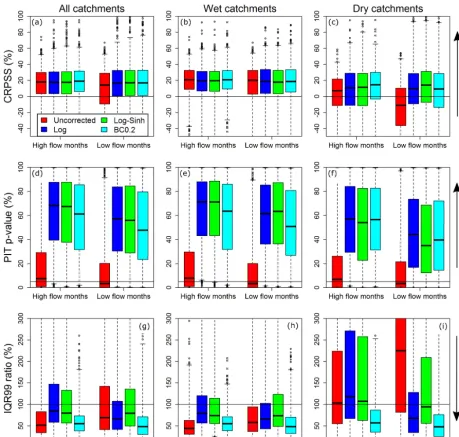
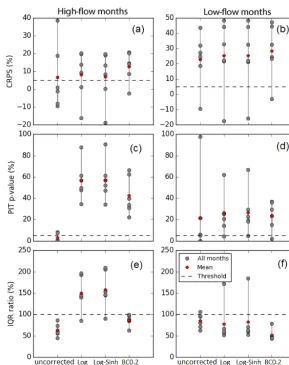
Results for monthly and seasonal streamflow forecasts are now presented. Section 4.1 compares the uncorrected and post-processed streamflow forecast performance. Section 4.2 evaluates the performance of post-processed streamflow forecasts obtained using the Log, Log-Sinh, and BC0.2 schemes. The CRPSS, reliability, and sharpness metrics are presented in Figs. 4 and 5 for monthly and seasonal forecasts respectively.
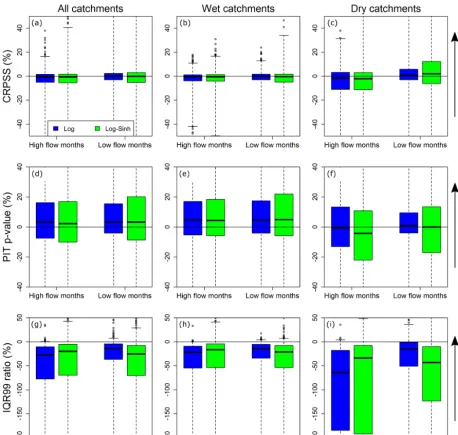
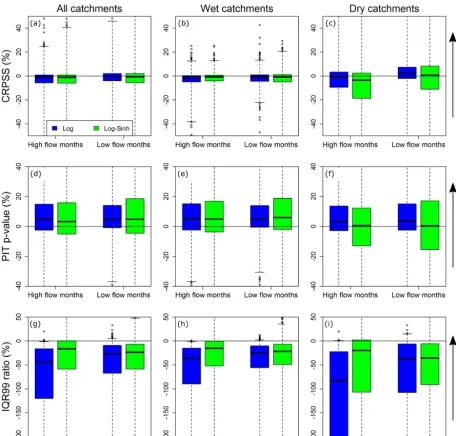
Initial inspection of results found considerable overlap in the performance metrics achieved by the error models. To determine whether the differences in metrics are consistent over multiple catchments, the Log and Log-Sinh schemes are compared to the BC0.2 scheme. This comparison is pre-sented in Figs. 6 and 7 for monthly and seasonal forecasts respectively. The BC0.2 scheme is taken as the baseline be-cause inspection of Figs. 4 and 5 suggests that the BC0.2 scheme has better median sharpness than the Log and Log-Sinh schemes, over all the catchments and for both high- and low-flow months individually.
The streamflow forecast time series and correspond-ing skill for a scorrespond-ingle representative catchment, Dieckmans Bridge, are presented in Figs. 8 and 9 respectively.
The summary skills of the monthly and seasonal forecasts are presented in Figs. 10 and 11. The figures include a his-togram of summary skills across all catchments to enable comparison between the uncorrected and post-processing ap-proaches.
4.1 Comparison of uncorrected and post-processed streamflow forecasts: individual metrics
Figure 4.Performance of monthly forecasts in terms of CRPSS, reliability (PITp-value), and sharpness (IQR99 ratio).
catchments for seasonal forecasts; however, the improvement is not as pronounced as for monthly forecasts (Fig. 5c).
In terms of reliability, the performance of uncorrected streamflow forecasts is poor, with about 50 % of the catch-ments being characterized by unreliable forecasts at both the monthly and seasonal timescales (Figs. 4 and 5, middle row). In comparison, post-processing using the three transforma-tion approaches produces much better reliability, achieving reliable forecasts in more than 90 % of the catchments.
In terms of sharpness, the uncorrected forecasts and the BC0.2 post-processed forecasts are generally sharper than forecasts generated using the other transformations (Figs. 4g and 5g). The use of post-processing achieves much better sharpness than uncorrected forecasts for low-flow months,
particularly in dry catchments. For example, for low-flow months in dry catchments (Fig. 4i), the median IQR99 is greater than 200 %, while similar values range between 40 % and 100 % for post-processed forecasts. Similarly, for sea-sonal forecasts, post-processing approaches improve the me-dian sharpness from 150 % (uncorrected forecasts) to 50 %– 110 % (Fig. 5i).
4.2 Comparison of post-processing schemes: individual metrics
Figure 5.Performance of seasonal forecasts in terms of CRPSS, reliability (PITp-value), and sharpness (IQR99 ratio).
the post-processing schemes, and is further confirmed by Figs. 6a–c and 7a–c, which show boxplots of the differences between the CRPSS of the Log and Log-Sinh schemes versus the CRPSS of the BC0.2 scheme. Across all catchments, the distribution of these differences is approximately symmetric with a mean close to 0. In dry catchments, the BC0.2 slightly outperforms the Log scheme for high-flow months and the Log-Sinh scheme slightly outperforms the Log scheme for low-flow months. Overall, these results suggest that none of the Log, Log-Sinh, or BC0.2 schemes is consistently better in terms of CRPSS values.
In terms of reliability, post-processing using any of the three post-processing schemes produces reliable forecasts at both monthly and seasonal scales, and in the majority of the
catchments (Figs. 4 and 5, middle row). The medianp-value is approximately 60 % for monthly forecasts compared with 45 % for seasonal forecasts. This indicates that better focast reliability is achieved at shorter lead times. Median re-liability is somewhat reduced when using the BC0.2 scheme compared to the Log and Log-Sinh schemes in wet catch-ments (Fig. 6e), but not so much in dry catchcatch-ments (Fig. 6f). Nevertheless, the monthly and seasonal forecasts are reliable in 96 % and 91 % of the catchments respectively. The corre-sponding percentages for the Log scheme are 97 % and 94 %, and for Log-Sinh they are 95 % and 90 %.
Figure 6.Distributions of differences in the monthly forecast performance metrics of the Log and Log-Sinh schemes compared to the BC0.2 scheme.
for monthly and seasonal forecasts (Figs. 4 and 5, bottom row). The plot of differences in the sharpness metric (Figs. 6 and 7, bottom row) highlights this improvement. In half of the catchments, during both high- and low-flow months, the BC0.2 scheme improves the IQR99 by 30 % (or more) com-pared to the Log and Log-Sinh schemes. In dry catchments, the improvements are larger than in wet catchments. For example, in dry catchments during high-flow months, the BC0.2 scheme improves on the IQR99 of Log and Log-Sinh by 40 %–60 % in over a half of the catchments, and by as much as 170 %–190 % in a quarter of the catchments.
To illustrate these results, a streamflow forecast time se-ries at Dieckmans Bridge catchment (site id: 145010A) is shown in Fig. 8 and performance metrics calculated over 6
sharp-Figure 7.Distributions of differences in the seasonal forecast performance metrics of the Log and Log-Sinh schemes compared to the BC0.2 scheme.
ness, the Log and Log-Sinh schemes produce a wider 99 % predictive range than the BC0.2 scheme (Figs. 8 and 9).
4.3 Comparison of summary skill between uncorrected and post-processing approaches
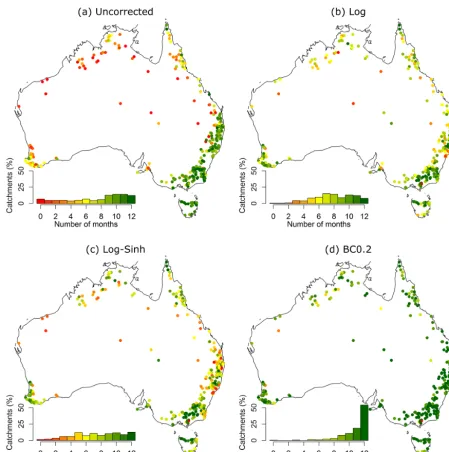
Figures 10 and 11 show the geographic distribution of the summary skill of the uncorrected and post-processing ap-proaches for monthly and seasonal forecasts respectively. Recall that the summary skill represents the number of months with streamflow forecasts that are both reliable and sharper than climatology. Table 1 provides a summary of the percentage of catchments with high and low summary
skill for the uncorrected and post-processing approaches for monthly and seasonal forecasts (see Sect. 3.5.5).
The findings for forecasts at the monthly scale are as fol-lows (Fig. 10 and Table 1).
[image:12.612.71.528.64.501.2]sum-Figure 8.Seasonal streamflow forecast time series (blue line) and observations (red dots) at Dieckmans Bridge catchment (site id: 145010A). The shaded area shows the 99 % prediction limits.
mary skill also decreases (in comparison to uncorrected forecasts), from 40 % to 33 % for both the Log and Log-Sinh schemes.
Post-processing with the BC0.2 scheme provides the best performance, with the smallest percentage of catchments with low summary skills (<1 %) and the largest percentage of catchments with high summary skills (84 %), as seen in Fig. 10.
– Figure 10: the improvement achieved by the BC0.2 scheme (compared to the Log/Log-Sinh schemes) is most pronounced in New South Wales (NSW) and in the tropical catchments in Queensland (QLD) and the
Northern Territory (NT). The few catchments where the BC0.2 scheme does not achieve a high summary skill are located in the north and north-west of Australia. The findings for forecasts at the seasonal scale are as follows (Fig. 11 and Table 1).
[image:13.612.133.465.65.509.2]Figure 9.Seasonal streamflow forecast skill scores at Dieckmans Bridge catchment, computed from the time series shown in Fig. 8 for 6 high-flow months and 6 low-flow months.
Table 1. Performance of post-processing schemes, expressed as the percentage of catchments with high and low summary skill. Results shown for monthly and seasonal forecasts. A catchment with “high summary skill” is defined as a catchment where “high-skill” forecasts are achieved in 10–12 months out of the year; “high-skill” forecasts are defined as forecasts that are reliable and sharper than climatology.
Post-processing scheme
Uncorrected forecasts Log Log-Sinh BC0.2
Monthly forecasts
High summary skill 40 % 33 % 33 % 84 % Low summary skill 16 % 2 % 7 % <1 %
Seasonal forecasts
[image:14.612.153.443.575.699.2]Figure 10.Summary skill of monthly forecasts obtained using the Log, Log-Sinh, and BC0.2 schemes across 300 Australian catchments. The performance of uncorrected forecasts is also shown. The summary skill is defined as the number of months where high-skill forecasts (i.e. forecasts that are reliable and sharper than climatology) are obtained. The inset histogram shows the percentage of catchments in each performance category and also serves as the colour legend.
The percentage of catchments with high summary skill increases from 9 % to 12 % and 22 % respectively.
– Post-processing with the BC0.2 scheme once again pro-vides the best performance: it produces forecasts with low summary skill in only 2 % of the catchments, and achieves high summary skill in 54 % of the catchments. As seen in Fig. 11, similar to the case of monthly fore-casts, the biggest improvements for seasonal forecasts occur in the NSW and Queensland regions of Australia.
– Overall, Table 1 shows that, across all schemes, BC0.2 results in a larger percentage of catchments with low summary skill and a larger percentage of catchments with high summary skill. It can also be seen that the summary skills of post-processing approaches are lower for seasonal forecasts than for monthly forecasts. 4.4 Summary of empirical findings
Figure 11.Summary skill of seasonal forecasts obtained using the Log, Log-Sinh, and BC0.2 schemes across 300 Australian catchments. See Fig. 10’s caption for details.
sharpness, particularly in dry catchments. Although all three post-processing schemes under consideration provide im-provements in some of the performance metrics, the BC0.2 scheme consistently produces better sharpness than the Log and Log-Sinh schemes, while maintaining similar reliabil-ity and CRPSS. This finding holds for both monthly and, to a lower degree, seasonal forecasts. Of the three post-processing schemes, the BC0.2 scheme improves by the largest margin the percentage of catchments and the number of months where the post-processed forecasts are reliable and sharper than climatology.
5 Discussion
5.1 Benefits of forecast post-processing
impor-tant to correct for these shortcomings and improve fore-cast skill. In this study, all post-processing models provide a clear improvement in reliability and sharpness, especially in dry catchments. The value of post-processing is more pro-nounced in dry catchments than in wet catchments (Figs. 4 and 5). This finding can be attributed to the challenge of cap-turing key physical processes in dry and ephemeral catch-ments (Ye et al., 1997), as well as the challenge of achiev-ing accurate rainfall forecasts in arid areas. In addition, the simplifications inherent in any hydrological model, includ-ing the conceptual model GR4J used in this work, might also be responsible for the forecast skill being relatively lower in dry catchments than in wet catchments. Whilst using a single conceptual model is attractive for practical operational sys-tem, there may be gains in exploring alternative structures for ephemeral catchments (e.g. Clark et al., 2008; Fenicia et al., 2011). We intend to explore such alternative model struc-tures for difficult ephemeral catchments. In such dry catch-ments, the hydrological model forecasts are particularly poor and leave a lot of room for improvement: post-processing can hence make a big difference on the quality of results. 5.2 Interpretation of differences between
post-processing schemes
We now discuss the large differences in sharpness between the BC0.2 scheme versus the Log and Log-Sinh schemes. The Log-Sinh transformation was designed by Wang et al. (2012) to improve the reliability and sharpness of predic-tions, particularly for high flows, and has worked well as part of the statistical modelling system for operational streamflow forecasts by the Bureau of Meteorology. The Log-Sinh trans-formation has a variance stabilizing function that (for certain parameter values) tapers off for high flows. In theory, this feature can prevent the explosive growth of predictions for high flows that can occur with the Log and Box–Cox trans-formations (especially whenλ <0).
McInerney et al. (2017) found that, when modelling peren-nial catchments at the daily scale, the Log-Sinh scheme did not achieve better sharpness than the Log scheme. Instead, the parameters for the Log scheme tended to converge to values for which the tapering off of the Log-Sinh trans-formation function occurs well outside the range of sim-ulated flows, effectively reducing the Log-Sinh scheme to the Log scheme. In contrast, the Box–Cox transformation function with a fixed λ >0 gradually flattens as stream-flow increases, and exhibits the “desired” tapering-off be-haviour within the range of simulated flows. This bebe-haviour leads to the Box–Cox scheme achieving, on average, more favourable variance-stabilizing characteristics than the Log-Sinh scheme.
Our findings in this study confirm the insights of McIn-erney et al. (2017) – namely that the Log-Sinh scheme pro-duces comparable sharpness to the Log scheme – across a wider range of catchments. This finding indicates that
in-sights from modelling residual errors at the daily scale apply at least to some extent to streamflow forecast post-processing at the monthly and seasonal scales. Note the minor difference in the treatment of the offset parametercin Eq. (6): in the Log scheme used in McInerney et al. (2017) this parameter is inferred, whereas in this study it is fixed a priori. This minor difference does not impact on the qualitative behaviour of the error models described earlier in this section. Overall, when used for post-processing seasonal and monthly forecasts in a dynamic modelling system, the BC0.2 scheme provides an opportunity to improve forecast performance further than is possible using the Log and Log-Sinh schemes.
5.3 Importance of using multiple metrics to assess forecast performance
The goal of the forecasting exercise is to maximize sharp-ness without sacrificing reliability (Gneiting et al., 2005; Wilks, 2011; Bourdin et al., 2014). The study results show that relying on a single metric for evaluating forecast perfor-mance can lead to sub-optimal conclusions. For example, if one considers the CRPSS metric alone, all post-processing schemes yield comparable performance and there is no basis for favouring any single one of them. However, once sharp-ness is taken into consideration explicitly, the BC0.2 scheme can be recommended due to substantially better sharpness than the Log and Log-Sinh schemes.
Similarly, comparisons based solely on CRPSS might sug-gest reasonable performance of the uncorrected forecasts: 55 %–80 % of months have CRPSS>0 (with some variabil-ity across high-/low-flow months and monthly/seasonal fore-casts). Yet once reliability is considered explicitly, it is found that uncorrected forecasts are unreliable at approximately 50 % of the catchments. Note that performance metrics based on the CRPSS reflect an implicitly weighted combination of reliability, sharpness, and bias characteristics of the forecasts (Hersbach, 2000). In contrast, the reliability and sharpness metrics are specifically designed to quantify reliability and sharpness attributes individually. These findings highlight the value of multiple independent performance metrics and diag-nostics that evaluate specific (targeted) attributes of the fore-casts, and highlight important limitations of aggregate mea-sures of performance (Clark et al., 2011).
not necessarily lead to a proportional increase in its value. This question requires further multi-disciplinary research, in-cluding human psychology, economic theory, communica-tion and social studies (e.g. Matte et al., 2017; Morss et al., 2010).
5.4 Importance of performance evaluation over large numbers of catchments
When designing an operational forecast service for loca-tions with streamflow regimes as diverse and variable as in Australia (Taschetto and England, 2009), it is essential to thoroughly evaluate multiple modelling methods over mul-tiple locations to ensure the findings are sufficiently robust and general. This was the major reason for considering the large set of 300 catchments in our study. This set-up also yields valuable insights into spatial patterns in forecast formance. For example, the Log and Log-Sinh schemes per-form relatively well in catchments in south-eastern Australia, and relatively worse in catchments in northern and north-eastern Australia (Figs. 10 and 11). In contrast, the BC0.2 scheme performs well across the majority of the catchments in all regions included in the evaluation. The evaluation over a large number of catchments in different hydro-climatic re-gions is clearly beneficial to establish the robustness of post-processing methods. Restricting the analysis to a smaller number of catchments would have led to less conclusive find-ings.
5.4.1 Implication of results for water resource management
The empirical results clearly show that the BC0.2 post-processing scheme improves forecast sharpness (precision) while maintaining forecast accuracy and reliability. As dis-cussed below, this improvement in forecast quality offers an opportunity to improve operational planning and manage-ment of water resources.
The management of water resources, for example, decid-ing which water source to use for a particular purpose or al-locating environmental flows, requires an understanding of the current and future availability of water. For water re-sources systems with long hydrological records, water man-agers have devised techniques to evaluate current water avail-ability, water demand, and losses. However, one of the main unknowns is the volume of future system inflows. Stream-flow forecasts provide crucial information to water managers and users regarding the future availability of water, thus help-ing reduce uncertainty in decision makhelp-ing. This informa-tion is particularly valuable for supporting decisions during drought events. In this study, forecast performance is eval-uated separately for high- and low-flow months – provid-ing a clearer indication of predictive ability for flows that are above and below average respectively. A detailed evalu-ation of forecasts for more extreme drought events is
chal-lenging as these events are correspondingly rarer. Limited sample size makes it difficult to make conclusive statements: e.g. if we focus on the lowest 5 % of historical data with a 30-year record, we may only have roughly 1.5 samples for each month/season. The uncertainty arising from limited sample size requires further development of forecast verifica-tion techniques, potentially adapting some of the approaches used by Hodgkins et al. (2017).
5.5 Opportunities for further improvement in forecast performance
There are several opportunities to further improve the sea-sonal streamflow forecasting system. This section describes avenues related to specialized treatment of zero flows and high-flow forecasts, uncertainty analysis of post-processing model parameters, and the use of data assimilation (state up-dating).
The post-processing approaches used in this work do not make special provision for zero flows in the observed data. Robust handling of zero flows in statistical models, espe-cially in arid and semi-arid catchments, is an active research area (Wang and Robertson, 2011; Smith et al., 2015), and ad-vances in this area are certainly relevant to seasonal stream-flow forecasting.
A similar challenge is associated with the forecasting of high flows, as the post-processing approaches used in this work can produce streamflow predictions that exceed histor-ical maxima. The IQR ratio used to assess forecast sharp-ness will detect unreasonably long tails (i.e. extremes) in the predictive distributions and hence can indirectly identify in-stances of unreasonably high-flow forecasts. Further research is needed to develop techniques to evaluate the realism of forecasts that exceed historical maxima.
Another area for further investigation is the identifiability of parametersµmη(t )andσηm(t )of the monthly post-processing
model. These parameters are estimated using monthly data (see Sect. 2.3.2), and hence could be subject to substantial uncertainty and/or overfitting to the calibration period. In this study, 29 years of data were employed in the calibra-tion, making these problems unlikely. Importantly, the use of a cross-validation procedure (Sect. 3.4) is expected to detect potential overfitting. That said, as many sites of potential ap-plication may lack the data length available in this work, the sensitivity of forecast performance to the length of calibra-tion period warrants further investigacalibra-tion.
6 Conclusions
This study focused on developing robust streamflow forecast post-processing schemes for an operational forecasting ser-vice at the monthly and seasonal timescales. For such fore-casts to be useful to water managers and decision-makers, they should be reliable and exhibit sharpness that is better than climatology.
We investigated streamflow forecast post-processing schemes based on residual error models employing three data transformations, namely the logarithmic (Log), log-sinh (Log-Sinh), and Box–Cox withλ=0.2 (BC0.2). The Aus-tralian Bureau of Meteorology’s dynamic modelling system was used as the platform for the empirical analysis, which was carried out over 300 Australian catchments with diverse hydro-climatic conditions.
The following empirical findings are obtained.
1. Uncorrected forecasts (no post-processing) perform poorly in terms of reliability, resulting in a mischarac-terization of forecast uncertainties.
2. All three post-processing schemes substantially im-prove the reliability of streamflow forecasts, both in terms of the dedicated reliability metric and in terms of the summary skill given by the CRPSS.
3. From the post-processing schemes considered in this work, the BC0.2 scheme is found to be best suited for operational application. The BC0.2 scheme provides the sharpest forecasts without sacrificing reliability, as mea-sured by the reliability and CRPSS metrics. In particu-lar, the BC0.2 scheme produces forecasts that are both reliable and sharper than climatology at substantially more catchments than the alternative Log and Log-Sinh schemes.
A major practical outcome of this study is the development of a robust streamflow forecast post-processing scheme that achieves forecasts that are consistently reliable and sharper than climatology. This scheme is well suited for opera-tional application, and offers the opportunity to improve de-cision support, especially in catchments where climatology is presently used to guide operational decisions.
Data availability. The data underlying this research can be ac-cessed from the following links: observed rainfall data (http:// www.bom.gov.au/climate, last access: 7 November 2018), POAMA rainfall forecast generated by the Australian Bureau of Meteo-rology (http://poama.bom.gov.au, Charles et al., 2013), and ob-served streamflow data (http://www.bom.gov.au/waterdata, last ac-cess: 7 November 2018).
Competing interests. The authors declare that they have no conflict of interest.
Acknowledgements. Data for this study are provided by the Australian Bureau of Meteorology. This work was supported by Australian Research Council grant LP140100978 with the Aus-tralian Bureau of Meteorology and South East Queensland Water. We thank the anonymous reviewers for constructive comments and feedback that helped us substantially improve the paper.
Edited by: Albrecht Weerts
Reviewed by: two anonymous referees
References
Bennett, J. C., Wang, Q. J., Li, M., Robertson, D. E., and Schepen, A.: Reliable long-range ensemble streamflow forecasts: Combin-ing calibrated climate forecasts with a conceptual runoff model and a staged error model, Water Resour. Res., 52, 8238–8259, https://doi.org/10.1002/2016WR019193, 2016.
Bennett, J. C., Wang, Q. J., Robertson, D. E., Schepen, A., Li, M., and Michael, K.: Assessment of an ensemble seasonal streamflow forecasting system for Australia, Hydrol. Earth Syst. Sci., 21, 6007–6030, https://doi.org/10.5194/hess-21-6007-2017, 2017.
Bogner, K. and Kalas, M.: Error-correction methods and evalua-tion of an ensemble based hydrological forecasting system for the Upper Danube catchment, Atmos. Sci. Lett., 9, 95–102, https://doi.org/10.1002/asl.180, 2008.
Bourdin, D. R., Nipen, T. N., and Stull, R. B.: Reliable probabilistic forecasts from an ensemble reservoir inflow forecasting system, Water Resour. Res., 50, 3108–3130, https://doi.org/10.1002/2014WR015462, 2014.
Box, G. E. P. and Cox, D. R.: An analysis of transformations, J. R. Stat. Soc. Ser. B, 211–252, https://doi.org/10.2307/2287791, 1964.
Brown, J. D., Wu, L., He, M., Regonda, S., Lee, H., and Seo, D. J.: Verification of temperature, precipitation, and streamflow forecasts from the NOAA/NWS Hydrologic Ensemble Forecast Service (HEFS): 1. Experimental de-sign and forcing verification, J. Hydrol., 519, 2869–2889, https://doi.org/10.1016/j.jhydrol.2014.05.028, 2014.
Carpenter, T. M. and Georgakakos, K. P.: Assessment of Fol-som lake response to historical and potential future cli-mate scenarios: 1. Forecasting, J. Hydrol., 249, 148–175, https://doi.org/10.1016/S0022-1694(01)00417-6, 2001. Carrillo, G., Troch, P. A., Sivapalan, M., Wagener, T., Harman, C.,
and Sawicz, K.: Catchment classification: hydrological analysis of catchment behavior through process-based modeling along a climate gradient, Hydrol. Earth Syst. Sci., 15, 3411–3430, https://doi.org/10.5194/hess-15-3411-2011, 2011.
Charles, A., Miles, E., Griesser, A., de Wit, R., Shelton, K., Cot-trill, A., Spillman, C., Hendon, H., McIntosh, P., Nakaegawa, T., Atalifo, T., Prakash, B., Seuseu, S., Nihmei, S., Church, J., Jones, D., and Kuleshov, Y.: Dynamical Seasonal Prediction of Climate Extremes in the Pacific, in 20th International Congress on Mod-elling and Simulation (Modsim2013), 2841–2847, 2013. Clark, M. P., Slater, A. G., Rupp, D. E., Woods, R. A., Vrugt, J. A.,
Res., 44, W00B02, https://doi.org/10.1029/2007WR006735, 2008.
Clark, M. P., Kavetski, D., and Fenicia, F.: Pursuing the method of multiple working hypotheses for hydro-logical modeling, Water Resour. Res., 47, W09301, https://doi.org/10.1029/2010WR009827, 2011.
Cloke, H., Pappenberger, F., Thielen, J., and Thiemig, V.: Opera-tional European Flood Forecasting, in Environmental Modelling, John Wiley & Sons, Ltd., 415–434, 2013.
Crochemore, L., Ramos, M.-H., and Pappenberger, F.: Bias cor-recting precipitation forecasts to improve the skill of seasonal streamflow forecasts, Hydrol. Earth Syst. Sci., 20, 3601–3618, https://doi.org/10.5194/hess-20-3601-2016, 2016.
Dawid, A. P.: Present Position and Potential Developments: Some Personal Views: Statistical theory: the prequential approach (with discussion), J. R. Stat. Soc. Ser. A, 147, 278–292, https://doi.org/10.2307/2981683, 1984.
DeChant, C. M. and Moradkhani, H.: Improving the characteriza-tion of initial condicharacteriza-tion for ensemble streamflow prediccharacteriza-tion us-ing data assimilation, Hydrol. Earth Syst. Sci., 15, 3399–3410, https://doi.org/10.5194/hess-15-3399-2011, 2011.
Demargne, J., Wu, L., Regonda, S. K., Brown, J. D., Lee, H., He, M., Seo, D. J., Hartman, R., Herr, H. D., Fresch, M., Schaake, J., and Zhu, Y.: The science of NOAA’s operational hydrologic ensemble forecast service, B. Am. Meteorol. Soc., 95, 79–98, https://doi.org/10.1175/BAMS-D-12-00081.1, 2014.
Evin, G., Thyer, M., Kavetski, D., McInerney, D., and Kuczera, G.: Comparison of joint versus postprocessor approaches for hydro-logical uncertainty estimation accounting for error autocorrela-tion and heteroscedasticity, Water Resour. Res., 50, 2350–2375, https://doi.org/10.1002/2013WR014185, 2014.
Fenicia, F., Kavetski, D., and Savenije, H. H. G.: Elements of a flex-ible approach for conceptual hydrological modeling: 1. Motiva-tion and theoretical development, Water Resour. Res., 47, 1–13, https://doi.org/10.1029/2010WR010174, 2011.
Gibbs, M. S., McInerney, D., Humphrey, G., Thyer, M. A., Maier, H. R., Dandy, G. C., and Kavetski, D.: State up-dating and calibration period selection to improve dynamic monthly streamflow forecasts for an environmental flow man-agement application, Hydrol. Earth Syst. Sci., 22, 871–887, https://doi.org/10.5194/hess-22-871-2018, 2018.
Del Giudice, D., Honti, M., Scheidegger, A., Albert, C., Reichert, P., and Rieckermann, J.: Improving uncertainty estimation in urban hydrological modeling by statistically describing bias, Hydrol. Earth Syst. Sci., 17, 4209–4225, https://doi.org/10.5194/hess-17-4209-2013, 2013.
Gneiting, T., Raftery, A. E., Westveld, A. H., and Goldman, T.: Cal-ibrated Probabilistic Forecasting Using Ensemble Model Output Statistics and Minimum CRPS Estimation, Mon. Weather Rev., 133, 1098–1118, https://doi.org/10.1175/MWR2904.1, 2005. Gneiting, T., Balabdaoui, F., and Raftery, A. E.: Probabilistic
fore-casts, calibration and sharpness, J. R. Stat. Soc. Ser. B, 69, 243– 268, https://doi.org/10.1111/j.1467-9868.2007.00587.x, 2007. Hashino, T., Bradley, A. A., and Schwartz, S. S.:
Evalu-ation of bias-correction methods for ensemble streamflow volume forecasts, Hydrol. Earth Syst. Sci., 11, 939–950, https://doi.org/10.5194/hess-11-939-2007, 2007.
Hazelton, M. L.: Methods of Moments Estimation BT – Interna-tional Encyclopedia of Statistical Science, edited by: Lovric, M., Springer Berlin Heidelberg, Berlin, Heidelberg, 816–817, 2011. Hersbach, H.: Decomposition of the Continuous Ranked Prob-ability Score for Ensemble Prediction Systems, Weather Forecast., 15, 559–570, https://doi.org/10.1175/1520-0434(2000)015<0559:DOTCRP>2.0.CO;2, 2000.
Hudson, D., Marshall, A. G., Yin, Y., Alves, O., and Hendon, H. H.: Improving Intraseasonal Prediction with a New Ensem-ble Generation Strategy, Mon. Weather Rev., 141, 4429–4449, https://doi.org/10.1175/MWR-D-13-00059.1, 2013.
Humphrey, G. B., Gibbs, M. S., Dandy, G. C., and Maier, H. R.: A hybrid approach to monthly streamflow fore-casting: Integrating hydrological model outputs into a Bayesian artificial neural network, J. Hydrol., 540, 623–640, https://doi.org/10.1016/j.jhydrol.2016.06.026, 2016.
Jeffrey, S. J., Carter, J. O., Moodie, K. B., and Beswick, A. R.: Us-ing spatial interpolation to construct a comprehensive archive of Australian climate data, Environ. Model. Softw., 16, 309–330, https://doi.org/10.1016/S1364-8152(01)00008-1, 2001. Kavetski, D., Kuczera, G., and Franks, S. W.: Bayesian
analysis of input uncertainty in hydrological mod-eling: 1. Theory, Water Resour. Res., 42, W03407, https://doi.org/10.1029/2005WR004368, 2006.
Knoche, M., Fischer, C., Pohl, E., Krause, P., and Merz, R.: Combined uncertainty of hydrological model complexity and satellite-based forcing data evaluated in two data-scarce semi-arid catchments in Ethiopia, J. Hydrol., 519, 2049–2066, https://doi.org/10.1016/j.jhydrol.2014.10.003, 2014.
Kuczera, G., Kavetski, D., Franks, S., and Thyer, M.: To-wards a Bayesian total error analysis of conceptual rainfall-runoff models: Characterising model error using storm-dependent parameters, J. Hydrol., 331, 161–177, https://doi.org/10.1016/j.jhydrol.2006.05.010, 2006.
Laio, F. and Tamea, S.: Verification tools for probabilistic fore-casts of continuous hydrological variables, Hydrol. Earth Syst. Sci., 11, 1267–1277, https://doi.org/10.5194/hess-11-1267-2007, 2007.
Laugesen, R., Tuteja, N. K., Shin, D., Chia, T., and Khan, U.: Seasonal Streamflow Forecasting with a workflow-based dy-namic hydrologic modelling approach, in: MODSIM 2011 – 19th International Congress on Modelling and Simulation – Sustaining Our Future: Understanding and Living with Uncer-tainty, 2352–2358, available at: http://www.scopus.com/inward/ record.url?eid=2-s2.0-84858823270&partnerID=tZOtx3y1 (last access: 7 November 2018), 2011.
Lerat, J., Pickett-Heaps, C., Shin, D., Zhou, S., Feikema, P., Khan, U., Laugesen, R., Tuteja, N., Kuczera, G., Thyer, M., and Kavet-ski, D.: Dynamic streamflow forecasts within an uncertainty framework for 100 catchments in Australia, in In: 36th Hydrol-ogy and Water Resources Symposium: The art and science of water, 1396–1403, Barton, ACT: Engineers Australia, 2015. Li, M., Wang, Q. J., Bennett, J. C., and Robertson, D. E.: Error
reduction and representation in stages (ERRIS) in hydrological modelling for ensemble streamflow forecasting, Hydrol. Earth Syst. Sci., 20, 3561–3579, https://doi.org/10.5194/hess-20-3561-2016, 2016.
soil moisture and snow depth, Remote Sens., 8, 503, https://doi.org/10.3390/rs8060503, 2016.
Madadgar, S., Moradkhani, H., and Garen, D.: Towards improved post-processing of hydrologic forecast ensembles, Hydrol. Proc., 28, 104–122, https://doi.org/10.1002/hyp.9562, 2014.
Matte, S., Boucher, M.-A., Boucher, V., and Fortier Filion, T.-C.: Moving beyond the cost-loss ratio: economic assessment of streamflow forecasts for a risk-averse decision maker, Hydrol. Earth Syst. Sci., 21, 2967–2986, https://doi.org/10.5194/hess-21-2967-2017, 2017.
McInerney, D., Thyer, M., Kavetski, D., Lerat, J., and Kucz-era, G.: Improving probabilistic prediction of daily streamflow by identifying Pareto optimal approaches for modeling het-eroscedastic residual errors, Water Resour. Res., 53, 2199–2239, https://doi.org/10.1002/2016WR019168, 2017.
Mendoza, P. A., Wood, A. W., Clark, E., Rothwell, E., Clark, M. P., Nijssen, B., Brekke, L. D., and Arnold, J. R.: An inter-comparison of approaches for improving operational seasonal streamflow forecasts, Hydrol. Earth Syst. Sci., 21, 3915–3935, https://doi.org/10.5194/hess-21-3915-2017, 2017.
Middleton, N., Programme, U. N. E., and Thomas, D. S. G.: World Atlas of Desertification, Arnold, 1997.
Morss, R. E., Lazo, J. K., and Demuth, J. L.: Examining the use of weather forecasts in decision scenarios: Results from a us sur-vey with implications for uncertainty communication, Meteorol. Appl., 17, 149–162, https://doi.org/10.1002/met.196, 2010. Murphy, A. H. and Ehrendorfer, M.: On the relationship between the
accuracy and value of forecasts in the cost–loss ratio situation, Weather Forecast., 2, 243–251, https://doi.org/10.1175/1520-0434(1987)002<0243:OTRBTA>2.0.CO;2, 1987.
Perrin, C., Michel, C., and Andréassian, V.: Improvement of a parsi-monious model for streamflow simulation, J. Hydrol., 279, 275– 289, https://doi.org/10.1016/S0022-1694(03)00225-7, 2003. Pokhrel, P., Robertson, D. E., and Wang, Q. J.: A Bayesian
joint probability post-processor for reducing errors and quan-tifying uncertainty in monthly streamflow predictions, Hydrol. Earth Syst. Sci., 17, 795–804, https://doi.org/10.5194/hess-17-795-2013, 2013.
Prudhomme, C., Hannaford, J., Harrigan, S., Boorman, D., Knight, J., Bell, V., Jackson, C., Svensson, C., Parry, S., Bachiller-Jareno, N., Davies, H., Davis, R., Mackay, J., McKenzie, A., Rudd, A., Smith, K., Bloomfield, J., Ward, R., and Jenk-ins, A.: Hydrological Outlook UK: an operational stream-flow and groundwater level forecasting system at monthly to seasonal time scales, Hydrol. Sci. J., 62, 2753–2768, https://doi.org/10.1080/02626667.2017.1395032, 2017. Renard, B., Kavetski, D., Leblois, E., Thyer, M., Kuczera, G., and
Franks, S. W.: Toward a reliable decomposition of predictive un-certainty in hydrological modeling: Characterizing rainfall errors using conditional simulation, Water Resour. Res., 47, W11516, https://doi.org/10.1029/2011WR010643, 2011.
Robertson, D. E. and Wang, Q. J.: Selecting predictors for sea-sonal streamflow predictions using a Bayesian joint probabil-ity (BJP) modelling approach, 18th World IMACS/MODSIM Congr. Cairns, Aust. 13–17 July 2009, 376–382, 2009.
Robertson, D. E. and Wang, Q. J.: A Bayesian Approach to Pre-dictor Selection for Seasonal Streamflow Forecasting, J. Hy-drometeorol., 13, 155–171, https://doi.org/10.1175/JHM-D-10-05009.1, 2011.
Robertson, D. E., Pokhrel, P., and Wang, Q. J.: Improving statistical forecasts of seasonal streamflows using hydrolog-ical model output, Hydrol. Earth Syst. Sci., 17, 579–593, https://doi.org/10.5194/hess-17-579-2013, 2013a.
Robertson, D. E., Shrestha, D. L., and Wang, Q. J.: Post-processing rainfall forecasts from numerical weather prediction models for short-term streamflow forecasting, Hydrol. Earth Syst. Sci., 17, 3587–3603, https://doi.org/10.5194/hess-17-3587-2013, 2013b. Sawicz, K. A., Kelleher, C., Wagener, T., Troch, P., Sivapalan,
M., and Carrillo, G.: Characterizing hydrologic change through catchment classification, Hydrol. Earth Syst. Sci., 18, 273–285, https://doi.org/10.5194/hess-18-273-2014, 2014.
Schick, S., Rössler, O., and Weingartner, R.: Monthly streamflow forecasting at varying spatial scales in the Rhine basin, Hydrol. Earth Syst. Sci., 22, 929–942, https://doi.org/10.5194/hess-22-929-2018, 2018.
Senlin, Z., Feikema, P., Shin, D., Tuteja, N. K., MacDonald, A., Sunter, P., Kent, D., Le, B., Pipunic, R., Wilson, T., Pickett-Heaps, C., and Lerat, J.: Operational efficiency measures of the national seasonal streamflow forecast service in Australia, edited by: Syme, G., MacDonald, D. H., Fulton, B., and Piantadosi, J., The Modelling and Simulation Society of Australia and New Zealand Inc, Hobart, Australia., 2017.
Seo, D.-J., Herr, H. D., and Schaake, J. C.: A statistical post-processor for accounting of hydrologic uncertainty in short-range ensemble streamflow prediction, Hydrol. Earth Syst. Sci. Dis-cuss., 3, 1987–2035, https://doi.org/10.5194/hessd-3-1987-2006, 2006.
Shapiro, S. S. and Wilk, M. B.: An Analysis of Variance Test for Normailty (Complete Samples), Biometrika, 52, 591–611, https://doi.org/10.2307/1267427, 1965.
Smith, T., Marshall, L., and Sharma, A.: Modeling residual hy-drologic errors with Bayesian inference, J. Hydrol., 528, 29–37, https://doi.org/10.1016/j.jhydrol.2015.05.051, 2015.
Tang, Q. and Lettenmaier, D. P.: Use of satellite snow-cover data for streamflow prediction in the Feather River Basin, California, Int. J. Remote Sens., 31, 3745–3762, https://doi.org/10.1080/01431161.2010.483493, 2010.
Taschetto, A. S. and England, M. H.: An analysis of late twentieth century trends in Australian rainfall, Int. J. Climatol., 29, 791– 807, https://doi.org/10.1002/joc.1736, 2009.
Timbal, B. and McAvaney, B. J.: An Analogue based method to downscale surface air temperature: Ap-plication for Australia, Clim. Dynam, 17, 947–963, https://doi.org/10.1007/s003820100156, 2001.
Turner, S. W. D., Bennett, J. C., Robertson, D. E., and Galelli, S.: Complex relationship between seasonal streamflow forecast skill and value in reservoir operations, Hydrol. Earth Syst. Sci., 21, 4841–4859, https://doi.org/10.5194/hess-21-4841-2017, 2017. Tuteja, N. K., Shin, D., Laugesen, R., Khan, U., Shao, Q., Wang, E.,
Li, M., Zheng, H., Kuczera, G., Kavetski, D., Evin, G., Thyer, M., MacDonald, A., Chia, T., and Le, B.: Experimental evalu-ation of the dynamic seasonal streamflow forecasting approach, Melbourne, 2011.
Schaake, J. C., Springer Berlin Heidelberg, Berlin, Heidelberg, 1–19, 2016.
Tyralla, C. and Schumann, A. H.: Incorporating structural un-certainty of hydrological models in likelihood functions via an ensemble range approach, Hydrol. Sci. J., 61, 1679–1690, https://doi.org/10.1080/02626667.2016.1164314, 2016. Wandishin, M. S. and Brooks, H. E.: On the
relation-ship between Clayton’s skill score and expected value for forecasts of binary events, Meteorol. Appl., 9, 455–459, https://doi.org/10.1017/S1350482702004085, 2002.
Wang, Q. J. and Robertson, D. E.: Multisite probabilistic forecasting of seasonal flows for streams with zero value occurrences, Water Resour. Res., 47, https://doi.org/10.1029/2010WR009333, 2011. Wang, Q. J., Robertson, D. E., and Chiew, F. H. S.: A Bayesian joint probability modeling approach for seasonal forecasting of streamflows at multiple sites, Water Resour. Res., 45, W05407, https://doi.org/10.1029/2008WR007355, 2009.
Wang, Q. J., Shrestha, D. L., Robertson, D. E., and Pokhrel, P.: A log-sinh transformation for data normalization and variance stabilization, Water Resour. Res., 48, W05514, https://doi.org/10.1029/2011WR010973, 2012.
Wilks, D. S.: Statistical methods in the atmospheric sciences, Ams-terdam, Academic Press, 2011.
Wood, A. W. and Schaake, J. C.: Correcting Errors in Streamflow Forecast Ensemble Mean and Spread, J. Hydrometeorol., 9, 132– 148, https://doi.org/10.1175/2007JHM862.1, 2008.
Ye, W., Bates, B. C., Viney, N. R., Sivapalan, M., and Jakeman, A. J.: Performance of conceptual rainfall-runoff models in low-yielding ephemeral catchments, Water Resour. Res., 33, 153– 166, https://doi.org/10.1029/96WR02840, 1997.
Yin, Y., Alves, O., Oke, P. R., Yin, Y., Alves, O., and Oke, P. R.: An ensemble ocean data assimilation system for seasonal prediction, Mon. Weather Rev., 139, 786–808, https://doi.org/10.1175/2010MWR3419.1, 2011.
Zhang, Q., Xu, C.-Y., and Zhang, Z.: Observed changes of drought/wetness episodes in the Pearl River basin, China, us-ing the standardized precipitation index and aridity index, Theor. Appl. Climatol., 98, 89–99, https://doi.org/10.1007/s00704-008-0095-4, 2009.