http://dx.doi.org/10.4236/jmmce.2015.32007
Investigation on Structural, Optical and
Thermal Properties of Diphenyl Urea—An
Organic Non-Linear Optical Crystal
Jaishree Damodharan
1, Kanchana Gopinath
2, Kesavasamy Ramasamy
3 1Department of Physics, Sri Ramakrishna Institute of Technology, Coimbatore, India 2Department of Physics, Government Arts College, Coimbatore, India3Department of Physics, Sri Ramakrishna Engineering College, Coimbatore, India
Email: [email protected], [email protected], [email protected] Received 7 January 2015; accepted 23 January 2015; published 27 January 2015
Copyright © 2015 by authors and Scientific Research Publishing Inc.
This work is licensed under the Creative Commons Attribution International License (CC BY).
http://creativecommons.org/licenses/by/4.0/
Abstract
Organic non-linear optical crystal diphenyl urea with molecular formula C13H12N2O was
synthe-sized and grown successfully by slow evaporation solution growth technique. The single crystal X-ray diffraction (XRD) confirms that it crystallizes in orthorhombic crystal system with non-cen- trosymmetric space group Pna21. The various functional groups were identified qualitatively by
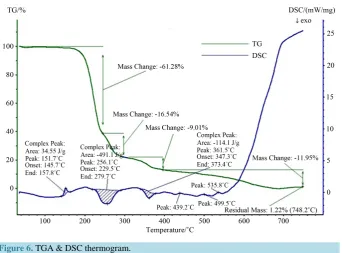
Fourier transform-infra red (FT-IR) and FT-Raman techniques. The electron absorption spectrum was studied by UV-Vis spectrophotometer. Thermal behavior of the crystal was evidenced by thermogravimetric (TG) and differential scanning calorimetric (DSC) analyses. From DSC the melt- ing point of the crystal is found to be 145˚C. The existence of second harmonic generation (SHG) signal was evidenced using Kurtz Perry powder test and the efficiency of the crystal was found to be 0.64 times that of the standard KDP crystal.
Keywords
Non-Linear Optical Crystal, Slow Evaporation Technique, Characterization
1. Introduction
growth of non-linear optical (NLO) materials over the past decade because of their potential application in the field of telecommunication, optical signal processing and optical switching. Organic materials have been of par- ticular interest because the NLO responses in this broad class of materials are microscopic in origin, offering an opportunity to use theoretical modelling coupled with synthetic flexibility to design and produce novel materials [2] [3]. The most popular non-linear optical materials used to generate the SHG signal so far have been inorganic bulk crystals with rather small second-order nonlinear optical susceptibilities, such as potassium dihydrogen phosphate (KDP), lithium triborate (LBO), β-barium borate (BBO), lithium niobate (LiNbO3), potassium ni-obate (KNbO3) etc., [4]. But due its lower SHG efficiency and laser damage threshold, materials scientist fo- cused their attention on organic materials because they possess large second-order nonlinear optical susceptibili-ties due to delocalized π-electrons [5]. These crystals were composed of aromatic molecules with π electron do-nor and acceptor substitutions. They do-normally exhibit intermolecular charge transfer and lead to the required pro- perty of non centrosymmetry and make them good frequency conversion material [6].
Diphenyl urea has a wide biological importance. It has been expected to be an excellent potential tyrosine phosphate inhibitor and sickle-cell anemia treatment drug. The structure of diphenyl urea was reported by Raji-nikant et al. [7] but there are no reports available in the literature on the growth and characterizations of di-phenyl urea. Not only in biological aspects, didi-phenyl urea can also be used as non-linear optical crystal for in-dustrial purposes. Hence in the present article we have reported the material synthesis, growth and characteriza-tion of diphenyl urea by slow evaporacharacteriza-tion solucharacteriza-tion growth technique. The grown crystals have been subjected into structural, spectral, optical, thermal and SHG studies.
2. Experimental
Synthesis and Growth
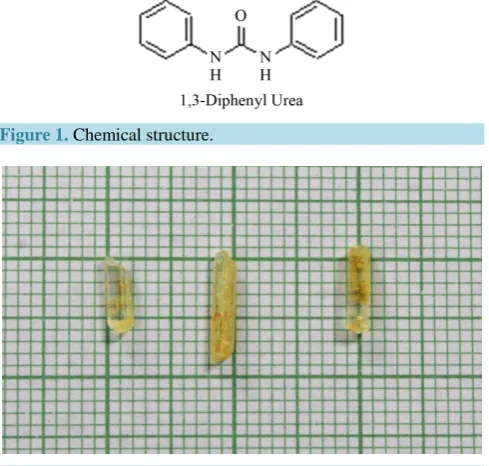
Analar R grade samples of 1.07 g of phenylisocyanate, 0.94 g of aniline and 0.5 ml of triethyl amine are used as the reactants. The precipitated diphenylurea was filtered off and repeatedly recrystallised from ethanol to en-hance the degree of purity of the synthesized compound. The chemical structure is shown in Figure 1.
The photograph of the grown crystals was shown in Figure 2.
3. Characterization Studies
[image:2.595.192.437.476.709.2]The grown crystals were subjected to single crystal X-ray diffraction using Enraf Nonius-CAD 4 diffractometer. FT-IR and FT-Raman spectra were recorded to confirm the presence of functional groups using Bruker: RFS 27
Figure 1. Chemical structure.
spectrometer in the frequency range 400 - 4000 cm−1. The optical absorption spectrum was recorded by double beam UV-Vis spectrophotometer. Thermal stability of the crystals was tested in the temperature range 0˚ to 800˚C using NETZSCH STA 409C. The NLO property of the crystal was confirmed by Nd-YAG laser using Kurtz Perry powder test.
4. Results and Discussion
4.1. Single Crystal X-Ray Diffraction Analysis
The single crystal XRD analysis of the grown crystal was carried out using Enraf Nonius-CAD 4 single crystal diffractometer. This study reveals that the crystal belongs to orthorhombic crystal system and crystallizes under non-centrosymmetric space group Pna21 with molecularformula C13H12N2O. The obtained lattice parameters are a = 9.11 Å, b = 10.56 Å, c = 11.78 Å and its volume is found to be 1133 Å which are in close agreement with the reported values [7].
4.2. FT-IR Analysis
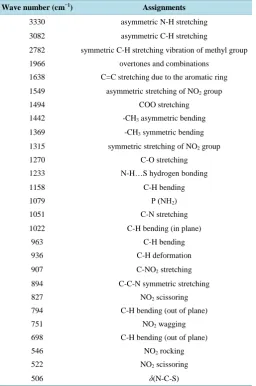
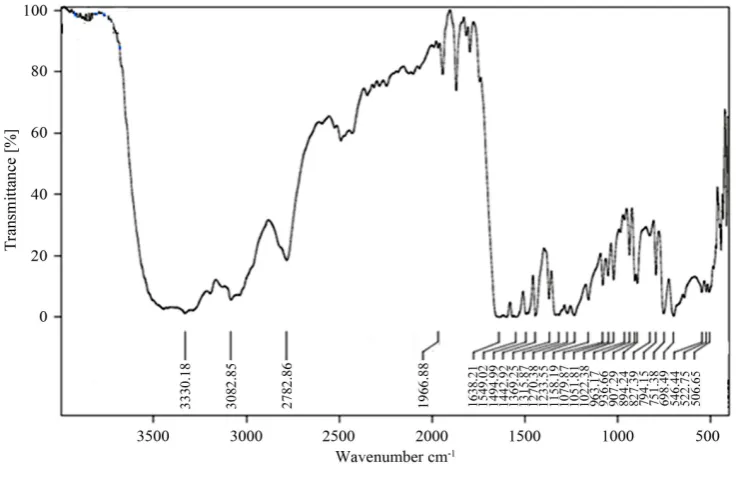
[image:3.595.188.445.334.721.2]The FT-IR spectrum of the grown crystal was recorded within the frequency region 400 - 4000 cm−1 using Bruker: RFS 27 spectrometer. The recorded spectrum is shown in Figure 3. The presence of functional groups was iden-tified and the band assignments are tabulated in Table 1.
Table 1. Band assignments of diphenyl urea.
Wave number (cm−1) Assignments
3330 asymmetric N-H stretching
3082 asymmetric C-H stretching
2782 symmetric C-H stretching vibration of methyl group
1966 overtones and combinations
1638 C=C stretching due to the aromatic ring
1549 asymmetric stretching of NO2 group
1494 COO stretching
1442 -CH3 asymmetric bending
1369 -CH3 symmetric bending
1315 symmetric stretching of NO2 group
1270 C-O stretching
1233 N-H…S hydrogen bonding
1158 C-H bending
1079 Ρ (NH2)
1051 C-N stretching
1022 C-H bending (in plane)
963 C-H bending
936 C-H deformation
907 C-NO2 stretching
894 C-C-N symmetric stretching
827 NO2 scissoring
794 C-H bending (out of plane)
751 NO2 wagging
698 C-H bending (out of plane)
546 NO2 rocking
522 NO2 scissoring
Figure 3. FT-IR spectrum.
4.3. FT-Raman Analysis
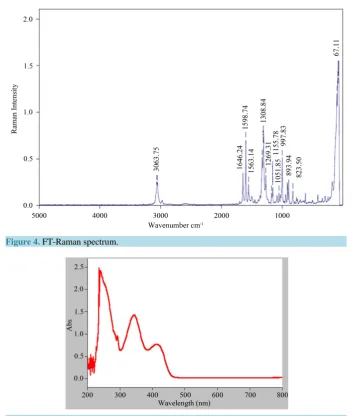
The recorded FT-Raman spectrum was shown in Figure 4.
The presence of functional groups was further confirmed by Raman spectrum. The peak at 3063.75 cm−1 is due to asymmetric stretching and the peak observed at 1646.24 cm−1 is due to C-C stretching. The strong peaks at 1328 cm−1 and 1308 cm−1 are due to symmetric stretching of NO2 group. The weak bands at 1269.31 cm−1 and 1155.78 cm−1 are due to C-O stretching and C-H bending respectively. The C-N and C-NO2 stretching bands are evidenced at 1051.85 cm−1 and 913.64 cm−1. NO2 scissoring is observed at 823 cm−1.
4.4. UV-Vis Studies
The absorption spectrum of the grown crystals was measured by double beam UV-Vis spectrophotometer for the wavelength range 200 to 800 nm and is shown in Figure 5.
The absorption spectrum plays a vital role in the fabrication of devices. It is observed that there is no remark- able absorption in the visible region and the lower cut off wavelength is 450 nm. The absence of absorption above 450 nm is an advantage, as it is the prime requirement for materials having NLO properties. It can be used as an SHG material in the visible region.
4.5. Thermogravimetric and Differential Scanning Calorimetric Studies
TGA and DSC thermograms are recorded using NETZSCH STA 409C instrument between room temperature and 700˚C in nitrogen atmosphere. Simultaneously recorded TGA and DSC thermograms are shown in Figure 6.
Figure 4. FT-Raman spectrum.
Figure 5. UV absorption spectrum.
4.6. Non-Linear Optical Studies
The SHG efficiency of the newly grown crystal is determined by Kurtz Perry powder test. The sample is pow- dered and is sandwiched between the two glass slides. A Q-switched Nd:YAG laser emitting a fundamental wa-velength of 1064 nm and 8 ns pulse width, with 10 Hz pulse rate was focused on the glass slides. The frequency conversion efficiency of the crystal was confirmed by the emission of green radiation from the sample. Here the conversion efficiency of the material is compared with standard reference potassium di hydrogen phosphate (KDP) sample. The SHG efficiency of the crystal is found to be 0.64 times that the standard KDP crystal.
5. Conclusion
Figure 6. TGA & DSC thermogram.
efficiency of the grown crystal was measured by Kurtz Perry powder test and its efficiency was found to be 0.64 times that of the standard KDP crystal. All the above strongly attributes diphenyl urea, a novel material for non linear optical applications.
References
[1] Lakshmana Perumal, C.K., Arulchakkaravarthi, A., Rajesh, N.P., Santhanaraghavan, P. and Ramasamy, P. (2002)Micro- hardness and Slip Systems of Solution Grown MHB Crystals. Materials Letters, 56, 578-586.
http://dx.doi.org/10.1016/S0167-577X(02)00555-4
[2] Prasad, P.N. and Williams, D.J. (1991) Introduction to Nonlinear Optical Effects in Organic Molecules and Polymers. Wiley, New York.
[3] Chemla, D.S. and Zyss, J. (1987) Nonlinear Optical Properties of Organic Molecules and Crystals. Academic Press, New York.
[4] Bhowmik, A.K., Tan, S., Ahyi, A.C., Dharmadhikari, J.A., Dharmadhikari, A.K. and Mathur, D. (2007) Measurement of Ultrashort Laser Pulses Using Single-Crystal Films of 4-Aminobenzophenone. Optics Communications, 280, 472- 476.
[5] Iyanar, M., Thomas Joseph Prakash, J., Muthamizhchelva, C. and Ponnusamy, S. (2009) Synthesis, Growth and Cha-racterization Studies of a Semiorganic Nonlinear Optical Single Crystal of Gamma Glycine. Journal of Physical Sci- ences, 13, 235-244.
[6] Chandramohan, A., Bharathikannan, R., Kandavelu, V., Chandrasekaran, J. and Kandhaswamy, M.A. (2008) Synthesis, Crystal Growth, Structural, Thermal and Optical Properties of Naphthalene Picrate an Organic NLO Material. Spec-trochimica Acta Part A: Molecular and Biomolecular Spectroscopy, 71, 755-759.
http://dx.doi.org/10.1016/j.saa.2008.01.036