Received Power Improvement using SOA in
All-Optical Networks
Pankaj Singh
Dept. of Electronics and Communication Lovely Professional University
Phagwara, India
Gurpartap Singh
Assistant Professor Lovely Professional UniversityPhagwara, India
ABSTRACT
Network management for optical networking facing many problems as the system capacity and complexity increasing day by day that arises by using the transparent optical network components in communication system. In this article we are proposing a novel scheme of all optical networking management system. Semiconductor optical amplifier (SOA) is used after the channel to equalize the signal power which will help us to reduce crosstalk and reduce the probability of the failure of the network. Network failure occurs in the network by increasing the signal power by external source therefore amplified signal travel longer distance then the required distance. To overcome from this problem SOA is used to equalizing the power and to reduce the networks failures.
General Terms
Optical communication, fault management in optical networks.
Keywords
Optical Communication, Network management, SOA.
1.
INTRODUCTION
Network management system is responsible for secure and continuous functioning of any network it keeps a network error free and manage the all type of functioning of a network. There are many types of management in All-optical networks (AON) like security management, fault management and power management. While some available management mechanisms are applicable to different types of network architectures, many of these are not enough for all-optical networks (AONs). These contain only transparent optical components and therefore differ to a large extent from the optical networks currently used. As a result, AONs have unique features and requirements in terms of security and quality of service (QoS) that require a much targeted approach in terms of network management. Although the job of network management for AONs is essentially no different from that of managing traditional optical networks, numerous management issues arise, in particular because of network transparency and the characteristics of AON components. These specific features thus require more sophisticated techniques and methods for managing and monitoring the network, controlled with an appropriate Network Management System (NMS) that can meet and satisfy the challenges posed by AONs [1].
Wavelength Division Multiplexed (WDM) all optical transport networks have many imbalance of power among different wavelengths which comes from both static and dynamically all optical switching. After several nodes, the imbalance will induce severe restriction into system, which includes network instability, the limitation on network scale, and transparence, etc [2].
2.
ATTACK SCENARIO
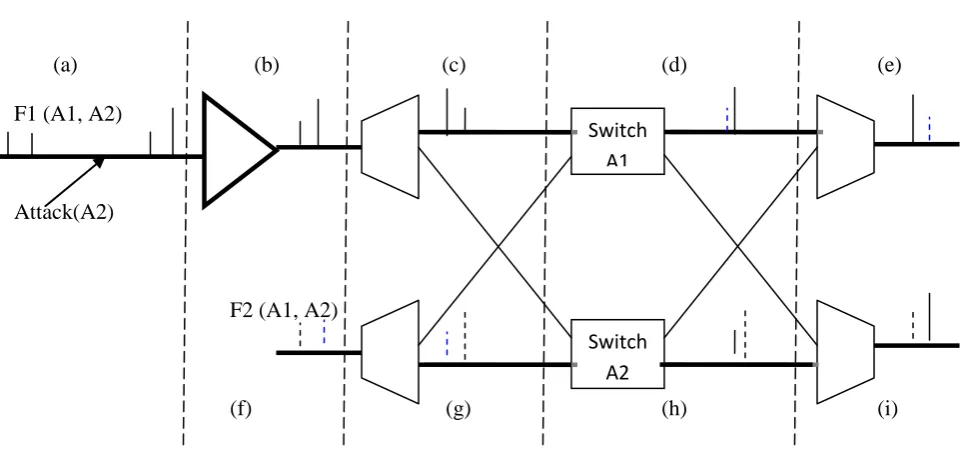
To understand that how failure occur in the network and how error travels in the whole network, an attack scenario has been represented in Fig. 1.In this scenario two data signal and a attack signal passes through the MUX/DEMUX, optical switches and SOA. Power of signal varies at every component that is explained below.
An attacker that can access to the network, as shown in Fig. 1(a), is then able to perform a disturbance by injecting a strong optical signal at wavelength A2, which is already in use. This causes an increase of the optical power at that wavelength and can thus impact other legitimate channels that co propagate at the same time, in the result signal having the high power will propagate through the network for long distance,. When traversing the optical amplifier as shown in Fig. 1(b), channel A2 robs channel A1 of power and propagates downstream through successive AON components, affecting other channels in its route. This type of attack is known as a gain competition attack. Furthermore, the demultiplexers as depicted in Fig. 1(c) and 1(g), ideally separate incoming wavelengths to corresponding switches. The non ideal crosstalk specification of the optical demultiplexer means that a small portion of the signal at channel A1 leaks into the adjacent channel A2 and vice versa. When signal passes through the optical switches as represented in Fig. 1(d) and Fig. 1(h), channels with the same wavelength interfere with each other. This causes crosstalk arising from the non ideal isolation of one switch port from the other. As shown in Fig. 1(e) and 1(i), when the channels are combined again by the multiplexer, a small portion of A1 that leaked into A2 will also leak back into the common output fiber. This also causes crosstalk, which accumulates from several AON components as the signals travels downstream through many intermediate AON nodes in the network. According to whether it has the same nominal wavelength as an affected signal or not, crosstalk can be categorized in two forms, interchannel and intrachannel [3].
eliminated by optical filters or demultiplexers. Intrachannel crosstalk thus imposes an important limitation on practical implementation of AONs [4].
To improve the quality of service (QoS) of all-optical networks, SOA is deployed to increase the total received power and to avoid the crosstalk in the system which is occurred due to the leakage of MUX/DEMUX.
(a)
(b)
(c)
(d)
(e)
F1 (A1, A2)
Attack(A2)
F2 (A1, A2)
(f)
(g)
(h)
(i)
[image:2.595.47.529.139.367.2]Fig. 1 Attack scenario in All-optical network
3.
SEMICONDUCTOR OPTICAL
AMPLIFIER (SOA)
The Semiconductor Optical Amplifier (SOA) is a highly multipurpose component that can be used for a wide range of amplification and routing functions within the telecommunications engineering. The minimal size, integration capability, and strong potential for cost reduction through scaled manufacturing processes will ensure that the SOA plays an gradually more important role in future advanced optical networks. SOAs are the cost-effective solution to implementing optical amplification in advanced optical networking subsystems for core, metro, and ultimately access applications.
An SOA is essentially a laser diode (LD) with no feedback from its input and output ports and hence is also referred to as a Traveling-Wave Amplifier (TWA). SOAs is a multifunctional device and it will be a key building block for future optical networks. There are five Parameters used to characterize SOAs [5]:
Gain (Gs),
Gain Bandwidth,
Saturation Output Power (Psat),
Noise Figure (NF),
Polarization Dependent Gain (PDG)
SOAs can be deployed in classical amplifier roles, as long as the signal levels lie within the linear region of operation. In
recovery time of an SOA is typically of the same order as the data modulation speeds. Thus, in order to ensure linear functionality, the key operating issue is the management of the input power levels so that the SOA is not driven into saturation [6].
A wide optical bandwidth is also needed so that the SOA can amplify a wide range of signal wavelengths. Gain saturation effects introduce unwanted distortion to the output so an ideal SOA should have very high saturation output power to achieve good linearity and to maximize its dynamic range with least amount of distortion.
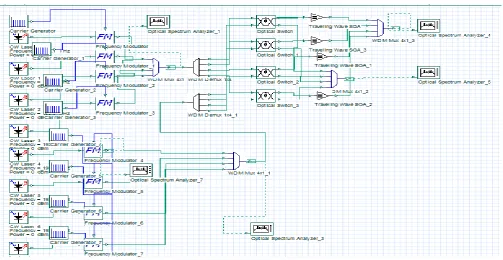
In our experiment, a scheme has been proposed to unite the equalization and amplification into one function module after the switch array. It is planned as shown in Fig. 2.
By comparison with the MWTN scheme [7], the features of our scheme are as follows.
1) Semiconductor optical amplifiers are used to replace the attenuators and output EDFA and to increase the received power.
2) SOA is set before the multiplexer as shown in Fig. 2, the injecting intensity being adjusted to change the gain actively and dynamically.
3) The preset power value is the total value at the detecting point.
The main reasons to use of SOA include its fast gain response
Switch
A1
limitations of its utilization in Wavelength Division Multiplexing (WDM) transmission. While in our project, the SOA only amplifies a single wavelength so that there are no more such problems. Moreover, because the power of the signal is much larger than that of crosstalk wavelengths (leaked from Mux/Demux or switch), it can suppress the unwanted part [8].
4.
EXPERIMENT
To measure the performance system is divided into two systems. In first system SOA is not used and in second system
[image:3.595.56.560.196.456.2]SOA is used after the channel. Experimental setup implemented on optisystem as shown in Fig. 2. Experimental setup consist of a laser array as a source which generate four signals having frequencies 193.1, 193.2, 193.3 and 193.4 THz. After getting the four frequencies two streams of four frequencies are made and pass through the two DEMUXs and then signal is passed through the cross switches. While passing through the MUX/DEMUX signal got affected by crosstalk due to the leakage of MUX/DEMUX. Switches also degrade the signal. Performance of the signal is measured on the basis of their total power, noise and on the basis of the spectrum analyzer that is described in the next section.
Fig. 2 Circuit Diagram implemented in Optisystem
5.
SIMULATION RESULTS
In the previous section two types of system is described, first system was without SOA and second system was with SOA. This section describes the result of experiment explained in previous section. is transmitted first signal is with SOA and the other signal is without SOA. Total received power for first system is shown in Fig. 3. For first system total received power is only 2.682 dBm that is very less. Power for second system in which SOA is used is shown in Fig. 4. SOA increased the received power that is 24.465 dBm. Power received for second system is very large as compared to the first system.
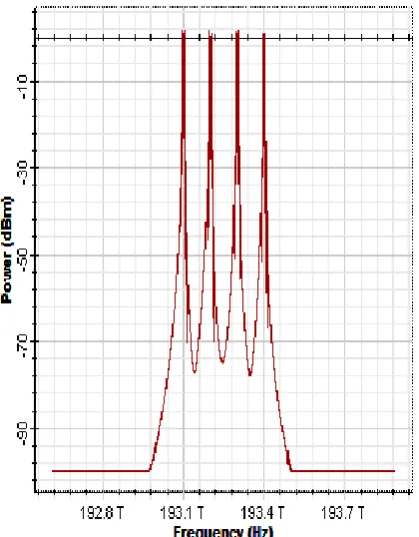
And further the comparison of total received power at different frequencies for both systems is presented in Fig. 5 and Fig. 6, detail of which is further summarized in the tabular form in Table 1.
Fig. 3 Total power of without SOA system
[image:3.595.314.543.593.678.2]Fig. 5 Optical spectrum of system without SOA
Table 1 Power comparison of system without SOA and with SOA
[image:4.595.317.527.72.341.2]The signal power of the second system at four frequencies 193.1, 193.2, 193.3 and 193.4THz is far better than the power of the first system that is without SOA.
Fig. 6 Optical spectrum of system with SOA.
6.
CONCLUSION
Semiconductor optical amplifier (SOA) in optical communication system is used to amplify the total power and it helps in error reduction as it has capability of power equalization. SOA is more immune to noise. This paper exhibits that with a implementation of SOA system gives better performance in terms of not only Power but also it avoids crosstalk. Therefore, SOA can play an important role in optical communication and it can be deployed in classical amplifier roles, as long as the signal levels lie within the linear region of operation.
7.
ACKNOWLEDGMENTS
I would like to thank Gurpartap Singh for their help for the completion of this paper. I am also thankful to my friends for their motivations and help for the completion of this paper.
8.
REFERENCES
[1] R. Rejeb.2004. “Management Issues In Transparent Optical Networks,” 6th IEEE Int’l. Conf. Transparent Opt. Networks, vol. 1, Wroclaw, pp. 248–54.
[2] C. P. Larsen, and P. O. Andersson.2000. “Signal Quality Monitoring in Optical Networks,” Opt. Net. Mag., vol. 1, no. 4, pp. 17–23
[3] R. Rejeb, M. S. Leeson & R. J. Green.2006. “Multiple Attack Localization and Identification in All-Optical Networks,” Opt. Switching and Net., vol. 3, no. 1, pp. 41–49.
[4] R. Rejeb, M. S. Leeson & R. J. Green.2006. “Fault and Attack Management in All-Optical Networks,” IEEE Communications Magazine, pp. 79-86.
Sr. No.
Power at (Frequency)
Power Without SOA (in dBm)
Power With SOA(in dBm)
1 193.1THz -3.31651+000 dBm
1.184394e+001 dBm
2 193.2THz -3.39552+000 dBm
1.184248e+001 dBm
3 193.3THz -3.33733+000 dBm
1.184521e+001 dBm
4 193.4THz -3.30508+000 dBm
[image:4.595.49.282.428.615.2]Amplifier and their role in Advanced Optical Networking, InPhenix, Inc.,
[6] C. Michie, A. E. Kelly, I. Armstrong, I. Andonovic & C. Tombling.2007. “An Adjustable Gain-Clamped Semiconductor Optical Amplifier (AGC-SOA),”Journal of Lightwave Technology, Vol. 25, No. 6, pp. 1466-1473.
[7] J. Zhou and M. J. O’Mahony.1996. “Power management system design of an optical multiwavelength transport
network,” Proc. Inst. Elect. Eng.—Optoelectron., vol. 143, no. 3, pp. 178–188.