0095-1137/11/$12.00
doi:10.1128/JCM.02602-10
Copyright © 2011, American Society for Microbiology. All Rights Reserved.
Web-Accessible Database of
hsp65
Sequences from
Mycobacterium
Reference Strains
䌤
†
Jianli Dai,
1,4* Yuansha Chen,
1,2and Michael Lauzardo
3,4Emerging Pathogens Institute, University of Florida, Gainesville, Florida 32611
1; Department of Pathology, Immunology,
and Laboratory Medicine, College of Medicine, University of Florida, Gainesville, Florida 32610
2;
Southeastern National Tuberculosis Center, Gainesville, Florida 32611
3; and Department of
Medicine, College of Medicine, University of Florida, Gainesville, Florida 32610
4Received 22 December 2010/Returned for modification 26 January 2011/Accepted 18 March 2011
Mycobacteria include a large number of pathogens. Identification to species level is important for diagnoses
and treatments. Here, we report the development of a Web-accessible database of the
hsp65
locus sequences
(http://msis.mycobacteria.info) from 149 out of 150
Mycobacterium
species/subspecies. This database can serve
as a reference for identifying
Mycobacterium
species.
Included among the mycobacteria are a large number of
clinically important pathogens, both obligate (e.g.,
M.
tubercu-losis
and
M. leprae
) and opportunistic (e.g.,
M. avium
,
M.
kan-sasii
, etc.). The impact of mycobacteria on human morbidity
and mortality is hard to overstate. Although tuberculosis (TB)
is arguably one of the most important infectious diseases in the
world, the incidence of disease due to nontuberculous
myco-bacteria (NTM) has been steadily increasing worldwide (6, 27,
42, 48, 59) and has likely far surpassed TB in the United States
(7). Thus, the American Thoracic Society and the Infectious
Diseases Society of America have recommended identifying
the clinically significant NTM to the species level upon the
diagnosis of nontuberculous mycobacterial diseases (17).
The
Mycobacterium
genus currently includes 150
species/sub-species (http://www.bacterio.cict.fr/m/mycobacterium.html), and
the number has been increasing exponentially (Fig. 1), making
identification difficult and challenging. Current identification
based on biochemical tests of culture is slow and inadequate to
differentiate among closely related mycobacteria, especially for
those mycobacteria that are biochemically inert and slowly
growing. In contrast, molecular identification methods based
on PCR and nucleotide sequencing dramatically shorten the
detection time and improve the accuracy of identification. The
most common genomic loci used in molecular identification
are the 16S rRNA gene (25), 16S-23S rRNA internal
tran-scribed spacer (15),
hsp65
(40, 47), and
rpoB
(22). Almost all
recent publications on new mycobacterial species compared
sequences from multiple loci to those of established species,
and
hsp65
is always included. A previous study has shown a
99.1% agreement between identification using
hsp65
sequenc-ing and a conventional method combinsequenc-ing Accuprobes,
bio-chemical test panels, or 16S rRNA gene sequencing (33),
sug-gesting that
hsp65
sequencing is an effective method for
identifying mycobacterial species. It was also suggested that
completeness of the sequence database was critical for this
identification method (33). To our knowledge, there is no
publicly accessible
hsp65
sequence database that covers all
currently validated mycobacterial species. Laboratorians and
researchers have to rely on the sequences deposited in public
databases, such as GenBank, EMBL, and DDBJ. The vast
majority of these mycobacterial entries are from
uncharacter-ized strains or undetermined species, and problematic
se-quence entries, such as base errors, incomplete sese-quences,
invalid or misidentified species, and even species-strain
mis-matches, are frequently present. This makes identification by
searching public databases onerous and error prone. To
facil-itate the taxonomic identification of mycobacterial isolates, we
have developed a Web-accessible database of mycobacterial
hsp65
sequences from 149 species/subspecies, excluding the
problematic GenBank entries mentioned above.
The type strain
hsp65
sequences of 147 mycobacterial
spe-cies/subspecies were downloaded from GenBank.
M.
lepraemu-rium
and
M. leprae
do not have type strains due to difficult
cultivation. We chose
M. lepraemurium
TS130 and
M. leprae
TN as their reference strains and obtained their
hsp65
se-quences with the GenBank sequence accession numbers
AY550232 (34) and NC_002677 (11). Multiple identical
GenBank sequences from the type strain of the same species were
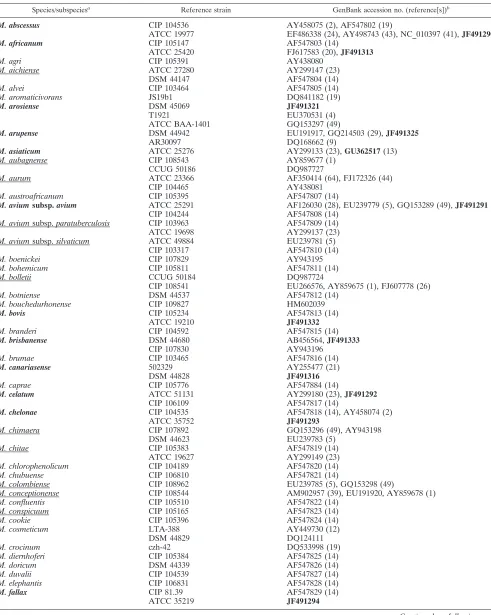
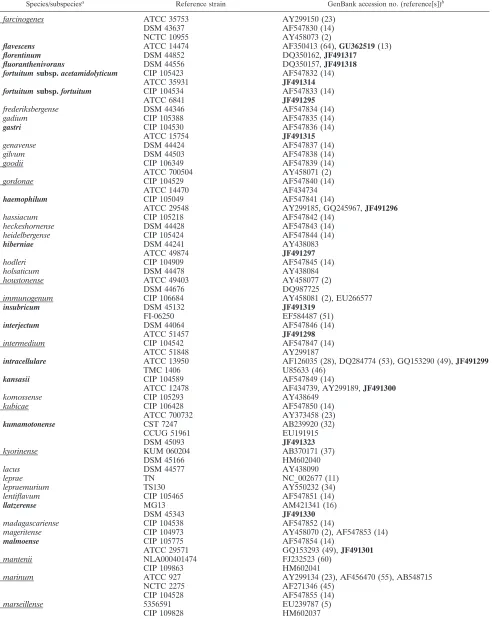
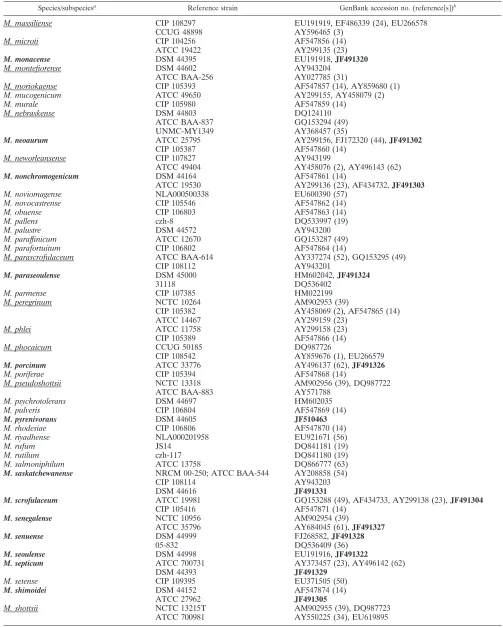
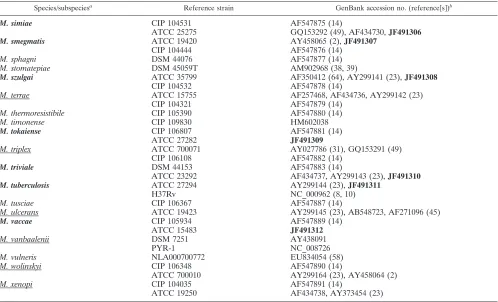
combined into a single entry in our database (Table 1). We
trimmed the sequences to 401 bp, which corresponds to
nucle-otide positions 165 to 565 of the
M. tuberculosis
H37Rv
hsp65
* Corresponding author. Mailing address: 2055 Mowry Rd., Rm.
275, Gainesville, FL 32611. Phone: (352) 9429. Fax: (352)
273-9430. E-mail: [email protected].
† Supplemental material for this article may be found at http://jcm
.asm.org/.
䌤
Published ahead of print on 30 March 2011.
from 1896 to 2010.
FIG. 1. Numbers of approved
Mycobacterium
species/subspecies
on May 16, 2020 by guest
http://jcm.asm.org/
[image:1.585.334.507.596.705.2]Species/subspeciesa Reference strain GenBank accession no. (reference关s兴)b
M. abscessus
CIP 104536
AY458075 (2), AF547802 (19)
ATCC 19977
EF486338 (24), AY498743 (43), NC_010397 (41),
JF491290
M. africanum
CIP 105147
AF547803 (14)
ATCC 25420
FJ617583 (20),
JF491313
M. agri
CIP 105391
AY438080
M. aichiense
ATCC 27280
AY299147 (23)
DSM 44147
AF547804 (14)
M. alvei
CIP 103464
AF547805 (14)
M. aromaticivorans
JS19b1
DQ841182 (19)
M. arosiense
DSM 45069
JF491321
T1921
EU370531 (4)
ATCC BAA-1401
GQ153297 (49)
M. arupense
DSM 44942
EU191917, GQ214503 (29),
JF491325
AR30097
DQ168662 (9)
M. asiaticum
ATCC 25276
AY299133 (23),
GU362517
(13)
M. aubagnense
CIP 108543
AY859677 (1)
CCUG 50186
DQ987727
M. aurum
ATCC 23366
AF350414 (64), FJ172326 (44)
CIP 104465
AY438081
M. austroafricanum
CIP 105395
AF547807 (14)
M. avium
subsp.
avium
ATCC 25291
AF126030 (28), EU239779 (5), GQ153289 (49),
JF491291
CIP 104244
AF547808 (14)
M. avium
subsp.
paratuberculosis
CIP 103963
AF547809 (14)
ATCC 19698
AY299137 (23)
M. avium
subsp.
silvaticum
ATCC 49884
EU239781 (5)
CIP 103317
AF547810 (14)
M. boenickei
CIP 107829
AY943195
M. bohemicum
CIP 105811
AF547811 (14)
M. bolletii
CCUG 50184
DQ987724
CIP 108541
EU266576, AY859675 (1), FJ607778 (26)
M. botniense
DSM 44537
AF547812 (14)
M. bouchedurhonense
CIP 109827
HM602039
M. bovis
CIP 105234
AF547813 (14)
ATCC 19210
JF491332
M. branderi
CIP 104592
AF547815 (14)
M. brisbanense
DSM 44680
AB456564,
JF491333
CIP 107830
AY943196
M. brumae
CIP 103465
AF547816 (14)
M. canariasense
502329
AY255477 (21)
DSM 44828
JF491316
M. caprae
CIP 105776
AF547884 (14)
M. celatum
ATCC 51131
AY299180 (23),
JF491292
CIP 106109
AF547817 (14)
M. chelonae
CIP 104535
AF547818 (14), AY458074 (2)
ATCC 35752
JF491293
M. chimaera
CIP 107892
GQ153296 (49), AY943198
DSM 44623
EU239783 (5)
M. chitae
CIP 105383
AF547819 (14)
ATCC 19627
AY299149 (23)
M. chlorophenolicum
CIP 104189
AF547820 (14)
M. chubuense
CIP 106810
AF547821 (14)
M. colombiense
CIP 108962
EU239785 (5), GQ153298 (49)
M. conceptionense
CIP 108544
AM902957 (39), EU191920, AY859678 (1)
M. confluentis
CIP 105510
AF547822 (14)
M. conspicuum
CIP 105165
AF547823 (14)
M. cookie
CIP 105396
AF547824 (14)
M. cosmeticum
LTA-388
AY449730 (12)
DSM 44829
DQ124111
M. crocinum
czh-42
DQ533998 (19)
M. diernhoferi
CIP 105384
AF547825 (14)
M. doricum
DSM 44339
AF547826 (14)
M. duvalii
CIP 104539
AF547827 (14)
M. elephantis
CIP 106831
AF547828 (14)
M. fallax
CIP 81.39
AF547829 (14)
ATCC 35219
JF491294
Continued on following page
on May 16, 2020 by guest
http://jcm.asm.org/
[image:2.585.45.536.88.703.2]TABLE 1—
Continued
Species/subspeciesa
Reference strain GenBank accession no. (reference关s兴)b
M. farcinogenes
ATCC 35753
AY299150 (23)
DSM 43637
AF547830 (14)
NCTC 10955
AY458073 (2)
M. flavescens
ATCC 14474
AF350413 (64),
GU362519
(13)
M. florentinum
DSM 44852
DQ350162,
JF491317
M. fluoranthenivorans
DSM 44556
DQ350157,
JF491318
M. fortuitum
subsp.
acetamidolyticum
CIP 105423
AF547832 (14)
ATCC 35931
JF491314
M. fortuitum
subsp.
fortuitum
CIP 104534
AF547833 (14)
ATCC 6841
JF491295
M. frederiksbergense
DSM 44346
AF547834 (14)
M. gadium
CIP 105388
AF547835 (14)
M. gastri
CIP 104530
AF547836 (14)
ATCC 15754
JF491315
M. genavense
DSM 44424
AF547837 (14)
M. gilvum
DSM 44503
AF547838 (14)
M. goodii
CIP 106349
AF547839 (14)
ATCC 700504
AY458071 (2)
M. gordonae
CIP 104529
AF547840 (14)
ATCC 14470
AF434734
M. haemophilum
CIP 105049
AF547841 (14)
ATCC 29548
AY299185, GQ245967,
JF491296
M. hassiacum
CIP 105218
AF547842 (14)
M. heckeshornense
DSM 44428
AF547843 (14)
M. heidelbergense
CIP 105424
AF547844 (14)
M. hiberniae
DSM 44241
AY438083
ATCC 49874
JF491297
M. hodleri
CIP 104909
AF547845 (14)
M. holsaticum
DSM 44478
AY438084
M. houstonense
ATCC 49403
AY458077 (2)
DSM 44676
DQ987725
M. immunogenum
CIP 106684
AY458081 (2), EU266577
M. insubricum
DSM 45132
JF491319
FI-06250
EF584487 (51)
M. interjectum
DSM 44064
AF547846 (14)
ATCC 51457
JF491298
M. intermedium
CIP 104542
AF547847 (14)
ATCC 51848
AY299187
M. intracellulare
ATCC 13950
AF126035 (28), DQ284774 (53), GQ153290 (49),
JF491299
TMC 1406
U85633 (46)
M. kansasii
CIP 104589
AF547849 (14)
ATCC 12478
AF434739, AY299189,
JF491300
M. komossense
CIP 105293
AY438649
M. kubicae
CIP 106428
AF547850 (14)
ATCC 700732
AY373458 (23)
M. kumamotonense
CST 7247
AB239920 (32)
CCUG 51961
EU191915
DSM 45093
JF491323
M. kyorinense
KUM 060204
AB370171 (37)
DSM 45166
HM602040
M. lacus
DSM 44577
AY438090
M. leprae
TN
NC_002677 (11)
M. lepraemurium
TS130
AY550232 (34)
M. lentiflavum
CIP 105465
AF547851 (14)
M. llatzerense
MG13
AM421341 (16)
DSM 45343
JF491330
M. madagascariense
CIP 104538
AF547852 (14)
M. mageritense
CIP 104973
AY458070 (2), AF547853 (14)
M. malmoense
CIP 105775
AF547854 (14)
ATCC 29571
GQ153293 (49),
JF491301
M. mantenii
NLA000401474
FJ232523 (60)
CIP 109863
HM602041
M. marinum
ATCC 927
AY299134 (23), AF456470 (55), AB548715
NCTC 2275
AF271346 (45)
CIP 104528
AF547855 (14)
M. marseillense
5356591
EU239787 (5)
CIP 109828
HM602037
on May 16, 2020 by guest
http://jcm.asm.org/
M. massiliense
CIP 108297
EU191919, EF486339 (24), EU266578
CCUG 48898
AY596465 (3)
M. microti
CIP 104256
AF547856 (14)
ATCC 19422
AY299135 (23)
M. monacense
DSM 44395
EU191918,
JF491320
M. montefiorense
DSM 44602
AY943204
ATCC BAA-256
AY027785 (31)
M. moriokaense
CIP 105393
AF547857 (14), AY859680 (1)
M. mucogenicum
ATCC 49650
AY299155, AY458079 (2)
M. murale
CIP 105980
AF547859 (14)
M. nebraskense
DSM 44803
DQ124110
ATCC BAA-837
GQ153294 (49)
UNMC-MY1349
AY368457 (35)
M. neoaurum
ATCC 25795
AY299156, FJ172320 (44),
JF491302
CIP 105387
AF547860 (14)
M. neworleansense
CIP 107827
AY943199
ATCC 49404
AY458076 (2), AY496143 (62)
M. nonchromogenicum
DSM 44164
AF547861 (14)
ATCC 19530
AY299136 (23), AF434732,
JF491303
M. noviomagense
NLA000500338
EU600390 (57)
M. novocastrense
CIP 105546
AF547862 (14)
M. obuense
CIP 106803
AF547863 (14)
M. pallens
czh-8
DQ533997 (19)
M. palustre
DSM 44572
AY943200
M. paraffinicum
ATCC 12670
GQ153287 (49)
M. parafortuitum
CIP 106802
AF547864 (14)
M. parascrofulaceum
ATCC BAA-614
AY337274 (52), GQ153295 (49)
CIP 108112
AY943201
M. paraseoulense
DSM 45000
HM602042,
JF491324
31118
DQ536402
M. parmense
CIP 107385
HM022199
M. peregrinum
NCTC 10264
AM902953 (39)
CIP 105382
AY458069 (2), AF547865 (14)
ATCC 14467
AY299159 (23)
M. phlei
ATCC 11758
AY299158 (23)
CIP 105389
AF547866 (14)
M. phocaicum
CCUG 50185
DQ987726
CIP 108542
AY859676 (1), EU266579
M. porcinum
ATCC 33776
AY496137 (62),
JF491326
M. poriferae
CIP 105394
AF547868 (14)
M. pseudoshottsii
NCTC 13318
AM902956 (39), DQ987722
ATCC BAA-883
AY571788
M. psychrotolerans
DSM 44697
HM602035
M. pulveris
CIP 106804
AF547869 (14)
M. pyrenivorans
DSM 44605
JF510463
M. rhodesiae
CIP 106806
AF547870 (14)
M. riyadhense
NLA000201958
EU921671 (56)
M. rufum
JS14
DQ841181 (19)
M. rutilum
czh-117
DQ841180 (19)
M. salmoniphilum
ATCC 13758
DQ866777 (63)
M. saskatchewanense
NRCM 00-250; ATCC BAA-544
AY208858 (54)
CIP 108114
AY943203
DSM 44616
JF491331
M. scrofulaceum
ATCC 19981
GQ153288 (49), AF434733, AY299138 (23),
JF491304
CIP 105416
AF547871 (14)
M. senegalense
NCTC 10956
AM902954 (39)
ATCC 35796
AY684045 (61),
JF491327
M. senuense
DSM 44999
FJ268582,
JF491328
05-832
DQ536409 (36)
M. seoulense
DSM 44998
EU191916,
JF491322
M. septicum
ATCC 700731
AY373457 (23), AY496142 (62)
DSM 44393
JF491329
M. setense
CIP 109395
EU371505 (50)
M. shimoidei
DSM 44152
AF547874 (14)
ATCC 27962
JF491305
M. shottsii
NCTC 13215T
AM902955 (39), DQ987723
ATCC 700981
AY550225 (34), EU619895
Continued on following page
on May 16, 2020 by guest
http://jcm.asm.org/
[image:4.585.39.542.81.708.2]gene and can be amplified and sequenced using primers Tb11
and Tb12 (47). Entries that did not completely cover this
401-bp
hsp65
locus were excluded from our database. Using
previously described methods (13), we determined and verified
47
hsp65
sequences and submitted them to GenBank (bold
accession numbers in Table 1). As a result of our verification,
the incorrect sequences from
M. asiaticum
,
M. flavescens
,
M.
intracellulare
,
M. porcinum
,
M. senegalense
,
M. septicum
, and
M.
szulgai
in GenBank were excluded from our database, and only
verified sequences of these species were adopted. Sequence
similarities were determined by MEGA 5.02 (http://www
.megasoftware.net/). Currently, there are a total of 143 unique
sequences from 149 species/subspecies in this database.
Iden-tical sequences are found among the three
M. avium
subspe-cies, between two
M. fortuitum
subspecies, and among four
M.
tuberculosis
complex members (i.e.,
M. bovis
,
M. caprae
,
M.
microti
, and
M. tuberculosis
). A BLAST server based on this
database has been developed (http://msis.mycobacteria.info).
Query sequences are accepted in FASTA format by copying
and pasting or file uploading and then searched against the
database using NCBI’s BLASTN program. The output results
will show 20 best hits to suggest their taxonomic categories at
species level. The pairwise alignments and the percentages of
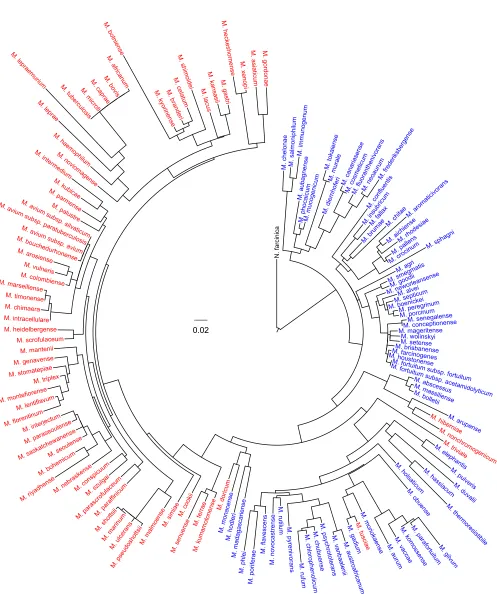
identities are shown in the results as well. PhyML 3.0 (18) was
used to generated a maximum-likelihood phylogeny of these
149
Mycobacterium
species/subspecies (Fig. 2) that is the most
complete so far, covering 99.3% of the
Mycobacterium
genus
(the only missing species is
M. pinnipedii
, an
M. tuberculosis
complex member). Slowly growing mycobacteria (SGM) and
rapidly growing mycobacteria (RGM) are clearly separated,
except that the slowly growing
M. tusciae
,
M. hiberniae
,
M.
nonchromogenicum
, and
M. triviale
are grouped with the RGM.
The popularity of species identification using
hsp65
se-quences has resulted in a large number of mycobacterial
hsp65
sequences being deposited in public repositories. McNabb et
al. also developed an in-house database, including 111
Myco-bacterium
species (34). The accuracy and coverage are crucial
for the database to become a viable solution for species
iden-tification. Here, we report a publicly accessible
hsp65
database
with 99.3% coverage of the entire
Mycobacterium
genus, of
which 47 species/subspecies have been verified in our
labora-tory (boldface in Table 1) and 40 entries are supported by
multiple GenBank sequences and thus are considered
con-firmed sequences (underlined in Table 1). A 97% identity was
previously suggested as a criterion for identifying a species
using
hsp65
sequences (34). However, pairwise comparison of
[image:5.585.43.541.81.383.2]these 149 species identified 219, 121, and 45 instances of
se-quence similarity greater than 97%, 98%, and 99%, involving
94 (63.1%), 82 (55.0%), and 42 (28.2%) species/subspecies,
respectively (see the table in the supplemental material). This
makes the identification of species with less than 100%
matches challenging. Because the interspecies similarities vary
from group to group in the phylogeny and change as the
num-ber of species/subspecies increases, investigators need to be
TABLE 1—
Continued
Species/subspeciesa
Reference strain GenBank accession no. (reference关s兴)b
M. simiae
CIP 104531
AF547875 (14)
ATCC 25275
GQ153292 (49), AF434730,
JF491306
M. smegmatis
ATCC 19420
AY458065 (2),
JF491307
CIP 104444
AF547876 (14)
M. sphagni
DSM 44076
AF547877 (14)
M. stomatepiae
DSM 45059T
AM902968 (38, 39)
M. szulgai
ATCC 35799
AF350412 (64), AY299141 (23),
JF491308
CIP 104532
AF547878 (14)
M. terrae
ATCC 15755
AF257468, AF434736, AY299142 (23)
CIP 104321
AF547879 (14)
M. thermoresistibile
CIP 105390
AF547880 (14)
M. timonense
CIP 109830
HM602038
M. tokaiense
CIP 106807
AF547881 (14)
ATCC 27282
JF491309
M. triplex
ATCC 700071
AY027786 (31), GQ153291 (49)
CIP 106108
AF547882 (14)
M. triviale
DSM 44153
AF547883 (14)
ATCC 23292
AF434737, AY299143 (23),
JF491310
M. tuberculosis
ATCC 27294
AY299144 (23),
JF491311
H37Rv
NC_000962 (8, 10)
M. tusciae
CIP 106367
AF547887 (14)
M. ulcerans
ATCC 19423
AY299145 (23), AB548723, AF271096 (45)
M. vaccae
CIP 105934
AF547889 (14)
ATCC 15483
JF491312
M. vanbaalenii
DSM 7251
AY438091
PYR-1
NC_008726
M. vulneris
NLA000700772
EU834054 (58)
M. wolinskyi
CIP 106348
AF547890 (14)
ATCC 700010
AY299164 (23), AY458064 (2)
M. xenopi
CIP 104035
AF547891 (14)
ATCC 19250
AF434738, AY373454 (23)
aThe sequences of 47 species/subspecies (boldface) were validated by our laboratory. The sequences of 40 species/subspecies (underlined) are supported by multiple
GenBank records deposited by other research groups.
bAccession numbers in bold are for sequences determined in our laboratory.
on May 16, 2020 by guest
http://jcm.asm.org/
FIG. 2. Maximum-likelihood phylogeny of
Mycobacterium
genus. PhyML 3.0 with default settings (18) and iTOL (30) were used to generate
the circular phylogenic tree rooted with
Nocardia farcinica
(strain IFM 10152). Rapidly growing mycobacteria are in blue, while slowly growing
mycobacteria are in red. The scale bar is equivalent to 0.02 substitution/site.
on May 16, 2020 by guest
http://jcm.asm.org/
cautious when assigning species/subspecies for these isolates.
Further research is needed to establish a more reliable
crite-rion and validate our database with clinical and environmental
isolates. Nevertheless, our database provides the most
compre-hensive phylogenetic information on the mycobacterial
hsp65
locus that can facilitate species identification in this genus.
We thank Jack Crawford for thoughtful suggestions and helpful
comments.
REFERENCES
1.Adekambi, T., P. Berger, D. Raoult, and M. Drancourt.2006.rpoBgene sequence-based characterization of emerging non-tuberculous mycobacteria with descriptions ofMycobacterium bolletiisp. nov.,Mycobacterium phocai-cumsp. nov. and Mycobacterium aubagnensesp. nov. Int. J. Syst. Evol. Microbiol.56:133–143.
2.Adekambi, T., and M. Drancourt.2004. Dissection of phylogenetic relation-ships among 19 rapidly growingMycobacteriumspecies by 16S rRNA,hsp65,
sodA,recAandrpoBgene sequencing. Int. J. Syst. Evol. Microbiol.54:2095– 2105.
3.Adekambi, T., et al.2004. Amoebal coculture of “Mycobacterium massiliense” sp. nov. from the sputum of a patient with hemoptoic pneumonia. J. Clin. Microbiol.42:5493–5501.
4.Bang, D., et al.2008.Mycobacterium arosiensesp. nov., a slowly growing, scotochromogenic species causing osteomyelitis in an immunocompromised child. Int. J. Syst. Evol. Microbiol.58:2398–2402.
5.Ben Salah, I., T. Adekambi, D. Raoult, and M. Drancourt. 2008.rpoB
sequence-based identification ofMycobacterium aviumcomplex species. Mi-crobiology154:3715–3723.
6.Bodle, E. E., J. A. Cunningham, P. Della-Latta, N. W. Schluger, and L. Saiman.2008. Epidemiology of nontuberculous mycobacteria in patients without HIV infection, New York City. Emerg. Infect. Dis.14:390–396. 7.Butler, W. R., and J. T. Crawford.1999. Nontuberculous mycobacteria
re-ported to the public health laboratory information system by state public health laboratories, United States, 1993–1996. Centers for Disease Control and Prevention, Atlanta, GA.
8.Camus, J. C., M. J. Pryor, C. Medigue, and S. T. Cole.2002. Re-annotation of the genome sequence ofMycobacterium tuberculosisH37Rv. Microbiology 148:2967–2973.
9.Cloud, J. L., et al.2006.Mycobacterium arupensesp. nov., a non-chromogenic bacterium isolated from clinical specimens. Int. J. Syst. Evol. Microbiol. 56:1413–1418.
10.Cole, S. T., et al.1998. Deciphering the biology ofMycobacterium tuberculosis
from the complete genome sequence. Nature393:537–544.
11.Cole, S. T., et al.2001. Massive gene decay in the leprosy bacillus. Nature 409:1007–1011.
12.Cooksey, R. C., et al.2004.Mycobacterium cosmeticumsp. nov., a novel rapidly growing species isolated from a cosmetic infection and from a nail salon. Int. J. Syst. Evol. Microbiol.54:2385–2391.
13.Dai, J., et al.2011. Multiple-genome comparison reveals new loci for Myco-bacteriumspecies identification. J. Clin. Microbiol.49:144–153.
14.Devulder, G., M. Perouse de Montclos, and J. P. Flandrois.2005. A multi-gene approach to phylomulti-genetic analysis using the genusMycobacteriumas a model. Int. J. Syst. Evol. Microbiol.55:293–302.
15.Frothingham, R., and K. H. Wilson.1993. Sequence-based differentiation of strains in theMycobacterium aviumcomplex. J. Bacteriol.175:2818–2825. 16.Gomila, M., A. Ramirez, and J. Lalucat.2007. Diversity of environmental
Mycobacteriumisolates from hemodialysis water as shown by a multigene sequencing approach. Appl. Environ. Microbiol.73:3787–3797.
17.Griffith, D. E., et al. 2007. An official ATS/IDSA statement: diagnosis, treatment, and prevention of nontuberculous mycobacterial diseases. Am. J. Respir. Crit. Care Med.175:367–416.
18.Guindon, S., et al.2010. New algorithms and methods to estimate maximum-likelihood phylogenies: assessing the performance of PhyML 3.0. Syst. Biol. 59:307–321.
19.Hennessee, C. T., J. S. Seo, A. M. Alvarez, and Q. X. Li.2009. Polycyclic aromatic hydrocarbon-degrading species isolated from Hawaiian soils: My-cobacterium crocinumsp. nov.,Mycobacterium pallenssp. nov., Mycobacte-rium rutilumsp. nov.,Mycobacterium rufumsp. nov. and Mycobacterium aromaticivoranssp. nov. Int. J. Syst. Evol. Microbiol.59:378–387. 20.Huard, R. C., et al.2006. Novel genetic polymorphisms that further delineate
the phylogeny of theMycobacterium tuberculosiscomplex. J. Bacteriol.188: 4271–4287.
21.Jimenez, M. S., et al.2004.Mycobacterium canariasensesp. nov. Int. J. Syst. Evol. Microbiol.54:1729–1734.
22.Kim, B. J., et al.1999. Identification of mycobacterial species by comparative sequence analysis of the RNA polymerase gene (rpoB). J. Clin. Microbiol. 37:1714–1720.
the heat-shock protein 65 gene (hsp65). Int. J. Syst. Evol. Microbiol.55: 1649–1656.
24.Kim, H. Y., et al.2007. Outbreak ofMycobacterium massilienseinfection associated with intramuscular injections. J. Clin. Microbiol.45:3127–3130. 25.Kirschner, P., and E. C. Bottger.1998. Species identification of mycobacteria
using rDNA sequencing. Methods Mol. Biol.101:349–361.
26.Koh, W. J., et al.2009. First case of disseminatedMycobacterium bolletii
infection in a young adult patient. J. Clin. Microbiol.47:3362–3366. 27.Lai, C. C., et al.2010. Increasing incidence of nontuberculous mycobacteria,
Taiwan, 2000-2008. Emerg. Infect. Dis.16:294–296.
28.Leao, S. C., et al.1999. Identification of two novelMycobacterium avium
allelic variants in pig and human isolates from Brazil by PCR-restriction enzyme analysis. J. Clin. Microbiol.37:2592–2597.
29.Lee, H., et al.2010.Mycobacterium paraterrae sp. nov. recovered from a clinical specimen: novel chromogenic slow growing mycobacteria related to
Mycobacterium terraecomplex. Microbiol. Immunol.54:46–53.
30.Letunic, I., and P. Bork.2007. Interactive Tree Of Life (iTOL): an online tool for phylogenetic tree display and annotation. Bioinformatics23:127– 128.
31.Levi, M. H., et al.2003. Characterization ofMycobacterium montefiorensesp. nov., a novel pathogenicMycobacteriumfrom moray eels that is related to
Mycobacterium triplex. J. Clin. Microbiol.41:2147–2152.
32.Masaki, T., et al.2006.Mycobacterium kumamotonensesp. nov. recovered from clinical specimen and the first isolation report ofMycobacterium arupensein Japan: novel slowly growing, nonchromogenic clinical isolates related toMycobacterium terraecomplex. Microbiol. Immunol.50:889– 897.
33.McNabb, A., K. Adie, M. Rodrigues, W. A. Black, and J. Isaac-Renton.2006. Direct identification of mycobacteria in primary liquid detection media by partial sequencing of the 65-kilodalton heat shock protein gene. J. Clin. Microbiol.44:60–66.
34.McNabb, A., et al.2004. Assessment of partial sequencing of the 65-kilodal-ton heat shock protein gene (hsp65) for routine identification of Mycobac-teriumspecies isolated from clinical sources. J. Clin. Microbiol.42:3000– 3011.
35.Mohamed, A. M., P. C. Iwen, S. Tarantolo, and S. H. Hinrichs.2004.
Mycobacterium nebraskensesp. nov., a novel slowly growing scotochromoge-nic species. Int. J. Syst. Evol. Microbiol.54:2057–2060.
36.Mun, H. S., et al.2008.Mycobacterium senuensesp. nov., a slowly growing, non-chromogenic species closely related to theMycobacterium terrae com-plex. Int. J. Syst. Evol. Microbiol.58:641–646.
37.Okazaki, M., et al.2009.Mycobacterium kyorinensesp. nov., a novel, slow-growing species, related toMycobacterium celatum, isolated from human clinical specimens. Int. J. Syst. Evol. Microbiol.59:1336–1341.
38.Pourahmad, F., et al.2008.Mycobacterium stomatepiaesp. nov., a slowly growing, non-chromogenic species isolated from fish. Int. J. Syst. Evol. Mi-crobiol.58:2821–2827.
39.Pourahmad, F., K. D. Thompson, A. Adams, and R. H. Richards.2009. Comparative evaluation of polymerase chain reaction-restriction enzyme analysis (PRA) and sequencing of heat shock protein 65 (hsp65) gene for identification of aquatic mycobacteria. J. Microbiol. Methods76:128–135. 40.Ringuet, H., et al.1999.hsp65sequencing for identification of rapidly
grow-ing mycobacteria. J. Clin. Microbiol.37:852–857.
41.Ripoll, F., et al.2009. Non mycobacterial virulence genes in the genome of the emerging pathogenMycobacterium abscessus. PLoS One4:e5660. 42.Ryoo, S. W., et al.2008. Spread of nontuberculous mycobacteria from 1993
to 2006 in Koreans. J. Clin. Lab. Anal.22:415–420.
43.Selvaraju, S. B., I. U. Khan, and J. S. Yadav.2005. A new method for species identification and differentiation ofMycobacterium chelonae com-plex based on amplifiedhsp65restriction analysis (AHSPRA). Mol. Cell. Probes19:93–99.
44.Simmon, K. E., Y. Y. Low, B. A. Brown-Elliott, R. J. Wallace, Jr., and C. A. Petti.2009. Phylogenetic analysis ofMycobacterium aurumand Mycobacte-rium neoaurumwith redescription ofM. aurumculture collection strains. Int. J. Syst. Evol. Microbiol59:1371–1375.
45.Stinear, T. P., G. A. Jenkin, P. D. Johnson, and J. K. Davies.2000. Com-parative genetic analysis ofMycobacterium ulceransandMycobacterium ma-rinumreveals evidence of recent divergence. J. Bacteriol.182:6322–6330. 46.Swanson, D. S., et al.1997. Subspecific differentiation ofMycobacterium
aviumcomplex strains by automated sequencing of a region of the gene (hsp65) encoding a 65-kilodalton heat shock protein. Int. J. Syst. Bacteriol. 47:414–419.
47.Telenti, A., et al.1993. Rapid identification of mycobacteria to the species level by polymerase chain reaction and restriction enzyme analysis. J. Clin. Microbiol.31:175–178.
48.Thomson, R. M., NTM working group at Queensland TB Control Centre, and Queensland Mycobacterial Reference Laboratory.2010. Changing epi-demiology of pulmonary nontuberculous mycobacteria infections. Emerg. Infect. Dis.16:1576–1583.
49.Toney, N., T. Adekambi, S. Toney, M. Yakrus, and W. R. Butler.2010.
on May 16, 2020 by guest
http://jcm.asm.org/
Mycobacterium setenseinfection in humans. Emerg. Infect. Dis.14:1330– 1332.
51.Tortoli, E., et al.2009.Mycobacterium insubricumsp. nov. Int. J. Syst. Evol. Microbiol.59:1518–1523.
52.Turenne, C. Y., et al.2004.Mycobacterium parascrofulaceumsp. nov., novel slowly growing, scotochromogenic clinical isolates related toMycobacterium simiae. Int. J. Syst. Evol. Microbiol.54:1543–1551.
53.Turenne, C. Y., M. Semret, D. V. Cousins, D. M. Collins, and M. A. Behr. 2006. Sequencing ofhsp65distinguishes among subsets of theMycobacterium aviumcomplex. J. Clin. Microbiol.44:433–440.
54.Turenne, C. Y., et al.2004.Mycobacterium saskatchewanensesp. nov., a novel slowly growing scotochromogenic species from human clinical isolates re-lated toMycobacterium interjectumand Accuprobe-positive for Mycobacte-rium aviumcomplex. Int. J. Syst. Evol. Microbiol.54:659–667.
55.Ucko, M., et al.2002. Strain variation inMycobacterium marinumfish iso-lates. Appl. Environ. microbiol.68:5281–5287.
56.van Ingen, J., et al.2009.Mycobacterium riyadhensesp. nov., a non-tubercu-lous species identified asMycobacterium tuberculosiscomplex by a commer-cial line-probe assay. Int. J. Syst. Evol. Microbiol.59:1049–1053. 57.van Ingen, J., et al. 2009.Mycobacterium noviomagensesp. nov.; clinical
relevance evaluated in 17 patients. Int. J. Syst. Evol. Microbiol.59:845–849.
59.van Ingen, J., W. Hoefsloot, P. N. Dekhuijzen, M. J. Boeree, and D. van Soolingen.2010. The changing pattern of clinicalMycobacterium avium iso-lation in the Netherlands. Int. J. Tuberc. Lung Dis.14:1176–1180. 60.van Ingen, J., et al.2009.Mycobacterium manteniisp. nov., a pathogenic,
slowly growing, scotochromogenic species. Int. J. Syst. Evol. Microbiol.59: 2782–2787.
61.Wallace, R. J., Jr., et al.2005. Polyphasic characterization reveals that the human pathogenMycobacterium peregrinumtype II belongs to the bovine pathogen speciesMycobacterium senegalense. J. Clin. Microbiol.43:5925– 5935.
62.Wallace, R. J., Jr., et al.2004. Clinical and laboratory features of Mycobac-terium porcinum. J. Clin. Microbiol.42:5689–5697.
63.Whipps, C. M., W. R. Butler, F. Pourahmad, V. G. Watral, and M. L. Kent. 2007. Molecular systematics support the revival of Mycobacterium sal-moniphilum(ex Ross 1960) sp. nov., nom. rev., a species closely related to
Mycobacterium chelonae. Int. J. Syst. Evol. Microbiol.57:2525–2531. 64.Wong, D. A., P. C. Yip, D. T. Cheung, and K. M. Kam.2001. Simple and
rational approach to the identification ofMycobacterium tuberculosis, Myco-bacterium aviumcomplex species, and other commonly isolated mycobacte-ria. J. Clin. Microbiol.39:3768–3771.