Exploiting Arabic Diacritization for High Quality Automatic Annotation
Nizar Habash, Anas Shahrour, Muhamed Al-Khalil
Computational Approaches to Modeling Language LabNew York University Abu Dhabi, UAE
{nizar.habash,anas.shahrour,muhamed.alkhalil}@nyu.edu
Abstract
We present a novel technique for Arabic morphological annotation. The technique utilizes diacritization to produce morphological annotations of quality comparable to human annotators. Although Arabic text is generally written without diacritics, diacritization is already available for large corpora of Arabic text in several genres. Furthermore, diacritization can be generated at a low cost for new text as it does not require specialized training beyond what educated Arabic typists know. The basic approach is to enrich the input to a state-of-the-art Arabic morphological analyzer with word diacritics (full or partial) to enhance its performance. When applied to fully diacritized text, our approach produces annotations with an accuracy of over 97% on lemma, part-of-speech, and tokenization combined.
Keywords:Arabic, Morphology, Annotation, Diacritization
1.
Introduction
The automatic processing of the Arabic language is chal-lenging for a number of reasons. Two inter-related reasons are Arabic’s complex morphology and its diacritic-optional orthography (Habash, 2010). This combination leads to the high number of about 12.8 possible analyses per word out of context (Shahrour et al., 2015). Much research has been done on Arabic morphological disambiguation and automatic diacritization. Most of this work relies on ex-isting morphologically annotated (i.e., contextually disam-biguated) corpora. Some researchers interested only in di-acritization also use diacritized corpora. The morphologi-cally annotated corpora for Arabic are limited by size and genre. This is because the cost of creating such corpora is prohibitive as time and money must be dedicated to collect data, create guidelines, hire and train annotators, and con-tinuously evaluate the quality of the annotations.
In this paper we explore an alternative approach to Ara-bic morphological annotation: we exploit fully diacritized text to rerank the morphological analyses of a state-of-the-art morphological tagger that expects no diacritics as input and provides not only part-of-speech, morphological fea-tures and lemmas, but also diacritizations. We evaluate and analyze the accuracy of this method in generating high quality morphologically analyzed corpora that can them-selves be used for improving tools for Arabic processing, especially for less studied genres. The approach relying solely on diacritization is also very cheap in comparison to hiring specialized (linguist) annotators and training them. Although educated Arabic speakers do not use diacritics in their writing they know how to assign them reasonably well. Of course, we still expect the diacritic annotators to be well educated in Standard Arabic grammar and be fast typists. But the supply and demand, as well as the limited overhead of training is in our favor.1 Obviously, this kind of
approach can work only because we already have a mass of
1For reference, a professional Arabic typist can type around
2,250 words/hour undiacritized and 660 words/hour diacritized. S/he can start working immediately to produce diacrtitized text and requires no training or special interfaces.
Arabic resources (the taggers and analyzers) that facilitate it. The idea is also applicable to other languages with sim-ilar orthographic ambiguity challenges, e.g., Hebrew and Persian. Our results on Arabic show that using our ap-proach produces quality comparable to human manual an-notation (Maamouri et al., 2008; Habash and Roth, 2009) and other automatic enhancement techniques (Alkuhlani et al., 2013), reaching an accuracy of over 97% on lemma, part-of-speech, and tokenization combined.
We present next some background Arabic linguistic facts and related work, followed by a discussion of our approach and a detailed evaluation of it on different genres and dif-ferent degrees of diacritization.
2.
Arabic Linguistic Facts
The Arabic script consists of two classes of symbols: letters and diacritics (Habash and Rambow, 2007; Habash, 2010). Whereas letters are always written, diacritics are optional. Written Arabic text can be undiacritized, partially, or fully diacritized. Religious text such as the Holy Qur’an are fully diacritized. However, in newswire text, 1.6% of all words have at least one diacritic indicated by their author, mostly to disambiguate the text for readers (Habash, 2010). There are three types of diacritics: vowel, nunation, and shadda. Vowel diacritics represent Arabic’s three short vowels (/a/, /i/, /u/) and the absence of any vowel. The following is the same word with and without these four diacritics:
ÕæJJ.Ó
mbtsm2 /Õæ
JJ.
Ó
mubtasim‘smiling’. The three nunation diacritics can only occur in word final po-sitions in nominals (nouns, adjectives and adverbs). They represent a short vowel followed by an /n/ sound, and in-dicate nominal indefiniteness, e.g.,Õæ
JJ.
Ó
mubtasim˜u /mub-tasimun/ ‘smiling [nominative indefinite]’. The Shadda di-acritic is a consonant doubling marker, and can becom-2Arabic transliteration is presented in the
Habash-Soudi-Buckwalter scheme (Habash et al., 2007b): (in alphabetical order)
@ H. H H h. h p X
XP P
¨
¨
¬
¼ È Ð à è ð ø
bined with vowel or nunation diacritics, e.g., compare
I
.
J
»
kataba(no Shadda) ‘he wrote’, with
I
.
J
»
kat∼aba/kattaba/ (with Shadda) ‘he dictated’.Functionally, diacritics can be split into: lexemic diacrit-icsandinflectional diacritics(Habash and Rambow, 2007; Habash, 2010). Lexemic diacritics distinguish between two lexemes. For example, the diacritization difference between the lexemes
I
.
KA
¿
kAtib‘writer’ andI
.
KA
¿
kAtab ’he corresponded’ distinguish between the meanings of the word rather than their inflections. Inflectional diacritics dis-tinguish different inflected forms (morpho-syntactic vari-ants) of the same lexeme. For instance, the following three forms of the wordI
.
KA¿
kAtb‘writer’ vary in terms of their inflectional case and state:I
.
KA
¿
kAtibu‘[nominative def-inite]’,I
.
KA
¿
kAtib˜u ‘[nominative indefinite]’,I
.
KA
¿
kAtibi ‘[genitive definite]’, andI
.
KA
¿
kAtib˜ı’‘[genitive indefinite]’. While the lack of diacritics does not seriously hinder ed-ucated Arabic speakers, it is a serious cause of ambiguity and a challenge to automatic processing. The state-of-the-art morphological tagger MADAMIRA (Pasha et al., 2014) reports a lexical choice accuracy of about 96% and a full diacritization accuracy of about 86%. Inflectional diacrit-ics, and specifically nominal case diacritics are particularly challenging. Recently, Shahrour et al. (2015) demonstrated that the use of syntactic parsing can help improve the dia-critization choice. For more information on Arabic diacriti-zation and morphology, see (Habash and Rambow, 2007; Habash et al., 2007a; Habash, 2010).3.
Related Work
There have been many notable efforts on the develop-ment of annotated Arabic language corpora (Maamouri and Cieri, 2002; Maamouri et al., 2004; Smrž and Hajiˇc, 2006; Habash and Roth, 2009; Alansary and Nagi, 2014). How-ever, most contributions adopted manual annotation and morphological features, which is a time-consuming pro-cess that requires lots of training for annotators. The effort to build the Penn Arabic Treebank at the Linguistic Data Consortium (Maamouri and Cieri, 2002; Maamouri et al., 2004), made active use of morphological analyzers (Buck-walter, 2004; Graff et al., 2009) to jointly select diacritiza-tions and morphological tags.
Much work has been done on Arabic diacritization (Vergyri and Kirchhoff, 2004; Nelken and Shieber, 2005; Zitouni et al., 2006; Habash and Rambow, 2007; Alghamdi and Muzafar, 2007; Rashwan et al., 2009; Bebah et al., 2014; Hadj Ameur et al., 2015; Abandah et al., 2015; Bouamor et al., 2015; Shahrour et al., 2015; Belinkov and Glass, 2015). While previous approaches focused on improving the qual-ity of automatic diacritization, sometimes through the use of improved morphological and syntactic feature predic-tions, this work utilizes diacritization to generate high qual-ity predictions of morphological features.
A method for automatic morphological enrichment of a morphologically underspecified treebank has was presented in Alkuhlani et al. (2013), extending previous efforts on case prediction over syntactic trees by (Habash et al.,
2007a). Our work relates to their work by the virtue of us-ing limited information from annotators (in our case, dia-critizers) to automatically generate annotations for all mor-phological features. Building a treebank however is time-consuming since it requires training annotators for specific tools and conventions, while typing diacritized text can be quickly done by an educated Arabic typist.
4.
Approach
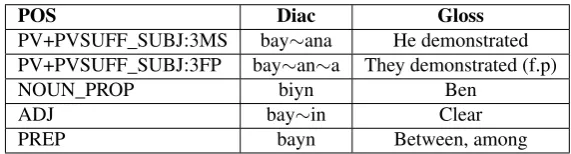
Undiacritized Arabic words are highly ambiguous: in our training data, words had an average of 12.8 analyses per word, most of which are associated with different diacriti-zations. Morphological analysisrefers to the process of determining all the possible morphological analyses for a specific word out of context. Each Analysis has a single diacritized form, part-of-speech, and other morphological features. Table 1 shows a list of analyses produced by the morphological analyzer for the word
áK.
byn. Morpholog-ical tagging(akamorphological disambiguation) refers to the choosing of a morphological analysis in a specific con-text.Our approach is to generate high-quality automatic mor-phological tagging output by exploiting full diacritization information. Our baseline system is the state-of-the-art Arabic morphological tagger MADAMIRA (Pasha et al., 2014) which uses the Standard Arabic Morphological Ana-lyzer (SAMA) (Graff et al., 2009). The morphological an-alyzer produces a list of possible analyses for each word, and the tagger ranks the mentioned list and selects the optimal full morphological tag for each word in context. MADAMIRA does not expect any diacritics as input and in fact it ignores any naturally occurring diacritics.
In our approach, we use the original full diacritics of the words to filter the ranked choices. Each analysis gets a score based on the edit distance of its associated diacriti-zation with the input diacritidiacriti-zation. The analysis with the highest rank and lowest edit distance is selected as the in-context analysis. Since MADAMIRA in default mode pro-duces no analyses sometimes (lexical out-of-vocabulary), we utilize its back off mode to produce all possible analy-ses (including diacritizations for affixes only).
Diacritization variants While Arabic diacritization con-ventions are generally well established, we found a number of common stylistic variants in our data sets:
• The long vowel /a:/ is written as
@
aAor@
A(without the short vowel diacritic).• The Alif Wasla letter
@
Äis sometimes written as a bareAlif
@
A.• The Alif Hamza Below
@
Aiˇ is sometimes written with-out the short vowel diacritic@
A.ˇ• The word-final Alif - Fatha nunation character pair can
appear as
@
ãAor@
Aã.POS Diac Gloss
PV+PVSUFF_SUBJ:3MS bay∼ana He demonstrated
PV+PVSUFF_SUBJ:3FP bay∼an∼a They demonstrated (f.p)
NOUN_PROP biyn Ben
ADJ bay∼in Clear
PREP bayn Between, among
Table 1: Analyses produced by the morphological analyzer for the word
áK.
byn.• The Sukun diacritic, indicating absence of voweliza-tion can be written or omitted even with (almost) full diacritization.
To make our approach independent of these variants, we normalized them to one form in the edit-distance calcula-tion and the system evaluacalcula-tions. In the above mencalcula-tioned example pairs, we always normalized to the second variant. As for the Sukun, we always dropped it.
5.
Evaluation
In this section, we present our experimental setup, evalua-tion metrics and experimental results.
5.1.
Experimental Setup
Morphological tagger For our baseline system, we use the MADAMIRA morphological tagger (Pasha et al., 2014), which was trained on the training portion of the Penn Arabic Treebank (PATB, parts 1, 2 and 3) (Maamouri et al., 2004; Maamouri et al., 2006; Maamouri et al., 2009) along the recommendations of Diab et al. (2013).
Used texts We selected three fully diacritized and mor-phologically annotated texts from three genres to report on.
• A newswire genre text (Newswire) is selected from the PATB and includes all of the development set (about 63K words) along the recommendations of Diab et al. (2013). The morphological annotation was done by the LDC and includes all morphological features.
• A children’s novel text (Novel) is selected to cover the first chapter (1,175 words) of a book titled
àA ¢ÊË@ è Pð
wz¯hAlslTAn ‘The Sultan’s Goose’ (Ki-lany, 2013). The morphological annotation was done by the authors and only included diacritization, lemma, POS and tokenization.• An Islamic jurisprudence text (Religious) is selected to cover the first four pages (970 words) of a book titled
HA
KA
Ò Ë@ ©Òm.×
mjmς AlDmAnAt‘Congregation of Guarantees’ (Baghdadi, 1987). The morphological annotation was done by the authors and only included diacritization, lemma, POS and tokenization.The choice of the different genres is intended to measure the effect of similarity between the training data of the base-line morphological tagger (Newswire) and other genres. In later sections we refer to experiments involving Newswire as in-genresince the text matches the genre of the mor-phological tagger; and we accordingly refer to the non-newswire genre experiments asout-of-genre.
5.2.
Evaluation Metrics
The evaluation was conducted across several accuracy met-rics (all on the word level):
• Diac: Percentage of words where the chosen analy-sis has the correct fully diacritized form (with exact spelling).
• Lex: Percentage of words where the chosen analysis has the correct lemma.
• POS: Percentage of words where the chosen analysis has the correct part-of-speech.
• Tok: Percentage of words where the chosen analysis has the correct tokenization.
• Diac+Lex+POS+Tok: Percentage of words where the chosen analysis has the correct diacritization, lemma, part-of-speech, and tokenization combined.
• Star: Percentage of words where the chosen analysis is perfectly correct (that is, all the morphological fea-tures such as gender, number, person, etc. match their gold values). This is the strictest possible metric and is only used for Newswire text.
5.3.
Experimental Results
We present next three sets of results on in-genre experi-ments, out-of-genre experiments and an investigation in the effect of partial diacritization.
5.3.1. In-Genre Experiments
Initial Ranking Filter Diac Lex POS Tok Diac+Lex+POS+Tok Star
Random none 35.0 71.6 71.5 79.4 31.8 30.3
Morph. Tagger none 87.8 96.7 96.5 98.4 86.6 85.6
Random Full Diac 99.1 96.2 86.2 98.5 85.5 78.6
Morph. Tagger Full Diac 99.1 98.7 97.4 99.3 97.1 95.8
Table 2: System performance on an in-genre text (63K words of newswire articles).
Genre System Diac Lex POS Tok Diac+Lex+POS+Tok
Newswire Tagger 87.8 96.7 96.5 98.4 86.6
Newswire Tagger+Full Diac Filter 99.1 98.7 97.4 99.3 97.1
Novel Tagger 82.8 93.0 93.8 96.5 81.0
Novel Tagger+Full Diac Filter 98.2 97.7 96.0 99.0 95.6
Religious Tagger 74.8 89.8 92.3 96.4 72.4
Religious Tagger+Full Diac Filter 97.2 95.6 95.3 98.1 92.8
Table 3: System performance on three genres of text.
diacritization filter without the morphological analyzer per-forms as well as the best system on diacritization, but worse than the morphological analyzer without the filter on other features. A combination of both the morphological ana-lyzer and the diacritization filter is needed to produce high-quality annotations. The annotation scores produced are comparable to reported numbers on inter-annotator agree-ment and enhanced annotations (Maamouri et al., 2008; Habash and Roth, 2009; Alkuhlani et al., 2013) (although it is hard to make direct apple-to-apple comparisons with the cited efforts).
The best system achieves 93% error reduction on diacriti-zation, 85% on case, 70-80% on voice, mood, state, and the Buckwalter tag, 55-69% on lemma, aspect, person, ra-tionality, and token sequences, 40-49% on gender, num-ber, and enclitics, 18-39% on proclitics, part-of-speech, and gloss. The detailed error reduction for all the features are mentioned in Table 4.
5.3.2. Out-of-Genre Experiments
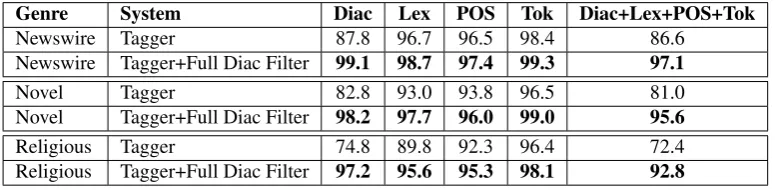
A comparison between the baseline and the best system was conducted on two extra data sets (of novel, and religious genres), and the results are listed in Table 3. Similar im-provements to the previous results can be seen, which sug-gests that this approach can be used to annotate text of new genres that the morphological tagger was not trained on.
Error analysis We performed a manual investigation of the types of errors in our best system. The error analysis was performed on 1000 words of newswire, and on the full text of the novel and the religious genres. The errors are classified into the following categories according to their order in Table 5.:
• No (Correct) Analysis: Words for which no analy-sis was provided by the morphological analyzer, or no provided analysis was completely correct.
• Input Error: Errors caused by typos in the input text.
• Inter-Word Diac: Errors caused by phonological epenthesis between words, which is not modeled by
Feature Tagger Tagger+Filter Error Reduction
Diacritization 87.8 99.1 92.7
Case 90.5 98.6 85.2
Voice 99.1 99.8 76.6
Buckwalter Tag 85.6 95.9 71.6
Mood 99.1 99.7 70.6
State 96.7 99.0 69.9
Aspect 99.3 99.8 67.8
Lemma 96.7 98.7 62.1
Person 99.2 99.7 62.0
Rationality 99.2 99.7 56.9
Tokenization 98.4 99.3 56.3
Gender 99.3 99.6 49.0
Enclitic 0 99.5 99.8 48.8
Number 99.4 99.6 40.8
Proclitic 1 99.6 99.7 39.1
Proclitic 0 99.6 99.7 31.6
Gloss 92.9 95.1 30.5
POS 96.5 97.4 27.0
Proclitic 3 99.9 99.9 25.0
Proclitic 2 99.6 99.7 17.7
diac+pos+lemma+tok 86.6 97.1 78.6
Star 85.6 95.8 71.1
Table 4: Percentage of error reduction for all features.
the tagger system.
• POS: Errors in POS prediction: Nominalsare noun-adjective errors. Closed classes are errors in closed classes of POS, such as particles, pronouns and con-junctions. Otherare types of POS errors other than the aforementioned ones.
• Lemma: Errors in the prediction of the lemma.
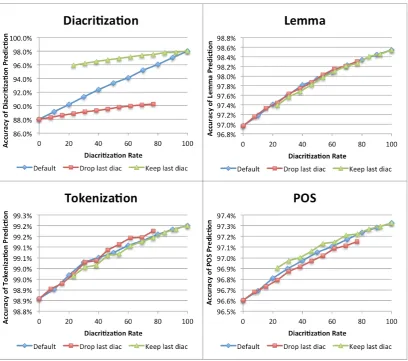
Figure 1: System performance on partially diacritized text.
Error Type Newswire Novel Religious
No Analysis 31.3 5.8 15.7
No Correct Analysis 0 26.9 21.4
Input Error 0 5.8 2.9
Inter-Word Diac 0 3.8 0
POS: Nominals 37.5 28.8 28.6
POS: Closed Classes 6.3 23.1 20.0
POS: Other 6.3 3.8 4.3
Lemma 18.8 1.9 7.1
Table 5: Percentage of errors by type among different gen-res of text.
5.3.3. Partial Diacritization
In this section we study the effect of using partially dia-critized text instead of fully diadia-critized text. We recognize that using less diacritics is bound to lower the overall qual-ity of the resulting morphological choices; however, we want to understand the nature of the change in quality on different metrics.
Using partially diacritized input instead of fully diacritized input causes a major drop in the performance since the edit-distance measure we use interprets missing diacritics as no-diacritics (or Sukuns) as opposed under-specified no-diacritics. To address this issue, we created a second mode of the edit
distance that does not penalize disagreements involving di-acritic underspecification (i.e. missing didi-acritics) in the in-put.3
Figure 1 shows the performance of our system with the partial-dicritic mode on inputs with different diacritization rates. A linear correlation between the diacritization rate and the performance on all features can be seen. The partially diacritized text is constructed from the fully dia-critized form by passing on every diacritic in the text and deciding whether to keep it or not by comparing the out-put of a random function (in the range of 0-100%) to the diacritization rate. Three settings are illustrated:Defaultis when all diacritics has the same chance of being kept.Drop last diacis the same asDefaultexcept that the last diacritic is always dropped. Keep last diacis the same asDefault except that the last diacritic is always kept. It can be seen from the figure that keeping only the last diacritic (around 23% of total diacritics) gives similar score on predicted
dia-3
critization to keeping 80% of the diacritics randomly. This is due to the tagger’s weakness at predicting the last dia-critic. On lemma, POS, and tokenization, the last diacritic performs in a proportional way to its ratio in the text. It’s worth mentioning that the fully diacritized form con-tains not only extra diacritics, but also spelling corrections (in around 12% of the words). This is why the partial di-acritization system performs better than the baseline even with a 0% diacritization rate (0.3% absolute increase on Star). On the other hand, applying the partial diacritiza-tion system on a raw text performs worse than the baseline (0.4% absolute decrease onStar).
6.
Conclusion and Future Work
We have demonstrated a solution to Arabic rich morpholog-ical annotation which relies on diacritizations that can be provided by educated Arabic speakers who do not need to be trained in specialized morphological tag sets and guide-lines. The solution can work on fully or partially diacritized text. We plan to use this technique to automatically gener-ate large annotgener-ated Arabic corpora in less studied genres. The corpora will be diacritized by volunteers and paid typ-ists (potentially using crowd-sourcing). The generated an-notations can then be used to enhance Arabic tools.
References
Abandah, G. A., Graves, A., Al-Shagoor, B., Arabiyat, A., Jamour, F., and Al-Taee, M. (2015). Automatic diacriti-zation of Arabic text using recurrent neural networks. In-ternational Journal on Document Analysis and Recogni-tion (IJDAR), 18(2):183–197.
Alansary, S. and Nagi, M. (2014). The international corpus of Arabic: Compilation, analysis and evaluation. ANLP 2014, page 8.
Alghamdi, M. and Muzafar, Z. (2007). KACST Arabic di-acritizer. InFirst International Symposium on Comput-ers and Arabic Language, pages 25–28.
Alkuhlani, S., Habash, N., and Roth, R. (2013). Automatic morphological enrichment of a morphologically under-specified treebank. InHLT-NAACL, pages 460–470. Baghdadi, A. M. i. G. (1987). Majma‘ Al-damanat. Alam
Al-Kutub.
Bebah, M., Amine, C., Azzeddine, M., and Abdelhak, L. (2014). Hybrid approaches for automatic vowelization of Arabic texts. arXiv preprint arXiv:1410.2646. Belinkov, Y. and Glass, J. (2015). Arabic diacritization
with recurrent neural networks. In Proceedings of the 2015 Conference on Empirical Methods in Natural Lan-guage Processing, pages 2281–2285, Lisbon, Portugal, September. Association for Computational Linguistics. Bouamor, H., Zaghouani, W., Diab, M., Obeid, O., Oflazer,
K., Ghoneim, M., and Hawwari, A. (2015). A pilot study on Arabic multi-genre corpus diacritization. In Proceedings of the Second Workshop on Arabic Natu-ral Language Processing, pages 80–88, Beijing, China, July. Association for Computational Linguistics. Buckwalter, T. (2004). Buckwalter Arabic
Morpho-logical Analyzer Version 2.0. LDC catalog number LDC2004L02, ISBN 1-58563-324-0.
Diab, M., Habash, N., Rambow, O., and Roth, R. (2013). LDC Arabic treebanks and associated corpora: Data di-visions manual.arXiv preprint arXiv:1309.5652. Graff, D., Maamouri, M., Bouziri, B., Krouna, S., Kulick,
S., and Buckwalter, T. (2009). Standard Arabic Morpho-logical Analyzer (SAMA) Version 3.1. Linguistic Data Consortium LDC2009E73.
Habash, N. and Rambow, O. (2007). Arabic Diacritization through Full Morphological Tagging. InProceedings of the 8th Meeting of the North American Chapter of the Association for Computational Linguistics/Human Lan-guage Technologies Conference (HLT-NAACL07). Habash, N. and Roth, R. (2009). CATiB: The Columbia
Arabic Treebank. In Proceedings of the ACL-IJCNLP 2009 Conference Short Papers, pages 221–224, Suntec, Singapore.
Habash, N., Gabbard, R., Rambow, O., Kulick, S., and Mar-cus, M. (2007a). Determining case in Arabic: Learning complex linguistic behavior requires complex linguistic features. In Proceeings of the The 2007 Joint Confer-ence on Empirical Methods in Natural Language Pro-cessing and Computational Natural Language Learning (EMNLP-CoNLL 2007), Prague, June.
Habash, N., Soudi, A., and Buckwalter, T. (2007b). On Arabic Transliteration. In A. van den Bosch et al., ed-itors, Arabic Computational Morphology: Knowledge-based and Empirical Methods. Springer.
Habash, N. (2010). Introduction to Arabic Natural Lan-guage Processing. Morgan & Claypool Publishers. Hadj Ameur, M. S., Moulahoum, Y., and Guessoum, A.
(2015). Restoration of Arabic diacritics using a mul-tilevel statistical model. In Computer Science and Its Applications, volume 456 of IFIP Advances in Infor-mation and Communication Technology, pages 181–192. Springer International Publishing.
Kilany, K. (2013). Wazzat Al-sultan. Hindawi Foundation for Education and Culture.
Maamouri, M. and Cieri, C. (2002). Resources for Natural Language Processing at the Linguistic Data Consortium. InProceedings of the International Symposium on Pro-cessing of Arabic, pages 125–146, Manouba, Tunisia. Maamouri, M., Bies, A., Buckwalter, T., and Mekki, W.
(2004). The Penn Arabic Treebank: Building a Large-Scale Annotated Arabic Corpus. In NEMLAR Confer-ence on Arabic Language Resources and Tools, pages 102–109, Cairo, Egypt.
Maamouri, M., Bies, A., and Kulick, S. (2006). Diacriti-zation: A challenge to Arabic treebank annotation and parsing. In Proceedings of the Conference of the Ma-chine Translation SIG of the British Computer Society. Maamouri, M., Bies, A., and Kulick, S. (2008).
Enhanc-ing the Arabic Treebank: a Collaborative Effort toward New Annotation Guidelines. In European Language Re-sources Association (ELRA), editor,Proceedings of the Sixth International Language Resources and Evaluation (LREC’08), Marrakech, Morocco, May.
Pro-ceedings of MEDAR International Conference on Arabic Language Resources and Tools, Cairo, Egypt.
Nelken, R. and Shieber, S. (2005). Arabic Diacritization Using Weighted Finite-State Transducers. In Proceed-ings of the Workshop on Computational Approaches to Semitic Languages at 43rd Meeting of the Association for Computational Linguistics (ACL’05), pages 79–86, Ann Arbor, Michigan.
Pasha, A., Al-Badrashiny, M., Kholy, A. E., Eskander, R., Diab, M., Habash, N., Pooleery, M., Rambow, O., and Roth, R. (2014). MADAMIRA: A Fast, Comprehensive Tool for Morphological Analysis and Disambiguation of Arabic. InIn Proceedings of LREC, Reykjavik, Iceland. Rashwan, M., Al-Badrashiny, M., Attia, M., and Abdou, S. (2009). A hybrid system for automatic Arabic diacriti-zation. InThe 2nd International Conference on Arabic Language Resources and Tools. Citeseer.
Shahrour, A., Khalifa, S., and Habash, N. (2015). Im-proving Arabic diacritization through syntactic analy-sis. InProceedings of the 2015 Conference on Empiri-cal Methods in Natural Language Processing, EMNLP 2015, Lisbon, Portugal, September 17-21, 2015, pages 1309–1315.
Smrž, O. and Hajiˇc, J. (2006). The Other Arabic Treebank: Prague Dependencies and Functions. In Ali Farghaly, editor, Arabic Computational Linguistics: Current Im-plementations. CSLI Publications.
Vergyri, D. and Kirchhoff, K. (2004). Automatic Dia-critization of Arabic for Acoustic Modeling in Speech Recognition. In Ali Farghaly et al., editors, COLING 2004 Workshop on Computational Approaches to Arabic Script-based Languages, pages 66–73, Geneva, Switzer-land.