R E S E A R C H
Open Access
Suboptimal chemotherapy is an adverse
prognostic factor in osteosarcoma
Bicheng Yong
†, Pingxian Tan
†, Junqiang Yin, Changye Zou, Xianbiao Xie, Jin Wang, Gang Huang,
Qianyong Wang and Jingnan Shen
*Abstract
Background:We sought to determine whether suboptimal chemotherapy compromised the prognosis of osteosarcoma patients.
Methods:A total of 132 eligible patients who underwent chemotherapy between 1998 and 2008 were identified in our database. Information regarding patient demographics, clinical characteristics, and survival status were extracted for analysis. Optimal chemotherapy was defined as receipt of≥80% of the planned dose intensity of prescribed agents within the planned durations.
Results:The use of optimal chemotherapy resulted in an overall survival benefit withP =0.006. Patients who failed to complete the optimal chemotherapy protocol had a dismal prognosis of 30.8% overall survival over five years, whereas those who completed the optimal chemotherapy had an overall survival rate over five years of 65.3%. Based on multivariate analysis, patients who were treated with a suboptimal protocol had a higher risk of relapse, metastasis and mortality. The hazard ratio (HR) of recurrence or death for the suboptimal chemotherapy group was as high as 2.512 over that of the optimal chemotherapy group (HR = 2.512, 95% confidence interval = 1.242 to 3.729).
Conclusions:Chemotherapy is a significant independent prognostic variable, and suboptimal chemotherapy was found to have a detrimental effect on the outcome of patients with osteosarcoma.
Keywords:Osteosarcoma, Suboptimal chemotherapy, Survival
Background
Osteosarcoma is the most common malignant bone tumor; it predominantly affects adolescents and con-tinues to be an extremely aggressive disease despite the use of neoadjuvant chemotherapy protocols and wide-margin, limb-salvaging surgery [1]. The five-year overall survival (OS) rate of osteosarcoma patients of all ages has been reported to range from 53% to 58% in the United States and Europe [2].
An approximately 70% long-term event-free survival rate for osteosarcoma patients can currently be achieved by using the standard three-drug chemotherapy protocol that includes cisplatin, doxorubicin and high-dose methotrexate [3]. The addition of ifosfamide to a three-drug regimen has
been extensively used and tested in several clinical trials [4-7]. In China, chemotherapy for osteosarcoma has lagged significantly behind other countries. Most chemotherapy treatments for osteosarcoma were adopted from other countries [8]. However, the phenomenon that patients often abandon treatment prematurely or choose to delay resuming chemotherapy is quite prevalent but is not ser-iously recognized in musculoskeletal oncology.
The present study aimed to evaluate the effect of in-complete or suboptimal chemotherapy on survival and to discuss possible reasons for lack of compliance to treatment. We found that suboptimal chemotherapy is an unfavorable prognostic factor in the overall survival (OS), event free survival (EFS), relapse free survival and metastasis free survival of osteosarcoma patients. Inade-quate finances, poor patient-doctor relationship and psy-chological and behavioral compromise may contribute to suboptimal chemotherapy.
* Correspondence:[email protected]
†Equal contributors
Musculoskeletal Oncology Department, First Affiliated Hospital of Sun Yat-Sen University, 14th floor #58 Zhongshan 2nd Road, Guangzhou, Guangdong 510080, China
Methods Patient eligibility
We retrospectively reviewed the medical charts of 410 osteosarcoma patients who were treated at our hospital between 1998 and 2008. The last follow-up for event-free survivors was in October, 2010. The minimum follow-up time was 24 months. The criteria for inclusion in the study were as follows: (1) Enneking stage IIB [9]; (2) no history of treatment except needle biopsy; (3) scheduled for neo- and adjuvant chemotherapy; (4) sur-gery at our institute; and (5) longer than 24 months of follow-up for event-free patients. Of the 410 patients, 367 were Enneking stage IIB. Patients were excluded for the following reasons: prior chemotherapy, surgery or open biopsy at another hospital (n = 32), no treatment (n = 23), chemotherapy alone (n = 63), or surgery alone (n = 9). In addition, patients who were followed for less than 24 months (n = 108) were excluded. Therefore, the final study population consisted of 132 patients; the clin-icopathological characteristics of these patients are sum-marized in Table 1. Several variables were recorded, and the influence of the variables on survival, local recur-rence, and metastasis were statistically evaluated. This study was approved by the Ethical Committee of First Affiliated Hospital, Sun Yat-Sen University.
Protocol description
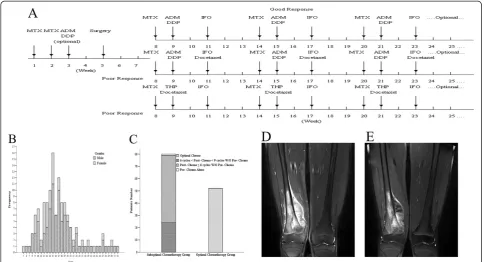
Optimal chemotherapy was defined as follows: (1) the ad-ministration of methotrexate (MTX), cisplatin (DDP), adriamycin (ADM), ifosfamide (IFO) or their combina-tions; (2) the administration of MTX at a dose of 8 to 12 g/m2(with leucovorin‘rescue’commencing six hours after the initiation of the MTX infusion), cisplatin at a dose of 100 mg/m2for four hours followed by 60 mg/m2of adria-mycin for 48 hours, and IFO at a dose of 2 to 3 g/m2for five days with an injection of mesna (400 mg) after 12 hours of IFO administration; (3) one cycle of chemothe-rapy (MTX, DDP + ADM, IFO) that took place over 42 days; and (4) patients who received≥80% of the planned dose intensity [10]. At least two courses of MTX were required for induction chemotherapy, and at least three cycles of triplets (MTX, DDP + ADM, IFO) were applied after definitive surgical therapy (Figure 1A). At our insti-tute, IFO was introduced into our optimal protocol in 1999. Prior to that, postoperative chemotherapeutic regi-mens were the same as the preoperative regiregi-mens; after the inclusion of IFO, poor responders were administered IFO-containing regimens more frequently, while good responders were treated with the same regimen as for the preoperative therapy. The chemotherapy response was primarily determined based on physical evaluation and radiographic reassessment according to Response Evalua-tion Criteria in Solid Tumors (RECIST) criteria. A lesion in the same plane was consistently measured [11].
Study definition
In the survival analysis, the primary end points were time until death, time until relapse, and time until me-tastasis. Overall survival (OS) was measured in days from the date of diagnosis to the date of death. Metastasis-free intervals were measured from the date of diagnosis to the date of metastasis (the metastatic loca-tion was either lung or bone) or death. The relapse-free interval was measured from the date of diagnosis to the
Table 1 Demographic and clinical characteristics of the cohort
Number Percent of total (100%)
date of relapse or death. Event-free survival (EFS) was measured from the date of diagnosis to the date of any significant event (metastasis, relapse or death). Patients who did not develop metastasis or relapse or remained alive at the final follow-up were censored at that time.
Surgery
Surgical interventions for osteosarcoma included limb salvage surgery and amputation. Definitive surgical the-rapy required a wide or radical surgical margin. The options for postoperative reconstruction included modu-lar prosthesis, extendible prosthesis, and autograft or allograft transplantation with plate or intramedullary interlocking nail. Amputation included simple amputa-tion, rotationplasty amputaamputa-tion, and modified rotation-plasty amputation. The surgical type was determined by the patient’s life expectancy, maturity of epiphysis, pre-sence of pathological fracture, clinical and surgical clas-sification, and the patient’s willingness and financial capacities.
Follow-up
After completing chemotherapy, patients were followed up for two years with quarterly radiographs of the ope-rated limb. Computed tomography (CT) of the chest
was performed every three months for two years. There-after, the same protocol was repeated every six months for up to five years and then annually for up to the tenth year after surgery. All of the patients were followed up for at least two years after diagnosis unless they were deceased.
Statistics
Both OS and EFS were determined based on the Kaplan-Meier Survival Analysis, and the results in the different groups were compared using the log-rank test. Only variables that were significantly different in the univariate study were entered into the multivariate analysis using the Cox proportional-hazards regression model. The analysis was performed using SPSS 13.0 and P-values of <0.05 were considered to be statistically significant.
Results
Demographic information
Among the total 410 patients, 132 met the inclusion cri-teria and their charts were reviewed for inclusion in the study group. The study population included 93 males and 39 females, with a median age of 16 years (range, 5 to 56 years); 34 (25.8%) patients had undergone the onset of their growth spurt (12 to 14 (females), 13 to 15
Figure 1A Optimal chemotherapy protocol.MTX: methotrexate, DDP: cisplatin, ADM: adriamycin, IFO: ifosfamide.BAge and gender distribution in this cohort.CProportion of patients receiving suboptimal chemotherapy and optimal chemotherapy.DInitial MRI of a patient with osteosarcoma of the right distal femur. T2-weighted MRI shows altered signal intensity involving the distal metaphysis, growth plate and medial condylar of the right femur with minimal necrosis.EFollow-up after two courses of MTX (8.5 g/m2) and one course of ADM (60 mg/m2) plus
DDP (100 mg/m2) demonstrated a positive response to chemotherapy based on the extent of liquefactive necrosis and cystic changes of the soft
(males) (Figure 1B). The distal femur was the dominant location affected by osteosarcoma (50%), and the major-ity of the pathological sub-classifications were the osteo-blast subtype (Table 1). Fifty-three (39.4%) cases underwent optimal chemotherapy while 80 (60.6%) cases did not complete the prescribed chemotherapy protocol. Among these, 2 cases underwent only preoperative chemotherapy, 23 cases underwent fewer than 9 cycles and more than 6 cycles of postoperative chemotherapy with or without preoperative chemotherapy, and 55 cases underwent fewer than 6 cycles of postoperative chemotherapy with or without preoperative chemothe-rapy (Figure 1C). Sixty-three (47.7%) events were recorded. Local recurrence occurred in 25 cases, includ-ing 3 cases of isolated local recurrence and 22 cases that eventually developed metastasis. Metastasis occurred in 57 cases, and the involved sites were the lung (55 cases), bone (1 case) and other sites (1 case).
Suboptimal chemotherapy was correlated with adverse overall survival, event free survival, relapse free survival and metastasis free survival in univariate analysis
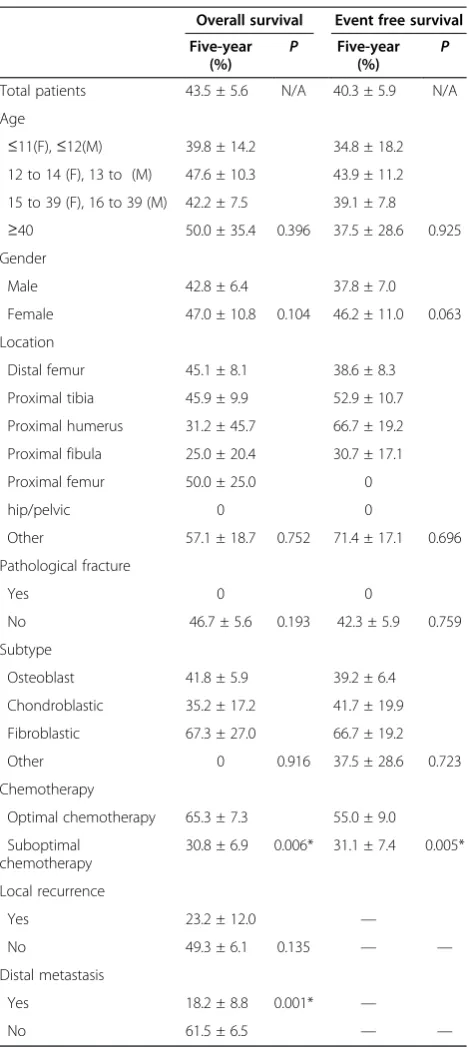
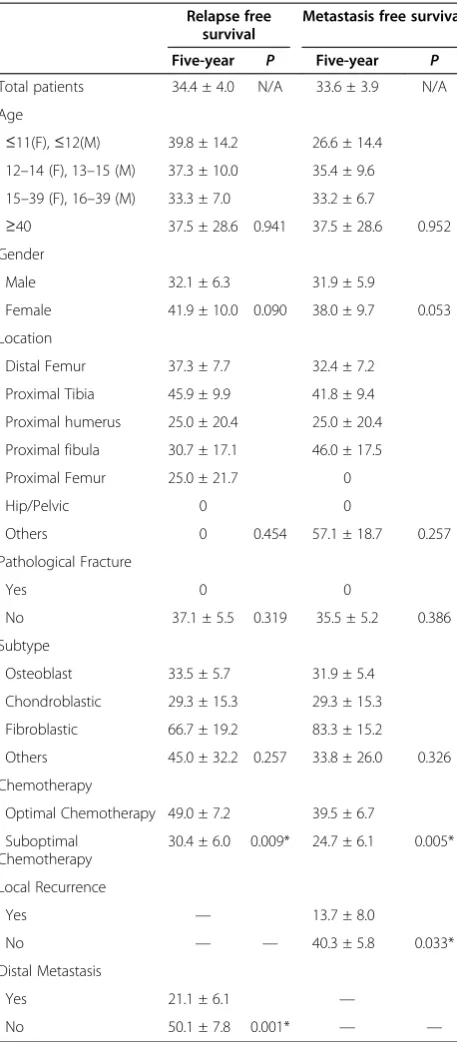
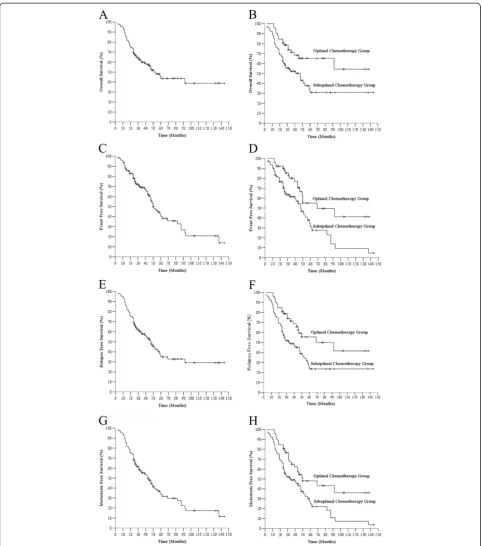
The five-year OS and EFS statistics are summarized in Table 2. The OS for the entire cohort was 43.5 ± 5.6%. However, patients who adhered to the optimal protocol had a five-year survival rate of 65.3 ± 7.3%, which was significantly better than the 30.8 ± 6.9% survival rate for the suboptimal chemotherapy group (P =0.013). Similar results were obtained in EFS: 55.0 ± 9.0% patients were alive without disease in the optimal chemotherapy group, but only 31.1 ± 7.4% patients survived longer than five years without significant findings in the sub-optimal chemotherapy group. Among the patients with metastases in the optimal chemotherapy group, 49.0 ± 7.2% survived for five years, while 30.4 ± 6.0% of those in the suboptimal chemotherapy group was still alive after five years of follow up. The outcome of patients with local recurrence in the optimal chemotherapy group was better than that of patients in the suboptimal chemotherapy group (five-year survival of 39.5 ± 6.7% versus 24.7 ± 6.1%) (Table 3).
Suboptimal chemotherapy is an independent unfavorable factor for overall survival, event free survival and
metastasis free survival
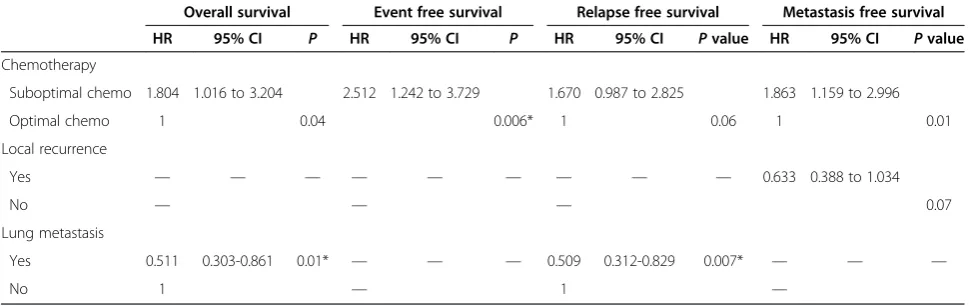
Based on the multivariate analysis, chemotherapy was found to be an independent risk factor for OS, EFS and metastasis free survival. The risk of mortality and metas-tasis was approximately 1.8-fold higher in patients with suboptimal chemotherapy (hazard ratio (HR) = 1.804, 95% confidence interval (CI) = 1.016 to 3.204). Patients in the optimal chemotherapy group were more likely to experience recurrence (HR = 1.670, 95% CI = 0.987 to 2.825), although chemotherapy did not independently
affect relapse free survival (P = 0.06) (Table 4). The Kaplan-Meier survival curves for the aforementioned data are shown in Figure 2.
Discussion
The addition of neoadjuvant and adjuvant chemotherapy to radical surgery has been demonstrated to improve
Table 2 Overall survival and event-free survival
Overall survival Event free survival
Five-year
Proximal tibia 45.9 ± 9.9 52.9 ± 10.7
Proximal humerus 31.2 ± 45.7 66.7 ± 19.2
Proximal fibula 25.0 ± 20.4 30.7 ± 17.1
Proximal femur 50.0 ± 25.0 0
hip/pelvic 0 0
Chondroblastic 35.2 ± 17.2 41.7 ± 19.9
Fibroblastic 67.3 ± 27.0 66.7 ± 19.2
Other 0 0.916 37.5 ± 28.6 0.723
Chemotherapy
Optimal chemotherapy 65.3 ± 7.3 55.0 ± 9.0
significantly the prognosis for osteosarcoma patients. Long-term survival in localized osteosarcoma has increased substantially from 10% to 20% (when surgery was performed as the only treatment) to 50% to 60% [12]. Five-year OS from 17 musculoskeletal oncology institutes in China ranges from 37.5% to 77.6% [13]. In the present study, the five-year OS for all patients was 43.5%, which is
significantly lower than the international survival rate for these patients [14-16]. However, the five-year OS among patients who completed the optimal chemotherapy regi-men was as high as 65.3% which is comparable to the international survival rate. There is a suggestion that many patients failed to complete the optimal chemotherapy protocol, and this phenomenon is also observed at other Chinese hospitals.
A combination drug protocol consisting of four drugs (DDP, ADM, MTX, and IFO) has been associated with an overall five-year survival rate of 44% to 65% [17,18]. Inter-national chemotherapy standards using these four drugs in-clude the T12/T19 treatment developed by Rosen [19], the IOR-OS/N-2 treatment developed by Bacci and recommen-dations by the European Society for Medical Oncology (ESMO) in 2009 [20,21]. Although efforts have been made to identify optimized standard chemotherapy protocols that are suitable for the Chinese population, we do not yet have a nationwide sarcoma registry system that would support clinical trials with a large sample size to test standard proto-cols [8]. Our chemotherapy regimen was based on the four drugs described above and was a modified version of IOR-OS/N-2. The differences are as follows: (1) only two courses of MTX were required for induction chemotherapy and (2) IFO was routinely used after definitive surgery. For those who responded poorly to induction chemotherapy, we administered a more frequent IFO-containing regimen and/or added second-line drugs. The IOR-OS/N-2 protocol requires at least two cycles (four to six courses) for induc-tion chemotherapy, but only two courses of preoperative medication are required in our protocol. We agree with Jeon and Bacci that the delayed removal of tumor increases the risk of systemic metastasis [22,23]. Furthermore, a smaller need exists for long-term neo-adjuvant therapy to bridge the gap between biopsy and resection due to the im-provement of endoprostheses manufacturing. Third, the concern of non-compliance with long term induction chemotherapy must be considered. In our experience, two courses of MTX or two courses of MTX plus one course of ADM and DDP were adequate to achieve a good response to induction chemotherapy (Figure 1D and E). With this modified protocol, patients in the optimal chemotherapy group achieved an OS rate of 65.3% ± 7.3%, which is com-parable to that in Bacci’s study [19].
In the univariate study, factors that were significantly different according to our stratifications are chemothe-rapy, local recurrence and lung metastasis.
Bajpai et al. showed that there was no significant dif-ference in survival between the noncompliant versus compliant group in osteosarcoma [24] but in our study, patients who failed to complete the optimal chemothe-rapy protocol had less opportunity to achieve a stable disease status or complete remission. The reason why these two studies have different conclusions is obvious.
Table 3 Relapse free survival and metastasis free survival
Relapse free
Proximal humerus 25.0 ± 20.4 25.0 ± 20.4
Proximal fibula 30.7 ± 17.1 46.0 ± 17.5
Proximal Femur 25.0 ± 21.7 0
Hip/Pelvic 0 0
Others 0 0.454 57.1 ± 18.7 0.257
Pathological Fracture
Yes 0 0
No 37.1 ± 5.5 0.319 35.5 ± 5.2 0.386
Subtype
Osteoblast 33.5 ± 5.7 31.9 ± 5.4
Chondroblastic 29.3 ± 15.3 29.3 ± 15.3
Fibroblastic 66.7 ± 19.2 83.3 ± 15.2
Others 45.0 ± 32.2 0.257 33.8 ± 26.0 0.326
Chemotherapy
Optimal Chemotherapy 49.0 ± 7.2 39.5 ± 6.7
Bajpai’s median follow up time is 7.9 months while our minimum follow-up time is 24 months. However, chemo-therapy did not independently affect relapse-free survival (P >0.05). These data indicate that other factors (such as surgery) act in combination with chemotherapy to main-tain local control of the disease. Picci has convincingly demonstrated that the local failure rate in osteosarcoma correlates with both the quality of the surgical margins and the extent of tumor response to induction therapy [25]. Surgical margins should always be seriously consid-ered to be equally as important as chemotherapy.
Chemotherapy compliance was defined as adherence to a prescribed treatment regimen [26]. It can be affected by psychological and behavioral aspects as well as financial aspects. The former may include physician’s attitude, doctor-patient relationship, psychological support from others and religious convictions [27]. The latter was often unjustifiable and has social and economic roots. In China, the high price of drugs (including chemotherapy drugs and their rescue drugs) has long been blamed for medical ser-vices being unaffordable for less advantaged people and has triggered increasing complaints from the public [28]. Moreover, very expensive prosthesis (manufactured both domestically and abroad) causes some patients to discon-tinue chemotherapy after surgery. The current basic me-dical insurance system in China has not yet determined how to disseminate basic medical insurance coverage to benefit more patients with malignant tumors and how to reduce the proportion of personal health expenditures [29]. The possible solutions for unjustifiable chemotherapy non-compliance may include: (1) Increase the budget for medical services and restrain the price of chemotherapy drugs; (2) improve the national medical insurance system and enlarge the insurance coverage for malignant tumors; (3) encourage sponsorships and donations from society and set a charity fund for osteosarcoma patients; and (4) en-courage domestic prosthesis development. The suggestions
for justifiable non-compliance are as follow: (1) Strengthen the physician-patient relationship by providing adequate time for counseling, correct and accurate information in-terpretation, patient privacy protection and so on; (2) strengthen the family and social support system by provi-ding personal and individualized care, chaplain services or psychological counseling; (3) strengthen patient education before and after hospitalization; and (4) strengthen the follow-up system by telephone, e-mail, and family visits to keep patients accountable for their timely therapy.
This study included some limitations. First, our study was limited by its retrospective nature; however, the issue under investigation could not be studied prospectively.
The prospective cohort study is of superior quality to a retrospective study in observational research; and the evi-dence level of a prospective study is higher than that of retrospective research. Nevertheless, it has the disadvantages of substantial expense, sensitivity to attrition and lengthy follow-up time. Desiring to improve our patients’survival rates, we conducted this study to investigate the effects of suboptimal chemotherapy on osteosarcoma prognosis.
Second, our study was devised using data available from osteosarcoma patients at a single institution, and therefore, the total number of patients was relatively small. Our results would be more compelling if a larger number of patients being treated at different institutions had been included in the study, but our strict standards for inclusion naturally limited the size of our study. Our results also require validation in a large number of patients at differ-ent institutions. Finally, bias led by the inherdiffer-ent hetero-geneity of the optimal chemotherapy regimen is difficult to eliminate.
Conclusions
In summary, we investigated a cohort of osteosar-coma patients with long term follow-up, suboptimal chemotherapy compromised the outcome and
Table 4 Cox proportional hazards model for the risk of death, relapse or metastasis, relapse alone and metastasis alone
Overall survival Event free survival Relapse free survival Metastasis free survival
HR 95% CI P HR 95% CI P HR 95% CI Pvalue HR 95% CI Pvalue
Chemotherapy
Suboptimal chemo 1.804 1.016 to 3.204 2.512 1.242 to 3.729 1.670 0.987 to 2.825 1.863 1.159 to 2.996
Optimal chemo 1 0.04 0.006* 1 0.06 1 0.01
Local recurrence
prognosis of the subjects. Standardization of treat-ment is deemed necessary in the Chinese osteosar-coma population, and multicenter clinical trials to identify optimized chemotherapy drugs and protocols suitable for Chinese patients must be developed. Moreover, taking measures to improve patients’ com-pliance to treatment is of equal importance.
Abbreviations
ADM: adriamycin; CI: confidence interval; DDP: cisplatin; EFS: eventfree survival; ESMO: European Society for Medical Oncology; HR: hazard ratio; IFO: ifosfamide; MTX: methotrexate; OS: overall survival.
Competing interests
We declare that we have no conflicts of interest.
Authors’contributions
JNS and JW conceived the study. BCY, PXT, CYZ did the chart review. BCY and YQW followed up the patients and obtained the survival information. GH and BCY performed the statistical analysis and interpreted the results. BCY, XBX and JQY performed the literature review and wrote the manuscript. All authors read and approved the final manuscript.
Authors’information
Professor JNS is the director and chief surgeon of Musculoskeletal Department of First Affiliated Hospital of Sun Yat-Sen University, China.
Acknowledgements
We thank Dr. Yaofei Wang, Dr. Jingchun Li, Dr. Jinchang Lu, and Dr. Haihua Guo for their efforts in helping gather the data. We are also grateful to Zhibin Li for his assistance with the statistical analysis. We also give credit to Patricia Yong for her critical editing of the manuscript. This study was supported by Sun Yat-Sen University 5010 Project (grant number: 180009).
Received: 3 May 2012 Accepted: 31 August 2012 Published: 17 September 2012
References
1. Bielack SS, Kempf-Bielack B, Delling G, Exner GU, Flege S, Helmke K, Kotz R, Salzer-Kuntschik M, Werner M, Winkelmann W, Zoubek A, Jürgens H, Winkler K:Prognostic factors in high-grade osteosarcoma of the extremities or trunk: an analysis of 1,702 patients treated on neoadjuvant cooperative osteosarcoma study group protocols.J Clin Oncol2002,20:776–790.
2. Savage SA, Mirabello L:Using epidemiology and genomics to understand osteosarcoma etiology.Sarcoma2011,2011:548151.
3. Chou AJ, Gorlick R:Chemotherapy resistance in osteosarcoma: current challenges and future directions.Expert Rev Anticancer Ther2006, 6:1075–1085.
4. Fuchs N, Bielack SS, Epler D, Bieling P, Delling G, Korholz D, Graf N, Heise U, Jurgens H, Kotz R, Salzer-Kuntschik M, Weinel P, Werner M, Winkler K: Long-term results of the co-operative German-Austrian-Swiss osteosarcoma study group's protocol COSS-86 of intensive multidrug chemotherapy and surgery for osteosarcoma of the limbs.Ann Oncol 1998,9:893–899.
5. Bacci G, Ferrari S, Longhi A, Picci P, Mercuri M, Alvegard TA, Saeter G, Donati D, Manfrini M, Lari S, Briccoli A, Forni C, Italian Sarcoma Group/Scandinavian Sarcoma Group:High dose ifosfamide in combination with high dose methotrexate, adriamycin and cisplatin in the neoadjuvant treatment of extremity osteosarcoma: preliminary results of an Italian Sarcoma Group/Scandinavian Sarcoma Group pilot study.J Chemother2002, 14:198–206.
6. Ferrari S, Smeland S, Mercuri M, Bertoni F, Longhi A, Ruggieri P, Alvegard TA, Picci P, Capanna R, Bernini G, Müller C, Tienghi A, Wiebe T, Comandone A, Böhling T, Del Prever AB, Brosjö O, Bacci G, Saeter G, Italian and Scandinavian Sarcoma Groups:Neoadjuvant chemotherapy with high-dose Ifosfamide, high-high-dose methotrexate, cisplatin, and doxorubicin for patients with localized osteosarcoma of the extremity: a joint study by
the Italian and Scandinavian Sarcoma Groups.J Clin Oncol2005, 23:8845–8852.
7. Meyers PA, Schwartz CL, Krailo MD, Healey JH, Bernstein ML, Betcher D, Ferguson WS, Gebhardt MC, Goorin AM, Harris M, Kleinerman E, Link MP, Nadel H, Nieder M, Siegal GP, Weiner MA, Wells RJ, Womer RB, Grier HE, Children's Oncology Group:Osteosarcoma: the addition of muramyl tripeptide to chemotherapy improves overall survival--a report from the Children's Oncology Group.J Clin Oncol2008, 26:633–638.
8. Lin F, Wang Q, Yu W, Tang L, Zheng S, Sun Y, Shen Z, Yao Y, Dong Y: Clinical analysis of Chinese limb osteosarcoma patients treated by two combinations of methotrexate, cisplatin, doxorubicin and ifosfamide. Asia Pac J Clin Oncol2011,7:270–275.
9. Enneking WF, Spanier SS, Goodman MA:A system for the surgical staging of musculoskeletal sarcoma.Clin Orthop Relat Res1980, (153):106–120.
10. Uchida A, Myoui A, Araki N, Yoshikawa H, Shinto Y, Ueda T:Neoadjuvant chemotherapy for pediatric osteosarcoma patients.Cancer1997, 79:411–415.
11. Therasse P, Arbuck SG, Eisenhauer EA, Wanders J, Kaplan RS, Rubinstein L, Verweij J, Van Glabbeke M, van Oosterom AT, Christian MC, Gwyther SG: New guidelines to evaluate the response to treatment in solid tumors. European Organization for Research and Treatment of Cancer, National Cancer Institute the United States, National Cancer Institute of Canada. J Natl Cancer Inst2000,92(3):205–216.
12. Pazdur R, Wagman LD, Camphausen KA, Hoskins WJ:Cancer Management: A Multidisciplinary Approach. 11th edition. Manhaset, NY: CMP Medica; 2009. 13. Zhang Q, Xu WP, Guo W:The current status of the treatment for
osteosarcoma in China.Chin J Bone Tumor Bone Dis2009,8:129–132. 14. Smeland S, Bruland OS, Hjorth L, Brosjo O, Bjerkehagen B, Osterlundh G,
Jakobson A, Hall KS, Monge OR, Bjork O, Alvegaard TA:Results of the Scandinavian Sarcoma Group XIV protocol for classical osteosarcoma: 63 patients with a minimum follow-up of 4 years.Acta Orthop2011, 82:211–216.
15. Gatta G, Zigon G, Capocaccia R, Coebergh JW, Desandes E, Kaatsch P, Pastore G, Peris-Bonet R, Stiller CA:Survival of European children and young adults with cancer diagnosed 1995–2002.Eur J Cancer2009, 45:992–1005.
16. Bielack S, Jurgens H, Jundt G, Kevric M, Kuhne T, Reichardt P, Zoubek A, Werner M, Winkelmann W, Kotz R:Osteosarcoma: the COSS experience. Cancer Treat Res2009,152:289–308.
17. Longhi A, Errani C, De Paolis M, Mercuri M, Bacci G:Primary bone osteosarcoma in the pediatric age: state of the art.Cancer Treat Rev2006, 32:423–436.
18. Ferrari S, Palmerini E:Adjuvant and neoadjuvant combination
chemotherapy for osteogenic sarcoma.Curr Opin Oncol2007,19:341–346. 19. Rosen G, Caparros B, Huvos AG, Kosloff C, Nirenberg A, Cacavio A, Marcove RC,
Lane JM, Mehta B, Urban C:Preoperative chemotherapy for osteogenic sarcoma: selection of postoperative adjuvant chemotherapy based on the response of the primary tumor to preoperative chemotherapy.Cancer1982, 49:1221–1230.
20. Bacci G, Longhi A, Fagioli F, Briccoli A, Versari M, Picci P:Adjuvant and neoadjuvant chemotherapy for osteosarcoma of the extremities: 27 year experience at Rizzoli Institute, Italy.Eur J Cancer2005,41:2836–2845. 21. Bielack S, Carrle D, Casali PG:Osteosarcoma: ESMO clinical
recommendations for diagnosis, treatment and follow-up.Ann Oncol 2009,20(Suppl 4):137–139.
22. Jeon DG, Song WS:How can survival be improved in localized osteosarcoma?Expert Rev Anticancer Ther2010,10:1313–1325. 23. Bacci G, Ferrari S, Longhi A, Forni C, Ruggieri P, Briccoli A, De Paolis M,
Setola E:Preoperative therapy versus immediate surgery in nonmetastatic osteosarcoma.J Clin Oncol2003,21:4662–4663. 24. Bajpai J, Puri A, Shah K, Susan D, Jambhekar N, Rekhi B, Desai S, Gulia A,
Gupta S:Chemotherapy compliance in patients with osteosarcoma. Pediatr Blood Cancer2012, doi:10.1002/pbc.24155.
25. Picci P, Sangiorgi L, Rougraff BT, Neff JR, Casadei R, Campanacci M: Relationship of chemotherapy-induced necrosis and surgical margins to local recurrence in osteosarcoma.J Clin Oncol1994, 12:2699–2705.
27. Balasubramanian SP, Murrow S, Holt S, Manifold IH, Reed MW:Audit of compliance to adjuvant chemotherapy and radiotherapy guidelines in breast cancer in a cancer network.Breast2003,12:136–141.
28. Yu X, Li C, Shi Y, Yu M:Pharmaceutical supply chain in China: current issues and implications for health system reform.Health Policy2010,97:8–15. 29. Song P, Wu Q, Huang Y:Multidisciplinary team and team oncology
medicine research and development in China.Biosci Trends2010,4:151–160.
doi:10.1186/1477-7819-10-191
Cite this article as:Yonget al.:Suboptimal chemotherapy is an adverse prognostic factor in osteosarcoma.World Journal of Surgical Oncology
201210:191.
Submit your next manuscript to BioMed Central and take full advantage of:
• Convenient online submission
• Thorough peer review
• No space constraints or color figure charges
• Immediate publication on acceptance
• Inclusion in PubMed, CAS, Scopus and Google Scholar
• Research which is freely available for redistribution