R E S E A R C H
Open Access
Robot indoor location modeling and
simulation based on Kalman filtering
Jian Yin Lu
*and Xinjie Li
Abstract
Wireless signal fingerprint positioning technology has been widely used in indoor positioning. In view of the influence of a large number of interference noise in indoor, the error of receive signal strength indicator is large, the more complex and chaotic indoor environment, the location accuracy deviation of the system will be very large; an algorithm based on Kalman filter is proposed to filter the velocity and direction of motion of indoor robots. The position coordinates of the robot are estimated by RSSI-based positioning method, and the indoor robot positioning model and Kalman filter model are established. Kalman filter autoregressive algorithm is used to optimize the estimated position coordinates of the robot. Mathematical reasoning and simulation results show that the probability of positioning error is 80% when Kalman filter is not used, and the location error is controlled within 1.2 m after Kalman filter, which effectively improves the location accuracy of indoor robots.
Keywords:Indoor positioning, Kalman filtering, Robot
1 Introduction
China’s demographic dividend is fading, the trend of ma-chine replacement is accelerating, and mobile robots pro-mote the advent of the era of intellectualization [1]. With the decline of the birth rate and the increase of the pro-portion of the elderly population in China, the demo-graphic dividend has gradually disappeared, “labor shortage”is frequent, and the cost of labor has risen. On the other hand, with the improvement of living standards, workers have higher requirements for the quality of work, and their willingness to engage in indoor boring, harsh en-vironment and dangerous work is reduced. Robots can work continuously for a long time, with higher efficiency and accuracy than human beings, and the pace of “ ma-chine replacement” is accelerated. Obviously, the robot market will flourish day by day, but the difficulty of locat-ing mobile robots in an indoor environment is a problem. Satellite positioning can be used and the following are mainly commercial and some of the most successful: American Global Positioning System [2,3], Russia’s GLO-NASS satellite positioning system, Europe’s Galileo satel-lite positioning system, and Chinese BeiDou Navigation Satellite System [4,5] in our country. GPS is used to lo-cate the personnel, but the indoor GPS signal cannot be
used properly due to the occlusion of the building, the interference of the reinforced concrete to the signal, and the low positioning accuracy. Many scientific research in-stitutions and scholars at home and abroad have been making unremitting efforts in this regard.
The application of radio frequency identification [6, 7] technology to intelligent robots is also developing such as robots for monitoring kindergarten children, vacuum cleaner robots, and shopping guide robots. In the process of motion, the robot has the problem of self-localization. Airborne sensors are mostly used for localization. RFID [8] technology is a technology which uses an electromagnetic induction principle to generate information reading by wireless excitation. Radio fre-quency identification ranges from a few centimeters to a dozen meters. When RFID [9] is used for robot localization, mainly for personnel whether exists in the identification of a region, it cannot achieve real-time tracking, and the standard network system of location application is not yet mature. Ultra-wideband [10] is a non-carrier communication technology; by laying a cer-tain number of UWB positioning base stations indoors, the robot carries positioning labels and finally realizes the precise positioning and navigation of the robot. Base stations are usually set up as square according to a need, and one is laid every 50–200 m. The principle is to
© The Author(s). 2019Open AccessThis article is distributed under the terms of the Creative Commons Attribution 4.0 International License (http://creativecommons.org/licenses/by/4.0/), which permits unrestricted use, distribution, and reproduction in any medium, provided you give appropriate credit to the original author(s) and the source, provide a link to the Creative Commons license, and indicate if changes were made.
* Correspondence:[email protected]
ensure that the pulses emitted by the target to be located can be received by any three base stations at the same time, so as to determine the location of the location tag. On the other hand, its technology could realize cm-level positioning level, but positioning the cost is very high, suitable for locating the area which is small, has high value-added industries and the field of plant at big mil-lions of investment, and to the person’s cm-level posi-tioning, it is a little bit“big small”.
Kalman filter is widely used in mobile robot localization [11,12]. In view of the unstable transmission and poor posi-tioning accuracy of indoor wireless sensor network commu-nication, an autonomous dynamic positioning system for mobile robots is proposed, by real-time selection of adjacent beacon nodes, determination of boundaries, and drawing of local grid space; the dynamic positioning of the robot is real-ized [13,14]. Ranging is achieved by using received signal strength index. Then, the improved approximate triangle in-terior point test (APIT) algorithm based on ranging is used to complete the positioning, and the Kalman algorithm is used to correct the positioning error. This method is suit-able for the actual situation of unstsuit-able transmission in an indoor network [15,16]. Kalman filter is used to obtain the optimal data, so that the indoor robot positioning has better accuracy and adaptability [17, 18]. In order to solve the problem that the positioning accuracy of mobile robots de-creases sharply due to the sensor measurement error and the pose error caused by the robot model in the positioning process, a filtering algorithm is proposed [19,20]. Based on the standard Kalman filter, when the sensor measurement error exists, the positioning accuracy is improved by adjust-ing the size of the state covariance matrix to resist the filter-ing divergence caused by the pose error.
In this text, the Kalman filtering algorithm is put forward to select the appropriate state error matrix and observation error array and optimize the positioning accuracy, so as to improve the location performance of the robot room. Mathematical reasoning and simulation results show that the probability of positioning error is 80% when Kalman fil-ter is not used, and the positioning error is controlled within 1.2 m after Kalman filter, which effectively improves the positioning effect of indoor robots.
2 Kalman filtering algorithm
Suppose the equation of the stochastic linear discrete system (without considering the control action first) is
X kð Þ ¼ΦX kð −1Þ þΓW kð −1Þ ð1Þ Z kð Þ ¼HX kð Þ þV kð Þ ð2Þ
In the formula,X(k) is then-dimensional state vector of the system, and W(k) is the process noise vector of the
p-dimensional system. Z(k) is the m-dimensional observa-tion vector of the system, and V(k) is the m-dimensional
observation noise vector.Φis then×n-dimensional trans-fer matrix of the system,Γisn×p-dimensional noise input matrix, andHis them×n-dimensional observation matrix. The statistic characteristics of system observation noise and process noise are assumed as below:
E W k½ ð Þ ¼0; E W kð ÞWTj
Q(k) is the pby p dimension symmetric non-negative definite variance matrix of system process noise W(k), and R(k) is the m by m dimension symmetric positive definite variance matrix of system observation noise
V(k), andδkjis the function Kronecker-δ.
The calculation process of Kalman filtering of the above discrete system is as follows:
The calculation state is further predicted:
^ One-step prediction error variance matrix:
P kð jk−1Þ ¼ΦP kð −1ÞΦTþΓQ kð −1ÞΓT ð7Þ Estimation error variance matrix:
P kð Þ ¼½I−K kð ÞHP kð jk−1Þ ð8Þ The above five equations are the fundamental equations of Kalman filtering for stochastic linear discrete systems [9]. In a filtering cycle, from the Kalman filtering in the use of information and observation of order, the Kalman filtering has two obvious information update processes: time update observation and process update process. In this calculation, only information related to the dynamic characteristics of the system is used, such as state-step transfer matrix, noise input array, and process noise vari-ance matrix. As shown in Fig.1, the Kalman filtering algo-rithm has two computing loops: gain calculation loop and filter calculation loop. The filter calculation loop relies on the gain calculation loop, and the gain calculation loop is calculated independently.
2.1 Kalman filtering
Kalman filtering is a digital signal filter based on Kalman fil-tering. The observed value of the system state is the input of the filter, and the estimated value of the system state is the
output. The flow diagram of Kalman filtering is shown in Fig.2.
Mobile robot localization is to ensure the mobile robot working in a two-dimensional working condition relative to the global coordinates and its attitude, is the use of a priori map information environment, the robot position of the current estimated and observed value of the sensor input in-formation, through certain processing and transin-formation, to produce more accurate estimate of the current robot position. For most mobile robot applications, the system is nonlinear. So we need to apply the Kalman filtering after linearization.
2.2 Kalman filtering indoor location algorithm
2.2.1 System schematic diagram
System schematic diagram is shown in Fig.3.
2.2.2 Building an indoor positioning model
In this paper, RSSI [10] values of locating nodes are col-lected by various reference nodes, and the mathematical model of RSSI value and distance is built on the basis of
the particular relation between RSSI measured value and distance value:
RSSI¼−ð10nlgdþAÞ ð9Þ
In Eq. (9), n is the signal propagation constant, d is the distance from the transmitter, and A is the RSSI measured value when the distance is 1 m.
Assuming the space position of the reference node is (xi,yi, zi), the space position of the locating node is (xu,yu,zu), the distance between the locating node and the reference node is
di, and the equation is obtained the matrix form is as follows: Δd1
Fig. 1The chart of Kalman filtering algorithm. Given the initial value, the state estimation atktime can be obtained by recursive calculation according to the observed valueZ(k) atKtime
make Δd= [Δd1 Δd2 . . . Δdn]T and Δx¼
Δxu Δyu Δzu
½ T
.
Formula (10) can be written as follows:
Δd¼HΔx; namelyΔx¼H−1Δd ð11Þ
When the reference node is more than 4, Eq. (4) is the contradictory equation. Another calculation method is
Δx¼HTH−1HTΔd ð12Þ
The above equation to solve the least squares method can be used for iteration calculation, namely from the first position the nodes and transmission distance error values probably start, and gradually to the calculation re-sults that meet the requirements of measurement and the value as a result of positioning. The advantage of this method is that when the computer is solved, it can utilize all kinds of valuable information as much as pos-sible to reduce the error imported in the solution.
2.2.3 Establish the model of Kalman filter
RSSI-based localization focuses on distance measurement, while RSSI ranging is easily affected by interference noise, and the above method cannot meet the requirements of the robot for positioning accuracy. Kalman filtering is a valid algorithm for the best filtering of Gaussian process. When the objective model is sufficiently accurate and the system state and parameters are not mutated, the
performance is better. Therefore, the Kalman filtering is combined with the above method to reduce the influence of noise on the system by using the filter function of Kal-man filtering, so as to improve the positioning accuracy.
Firstly, the state equation of displacement and velocity of the system is established according to the above posi-tioning information and discretization. The state equa-tion of the posiequa-tioning system is:
X kð þ1Þ ¼AX kð Þ þW kð Þ ð13Þ
S kð Þ ¼CX kð Þ þV kð Þ ð14Þ
In the formula, the state vector X(k) is the positioning information of the robot to be optimized.
XðkÞ ¼½xk yk zk Vkx Vky VkzT, Xk, Yk, Zk, and Vkx,Vky,Vkzare the displacement and velocity esti-mates of the three directions of the robot at the time of
k.Ais the system matrix; the positioning information of the robot is the observation vector S(k). SðkÞ ¼½skx sky skzT and skx, sky, skz are the observed values of the displacement of the robot in three direc-tions in the coordinate system; C is the output matrix;
V(k) and W(k) are observation noise and state noise and meet E[W(k)] =E[V(k)] = 0, E[W(k)W(k)T] =Q, and
E[V(k)V(k)T] =R, that is, W(k) and V(k) are separate white noise sequences with zero mean values.
The initial value of the state vectorX(0)’statistical fea-tures are defined as E[X(0)] =μ0, Var[X(0)] =E[[X(0)
−μ0][X(0)−μ0]T] =P0. The calculation of Kalman filter-ing is divided into the followfilter-ing equations:
The forecast process of Kalman filtering equation:
X kð jk−1Þ ¼AX k^ð −1jk−1Þ ð15Þ P kð jk−1Þ ¼AP kð −1jk−1ÞATþQ ð16Þ The correction process of the Kalman filtering equation:
results in two Dimensional path, namely the two-dimensional position information
According to the system node location, obtain the distance information
According to system node and distance information, location information is solved by locating model
Random processed through the Kalman filter
Fig. 3System schematic diagram
Table 1Reference node addresses and coordinates
Reference node address Coordinates/m
0X0001 (0,0,2)
P kð jkÞ ¼½I−K kð ÞCP kð jk−1Þ ð19Þ The initial value selection isX(0) = 0,
Pð Þ ¼0j0
20 0 0 0 0 0
0 20 0 0 0 0
0 0 20 0 0 0
0 0 0 20 0 0
0 0 0 0 20 0
0 0 0 0 0 20
2 6 6 6 6 6 6 4
3 7 7 7 7 7 7 5
ð20Þ
The advantage of the Kalman filtering algorithm is that it is only related to the value of the previous moment, and the value of the latter time is estimated by the
previous moment, and the variance is considered to be optimized in the feedback system. The computer mem-ory is not piled with redundant data, and the computa-tional efficiency is improved.
3 Experimental simulation and result analysis 3.1 The simulation environment
MATLAB platform is used in the simulation experi-ment, and the emulation test is set in a square plane district of 20 m × 20 m. The robot’s angle is θ, the
X-axis is going to be 0°, and it is going counter-clockwise. The working process of the positioning system is first through locating node gathers the
0 2 4 6 8 10 12 14
2.5 3 3.5
x/m
y/m
the real position information
the observation position information
Fig. 4The uniform motion of the robot is true. The robot moves from the point (0, 3) to the point (14, 3) along the line, and the movement azimuthθ= 0°. Without Kalman filter, the probability of positioning error is 80% within 2 m, while after Kalman filter, the positioning error is controlled within 1 m
0 20 40 60 80 100 120 140
0 2 4 6 8 10 12 14
X Observation position information Y Observation position information
The sampling point
y/m
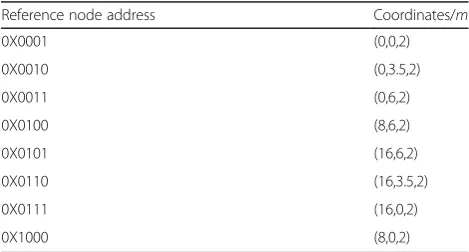
signal intensity of 8 beacon nodes, according to the radio signal strength and the related theory for posi-tioning the distance between the nodes and 8 beacon nodes. Then, the location model is established by using the location of distance information and bea-con nodes to determine the location of the locating node. Furthermore, the Kalman filtering model is established to filter the location message of the lo-cating node. See Table 1 for reference node ad-dresses and coordinates.
3.2 The emulation results
3.2.1 Emulation results of uniform motion of the robot Robot positioning includes robot position and direction of movement. Figure 4 shows that the uniform motion of the robot is true. Kalman filtering is close to the real orbit, and it can reduce noise interference. In Fig.4, the acceleration value processed by the Kalman filter algo-rithm is obviously different from the acceleration acqui-sition value, and the data obtained is more stable than the measured data. Because the attitude of moving
0 20 40 60 80 100 120 140
0 2 4 6 8 10 12 14
The sampling point
x/m
X's Karlman filtering position information X's the real position information
X's observation position information
Fig. 6Uniform motionXdirection effect
0 20 40 60 80 100 120 140
0 0.5 1 1.5 2 2.5 3 3.5 4
The sampling point
y/m
y's Karlman filtering position information y's real position information
y's observation position information
Fig. 7Uniform motionYdirection effect
objects is different, the acceleration is affected by gravity, so the measured value is a gravity accelerationg.
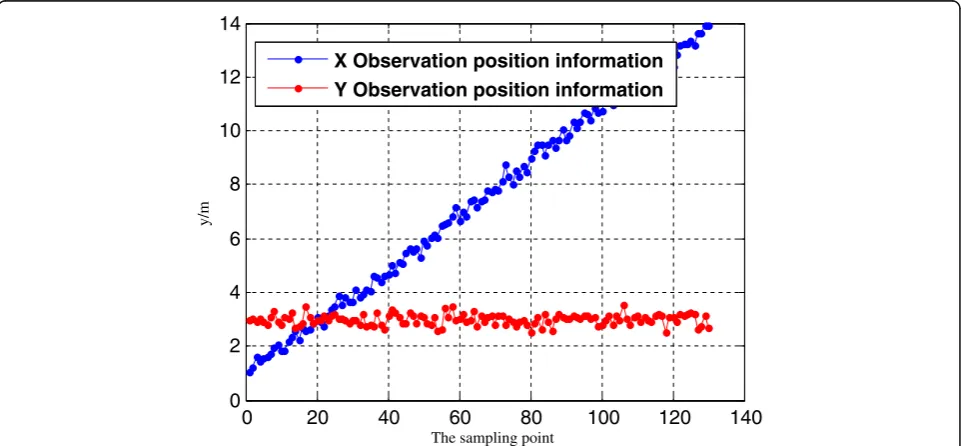
Figure 5 is the observation position information of X
and Y direction generated by simulation. The two-dimensional indoor road map of the robot shown in Fig.5 shows the real position and observed the position of the robot in uniform motion. Taking the cement ground covered with pebbles as the experimental plat-form, the global coordinates are set and the starting
heading angle of the robot is recorded as 0. Then, the straight and turning walking of the robot is realized by the encoder. In the process of robot motion, due to the influence of noise and odometer error, the actual trajec-tory of the robot deviates from the set trajectrajec-tory.
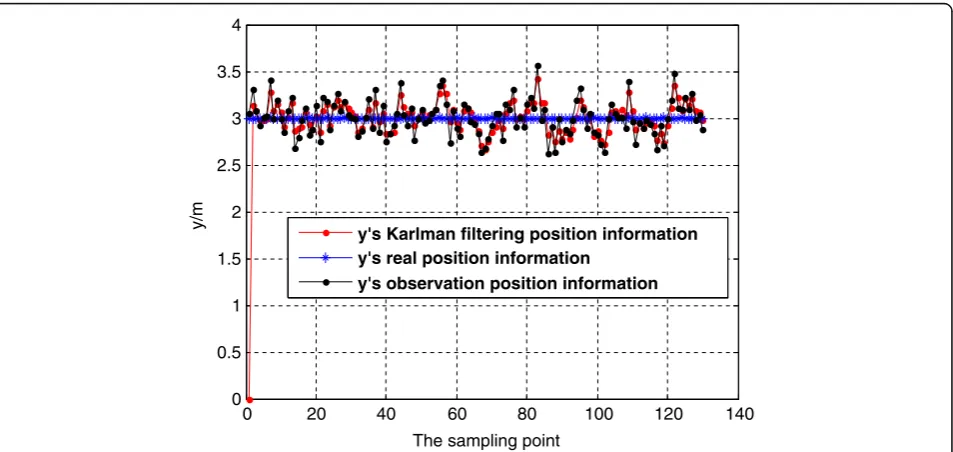
Figures 6 and 7 show that the tracking effect is very good in the effective detection range. The estimated mo-tion curve is accurate for the actual posimo-tion, which can reflect the actual state of the robot at the moment. In
0 2 4 6 8 10 12
-1 0 1 2 3 4 5 6 7
x/m
y/m
the real position information
the observation position information
Fig. 8The real and observation position information
0 10 20 30 40 50 60
-2 0 2 4 6 8 10 12
X's observation position information Y's observation position information
addition, it can be seen that because of the velocity com-ponent in theYdirection; therefore, the estimation error in the Y direction is larger than that in theX direction. Later, near the real motion trajectory error levels near constant; thus, it can be found that the Kalman filtering estimates of robot target motion trajectory prediction can achieve a better effect. Specific functions of the Kalman filter are as follows: The velocity and starting point
coordinates of the robot have a great error noise, and the label measurement value also has a great error noise. Kal-man filter can get the optimal coordinates, i.e., the optimal state, by fusing the above two noisy measurements to-gether. This is a noise reduction process. The filtered co-ordinates are noisy, but very small. When the optimal coordinates and noise arrive at the next time t+ 1, the label observations and noise oft+ 1 are deduced again as
0 10 20 30 40 50 60
0 2 4 6 8 10 12
The sampling poin
x/m
X's Karlman filtering position information X's real position information
X's observation position information
Fig. 10Xorientation effect. It can be found from this figure the orientation effect ofXdirection. Estimated curve for actual location estimation is more accurate and basically could reflect the actual status of robot at the moment, using Kalman filtering algorithm, and is used for the observation location information filtering
0 10 20 30 40 50 60
-1 0 1 2 3 4 5 6 7
The sampling point
y/m
Y's Karlman filtering position information Y's real position information
Y's observation position information
Fig. 11Yorientation effect. It can be found from this figure the orientation effect ofYdirection. Estimated curve for actual location estimation is more accurate and basically could reflect the actual status of robot at the moment, using Kalman filtering algorithm, and is used for the observation location information filtering
the input of filtering combined with the label observations oft+ 1. The optimal trajectory of the robot is deduced by the continuous autoregressive filtering of the algorithm. The smaller the intervalΔt, the higher the accuracy of fil-tering and the more accurate the trajectory is estimated.
3.2.2 Simulation results of robot uniform acceleration motion
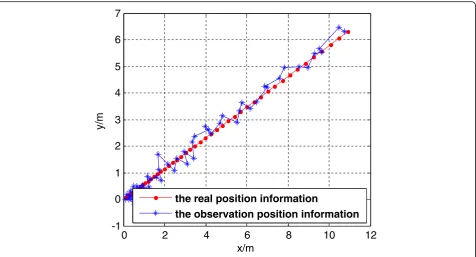
The 2D road map of the robot produced by simulation is shown in Fig.8. The position of the correspondingX direc-tion andYdirection is shown in Fig.9. From Figs.8and9, it can be clearly seen that the mean error of theYdirection is larger than that of theXdirection because of the velocity component in theYdirection. Kalman filter is close to the real trajectory. After reaching the real trajectory, the error level remains near zero, so it can be seen that the Kalman filter can really achieve good results in estimating and pre-dicting the trajectory of maneuvering target.
It can be found from Figs. 10 and 11 the orientation effect ofX direction andYdirection. In Figs.10and 11, multi-sensor information fusion technology is adopted. The main advantage is that it can provide better per-formance in the repeatability and complementarity of in-door robot motion observation information. The distance of obstacles around the robot is measured by uniformly spaced sonar, and multi-sensor information fusion is carried out. Based on the data of multi-sensor fusion, the navigation map of the robot can be estab-lished to achieve accurate positioning of indoor robot motion.
The partial correctness of the algorithm is proved by Floyd invariant assertion method. The termination of the algorithm is proved by a well-ordered set method. The al-gorithm is completely correct, which can be illustrated by the conclusion which is that the algorithm is partially cor-rect and can be terminated. The time complexity of the al-gorithm isO(n3), and the space complexity isO(n).
4 Results and discussion
Through simulation, it is shown that without using Kal-man filtering to make system optimization, the effects of indoor environment have a lot of interference noise, the error of RSSI values will be very big, there is more com-plex indoor environment confusion, and deviation sys-tem positioning precision is very large. Given an indoor environment, the proper selection of state error matrix and observation error array, an indoor robot positioning model and Kalman filter model are established, and Kalman filter autoregressive algorithm is used to optimize the estimated position coordinates of the robot. The simulation results show that when the Kalman filter is not used, the probability of robot positioning error is less than 1.8 m, and after the Kalman filter, the positioning error is less than 1.2
m. The positioning effect of the indoor robot is im-proved obviously.
In conclusion, the Kalman filtering algorithm can improve the positioning accuracy of the robot indoor. But there are other shortcomings that need to be fur-ther improved, such as that this article’s main re-search is limited in the two-dimensional space, cannot carry on the omnidirectional location meas-urement of carrier, and a further work that needs to be done is to study the robot positioning in this re-gard and the multidimensional space of carrier in order to realize the all-round position measurement. The main work in the future includes the integration and conversion of various indoor positioning modes, the perfect realization of the docking and conversion of indoor and outdoor mobile object positioning, the realization of a wide range of multi-choice positioning system, and the further improvement of positioning speed and accuracy, as well as the application in mo-bile terminals.
Abbreviations
APIT:Approximation point-in-triangulation test; GLONASS: Global Navigation Satellite System; GPS: Global Positioning System; RFID: Radio frequency identification; RSSI: Received signal strength indication; UWB: Ultra-wideband
Acknowledgements
The research presented in this paper was supported by Chao Hu University, Hefei, Anhui, China.
Funding
The research was funded within the project No. 2018zygc029 entitled “Network engineering excellence engineer education and training program,” supported by funds for a key project from Quality Engineering Project in Colleges and Universities in Anhui Province, No. ch18xnfz03 entitled “Network engineering virtual simulation experiment teaching center,” supported by funds for a project from Chao Hu University.
Availability of data and materials Not applicable.
Authors’contributions
JYL is the main writer of this paper. She proposed the main idea, proposed and deduced the idea, completed the simulation, and analyzed the result. XJL mainly translated the Chinese article into English. All authors read and approved the final manuscript.
Competing interests
The authors declare that they have no competing interests.
Publisher’s Note
Springer Nature remains neutral with regard to jurisdictional claims in published maps and institutional affiliations.
Received: 18 February 2019 Accepted: 3 May 2019
References
1. G. Wu, J. Zheng, J. Bao, et al., Mobile robot location algorithm based on image processing technology. EURASIP J. Image Video Process.2018(1), 107 (2018)
3. S.T. Lowe, J.L. Labrecque, C. Zuffada, et al., First spaceborne observation of an Earth reflected GPS signal. Radio Sci.37(1), 1–28 (2002)
4. M.B. Bokov, N.P. Velikanova, K. Vishnevskiy, et al.,“After 300 meters turn right”–the future of Russia’s GLONASS and the development of global satellite navigation systems. Foresight16(5), 448–461 (2014) 5. C. Lu, X. Li, F. Zus, et al., Improving BeiDou real-time precise point
positioning with numerical weather models. J. Geod.91(9), 1–11 (2017) 6. J. Prinsloo, R. Malekian, Accurate vehicle location system using RFID, an
internet of things approach. Sensors16(6), 825 (2016)
7. E.G. Lim, J. Wang, G. Juans, et al., Design of wearable radio frequency identification antenna. Wirel. Pers. Commun.98(4), 3059–3070 (2018) 8. P. Barge, P. Gay, V. Merlino, et al., Radio frequency identification
technologies for livestock management a. Can. J. Anim. Sci.93(1), 23–33 (2017)
9. C. Nguyen, T. Bui, V.D. Nguyen, et al., Modified tree-based identification protocols for solving hidden-tag problem in RFID systems over fading channels. IET Commun.11(7), 1132–1142 (2017)
10. A. Alarifi, A.M. Alsalman, M. Alsaleh, et al., Ultra wideband indoor positioning technologies: analysis and recent advances. Sensors16(5), 1–36 (2016) 11. M.W. Mehrez, G.K.I. Mann, R.G. Gosine, An optimization based approach for
relative localization and relative tracking control in multi-robot systems. J. Intell. Robot. Syst.85, 1–24 (2017)
12. M.S. Miah, J. Knoll, K. Hevrdejs, Intelligent range-only mapping and navigation for mobile robots. IEEE Trans. Ind. Inf.14(3), 1164–1174 (2018) 13. X. Fang, L. Nan, Z. Jiang, et al., Fingerprint localisation algorithm for noisy wireless sensor network based on multi-objective evolutionary model. IET Commun.11(8), 1297–1304 (2017)
14. C. Urrea, R. Muñoz, Joints position estimation of a redundant Scara robot by means of the unscented Kalman filter and inertial sensors. Asian J. Control
18(2), 481–493 (2016)
15. Q. Fan, B. Sun, S. Yan, et al., Data fusion for indoor mobile robot positioning based on tightly coupled INS/UWB. J. Navig.70(5), 1–19 (2017)
16. G. Du, Z. Ping, L. Xin, Markerless human–manipulator interface using leap motion with interval Kalman filter and improved particle filter. IEEE Trans. Ind. Inf.12(2), 694–704 (2017)
17. M. Alatise, G. Hancke, Pose estimation of a mobile robot based on fusion of IMU data and vision data using an extended Kalman filter. Sensors17(10), 2164 (2017)
18. X. Chen, X. Yuan, Q. Li, et al., Improving ultrasonic-based seamless navigation for indoor mobile robots utilizing EKF and LS-SVM. Measurement
92, 243–251 (2016)
19. J. Yang, J. Yang, Z. Cai, An efficient approach to pose tracking based on odometric error modelling for mobile robots. Robotica33(6), 1231–1249 (2015)
20. D. Zhu, B. Zhao, S. Wang, Mobile target indoor tracking based on multi-direction weight position Kalman filter. Comput. Netw.141, 115–127 (2018)