Home Automation System using Hand
Gestures and Speech Recognition Mechanism
Prasannajeet Rout1, Naresh Kumar Devasi R2, Ajay N3,
U G Student, Department of Computer Science and Engineering, SJC Institute of Technology, Chickballapur, Karnataka, India1
U G Student, Department of Computer Science and Engineering, SJC Institute of Technology, Chickballapur, Karnataka, India2
Assistant Professor, Department of Computer Science and Engineering, SJC Institute of Technology, Chickballapur, Karnataka, India3
ABSTRACT: Home automation is the recent technology which is helping to make the usage of gadgets as simple as
instructing another human being to do our tasks. The control of these gadgets can be done through speech control, hand gestures and through visual control. In this paper we suggest the automation controls by the means of gestures, speech and visual commands.
Gesture recognition is a challenging problem in its normal form. We are going to consider a stable set of manual commands and a reasonably organized environment, and develop a basic, so far effective, method for hand gesture recognition. Our methodology contains steps for segmenting the hand region, locating the fingers, and finally classifying the gesture. The algorithm is constant to rotation, translation and scale of the hand gesture. Along with that, speech control is an emerging innovative method to accomplish control tasks. In this work, a system iscreated to control two of the most human interactive activities; switching on and off of lights and fans using ATMEGA-328P microcontroller and Android OS’ speech recognition. This system improves the living standard by making life easier and increasing productivity.
KEYWORDS: Detection, hand gesture, home automation, recognition, real time.
I.INTRODUCTION
Vision-based automatic hand gesture recognition has been a very industrious research area in recent years with interesting applications such as human computer interaction (HCI), robot control, home automation, and sign language interpretation. The overall problem is bit difficult due a number of problems including the complex nature of static and dynamic hand gestures, complicated backgrounds, and obstructions.Speech recognition is the process of words into machine readable format, suitable for processing. The concept of controlling a device by speech was tested with mobile robots through a mechanism to process voice commands in quasi-natural language. Using near-field and far-field algorithm, a system of microphone arrays was made with the objective towards full spatial control of the robot through spatial voice commands. Upon receiving voice commands, the processing is conducted by recognizing individual words of the voice command by a Speech Recognition engine, using grammar rules, syntactic analysis using spread activation algorithm as well as semantic analysis based on procedural semantic network. These steps will initiate the device to receive instructions and perform action as how it is programmed.
II.LITERATURE SURVEY
In 1975, the first general purpose home automation network technology, X10, was developed. It is a communication protocol for electronic devices. It primarily uses electric power transmission wiring for signalling and control, where the signals involve brief radio frequency bursts of digital data, and remains the most widely available. By 1978, X10 products included a 16 channel command console, a lamp module, and an appliance module. Soon after came the wall switch module and the first X10 timer.
By 2012, in the United States, according to ABI Research, 1.5 million home automation systems were installed. There are three generations of home automation:
1. First generation: wireless technology with proxy server, e.g. Zigbee automation 2. Second generation: artificial intelligence controls electrical devices, e.g. Amazon Echo 3. Third generation: robot buddy who interacts with humans, e.g. Robot Rovio, Roomba.
III.METHODOLOGY
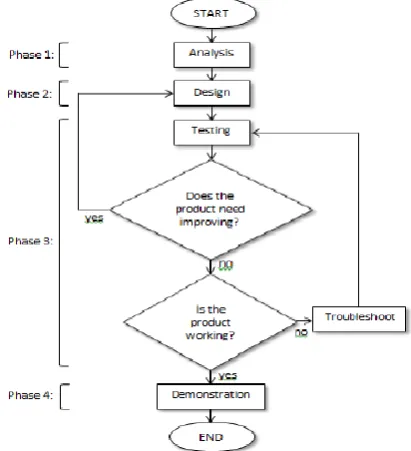
Rapid Application Development (RAD) model was used to develop the system, which provides the ability to shorten construction cycle to build a product. The figure shows the comparison between traditional and RAD models. The RAD model that will be used for developing the system is as shown below
Fig 3.1: Methodology implemented for development of the system
There are many advantages of this model. The main advantage is less development time is used. The advantages of RAD model are:
• Reduced development time. • Increase reusability of components.
• Integration from very beginning solves a lot of integration issues.
However, there are disadvantages of the model. The main disadvantage is this model requires an individual who is experienced and familiar with the system to be developed. The disadvantages of RAD model are:
• Depends on strong team and individual performances for identifying requirements of the system. • Only systems that are modular can be built using this model.
• High dependency on modelling skills.
• Team may be tempted to rush the product, skipping important planning and design consideration.
In the proposed system architecture, we can see that computer system is connected to the micro-controller board through USB port.
Fig 3.2: System Architecture
As shown above, we will be using webcam of the computer system for getting capturing signal. Connection between computer system and controller board is successfully done via
USB to Serial Convertor. Also, a
power unit must be connected to controller board for power supply. Finally, home appliances will be connected to the micro-controller with the help of relay.IV.HAND GESTURE RECOGNITION
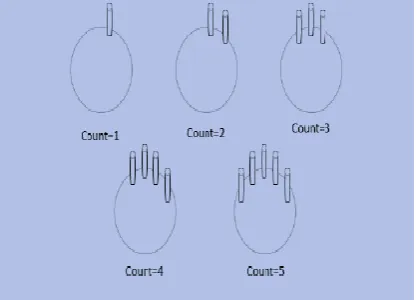
Consider a robot navigation problem, in which a robot responds to the hand pose signs given by a human, visually observed by the robot through a camera. This algorithm enables the robot to detect a hand pose in the image, as one of five possible commands. The recognized command will then be used as a regulator input for the robot to accomplish a certain set of action or execute certain tasks. The hand poses could be linked with several significances reliant on the function of the robot. For instance, a “one” count could mean “move reverse”, a “five” count could mean “fast”. Furthermore, “two”, “three”, and “four” counts could be interpreted as “forward”, “turn right,” and “turn left.”
Our projected technique of hand gesture recognition consists of the next steps: • Localizing hand-like regions based on skin colour
• Fragmentation and False-Region removal. • Discovering Convex points in contour. • Determine farthest points from convex vertex. • Filter out convexity defects.
• Finding finger count from defects.
Localizing Hand-like Regions by Skin Detection:
We shoulder that the part of the scene about the hand has previously been extracted. Then our first chore is to divide the hand in image from the background. We secure that goal in two phases. Firstly, we find the pixels in the image that are probable to have its place to the hand region, which we mention in this section. Then we simplify that result, as we describe in the next section.
It has been detected that the YCC coordinates are the differential characteristic feature for human skin colour. Our statistical analysis also upholds this claim. From this we spot that the YCC coordinates lies within a thin band of values for skin pixels, however it is much more variable for non-skin pixels. Hence, we could use these coordinates to determine whether a pixel belongs to the hand region or not. In precise, we pragmatically notice that the following range of YCC coordinates fruitfully capture hand-like intensities
YCC (0,131,80) to YCC(255,185,135)
This simple scheme could harvest many erroneous decisions, for example many contextual pixels having skin-like colours could be classified as “hand-like.” We refine this output in the next section.
Fragmentation and False-Region removal:
The design described in the previous section could produce many disconnected areas in the image classified as hand-like. We use concepts from region-based fragmentation to reduce this problem. Our presumption is that the largest connected skin coloured region belongs to the hand. So we use a comparative YCC coordinates to remove the undesired areas.
Discovering Convex points in contour:
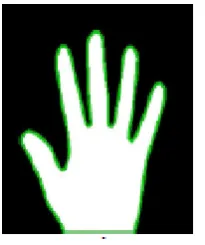
Considering the fragmented hand region, our main aim is to find out the convex points from the contour. Following figure depicts convex points over a hand region. This is showed by a green line of specified thickness around the segmented hand region.
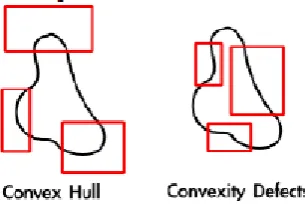
Further we will find out the convexity defects and convexity hulls from the above obtained image. These terms are explained below in pictorial from.
Fig 4.3: Convex hull and convex defects
Determine farthest points from convex vertex:
We will need to find out these convex defects and hulls from the previously obtained hand region with convex points. This is the task of determining point farthest away from each convex vertex. These farthest points will be known as Convexity defects. So initially we will construct another margin around the hand region. This margin is shown by red coloured line of specified thickness. This contour will be marked only considering the extreme points of hand region leaving the defects. After this our major task is to find out convexity defects with the help of previously mentioned concept. Diagram below shows the plotting of defects (small circles) between fingers.
Fig 4.4: Steps to find defects
These defects will be further used by the system to count the number of active fingers.
Filter out convexity defects:
As we have got the defect points on hand, now final task is to filter out the convexity defects that are not relevant. This step consists of filtering of captured image. Finally we will obtain a hand image with necessary and vital convexity defects, which will be processed further. Last image shows filtered segmented hand region.
Finding finger count from defects:
V.HARDWARE IMPLEMENTATION
As the entire model is a combination of both speech recognition as well as vision based hand gesture recognition, the two different modules will be integrated but have separate functioning mechanisms.
Speech recognition module
Initial design from Instructables shows a system controlling LEDs using an Android smartphone via Bluetooth. The system’s hardware was improved so that it can control electrical devices such as light and fan. The improved system is as shown in Fig: 5.1, where there is an addition of a 2 relay module, battery representing power source, motor and LED to represent electrical devices controlled by the system, and voltage divider from the TX pin of Arduino Uno R3 to the RX pin of the
Bluetooth module HC-06 was created using open-source software called Fritzing
(www.fritzing.org) where it enables users to create circuit graphically, in schematic, and in PCB.
Fig: 5.1 Circuit developed using Fritzing application
Vision based hand gesture recognitionmodule
VI.SOFTWARE IMPLEMENTATION
The software is being implemented for the speech recognition system for now primarily and the software controls for hand gesture recognition will be integrated with this software as a sub-module.
The design of software is represented in Fig: 6.1.The system must be connected to an Android OS smart phone with Bluetooth capabilities to work. The software was designed to be compatible with the Arduino IDE, which uses C language to program. Arduino IDE is chosen because it is an IDE that is well maintained by a community of developers.
VII.CONCLUSION
Based on our inspiring home automation applications, we have only considered a limited set of gestures. Our algorithm can be stretched in a number of techniques to classify a wider set of gestures. The dissect portion of our algorithm is too simple, and would need to be enhanced if this technique is to be used in challenging operating conditions. However we should note that the separation problem in a general setting is an open research problem itself.
The speech recognition module will be able to record the speech samples to a limited number as this is a prototype model with a small memory capacity so in the real world scenario it can be used by a single user for the home appliances controlling system.
REFERENCES
[1] C.-C. Chang, I.-Y Chen, and Y.-S. Huang, "Hand Pose Recognition Using Curvature Scale Space", IEEE International Conference on Pattern
Recognition, 2002.
[2] L. Bretzner, I. Laptev, and T. Lindberg, "Hand Gesture Recognition using Multi-Scale Color Features, Hierarchical Models and Particle
Filtering", IEEE International Conf. on Automatic Face and Gesture Recognition, 2002.
[3]Casimiro, (2014) Voice Activated Arduino (Bluetooth +Android). Retrieved from: http://www.instructables.com/id/Voice-Activated-Arduino-Bluetooth-Android