A Novel Technique for Computing Shortest
Path Using Traffic Analysis Approach
Roshni Kharche1, Manjiri Karande 2, Bharat Chaudhari3
P.G. Student, Department of Computer Engineering, VBKCOE, Malkapur, Maharastra, India1
Assistant Professor, Department of Computer Engineering, VBKCOE, Malkapur, Maharastra, India2
Assistant Professor, Department of Computer Engineering, VBKCOE, Malkapur, Maharastra, India3
ABSTRACT: The online most limited way issue goes for figuring the briefest way in view of live movement circumstances. This is extremely critical in advanced auto route frameworks as it helps drivers to settle on sensible choices. To our best learning, there is no effective framework/arrangement that can offer reasonable expenses at both customer and server sides for online most brief way processing. The customary server structural engineering scales inadequately with the quantity of customer. A promising methodology is to let the server gather live movement data and after that telecast them over radio or remote system. This methodology has fantastic versatility with the quantity of customers. Subsequently, we add to another structure called live movement record (LTI) which empowers drivers to rapidly and viably gather the live movement data on the TV channel. An amazing result is that the driver can process/overhaul their most brief way come about by getting just a little division of the list. Our trial study demonstrates that LTI is powerful to different parameters and it offers moderately short tune-in expense (at customer side), quick inquiry reaction time (on the customer side), little telecast size (on server side), and light support time (at server side) for online most brief way issue.
KEYWORDS: LTI, Index.
I. INTRODUCTION
again from the supplier (called result transmission model).On the other hand, given the fast progress of cell phones and administrations, this model is confronting versatility restrictions as far as system data transmission and server stacking. As indicated by the Cisco Visual Networking Index figure[13], worldwide versatile movement in 2010 was 237 petabytes for each month and it developed by 2.6-fold in 2010, almost tripling for the third year in succession[14]. The world's cell systems need to give 100 times the limit in 2015 when contrasted with the systems in 2011. Besides, live movement are overhauled often as this information can be gathered by utilizing crowd sourcing procedures (e.g., unknown activity information from Google map clients on certain cell phones). Accordingly, immense correspondence expense will be spent on sending result ways on this model. Clearly, the customer server construction Modelling will soon get to be unrealistic in managing monstrous live movement in close future. Ku et al[15]. Bring the same concern up in their work which forms spatial inquiries in remote show situations in light of Euclidean separation metric. Malviya et al. [16] developed a client-server system for continuous monitoring of registered shortest path queries.For each registered query the server first precomputes K different candidate paths from s to t. After that server periodically updates the travel times on these K paths based on the latest traffic, and reports the current best path to the corresponding user.
a) Shortest route using pre-stored weights b)Shortest route using live traffic (by LTI) Fig.1 Two alternative shortest paths in Manhattan
II. RELATED WORK
A. AN EFFICIENT PATH COMPUTATION MODEL FOR HIERARCHICALLY STRUCTURED
TOPOGRAPHICAL ROAD MAPS
We have developed a HiTi i,e. Hierarchical MulTi graph model for structure large topographical roadmaps to speed up the minimum cost route calculation. The HiTi graph model provides a novel approach
to
abstract and structuring a topographical roadmap in a hierarchical fashion. We suggest a new shortest path algorithm named SPAH, which utilize HiTi graph form of a topographical roadmap for its computation. We give the proof for the optimality of SPAH. Our performance analysis of SPAH on grid graphs show that it appreciably reduces the search space over existing method. We also present an in-depth experimental study of HiTi graph process by comparing it with other similar works on grid graphs. Within the HiTi graph framework, we also suggest a parallel shortest path algorithm named ISPAH. Experimental results shows that inter query shortest path trouble provide additional opportunity for scalable parallelism than the intra query shortest path trouble.B. SHORTEST PATH TREE COMPUTATION IN DYNAMIC GRAPHS:
Let G = (V, E, omega) be a simple digraph, in which all edge weights are nonnegative real information. Let G' be obtain from G by a request of a set of edge weight updates to G. Let sin V and let Ts and Ts' be Shortest Path Trees i.e,SPTs fixed at s in G and G', correspondingly. The Dynamic Shortest Path i.e,DSP difficulty is to calculate Ts' from Ts. Existing work on this difficulty focus on either a single edge weight change or multiple edge weight change in which some of them are incorrect or are not optimized. We correct and extend a few state-of-the-art dynamic SPT algorithms to handle several edge weight update. We prove that these algorithms are correct. Dynamic algorithms may not outperform static algorithms all the time. To educated guess the proposed dynamic algorithms, we assess them with the well-known static algorithm.
C. DATA ON AIR : ORGANIZATION AND ACCESS
Organizing huge amount of data on wireless communiqué networks in order to give fast and low power access to users set with palmtops, is a novel challenge to the data organization and telecommunication communities. Solutions have to take under consideration the physical restrictions of low network bandwidth and incomplete battery life of palmtops. This paper proposes algorithms for multiplexing clustering and non clustering indexes beside with data on wireless networks. The power consumption and the latency for obtaining the required data are considered as the two basic presentation criteria for all algorithms. First in the paper describe 2 algorithms that is, (1, m) indexing and another distributed Indexing, for multiplexing data and their clustering index. Secondly an algorithm such called as Non clustered Indexing is described for allocating static data and its corresponding non clustered index. Then, the Non clustered indexing algorithm is widespread to the case of multiple indexes. At last the proposed algorithms are analytically established to lead to important improvement of battery life while retain a low latency.
III.IMPLEMENTATION
Fig.2 System Architecture
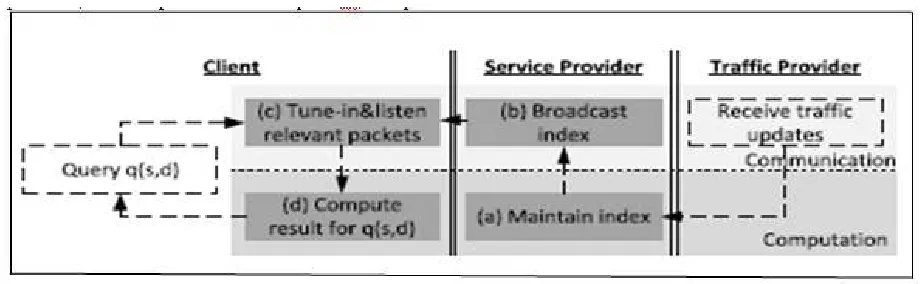
The service provider occasionally receives live traffic update as of the traffic provider and broadcasts the live traffic index on radio or wireless system such as 3G, LTE, and Mobile WiMAX. as soon as a mobile client wishes to figure and monitor a shortest path, it listens to the live traffic index and reads the relevant portion of the index for computing the shortest path. In this work, we focus on handling traffic updates but not graph structure updates. For actual road networks, it is rare to have graph structure updates such as construction of a new road when compare to edge weight updates. Thus, we assume that the graph structures are distributed to every client in advance i,e. by monthly updates or at system boot-up via typical transmission protocol such as HTTP and FTP. We demonstrate the components and system flow in our LTI framework.
Fig.3 Components of LTI
The above figure 3shows the component of live traffic Index .The components shaded by gray color are the core of LTI. In order to offer live traffic information, the server maintains such that component a and broadcasts eg. Component b the index according to the up-to-date traffic circumstances. In order to compute the online shortest path, a client listens to the live traffic index, reads the appropriate portion of the index i.e. component c, and compute the shortest path from source to destination i.e, component d.
A. ALGORITHM: SHORTEST PATH COMPUTATION
Initialize Single-Source (G, s)
Initialize priority queue Q i.e., Q ← V[G]
while priority queue Q is not empty do
u ← EXTRACT_MIN(Q) // drag out new vertex
S ← S U{u} // present relaxation for each vertex v adjacent to u
for each vertex v in Adj[u] do
Relax (u, v, w)
B. MATHEMATICAL MODEL:
The below are the some mathematical term which are used,
Let S is the System which Consist of
S= {I, P, O}
I = Input.
I = {U, Q, A, S,}
U = User
U = {u1,u2,u3….un}
Q = Query Entered by user
Q = {q1, q2, q3,q4…qn}
A = Algorithm
S = Source
IV.EXPERIMENTAL RESULTS
The system has been implemented for online shortest path and live traffic detail and also adds a new category on the system. In this system it simultaneously adds and updates the data such as traffic simultaneously and we get a updated current online shortest path and traffic detail. Table shows comparison between existing system and proposed system in case of efficiency.
A) PERFORMANCE ANALYSIS:
Table 1: Efficiency of proposed system against various existing systems
Algorithms Existing System Proposed System
Robust Hash 80.1% About 87.9%
Piecewise Inverted Index 88.4% About 91.8%
Approximate Nearest
Neighbour search
In table 1, we calculated the efficiency of various existing system with respect to the proposed system. By using robust hash algorithm they get 80.1% efficiency and from proposed system we get about 87.9% of efficiency. After that piecewise inverted index algorithm have 88.4% with respect to proposed system we get about 91.8% efficiency. Approximate nearest neighbor search have 83.2% efficiency and proposed system get about 89.5%. From this calculation the proposed system is more efficient than previous system.
Fig.4 Efficiency of pos tagging verses hash tagging.
In this above figure 4 which consist of efficiency of pos tagging verses hash tagging for existing algorithm such as robust hash , piecewise inverted index and approximate nearest search versus proposed system in terms of percentage.
V. CONCLUSION
In this project we studied online shortest path computation; the shortest path result is computed/ updated based on the live traffic circumstances. We carefully analyse the existing work and discuss their inapplicability to the problem to address the problem, we suggest a promising architecture that broadcasts the index on the air. We first identify an important mark of the hierarchical index structure which enables us to compute shortest path on a small portion of index. In our project we also add some traffic detail from our system and give detail information about traffic and also add some category detail about some specific category such as college etc. This important feature is thoroughly used in our solution, LTI.
REFERENCES
[1] Leong Hou U, Hong Jun Zhao, Man Lung Yiu, Yuhong Li, and Zhiguo Gong,“ Towards Online Shortest Path Computation”, IEEE Transactions On Knowledge And Data Engineering, Vol. 26, No. 4, April 2014.
[2] H. Bast, S. Funke, D. Matijevic, P. Sanders, and D. Schultes, “In Transit to Constant Time Shortest-Path Queries in Road Networks”, Proc. Workshop Algorithm Eng. and Experiments (ALENEX), 2007.
[3] P. Sanders and D. Schultes, “Engineering Highway Hierarchies”, Proc. 14th Conf. Ann. European Symp. (ESA), pp. 804-816, 2006. [4] G. Dantzig, “Linear Programming and Extensions”, series Rand Corporation Research Study Princeton Univ. Press, 1963.
[7] P. Sanders and D. Schultes, “Highway Hierarchies Hasten Exact Shortest Path Queries”, Proc. 13th Ann. European Conf. Algorithms(ESA), pp. 568-579, 2005.
[8] D. Schultes and P. Sanders, “Dynamic Highway-Node Routing ”,Proc. Sixth Int’l Conf. Experimental Algorithms (WEA), pp. 66-79,2007. [9] F. Zhan and C. Noon, “Shortest Path Algorithms: An Evaluation Using Real Road Networks”, Transportation Science, vol. 32, no. 1,pp. 65-73,
1998.
[10] “NAVTEQ Maps and Traffic”, http://www.navteq.com, 2014.
[11] “INRIX Inc. Traffic Information Provider”, http://www.inrix.com, 2014. [12] “TomTom NV”, http://www.tomtom.com, , 2014.
[13] “Cisco Visual Networking Index: Global Mobile Data Traffic Forecast Update, 2010-2015”, 2011. [14] D. Stewart, “Economics of Wireless Means Data Prices Bound to Rise”, The Global and Mail, 2011.
[15] W.-S. Ku, R. Zimmermann, and H. Wang, “Location-Based Spatial Query Processing in Wireless Broadcast Environments”, IEEE Trans. Mobile Computing, vol. 7, no. 6, pp. 778-791, June 2008.
[16] N. Malviya, S. Madden, and A. Bhattacharya, “A Continuous Query System for Dynamic Route Planning”, Proc. IEEE 27th Int’l Conf Data Eng. (ICDE), pp. 792-803, 2011.
[17] G. Kellaris and K. Mouratidis, “Shortest Path Computation on Air Indexes”, Proc. VLDB Endowment, vol. 3, no. 1, pp. 741-757, 2010. [18] Y. Jing, C. Chen, W. Sun, B. Zheng, L. Liu, and C. Tu, “Energy-Efficient Shortest Path Query Processing on Air”, Proc. 19th