Application of Goal Programming on Yield
Optimization of Selected Agricultural Crops
Shivatharsinii Jeyavanan1, Sarath B. Siyambalapitiya2, Karthigesu Jeyavanan3
Student, Department of Mathematics, Faculty of Science, University of Peradeniya, Kandy, Sri Lanka1 Professor, Department of Engineering Mathematics, Faculty of Engineering, University of Peradeniya, Kandy,
Sri Lanka2
Lecturer, Department of Agronomy, Faculty of Agriculture, University of Jaffna, Kilinochchi, Sri Lanka3
ABSTRACT:A study was carried out in the field of agriculture to optimize the yield of the crops by the application of goal programming. From the review of literature, it can be seen that the application of optimization models in agriculture is comparatively less in scientific world. Hence, crops such as chilli and string bean were selected for the study, assigning with different levels of spacing and fertilizer under monocropping and intercropping systems. Yield was optimized with application of input cost such as weeding, land preparation, irrigation and planting materials to find out the optimum yield over recommended yield through goal programming. From this optimization model, plant number and planting material cost were optimized by 14.6 % and 14.3 %, respectively. Total recommended and optimized yield of green chilli under monocropping were 58 ton/ha and 51.25 ton/ha, respectively. Similarly, under intercropping, total recommended and optimized yield of green chilli were 28 ton/ha and 21.25 ton/ha, respectively. However, the recommended and optimized yield of string bean were 17.28 ton/ha and 14.9 ton/ha respectively under each system due to equal number of the population maintained in both systems.
KEYWORDS:Agriculture, Crops, Goal programming, Optimization, Yield.
I. INTRODUCTION
cost. Objective of the study is to optimize the yield of the crops for different levels of fertilizer and spacing under both intercropping and monocropping system.
II. MATERIALS AND METHODS
Crops such as string bean and chilli were selected for the study. Different levels of organic fertilizer (F1-control;
F2-450 g/6 m2; F3-1,200 g/6 m2; F4-1,800 g/6 m2), spacing (string bean: S1-90 cm×30 cm; S2-100 cm×35 cm; S3-110
cm×40 cm) (chilli: S1-45 cm×60 cm, S2-100 cm×35 cm; S3-55 cm×70 cm) and cropping systems (M1-monocropping
of chilli and string bean; M2- Intercropping of chilli and string bean) were taken as treatments for the optimization.
Field plot was assigned in randomized complete block design with dimension of 3 meters length and 2 meters width. Total planting areas was assessed to be 648 square meters. Projected areas for each crop were 432 square meters. Projected areas for each system of intercropping and monocropping were 216 square meters. Around 5 kg of
azosprillum bio-fertilizer was mixed with 100 kg super compost mixture containing 30 kg super compost and 70 kg reddish soil is recommended for one acre of field (VDF, undated). Expected yield and planting material (PM) cost were determined based on the required number of planting materials. Yield and inputs of crops were taken as objectives and constraints, respectively. Objectives were formulated with the application of the following constraints in the experiment (Table 1).
Model application for optimization
Optimization model was applied on recommendation of the agriculture. Objectives were taken with the application of constraints in the experiment.
Table 1: Variable Description
Variables Crops Cropping systems i j
Chilli Monocropping
Fertilizer i=1,2,3,4
Spacing j=1,2,3 Stringbean Monocropping
Chilli Intercropping Stringbean Intercropping
Table 1 shows the variables of two crops: chilli and string bean, cropping system: monocropping and intercropping, levels of fertilizer: i=1,2,3,4 and levels of spacing:j=1,2,3.
Let be the number of chilli plants in monocropping in thfertilizer th spacing level. = 1,2,3,4and = 1,2,3
be the number of string bean plants in monocropping in th fertilizer th spacing level. = 1,2,3,4and = 1,2,3
be the number of chilli plants in intercropping in th fertilizer th spacing level. = 1,2,3,4and = 1,2,3
be the number of string bean plants in intercropping in th fertilizer th spacing level. = 1,2,3,4 And = 1,2,3
Objective 1: Maximize the expected yield of chilli in monocropping (Eq.1)
= 2,700∗ ≥302,000
Where,
Objective 2: Maximize the expected yield of string bean in monocropping (Eq.2)
= 972∗ ≥186,624
Where,
Z is the expected yield of string bean, such thatx be the number of plants in a plot with the ith fertilizer in jth spacing
Objective 3: Maximize the expected yield of string bean and chilli in intercropping (Eq.3)
= 2,700∗ + 972∗ ≥489,024
Where,
Where is the expected yield of chilli and string bean, such that and be the number of plants in a plot with the ith fertilizer in jthspacing
Constraint 1: Total cost (Eq.4)
4∗ + + 6∗ + ≤11,040
Total cost obtained should be limited for Rs 11,040. This constraint should be satisfied because cost optimization is much important.
Constraint 2: Total chilli plant available (Eq.5)
+ ≤1,034
Total number of chilli plant should be limited to 1,034.
Constraint 3: Total number of string bean available (Eq.6)
+ ≤1,152
Total number of string bean should be limited to 1,152.
Constraint 4: Total fertilizer available (Eq.7)
0∗ + + + ) + 32,400∗( + + + + 64,800∗( +
+ + + 97,200∗ + + + ≤97,200
Total fertilizer available for total plants should be less than 97,200 g. Maximum fertilizer available according to recommended level is 97,200 g.
Constraint 6: Total number of plants in each plot (Eq.9 – Eq.56)
25≤ ≤28, 12≤ ≤15, 12≤ ≤15, 25≤ ≤28,
12≤ ≤15, 12≤ ≤15, 25≤ ≤28 12≤ ≤15,
12≤ ≤15, 25≤ ≤28, 12≤ ≤15, 12≤ ≤15,
15≤ ≤18, 12≤ ≤15, 12≤ ≤15, 15≤ ≤18,
12≤ ≤15, 12≤ ≤15, 15≤ ≤18, 12≤ ≤15
12≤ ≤15, 15≤ ≤18, 12≤ ≤15, 25≤ ≤15
13≤ ≤16, 03≤ ≤06, 03≤ ≤06, 13≤ ≤16
03≤ ≤06, 03≤ ≤06, 13≤ ≤16, 03≤ ≤06
03≤ ≤06, 13≤ ≤16, 03≤ ≤06, 03≤ ≤06
15≤ ≤18, 12≤ ≤15, 12≤ ≤15, 15≤ ≤18
12≤ ≤15, 12≤ ≤15, 15≤ ≤18, 12≤ ≤15
12≤ ≤15, 15≤ ≤18, 12≤ ≤15, 12≤ ≤15
Each category of plants should be within range maximum and minimum number of plants that should be allocated within a plot.
Other constraints
, , , ≥0 (Eq.57)
, , , − (Eq.58)
The Excel software was used as a tool to solve the goal programming model. The solver function is very useful to elucidate the goals. In model solving procedure, each goal was satisfied to get success model. Condition of the model is that each yield obtained by our model is greater than the recommended level.
III.EXPERIMENTAL RESULTS
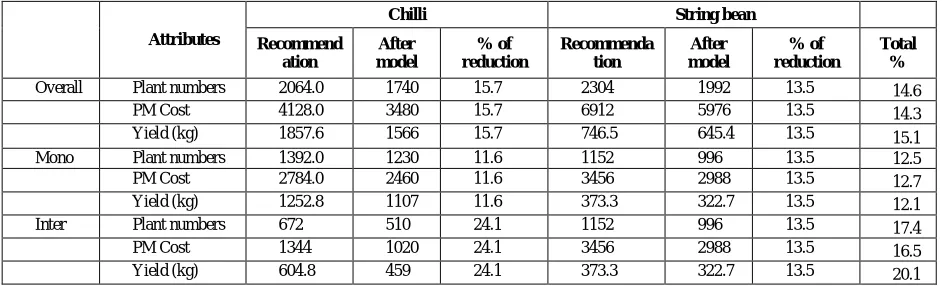
Table 2: Inputs of experiment in both chilli and string bean after model application
Attributes
Chilli String bean
Recommend ation After model % of reduction Recommenda tion After model % of reduction Total %
Overall Plant numbers 2064.0 1740 15.7 2304 1992 13.5 14.6
PM Cost 4128.0 3480 15.7 6912 5976 13.5 14.3
Yield (kg) 1857.6 1566 15.7 746.5 645.4 13.5 15.1
Mono Plant numbers 1392.0 1230 11.6 1152 996 13.5 12.5
PM Cost 2784.0 2460 11.6 3456 2988 13.5 12.7
Yield (kg) 1252.8 1107 11.6 373.3 322.7 13.5 12.1
Inter Plant numbers 672 510 24.1 1152 996 13.5 17.4
PM Cost 1344 1020 24.1 3456 2988 13.5 16.5
Yield (kg) 604.8 459 24.1 373.3 322.7 13.5 20.1
Note: PM: planting materials; recommended average yield of chilli and string bean per plant was 900g and 324g, respectively. From optimized number of plants, yield and planting material cost were calculated. Cost of chilli and string bean per plant was Rs.2 and 3, respectively. From optimized number of plants, cost was calculated. Expected sales price of chilli and string bean per kg was Rs.50 and 70, respectively.
Table 2 shows the details of attributes of plant numbers, planting materials cost and yield for recommended, after model application and % of optimization.
IV. CONCLUSION
From this experiment, it can be concluded that required number of planting materials and cost of planting materials were optimized by this optimization model. By considering the input cost, model was run to obtain the optimized yield. Farmer can get the optimum yield and safe income by this reduced number of planting materials.
REFERENCES
[1] Adekanmbi, O. and Olugbara1, O.,“Multi objective Optimization of Crop-mix Planning Using Generalized Differential Evolution Algorithm”, Journal of Agriculture Science Technology, vol.17, pp. 1103-1114, 2015.
[2] DOA, Crop recommendation, Department of Agriculture, Peradeniya, Sri Lanka. http://www.doa.gov.lk/index.php/en/crop-recommendations,undated, Accessed on 12/04/2016
[3] Janova,J. Crop plan optimization under risk on a farm level in the Czech Republic, Agriculture Economics – Czech, vol.60, no.3, pp. 123–132, 2014.
[4] Shivatharsinii, K., Siyambalapitiya, S.B.,and Jeyavanan,K.,Yield optimization of chilli and string bean for different levels of spacing and organic fertilizer under intercrop and monocrop systems, Proceedings of the Peradeniya University International Research Sessions, Sri Lanka, held at Faculty of Dental Science on 4th & 5th November, vol.20, pp. 268, 2016
[5] Anon, Allocation of Agricultural Land To The Major Crops of Saline Track By Linear Programming Approach: A Case Study, international journal of scientific & technology research, vol.1, pp. 21-25, undated
[6] Berbel,J., Analysis of protected cropping: an application of multi-objective programming techniques to Spanish horticulture. European Review of Agricultural Economics, vol.16, pp.203-216, 1989
[7] Mansourifar, M., Almassi, M., Borghaee, M.,and Moghadassi,R.,Optimization Crops Pattern in Variable Field Ownership, World Applied Sciences Journal, vol.21, pp. 492-497, 2013.
[8] Muncan, M.,The use of models in optimizing the field crop production in agricultural enterprise - MBA thesis - Applied Studies in Agribusiness and Commerce, Agroinform Publishing House, Budapest, pp. 93-96,undated
[9] Qingzhen,Z., Changyu, W., Zhimin, Z., Yunxiang, Z.,Chuanjiang, W.,The Application of Operations Research in the Optimization of Agricultural Production. Operations Research, vol. 39, 194-205,1991.
[10] Rani, Y.R., and Rao, P. T.,Multi Objective Crop Planning For Optimal Benefits, International Journal of Engineering Research and Applications, vol.2, pp.279-287,2012.
[12] Scarpari, M. S.,and Ferreira de Beauclair,E. G., Optimized agricultural planning of sugarcane using linear programming, Revista Investigacion Operational, vol.31, pp. 126-132, 2010.
[13] Sirotenko, O.D.,and ,V.A., Mathematical models of agricultural supply, Mathematical models of life support systems, vol.2,pp.1-9(http://www.eolss.net/Eolss-sampleAllChapter.aspx, undated
[14] VDF,Biofertilizer-Azosprillum, Leaflet, Vaddukoddai Development Foundation, Jaffna, Sri Lanka.