R E S E A R C H
Open Access
Synchronization stability of delayed
discrete-time complex dynamical networks
with randomly changing coupling strength
MJ Park
1, OM Kwon
1*, Ju H Park
2, SM Lee
3and EJ Cha
4*Correspondence: [email protected]
1School of Electrical Engineering, Chungbuk National University, 52 Naesudong-ro, Heungduk-gu, Cheongju, 361-763, Republic of Korea
Full list of author information is available at the end of the article
Abstract
This paper addresses a delay-dependent synchronization stability problem for discrete-time complex dynamical networks with interval time-varying delays and randomly changing coupling strength. The randomly changing coupling strength is considered with the concept of binomial distribution. By constructing a suitable Lyapunov-Krasovskii functional and utilizing reciprocally convex approach and Finsler’s lemma, the proposed synchronization stability criteria for the networks are established in terms of linear matrix inequalities which can be easily solved by various effective optimization algorithms. The networks are represented by use of the Kronecker product technique. The effectiveness of the proposed methods will be verified via numerical examples.
1 Introduction
During the last few years, complex dynamic networks (CDNs), which is a set of inter-connected nodes with specific dynamics, have received increasing attention from the real world such as the Internet, the World Wide Web, social networks, electrical power grids, global economic markets, and so on. Also, many models were proposed to describe vari-ous complex networks, small-world network and scale-free network,etc.For more details, see the literature [–]. In the implementation of many practical CDNs, there exists time-delay because of the finite speed of information processing or amplifiers. It is well known that time-delay often causes undesirable dynamic behaviors such as oscillation and insta-bility of the network. Therefore, various approaches to synchronization analysis for CDNs with time-delay have been investigated in the literature [–]. By using network mod-eling with coupling delays, Liet al.[] proposed, for the first time, the synchronization criteria for the CDNs with time-delay which were expressed in the form of linear matrix inequalities (LMIs). Kooet al.[] presented a synchronization criterion for singular CDNs with time-varying delays. In [–], various synchronization problems are addressed for discrete-time CDNs with delay. In this regard, discrete-time modeling with time-delay plays an important role in many fields of CDNs. Moreover, to implement the net-work, the network uses digital computers (usually a microprocessor or microcontrollers) with the necessary input/output hardware. The fundamental character of the digital com-puter is that it computes answers at discrete steps.
On the other hand, in [–], the problems for various systems with randomly occur-ring delay, uncertainties and nonlinearities were considered. The randomly occuroccur-ring
siderations in these literature works are described by the Bernoulli distribution. Here, the Bernoulli distribution is recognized as the experiment for the combination ofUidentical subexperiments. For more details, letAbe the elementary event having one of the two possible outcomes as its element.A¯ is the only other possible elementary event. At this time, we shall repeat the basic experimentsUtimes and determine the probability thatA is observed exactlyvtimes out ofUtrials. Such repeated experiments are called Bernoulli trials []. Moveover, in [], the stability of stochastic difference equations was addressed based on the Lyapunov functionals.
Regarding the CDNs, the coupling strength is the information of coupling strength be-tween agents and a leader. Since an environmental change exists in practical networks, the change of coupling strength is a considerable factor affecting dynamics for the worse of the networks. At this point, the randomly changing coupling strength is being put to use in the problem of synchronization stability for CDNs. Moreover, to the best of authors’ knowledge, the synchronization analysis of CDNs with changing coupling strength has not been formulated yet.
Motivated by the results mentioned above, in this paper, a synchronization stability problem for discrete-time CDNs with interval time-varying delays and randomly changing coupling strength will be studied. This information is one of randomly occurring coupling strength with binomial distribution. Put simply, the first and simplest random variable is the Bernoulli random variable. LetXbe a random variable that takes on only two possi-ble numerical values,X() ={, }, whererepresents the universal set consisting of the collection of all objects of interest in a particular context. Multiple independent Bernoulli random variables can be combined to construct more sophisticated random variables. SupposeXis the sum ofwindependent and identically distributed Bernoulli random vari-ables. ThenXis called a binomial random variable with parametersw, the number of trials, andp, the probability of success for each trial. Thus, the binomial distribution is a general-ization of the Bernoulli distribution. Also, since delay-dependent analysis makes use of the information on the size of time delay, more attention has been paid to the delay-dependent analysis than to the delay-independent one []. That is, the former is generally less con-servative than the latter. Therefore, a great number of results on a delay-dependent stabil-ity condition for time-delay systems have been reported in the literature [–]. So, by construction of a suitable Lyapunov-Krasovskii functional and utilization of a reciprocally convex approach [], a synchronization stability problem for discrete-time CDNs with interval time-varying delays and randomly changing coupling strength is derived in terms of LMIs which can be solved efficiently by use of standard convex optimization algorithms such as interior-point methods []. Moreover, the discrete-time CDNs are represented by use of the Kronecker product technique. Two numerical examples are included to show the effectiveness of the proposed methods.
matrix.X[f(t)]∈Rm×nmeans that the elements of matrixX[f(t)]include the scalar value of f(t).
2 Problem statements
Consider the following discrete-time CDNs with interval time-varying delays in the cou-pling term
yi(k+ ) =fyi(k),yik–h(k)+c N
j=
gijyjk–h(k), i= , , . . . ,N. ()
Here,N is the number of coupled nodes,nis the number of state of each node,yi(k) = [yi(k),yi(k), . . . ,yin(k)]T ∈Rn is the state vector of the ith node. f(yi(k)) = [f(yi(k)), f(yi(k)), . . . ,f(yin(k))]∈Rnis a continuous differentiable vector function. The constant c> is the coupling strength.h(k) is an interval time-varying delay satisfying ≤hm≤ h(k)≤hM, wherehmandhMare known positive integers.
= [γij]n×nis the inner-coupling matrix of nodes, in whichγij= means two coupled nodes are linked through theirith andjth state variables; otherwise,γij= .G= [gij]N×N is the outer-coupling matrix of the network, in whichgijis defined as follows. If there is a connection between nodeiand nodej(j=i), thengij=gji= ; otherwise,gij=gji= (j=i), and the diagonal elements of the matrixGare defined by
gii= – N
j=,i=j gij= –
N
j=,i=j
gji, i= , , . . . ,N. ()
In order to investigate the synchronization stability analysis for discrete-time CDNs with interval time-varying delays in the coupling term (), we introduce the following definition and lemmas.
Definition ([]) The discrete-time delayed dynamical network () is said to achieve asymptotic synchronization if
y(k) =y(k) =· · ·=yN(k) =s(k) ast→ ∞, ()
wheres(k)∈Rnis a solution of an isolated node, satisfyings(k+ ) =f(s(k),s(k–h(k))).
Lemma ([]) Consider the network().Let =λ>λ≥ · · · ≥λN be the eigenvalues of the outer-coupling matrix G.If the following N– linear delayed difference equations are asymptotically stable about their zero solution
xl(k+ ) =Jxl(k) +Jdxlk–h(k)+cλlxl
k–h(k), l= , , . . . ,N, ()
where J and Jdare the Jacobian of f(x(k),x(k–h(k)))at s(k)and s(k–h(k)),respectively. Then the synchronized states()are asymptotically stable.
Lemma (Kronecker product []) Let⊗denote the notation of the Kronecker product. Then the following properties of the Kronecker product are easily established:
(i) (αA)⊗B=A⊗(αB), (ii) (A+B)⊗C=A⊗C+B⊗C, (iii) (A⊗B)(C⊗D) = (AC)⊗(BD).
Let us define
x(k) =xT(k),xT(k), . . . ,xTN(k)T∈R(N–)n,
=diag{λ, . . . ,λN} ∈R(N–)n×(N–)n,
whereNis the number of agents.
Then the system () can be rewritten in the matrix form
x(k+ ) = (IN–⊗J)x(k) + (IN–⊗Jd)x
k–h(k)+c(⊗)xk–h(k). ()
Moreover, it is assumed that the coupling strength has changed by the following assump-tion.
Assumption The coupling strength is randomly changing. This means that, ρm is a stochastic process representing the information changing process of coupling strength; that is, the transition of coupling strength is described by the following binomial proba-bility:
Pr{ρm=m}=
l m
ρm( –ρ)l–m, m= , , . . . ,l,
wheremis the number of changes,ρis the probability of change in one term andρm satisfies
E{ρm}=lρ.
With Assumption , a model of discrete-time CDNs with interval time-varying delays in the coupling term and the above assumptions is considered as
x(k+ ) = (IN–⊗J)x(k) +
IN–⊗Jd+ρmc(⊗)
xk–h(k). ()
Remark From Assumption , the coupling strength per discrete step is changed with the multiple of given strength,c, and the number of changes,m. Also, the probability of change is given as ρ. Based on the results mentioned above, for the concerned discrete-time CDNs (), the coupling strength with the binomial random variable can be represented in the model of discrete-time CDNs with randomly changing coupling strength (). It should be noted that this problem for the change of coupling strength has not been investigated yet.
The aim of this paper is to investigate the delay-dependent synchronization stability analysis for the system (). In order to do this, we introduce the following definition and lemmas.
Lemma For any constant matrix <M=MT∈Rn×n, integers hm and hM satisfying hm≤hM,and vector function x:{hm,hm+ , . . . ,hM} →Rn,the following inequality holds:
–(hM–hm+ ) hM
s=hm
xT(s)Mx(s)≤– hM
s=hm
x(s)
T M
hM
s=hm
x(s)
. ()
Proof From Lemma in [], the following inequality holds forhm≤s≤hM:
xT(s)Mx(s) xT(s) x(s) M–
≥. ()
Sum of the inequality () fromhmtohMyields
hM
s=hmx
T(s)Mx(s) hM
s=hmx
T(s)
hM
s=hmx(s) (hM–hm+ )M
–
≥. ()
Therefore, the inequality () is equivalent to the inequality () according to the Schur
com-plement [].
Lemma (Finsler’s lemma []) Letζ ∈Rn,=T∈Rn×n,andϒ ∈Rm×nsuch that
rank(ϒ) <n.The following statements are equivalent: (i) ζTζ< ,∀ϒ ζ = ,ζ = ,
(ii) ϒ⊥Tϒ⊥< ,
(iii) ∃F∈Rn×m:+Fϒ+ (Fϒ)T< .
3 Main results
In this section, we propose new synchronization criteria for the system (). For the sake of simplicity on matrix representation,ei∈Rκ×κ, whereκ= (N– )n, are defined as block
entry matrices,e.g.,e= [κ,Iκ, κ, κ, κ]T. The notations of several matrices are defined
as:
x(k) =x(k+ ) –x(k),
ζ(k) =xT(k),xT(k–hm),xTk–h(k),xT(k–hM),xT(k)T,
= [e–e,e–e],
Now, the following theorem is given for synchronization stability of the model of discrete-time CDNs with interval time-varying delays in the coupling term ().
Theorem For given positive integers hm,hM,l and positive scalars c,ρ< ,the system() is asymptotically synchronous for hm≤h(k)≤hM,if there exist positive matrices P∈Rn×n, Qi∈Rn×n,Rj∈Rn×n,any symmetric matrices Si∈Rn×n,where i= , and j= , . . . , ,and any matrix M∈Rn×nsatisfying the following LMIs:
Proof Let us consider the following Lyapunov-Krasovskii functional candidate as
V(k) =hm
The mathematical expectation of theV(k) andV(k) are calculated as
EV(k)=xT(k+ )(IN–⊗P)x(k+ ) –xT(k)(IN–⊗P)x(k)
Inspired by the work of [], the following two zero equalities hold with any symmetric matricesSandS:
and adding the results into Eq. (), we get
= –ζT(k)(e–e)(IN–⊗R)(e–e)Tζ(k)
Here, whenhm <h(t) <hM, since α(k) satisfies <α(t) < , by a reciprocally convex approach [], the following inequality for any matrixMholds:
⎡
≤–ζT(k)(e–e)(IN–⊗R)(e–e)Tζ(k)
Therefore, from Eqs. ()-() and by application of theS-procedure [], the mathemat-ical expectation onV(k) has a new upper bound as
EV(k)≤EζT(k) ( ++++)
Also, the system () with the augmented vectorζ(k) can be rewritten as
Eϒ[ρm]ζ(k)
= κ×, ()
whereϒ[ρm]is defined in ().
Then a delay-dependent stability condition for the system () is
EζT(k)ζ(k)< ()
subject to
Eϒ[ρm]ζ(k)
= κ×.
From Lemma (iii) and Assumption , the inequality () is equivalent to the following condition:
E+Fϒ[ρm]+ (Fϒ[ρm])T
= +Fϒ[lρ]+ (Fϒ[lρ])T ˜
[lρ]
< κ, ()
whereFis any matrix with appropriate dimension.
Here, by utilizing Lemma (ii), the condition () is equivalent to the following inequal-ity:
ϒ[l⊥ρ]Tϒ[l⊥ρ]< κ. ()
From the inequality (), if the LMIs ()-() are satisfied, then the synchronization sta-bility condition () holds by Definition . This completes our proof.
As a special case, consider the following discrete-time CDNs with only interval time-varying delays in nodes and randomly changing coupling strength:
yi(k+ ) =fyi(k),yik–h(k)+ρmc N
j=
gijyj(k), i= , , . . . ,N. ()
By use of the similar method in the driven procedure of the model (), a model of discrete-time CDNs () can be obtained as
x(k+ ) =IN–⊗J+ρmc(⊗)
x(k) + (IN–⊗Jd)x
k–h(k). ()
The following is given for synchronization stability of the model of discrete-time CDNs with only interval time-varying delays in nodes ().
Rn×n,Qi∈Rn×n,Rj∈Rn×n,any symmetric matrices Si∈Rn×n,i= , ,j= , . . . , ,and any matrix M∈Rn×nsatisfying the following LMIs with()and():
ˆ
ϒ[l⊥ρ]Tϒˆ[l⊥ρ]< κ. ()
Proof The above criterion is derived in the similar method as the proof of Theorem , instead of the matrixϒ[ρm], using the following matrix:
ˆ ϒ[ρm]=
IN–⊗(J–In) +ρmc(⊗)
, κ, (IN–⊗Jd), κ, –Iκ
.
The other procedure is straightforward from the proof of Theorem , so it is omitted.
Remark The systems () and () with randomly changing coupling strength and the switched systems [–] are similar in the concept of changing parameters. In [–], the various problems for the switched neural networks with time-invariant delay were addressed. However, since time delay has not only a fixed value in a practical system [], the concerned systems with interval time-varying delays were considered in this paper. Moreover, the changing information of a parameter was considered with the probabilistic rule; that is, the Bernoulli sequence.
4 Numerical examples
In this section, we provide two numerical examples to show the effectiveness of the pre-sented stability criteria in this paper.
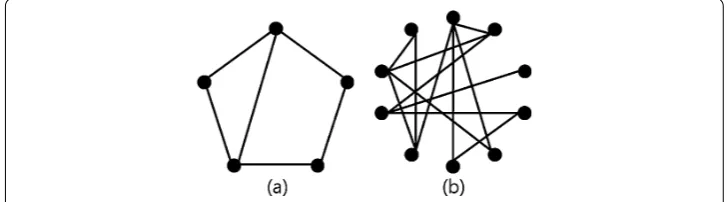
Example Consider the following -order system with the structure in Figure and the inner-coupling matrix= .In:
yi(k+ ) = .yi(k) –yi(k) – .yi
k–h(k)+c N
j= gijyj
k–h(k),
yi(k+ ) = .yi(k) + .yi(k) –yi(k)yi(k) – .yik–h(k) ()
– .yik–h(k)+c N
j=
gijyjk–h(k),
which is asymptotically stable at the equilibrium points(k) = ands(k–h(k)) = . To analyse the synchronization stability for randomly changing coupling strength, theN–
linear delayed difference equations () are
with the Jacobian matrices
J=
From Figure , the outer-coupling matrices are considered as two cases. •Case :
Moreover, from Case ,
=diag{–., –., –., –.}
and from Case ,
=diag{–., –., –., –., –.,
– ., –., –., –.}.
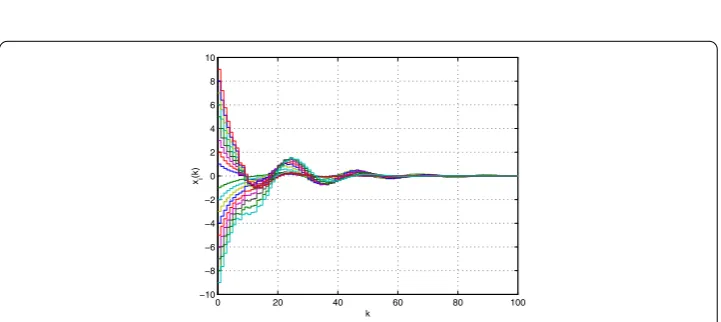
Figure 2 State trajectories of Case 1: (a) With randomly changing coupling strength,ρmc; (b) With fixed coupling strength,c(Example 1).
Figure 3 State trajectories of Case 2 with randomly changing coupling strength,ρmc(Example 1).
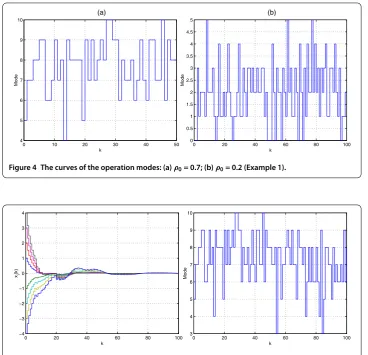
strength. Next, the result of maximum bound of time-delay with fixedc= ,ρ= .,hm= , andGin Case by Theorem is . With the condition of time-varying delay ash(k) = |sin(kπ/)|+ , the simulation results for the state trajectories of the network () are shown in Figure . Also, this figure shows that the trajectories between the synchronized states converge to zero under the time-delayh(k). Lastly, in Figure , the distribution of a binomial random variable is drawn with the values of probability,ρ, . and ..
Example Recall the system () in Example and the structure shown in Figure . Thus, consider the following coupled networks with only interval time-varying delay in nodes
x(k+ ) = (IN–⊗J+ρmc(⊗)x(k) + (IN–⊗Jd)x
k–h(k), ()
where the associated parameters are defined in Example .
Figure 4 The curves of the operation modes: (a)ρ0= 0.7; (b)ρ0= 0.2 (Example 1).
Figure 5 State trajectories and the curve of the operation modes (Example 2).
5 Conclusions
In this paper, new delay-dependent synchronization criteria for the discrete-time CDNs with interval time-varying delays and randomly changing coupling strength are proposed. The randomly changing coupling strength is considered with the concept of binomial dis-tribution, which is a generalization of the Bernoulli distribution. To drive these results, the suitable Lyapunov-Krasovskii functional and reciprocally convex approach are used to ob-tain the feasible region of synchronization stability criteria. Two numerical examples have been given to show the effectiveness and usefulness of the presented criteria.
Competing interests
The authors declare that they have no competing interests.
Authors’ contributions
All authors contributed equally and significantly in writing this paper. All authors read and approved the final manuscript.
Author details
Acknowledgements
This research was supported by the Basic Science Research Program through the National Research Foundation of Korea (NRF) funded by the Ministry of Education, Science and Technology (2012-0000479), and by a grant of the Korea Healthcare Technology R & D Project, Ministry of Health & Welfare, Republic of Korea (A100054).
Received: 14 September 2012 Accepted: 19 November 2012 Published: 7 December 2012 References
1. Watts, DJ, Strogatz, SH: Collective dynamics of ‘small-world’ networks. Nature393, 440-442 (1998) 2. Strogatz, SH: Exploring complex networks. Nature410, 268-276 (2001)
3. Li, C, Xu, C, Sun, W, Xu, J, Kurths, J: Outer synchronization of coupled discrete-time networks. Chaos19, 013106 (2009) 4. Boccaletti, S, Latora, V, Moreno, Y, Chavez, M, Hwang, DU: Complex networks: structure and dynamics. Phys. Rep.424,
175-308 (2006)
5. Li, C, Chen, G: Synchronization in general complex dynamical networks with coupling delays. Physica A343, 263-278 (2004)
6. Li, K, Gong, X, Guan, S, Lai, CH: Synchronization stability of general complex dynamical networks with time-varying delays. Phys. Lett. A372, 7133-7139 (2008)
7. Wang, B, Guan, ZH: Chaos synchronization in general complex dynamical networks with coupling delays. Nonlinear Anal., Real World Appl.11, 1925-1932 (2010)
8. Park, MJ, Kwon, OM, Park, JH, Lee, SM, Cha, EJ: Synchronization criteria for coupled stochastic neural networks with time-varying delays and leakage delay. J. Franklin Inst.349, 1699-1720 (2012)
9. Koo, JH, Ji, DH, Won, SC: Synchronization of singular complex dynamical networks with time-varying delays. Appl. Math. Comput.217, 3916-3923 (2010)
10. Gao, H, Lam, J, Chen, G: New criteria for synchronization stability of general complex dynamical networks with coupling delays. Phys. Lett. A360, 263-273 (2006)
11. Yue, D, Li, H: Synchronization stability of continuous/discrete complex dynamical networks with interval time-varying delays. Neurocomputing73, 809-819 (2010)
12. Liu, Y, Wang, Z, Liu, X, Liang, J: Synchronization and state estimation for discrete-time complex networks with distributed delays. IEEE Trans. Syst. Man Cybern., Part B, Cybern.38, 1314-1325 (2008)
13. Bao, H, Cao, J: Synchronization of discrete-time stochastic neural networks with random delay. Discrete Dyn. Nat. Soc. (2011). doi:10.1155/2011/713502
14. Wu, ZG, Park, JH, Su, H, Chu, J: Robust dissipativity analysis of neural networks with time-varying delay and randomly occurring uncertainties. Nonlinear Dyn.69, 1323-1332 (2012)
15. Hu, J, Wang, Z, Gao, H, Stergioulas, LK: Robust sliding mode control for discrete stochastic systems with mixed time delays, randomly occurring uncertainties, and randomly occurring nonlinearities. IEEE Trans. Ind. Electron.59, 3008-3015 (2012)
16. Peebels, PZ: Probability, Random, Variables, and Random Signal Principles. McGraw-Hill, New York (2001) 17. Shaikhet, L: Lyapunov Functionals and Stability of Stochastic Difference Equations. Springer, New York (2011) 18. Xu, S, Lam, J: A survey of linear matrix inequality techniques in stability analysis of delay systems. Int. J. Syst. Sci.39,
1095-1113 (2008)
19. Niculescu, SI: Delay Effects on Stability: A Robust Approach. Springer, New York (2002)
20. Richard, JP: Time-delay systems: an overview of some recent advances and open problems. Automatica39, 1667-1694 (2003)
21. Gao, HJ, Chen, TW: New results on stability of discrete-time systems with time-varying state delay. IEEE Trans. Autom. Control52, 328-334 (2007)
22. Ahn, CK: Fuzzy delayed output feedback synchronization for time-delayed chaotic systems. Nonlinear Anal. Hybrid Syst.4, 16-24 (2010)
23. Kwon, OM, Park, JH, Lee, SM: An improved delay-dependent criterion for asymptotic stability of uncertain dynamic systems with time-varying delays. J. Optim. Theory Appl.145, 343-353 (2010)
24. Park, P, Ko, JW, Jeong, CK: Reciprocally convex approach to stability of systems with time-varying delays. Automatica
47, 235-238 (2011)
25. Boyd, S, Ghaoui, LE, Feron, E, Balakrishnan, V: Linear Matrix Inequalities in System and Control Theory. SIAM, Philadelphia (1994)
26. Graham, A: Kronecker Products and Matrix Calculus: With Applications. Wiley, New York (1982)
27. Gu, K: An integral inequality in the stability problem of time-delay systems. In: The 39th IEEE Conf. Decision Control, December 2000, Sydney, Australia, pp. 2805-2810 (2000)
28. de Oliveira, MC, Skelton, RE: Stability tests for constrained linear systems. In: Perspectives in Robust Control, pp. 241-257. Springer, Berlin (2001)
29. Kim, SH: Improved approach to robustH∞stabilization of discrete-time T-S fuzzy systems with time-varying delays. IEEE Trans. Fuzzy Syst.18, 1008-1015 (2010)
30. Ahn, CK: Sets of generalized H2 exponential stability criteria for switched multilayer dynamic neural networks. Adv. Differ. Equ. (2012). doi:10.1186/1687-1847-2012-150
31. Ahn, CK: Linear matrix inequality optimization approach to exponential robust filtering for switched Hopfield neural networks. J. Optim. Theory Appl.154, 573-587 (2012)
32. Ahn, CK: An error passivation approach to filtering for switched neural networks with noise disturbance. Neural Comput. Appl.21, 853-861 (2012)
33. Ahn, CK: Switched exponential state estimation of neural networks based on passivity theory. Nonlinear Dyn.67, 573-586 (2012)
34. Ahn, CK: Exponentially convergent state estimation for delayed switched recurrent neural networks. Eur. Phys. J. E34, 122 (2011)
36. Ahn, CK: Switched synchronization with a guaranteedH∞performance. Chin. Phys. Lett.28, 010501 (2011) 37. Ahn, CK: Passive learning and input-to-state stability of switched Hopfield neural networks with time-delay. Inf. Sci.
180, 4582-4594 (2010)
38. Ahn, CK: AnH∞approach to stability analysis of switched Hopfield neural networks with time-delay. Nonlinear Dyn.
60, 703-711 (2010)
39. Jiang, L, Yao, W, Wu, QH, Wen, JY, Cheng, SJ: Delay-dependent stability for load frequency control with constant and time-varying delays. IEEE Trans. Power Syst.27, 932-941 (2012)
doi:10.1186/1687-1847-2012-208