© 2015, IRJET.NET- All Rights Reserved Page 360
A_AODV: A Modern Routing Algorithm for Mobile Ad-Hoc Network
Ritu Parasher
1, Yogesh Rathi
21
M.Tech Scholar, Department of Computer Science & Engineering, Y.I.T., Jaipur,Rajasthan,India
2Asst. Prof., Department of Computer Science & Engineering, Y.I.T., Jaipur, Rajasthan,India
---***---Abstract -
Mobile ad-hoc network (MANET) is anautonomous wireless network, deploy without any fixed infrastructure and assistance of base stations. Each
node in network shares wireless link for
interconnections and not only operates as an end system, but also as a router to forward packets. Since the network nodes are mobile, can be move in any direction with varying paces that generate high dynamicity of network so the protocols that are developed for general ad hoc networks are unsuitable for such an environment. In addition, on-hand routing protocols performance decreases as size of network increased. In this context, to enhance the recitation of routing in MANETs, we propose a new approach in this paper, named Advanced Ad hoc On-Demand Distance Vector (A_AODV). It is a modified version of traditional AODV routing protocol, shrink the active path whenever optimal pathway is available and switches the traffic on it. Simulation studies are conducted using NS2 to prove that proposed approach enhance network performance when network size, load or the mobility increases.
Key Words:
MANETs, AODV, Routing protocols.
1.
INTRODUCTION
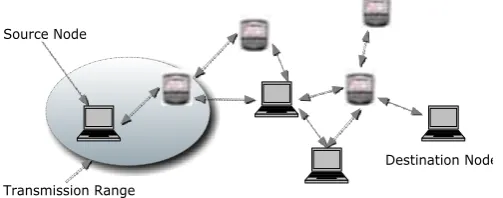
Nowadays, due to rapid development of wireless communication arena, a generation of Ad-hoc networks, Mobile Ad-hoc network (MANETs) has gained increasing attention of the researchers. MANETs is a wireless networks, dynamically forming a communication network without any centralized control and pre-existing network infrastructure. Figure 1 shows a mobile ad hoc network with 8 nodes
Fig. 1 Mobile Ad-hoc Network
Since the nodes are mobiles in MANETs, change their locations rapidly so finding a delivery path to a destination
is a challenging task. On the other hand some unique personality of such network like frequent changes in topology, mobility patterns, varying density over time, channel fading, and unstable communication conditions pose many unique research challenges for routing protocols being used in MANETs. Apart from these, the speed and size of the network degrades the performance of routing protocols and pose new challenges in front of researchers to design an efficient routing algorithm for MANETs environment [1-5]. However, a number of unique approaches have been proposed by several of researchers in last few decades to overcome the routing issues of MANETs but still no one routing approach is efficient to outperform in all scenarios of ad-hoc networks. Each proposed solution has its unique merits in some definite networking environments, but mobile nodes should be able to operate in every environment that pose challenge to researchers in terms to design an efficient routing algorithm [6-8]. The work reported in this paper address the routing issues of accessible routing protocol in environment of MANETs and introduces optimized routing solution which augment the routing recital in challenging environment of MANETs.
The rest of the paper is organized as follows: Section 2 presents the classification of various routing protocols. Sections 3 present the related work. The issues of on-hand routing protocols present in section 4. Proposed approach present in section 5. Section 6 present simulation results and analysis work and finally conclusion and future work present in section7.
2.
CLASSIFICATION OF ROUTING PROTOCOLS
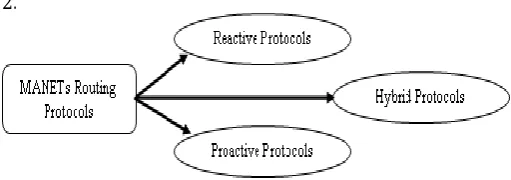
© 2015, IRJET.NET- All Rights Reserved Page 361 classified into three main categories as depicted in figure
2.
Fig. 2 MANETs Routing Protocols Categorization
2.1
Proactive Routing Protocols
The proactive routing protocols are mostly based on shortest path algorithms and also known as table driven routing protocol because they store the information of all connected nodes in form of tables. These types of routing protocols maintain routes to all destinations, regardless of whether or not these routes are needed. Whenever any change present in network the node shared information with their neighbors. In order to maintain correct route information, a node must periodically send control messages. Therefore, proactive routing protocols may waste bandwidth since control messages are sent out unnecessarily when there is no data traffic.
2.2
Reactive Routing Protocols
The routing protocols that are fall under the category of reactive routing protocol also known as the on-demand routing protocols. The reactive / on-demand routing protocols set up a link between pair of nodes only when it is necessary and only for those nodes that are currently being used to send data packets from source to destination thus reduce the overhead problem as arise with proactive routing protocols. However, Reactive types of protocols reduces the issues of proactive routing protocols but use flooding process for route discovery, which causes more routing overheads, bandwidth consumption, and battery powers. Apart from these, the protocols also suffer from the initial route discovery process, which make them unsuitable for safety applications in MANETs
2.3
Hybrid Routing Protocols
The hybrid routing protocol combines the characteristics of both reactive and proactive routing protocols. These types of protocols have been introduced to trim down the overheads ratio and the initial route discovery delays of existing routing protocols. Typically the hybrid routing protocols are area based protocols where the number of nodes are divided into different zones. However, hybrid routing protocols contain the functionality of both reactive and proactive routing protocols and reduce the issues of existing protocols but the protocols that are based on hybrid technique face the problem of network connectivity because in a huge network scenario it works like a proactive routing protocol and in a small network it
treat like a reactive routing protocols thus may not be guaranteed in scenarios with low nodes density networks.
3.
RELATED WORK
Since the advent of MANETs, design and implementation of an efficient routing protocol with good performance and less overhead is one of the fundamental challenges of this network. However a lot of research has been endeavors in direction to trim down such routing issues for the real time network scenarios of MANETs but due to unique characteristics of such networks like high dynamicity, rapid changes in network topology, scalability, no one routing protocol is efficient in way to outperform in each and every scenario of MANETs.
Several of researchers [12-20] have investigates the applicability of traditional routing protocols in the environment of MANETs by huge amount of experiments. They have compared AODV routing protocol with a number of approaches, on the basis of different parameters and network scenarios to evaluate the efficiency of such protocol. However, they focused on certain aspects of the simulation. Their investigation results indicate that AODV routing protocol is more suitable for the dynamic environment of MANETs but has some disadvantages such as high overheads, tall energy consumption in large network and use flooding process that generate the need of modification. In direction to trim down the energy consumption ratio of network and increase the link stability under high dynamic environment of MANETs, the authors [21] have proposed a novel energy-efficient on-demand routing algorithm EEAODR. The proposed approach enhances the working techniques of conventional AODV routing scheme and paying attention to maintain balance energy load among network nodes to increases the network stability. In same direction by modifying the route establishment technique of existing AODV routing protocol, a novel energy efficient routing approach has presented in [22]. The proposed approach decides the optimal route based on the basis of maximum energy of each route. Investigation results of proposed approach have presents its effectiveness over the traditional routing scheme.
In [23], authors have introduced a new modified version of conventional AODV routing protocol, name as EAODV. The anticipated approach picks up the QOS of real time VoIP in wireless ad hoc networks by consuming the unexploited part of network. The simulated results have shown the efficiency of EAODV protocol over the traditional routing approach. In same direction to improve the performance of conventional AODV routing protocol, fresh approach have been proposed in [24], named A-SAODV (Adaptive SAODV). The approach tunes the behavior of SAODV by including filtering strategies.
© 2015, IRJET.NET- All Rights Reserved Page 362 neighbor trust value. For the packet broadcasting,
proposed approach has used the utmost trust value of
neighbor, thus it not only keep the node’s power by pass
up avoidable broadcast control information but also enhance the routing recitation in terms of bandwidth efficient routing protocols and they enhance the routing recitation on the base of different parameters but most of the previous work deals with the problem of finding and maintaining correct routes to the destination during mobility and changing topology. In addition, major of proposed approaches has backbone routing path that increases the overhead and consume more bandwidth and nodes power in communication, different terrains pose separate challenges to routing in high dynamic environment of MANETs. In MANETs, the Issues of accessible routing protocols can be represent in point as
The accessible routing protocols are effective only when the node population is small.
The proactive routing protocols will be overwhelmed by the rapid topology changes and even fail to converge during the routing information exchange stage.
Reactive routing schemes will fail to discover a complete path due to frequent network partition.
Most of existing routing protocols use flooding process to setup a link between the pair of nodes thus consumes high bandwidth and generates high end to end delays.
Low scalability, where network can go from scarce to dense in a very short time.
5.
PROPOSED APPROACH
Since the nodes are mobile in MANETs, move rapidly with varying velocity and the density. However, high mobility of the network is main cause of rapid link failure but due to this mobility there is a chance that without breaking the existing communication path the two or more nodes, which are part of active route, come in direct range of each other. Traditional AODV routing protocol does not consider this situation. It uses the active path for packet forwarding till any link breakage does not occur. In this case packet travel huge distance and increases the chance of dropping and network collision, while optimal shortest path is available. This functionality has affects the performance of routing protocol that are being use in the network to route the packet.
In this context, to enhance routing recitation and scalability of MANET network, a novel routing approach
called Advance AODV (A_AODV has introduced in this paper. The proposed approach is an advanced version of traditional Ad-hoc On-demand Distance Vector (AODV) routing protocol. For enhancing recitation of exiting approach in addition to reducing the flooding, overhead effects and minimizing the rate of link breakages the proposed approach comprises a self-healing routing technique with traditional AODV routing protocol. The approach reduces number of hops dynamically by continuously monitoring active routing paths and redirecting the path whenever a shortcut path is available, by excluding the redundant nodes from the active route.
6.
SIMULATION RESULTS AND ANALYSIS
6.1
Simulation Tool & Parameters
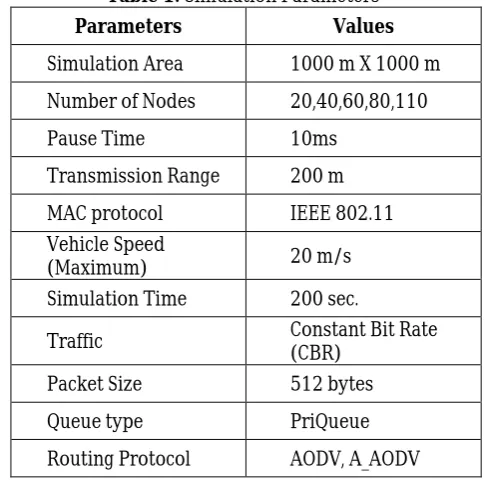
To evaluate the performance of proposed approach, several of simulations are conducted by using the Network Simulator NS-2.32 [16] with varying network load from performance metrics of Throughput, Packet Delivery Ratio (PDR), Normalized Routing Load (NRL) and the End to End Delays (E2ED).
Throughput: The throughput of the protocols can be
© 2015, IRJET.NET- All Rights Reserved Page 363
Packet Delivery Ratio (PDR): This metric gives the ratio of the total data packets successfully received at the destination and total number of data packets generated at source.
Average End to End Delay (E2E): The end to end
delay (E2E) metric presents the average time taken by the packets to pass through the network, successfully delivered to their destinations.
Normalized Routing Load (NRL): Normalized
Routing load is the numbers of routing packets transmitted per data packet send to the destination.
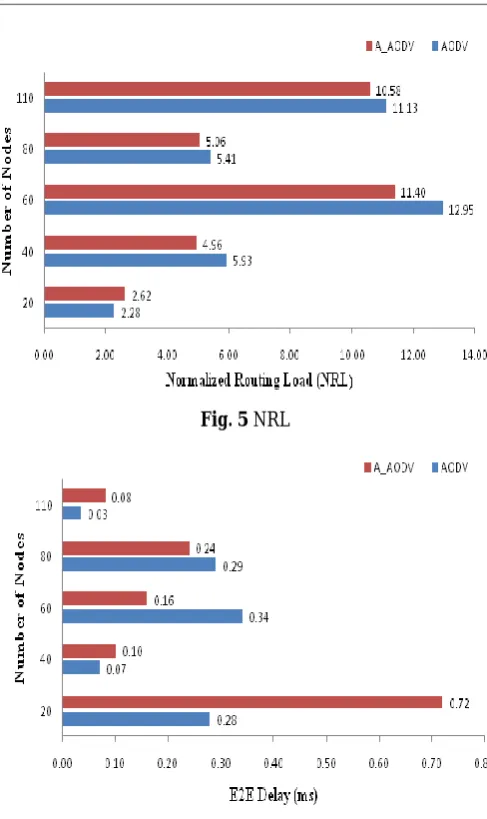
In order to obtain a fair comparison, the traditional AODV routing approach simulate in the same environment as used to simulate the proposed approach, and demonstrate the evaluation results based on performance metrics. The same scenario is used because of unique behavior of each algorithm to produce the output. The following figures has presents the significant results of proposed approach in terms of simulation matrices.
Fig. 3 Throughput (kbps)
Fig. 4 PDR (%)
Fig. 5 NRL
Fig. 6 Average E2E Delay (ms)
© 2015, IRJET.NET- All Rights Reserved Page 364 The results depicted in figures 3 to 6 and table 2 clearly
indicates that proposed approach put up comparable results against traditional AODV routing approach. The table 2 values clearly indicate the significance results of proposed approach in terms of matrices, used to analyze the performance of approaches. These results undoubtedly show the superiority of proposed approach over the traditional AODV routing algorithm. To enhance the recital of existing routing approach the proposed method has maintain link stability between establish path and use dynamic route reduction method, to shrink the route length, in case of optimal route availability, to reducing E2E delays and NRL.
7.
CONCLUSION & FUTURE WORK
This paper address the routing issues of MANETs and proposed a new routing approach by optimizing the route maintenance procedure of traditional AODV routing protocol, intend to escalate the routing recitation in the challenging environment of MANETs. The proposed approach has monitor active routing paths continuously and redirecting the path whenever a shortcut path is available. It excludes the redundant nodes from the route. Several of simulation carried out to present the efficiency of proposed approach by varying the traffic load and mobility in the network. The simulation results clearly indicate the efficiency and effectiveness of proposed approach over the traditional AODV routing protocol. Accordingly, future concerns more investigation is needed in terms of provide power control in the communications. For wireless networks, energy is always vital resource. In Addition future work can be done in direction to trim down the ratio of End to End delays. It can enhance the recitation of the network in new way.
REFERENCES
[1] Eman S. Alwadiyeh, Ala’ F A Aburumman “
Interference-Aware Multipath Routing Protocols For
Mobile Ad Hoc Networks” 13th Annual IEEE
Workshop on Wireless Local Networks, 2013.
[2] MENG Limin, SONG Wenbo* “Routing Protocol Based on Grover’s Searching Algorithm for Mobile Ad-hoc
Networks” Network Technology And Application,
China Communications • March 2013
[3] Israat Tanzeena Haque “On the Overheads of Ad Hoc
Routing Schemes” IEEE Systems Journal, 2013.
[4] Wei-Liang Shen, Chung-Shiuan Chen “Autonomous Mobile Mesh Networks” IEEE Transactions On Mobile
Computing, Vol. 13, No. 2, February 2014.
[5] Wei Liu and Ming Yu “AASR: Authenticated
Anonymous Secure Routing for MANETs in
Adversarial Environments” IEEE Transactions On
Vehicular Technology, Vol. 63, No. 9, November 2014. [6] B. Ramakrishnan, Dr. R. S. Rajesh, R. S. Shaji
“CBVANET: A Cluster Based Vehicular Adhoc Network Model for Simple Highway Communication”
Int. J. Advanced Networking and Applications Volume: 02, Issue: 04, Pages: 755-761 (2011)
[7] Mohammad Al-Rabayah and Robert Malaney “A New Scalable Hybrid Routing Protocol for VANETs” IEEE
Transactions on Vehicular Technology, Vol. 61, No. 6, July 2012
[8] Pratap Kumar Sahu, Eric Hsiao-Kuang Wu “BAHG:
Back-Bone-Assisted Hop Greedy Routing for VANET’s City Environments” IEEE Transactions on Intelligent
Transportation Systems, Vol. 14, No. 1, March 2013 [9] Alex Hinds, Michael Ngulube, Shaoying Zhu, and
Hussain Al-Aqrabi “A Review of Routing Protocols for Mobile Ad-Hoc NETworks (MANET)” International
Journal of Information and Education Technology, Vol. 3, No. 1, February 2013
[10] Harjeet Kaur, Varsha Sahni, Dr. Manju Bala “A Survey
of Reactive, Proactive and Hybrid Routing Protocols in MANET: A Review” International Journal of
Computer Science and Information Technologies, Vol. 4 (3) , 2013, 498-500
[11] Mehran Abolhasan, Tadeusz Wysocki, Eryk
Dutkiewicz “A Review of Routing Protocols for Mobile Ad hoc Networks”, Ad Hoc Networks 2 (2004) 1–22, Elsevier.
[12] Al-Maashri, Ahmed and Mohamed Ould-Khaoua,
“Performance Analysis of MANET Routing Protocols
In Presence Of Self-Similar Traffic” – Dept. of Electrical and Computer Engineering – Sultan Qaboos University, Sultanate of Oman, 2006, IEEE
[13] Samir R. Das, Robert Castaneda and Jiangtao Yan;
“Simulation based Performance Evalution of Routing Protocols for Mobile Ad Hoc Networks” Baltzer
Science Publishers BV. Seventh International conference on Computer Communication and Networks (IC3N), Lafayette, LA, October 1998. [14] Qasim Nadia, Said Fatin & Aghvami Hamid –“Mobile
Ad Hoc Networking Protocol’s Evaluation through Simulation for Quality of Service.” - IAENG International Journal of Computer Science, 36:1, IJCS_36_1_10, 17 February, 2009.
[15] Mukesh Kumar1, A.K.Jaiswal Vivek Kumar Singh,
Rohini Saxena” Performance Analysis And Energy
Consumption Of Routing Protocol In Manet Using
Grid Topology” International Journal of Technical
Research and Applications Volume 1, Issue 5 (Nov-Dec 2013), PP. 70-75
[16] Hadi Sargolzaey, Ayyoub Akbari Moghanjoughi and
Sabira Khatun “A Review and Comparison of Reliable
Unicast Routing Protocols For Mobile Ad Hoc
Networks” IJCSNS International Journal of Computer
Science and Network Security, VOL.9 No.1, January 2009
[17] Dr Chandra Shekar Reddy Putta , Dr K.Bhanu Prasad ,
Dilli Ravilla, Murali Nath R.S, M.L.Ravi Chandra “
Performance of Ad hoc Network Routing Protocols in
© 2015, IRJET.NET- All Rights Reserved Page 365 [18] Shakeel Ahmed, A. K. Ramani1 and Nazir Ahmad
Zafar “Verifying Route Request Procedure Of Aodv
Using Graph Theory And Formal Methods”
International journal on applications of graph theory in wireless ad hoc networks and sensor networks (GRAPH-HOC) Vol.3, No.2, June 2011
[19] Said El Kafhali, Abdelkrim Haqiq “ Effect of Mobility
and Traffic Models on the Energy Consumption in
MANET Routing Protocols” International Journal of
Soft Computing and Engineering (IJSCE) Volume-3, Issue-1, March 2013
[20] Parul Aggarwal, Himanshu Aggarwal “ Comparative
Analysis of Routing Protocols in Mobile Ad-Hoc Networks (MANETs)” International Journal of
Computer Applications (0975 – 8887) Volume 95–
No.4, June 2014
[21] Sanjay Kumar Dhurandher, Sudip Misra, Mohammad S. Obaidat, Vikrant Bansal, Prithvi Singh, Vikas Punia
“An Energy-Efficient On-Demand Routing Algorithm for Mobile Ad-Hoc Networks”, International
Conference on Computer and Communication Engineering, pp. 995-961, Aug. 31 2008-Sept. 3 2008. [22] Tai Hieng Tie, Chong Eng Tan, Sei Ping Lau “Alternate
Link Maximum Energy Level Ad Hoc Distance Vector Scheme for Energy Efficient Ad Hoc Networks
Routing” International Conference on Computer and
Communication Engineering (ICCCE 2010), pp.1-6, 11-13 May 2010.
[23] HuiYao Zhang, Marek E. Bialkowski “An Extended
AODV Protocol for VoIP Application in Mobile Ad Hoc
Network” ECTI Transactions on Electrical Eng., Electronics, and Communications Vol.7, No.2 August 2009.
[24] Alekha Kumar Mishra, Bibhu Dutta Sahoo “A
Modified Adaptive-Saodv Prototype For Performance
Enhancement in MANET”, International Journal of
Computer Applications in Engineering, Technology and Sciences, Volume 1 : Issue 2 April – September 2009, Page: 443-447
[25] S.Neelakandan, J.Gokul Anand “Trust Based Optimal Routing in MANET's”, Proceedings of IEEE conference
ICETECT, September 2011
[26] Scott Linfoot, Haitham Y. Adarbah, Bassel Arafeh, and
Alistair Duffy “Impact of Physical and Virtual Carrier
Sensing on the Route Discovery Mechanism in Noisy
MANETs” IEEE Transactions on Consumer
Electronics, Vol. 59, No. 3, August 2013
[27] LI Xut, LIU Tianjiaot, LIU Yingt, TANG Van “Optimized
Multicast Routing Algorithm Based on Tree Structure
in MANETs” Network Technology and Applications,
China Communications· February 2014
[28] Bin Yang, Yin Chen, Ying Cai and Xiaohong Jiang
“Packet Delivery Ratio/Cost in MANETs with Erasure
Coding and Packet Replication” IEEE Transactions on
Vehicular Technology 2013
BIOGRAPHIES
Ms. Ritu Parasher currently
pursuing M.Tech (Computer Science) from YIT College Jaipur affilated to Rajasthan Technical University, Kota. She did B.TECH in Computer Science and Engg. from JNIT, Jaipur in 2010. Her interested research areas are Ad-hoc Networks.
Mr. Yogesh Rathi obtained B.Tech. Degree in Computer Science and
Engineering from Rajasthan