International Journal in Physical & Applied Sciences (Impact Factor- 4.657)
STUDY OF THE PHYSICAL PROPERTIES OF PALM KERNELS AND SHELLS RELEVANT THEIR HANDLING
Eje, B.E.
Department of Agricultural and Bioresource Engineering, Enugu State University of Science and Technlogy, Enugu
Chiwetalu, U.J.
Department of Agricultural and Bioresource Engineering, Enugu State University of Science and Technlogy, Enugu
Ogbuagu, N.J.
Department of Agricultural and Bioresource Engineering, Enugu State University of Science and Technlogy, Enugu Abstract.
Relevant physical properties of Palm Kernels and shells were determined as a basis for designing a palm kernel and shell separator. The physical properties determined were the characteristic dimensions, moisture content (wet basis), bulk density, specific gravity and angle of repose.. The shells were found to have distinctive size distribution pattern from the kernels as identified through sieve analysis. The kernels have tendency of being spherical, with sphericity of 0.8 while the shells have a sphericity of 0.6 which makes them hemispherical. These distinctive shapes are characteristics that can be utilized in the mechanical separation of kernels from the shells.
Keywords: Physical Properties, Palm Kernels, Shells, Handling 1.0 Introduction
The oil palm fruit is produced by oil palm tree. The oil palm tree is an erect single stemmed tree of fairly uniform column growing up to 8m or more at maturity. The ovaries of the female inflorescence develop into large bunches and each bunch may contain about 800-1000 fruits (Food and Agricultural Organisation (FAO), 1970). The sizes of the fruits or the nuts depend mainly on the thickness of the shell. As a drupe, each fruit is made up of three major layers: an outer exocarp, a middle fibrous mesocarp and finally, a hard breakable endocarp or shell. The kernel however consists of a small embryo embedded in a mass of hard oily endosperm, surrounded by a tough black integument, the testa (Corley et al, 1976, Wood et al, 1976).
make the soap produced from it the best quality soap due to its superior lathering quality.(Elaine Moore, 1968, Vegetable oil of Nig.(VON), 1987).The shells have been successfully used as coarse aggregate in wide range of concrete mix (Acheampong et al.,2013,Mahmud et al.,2009)
It is then evident that palm kernel and its products are of great economic importance to the nation. However, before it gets to this final stage of usefulness, it passes through series of post-harvest processing and handling activities such as nut cracking, kernel/shell separation, washing and cleaning, kernel milling, kernel oil extraction etc. Mohsenin (1970) in his work noted that an understanding of the physical laws governing the responses of the biologicalto various handling and processing methods is a fundamental requirement to the design of machines required for handling them. Henderson and Perry (1976) also specified cleaning, sorting, partial or perhaps final grading or classification of agricultural products as being based upon their sizes, shapes, specific gravity and surface characteristics. This study is therefore aimed at determining some of the physical properties of the kernels and shells relevant to the design of machines for their processing and handling.
2.0 Materials and Methods
The palm kernel nuts used for the experiments were obtained from the local farmers in the surrounding communities of Nsukka, Ehalumona, Ibagwa,Obukpa and Orba during the 2015 harvesting season. The study was carried out about two weeks after the palm oil extraction and nut drying processes. A total of 80kg of the palmnuts were obtained from these areas. 30kg of the nuts were left uncracked while the remaining 50kg were cracked using a locally fabricated hammer mill specially designed for palmnut cracking. The kernels were finally separated from the shells by manual handpicking method. All measurements were taken in the laboratory at a room temperature of 31°c and 42% relative humidity.
5okg of the sample was dried in an oven at a temperature of 103°c for 72 hours and the moisture content of each sample was also calculated according to the ASAE (1984) standards.
International Journal in Physical & Applied Sciences (Impact Factor- 4.657)
calibrations was used for all linear dimensions. The geometric mean diameter is calculated using the formular:
DG = (ABC)½ ………..(1).
The sphericity which is a measure of how close a material is to being spherical is given by the formular:
S = (bc/a2)½………(2) where DG is the geometric mean diameter, S is the sphericity, a is the major diameter, b is the
intermediate diameter and C, the minor diameter (Mohsenin 1970).
A cylindrical container with a volume of 3.23x10⁴ m3 was used for the bulk density measurement. For each measurement, the container was freely filled with the sample material and leveled. The bulk density was then calculated using the frmular:
BD =Ws/Vs………..……..(3) where
BD is the bulk density, Ws is the weight of the sample and Vsis the volume of the sample in the
container.
The specific gravity was determined using the specific gravity balance (analytical balance). The samples were weighed in the air and then weighed submerged in water. The specific gravity was calculated Using the expression (SG)s = WaX (SG)b/Wa
-Ww……….….(4) where (SG)s is the specific
gravity of the sample, (SG)b is the specific gravity of water Wa is weight of sample in air and Ww
is the weight of sample in water.
𝜃 = arc tan((Hc - Hp) x2) Dp………..(5) where is
the angle of repose, Hp and Hc are the constant heights of the platform and the crest of the
material respectively from the datum point and Dp is the diameter of the platform.
In determining the kernel to shell weight and volume ratio of cracked palm nuts, the weight and volume of the kernels and shells in the sample were separately measured. The percentage weight or volume of the kernel or shell fraction was ‘then calculated using the following equations:
PWf = (Wf x 100) WT………...(6)
PVf = Vf/VT………..……….(7)
Where PWf is the percentage weight of fraction, Wf is the weight of fraction in the sample, WT is
the weight of the sample, PVf is the percentage volume of fraction, Vf is the total volume of
fraction in the sample and VT is the Volume of the sample.
The kernel and shell size distribution was determined by subjecting them individually to a standard sieve analysis. A set of sieves were arranged in a Ro-Tap shaking machine and the machine was allowed to run for five minutes. The weight fraction and axial dimensions of thekernels or shells retained on each sieve was measured with electronic weighing balance and vernier caliper respectively.
3.0 Results and Discussion
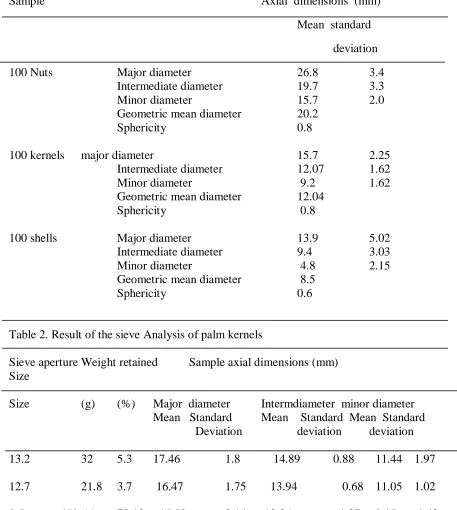
Results obtained from palm nut size measurements and shape determination show that the nuts have varying shapes and sizes. Most of them were found to have irregular shapes with a good number having a higher tendency to being spherical or elliptical. The kernels are somewhat more spherical with the cross section close to being round while the shells which have hard hairy structure and fragmented into several pieces by the nut cracker are more irregular in shape though with a greater tendency to being hemispherical. Results of the mean values of measurements of the axial dimensions taken for 100 samples of the nuts, kernels, and shells are as presented in Table.1 the values of the sphericity are 0.8 for kernels and nuts and 0.6 for shells.
International Journal in Physical & Applied Sciences (Impact Factor- 4.657)
dimensions of various fractions in the sieve analysis and the weight percent of such actions that can pass through a given aperture.
The values of the percentage weight of the individual components in the kernel and shell mixture were 23.43% and76.57% for kernels and shells respectively. Likewise, the percentage volumes of the components in the mixture were 34.9% for kernels and 65.1% for shells.
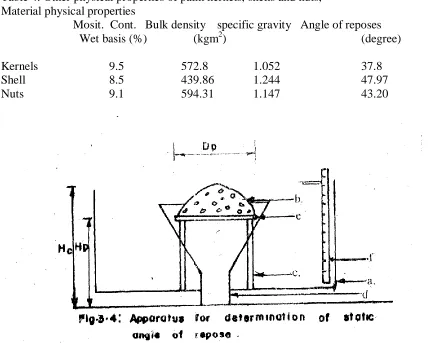
The results obtained from the study of other physical properties (relevant to the design of palm kernels and shells post-harvest handling machines) such as moisture content, bulk density, specific gravity and angle of repose are as summarised in Table 4.
Conclusion
References
Acheampong,A., M.Adom,Asamoah,J. Ayarkwa,J. andR.O. Afrifa. 2013. Comparative study of the Physical Properties off palm kernel shells concrete and normal weight concrete in GhanaJournal of Multi-disciplinary Research.5(1),129-146.
ASAE, 1984.American society of Agric Eng. Standards
Corley, R.H,V, JJ. Hardson and B.J. Wood, 1976.Oil palm Research, Elserviersciettific publishing company. Inc. Amsterdam
Eje, B.E. 1998.Design, Construction and evaluation of palm kernels and shell separator.M.Eng. Project Report Department of Agric Eng. University of Nigeria Nsukka.
Elaine Moore, M.A(oxon) 1968. Vegetable oils and fats.Their production and commercial extraction.Unilever Education Booklet London.
F.A.O, 1970.The oil palm. Food and Agricultural OrganisationRome,Italy.
Henderson, S.M. & Perry, R.L. 1981 .Agricultural process Engineering. Avi Publication company Inc. West Port.
Mahmud,A.,H., Jumaat, M.Z. and Alengaram N.J. 2009. Influence of sand/cement ratio on mechanical properties of palm kernel shell concrete. Journal of applied sciences. 9 (5)1764-1769.
Mohsenin, N.N. 1970. Physical properties of plant and Animal Materials, Vol.I Gordon and Breach series publication. London.
Onuegbu, C.U. 1982. Apparatus for determination of angle of repose of granular agricultural material.B. Eng. Project Report Department of Agric Eng. University of Nigeria Nsukka. Wood, B.J.T. Hardon, and R.H.V. Corley 1976.Development in crop science.oil palm Research,
Elservier Scientific pub. Corporation. Amsterdam.
International Journal in Physical & Applied Sciences (Impact Factor- 4.657) Table 1 The axial dimensions of palm kernels, nuts and shells
Sample Axial dimensions (mm)
Mean standard deviation
100 Nuts Major diameter 26.8 3.4
Intermediate diameter 19.7 3.3
Minor diameter 15.7 2.0
Geometric mean diameter 20.2
Sphericity 0.8
100 kernels major diameter 15.7 2.25
Intermediate diameter 12.07 1.62
Minor diameter 9.2 1.62
Geometric mean diameter 12.04
Sphericity 0.8
100 shells Major diameter 13.9 5.02
Intermediate diameter 9.4 3.03
Minor diameter 4.8 2.15
Geometric mean diameter 8.5
Sphericity 0.6
Table 2. Result of the sieve Analysis of palm kernels
Sieve aperture Weight retained Sample axial dimensions (mm) Size
Size (g) (%) Major diameter Intermdiameter minor diameter Mean Standard Mean Standard Mean Standard
Deviation deviation deviation
13.2 32 5.3 17.46 1.8 14.89 0.88 11.44 1.97
12.7 21.8 3.7 16.47 1.75 13.94 0.68 11.05 1.02
Table 3. Result of the sieve Analysis of palm kernels
aperture Weight retained Sample axial dimensions (mm) Size (mm)
(g) (%) Major diameter Interm diameter minor diameter Mean Stddevi. Meanstddevu.Mean Stddevi.
13.2 41.9 9.79 24.9 4.8 17.43 2.12 10.01 1.9 12.7 11.54 34.53 18.46 3.8 16.08 1.08 9.50 2.1 6.35 147.78 32.36 13.5 2.3n 9.6 1.40 4.9 1.04 4.76 58.32 13.63
2.4 24.4 5.70
Pan 5.5 1.29
Table 4. Other physical properties of palm kernels, shells and nuts, Material physical properties
Mosit. Cont. Bulk density specific gravity Angle of reposes Wet basis (%) (kgm2) (degree)
Kernels 9.5 572.8 1.052 37.8
Shell 8.5 439.86 1.244 47.97
Nuts 9.1 594.31 1.147 43.20
A Box; b, sample material; c, adjustable legs; d, funnel; e, circular platform; f, meter rule Dpdiameter of platform; Hpand Hc, heights of the platform and the crest of the test sample