697
Development Of Powerpoint-Based Learning
Media In Integrated Thematic Instruction Of
Elementary School
Zetra Hainul Putra, Gustimal Witri, Tria Yulita
Abstract: This study aimed at developing a learning media based on Information and Communication Technology (ICT), especially PowerPoint, for the integrated thematic instruction in the theme about saving energy, within the subtheme about energy and movement. The method used is the developmental research, and one of the important procedures is to validate the PowerPoint-based learning media. The qualitative validity was done with 41 student teachers from the elementary school teacher training study program, a public university in Pekanbaru, Indonesia, and the results indicated that the media had good quality. Then, the media was piloted with 32 four grade students from a public elementary school in Pekanbaru, Indonesia. The results showed that there was a significant improvement in students’ learning outcomes from 68.94 to 76.72. In addition, the PowerPoint-based learning media gave a positive effect to students in which they felt very happy when using it.
Index Terms:developmental research, PowerPoint-based learning media, thematic integrated learning.
————————————————————
1
I
NTRODUCTIONTHE development of information and communication technology (ICT) in recent decades has progressed rapidly. It has changed the paradigm of many people in finding and obtaining information. They are no longer looking for limited information on newspapers, radio or television, but also on a faster source of information, the internet. The development of ICT also has an impact on education, one of which is its use in teaching and learning. The use of ICT-based media today is not only in tertiary educations but also extends to elementary or even pre-school education. Some elementary schools in Indonesia already have adequate facilities and infrastructure to facilitate learning using technology-based media. The use of ICT-based learning media is not yet running optimally although several previous studies found that technology-based learning media can improve the quality of teaching and learning [1],[2],[3],[4]. Many studies have conducted a lot of research on the development of ICT-based learning media [1], [2], [5], but few of them has focused on the development of ICT-based learning media in elementary schools. In general, learning in elementary schools still focuses on using concrete media to support the learning process [6]. The concrete media is very helpful in the learning process, but on the other hand, it is necessary to develop ICT-based learning media in elementary schools that can support the improvement of the quality of teaching and learning. This is considered important because given the constantly evolving technology must be in line with its use in the world of education that begins in elementary schools. Various ICT-based learning media can be developed in learning in elementary schools, namely video, audio, and PowerPoint, Games, e-learning, and others.
Particularly in this study, the researchers focused on developing a PowerPoint-based learning media on the integrated thematic theme about always saving energy with the subtheme about forces and motion in grade four of elementary schools. We choose to develop the PowerPoint-based learning media because this media can enhance positive attitudes and student efficacy in learning [7]. According to Craig and Amernic [8], PowerPoint based learning media can also build dynamic learning in the classroom. The integrated thematic learning (integrated thematic instruction) is learning that combines several subjects in a learning theme [9]. This learning approach was first developed for gifted and talented students, intelligent children, learning expansion programs, and learners who learn quickly. According to Sutirjo and Mamik [10], thematic learning is an attempt to integrate knowledge, skills, values, or learning attitudes, as well as creative thinking using themes. Integrated thematic learning can also be interpreted as a learning activity by integrating the material of several subjects in one theme or a topic. Based on the results of a preliminary interview and observation with in-service teachers during their professional course about the technology-based learning media in the odd semester in 2014 in the elementary school teacher education study program (Prodi PGSD in the Indonesian term) in a public university in Riau province, Indonesia, most of the teachers had difficulty in designing and using PowerPoint-based learning media. They realize that PowerPoint-based learning media are very useful and can be used in integrated thematic learning in the classroom because of the availability of facilities such as infocus and computers at schools. From this situation, we formulate our research questions as follows: What are the steps in developing ICT-based learning media (PowerPoint) on integrated thematic learning in elementary schools? How is the quality of PowerPoint-based learning media about the theme of always saving energy with the subthemes about forces and motion in grade four of elementary schools? How do students' learning outcomes and attitudes towards PowerPoint-based learning media about the theme of always saving energy with the subthemes about forces and motion?
______________________________
Zetra Hainul Putra, Faculty of Teacher Training and Education,
University of Riau, Indonesia. E-mail: [email protected]
Gustimal Witri, Faculty of Teacher Training and Education, University of Riau, Indonesia. E-mail:
698
2
M
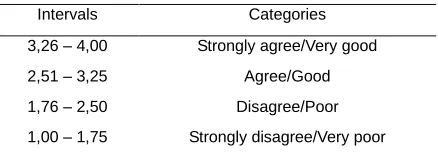
ETHODSThis study employs developmental research as the research method. It is interpreted as a series of processes or steps to develop an effective product and in the form of learning materials, media, learning strategies to be used in schools [11]. The product to be developed is the PowerPoint-based learning media of the theme about always saving energy with the subtheme about forces and motion in grade four of elementary schools. The implementation of development research has three stages, namely descriptive, evaluative, and experimental [12],[13]. However, this study only focused on the first two stages, the description and the evaluation. Descriptive process is used in preliminary research to collect data about existing conditions, which include: (1) the condition of existing products as a comparison material or basic ingredients of the product to be developed, (2) the condition of the product users, for example teachers, students, principals, and other users; (3) the conditions of supporting factors and obstacles to the development and use of the product to be produced. This includes the elements of educators and education personnel, costs needed, facilities and infrastructure, product management, and the educational environment in which the products will be applied. The evaluative process aims to evaluate products that are carried out through a trial process and then make improvements to the findings on the pilot study. Specifically, the stages of the research development of the PowerPoint learning media are as follows: 1) Collection of initial data, 2) Planning, 3) Development of initial products, 4) Product validation by distributing questionnaires to pre-service elementary teachers from a public university in Pekanbaru, Indonesia, 5) Pilot study of the media with grade four students from a public elementary school in Pekanbaru, Indonesia. Participants for validating the media were 41 pre-service elementary teachers from a public university in Pekanbaru, Indonesia. This subject was chosen because they had previously developed PowerPoint-based learning media on integrated thematic learning in technology-based learning media course in the even semester in 2013. The students were given a questionnaire consisting of 19 questions about the quality of the PowerPoint-based learning media developed. The questionnaire was first validated by 3 experts, teacher educators and a media developer. The distribution of the questionnaire was held in October 2014. Participants in the pilot study of the PowerPoint learning media about the theme of always saving energy with the subtheme of forces and motion were 36 four grade students from a public elementary school in Pekanbaru, Indonesia. However, only 34 students who took the pre-test and 32 students took the post-test and filled out the questionnaire about the PowerPoint-based learning media. Therefore, we only used the data from 32 students who took both pre and post-test and filling the questionnaire. This pilot study was held in the third week of October 2014. The data were analysed quantitatively. First, we analysed pre-service teachers’ answers to the quality of the PowerPoint-based learning media developed on the theme about always saves energy with the subtheme about forces and motion. The pre-service teachers are given questionnaires that have 4 choices with a score of 1-4: very agree / very good (4), agree/ good (3), disagree / fair (2), and disagree / poor (1). The distance intervals and categories for the quality of PowerPoint-based learning media developed are presented in table 1. Then we also developed a questionnaire consisting of 10 questions to ask students’ attitudes towards the
PowerPoint-based learning media developed. Finally, the non-parametric Wilcoxon sign rank test was used to test significantly students’ learning outcomes before and after an intervention using PowerPoint-based learning media.
TABLE1
INTERVALS AND CATEGORIES OF THE QUALITY OF THE POWERPOINT-BASED LEARNING MEDIA DEVELOPED
Intervals Categories
3,26 – 4,00 Strongly agree/Very good
2,51 – 3,25 Agree/Good
1,76 – 2,50 Disagree/Poor 1,00 – 1,75 Strongly disagree/Very poor
3
R
ESULTS3.1 Pre-service Teachers’ Responses to the Quality of the PowerPoint-Based Learning Media
699 revised the PowerPoint-based learning media for the first
meeting and produced 28 slides, and we also adjusted to the second meeting. The revised version of the PowerPoint-based learning media was presented back to 41 pre-service teachers on the second week of October 2014, and they gave an evaluation by filling out the questionnaire. First, pre-service teachers responded to the content of the PowerPoint-based learning media developed increased from 2.87 to 3.00, but it is still in the good category (table 2). The highest increase is in point 4 about the introductory of the introduction that was interesting and motivates students by 0.37 points. However, the aspects of PowerPoint-based learning media have included contents including examples of questions and exercises following the core and basic competencies to be achieved decreases by 0.02 points.
TABLE2
PRE-SERVICE TEACHERS’RESPONSES ABOUT THE CONTENTS OF THE POWERPOINT-BASED LEARNING MEDIA
No Statements Average
score (I)
Average score (2) 1 PowerPoint-based learning media
already includes the core and standard competencies to be achieved.
2.80 2.83
2 PowerPoint-based learning media already includes contents including examples and exercises in accordance with core and basic competencies to be achieved.
3.07 3.05
3 PowerPoint-based learning media presents contents that is clear and well understood.
2.90 3.00
4 PowerPoint-based learning media have an introductory of the introduction that is interesting and motivates students.
2.68 3.05
5 PowerPoint-based learning media is already interactive.
2.90 3.07
Average 2.87 3.00
Pre-service teachers’ responses about the background of the PowerPoint-based learning media increase from 2.88 (good) to 3.17 (good) (table 3). The highest increase is in the suitability between the colour of the background colour and the colour of the letters.
TABLE3
PRE-SERVICE TEACHERS’RESPONSES ABOUT THE BACKGROUND OF THE POWERPOINT-BASED LEARNING MEDIA
No Statements Average
score (I)
Average score (2) 1 The color of background is soft/
not tiring your eyes.
2.95 3.19
2 The color of the background and the color of the letters are appropriate.
2.61 3.21
3 The color of the background and the color of the clip art are
2.83 3.10
appropriate.
4 The color of the background chosen can attract students' interest in learning.
3.12 3.17
Average 2.88 3.17
Pre-service teachers’ responses to the font of the PowerPoint-based learning media has a significant improvement which is seen from the increase from 2.93 with a good category to 3.44 with a very good category (table 4). The three aspects contained in table 4 have increased from good to very good categories.
TABLE4
PRE-SERVICE TEACHERS’RESPONSES ABOUT THE FONT OF THE POWERPOINT -BASED LEARNING MEDIA
No Statements Average
score (I)
Average score (2) 1 The font used is appropriate and
easy for students to read.
2.83 3.52
2 The font sizes are appropriate and can be read by students in the classroom.
3.12 3.48
3 The numbers of letters/sentences for each slide are suitable, and they are easy for students to understand.
2.83 3.31
Average 2.93 3.44
Major changes were also found in the sound section of PowerPoint-based learning media, which was from 2.81 (good category) to 3. 37 in the very good category (table 5). The highest change is in the audio aspect which increases 0.67 points.
TABLE5
PRE-SERVICE TEACHERS’RESPONSES ABOUT THE SOUND OF THE
POWERPOINT-BASED LEARNING MEDIA
No Statements Average
score (I)
Average score (2) 1 The transition sound is
appropriate and can attract the attention of students to follow the lesson.
2.71 3.24
14 The audio can be heard clearly for all students in the class.
2.83 3.50
15 The sound effect used can attract students' attention in learning.
2.90 3.36
Average 2.81 3.37
700 TABLE6
PRE-SERVICE TEACHERS’RESPONSES ABOUT THE ANIMATION OF THE POWERPOINT-BASED LEARNING MEDIA
No Statements Average score (I) score (2) Average
16 The clip art is appropriate and can help students to understand the contents.
2.61 3.19
17 The size of the images is clearly visible for all students in the classroom.
2.73 3.48
18 The PowerPoint-based learning media contains supporting animations that can attract students' attention in learning.
2.88 3.29
19 The PowerPoint-based learning media uses hyperlinks that make it easy for teachers to move from one slide to another.
2.98 3.45
Average 2.80 3.35
Overall, the results of pre-service teachers’ responds to the PowerPoint-based learning media developed have increased from an average of 2.86 (good) to 3.26 (very good). Three aspects of media developed, namely fond, sound, and animation, have increased from good to very good categories, while the content and background although also have increased but are still in good categories.
3.1 The Pilot Study of the PowerPoint-Based Learning Media with Fourth Graders
The PowerPoint-based learning media was then tested in grade four of a public elementary school in Pekanbaru. This study was conducted for a week in October 2014. The researchers took preliminary data by providing tests on previous learning material, namely theme always saving energy with the subtheme of energy utilization. The average score of students on the initial test is 68.94 with a standard deviation of 8.70. From the results of normality testing with the Lilliefors test, it was obtained that Lcount (0.249) > Ltable (0.152)
for a significant level of 0.05. It was concluded that the data were not normally distributed so that the next test used the non-parametric of Wilcoxon signed-rank test. The average score of students on the post-test was 76.72 with a standard deviation of 15.22. The student's average score increased by 7.78 points and the students’ score varied more at the post-test compared to the pre-post-test. Based on the non-parametric of Wilcoxon signed-rank test, it was obtained the asymp.sig.2-tailed
(0.011) < sig. (0.025), and it can be concluded that Ho is rejected at a significant level of 0.05. This means that there are significant differences between students’ learning outcomes before and after using the PowerPoin-based learning media in the theme of always saving energy on the subtheme of forces and motion. Besides giving the test, the students were also given a questionnaire containing 10 statements about the PowerPoint-based learning media that are presented (table 7). From this data, an overall average of students’ responds is 3.76 (very good) with a standard deviation of 0.20.
TABLE7
STUDENTS’RESPONSES ON THE POWERPOINT-BASED LEARNING MEDIA
No Statements Average Standard deviation
1 Learning using the PowerPoint-based learning media is very fun.
4.00 0.00
2 The contents described using the PowerPoint-based learning media are clear.
3.69 0.48
3 The contents presented using the PowerPoint-based learning media is easy to understand.
3.75 0.76
4 The explanations conveyed by the teacher on the PowerPoint-based learning media are easy to understand.
3.94 0.25
5 The sentences contained in the PowerPoint-based learning media are easy to understand.
3.72 0.58
6 Examples and problems presented in the PowerPoint-based learning media are complete and easy to understand.
3.75 0.51
7 Texts displayed on the PowerPoint-based learning media are clear and easy to read.
3.91 0.39
8 The color of background is soft/ not tiring your eyes.
3.29 0.85
9 Images displayed on the PowerPoint based learning media are clearly visible.
3.81 0.47
10 Sounds from videos presented in the PowerPoint-based learning media can be heard clearly.
3.72 0.63
Rata-rata 3.76 0.20
The interesting thing is the average score of students’ responds to question 1 is 4.00 (very good). This means that all students enjoy learning using the PowerPoint-based learning media. They have a positive attitude with the use of ICT in learning. Meanwhile, the lowest average score is 3.29 (very good) with a deviation standard of 0.85 in the 8th statement about the attractiveness of the colour of the background. This means that the colour of the background needs to be the main concern in designing the PowerPoint-based learning media.
4
D
ISCUSSION701 the PowerPoint-based learning media with pre-service
elementary teachers who have developed a PowerPoint-based learning media. Other validations that can be done include expert validation and validation with elementary school teachers as users of the media. Overall, the PowerPoint-based learning media developed have experienced an increase in quality from the good to very good categories, but several aspects remain of concern in development such as the contents. In the future, the development of a PowerPoint-based learning media must pay more attention to the media content being developed because this aspect contains material that will be studied by students. Improvements that must be made mainly relate to learning materials, examples of problems, and suitability with the objectives to be achieved. Furthermore, the implementation of the PowerPoint-based learning media on the theme of always saving energy with the subtheme of forces and motion with fourth graders has a significant impact on improving students’ learning outcomes. The similar result is also found in the previous studies conducted by Lowry [14] and Mantei [15], but it is contrary to the studies conducted by Daniels [16] and Kask [17] in which the use of PowerPoint-based learning media does not influence on improving students’ learning. The PowerPoint-based learning media on the theme of always saving energy with the subtheme of forces and motions also build students’ positive attitudes toward the media used [7]. All students feel happy learning using the PowerPoint-based learning media. Learning by using the PowerPoint-based media also provides efficacy for students in understanding the contents presented because it creates dynamic learning in the classroom [8].
5
C
ONCLUSIONBased on the results of the study it can be concluded that the steps of developing the PowerPoint-based learning media on integrated thematic learning in elementary schools begin from searching for the information by interviewing teachers, studying syllabus, developing the PowerPoint-based learning media based on selected a theme and a subtheme, validating the media, and trying it to elementary students. Overall, the PowerPoint-based learning media developed on the theme of always saving energy with the subtheme of forces and motion is a good category. This is indicated by the increase of the average final score of the pr-service teachers’ responses to the PowerPoint-based learning media. The students’ learning outcome also significantly increases from 68.94 to 76.72. The students have a very good response to the PowerPoint-based learning media developed. This is indicated by the average score of student responses to the PowerPoint-based learning media that is 3.76 with a standard deviation of 0.20 This research has only been carried out in the evaluative stage, so further research needs to be carried out to the experimental stage of testing the PowerPoint-based learning media to more students from several schools, to produce a valid and practical PowerPoint-based learning media. PowerPoint is one of the ICT-based learning media, so it needs further research that develops audio and video-based learning media, games, and e-learning. Seeing the participation and enthusiasm of students in the use of the PowerPoint-based learning media, teachers must utilize this media in the classroom so that the teaching and learning process is more varied. Meanwhile, the use of the PowerPoint-based learning media in learning is closely related to the contents to be taught to students. The contents that require pictures, audio and video are very well
presented with the PowerPoint, but learning that requires students to do calculations and read text on display may not be very effective if presented in PowerPoint.
A
CKNOWLEDGMENTThe authors thank the Faculty of Teacher Training and Education, University of Riau, for supporting this study under the grand of DIPA FKIP UNRI 2014.
R
EFERENCES[1] E. Hartono, ―Pengembangan Media Pembelajaran Berbasis Web pada Materi Bangun Ruang Sisi Datar Kelas VIII SMPN 1 Bantul,‖ Bachelor Thesis, Faculty of Science and Technology, Sunan Kalijaga Islamic State University, Yogyakarta, 2012.
[2] E. Novitasari, S. Pur and S. Toro, ―Pengembangan Media
Pembelajaran Berbasis IT berbentuk Permainan Ular
Tangga Materi Alat Optik Untuk Kelas VIII SMP,‖ J.
Pendidikan Fisika, vol. 1, no. 1, pp. 37 – 45, 2013.
[3] N. Nuryadi, ―Pembelajaran Matematika Berbasis IT Menuju ke Pembelajaran E-learning untuk Menciptakan Pembelajaran yang Aktif, Konstruktif, dan Lingkungan Anak yang Melek Teknologi,” National Conference on Education, Malang State University, 2010.
[4] S. Suprapto, ―Peningkatan Kualitas Pendidikan Melalui Media Pembelajaran Menggunakan Teknologi Informasi di Sekolah.‖ J. Ekonomi dan Pendidikan, vol.3, no. 1, pp. 34 – 41, 2006.
[5] A. Muhson, ―Pengembangan Media Pembelajaran Berbasis Teknologi Informasi,‖ J. Pendidikan Akuntansi Indonesia, vol. 8, no. 2, pp. 1 – 10, 2010.
[6] Z. H. Putra, D. Darmawijoyo, R. I. I. Putri and J. de Hertog, ―Supporting First Grade Students Learning Number Facts up to 10 Using a Parrot Game,‖ J. on Mathematics Education, vol. 2, no. 2, pp. 163 – 172, 2011.
[7] J. E. Susskind, ―PowerPoint’s power in the classroom:
Enhancing students’ self-efficacy and
attitudes,‖ Computers & Education, vol. 45, no. 2, pp.
203-215, 2005.
[8] R. J. Craig and J. H. Amernic, ―Powerpoint Presentation
Technology and the Dynamics of Teaching" Innovative Higher Education, vol. 31, no. 3, pp. 147-160, 2006.
[9] Kementerian Pendidikan Nasional, ―Materi Pelatihan Guru Implementasi Kurikulum 2013 SD Kelas I,‖ Badan Pengembangan Sumber Daya Manusia Pendidikan dan Kebudayaan dan Penjaminan Mutu Pendidikan, Kementerian Pendidikan dan Kebudayaan, Jakarta, 2013.
[10] S. Sutirjo and S. I. Mamik, ―Tematik: Pembelajaran Efektif dalam Kurikulum 2004,” Malang: Bayumedia Publishing, 2005.
[11] L. R. Gay, ―Educational Evaluation and Measurement: Competencies for Analysis and Application – Second Edition,‖ Mavmillan New York :Publishing Company, 1990.
702 [13] P. Setyosari, ―Metode Penelitian Pendidikan dan
Pengembangan,” Jakarta: Kencana, 2013.
[14] R. B. Lowry, ―Electronic Presentation of Lectures – Effect upon Student Performance,‖ University Chemistry Education, Vol 3, pp. 18 – 21, 1999.
[15] E. J. Mantei, ―Using Internet Class Notes and PowerPoint in Physical Geology Lecture: Comparing the Success of Computer Technology with Traditional Teaching Techniques,‖ J. of College Science Teaching, vol.29, pp. 301 – 305, 2000.
[16] L. Daniels, ―Introducing Technology in The Classroom: Powerpoint as q First Step. J. of Computing in Higher Education, vol. 10, pp. 42–56, 1999.