
Available online: https://edupediapublications.org/journals/index.php/IJR/ P a g e | 214
Implementation of Hadamard Transform (HT) for Multiple-Rate Codes
based o n Block Markov Superposition Transm issio n
A B S TR AC T
Hadamard Transform (HT) as over the twofold field gives a characteristic approach to actualize numerous rate codes (alluded to as HT-coset codes), where the code length N = 2p is settled however the code measurement K can be shifted from 1 to N − 1 by a ltering the arrangement of solidified bits. Superior to anything HT we can actualize Fast Walsh-Hadamard Transform for era of HT–coset codes. The HT-coset codes, including Reed-Muller (RM) codes and polar codes as average cases, can share a couple of encoder and decoder with usage many-sided quality of request O(N log N ). In any case, to ensure that all codes with assigned rates perform well, HT-coset coding for the most part requires an adequately huge code length, which thusly causes challenges in the assurance of which bits are better to be solidified. In this paper, we propose to transmit short HT-coset codes in the purported piece Markov superposition transmission (BMST) way. At the transmitter, signs are spatially coupled through superposition, bringing about long codes. At the recipient, these coupled signs are recouped by a sliding-window iterative delicate progressive cancelation unraveling calculation. In particular, the execution around or beneath the bit -mistake rate (BER) of 10−5 can be anticipated by a straightforward genie-helped bring down bound. Both these limits and reenactment comes about demonstrate that the BMST of short HT-coset codes performs well (inside one dB far from the relating Shannon limits) in an extensive variety of code rates.
I N TRO DUC TIO N
In helpful correspondence structures, it is a great part of the time required to complete a couple codes with different code rates. This is fundamental for remote correspondence systems to execute the adaptable coded adjust, which can let down the power outage probability of a single code and along these lines allows more
capable usage of the uncommon transmission limit resources. It is then alluring to complete codes with each and every differing rate of eagerness with a few encoder and decoder. Rate-great (RC) codes are a class of various rate codes, which are typically worked from a mother code by the use of code modifying frameworks, for instance, shortening information bits and enlarging or puncturing I. NITHIN KUM A R,
M.Tech.,
Department of Electronics & Communication Engineering, Vaagdevi College of Engineering,
Jawaharlal Nehru Technological University, Hyderabad, Telangana,
India.
Email.id. [email protected] m
M . SHIVA PRA SA D Asst.prof,
Department of Electronics & Communication Engineering,, Vaagdevi College of Engineering,
Jawaharlal Nehru Technological University, Hyderabad,Telangana,
India
Email.id. [email protected]
U. VENU Asst.prof,
Department of Electronics & Communication Engineering, Vaagdevi College of Engineering,
Jawaharlal Nehru Technological University,Hyderabad, Telangana,
Indi.a
Available online: https://edupediapublications.org/journals/index.php/IJR/ P a g e | 215
equity check bits, as consolidated. The rate-great codes generally have assorted code lengths for different code rates. For a couple of uses, the code lengths can be changed in a wide range. For example, Raptor codes (with length the length of required) were enhanced by arranging the degree profiles to extend the ordinary throughput. In 2009, Casado et al proposed different rate codes with settled code length by solidifying lines of the fairness check network of a mother code. In 2012, Liu et al fabricated different rate nonbinary low-thickness fairness check (LDPC) codes with settled square length by using higher demand Galois fields for codes of lower rates [11]. But settled length various rate codes are not suitable to cross breed customized go over request (HARQ) with incremental redundancies, they may find applications in some unique circumstances.
Settled length different rate codes can be associated with the circumstances where a confining basic is constrained on the physical layer. This happens, for instance, when orthogonal frequency division modulation (OFDM) with a settled number of subcarriers is used. In this circumstance, less information bits should be encoded to keep up the unwavering quality essential when the direct is in a low signal-to-noise ratio (SNR) level. Settled length distinctive rate codes may in like manner find applications in blast memory structures, where as far as possible diminishes with ages yet the amount of memory cells keeps un-changed.
The more settled flash memory, which has encountered a significant number of erase cycles, has a degraded farthest point and requires a code of lower rate; while the "more youthful" blast memory has a greater breaking point and backings a code of higher rate. In this circumstance, settled length various rate codes with a comparative combine of encoder and decoder are favored. Square Markov
superposition transmission (BMST) is an advancement of enormous convolutional codes from short codes (suggested as major codes), which has an average execution over the binary-input additive white Gaussian noise channel (BI-AWGNC). In it has been pointed out that any short code with snappy encoding count and Softe in Soft out (SISO) translating figuring can be picked as the fundamental code. A sliding-window decoding (SWD) figuring with a tunable unraveling delay, as like the pipeline message-passing interpreting count of the LDPC convolutional codes, can be completed to
disentangle the BMST system. Most
importantly, the execution of the SWD count in the low oversight rate locale can be expected by an essential genie-cut down bound.
In this paper, the BMST is utilized to develop another class of numerous rate codes with settled code length. To start with, we propose to develop short various rate codes by adjusting the arrangement of solidified bits in Hadamard transform (HT), resulting in HT-coset codes. This group of codes, which have length N = 2p for some p > 0 and measurement K ranging from 1 to N − 1, can be executed by the utilization of a couple of encoder and decoder with multifaceted nature of request O(N log N ). Such a couple of encoder and decoder were initially shown using typical diagram for Reed-Muller (RM) codes by Forney. The HT-coset codes considered in this paper are likewise firmly identified with the polar codes, in any case, channel polarization assumes a less imperative part here in light of the fact that the considered codes will be short (ordinarily N ≤ 16). At that point, to enhance the execution of the short HT-coset codes, we propose to transmit short HT-coset codes in the BMST way.
Available online: https://edupediapublications.org/journals/index.php/IJR/ P a g e | 216
fundamental code a Cartesian result of short
HT-coset codes and henceforth has
encoding/decoding many-sided quality linearly growing with the transmission piece length. Also, the bound together structure of the HT-coset codes can fundamentally disentangle the equipment execution. Reproduction comes about demonstrate that the BMST-HT frameworks perform well (within one dB far from the corresponding Shannon limits) in an extensive variety of code rates. Whatever remains of this paper is composed as takes after. In Section II, we show the encoding and decoding calculation for the numerous rate HT-coset codes. In Section III, we build BMST-HT frameworks with a general plan methodology and present the encoding and decoding calculation for the different rate BMST-HT frameworks. Segment IV closes this paper.
FULL-DUPLEXCASE
Relay channel
Vander Meulen first proposes the idea of hand-off channel. Cover and El Gamal additionally outline a few vital procedures for transfer channels, including decipher forward, pack forward, and blended disentangle forward and pack forward. A variety of the disentangle forward plan is incomplete interpret forward, in which the Transfer just translates a part of the message from the source and advances it to the destination instead of decoding the entire message. Kramer, Gastpar and Gupta extend these plans to the numerous hub hand-off systems and propose a few rate locales in light of unravel forward, pack forward and blended techniques. Lim, Kim, El Gamal and Chung propose another plan called Noise Network coding (NNC) in view of pack forward relaying. These hand-off coding procedures have been broadly connected in different channels. For instance Liang and Kramer concentrate the
hand-off communicate channel using rate splitting, square Markov encoding and halfway interpret forward relaying.
I nt e r f e r e n c e c h a n n e l
Carleial first presents the obstruction channel and proposes inward and external limits and in addition limit comes about for a few exceptional cases. Sato concentrates the limit with respect to the Gaussian impedance divert with solid obstruction. Han and Kobayashi propose the notable Han-Kobayashi coding strategy in utilizing rate part at the transmitters and joint translating at the recipients, which to date accomplishes the biggest rate locale for the obstruction channel. Chong, Motani, Garg and El Gamal propose a variation plot in light of superposition coding, which accomplishes a similar rate area as the first Han-Kobayashi conspire yet has less assistant irregular factors and subsequently decreases the encoding and translating complexities.
C o g n i t i ve i nt e r f e r e n c e c h a n n e l
Available online: https://edupediapublications.org/journals/index.php/IJR/ P a g e | 217
no rate debasement and utilizations single-client decoder. Rini, Tuninetti and Devroye additionally propose a few new internal, external limits and limit comes about in view of rate spitting, superposition coding, a communicate channel-like binning plan and Gelfand-Pinsker coding.
A vital strategy utilized as a part of all subjective coding is the binning system proposed by Gelfand and Pinsker. In Gelfand-Pinsker binning, the condition of the channel is known at the information, however obscure at the yield. Marton proposes the twofold binning plan and applies it to the communicate channel. Kim, Sutivong and Cover additionally examine Gelfand-Pinsker binning to permit the translating of a piece of state data at the goal at a diminished data rate. Costa applies Gelfand-Pinsker binning to the Gaussian channel and proposes the outstanding messy paper coding (DPC) conspire, which accomplishes an indistinguishable rate from if the channel is without obstruction. An astonishing element of DPC binning is that the transmit flag is autonomous of the state.
Hadamard Matrix
The Kronecker product of two
matrices and
is defined as
In general, .
The Hadamard Matrix can be extensively defined recursively as below:
Obviously is rean and
symmetric. Here are two examples for
and :
Note that Hn is by matrix.
The primary section on the privilege of the framework H3 is for the indecies of the lines,
and the second segment speaks to the sequency (the quantity of zero-intersections or sign changes) in every line. Sequency is like yet not quite the same as recurrence as in it quantifies the rate of progress of non-periodical signs.
The rows of the matrix can be considered as
the samples of the following
Available online: https://edupediapublications.org/journals/index.php/IJR/ P a g e | 218
The Hadamard Matrix can likewise be acquired by characterizing its component in the kth push
and mth section of as
Where
i.e.,
and are the
binary representations of and ,
respectively. Obviously, .
We can show the Hadamard matrix is orthogonal by induction. First, it is obvious that is orthogonal:
Next we assume is orthogonal, i.e.,
Finally we show that is
also orthogonal:
In summary, the Hadamard matrix is real, symmetric, and orthogonal:
The Walsh-Hadamard Transform (Hadamard Ordered)
As any orthogonal (unitary) matrix can be used to define a discrete orthogonal (unitary) transform, we define a Walsh-Hadamard
transform of Hadamard order ( ) as
These are the forward and inverse
transform pair. Note that the forward and inverse transforms are identical!
Here
and
are the signal and spectrum vectors, respectively. The th element of the transform can also be written as
The complexity of WHT is . Similar to FFT algorithm, we can derive a fast WHT
Available online: https://edupediapublications.org/journals/index.php/IJR/ P a g e | 219
We will assume and in
the following derivation. An
point of signal is defined as
Here for simplicity, we ignored the coefficient . This equation can be separated into two parts. The first half of the vector can be obtained as
Where
The second half of the vector can be obtained as
(3)
Where
(4)
What we have done is converting a of
size into two of
size . Continuing this process
recursively, we can rewrite Eq. (1) as the following (similar process for Eq. (3))
This equation can again be separated into two halves. The first half is
(5)
Where
(6)
The second half is
(7)
Where
(8)
through of the second half can be obtained similarly.
(9)
and
(10)
Available online: https://edupediapublications.org/journals/index.php/IJR/ P a g e | 220
Sequency Ordered Walsh-Hadamard Matrix
In order for the elements in the spectrum
to represent different sequency components contained in the signal in a low-to-high order, we can re-order the rows (or columns) of the Hadamard matrix according to their sequencies.
The conversion of a given sequency into the corresponding index number in Hadamard order is a three-step process:
1. represent in binary form:
2. convert this binary form to Gray code:
where represents exclusive or and by definition.
3. bit-reverse 's to get 's:
Now can be found as
where or
equivalently .
For example, , we
have
Now the sequency-ordered or Walsh-ordered Walsh-Hadamard matrix can be obtained as
Available online: https://edupediapublications.org/journals/index.php/IJR/ P a g e | 221
the second segment is the list of the Hadamard requested. We see that this lattice is still symmetric:
Fast Walsh-Hadamard Transform (Sequency Ordered)
The sequency-ordered Walsh-Hadamard
transform ( also called Walsh
ordered ) can be obtained by first
carrying out the fast and then
reordering the components of as shown above. Alternatively, we can use the following
fast directly with better efficiency.
The sequency ordered WHT of can also be defined as
where , , and the exponent
of represents the conversion from sequency ordering to Hadamard ordering (binary-to-Gray code conversion and bit-reversal conversion).
In the following, we
assume , and we
represent and in binary form as,
respectively, and ,
i.e.,
As the first step of the algorithm, we rearrange the order of the samples by bit-reversal to get
We also define . Now
the can be written as
Expanding the 3rd summation into two terms, we get
Available online: https://edupediapublications.org/journals/index.php/IJR/ P a g e | 222
where and is defined as
(11)
Expanding the 2nd summation into two terms, we get
where is defined as
(12)
Finally, expanding the 1st summation into two terms, we have
(13)
Summarizing the above steps, we get the fast algorithm composed of the bit-reversal and the three equations (11), (12), and (13), as illustrated below:
A Simple Example
Consider a signal vector of N=4 elements (samples):
The corresponding 4 by 4 WHT matrix (Hadamard ordered) is:
The rows (or colums) of this matrix can be reordered according to their sequency by the
following mapping:
Available online: https://edupediapublications.org/journals/index.php/IJR/ P a g e | 223
where is the ithcolum (or row) vector of the
symmetric matrix representing a
square wave of sequency (with zero-crossings). Now the sequency spectrum of the
signal can be found as
and the inverse transform (note ) represents the signal vector as a linear combination of a set of square waves of
different sequencies:
We can also verify that indeed the inverse transform will produce the original signal from its spectrum:
III. BM STO FSHO RTHT-CO SETCO DES
A. ChoiceofEncodingMemory
We have exhibited that Hadamard change can be utilized to develop a group of codes with steady length N and adaptable measurement K. This group of codes can be executed by a similar match of encoder and decoder however with flexible sources of info. Notwithstanding, the exhibitions are far from as far as possible, as confirm by the development case with N = 8. One
Available online: https://edupediapublications.org/journals/index.php/IJR/ P a g e | 224
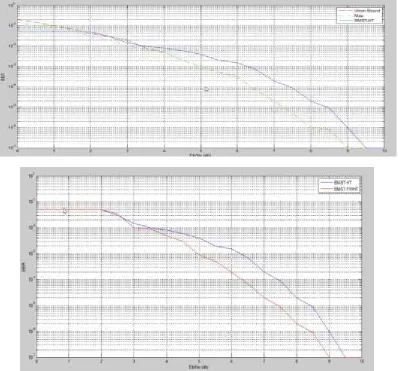
Fig. 4. The performance of the HT coset code with K = 4 and N = 8 under the SISO decoding algorithm (Algorithms 2 and 4) with an iteration number J = 3. The union bound and the
performance curve of the MAP decoding are also plotted.
Conceivable approach to enhance the execution is to develop the request of the Hadamard change. As N turns out to be adequately extensive, for any given measurement K, we have opportunity to choose dynamic set to approach the channel limit. The trouble lies in the decision of the dynamic set when N turns out to be expansive. Here we propose to join the BMST with the HT-coset codes. As pointed out in any short code can be inserted into the BMST framework to acquire additional coding increase the low BER area. The basic parameter for
BMST is the encoding memory m, which predicts the additional coding increase of 10 log10(m+1) dB over AWGN channels. Given this anticipated additional coding increase, we can utilize the accompanying deterministic system to discover the encoding memory mkrequired by the BMST-Ht sytem (N=2p, p>1) to approach as far as possible at an objective BER p target.
Available online: https://edupediapublications.org/journals/index.php/IJR/ P a g e | 225
TABLEII
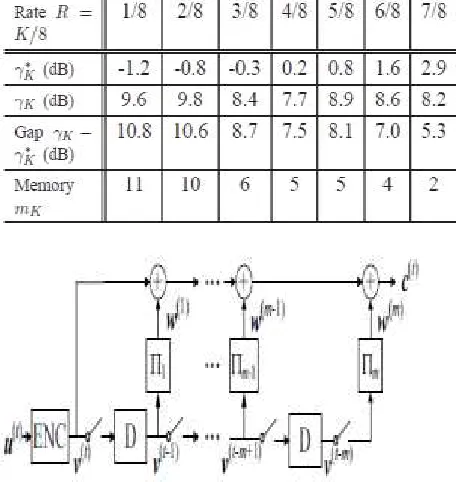
T H EM EMORYR EQUIREDFOREACHC ODE R AT EU S IN GT H EBM S TO FH
T-C OSETT-C ODESWITHN=8TOA P P R O A T-C H
T HES HANNONLIMITATTHEBERO F1 0− 5
Fig. 5. The encoding diagram of the BMST-HT system with a maximum memory m.
• For K = 1, 2, … ,N− 1, determine the encoding memory mKwith the following steps.
1) From the union bound of the HT-coset code with information bit K, find the required
Eb/N0 = ΓK to achieve the target BER
Ptarget.
2) Find the Shannon limit for the code rate K/N, denoted by .
3) Determine the encoding memory by 10 log10 (m + 1) ≥ ΓK− . That is,
where⌊x⌉stands for the integer that is closest to x.
Table II shows the memory required for each code rate using the BMST of HT-coset codes With N = 8 to approach the Shannon limit at a target BER of Ptarget= 10−5.
B. Encoding of BMST-HT System
A BMST-HT framework is built by taking the encoder for the HT-coset codes as the essential encoder, which acknowledges as info a double data grouping of length BK and conveys as yield a parallel coded arrangement of length BN. All the more correctly, the fundamental code [n, k] is a B-crease Cartesian result of [N,K], where n = BN and k = BK. To approach the limit,
Fig. 6. The normal graph of the BMST-HT system with L = 4 and m = 2.
D.AConstructionExample(Continued)
Available online: https://edupediapublications.org/journals/index.php/IJR/ P a g e | 226
K to approach the corresponding Shann onlimit at the BER of 10−5 is specified in TableII. Hence we need an encoder with a maximum memory m=11. The SISO decoding algorithm (Algorithms 2 and 4) with an iteration number J=3 is used to implement the SISO decoding algorithm for the basic code. The iterative sliding-window decoding algorithm for the BMST-HT system is performed with a maximum iteration number of 18, where the entropy- based early stopping criterion is used with athreshold of 10−5. Simulation results with L=1000 for encoding are shown in Fig.7, where the decoding delay is specified as dK=2mK forcoderate K/N.
Also shown in Fig.7 are the genie-aided lower bounds, which are obtained by shifting the corresponding performance curves of the basic codes to left by 10log10(1+mK) dB. We can
see that the performances of the BMST-HT system match well with the respective genie-aided lower bounds in the low BER region for all considered code rates. To evaluate the bandwidth efficiency of the BMST-HT system, we plot the required SNR to achieve the BER of 10−5 against the code rate in Fig.8. We can
Available online: https://edupediapublications.org/journals/index.php/IJR/ P a g e | 227
Figure 7: Performance of the BMST-HT system using the Cartesian products of the HT-coset codes [8,K]1250(1≤K≤7) with L=1000.
The sliding-window decoding algorithm is performed with a maximum iteration number Imax=18 and a decoding delay dK=2mK for
the code of rate K/8 rates. However, the performance gap of the code is slightly larger. This is due to the sub-optimality of Algorithm2, as mentioned previously. If an optimal (locally) SISO algorithm (the MAP decoding) is used for the code, the performance can be improved, as marked in Fig.8 by the cross×.
E. Further Discussions
We have also constructed a BMST-HT system using the B-fold Cartesian product C[16,K]B (1≤K ≤15) as the basic code, where B=625. The required encoding memories can be determined following the procedure described in Section III-A, which are shown in Table III. The required SNR to achieve the BER of 10−5 is plotted against the code rate in Fig.9. We can see that the BMST-HT system also has a BER of 10−5 with in oned B away from the Shannon limits for all considered code rates. Using
HT-coset codes with larger N, we can implement codes with finer code rates. However, this simple approach can only construct codes with rates of form K/2p. In practice, other code rates (say1/3and4/5 in the standard of Long Term Evolution (LTE)) are required. In this case, we can construct the basic code by combining several HT-coset codes with different rates. Taking rate1/3 as an example, we can use the Cartesian product of the HT-coset codes [[4,1] ×[4,1]×[4,2]]B as the basic code.
Available online: https://edupediapublications.org/journals/index.php/IJR/ P a g e | 228
10−5 with BPSK signaling over AWGN
channels
Fig.9.The required SNR for the BMST-HT system using the Cartesian products of HT-coset codes [16,K]625(1≤K≤15) to achieve the BER of 10−5with BPSK signaling over AWGN channels.
C O N CLUSIO NS
In this paper, we have proposed a new class of multiple-rate codes by embedding the Fast Walsh-Hadamard transform (FWHT) coset codes in to the block Markov super position transmission (BMST) system, resulting in the BMST-FWHT system. The implementation complexity of the system is linear in the code length, while the performance in the low error rate region can be predicted. The simulation results show that the BMST-FWHT system can approach the Shannon limit with in oned B at the BER of 10−6 for a wide range of code rates.
TABLE III
THE MEMORY REQUIRED FOR EACH CODE RATE USING THE BMST OF HT-COSET CODES WITH N = 16 TO APPROACH THE SHANNON LIMIT AT THE BER OF 10−5
R EFEREN C ES
1. Tse, D., & Viswanath, P. (2005). Fundamentals of wireless communication. Cambridge university press.
2. Alamouti, S. M., & Kallel, S. (1994). Adaptive trellis-coded multiple-phase-shift keying for Rayleigh fading channels. IEEE Transactions on Communications, 42(6), 2305-2314.
3. Sun, Y., Karkooti, M., & Cavallaro, J. R. (2007, May). VLSI decoder architecture for high throughput, variable block-size and multi-rate LDPC codes. In 2007 IEEE International Symposium on Circuits and Systems (pp. 2104-2107). IEEE.
4. Hagenauer, J. (1988). Rate-compatible punctured convolutional codes (RCPC codes) and their applications. IEEE transactions on communications, 36(4), 389-400.
5. Acikel, O. F., & Ryan, W. E. (1999). Punctured turbo-codes for BPSK/QPSK
channels. IEEE Transactions on
Communications, 47(9), 1315-1323.
Available online: https://edupediapublications.org/journals/index.php/IJR/ P a g e | 229
Communications, 2004 IEEE International Conference on (Vol. 1, pp. 430-434). IEEE.
7. Ha, J., Kim, J., & McLaughlin, S. W. (2004). Rate-compatible puncturing of low-density parity-check codes. IEEE Transactions on Information Theory, 50(11), 2824-2836.
8. Ha, J., Kim, J., & McLaughlin, S. W. (2004). Rate-compatible puncturing of low-density parity-check codes. IEEE Transactions on Information Theory, 50(11), 2824-2836.
9. Zhang, K., Ma, X., Zhao, S., Bai, B., & Zhang, X. (2012, July). A new ensemble of
rate-compatible LDPC codes. In
Information Theory Proceedings (ISIT), 2012 IEEE International Symposium on (pp. 2536-2540). IEEE.
10. Casado, A. I. V., Weng, W. Y., Valle, S., & Wesel, R. D. (2009). Multiple-rate low-density parity-check codes with constant blocklength. IEEE Transactions on Communications, 57(1), 75-83.
11. Uppal, M., Yue, G., Wang, X., & Xiong, Z. (2011). A rateless coded protocol for half-duplex wireless relay channels. IEEE Transactions on Signal Processing, 59(1), 209-222.
12. Liu, L., Zhou, W., & Zhou, S. (2012). Nonbinary multiple rate QC-LDPC codes with fixed information or block bit length. Journal of Communications and Networks, 14(4), 429-433.
13. Huang, X., Kavcic, A., Ma, X., Dong, G., & Zhang, T. (2013). Multilevel flash memories: Channel modeling, capacities and optimal coding rates. International Journal on Advances in Systems and
Measurements Volume 6, Number 3 & 4, 2013.
14. Ma, X., Liang, C., Huang, K., & Zhuang, Q. (2013, July). Obtaining extra coding gain for short codes by block Markov superposition transmission. In Information Theory Proceedings (ISIT), 2013 IEEE International Symposium on (pp. 2054-2058). IEEE.
![Fig. 8. The required SNR for the BMST-HT system using the Cartesian products of HT-coset codes [8,K]1250(1 ≤K≤7)to achieve the BER of](https://thumb-us.123doks.com/thumbv2/123dok_us/7777269.1283051/14.612.91.500.70.321/required-bmst-using-cartesian-products-coset-codes-achieve.webp)

