An Algorithm for Fetal Heart Rate detection
using Wavelet Transform
Neha Para1, Dr. Sulochana Wadhwani2
PG Student [MAC], Dept. of EE, Madhav Institute of Technology and Science, Gwalior, Madhya Pradesh, India1 Professor, Dept. of EE, Madhav Institute of Technology and Science, Gwalior, Madhya Pradesh, India2
ABSTRACT: Fetal ECG is very important tool for nowadays. FECG is the record of the electrical activity of fetal heart. This research work proposes an algorithm for extraction of heart rate of fetal from an ECG signal which is measured on the mother’s abdomen. When ECG signal is taken from mother’s abdomen the resultant ECG signal is composite signal because it contains both mother and fetal ECG signals. But the chest ECG contains only maternal ECG signal, Because of this we taken here only abdominal ECG signals. It is very important to birth of healthy baby. Eight out of the thousand baby born with congenital anomalies. Most of the congenital anomalies are related to the heart. Detection of the heart before the birth of the baby reduces the risk of the unhealthy baby birth. There are several techniques of monitoring the condition of fetal heart. Fetal monitoring techniques are classified into two techniques. These are invasive and non-invasive techniques. In this research paper we proposes an algorithm for fetal heart rate extraction from an ECG signals which measured by mother’s abdomen. The chest ECG contains only maternal ECG (MECG) but abdominal ECG is a composite ECG signal containing both mother as well as fetal ECG. Since past, in this field lots of research work have been done. Some methods are threshold and filtering method, neural network method, etc. Wavelet Transform is very effective and most popular method for detection of characteristics of ECG. This proposed algorithm consist with three steps: 1) Abdominal ECG signal is recorded from mother’s abdomen by surface electrodes and decomposed to estimate maternal ECG signals using wavelet Transform. 2) ECG of fetal is extracted by subtraction of MECG from AECG signal. 3) Then from extracted FECG signal R-peaks are detected and calculate heart rate. This research is implemented on 15 recorded signals using MATLAB. These recorded signals are taken from Physionet.
KEYWORDS: AECG (Abdominal Electrocardiogram), FECG (Fetal Electrocardiogram), MECG (Mother’s Electrocardiogram),Wavelet Transform, FHR (Fetal Heart Rate).
I.INTRODUCTION
Monitoring of fetal heart is the technique to examine the health-status and heart diseases during pregnancy with special equipment. Fetal heart rate (FRH) is the most important tool nowadays in clinical investigations to examine the heart status or health state of fetal in the womb during pregnancy and labor. FRH is the mostly used parameter during pregnancy for proper treatment. Monitoring of fetal heart rate helps to detect changes in heart rate and produce information about the condition of baby during pregnancy or labor. If any changes are detected, doctors can take some important steps to treat the problems. Fetal ECG are generally much weaker than maternal ECG (MECG). But fetal heart rate (FHR) is higher than maternal heart rate (MHR) [1][2].
gestational age. In the case of non-invasive Fetal ECG monitoring, surface electrodes are used which is placed on abdominal surface of mothers provides worthwhile information about the cardiac electrical activity of fetal. By using traditional techniques, extraction of the FECG from the abdominal signal is very hard even not possible [3].
Electrocardiogram (ECG) is the convenient, simplest and painless technique to find out the heart rate. It is non-invasive method to evaluate fetal heart condition. ECG provides cardiac waveform. This cardiac waveform of the fetal support to the physicians to find out problems. In non-invasive technique the surface electrodes are placed on the abdominal surface of the mother, then AECG is recorded which is composite of the mother and fetal ECG with some noises. It takes great amount of noises. In the FECG signal measuring process four main types of noise and interference occur such as 50 Hz power line interference, Base line drift, Maternal electromyogram (EMG) and random noise[2].The extracted FECG signal is very complex and severely contaminated by external disturbances or noises. The objective of our work is to remove the noises from the signal which is occurred due to power line interference, movement of patient etc.
Numerous methods and different approaches have been proposed for fetal electrocardiogram (FECG) signal detection: ECG extraction using wavelet transform [5] [7] [8], Using Wavelet Transform, we proposed here an algorithm to fetal ECG extraction from maternal abdominal signal and calculate FHR. The fetal ECG amplitude is always fluctuated. Some algorithms are not efficient to find out all R-peak. In this paper we generate an algorithm with threshold to find out all R-peaks of fetal ECG. This proposed approach consists with two steps: decomposed the abdominal signal into FECG and MECG with four level Wavelet Transform. Then R-peaks are detected from FECG. This paper is put in order as follows: Section II narrate the approach which is used for extraction of fetal ECG. Section III narrate the methodology with data acquisition and algorithm which is proposed in this paper. Section IV shows the result of this research and showing fetal heart rate and also showing the advantages of this proposed approach and conclusion is showing in section V.
II.OUR APPROACH
There are so many methods for ECG detection as mentioned above. The DWT characterization will deliver the firm features of the variations of the ECG waveform. Wavelet Transform is basically a convolution operation. This is the convolution of the subjective signal and wavelet function. The Wavelet Transform decomposes the original signal into two sub signals such as detail signal and approximation signal. Thus multi resolution analysis can be performed in discrete wavelet domain [1].
For large variety of applications known wavelet families and functions are present. We were seen the uses of these wavelet families. There is no way to select a certain wavelet. Here we create MATLAB program to obtain the wavelet analysis. In this paper we use db (Daubechies) wavelet because it is similar in shape to the human heart beat waveform. Wavelet Transform works on the basis of convolution. Here subjective signal is recorded signal and wavelet function is db (Daubechies).
III.METHODOLOGY
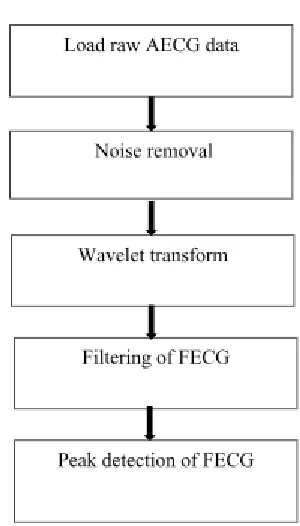
For R-peak detection following steps are:
Load raw AECG signal which is taken from Physionet. Pre-processing (noise removing).
Decomposition of the signal using Wavelet Transform. Filtering of FECG signal.
Fig. 1 Flow chart of FECG analysis
Data Acquisition
The subjective signals is taken from the Physionet [11]. In this research work we use non-invasive fetal ECG database, which is up to 40 weeks of gestational age and duration of each signal is 10 seconds long. Frequency of these signals is 1000 Hz and 16 bits resolution. This records has thoracic signals and abdominal signals both. Here we use only abdominal signals because it contains both maternal and fetal ECG. That is why we take only abdominal signals. Electrodes are placed on mother’s abdomen. 50 Hz notch filter switched on to filter power line or other related disturbances.
Pre-processing
The original signal is very noisy. These noises described above. Grid noise is removed by average filter. Power line interface is 50 Hz or 60 Hz noise component which is removed by IIR-notch filter. 50 Hz IIR-notch filter is used to filter out PLI (power line interface) or other related disturbances. Then, to get MECG and FECG here we apply Wavelet Transform which is also remove the baseline drift.
Proposed Algorithm
In the proposed algorithm a Daubechies Wavelet Transform with 10 level decomposition is used for decomposed the original signal. In this algorithm we use db4 wavelet because of its better result. To realize MECG signal, Decomposition of original signal (AECG) is done by filtering and down sampling operations. Level 1 coefficient are generate at this stage. Convolution is done of AECG signal with filter coefficient.
(original) signal. After subtraction of MECG from AECG fetal ECG (FECG) is obtained.Fetal heart rate is obtained by calculating no. of R-peaks of extracted FECG signal that is 10 second long in duration.Using RR interval including minimum &maximum heart rate, we first calculate R- peaks in the FECG signal. Based on the normal fetal heart rate, mean RR interval and sampling frequency, where the maximum heart rate is around 180 beats per minute and the minimum rate is around 90 beats per minute we can detect fetal peak. The resulted detected R-peaks are shown by red stars on the peak points.
IV.RESULT
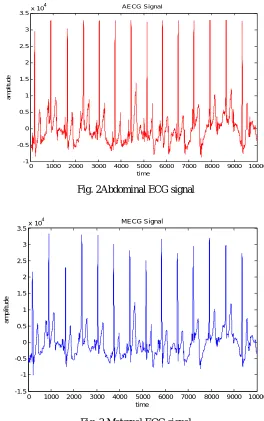
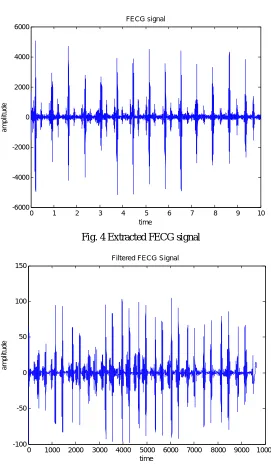
This proposed algorithm is performed on 15 recorded signals taken from Physionet database. These signals are different signals and gestational age is also different. Fetal ECG is extracted at the end. Fig.(2) shows abdominal ECG (AECG) which is taken from Physionet database. Fig.(3) showsestimated MECG signal and Fig.(4) shows the extracted fetal ECG. Filtered FECG is shown in Fig.(5) and detected R-peaks of FECG signal is shown in Fig.(6).
Fig. 2Abdominal ECG signal
Fig. 3 Maternal ECG signal
0 1000 2000 3000 4000 5000 6000 7000 8000 9000 10000
-1 -0.5 0 0.5 1 1.5 2 2.5 3 3.5x 10
4 AECG Signal
time a m p li tu d e
0 1000 2000 3000 4000 5000 6000 7000 8000 9000 10000
-1.5 -1 -0.5 0 0.5 1 1.5 2 2.5 3 3.5x 10
4 MECG Signal
Fig. 4 Extracted FECG signal
Fig. 5 Filtered FECG signal
0 1 2 3 4 5 6 7 8 9 10
-6000 -4000 -2000 0 2000 4000 6000
a
m
p
lit
u
d
e
time FECG signal
0 1000 2000 3000 4000 5000 6000 7000 8000 9000 10000 -100
-50 0 50 100 150
Filtered FECG Signal
time
a
m
p
lit
u
d
Fig. 6 R-peaks detected in FECG signal
The results obtained by proposed methodology applied on the recorded signals is showing in Table 1. The sensitivity is defined as [2],
Se = TP/(TP+FN)
Here sensitivity is denoted by “Se”. The formula to find the sensitivity is defined above. Where,True Positive (TP) represents the correctly detected number of peaks and False Negative (FN) represents the number of missed detection. Number of R-peaks, mean RR interval, Fetal Heart Rate (FECG) and sensitivityof signals that is 10 sec. long is shown in Table 1.
Table 1:No. of R peaks, Mean RR Interval, Fetal Heart Rate and Sensitivity
S. No. No. of R peaks
Mean RR Interval
Fetal Heart Rate
Sensitivity
1 28 0.3409 176 96.29%
2 29 0.3297 182 93.54%
3 30 0.3279 183 100%
4 28 0.3209 187 96.55%
5 27 0.3175 189 100%
6 26 0.3371 178 89.65%
7 29 0.3297 182 100%
8 25 0.3191 188 89.28%
9 28 0.3226 186 100%
10 27 0.3315 181 100%
11 26 0.3333 180 92.85%
12 29 0.3352 179 96.66%
13 24 0.3390 177 85.71%
14 23 0.3488 172 82.14%
VI.CONCLUSION
Our proposed method achieved results. R-peaks are detected successfully of resulted FECG signaland also find out the sensitivity. The average Sensitivity (Se) of this proposed algorithm is 94.85%. The average Fetal Heart Rate is 181.94 and average mean RR Interval is 0.3300. Table 1 shows detected no. of R-peaks, mean RR interval and Fetal Heart Rate of extracted FECG signals that is summarizes the performance of the proposed scheme on fifteen recorded signals.
REFERENCES
[1] Reshu Bhoker & J.P.Gawande, “Fetal ECG Extraction using Wavelet Transform.” M.E. Instrumentation & Control, Cummins college of Engg. Pune, Maharashtra. (Volume -1, Issue -4, 2013).
[2] Shashi Kala Nagarkoti, Balraj Singh, Manoj Kumar, “An algorithm for Fetal Heart rate detection using wavelet transform.”, IEEE Trans, 1st Intl Conf. on Recent Advances in Information Technology (RAIT),2012.
[3] A. Gaikwad & M.S. Panse, “Extraction of FECG from Non-Invasive AECG signal for Fetal Heart Rate Calculation”, International Journal of Scientific Research in Network Security and Communication, volume-5, Issue-2, June 2017.
[4] A. Khamene and S. Negahdaripour, “A new method for the extraction of fetal ECG from the composite abdominal signal.” IEEE Trans. On Biomed. Eng., vol. 47 (4), pp. 507-515, April 2000.
[5] J.S. Sahambi, S.N. Tandon, and R.K.P. Bhatt, “Using wavelet transforms for ECG characterization.” IEEE Engineering in Medicine and Biology, 1997, 77-83.
[6] Ajit Kumar Sahu & Jyotiranjan raj, “Fetal Electrocardiogram Extraction and Analysis.” Department of Electronics & Communication Engineering, National Institute of Technology Rourkela, Odisha-769008 (2013).
[7] Hamid Hassanpour and Amin Parsaei. “Fetal ECG Extraction Using Wavelet Transform”. International Conference on Computational Intelligence for Modeling Control and Automation, and International Conference on Intelligent Agents, Web Technologies and Internet Commerce (CIMCA-IAWTIC'06), 2006.
[8] C.W. Li, C.X. Zheng, C.F. Tai, “Detection of ECG Characteristic Points Using Wavelet Transforms.” IEEE Transaction on Biomedical Eng.,42.No.1:22-28, January 1995.
[9] L. D. Lathauwer, B. D. Moor and J. Vandewalle, “Fetal electrocardiogram extraction by blind source subspace separation”, IEEE Trans. on Biomed. Eng., vol. 47 (5), pp. 567-572, May 2000.