A Review on Object Tracking Using Genetic
Algorithm
M. Sushma Sri
Faculty, Department of Electronics and Communication Engineering, Govt. Institute of Electronics,
Secunderabad, India.
ABSTRACT: Object tracking is an important task within the field of computer vision. It is based on motion estimation that involves in tracking the objects or features in a motion sequence. The tracking and motion estimation are key components in a large number of applications, ranging from the navigation of autonomous vehicles to video data compression. A block matching algorithm is a well known technique for motion estimation that has been successfully applied to several applications such as video coding, compression and object tracking. In this paper we present object tracking using genetic algorithm based on motion estimation. And also we discuss novel mechanism of Block Matching Algorithm using Variable Size technique and K-means clustering.
KEYWORDS: Block Matching Algorithm, Genetic Algorithm, K-Means Clustering, Motion Estimation, Object Tracking
I. INTRODUCTION
The proliferation of high-powered computers, the availability of high quality and inexpensive video cameras, and the increasing need for automated video analysis has generated a great deal of interest in object tracking [3]. And this object tracking is based on motion estimation which is a popular technique for computing the displacement vectors between objects or attributes between images captured at subsequent time and overcomes the major problems in developing video coding applications. In recent years motion estimation techniques using block matching algorithm are merely used in Object tracking. This block matching algorithm is a standard technique used in video coding applications.
Generally object tracking based on motion estimation model iterates between two distinct processes: quad-tree decomposition and block matching. Other than these two approaches there is technique used in genetic algorithm for solving various problems is a K-means Clustering [16].
II. MOTION ESTIMATION
Fig.1: Motion Estimation
There are two classes of motion estimation methods:
Motion flow estimation:
It is used for determing a motion vector by using each pixel of the frame. The advantages of this method are high accuracy and high resolution of estimation and disadvantage in the computational complexity.
Motion estimation based on Block Matching:
In this the blocks of pixels, known as block matching motion estimation divides the current frame into macro blocks of non-overlapping and determines motion vectors for each block of video frame.
III. BLOCK MATCHING ALGORITHM
The main aim of Block Matching Motion Estimation [8] is to compare images taken at two different frames and estimate the direction of motion taken place between the two frames. Fig.2. demonstrates the basic concept of block matching motion estimation. In this two blocks reference and target block are shown. The main aspect in this method is how accurately we can estimate motion direction with appropriate motion vectors. There is a very important feature of the video that does not exist for images, namely the motion. Motion information is the most significant information of videos. A video can be regarded as a group of successive frames or images that together convey a specific message. Therefore, extracting features of videos can be accomplished using existing methods for extracting image features. The concept of motion refers to the variation in time of the spatial position and applies to existing objects or the entire frame, in the case of camera motion [5].
Block matching is a standard technique of encoding motion in video compression applications. There exist two forms of block matching. The first is Fixed Size Block Matching Algorithm (FSBMA) and the other is Variable Size Block Matching Algorithm (VSBMA). In fixed size block matching, an image is subdivided into blocks of uniform size, whereas in variable size block matching small block cover areas of complex motion, while regions of uniform motion are spanned by large blocks.
Variable Size Block Matching Algorithm:
An improvement to Fixed Size Block Matching algorithm is a Variable Size Block Matching algorithm in which by varying the size of blocks very accurately. This algorithm uses top-down approach which divides blocks repeatedly. We developed a variable-size block-matching scheme uses multi-resolution or multi-grid approaches to compute the displacement vector between frames [11].
IV. OBJECT TRACKING
Object tracking is a key computer vision topic, which aims at detecting the position of a moving object from a video sequence [8]. Motion detection was initially developed for video encoding. Motion vectors can be used to predict changes in the scene between two or more video frames. The size of video data is reduced by encoding only the current frame and the motion vectors, from which several future frames can be recovered. Motion detection for object tracking has distinctly different requirements. In object tracking, there is a need to interpret the information given by the motion vectors. In compression algorithms all background changes, moving objects, and camera motion need to be encoded, but the meaning of the motion vectors is not important. Object tracking, on the other hand, must detect only the moving objects and filter out the noise, small camera motions, and insignificant other motions.
V. PROPOSED METHOD
The main important concept of genetic is to motivate the accuracy of an object and to overcome the disadvantages in occlusion, variations in object boundaries, object deformation. The genetic algorithm based on motion estimation overcomes the complexity by improving variable size blocks matching [6] which perform better than the conventional techniques like quad tree approach. In this paper we propose genetic algorithm using K-means clustering algorithm the motion estimation based on Block Matching algorithm for object tracking and also uses the genetic algorithm operators.
VI. GENETIC ALGORITHM
This method is a search method which is based on the principles of natural selection and genetics [6], [7]. Genetic algorithm is applied to detect motion of the object and used in computing to find true or approximate solutions to optimization and search problems [4]. Genetic algorithms belong to the larger class of evolutionary algorithms, which generate solutions to optimization problems. A typical Genetic algorithm requires a genetic representation of the solution domain and a fitness function to evaluate the solution domain. It is attributed to the fact that they can handle arbitrary constraints and objectives with a high degree of simplicity. Genetic algorithms are used for problem solving and modelling in applications that include, machine learning, numerical optimisation, economic modelling and other pattern recognition tasks. There are two ways of using genetic algorithms for motion estimation. First, to optimize motion estimation or object localization parameters [16]. Second, to match objects within an unconstrained search space. Genetic algorithms are useful and efficient when:
a) The search space is large, complex and unclear,
b) There is available knowledge of the domain to restrict the search space and c) There is limited scope for mathematical analysis [6].
The genetic algorithm which consists of three genetic operators: Selector, k-means Clustering, and Mutation.
Selector finds best solutions in determing objective function called as fitness function used in genetic algorithms
Mutation:
Mutation is a genetic operator used to maintain genetic characteristics of a population of genetic algorithm. The main purpose of mutation in genetic algorithm is in preserving and introducing characteristics of population.
K-means clustering operator:
The performance of genetic algorithms is most efficient if the representation of the search space facilitates efficient encoding of chromosomes. Also, valid solutions of the problem must be obtained by the genetic operators formulated on these codes. Therefore, to perform genetic algorithms efficiently to solve various problems.
VII. K- MEANS ALGORITHM
K-means is the almost broadly is utilized in clustering algorithm. K-means clustering is a method of vector quantization; originally from signal processing that is popular for cluster analysis. It aims to partition ‘n’ observations into ‘k’ clusters in which each observation belongs to cluster with nearest mean. The K-means clustering algorithm classifies each pattern according to the similarity/dissimilarity between the pattern’s features and the centroid of the classes in the feature space, which is in essence the global information we want to involve in the allele assigning process. Therefore, we will employ K-means clustering in place of crossover. The advantages of k-means clustering in producing tighter clusters especially when clusters are globular and if variables are huge then k-means most of times computationally faster than hierarchical clustering. Therefore, the method of K-means clustering is a partition-clustering algorithm that puts together a set of objects into k clusters by means of optimizing a standard function [14] rather than using uses quad-tree decomposition which iteratively segments the image into blocks of different size based on the homogeneity condition
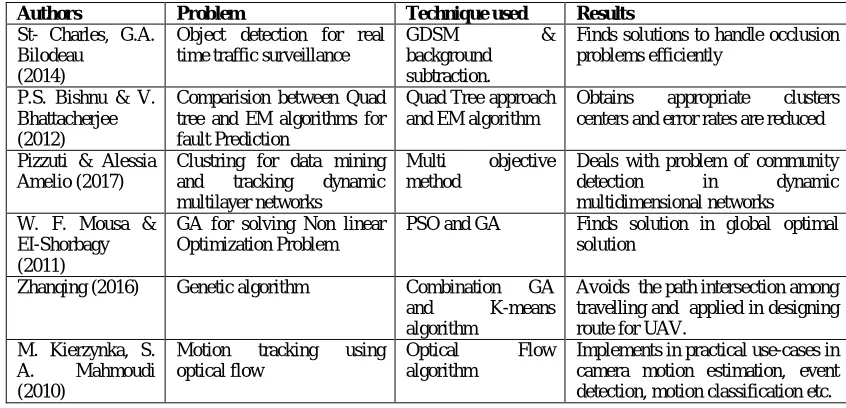
For past few years many methods and ways have been developed in Genetic algorithm for different applications. In this paper we present some literature reviews regarding genetic algorithm as shown in Table.1
Table 1: Literature Review
Authors Problem Technique used Results
St- Charles, G.A. Bilodeau
(2014)
Object detection for real time traffic surveillance
GDSM & background subtraction.
Finds solutions to handle occlusion problems efficiently
P.S. Bishnu & V. Bhattacherjee (2012)
Comparision between Quad tree and EM algorithms for fault Prediction
Quad Tree approach and EM algorithm
Obtains appropriate clusters centers and error rates are reduced
Pizzuti & Alessia Amelio (2017)
Clustring for data mining and tracking dynamic multilayer networks
Multi objective method
Deals with problem of community detection in dynamic multidimensional networks W. F. Mousa &
EI-Shorbagy (2011)
GA for solving Non linear Optimization Problem
PSO and GA Finds solution in global optimal solution
Zhanqing (2016) Genetic algorithm Combination GA and K-means algorithm
Avoids the path intersection among travelling and applied in designing route for UAV.
M. Kierzynka, S. A. Mahmoudi (2010)
Motion tracking using optical flow
Optical Flow algorithm
VIII. CONCLUSION
In this paper we present a review of literatures on K-Means combine with genetic algorithm. In general, K-means has been widely studied in a great deal of research from both the optimization and the data perspectives and also this technique improves and enhances the offspring produced by the group based crossover and there is no need for fixing the cluster numbers. For the reduction of the problem complexity, Cluster processing used to get the center point. In our paper we also discussed the motion estimation block matching algorithm using variable size by increasing the size in object tracking.
REFERENCES
[1] D. Nair and J. K. Aggarwal. Moving object detection from a navigating robot. IEEE Transactions onvRobotics and Automation, 14(3):404–416, June 1998.
[2] M.Gong, Y-H. Yang, "Multi-resolution genetic algorithm and its application to motion estimation", IEEE, 2002. [3] D. Turaga, M.Alkanhal, "Search Algorithms for Block Matching in Motion Estimation", 18-899, 1998. [4] D. E. Goldberg, “Genetic Algorithms in Search, Optimization and Machine Learning”, Addison-Wesley, 1989.
[5] J-B.Xu, L-M.Po, C-K.Cheung, "Adaptive Motion Tracking Block Matching Algorithms for Video Coding", IEEE Transactions on Circuits and Systems for Video technology, vol. 9, issue. 7, 1999.
[6]M.P. Servais, T. Vlachos and T. Davies, "Motion Compensation using Variable-Size Block-Matching with Binary Partition Trees," in Proceedings of the 12th IEEE International Conference on Image Processing (ICIP), 2005
[7] M.P. Servais, T. Vlachos and T. Davies, "Motion Compensation using Content-based Variable-Size Block Matching," in Proceedings of the 24th Picture Coding Symposium (PCS), 2004.
[8] A. Gyaourova, C. Kamath, S.-C. Cheung, "Block Matching for Object Tracking", Technical Report, Lawrence Livermore Nation Laboratory, 2003.
[9] S. Indu, M. Gupta, and A. Bhattacharyya, “Vehicle tracking and speed estimation using optical flow method”, Int. J. Engineering Science and Technology 3 (1), 429–434 (2011).
[10] P. Ricardo Possa, S.A. Mahmoudi, N. Harb, C. Valderrama, and P. Manneback, “A multi-resolution fpga-based architecture for real-time edge and corner detection”, IEEE Trans. on Computers 6, 130 (2013).
[11] B. Kitt, B. Ranft, and H. Lategahn, “Block-matching based optical flow estimation with reduced search space based on geometric constraints”, Intelligent Transportation Systems 1, 1104–1109 (2010).
[12] Forgy, E. W. (1965). Cluster analysis of multivariate data: efficiency versus interpretability of classifications. Biometrics 21: 768-769 [13] 9. Anon., Investigating the Performance of Parallel Genetic Algorithms.
[14] Lu, Z., et al. Applying K-means Clustering and Genetic Algorithm for Solving MTSP. in Bio-Inspired Computing-Theories and Applications. 2016. Springer.
[15] Chau, M., Cheng, R., & Kao, B. (2005, December). Uncertain data mining: A new research direction. In Proceedings of the Workshop on the Sciences of the Artificial, Hualien, Taiwan (pp. 199-204).