Application of Randomized Completely Block Design to The Yield
of Maize
1
Ogunsanya B.G.
2Sulaimon Mutiu O.
1,2
Department of Statistics & Mathematics
Moshood Abiola Polytechnic, Abeokuta, Ogun State, Nigeria.
1
[email protected]
[email protected]
ABSTRACT
This study examined the significant difference in the mean yield of maize in Ogun State, Nigeria with respect to the effect of fertilizer’s proportion and maize varieties. For the successful execution of this research work, secondary data was collected from Ogun State Agricultural Development Programme (OGADEP), Department of Agriculture Production Survey (APS), Ogun State. There were four levels of fertilizer’s proportion (50kg, 100kg, 150kg and 200kg) and three levels of maize variety (Open Pollinated, Hybrid and Local Maize). Data collected was analyzed electronically using SPSS version 21. The analysis techniques employed was a Randomized Completely Block Design (RCBD) without replicates. Results from the analysis revealed
that there is significant difference in the effect of the fertilizer’s proportions and maize varieties on the yield of maize in Ogun State, Nigeria. The multiple comparisons test for fertilizer proportion indicates the significant difference to be between 50kg & 200kg fertilizers and between 100kg & 200kg fertilizers. However, an evaluation of the marginal mean revealed the 200kg fertilizer to be the most suitable. The multiple comparisons test for maize varieties indicates the significant difference to be between Open pollinated and Hybrid maize. However, an evaluation of the marginal mean revealed the Hybrid type of maize to be the most suitable Keywords: Application, Block, Completely, Design, Maize, Randomized, Yield.
INTRODUCTION
Experiment is a planned investigation aimed at deriving information upon which decision can be based. The importance of experiment is mostly used in the field of Agriculture and other biological related studies. It gives information about two or more phenomena under study. For instance, an experiment may be carried out on two or more levels of a particular fertilizer, to find out whether or not the mean yield of crops resulting from the application of these fertilizers are the same or different.
Experimental design refers to the statistical procedure of imposing certain treatment on subjects or material (unit) so as to be able to monitor the effect of these treatments on the units. Selection of an appropriate design is therefore of primary importance in the process of experimentation.
AIM AND OBJECTIVES OF THE STUDY The aim of this research work is to examine the significant difference in the mean yield of maize in Ogun State with respect to the effect of fertilizer proportion and maize varieties.
The objectives are:
1. To investigate the significant difference
in the effect of fertilizer proportion on the mean yield of maize in the state.
2. To investigate the significant difference
in the effect of maize varieties on the mean yield of maize in the state.
SCOPE OF THE STUDY
This research work covers the
the design treatment and maize varieties taken as the block.
The data used is secondary in nature (year 2012/2013), extracted from the record of experiment conducted on the yield performance of varieties of maize with different proportion of NPK fertilizer.
There were four levels of fertilizer’s proportion (50kg, 100kg, 150kg and 200kg) and three levels of maize variety (Open Pollinated, Hybrid and Local Maize).
RESEARCH HYPOTHESES H01: H02:
Where is the effect of fertilizer’s proportion
and is the maize variety’s effect.
LITERATURE REVIEW
Maize (Zea mays L) is one of the major
cereal crops grown in the humid tropics and Sub-Saharan Africa. It is a versatile crop and ranks third following wheat and rice in world production as reported by Food and Agriculture Organization (FAO, 2002). Maize crop is a key source of food and livelihood for millions of people in many countries of the world. It is produced extensively in Nigeria, where it is consumed roasted, baked, fried, pounded or
fermented (Agbato, 2003). In advanced
countries, it is an important source of many industrial products such as corn sugar, corn oil, corn flour, starch, syrup, brewer’s grit and alcohol (Dutt, 2005). Corn oil is used for salad, soap-making and lubrication. Maize is a major component of livestock feed and it is palatable to poultry, cattle and pigs as it supplies them energy (Iken et al., 2001). The stalk, leaves, grain and immature ears are cherished by different species of livestock (Dutt, 2005).
In spite of the increasing relevance and high demand for maize in Nigeria, yield across the country continues to decrease with an average of about 1 t/ha which is the lowest African yield recorded (Fayenisin, 1993). The steady decline in maize yield can be attributed to:
1. Rapid reduction in soil fertility caused by intensive use of land and reduction of fallow period as reported by Directorate
of Information and Publications of Agriculture (DIPA, 2006).
2. Failure to identify and plant high yielding varieties most suited or adapted to each agro-ecological zone (Kim, 1997).
3. Use of inappropriate plant spacing which determines plant population and final yield (Zeidan et al., 2006).
Tolera et al., (1999) suggested that
breeders should select maize varieties that combine high grain yield and desirable stover characteristics because of large differences that exist between cultivars. Odeleye and Odeleye (2001) reported that maize varieties differ in
their growth characters, yield and its
components, and therefore suggested that breeders must select most promising combiners in their breeding programmes.
Randomized completely Block Design
Probably the most frequently used design is the randomized completely block design (RCBD). The fundamental idea of the RCBD is to group experimental material together into homogeneous blocks. The object of this grouping is to keep the errors within each group as small as possible (Cochran and Cox, John Wiley & Sons, Inc., 1957). The randomized complete block design has several advantages:
Using blocks of more homogeneous
experimental material usually results in more accurate results than if a completely randomized design is used.
Any number of treatments and any
number of replicates (blocks) can be used. In the complete block design, every treatment will have the same number of replicates.
Statistical analysis is straightforward.
If the variance is larger for some
units are missing there can be some problems. There is a “missing-plot" technique that lets us use the available data to their fullest extent. One other caution with the RCBD, if there are not real differences among the blocks then blocking can actually cost us some precision in the estimate of error variability. This is due to the fact that blocking takes away degrees of freedom from the estimate of the error variation.
The model for the Complete Randomized Block Design is defined as:
independent
where
is the random variable representing
the response for treatment i observed in
block j
is a constant (which may be thought of as the overall mean)
is the (additive) effect of the ith treatment (i = 1, 2, … , k)
is the (additive) effect of the jth block (j = 1, 2, … , n)
is the random error for the ith
treatment in the jth block.
METHODOLOGY
Techniques of data analysis
The analysis techniques employed is a Randomized Completely Block Design (RCBD) without replicates.
Method of data analysis
In analyzing the data for significant difference in the mean yield of maize, the RCBD model is partitioned into:
Sum of squares total, defined as: ∑ ∑ ( ̅ )
∑ ∑
with degree of freedom
Sum of squares treatment (Fertilizer proportion), defined as:
∑ ̅
∑ [ ]
With degree of freedom
Sum of squares block (maize varieties), defined as:
∑ ( ̅ )
∑ [ ]
With degree of freedom
And Sum of squares error defined as:
The respective mean square is thereafter estimated as thus:
Mean square treatment, defined as:
Mean square block, defined as:
And Mean square error, defined as:
Corresponding treatment and block F-ratio value is thereafter calculated thus:
and
The decision rule is to reject if:
*F-ratio ≥ Ftabulated - Manually
*Sig. value ≤ α -Electronically (SPSS)
The level of significance was set at α = 0.05.
The Tukey multiple comparisons test was further conducted for identified significant difference in effect of fertilizer proportions and maize varieties.
Fertilizer proportions and maize
varieties were respectively coded into the SPSS data editor as thus:
DATA PRESENTATION
Table1: The yield performance of varieties of maize with NPK fertilizer proportion
Rate of application per treatment kg/ha
Varieties 50kg 100kg 150kg 200kg
Open Pollinated
1.12 1.06 1.35 2.39
Hybrid 1.32 2.43 3.14 5.14
Local maize
0.85 1.19 2.50 2.66
RESULT
Table 2: Between-Subjects Factors
N
Fertilizer proportion
1 3
2 3
3 3
4 3
Maize varieties
1 4
2 4
3 4
Table 3: Tests of Between-Subjects Effects (ANOVA)
Dependent Variable: Yield
Source Type III
Sum of Squares
df Mean
Square
F Sig.
Model 66.999a 6 11.167 29.078 .000
Fertilizer proportion
9.097 3 3.032 7.897 .017
Maize variety 5.192 2 2.596 6.760 .029
Error 2.304 6 .384
Total 69.303 12
a. R Squared = .967 (Adjusted R Squared = .934)
Table 4: Estimated Grand Marginal Mean
Dependent Variable: Yield
Mean Std.
Error
95% Confidence Interval Lower Bound Upper Bound
2.096 .179 1.658 2.534
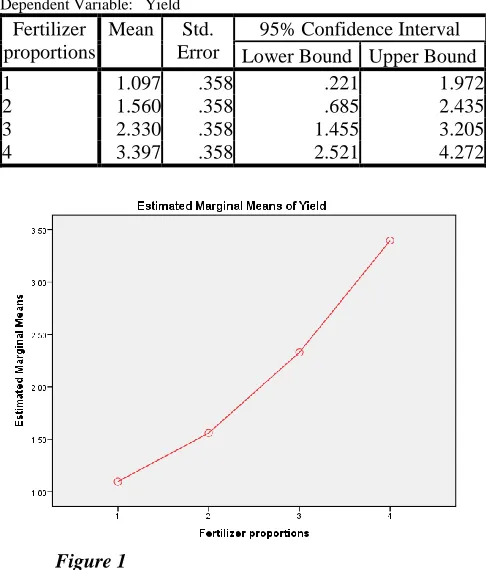
Table 5: Estimated Fertilizer proportions Marginal Mean
Dependent Variable: Yield
Fertilizer proportions
Mean Std.
Error
95% Confidence Interval Lower Bound Upper Bound
1 1.097 .358 .221 1.972
2 1.560 .358 .685 2.435
3 2.330 .358 1.455 3.205
4 3.397 .358 2.521 4.272
Figure 1
Table 6: Estimated Maize varieties Marginal Mean
Dependent Variable: Yield
Maize varieties
Mean Std.
Error
95% Confidence Interval Lower Bound Upper Bound
1 1.480 .310 .722 2.238
2 3.008 .310 2.249 3.766
3 1.800 .310 1.042 2.558
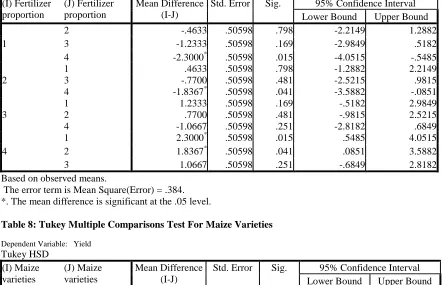
Table 7: Tukey Multiple Comparisons Test for Fertilizer Proportions
Dependent Variable: Yield
Tukey HSD (I) Fertilizer proportion
(J) Fertilizer proportion
Mean Difference (I-J)
Std. Error Sig. 95% Confidence Interval
Lower Bound Upper Bound
1
2 -.4633 .50598 .798 -2.2149 1.2882
3 -1.2333 .50598 .169 -2.9849 .5182
4 -2.3000* .50598 .015 -4.0515 -.5485
2
1 .4633 .50598 .798 -1.2882 2.2149
3 -.7700 .50598 .481 -2.5215 .9815
4 -1.8367* .50598 .041 -3.5882 -.0851
3
1 1.2333 .50598 .169 -.5182 2.9849
2 .7700 .50598 .481 -.9815 2.5215
4 -1.0667 .50598 .251 -2.8182 .6849
4
1 2.3000* .50598 .015 .5485 4.0515
2 1.8367* .50598 .041 .0851 3.5882
3 1.0667 .50598 .251 -.6849 2.8182
Based on observed means.
The error term is Mean Square(Error) = .384. *. The mean difference is significant at the .05 level.
Table 8: Tukey Multiple Comparisons Test For Maize Varieties
Dependent Variable: Yield
Tukey HSD (I) Maize varieties
(J) Maize varieties
Mean Difference (I-J)
Std. Error Sig. 95% Confidence Interval
Lower Bound Upper Bound
1 2 -1.5275
*
.43819 .030 -2.8720 -.1830
3 -.3200 .43819 .756 -1.6645 1.0245
2 1 1.5275
* .43819 .030 .1830 2.8720
3 1.2075 .43819 .074 -.1370 2.5520
3 1 .3200 .43819 .756 -1.0245 1.6645
2 -1.2075 .43819 .074 -2.5520 .1370
Based on observed means.
The error term is Mean Square(Error) = .384. *. The mean difference is significant at the .05 level.
DISCUSSION OF RESULTS
From the ANOVA table (table 3), the Sig. value of 0.017 [< α(0.05)] for fertilizer proportions implies that the null hypothesis of no significant difference in the effect of fertilizer’s proportions on the mean yield of maize is rejected. Similarly, the Sig. value of 0.029 for maize varieties implies that the null hypothesis of no significant difference in the effect of maize varieties on the mean yield of maize is rejected.
CONCLUSIONS
On the basis of the scope, methodology and analysis of the data, it can be concluded that at 5% significant level:
1. There is significant difference in the
effect of the fertilizer’s proportions on the yield of maize in Ogun State, Nigeria. In other words, fertilizer proportions do not give equal maize yield.
2. There is significant difference in the
3. The multiple comparisons test for
fertilizer proportion indicates the
significant difference to be between 50kg & 200kg fertilizers and between 100kg & 200kg fertilizers. However, an evaluation of the marginal mean revealed the 200kg fertilizer to be the most suitable.
4. The multiple comparisons test for maize
varieties indicates the significant
difference to be between Open
pollinated and Hybrid maize. However, an evaluation of the marginal mean revealed the Hybrid type of maize to be the most suitable.
RECOMMENDATIONS
In the light of the findings of this study, the following recommendations are made for adequate maize yield in Ogun State, Nigeria.
1. The 200kg fertilizer proportion
should be used.
2. The Hybrid type of maize should
equally be used.
REFERENCES
[1] Agbato, S. O. (2003). Principles and
Practices of crop production. Odumatt press publisher, Oyo, pp. 57-62.
[2] Cochran and Cox, John Wiley & Sons,
Inc. (1957). Randomized Complete
Block Designs, Adapted from
Experimental Designs, 2nd ed.
[3] DIPA (2006). Handbook of Agriculture:
facts and figures for farmers, students and all interested in farming. Directorate of Information and Publications of
Agriculture. Indian Council of
Agricultural Research, New Delhi, p. 435.
[4] Dutt, S. (2005). A Handbook of
Agriculture. ABD Publishers, India. Pp 116-118.
[5] FAO (2002). Fertilizer and the future.
IFA/FAO Agriculture Conference on Global food security and the role of Sustainability Fertilization. Rome, Italy. 16th-20th March, 2003, pp 1-2.
[6] Fayenisin, O. (1993). Search for
Improved maize varieties for farmers in Nigeria. 3rd National Workshop of
Maize Centre. NASPP, Ibadan
December, 6th - 10th 1976.
[7] Iken, J. E., Anusa, A. and Obaloju, V.
O. (2001). Nutrient Composition and Weight Evaluation of some Newly Developed maize Varieties in Nigeria. Journal of Food Technology, 7: 25-28.
[8] Kim, S. K. (1997). Achievement,
challenges and future direction of hybrid maize research and product in B. Badu-Apraku, Akoroda M.O., Oedraw M. and Quin F.M(eds). Proceedings of Required Maize Workshop May 99-june 2, 1995. IITA Cotonou, Benin Republic.
[9] Odeleye, F. O. and Odeleye, M. O.
(2001). Evaluation of morphological and agronomic characteristics of two exolic and two adapted varieties of tomato (Lycopersicom esculentum) in South West Nigeria. Proceedings of the 19th Annual Conference of HORTSON. (1): 140-145.
[10] Tolera, A., Berg, T. and Sundstol, F.
(1999). The effect of variety on maize grain and crop residue yield and nutritive value of the Stover. Journal of Animal feed Science and Technology 79(3): 165-177.
[11] Zeidan, M. S., Amany, A. and Balor