ISSN 2286-4822
www.euacademic.org DRJI Value: 5.9 (B+)
Inhibitory Action of Exudates / Resins Extracts on
the Corrosion of Steel Bar Yield Strength in
Corrosive Media Embedded in Concrete
KANEE SORBARI PETABA LEMII DONALDSON
School of Engineering, Department of Civil Engineering Kenule Beeson Saro-Wiwa Polytechnic, Bori, Rivers State, Nigeria
CHARLES KENNEDY
School of Engineering, Department of Mechanical Engineering Kenule Beeson Saro-Wiwa Polytechnic, Bori, Rivers State, Nigeria
Abstract
non-corroded and coated specimens. Corrosion properties of spalling and cracks noticed in non-coated members, Entire experimental results showed indications of low flexural failure load with high; midspan deflection, elongation, strain ratio and ultimate yields. Effect of corrosion on mechanical properties of reinforcing steel not noticed on non- corroded (controlled) members. Values obtained of non-corroded are of standard state to corroded members. Coated members showed low; midspan deflection, elongation and ultimate yields, high flexural failure load is required and compared to corroded members. Effect of corrosion not noticed in the mechanical properties of reinforcing steel experimented.
Keywords: Corrosion, Corrosion inhibitors, Flexural Strength,
Concrete and Steel Reinforcement
INTRODUCTION
Reinforcing steel corrosion is of great concern in the construction industries and other related industries. The effect of corrosion of steel embedded in concrete creates spalling, reduction in bonding effect between concrete and steel, cracking in concrete surrounding sections and weakens the bond between reinforcement and concrete, seriously affecting the durability, reduces the effective cross-sectional area of
reinforcing bars and the service-life of structures (Almusallam et al.
1995, Cabrera 1996, Rashid et al. 2010).
steel reinforcement cross- sectional area reduction is noticed thereby causing decreased in ductility of the structure, especially during the occurrence of corrosion pitting. Concrete produced with low water/cement ratio has low permeability that reduces the penetration factors that induced-corrosion, such as moisture, chloride and carbon dioxide to the steel surface (Ahmad, 2003). Steel reinforcement in concrete is normally immune from corrosion due to high alkanilty of concrete; however, steel corrodes when attacked by aggressive agents. Broomfield (1997) stated that concrete integrity is adversely attacked by sulphates ions before it extends to steel which normally takes long time except on accelerated conditions.
Rengaswamy et al.(1988) studied the properties of the
inhibited and sealed cement slurry coating system applied to steel rebars (mechanical, electrochemical and corrosion resistance) for its corrosion protection. It was concluded that inhibited and sealed cement slurry coating lead to economy and efficiency higher than other coating systems.
Charles et al. (2018) investigated the residual yield strength structural capacity effect of non-corroded, corroded and inhibited steel bar. The results of coated steel bar with three different resins / exudates extracts of Symphonia globulifera linn, ficus glumosa and acardium occidentale l.) versus corroded on comparison, the flexural strength failure load are 29.50%, 28.505,29.57% against 22.30% corroded, midspan deflection are 31.14%,25.30%, 22.30% against 39,30% corroded, tensile strength 11.84%, 12.13%, 12.14% against 10.17% and elongation are 32.40%, 32.13%, 32.40% against 46.30% corroded. Overall results indicated that coated steel bar showed higher values increased in failure load and tensile strength while corroded decreased in elongation and midspan deflection.
strength are 14.18%, 12.29%, 12.08% as against 10.17% decreased in corroded respectively. Entire results showed that low load subjection is recorded in coated members at failure loads as against in corroded with high deflection and elongation. This high yield was attributed to corrosion attack.
Charles et al. (2018) examined the effect/impact of corrosion inhibitors on flexural strength of failure load, midspan deflection, tensile strength and elongation of steel reinforcement layered with resins/exudates of magnifera indica extracts as corrosion inhibitors. Results recorded on experimental work showed flexural strength failure load, midspan deflection, tensile strength and elongation as 29.09%,31.20%, 11.75% and 31.50% for non-corroded, 29.42%, 27.43%, 12.09% and 31.60% for coated concrete beam respectively. For corroded concrete beam members, failure load decreased to 22.505, midspan deflection increased by 39.30%, tensile strength decreased to 10.17% while elongation increased by 46.30%. Entire results showed the effect of corrosion on the flexural strength of reinforcement that led to low load on failure load and higher midspan deflection on corroded beams and higher load on failure load and low midspan deflection on non-corroded and coated concrete beam members resulting to attack on surface condition of reinforcement from corrosion.
Charles et al. (2018) investigated the effects of corrosion on the residual structural steel bar capacity of resins/exudates inhibited and non-inhibited reinforced concrete beam members. Recorded results on non-corroded flexural strength test of failure load 29.09%, midspan deflection 28.30%, tensile strength 12.03% and elongation 31.50%, for coated beam members, failure load 29.42%, midspan deflection 27.42%, tensile strength 12.09% and elongation 31.80%, for corroded beam members, failure load decreased by 22.50%, midspan deflection increased by 39.30%, tensile strength decreased to 10.17% and elongation by increased 46.30%. The entire experimental results showed that corroded specimens has lower flexural load, higher midspan deflection, lower tensile strength and higher elongation due to loss of steel bar fibre from degradation effect from corrosion, inhibitors served as protective coating against corrosion, but no strength was added to steel members.
Otunyo and Kennedy (2017) investigated the effect of corrosion on the flexural strength and mid-span deflection of steel reinforcements coated with resins / exudates of trees extract known as inorganic inhibitors (dacryodes edulis-African Pear). The steel reinforcement members were embedded in concrete and exposed to harsh and saline environments (NaCl solution). Corrosion accelerated test were conducted on uncoated and dacryodes edulis resin pastes coated thicknesses of 150μm, 250μm and 300μm on steel reinforcement before corrosion test for 60 days to simulated corrosion process. Results obtained indicated that the flexural failure strength, and elongation increased by (29%) and (48%) respectively for the dacryodes edulis coated steel members, the mid-span deflection decreased by 26%, elongation increased by 23% and 32% respectively, while the mid-span deflection decreased by 40%.. The resin (mdacryodes edulis) added strength to the reinforcement.
12.03% and 31.50%, for coated beam members , 28.5%, 25.30%, 12.13% and 32.12% respectively. These results indicated increased in flexural failure load and ultimate tensile strength and decreased in midspan deflection and elongation respectively in corroded concrete beam members. This showed lower load and higher deflection in corroded members and higher in non-corroded and coated, higher elongation in corroded and lower in non-corroded and coated.
Charles et al. (2018) performed and investigated on uncoated and corrosion inhibitors (Symphonia globulifera linn) resins / exudates paste coated steel reinforcing bar. Results obtained on comparison between uncoated (corroded) and coated are flexural failure load 22.50% to 29.50%, midspan deflection 39.30% to 31.14%, tensile strength 10.17% to 11.84% and elongation 46.30% to 32.40% respectively. Thus, results showed decreased in failure load and tensile strength of corroded members while increased in midspan deflection and elongation. This attributes was due to effect of corrosion and reduction in strength from degradation properties. Resins / exudates coated members showed higher failure load with low deflection.
Rasheeduzzafar et al. (1992) conducted seven years site
exposure tests and evaluated the performance of corrosion resisting steels in chloride media concrete. Evaluation of bare mild steel, galvanized, epoxy-coated and stainless steel clad reinforcing steels examined by embedment process in concrete with three different levels of chloride content (0.6, 1.2 and 4.8% by weight of cement). Conclusion was drawn that bare mild steel bars suffer severe rust related damage in all the three chloride levels whereas the use of galvanized steel in concrete with high levels of chloride merely delay the concrete failure, while epoxy-coated bars offer good corrosion resistant properties in low chloride levels.
Ballim and Reid (2003) conducted and tested beams of 160 x 100 x 1500 mm, reinforced with a single 16 mm diameter bottom bar and a pair of 8 mm diameter top bars with initiated corrosion carbonation and accomplished by placing the beams in a CO2 filled pressure chamber (that was kept at 80kPa) and supplying a current of 400 μA/cm2. The beams were simultaneously corroded and loaded to
23% and 34% of the ultimate load (pu ), deflection ratios were observed
corroded beams with those of the control beams. The researchers attributed this initial increase in deflection to early crack formation, as the crack creation and widening progressed at a slower rate after a certain point.
MATERIALS AND METHODS FOR EXPERINMENT
Aggregates
The fine aggregate and coarse aggregate were purchased. Both met the requirements of BS 882
Cement
Portland limestone cement grade 42.5 is the most and commonly type of cement in Nigerian Market. It was used for all concrete mixes in this investigation. The cement met the requirements of BS EN 196-6 Water
The water samples were clean and free from impurities. The fresh water used was gotten from the tap at the Civil Engineering Department Laboratory, Kenule Beeson Polytechnic, Bori, and Rivers State. The water met the requirements of BS 3148.
Structural Steel Reinforcement
The reinforcements are gotten directly from the market in Port Harcourt. BS 4449:2005+A3
Corrosion Inhibitors (Resins / Exudates) Milicia excelsa The study inhibitor (Milicia excelsa Exudates) of natural tree resins/exudates extracts.
METHODS
was investigated. This was aimed at achieving the real harsh and corrosive state, concrete specimens were ponded in solutions (NaCl) and the depth of the solution was maintained for the given period of experiment as to observe the significant changes that resulted from the actions of the accelerator (NaCl) and the specimens. The determination of the contribution of the resins will be observed through its adhesive ability with the reinforcement through surface coating application and the bonding relationship between the coated specimens and concrete, its waterproofing and resistive nature (resistance) against accelerator penetration into the bare reinforcement.
Specimen Preparation and Casting of Concrete Beams
Standard method of concrete mix ratio was adopted, batching by weighing materials manually. Concrete mix ratio of 1:2:4 by weight of concrete, water-cement ratio of 0.65. Manual mixing was used on a clean concrete banker, and mixture was monitored and water added gradually to obtain perfect mix design concrete. Standard uniform color and consistency concrete was obtained by additions of cement, water and aggregates.
The test beams were cast in steel mould of 150mm x 150 mm x 750 mm. Fresh concrete mix for each batch was fully compacted by tamping rods, to remove trapped air, which can reduce the strength of the concrete and 16 mm reinforcements of coated and non-coated were spaced at 150 mm with concrete cover of 25 mm had been embedded inside the beam and projection of 100 mm for half-cell potential measurement. Specimens were molds are removed from specimen after 24hrs and cured for 28 days. The specimens were cured at room temperature in the curing tanks for accelerated corrosion test process and testing procedure allowed for 120 days first crack noticed and a further 30 days making a total of 150 days for further observations on corrosion acceleration process.
Flexure testing of Beam Specimens
while 18 beam samples of non-coated and exudates /resins coated were partially place in ponding tank for 150 days and examined accelerated corrosion process. After 150 days, the accelerated corrosion subjected samples were examined to determine residual flexural strength. Beam specimens were simply supported on a span of 650mm.
An Instron Universal Testing Machine of 100KN capacity at a slow loading rate of 1 mm/min was used in the flexural test. Beam samples were placed in the machine to specification, flexural test were conducted on a third point at two supports. Load was applied to failure with cracks noticed and corresponding values recorded digitally in a computerized system.
Tensile Strength of Reinforcing Bars
To ascertain the yield and tensile strength of tension bars, bar specimens of 16 mm diameter of non-corroded, corroded and coated were tested in tension in a Universal Testing Machine and subjected to direct tension until failure; the yield, maximum and failure loads being recorded. To ensure consistency, the remaining cut pieces from the standard length of corroded and non-corroded steel bars were subsequently used in the bond and flexural test.
RESULTS AND DISCUSSIONS
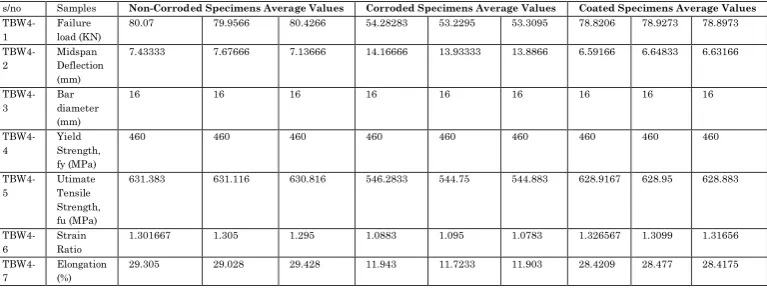
Results of 27 samples in tables 1, 2 and 3 are derived into averaged
values in 4 and summarized into summary of averages, percentile
values and percentile values difference in 5 of flexural strength of
concrete beam members as sampled, arbitrarily cast, cured for 28 days on normal and standard method, accelerated in corrosion medium environment for 120days at first crack s observation and 30days extended period and graphically represented in figures 1 - 3A.
Non-corroded Concrete Beam Members
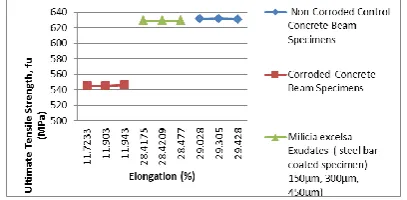
7.13666mm, collated to 7.415556mm with percentile collation of -47.0149% over 88.73239% corroded specimens. Average yield strength, fy 460MPa, collated to 100% with 0.00% with percentile collation. Average ultimate tensile strength, fu, 631.383MPa, 631.116MPa, and 630.816MPa, collated to 631.1056MPa with percentile collation of 15.7343% over -13.5952% corroded specimens. Average strain ratios are 1.301667, 1.305, and 1.295, collated to 1.300556 with percentile collation of 19.62187% over -16.4032%. Averaged elongations are 29.028%, 29.028%, 29.428%, collated to 29.25389% with percentile collation of 146.7295% over -59.4698%. Effect of corrosion on mechanical properties of reinforcing steel not noticed on non- corroded (controlled) members. Values obtained of non-corroded are of standard state to corroded members.
Corroded Concrete Beam members
Milicia excelsa Resins/Exudates Steel Coated Concrete Beam Members.
Derived flexural strength of beam specimens from table 3 into 4 and 5 flexural failure load averaged values of coated samples are 78.8206kN, 78.9273kN, 78.8973kN, collated to 78.88178kN with percentile collation of 47.14752% over -33.1172% over corroded specimens. Midspan deflection average values are 6.59166mm, 6.64833mm, 6.63166mm, collated to 6.623889mm with percentile collation of -52.6715% over 88.73239% corroded specimens. Average yield strength, fy 460MPa, collated to 100% with 0.00% percentile collation. Average ultimate tensile strength, fu, 628.9167MPa, 628.95MPa, 628.883MPa, collated to 628.9167MPa with percentile collation of 15.33289% over -13.5952% corroded specimens. Average strain ratios are 1.326567, 1.3099, and 1.31656, collated to 1.317678 with percentile collation of 21.19673% over -16.4032% of corroded specimens. Averaged elongations are 28.4209%, 28.477%, 28.4175%, collated to 28.43868% with percentile collation of 139.8539% over -59.4698% of corroded specimens. Coated members showed low; midspan deflection, elongation and ultimate yields, high flexural failure load is required and compared to corroded members. Effect of corrosion not noticed in the mechanical properties of reinforcing steel experimented.
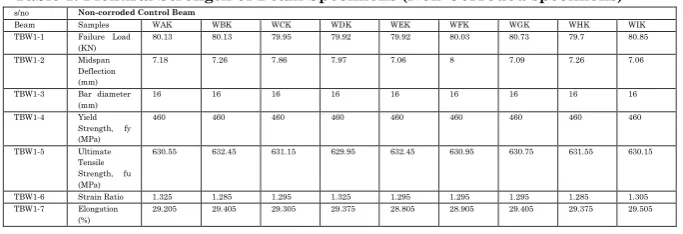
Table 1: Flexural Strength of Beam Specimens (Non-Corroded specimens)
s/no Non-corroded Control Beam
Beam Samples WAK WBK WCK WDK WEK WFK WGK WHK WIK
TBW1-1 Failure Load (KN)
80.13 80.13 79.95 79.92 79.92 80.03 80.73 79.7 80.85
TBW1-2 Midspan Deflection (mm)
7.18 7.26 7.86 7.97 7.06 8 7.09 7.26 7.06
TBW1-3 Bar diameter (mm)
16 16 16 16 16 16 16 16 16
TBW1-4 Yield Strength, fy (MPa)
460 460 460 460 460 460 460 460 460
TBW1-5 Ultimate Tensile Strength, fu (MPa)
630.55 632.45 631.15 629.95 632.45 630.95 630.75 631.55 630.15
TBW1-6 Strain Ratio 1.325 1.285 1.295 1.325 1.295 1.295 1.295 1.285 1.305
TBW1-7 Elongation (%)
Table 4: Average Flexural Strength of Beam Specimens (Non-Corroded, Corroded Exudates/Resins Coated Specimens)
s/no Samples Non-Corroded Specimens Average Values Corroded Specimens Average Values Coated Specimens Average Values
TBW4-1
Failure load (KN)
80.07 79.9566 80.4266 54.28283 53.2295 53.3095 78.8206 78.9273 78.8973
TBW4-2
Midspan Deflection (mm)
7.43333 7.67666 7.13666 14.16666 13.93333 13.8866 6.59166 6.64833 6.63166
TBW4-3
Bar diameter (mm)
16 16 16 16 16 16 16 16 16
TBW4-4
Yield Strength, fy (MPa)
460 460 460 460 460 460 460 460 460
TBW4-5 Utimate Tensile Strength, fu (MPa)
631.383 631.116 630.816 546.2833 544.75 544.883 628.9167 628.95 628.883
TBW4-6
Strain Ratio
1.301667 1.305 1.295 1.0883 1.095 1.0783 1.326567 1.3099 1.31656
TBW4-7
Elongation (%)
29.305 29.028 29.428 11.943 11.7233 11.903 28.4209 28.477 28.4175
Table 2 : Flexural Strength of Beam Specimen (Corrode specimens)
s/no Corroded Beam
Beam Samples WAK1 WBK1 WCK1 WDK1 WEK1 WFK1 WGK1 WHK1 WIK1 TBW2-1 Failure load
(KN)
54.6395 55.3195 52.8895 52.3695 54.6595 52.6595 52.4295 54.8595 52.6395
TBW2-2 Midspan Deflection (mm)
14.27 14.3 13.93 13.9 13.5 14.4 13.93 13.53 14.2
TBW2-3 Bar diameter (mm)
16 16 16 16 16 16 16 16 16
TBW2-4 Yield Strength, fy (MPa)
460 460 460 460 460 460 460 460 460
TBW2-5 Ultimate Tensile Strength, fu (MPa)
548.35 544.95 545.55 544.85 544.55 544.85 544.25 545.55 544.85
TBW2-6 Strain Ratio 1.095 1.085 1.085 1.125 1.075 1.085 1.085 1.075 1.075 TBW2-7 Elongation (%) 11.96 12.1 11.77 11.3 12.29 11.58 12.1 11.8 11.81
Table 3: Flexural Strength of Beam Specimens (Exudates/Resins Coated specimens)
Milicia excelsa exudates ( steel bar coated specimen)
s/no 150µm (Exudate/Resin)
coated
300µm (Exudate/Resin) coated
450µm (Exudate/Resin) coated
Beam Samples WAK2 WBK2 WCK2 WDK1 WEK2 WFK2 WGK2 WHK2 WIK2 TBW3-1 Failure load
(KN)
78.404 79.354 78.704 78.744 79.104 78.934 78.704 78.744 79.244
TBW3-2 Midspan Deflection (mm)
6.695 6.095 6.985 6.795 6.355 6.795 6.775 6.775 6.345
TBW3-3 Bar diameter (mm)
16 16 16 16 16 16 16 16 16
TBW3-4 Yield Strength, fy (MPa)
460 460 460 460 460 460 460 460 460
TBWE-5 Ultimate Tensile Strength, fu (MPa)
628.45 629.35 628.95 628.95 628.95 628.95 628.55 629.05 629.05
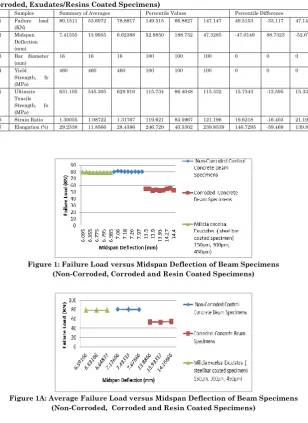
Table 5: Summary of Percentile Flexural Strength of Beam Specimens (Non-Corroded, Corroded, Exudates/Resins Coated Specimens)
Beam Samples Summary of Averages Percentile Values Percentile Difference TBW5-1 Failure load
(KN)
80.1511 53.6072 78.8817 149.515 66.8827 147.147 49.5153 -33.117 47.1475
TBW5-2 Midspan Deflection (mm)
7.41555 13.9955 6.62388 52.9850 188.732 47.3285 -47.0149 88.7323 -52.6715
TBW5-3 Bar diameter (mm)
16 16 16 100 100 100 0 0 0
TBW5-4 Yield Strength, fy (MPa)
460 460 460 100 100 100 0 0 0
TBW5-5 Ultimate Tensile Strength, fu (MPa)
631.105 545.305 628.916 115.734 86.4048 115.332 15.7343 -13.595 15.3328
TBW5-6 Strain Ratio 1.30055 1.08722 1.31767 119.621 83.5967 121.196 19.6218 -16.403 21.1967 TBW5-7 Elongation (%) 29.2538 11.8566 28.4386 246.729 40.5302 239.8539 146.7295 -59.469 139.8539
Figure 1: Failure Load versus Midspan Deflection of Beam Specimens (Non-Corroded, Corroded and Resin Coated Specimens)
Figure 2: Ultimate Tensile Strength versus Yield Strength of Beam Specimens (Non-Corroded, Corroded and Resin Coated Specimens)
Figure 2A: Average Ultimate Tensile Strength versus Yield Strength of Beam Specimens (Non-Corroded, Corroded and Resin Coated Specimens)
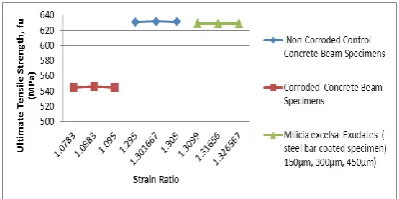
Figure 3: Ultimate Tensile Strength versus Strain Ratio of Beam Specimens (Non-Corroded, Corroded and Resin Coated Specimens)
Figure 4: Ultimate Tensile Strength versus Elongation of Beam Specimens (Non-Corroded, Corroded and Resin Coated Specimens)
Figure 4A: Average Ultimate Tensile Strength versus Elongation of Beam Specimens (Non-Corroded, Corroded and Resin Coated Specimens)
CONCLUSIONS
Experimental results gotten from tables 1 – 5 and figures 1 – 3A, the below conclusions were drawn:
i. Coated members showed low; midspan deflection, elongation
and ultimate yields, high flexural failure load is required as compared to corroded members.
ii. Effect of corrosion not noticed in the mechanical properties of
reinforcing steel experimented.
iii. Corrosion properties of spalling and cracks noticed in
non-coated members.
iv. Entire experimental results showed indications of low
flexural failure load with high; midspan deflection, elongation, strain ratio and ultimate yields.
v. Effect of corrosion on mechanical properties of reinforcing
Values obtained of non-corroded are of standard state to corroded members.
vi. Non-corroded members do not changed in any form of
mechanical properties of reinforcing steel.
REFERENCES
1. Ahmad, S. (2003). Reinforcement Corrosion in Concrete
Structures, its Monitoring and Service Life Prediction. Cement and Concrete Composites, 25, 459-471.
2. Almusallam, A., Ahmed, S., Gahtani, A. & Rauf, A. (1995).
Effect of Reinforcement Corrosion on Bond Strength. Construction and Building Materials, 10, 123-129
3. BS EN 196-6; 2010- Methods of Testing Cement
Determination of Fineness, British Standards Institute. London, United Kingdom.
4. BS 12390-5; 2005 – Testing Hardened Concrete: Flexural
Strength Test of Specimens, British Standards Institute. London, United Kingdom.
5. BS 12390-5; 2005 – Testing Hardened Concrete: Flexural
Strength Test of Specimens, British Standards Institute. London, United Kingdom.
6. BS 882; 1992- Specification for aggregates from natural
sources for concrete, British Standards Institute. London, United Kingdom.
7. Cabrera, J. G. (1996). Deterioration of Concrete Due to
Reinforcement Steel Corrosion, Cement and Concrete Composites. 18, 47-59.
8. Charles, K., Ishmael, O., Akatah, B, M. & Akpan, P, P.
(2018).Comparative Residual Yield Strength Structural
Capacity of Non-corroded, Corroded and Inhibited
Reinforcement Embedded in Reinforced Concrete Structure and Exposed to Severely Medium. International Journal of Scientific and Engineering Research, 9 (4), 1135-1149.
9. Charles, K., Terence, T, T, W., Kelechi, O. & Okabi, I., S.
Embedded in Concrete and Exposed to Corrosive Medium.
International Journal of Scientific & Engineering Research,
9(4), 655-670.
10. Charles, K., Gbinu, S, K. & Ugo, K. (2018) Load Carrying
Capacity of Coated Reinforcement with Exudates of Concrete
Beam in Corrosion Solution Ponding. International Journal of
Civil and Structural Engineering Research. 6(1), 5-12.
11. Charles, K., Ogunjiofor, E, I., Latam, L, P. (2018). Yield
Strength Capacity of Corrosion Inhibited (Resins / Exudates) Coated Reinforcement Embedded in Reinforced Concrete
Beam and Accelerated in Corrosive Medium. European
International Journal of Science and Technology,7(3), 25-33.
12. Charles, K., Akpan, P, P., and Gbinu, S, K. (2018). Corrosion
Effects on Residual Structural Capacity of Resins / Exudates
Inhibited Steel Reinforcement Flexural Beam. European
Journal of Engineering Research and Science, 3(5), 31-35.
13. Charles, K., Ogunjiofor, E, I., Letam, L, P. ,” Residual
Flexural Strength of Corrosion Inhibited Resin Coated Beam
in Corrosion Accelerated Media. Global Scientific Journal,
6(5), 84-96.
14. Charles, K., Letam, L, P. & Gbinu, S, K. (2018). Effect of
Resins / Exudates Inhibited Steel on the Flexural strength of Reinforced Concrete Beam under Corrosive Environment.
International Journal of Advances in Scientific Research and Engineering, 4(4), 52-61.
15. Otunyo, A. W. & Charles, K. (2018). Effect of Corrosion on
Flexural Residual Strength and Mid-Span Deflection of Steel (Coated with Resins/Exudates of Trees) Reinforced Concrete
Beams under Sodium Chloride Medium. European
International Journal of Science and Technology, 6(7), 77-87.
16. Pruckner, F. (2001). Corrosion and Protection of
Reinforcement in Concrete Measurements and Interpretation, PhD Thesis, University Of Vienna.
17. Rashid, M.H., Khatun, S., Uddin, S.M.K. & Nayeem, M.A.
(2010). Effect of Strength and Covering on Concrete Corrosion.
European Journal of Scientific Research, 40, 492-499.
18. Rengaswamy, N.S., Srinivasan, S. & Balasubramanian, T.M.
Rebar-A State of Art Report. Transactions of the SAEST, 23(2-3), 163-173.
19. Wang, K. & Monteiro, P.J. (1996). Corrosion Products of