Proposed Model for Predicting Environmental
Purchase Behavior of Consumers
SAADIA SHABNAM
Dept. of Business Administration Faculty of Business and Economics East West University Jahurul Isam City, Aftabnagar Dhaka, Bangladesh
Abstract:
Purpose – The purpose of this paper is to present a proposed model for predicting pro-environmental consumer behavior related to product purchase.
Design/methodology/approach – The proposed model will examine consumers’ purchasing behavior of environmentally sustainable products using the framework of the Theory of Planned Behavior. It will investigate how the proposed relationship between and among variables determines the purchase intention for environmentally sustainable products leading to the purchase behavior for the same. Extensive literature review generates insight and organizes evidence of critical relationship among variables. Structural Equation Modeling (SEM) is justified and suggested method to analyze the proposed relationship among variables. Data would be collected through a self-administered questionnaire survey of Bangladeshi consumers, aged over 18. Five point likert scale items to measure the strength of six hypothesized relationship, would be presented to the respondents. Proposed scales would be properly validated at the time of pre-testing. Earned responses would be analyzed and interpreted using AMOS software.
Originality/value – Environmental consumerism is a much-talked-about area in the global academic literature, but most of the time, researchers’ focus was on developed country consumers. Asians, especially South Asians, are almost absent from the mainstream literature and there are ample scope to explore the pro-environmental buyer behavior in this country on the distinct backdrop of socio-cultural and demographic context.
Key words: consumer behavior, theory of planned behavior, green marketing, structural equation modeling.
Introduction
Human consumption is the primary cause of irreparable damage to the planet. Since the industrial revolution, businesses, in the process of producing consumables, are largely blamed for exploitation of natural resources beyond their regenerative capacity, altered and interrupt ecosystems and somewhere extinguished the entire species of plants and animals. According to some studies, thirty to forty per cent of current environmental degradation is due to the consumption activities of private households (Grunert 1993).
Objective of the study
Objective of the proposed study is to examine the effects of environmental knowledge (EK), attitude toward the environmental behavior (ATB), subjective norm about pro-environmental behavior (SNB) and perceived behavioral control (PCB) in the form of perceived effectiveness, control on availability, perceived control on price on environmental purchase behavior of consumers as simulated by the model of The Theory of Reasoned Action. The linkages between and among variables at the regional scale have only recently been the subjects of research; hence, much work remains to improve our understanding of the environmental purchase behavior of consumers.
The guiding research question is: Under what conditions of environmental knowledge, attitude toward the environmental behavior, subjective norm about pro-environmental behavior and perceived behavioral control in the form of perceived effectiveness, control on availability, perceived control on price in Bangladeshi consumers show their pro-environmental purchase behavior of consumers?
This involves the following specific objectives:
1) To determine the contexts of environmental knowledge, attitude toward the environmental behavior, subjective norm about pro-environmental behavior and perceived behavioral control under which people invoke their pro-environmental purchases. This involves collecting data on characteristics of environmental knowledge, attitude toward the environmental behavior, subjective norm about pro-environmental behavior and perceived behavioral control in the form of perceived effectiveness, control on availability, perceived control on price. All these, in Bangladeshi consumers, show their pro-environmental purchase behavior of consumers.
Significance of the proposed study
Academic contribution
The lack of research examining consumers‘ environmental consciousness to develop a meaningful approach to define the pro-environmental consumer behavior from the developing country perspective is identified as a major research gap in the area of environmental consumerism. Inclusion of the variable ‗perceived consumer price of green products (PPC)‘ as a proposed extension of the Theory of Reasoned Action is of immense importance considering the price sensitivity of consumers in a developing country setting. With the particular reference of the developing countries this proposed conceptual model is to reveal causal relationship among variables determining the purchase behavior of environment conscious customers. Thus it would be a valuable contribution to the existing body of knowledge in the area of environmental consumerism.
Benefit to the industry
objectives with an integrated emphasis on ‗triple bottom line‘- people, planet and profit.
Theoretical framework
On the backdrop of causes and consequences of environmental degradation and increasing blame of on the nature of human consumption of goods and services, a whole discipline of environmental consumerism and responsible consumption has emerged. Started back in 1970s (Kassarjain 1971; Fisk 1973; Kinnear et al. 1974 and Webster 1975) the international community of academic research in the area of environmental consumerism gained a momentum after 1990s. The concept of environmental consciousness and its attributes (cognitive, attitudinal and behavioural variables) have been of particular interest to numerous researchers from various academic backgrounds like sociology, psychology, business, marketing. Social and environmental issues were identified as the influencer of consumer purchasing decisions (Menon et al. 1999). Businesses also start realizing to incorporate newly emerging concerns of environmental aspects into their strategies to remain competitive and even survive (Menon et al. 1999; Straughan and Roberts 1999; D‘Souza et al. 2006; Rivera-Camino 2007).
consequences of certain behavior and resultantly develop attitudes based on the perceptions of these consequences.
Environmental consciousness of consumers: Knowledge-Attitude-Behavior
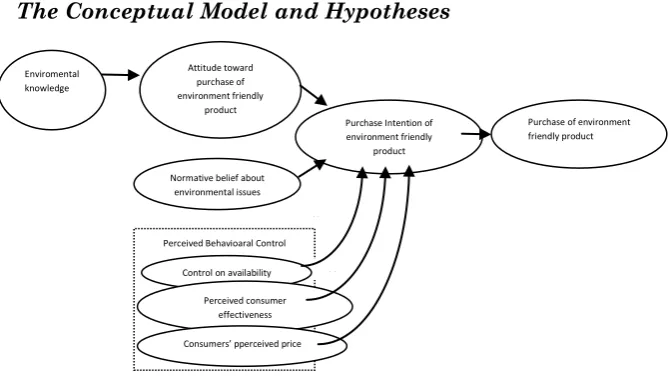
The theory of planned behavior is the basic framework for the proposed relationship to be examined with the help of the theoretical model. The proposed model includes constructs- environmental knowledge (EK), attitude toward the environmental behavior (ATB), normative belief (subjective norm) about pro-environmental behavior (SNB), perceived behavioral control (PCB). The framework designed in this proposal suggests exercise of control on availability, perceived consumer effectiveness and perception of green product price as three aspects where consumers would exert some volitional control and those are expressed in the proposed model as perceived consumer effectiveness (PEC), control on availability (PAC) and perceived consumer price (PPC).
Environmental Knowledge and Attitude towards Environmentally Sustainable Products
the concrete part of it related to the behavior or action upon the issues. Hines, Hungerford and Tomera (1987) have also mentioned knowledge to be the most significant predictor of the environmental action. We proposed to consider the single type of such action for our model that is the purchase of eco-friendly products.
Again, Kaiser et al. (1999) indicated environmental knowledge and awareness about contemporary environmental problems as the precondition for the formation of attitude towards environment, environmental problem, people‘s own role in the problem or perceived consequences of his environmental performance (Arbuthnot 1977; Frick, Kaiser and Wilson 2006). Elaboration Likelihood Model (ELM) suggested by Petty and Cacioppo (1986) prompted to explore the linkage between environmental knowledge and attitude which is used in the application of communication and persuasion of a certain kind of attitude. In general, knowledge and awareness about environment has been found to be related to environmental attitude and behavior and this relationship has been supported empirically (Arcury 1990; Diekmann and Preisendörfer 2003). We should also take into account that positive attitudes towards the environment are not necessarily indicative of high levels of environmental knowledge (e.g., Ramsey and Rickson 1976; Bagozzi et al. 1992). Thus, along with attitudinal and behavioral components, items to measure knowledge should capture individuals‘ level of factual information about some specific or general aspects of environmental, ecological, or energy-saving phenomena. In view of the above discussion and under the notion of positive effect of environmentally sustainable products on environment, it is hypothesized that:
H1: The environmental knowledge has positive relationship with attitude towards environmentally sustainable products.
Attitude and Purchase Intention for Environmentally Sustainable Products
person‘s enduring evaluation, emotional feeling and tendency to act towards an object or idea that lead people to behave in a fairly consistent way which in turn influence their buying behavior. It has been suggested that attitudes alone do not provide a complete picture of behavioral intention (Bohlen et al. 1993), they are important as they affect behavioral intentions (Kok and Siero 1985). Allport (1935) defined attitude as a state of readiness for a certain action. One extension of this phenomenon is operated by Schultz and Zelezny (1999), who described it as the deep-rooted concept in a person‘s self with a perception of the degree of bonding between self and the environment. Some of the researchers used environmental attitude as the estimator of the environmental behavior (Kaiser et al. 1999; Steg and Vlek 2009). A favorable attitude towards a product which is environmentally sustainable adds to sustainable consumption behavior as pointed out in several studies. (Chan 2001; Irland 1993; Tanner and Kast 2003; Vermeir and Verbeke 2004)
The attitude acts as an important antecedent to the behavioral intention which is described as the degree of favorable or unfavorable evaluation of the behavior under study (Ajzen 1991). Cheng, Lam, and Hsu (2006) concluded that a person willing to display a specific purchase behavior may undertake the cost benefit analysis to presume the consequence of the action undertaken. In such instances, the positive evaluation of the action is linked with favorable attitude (Ajzen 1991; Cheng et al. 2006). Ajzen (1991) emphasized that positive attitude towards a particular behavior strengthens the intention to perform that behavior. In this view, it is hypothesized that:
H2: An attitude towards environmentally sustainable products has positive relationship with the purchase intention for the products.
Subjective Norm and Purchase Intention for Environmentally Sustainable Products
norm can be comprehended as the perceived social force to carry out a particular behavior (Ajzen 1991). When individuals perform behavior under social pressure, the subjective norm also provides them information about the appropriateness (whether the behavior is desirable by the society) of behavior under consideration (Jager 2000). Subjective norm is perceived to affect general purchase intention independently (Robinson and Smith 2002). This particular concept of normative belief has been extensively analyzed in the studies on environmentally responsible behavior (Biel and Thøgersen 2007). Perhaps the reason for a pro-environmental behavior is becoming more desirable in societies.
Studies in different areas of consumer behavior such as sustainable food (Vermeir and Verbeke 2006), organic food (Chen 2007; Gotschi et al. 2007) indicated various degrees of relationship between subjective norm and consumer‘s intention to be engaged in that behavior which is both significant and positive. Some other studies undertaken by scholars such as Sidique et al. (2010) and Shaw (2008) concluded that behaviors such as recycling, which are more likely to be exposed to the society directly affected by the extent of the social pressure or social norm and the directionality of such relationship were positive in nature. Based on these discussions, it is hypothesized that:
H3a: Subjective norm has positive relationship with the purchase intention for environmentally sustainable products.
2002). Collectivism reflects consumers who are willing to cooperate, to help each other and put collective goals as a priority. This group supports eco-friendly programs (Junaedi 2012).
Many scholars such as Hofstede (1980), Sinha and Verma (1987), Triandis (1995), in their studies, have concluded that Indian culture is collectivistic in nature. Because of close geographic proximity, shared historical experiences, somewhat generalizable socio-demographic characteristics of their population and comparable value system, Indian cultural context, thus the collectivist nature of its people, can be assumed similar for Bangladesh. People in a collectivistic culture display values and orientation that is collectivist in nature i.e. oriented to belongingness to a group (Triandis 1995). Such culture can be characterized by emphasis on in-group membership, interdependence, and relational norms. Social norm is an important mean of viewing the life for people under collectivistic society and they keep more emphasis on the emotional aspect of the decision making rather than on the rational cost-benefit analysis in a relationship (Sinha et al. 2001). According to McCarty and Shrum (1994), people belonging to collectivistic culture are more concerned towards environmental issues as compared to people from individualistic culture. People from collectivistic culture also listen to the salient referent sources within their society (Lee and Green 1991). Logically the hypothesis can be drawn as:
H3b: Given the collectivistic nature of Indian people, subjective norm would have stronger impact on their outlook towards environmentally sustainable product purchase intention in comparison to their attitude.
Perceived Behavioral Control and Purchase Intention for Environmentally friendly Products
Perceived behavioral control (PBC) denotes the influences on behavior beyond people‘s control by Ajzen (1985). Perceived behavioral control measures how well an individual can accomplish an action required to manage specific situations, and reflects consumers‘ perceptions of how easy or difficult they think it is to perform a behavior. (Ajzen 1991)
PBC would be measured by means of the perception of one‘s control over situational factors such as economic constraints, the extent of availability of linking resources (Ajen 1991), ―social pressures and opportunities to choose different actions‖ (Hines et al., 1986 & 1987), which may interfere with one‘s attitude. According to Ajzen and Madden (1986), two assumptions will have to be made: first, the predicted behavior must be, at least partially, beyond volitional control, and the next is that perception of control must reflect actual control upon behavior with some accuracy. Ajzen (1991) also mentioned that the perceived behavioral control and the intention in conjunction may help in directly ascertaining a particular behavior.
In the proposed model, three variables have been included that influence the behavioral action beyond people‘s volitional control - control on availability (PAC) of environmentally sustainable products, perceived consumer effectiveness (PEC) and perceived consumer price (PPC).
Perceived Behavioral Control - Availability of the product
purchase intention or the purchase behavior (e.g., Baker et al. 2002). Above theories formed the basis of following hypothesized relationship:
H4a: There is a positive relationship between the control on availability of the environmentally friendly products and the purchase intention towards the products.
Perceived Behavioral Control - Perceived consumer effectiveness
The attitude or belief that individuals can positively influence the consequences to some problem is referred to as perceived consumer effectiveness (PCE) by Straughan and Roberts (1999). It is elaborated as the conviction that the individuals have the ability to manipulate the outcome in a positive manner as a result of their action in this regard which is widely supported by several researchers (Berger and Corbin 1992; Kinnear et al. 1974; Roberts 1995; 1996b; Webster 1975).
Perceived consumer effectiveness has significant relationship with perceived behavioral control (Vermeir & Verbeke 2008). According to Roberts (1996), consumers must be guided and believed to understand that the actions undertaken by them have impact on the outcome in order to motivate any sort of change in their behavior. Perceived consumer effectiveness affects the intention and behavior if the consumers sense that their behavior will not result into the intended outcome (Ellen, Wiener, and Cobb-Walgren 1991). Straughan and Roberts (1999) in this area of study found empirical validity for the positive relationship between the behavior showing anxiety for environment and perceived consumer effectiveness.
H4b: Perceived consumer effectiveness has positive relationship with purchase intention for environmentally friendly products.
quality: ease of use, usefulness, performance, durability, and status (Brucks, Zeithaml and Naylor 2000). But little empirical research has been conducted on the relation between ‗prestige‘ pricing of green products and consumer purchase behavior (Baek et al. 2010; Shukla 2010; Bartels and Hoogendam 2011).
According to Peattie (1995), the production of goods usually involves two costs: one economic and another socio-environmental and most consumers perceive that protecting environment is something of value worth paying a higher price. Such perceptions toward price shape buyer attitudes and their readiness (intention) to purchase green goods (Yoeh et al. 2007).
Indeed, green products generally tend to be more expensive and this is consistent with the expectation of consumers to pay higher prices for green products (Roarty 1997). This essentially does not mean that consumers are always willing to pay a premium for green products, particularly low-involvement frequent purchases. Consumer suspicion that companies are profiteering from their ‗green efforts‘ by charging an unwarranted premium has influenced consumers‘ generally low willingness to pay (Peattie and Charter 1994) extra amount of money for the environmentally friendly products. Given consumers‘ highly price sensitive nature, the relative importance of green goods in the consumer budget will dictate their purchases (Monroe 1973).
successful strategy for the company. When the price is held at the same level with its non-green alternatives, positive properties of the product about the environment can be used as a competitive advantage element (Boztepe 2012). In case the price of the product is higher, importance should be given to promotion of differentiated features and after use benefit of eco-friendly product and also there should be consumers ready to pay the extra charges for the product.
Grail Research conducted a survey on 520 US Green consumer in June 2009. According to this study, consumers who never bought green products are deterred from purchasing them because they are perceived to be too expensive. Price is the main reason consumers choose not to buy green products (Grailresearch 2010).
H4c: Perception of price has negative relationship with purchase intention for environmentally friendly products.
Purchase Intention and Purchase Behavior for Environmentally Sustainable Products
Intention is seen as a function of one‘s attitude towards performing a particular act and one‘s subjective norms (Kaiser et al. 1999). Intention to perform the behavior is proposed as the immediate antecedent of overt behavior for the first time by Ajzen (1985).
instances. The above evidence provide adequate support to form the following hypothesis:
H5: Purchase intention is positively related to the purchase behavior for environmentally sustainable products.
The Conceptual Model and Hypotheses
Figure 1: Conceptual model of pro-environmental consumer behavior
Conclusion
Although consumers continue to satisfy their wants and desires, nowadays, they feel that, at the same time, they should adopt a more active role in the protection, preservation and conservation of the environment. The question is how they will take these concerns into account when they buy or behave daily. This proposed model posits the extended TPB model to be executed on country-specific bases. Though not yet tested, it is envisaged that the proposed model will provide robust, detailed, constructive, and executable insight about the pro-environmental consumer segments. An aspect to consider in this field of study is that not all relevant variables can be included in a singular model of environmental behavior; the complexity of the links between behavioral antecedents and behavior itself is so evident that it is challenging to incorporate all pertinent variables in a single model. However, in the
H 5 + H 3 + + + H 2 + H 1 +
Perceived Behavioaral Control Enviromental knowledge Attitude toward purchase of environment friendly product
Normative belief about environmental issues
Purchase of environment friendly product Purchase Intention of
environment friendly product
Control on availability
Perceived consumer effectiveness
Consumers’ pperceived price
future, this model can be improved by the incorporation of additional variables, such as lifestyles, environmental knowledge, environmental activism. As far as the probable result of the simulated model is concerned, since the model includes elements of green purchase behavior of consumers, it offers a framework for theorists of environmental marketing body of knowledge. In addition, its practice-based approach means that it has the potential to be used by visionary marketing strategists and decision maker in guiding to have more sustainable marketing orientation.
BIBLIOGRAPHY
Ajzen, I. 1985. ―From intention to actions: A theory of planned behavior.‖ In Action control: From cognitions to behavior, edited by J. Kuhl and J. Beckman, 11-39. New York: Springer-Verlag.
Ajzen, I. 1991. ―The theory of planned behavior.‖
Organizational Behaviour and Human Decision Processes 50: 179-211.
Ajzen, I., and M. Fishbein. 1975. ―Attitude-behaviour relations: a theoretical analysis and review of empirical research.‖ Psychological Bulletin 84: 888-918.
___________________. 1980. Understanding Attitudes and Predicting Social Behaviour. Englewood Cliffs: Prentice-Hall.
Ajzen, I., and T. J. Madden. 1986. ―Prediction of goal-directed behavior: Attitudes, intentions, and perceived behavioral control.‖ Journal of Experimental Social Psychology
22: 453-74.
Alba, J.W. and J.W. Hutchinson. 1987. ―Dimensions of consumer expertise.‖ Journal of Consumer Research 13: 411 – 54.
Arbuthnot, J. 1977. ―The roles of attitudinal and personality variables in the prediction of environmental behavior and knowledge.‖ Environment and Behavior 9: 217-232.
Atkinson, J. W. 1964. An introduction to motivation.
Princeton, NJ: Van Nostrand.
Baek, T.H., J.Kim, and J.H. Yu. 2010. ―The differential roles of brand credibility and brand prestige in consumer brand choice.‖ Psychology & Marketing 27(7): 662-678.
Bagozzi, R.P., H. Baumgartner, and Y.Yi. 1992. ―State versus action orientation and the theory of reasoned action: an application to coupon usage.‖ Journal of Consumer Research
18(4): 505 –18.
Baker, J., A. Parasuraman, D. Grewal, and G. B. Voss. 2002. ―The Influence of Multiple Store Environment Cues on Perceived Merchandise Value and Patronage Intentions.‖
Journal of Marketing 66: 120-141.
Bartels, J., and K. Hoogendam. 2011. ―The role of social identity and attitudes toward sustainability brands in buying behaviors for organic products.‖ Journal of Brand Management
18: 697–708. doi:10.1057/bm.2011.3
Berger, I.E. and R.M. Corbin. 1992. ―Perceived consumer effectiveness and faith in others as moderators of environmentally responsible behavior.‖ Journal of Public Policy and Marketing 11(2): 79 – 88.
Biel, A., and J. Thøgersen. 2007. ―Activation of social norms in social dilemmas: a review of the evidence and reflections on the implications for environmental behaviour.‖
Journalof Economic Psychology 28: 93-112.
Blackwell, R.D., W.M. Paul, and F.E. James. 2006. ―Attributes of Attitudes.‖ in Consumer Behavior, 235-243. USA: Thomson Press.
Bloom, E. David, and S. Jaypee. 2004. ―Willingness to Pay for Environmental Quality:Testable Empirical Implications of the Growth and Environment Literature: Comment.‖ Journal in Economic Analysis & Policy 3(1).
Bohlen, G., B. B. Schlegelmilch, and A. Diamantopoulos. 1993. ―Measuring Ecological Concern: A Multi-Construct Perspective.‖ Journal of Marketing Management. 9: 415-430.
Boztepe, A. 2012. ―Green Marketing and Its Impact on Consumer Buying Behavior.‖ European Journal of Economic and Political Studies 5(1): 5-21.
Brucks, M. 1985. ―The effects of product class knowledge on information search behavior.‖ Journal of Consumer Research
12(1): 1‐16.
Brucks, M., V. A. Zeithaml, and G. Naylor. 2000. ―Price and brand names as indicators of quality dimensions for consumer durables.‖ Journal of the Academy of Marketing Science 28(3): 359−374.
Chan, R. Y.K. 2001. ―Determinants of Chinese Consumers‘ Green Purchase Behavior.‖ Psychology & Marketing 8(4): 389-413.
Chen, M.F. 2007. ―Consumer attitudes and purchase intentions in relation to organic foods in Taiwan: moderating effects of food-related personality traits.‖ Food Quality and Preference 18(7): 1008-1021.
Cheng, S., T. Lam, and C. H. C. Hsu. 2006. ―Negative word-of-mouth communication intention: An application of the Theory of Planned Behavior.‖ Journal of Hospitality and Tourism Research 30(1): 95-116.
Diamantopoulos, A., B. B. Schlegelmilch, R. R. Sinkovics, and G. B. Bohlen. 2003. ―Can socio-demographics still play a role in profiling green consumers? A review of the evidence and an empirical investigation.‖ Journal of Business Research 56: 465-480.
Diekmann, A., and P. Preisendörfer. 2003. ―Green and greenback. The behavioural effects ofenvironmental attitudes in low-cost and high-cost situations.‖ Rationality and Society
15(4): 441–472.
D‘Souza, C. et al. 2006. ―An Empirical Study on the Influence of Environmental Labels on Consumers.‖ Corporate Communications 11(2): 162-173.
________________. 2006. ―Green Products and Corporate Strategy: An Empirical Investigation.‖ Society and Business Review 11(2): 144-156.
Fisk, G. 1973. ―Criteria for a Theory of Responsible Consumption.‖ Journal of Marketing 37: 24-31.
Frick, J., F.G. Kaiser, and M. Wilson. 2006. ―Environmental knowledge and conservation behavior: exploring prevalence and structure in a representative sample.‖
Personality and Individual differences 37(8): 1597-1613.
Fryxall, G., and C. Lo. 2003. ―The influence on environmental knowledge and values on managerial behaviours on behalf of the environment: An empirical examination of managers in China.‖ Journal of Business Ethics 46: 45-59.
Gotschi, E., S. Vogel, and T. Lindenthal. 2007. ―High school students‘ attitudes and behaviour towards organic products: survey results from Vienna.‖Institute for Sustainable Economic Development, DoE aSS, University of Natural Resources and Applied Life Sciences, Vienna.
Gregorya, G.D., J. M. Munchb, and M. Peterson. 2002. ―Attitude functions in consumer research: comparing value– attitude relations in individualist and collectivist cultures.‖
Journal of Business Research 55: 933– 942.
Grunert, S. C. 1993. ―What‘s Green About Green Consumers Besides Their Environmental Concern?‖ 22nd Annual Conference of the European Marketing Academy, 2.
Grunert, S. C., and H.J. Juhl. 1995. ―Values, environmental attitudes, and buying organic foods.‖ Journal of Economic Psychology 16:39-62.
Hartono, A. 2008. ―Adopting socio-demographic characteristics in profiling green consumers: A review of hypotheses.‖ Journal Siasat Bisnis 12(1).
Hines, J.M., H.R. Hungerford, and A.N. Tomera. 1986/87. ―Analysis and synthesis of research on responsible pro-environmental behavior: a meta-analysis.‖ The Journal of Environmental Education 18(2): 1–8.
Hofstede, G. 1980. Culture’s Consequences: International Differences in Work-Related Values. Beverly Hills, CA: Sage Publications.
Irland, L.C. 1993. ―Wood producers face green marketing era: Environmentally Sound Products.‖ Wood Technology 120 – 134.
Jain, S.K., and G. Kaur. 2004. ―Green marketing: An attitudinal and behavioural analysis ofIndian consumers.‖
Global Business Review 5(2): 187-205.
Jamali, D. and R. Mirshak. 2007. ―Corporate Social Responsibility: Theory and practice in a developing country context.‖ Journal of Business Ethics 72: 243-262.
Junaedi, S. 2012. ―The Role of Income Level in Green Consumer Behavior: Multigroup Structural Equation Model Analysis.‖ The 2012 International Conference on Business and Management
Kaiser, G.K., S. Wölfing, and U. Fuhrer. 1999. ―Environmental attitude and ecological behavior.‖ Journal of Environmental Psychology 19(1): 1-19.
Kassarjain, H. 1971. ―Incorporating ecology into marketing strategy: the case of air pollution.‖ Journal of Marketing 35(3): 61-5.
Kinnear, T.C., J.R. Taylor, and S.A. Ahmed. 1974. ―Ecologically concerned consumers: who are they?‖ Journal of Marketing, 38(2): 20-24.
Kok, G., and S. Siera. 1985. ―Tin recycling: Awareness, comprehension, attitude, intention and behaviour.‖ J.Econ. Psychol. 6: 157–173.
Kotler, P. 2003. Marketing management. 11th ed. New Jersey: Prentice Hall.
Laroche, Michel, Jasmin Bergeron, and Guido Barbaro-Forleo. 2001. ―Targeting Consumers Who are Willing to Pay More for Environmentally Friendly Products.‖ Journal of Consumer Marketing 18(6): 503-520.
Lee, C., and R. T. Green. 1991. ―Cross-cultural examination of the Fishbein behavioral intentions models.‖
Journal of International Business Studies 22(2): 289-305.
McCarty, J.A., and L.J. Shrum. 1994. ―The recycling of solid wastes: personal values, valueorientations, and attitudes about recycling as antecedents of recycling behavior.‖ Journal of Business Research 30(1): 53-62.
Monroe, Kent B. 1973. ―Buyers‘ subjective perceptions of price‖ Journal of Marketing 10: 70-80.
Murray, K.B., and J.L. Schlacter.1990. ―The Impact of Services Versus Goods on Consumers‘ Assessment of Perceived Risk and Variability.‖ Journal of the Academy of Marketing Science 18: 51-65.
Peattie, K. 1995. Environmental Marketing Management. Pitman: London
Peattie, K, and M. Charter. 1994. ―Green marketing.‖ In
Green Management, a Reader, edited by P. McDonagh and A. Prothero. London: Dryden.
Petty, R.E., and J.T. Cacioppo. 1986. Communication and Persuasion: Central and Peripheral Routes to Attitude Change. New York: Springer-Verlag.
Ramsey, C.E., and R.E. Rickson. 1976. ―Environmental knowledge and attitudes.‖ J Environ Educ 8:10– 8.
Rivera-Camino, Jaime. 2007. ―Re-evaluating green marketing strategy: a stakeholder perspective.‖ European Journal of Marketing 41(11/12): 1328 – 1358.
Roarty, Michael. 1997. ―Greening business in a market economy.‖ European Business Review 97(5): 244 – 254.
Roberts, J.A. 1996. ―Green consumers in the 1990s: profile and implications for advertising.‖ Journal of Business Research 36(3): 217-31.
Robinson, R., and C. Smith. 2002. ―Psychosocial and demographic variables associated with consumer intention to purchase sustainable produced foods as defined by the Midwest food alliance.‖ Journal of Nutrition Education and Behaviour
34(6): 316-325.
Saba, A. and F. Messina. 2003. ―Attitudes towards organic foods and risk/benefit perception
associated with pesticides.‖ Food Quality & Preference
14(8): 637-45.
Schahn, J. and E. Holzer. 1990. ―Studies of individual environmental concern: the role of knowledge, gender and background variables.‖ Environment and Behavior 22(6): 767-86.
Schlegelmilch, B.B., G. M. Bohlen, and A. Diamantopoulos. 1996. ―The link between green purchasing decisions and measures of environmental consciousness.‖
European Journal of Marketing 30(5): 35 – 55.
Schultz, P.W., and L. Zelezny. 1999. ―Values as predictors of environmental attitudes: evidence for consistency across 14 countries.‖ Journal of Environmental Psychology
19(3): 255-65.
Sheppard, B. H., J. Hartwick, and P. R. Warshaw. 1988. ―The theory of reasoned action: A meta-analysis of past research with recommendations for modifications and future research.‖ Journal of Consumer Research 15: 325-343.
Shukla, P. 2010. ―Status consumption in cross-national context: socio-psychological, brand andsituational antecedents.‖
International Marketing Review 27(1): 108-29.
Shaw, P. J. 2008. ―Nearest Neighbour Effects in Kerbside Household Waste Recycling.‖ Resources, Conservation and Recycling 52: 775-84.
Sidique, S.F., S.V. Joshi, and F.Lupi. 2010. ―Factors influencing the rate of recycling: an analysis of Minnesota counties.‖ Resources, Conservation and Recycling 54:242-249.
Sinha, J. B. P., T. N. Sinha, J. Verma, and R. B. N. Sinha. 2001. ―Collectivism Coexisting withIndividualism: An Indian Scenario.‖ Asian Journal of Social Psychology 4: 133-45.
Steg, L., and C. Vlek. 2009. ―Encouraging pro-environmental behavior: An integrative review and research agenda.‖ Journal of Environmental Psychology 29: 307–317.
Straughan, Robert D., and James A. Roberts. 1999. ―Environmental segmentation alternatives: a look at green consumer behavior in the new millennium.‖ Journal of Consumer Marketing 16(6): 558-575.
Tanner, C., and S.W. Kast. 2003. ―Promoting sustainable consumption: Determinants of green purchases by Swiss Consumers.‖ Psychology and Marketing 20(10): 883-902.
Triandis, H. C. 1995. Individualism and collectivism.
Boulder, CO: Westview Press.
Triandis, H.C., R. Bontempo, M. Bond, K. Leung, A. Brenes, J. Georgas, C.H. Hui, G.Marin, B. Setiadi, J.B.P. Sinha, J. Verma, J. Spangenberg, H. Touzzard, and G. de Montmollin. 1986. ―The measurement of the ethnic aspects of individualism and collectivism across cultures.‖ Australian Journal of Psychology 38(3): 257-67.
Venkatesh, V., M.G. Morris, G.B. Davis, and F.D. Davis. 2003. ―User acceptance of information technology: toward a unifying view.‖ MIS Quarterly 27: 425–478.
Vermeir, I., and W. Verbeke. 2004. ―Sustainable food consumption: Exploring the consumer attitude-behaviour gap.‖ Ghent University, W.P. 04/268.
Vermeir, I., and W. Verbeke. 2006. ―Sustainable food consumption: exploring the consumer attitude-behavioural intention gap.‖ Journal of Agricultural and Environmental Ethics 19(2): 1-14.
Vermeir, I., and W. Verbeke. 2008. ―Sustainable food consumption among young adults in Belgium: Theory of planned behaviour and the role of confidence and values.‖
Ecological Economics 64(3): 542-553.
Webster, F.E. Jr. 1975. ―Determining the characteristics of the socially conscious consumer.‖ Journal of Consumer Research 2(3): 188-196.
Weiner, J.L., and T.A. Doescher. 1991. ―A framework for promoting cooperation.‖ Journal of Marketing 55: 38-47.
Yoeh, M., and A. Paladino. 2007. ―Analysing the Effects of Prestige on Environmental Attitudes and Behaviours upon Low-involvement Purchases: Does branding Matter?‖ Retrieved from