The Effect of Visual, Auditory and Semantic Coding on Short-Term
Memory Span
LohSook Yee1& Neo Ee Lynn2
Department of Psychology, Sunway University, Selangor Darul Ehsan, Malaysia [email protected]
ABSTRACT
The present study aimed to examine the coding system that involve in remembering Chinese language (i.e. radical & character). It was also aimed to obtain a general idea of short term memory (STM) spans for the most basic language units in Chinese. It is predicted that: (1) Chinese educated students rely on visual coding system to remember radicals whereas they use visual, auditory and semantic coding system to remember characters. (2). Chinese educated students have better STM capacity for characters than radicals. 40 Chinese educated students from local tertiary institutes in Klang Valley were participated in this study. Results obtained support both hypotheses in which Chinese-educated students have better STM span for characters (4.05 items) than radicals (3.18 items). Thus, this study proved that visual, auditory and semantic coding can be involved in STM. The existence of both auditory and semantic coding helps to enhance our STM capacity.
Key words-
short-term memory; visual; auditory;
semantic; Chinese radical; Chinese
character; coding
1. INTRODUCTION
According to Modal Model of Memory proposed by Atkinson and Shiffrin (1968), short-term memory allowed us to store information to be remembered for about 15- 30 seconds. The capacity of STM is about 5 – 8 items if according to measurements of digit span (Goldstein, 2008). However, research has shown that the capacity of STM is about 5 - 8 chunks of
item after Miller (1956) introduced the concept of “chunking” in his famous paper “The Magical Number Seven, Plus or Minus Two” (Goldstein, 2008). Chunking is the grouping of small units into a larger meaningful unit.
There were several studies proved the existence of different types of coding in short-term memory. Coding refers to how information is represented in our mind (Goldstein, 2008). Conrad (1964) found that there is auditory coding involved in short-term memory as participants tend to misidentify target letter as other letter that sounded similar with the target. Then, it was found that certain memory tasks require visual codes as well (Kroll, 1970; Zhang and Simon, 1985). According to Wong (1997), visual code played a primary role for the deaf to recall information. Both of
the acoustical and non-acoustical
components of STM were supported by Baddeley and Hitch’s “visuo-spatial sketch pad” and “phonological loop”. Besides, Wicken’s experiment had discovered the operation of semantic coding in STM, which involve coding in terms of meaning.
One of the purpose of our study was to determine the type of coding system that used by Chinese-educated students to remember Chinese radicals and characters. Chinese language is logographic and has at least of five principal structural levels. It consists of radical, character, word, phrase and sentence (Zhang & Simon, 1985). The radical is an important basic unit in Chinese
language and is called as bushou (部首).
used to look up a character in a dictionary (Zhang & Simon, 1985). On the other hand, there are over 10,000 characters in Chinese Language and about 7,000 is in common use. Every Chinese character composed of one or more radicals and can be appear in
different positions. (i.e. the 口 and 斤of the
character 听) (Ding, Pang & Taft, 2004).
In addition to this, there are some of the characteristics of Chinese language that are important to our studies: (1) Many radicals do not have pronunciation or
regularly used oral names (i.e. 巛, 疒); (2)
Each character has single syllable pronunciation and has semantic features; (3) Most of the characters have many homophones (same sound but different in
meaning, i.e., 踢, 替) (Zhang & Simon,
1985). According to previous study carried out by Zhang and Simon (1985), Chinese readers were still able to remember radical although there was no pronunciation and meaning attached to it. This proved that visual coding is involved in remembering Chinese radical (Zhang and Simon, 1985).
In their previous studies, they also found out that STM capacity for visual memory is only around two or three chunks of items. This is much less than STM capacity for characters that involve auditory or semantic coding, which appears to have about 5 – 8 chunks. It indicated that auditory coding plays a more important role in enhancing our memory. However, Reed (1982) stated that STM capacity for visual coding is greater than those with auditory coding (Shoong, 1994). Besides, according to Wong (1997), auditory code seemed to play the primary role whereas visual coding in a secondary role in the recall of longer sequences of normal hearing participants. Hence, another purpose of our study was to test on the STM span for Chinese language units (radicals and characters). It also aimed to examine the effect on STM span of the presence or absence of pronounceable names for visual stimuli.
According to level of processing theory proposed by Craik and Lockhart (1972), the way information is encoded plays a role in affecting our memory. In one experiment, participants showed a better memory performance when they were asked to relate words presented to other knowledge than just counting for the number of vowels in words (Goldstein, 2008). This indicated that deep processing may result in better memory as compared to shallow processing. Shallow processing involves lower level of attention to meaning and is focused on physical characteristics whereas deep processing involves paying high level of attention, process an item’s meaning and make connection to other item (Craik&Tulving, 1974; Goldstein, 2008).
In this study, we predicted that visual coding is involve in the process of remembering Chinese radical, which lead to shallow processing. In contrast, auditory and semantic coding are involve in the process of remembering Chinese characters, which then lead to deeper processing. Hence, Chinese-educated students tend to remember more Chinese characters as compared to radicals in serial recall. Based on this, our hypotheses are: (1) Chinese-educated students rely on visual coding system to remember radicals whereas they use visual, auditory and semantic coding system in remembering characters. (2) Chinese-educated students have better STM capacity for characters than radicals.
2. MATERIALS AND METHODS
2.1 STUDY DESIGN
2.2. PARTICIPANTS
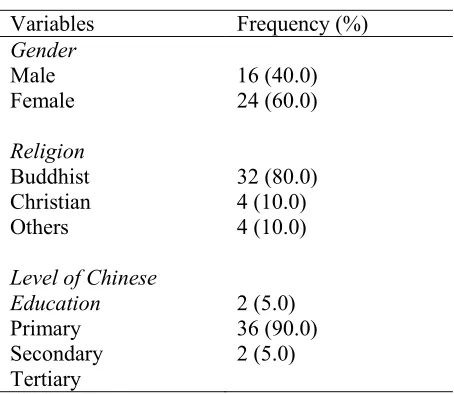
The participants were 40 native Chinese tertiary school students from Klang Valley. Their age ranged between 17 to 23 years old. Its mean was 20.53 years and the standard deviation was 1.432 years. 16 of the subjects were male and 24 were female.
36 participants have received
Chineseeducation up to secondary school level, and 2 had studied till primary and tertiary levels each. Most of them were Buddhist (80.0%), Christian (10.0%) and other religions (10.0%). (Refer to Table 1 & 2)
Table 1. Descriptive Statistics of Subjects’ Age
Variable Mean SD Range
Age 20.53 1.432 17-23
Table 2. Descriptive Statistics of Subjects’ Gender, Religion and Level of Chinese Education
Variables Frequency (%)
Gender
Male Female
16 (40.0) 24 (60.0)
Religion
Buddhist Christian Others
32 (80.0) 4 (10.0) 4 (10.0)
Level of Chinese Education
Primary Secondary Tertiary
2 (5.0) 36 (90.0) 2 (5.0)
2.3 PROCEDURES
The experiment was run in groups. Each group consisted of 5 – 6 participants. Participants were given a brief explanation
about the aims of the study and informed consent. After this, Microsoft Power Point slides were shown by using a projector at a rate of about 2 seconds per item. Each slide consisted of only one item. After each presentation, participants were asked to write down the symbol sequence according to the correct order and response time was not limited. They were not allowed to write anything down during the presentation of slides.
Subjects were next given 2 practice trials before the experimental trials were carried out. It was then followed by 6 symbol sequences for radicals and another 6 sequences for characters. Each sequence was shown in order of increasing length, which consisting three to eight stimuli.
2.4INSTRUMENTS
This is a self-design instrument. There is no reliability and validity. 33 radicals and 33 characters were selected from Chinese dictionary. The radical was part of characters whereas character was part of words. Two examples of Chinese symbol sets are shown in Table 3. In addition, whole list of Chinese symbols that were selected for this experiment was is shown in Appendix.
Table 3. Examples of experimental stimuli
Set Radical Character
1 勹 句
2 豸 貌
Microsoft Power Point slides, in which each slide contained only one item.
3. RESULTS
The results were obtained by carrying out descriptive statistics, frequency and T tests. Descriptive test was used to find out the average STM span of participants for both radicals and characters. As shown in Table 4, the mean of radicals is 3.18 with standard deviation of 1.412 while the mean of characters is 4.05 and standard deviation of 1.431. It was concluded that Chinese students can remember 3.18 items for radicals and 4.05 items for characters.
Table 4. Means of Radicals and Characters
Variable Mean SD Range
Radical 3.18 1.412 0-7
Character 4.05 1.431 2-8
In order to examine the differences between the STM capacity of Chinese-educated students in remembering radical and character, a paired sample T-Test was conducted. As shown in Table 5, there was a significant difference between STM capacity
of Chinese-educated students in
remembering radical and character [t (39) = -3.858]. They tend to have a better STM capacity for character than radical with mean 4.05 vs 3.18. (p = 0.00 means there is 0% chance that the result occurs by sampling error or by chance.)
Table 5.Mean and T-Value for STM capacity of Chinese-educated students in remembering radical and character
Variable Mean Scores
Radical Character t (39) STM
capacity
3.18 4.05 -3.855
** ** p< 0.01
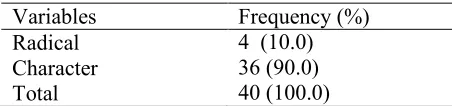
Participants were asked to compare the difficulty level in remembering radicals and characters in STM. 36 out of 40 students (90%) stated that it was easier for them to recall character as compared to radicals (10%) (see Table 6). 17 students (42.5%)
gave reason that characters were
pronounceable and have familiar names. Another 14 students (35%) reported that these characters were linked with some specific meaning. 5 students found both sound and meaning of characters helped them to remember more items. The remaining 4 students (10%) gave reason for why radical was easier to be remembered as compared to character. This implies that subjects were able to remember more characters more than radicals because characters are pronounceable and have meaning. (see Table 7)
Table 6. Frequency of students’ opinion on difficulty level of radical vs. characters
Variables Frequency (%)
Radical 4 (10.0)
Character 36 (90.0)
Total 40 (100.0)
Table 7. Reasons of Recalling
Variables Frequency (%)
Sound 17 (40.0%)
Meaning 14 (35.0%)
Both Sound and Meaning
5 (12.5%)
Radicals 4 (10.0%)
Total 40 (100.0%)
4. DISCUSSION
were still reported that it was more difficult to remember radicals in STM as compared to characters. The main reason given was that these radicals do not have commonly pronounceable names and there was no specific meaning for each item. Some students were complaint that they seldom see radicals in isolation and they were unfamiliar to them.
However, based on the result obtained, Chinese-educated students were still able to remember 3.18 radicals even though there was no pronunciation and meaning attached to the items presented. Hence, the experiment indicated that visual coding does involved in our short term memory. This result was consistent with previous study in which native Chinese participants were able to remember 2.71 radicals in a series of recall tasks (Zhang & Simon, 1985). Besides, it does provide some support for the existence of “visuo-spatial sketch pad” as proposed by Baddeley in 1983.
On the other hand, 36 out of 40 students agreed that characters were easier to be remembered as compared to radicals. The reason given was that characters were pronounceable and there was specific meaning attached to each item. Due to this, their STM span for characters was 4.05 items, which was slightly better than radicals. The result obtained was consistent with our hypotheses, in which Chinese educated students use visual, semantic and auditory coding to remember characters. It does provide support for some theories on the existence of acoustical and semantic code in STM (Baddeley, 1974; Conrad, 1964; Wickens et al, 1976).
In addition, this study also found out that students were more likely to make homophone errors while they were trying to recall Chinese characters. For example, they
were more likely to write “ 新” (new)
although the character presented was “心”
(heart). Their tendency to recall
similar-sounded character suggests strongly that items are encoded acoustically. This was consistent with “phonological similarity effect” proposed by Conrad (1964), in which people often confuse with similar-sounding letters. In his experiment, participants tend to perform worse in recall of letter or word strings with similar pronunciations (B, T, V, C) as compared to dissimilar sounded items(B,X,W,Q) (Conrad, 1964).
Although majority of our participants (36 out of 40) received Chinese education up to secondary school level, many of them were seldom exposed to Chinese language in tertiary school. Hence, their inability to perform well in recall task for Chinese character may due to their inability to recognize the item presented. Besides, there were only full-time students from several local tertiary institutes involved in this study and aged between 18 to 25 years old. Hence, the participants in this study were not representative of the population in Malaysia. In addition, the instruments and scoring system involved in this study were self-designed. Also, the sample size of participants involved in this study is small, which only consists of 40 students.
Therefore, future studies might do better if they can design tool and scoring system that are more reliable and valid. They should also involve sample who received Chinese education until primary school level and make comparison with those from secondary school group. Bigger population of participants should be involved to increase the power of study in the future. In spite of this, participants of this study were the representative of tertiary school students, who aged between 17 and 23 years old, which contributed to the strength of this study.
stimuli. As a result, Chinese-educated students rely on visual coding to remember radicals whereas they use visual, auditory
and semantic coding to remember
characters. They were able to show better memory capacity for recall tasks that involve acoustical and semantic coding. This finding is consistent with level of processing theory (Craik& Lockhart, 1972), in which people tend to show better memory performance when they were involved in deep processing rather than shallow processing in a task.
Hence, this study proved that visual, auditory and semantic coding can be involved in our STM. It has contributed in providing information about the importance of auditory and semantic coding in our learning process. Based on this, students should be encouraged to involve in meaningful learning rather than rote learning. They should learn to focus on the meaning of an item and make connection between the item with their own knowledge and experiences. By doing so, students will be able to enhance their study skills and perform better in examination.
5. REFERENCES
1. Atkinsom, R.C., &Shiffrin, R.
M. (1968). Human memory: A proposed system and its control processes. In
Goldstein, E. B. (2008). Cognitive
Psychology: Connecting Mind, Research, and Everyday Experience. 2nd ed. USA: Thomson.
2. Baddeley, A. D., & Hitch, G. J.
(1974). Working memory. In Goldstein, E.
B. (2008). Cognitive Psychology:
Connecting Mind, Research, and Everyday Experience. 2nd Ed. USA: Thomson.
3. Conrad, R.(1964). Acoustic
confusion in immediate memory. British
Journal of Psychology, 55, 75- 84.
4. Craik, F. I. M., & Lockhart, R.
S. (1972). Levels of processing: A
framework for memory research. Journal of
Verbal Learning and Verbal Behavior, 11, 671 -684.
5. Craik, F. I. M., &Tulving, E.
(1975). Depth of processing and retention of
words in episodic memory. Journal of
Experimental Psychology: General, 104, 268 – 294.
6. Ding, G. S., Pang, D. L., & Taft,
M. (2004). The nature of the mental representation of radicals in Chinese: A
priming study. Journal of Experimental
Psychology: Learning, Memory and Cognition, 30(2), 530 -539.
7. Goldstein, E. B. (2008).
Cognitive Psychology: Connecting Mind, Research, and Everyday Experience. 2nd ed. USA: Thomson.
8. Kroll, N. (1970). Short-term
memory while shadowing: Recall of visually
and aurally presented letters. Journal of
Experimental Psychology, 85, 220 -224.
9. Miller, G. A. (1956). The
magical number seven, plus or minus two: Some limits on our capacity for processing
information. Psychological Review, 63, 81 –
97.
10. Reed, S. K. (1982). Cognition: theory and applications. In Shoong, Y. L., Susanna. (1994). The effect of hearing loss and signing on coding Chinese characters by Cantonese-speaking adolescents, 1- 29.
11. Shoong, Y. L., Susanna. (1994). The effect of hearing loss and signing on coding Chinese characters by Cantonese-speaking adolescents, 1- 29.
encoding of word attributes in memory. Memory and Cognition, 4, 307 – 310.
13. Wong, C. W., Judy. (1997). Working memory and coding strategies for Chinese characters in normal and hearing impaired adolescents, 1- 36.
14. Zhang, G., & Simon, H. A., (1985). STM capacity for Chinese words and idioms: Chunking and acoustical loop
hypotheses. Memory and Cognition, 13, 193
– 201.
6. APPENDIX
Set Radical Character
1 彡, 饣, 冫 同 , 寻, 句
2 冂, 彐, 勹, 卜 般 , 台, 巡, 瘦
3 殳, 厶, 巛, 疒,
彑
凶, 尤, 处, 象,
务
4 凵, 尢, 攵, 豖,
屮, 爫
虎, 铁, 知, 亡,
津, 缸
5 虍, 钅, 矢, 亠,
聿, 缶, 舛
印, 貌, 状, 军,
区, 盒, 准
6 卩, 豸, 丬, 冖,
匚, 皿, 隹, 疋
防, 引, 慧, 男,