International Journal of Research (IJR)
e-ISSN: 2348-6848, p- ISSN: 2348-795X Volume 2, Issue 05, May 2015Available at http://internationaljournalofresearch.org
A Comparative Study on
Capital Structure of
Cashew
Processing Cooperative Society
(Special Refference to Dharampur taluka in Gujarat State)
Presented By :
Patel Dilipkumar
Research Scholar Pacific University, Udaipur ( Rajasthan)
A Comparative Study on
Capital Structure of Cashew Processing Cooperative Society (Special Refference to Dharampur taluka in Gujarat State) Abstract
This study Conducted in Cashew Processing Cooperative society , Dharampur taluk in Gujarat state’s to analyze the financial Capital Structure by using the data in Six years ( 2008-09 To 2013-14) annual audit reports of the financial statements Participatory discussion with management board team of Cashew processing Cooperative Society and interview with Manager, Accountant And shareholder’s. This article examines the financial Capital structure study of Cashew processing Cooperative society. The check up capital growth conducted in the framework of most common financial ratios used in the study.and Financial Capital structure hypothesis test on used ANOVA Test , Mean , Standard Devition and Variance also.
Key word :
Debt Equity Ratio ; Gearing Ratio ; Capital ; Fixed Assets; Properatory
Introduction
:Capital structure means the
mixture of share capital and other long term liabilities. In the company or other business firm, we know that liability of each shareholder is limited but how much be the total liability of shareholder is the important question for the business firm ? It can be decided by choosing best capital
structure. In capital structure, we include, equity share capital, preference share capital, debenture and long term debt. Suppose, business firm or Company capital structure may show Ratio of equity share capital, pref. share capital and debentures.and other long time debt, But all business firm and companies' capital structure may not be equal because different business need different type of capital structure which will be suitable according to the need of business or business all firm. this study is researcher‟s object to comparative study of Dharampur talukas in Gujarat state Cashew Processing
Cooperative Societies Capital structure
and suggestion for improwment to capital structure by societies Management.
About Dharampur Taluak :
Dharampur and kaparada taluka of valsad district are mostly tribal areas. They are in the lap of sahyadri mountain chain. Hill station of this district are comparable to any other hill stations in India. However, there are negligible
accommodation for lodging and
International Journal of Research (IJR)
e-ISSN: 2348-6848, p- ISSN: 2348-795X Volume 2, Issue 05, May 2015Available at http://internationaljournalofresearch.org
"District" science centre at dharampur
with modern scientific instruments
exhibiting and demonstrating various rules of science, which has become the centre of attractions for science lovers not only from valsad district but also from maharashtra state and Dacha and Nagar Haveli union territories. Splendid temple of an idol of eight metals of
Bhagwan "Bhav Bhaveshwar"
constructed by maha mandaleshwar
vidyanandji saraswati maharaj and its complex is emerging as a pilgrim place at Barumal "Sahayadri Srushti Centre Constructed.
Co-operative Society in
Dharampur Taluk :
Different education level of five talukas of dist Valsad of Gujarat can be seen .Base on the education level of the people, a variety can be seen in their languages, culture, living standard etc has undergone a huge changes in last two decades to go. One can not ignore the opportunity in term of trade, religion, heritage, and industry in these areas under study. Even today one can see the presence of traditional as well as modernization touch in the business of these local areas. The areas are surrounded by lust green natural beauty covering the areas by hill. Even till date, many areas are under developed. Due to bad economic condition, many people are still living below poverty line. We find good presence to traditional system of “HAAT” bazaar catching the heart
of local
peoples. People prefer to visit such bazaar for buying their basic
requirement .The political benefits has not
for underdevelopment of this areas. Considering all the above mention factors. Researcher‟s take study area Covered was Pindaval , Gadi and Dhamni Village same activity Cashew Processing Cooperative societies, and studies Capital structure study. Selected three societies covered 31 village in Dharampur taluk.
Literatutre Review
Dr. M. S. Ramananda And Dr. M.
Jayaprakash ( 2012) 7 in the article “ Impact
on Vydhanadhan Committee
Recomadations Of Wangaplly Primar Agricultural Cooperative Credit Society ” This study was an attempt to decipher the factors, which contribute to the financial health of the PACS, which form the base of the short-term cooperative credit structure prevalent in
India. The
study considered recovery performance of the PACS as the most suitable
indicator of their performance. The results indicate that as the PACS have drifted from some of the core principles of cooperation, their recovery performance has suffered. As membership size has grown over the years in case of the PACS, their recovery has taken a beating because peer pressure, which ensures recovery, has gradually weakened. Thus there is a need to relook into the issue of optimal member size of the cooperatives in the interest
of their
viability. In conformity with popular perception,
International Journal of Research (IJR)
e-ISSN: 2348-6848, p- ISSN: 2348-795X Volume 2, Issue 05, May 2015Available at http://internationaljournalofresearch.org
contribution in share capital not only gives it a hand to meddle with the affairs of the PACS; it might also be inducing indulgence amongst members because of the comfort of government bail out in case of difficulty.
Dr.Murali Vallapureddy (2013)8 in the article “People of rural India face a lot of
hardships to earn livelihood. A majority of
them are engaged in agriculture, animal husbandry and other ancillary activities. Income from agricultural activity has been as erratic as the monsoon. Hence, rural people are forced to think of generating additional revenues. Since these people are less literate and posses limited skills, the hunt for alternate source of income is constrained to a few occupations. A majority of them choose rearing of milch cattle and selling the milk as a source of secondary income. A cattle rearing is a diversification from existing agricultural activity. Largely, rural women are engaged in this activity. These rural women, besides doing hard household chores, also undertake the taxing job of cattle rearing. The present paper study on “Performance of Women Cooperative Dairy – A Study on Mulkanoor Women Cooperative Diary in Andhra Pradesh”, the MWCD (Swakrushi) is a promising community enterprise in enhancing livelihoods of large numbers of rural producers. It began its operations in Aug‟ 2002 and in Mar‟12, it has been providing services to its 20,118 members. The aim of the study is an attempt to identify the various factors/dimensions that have contributed to the growth of this rural women initiative. The focus on analysis of the growth path is particularly important as the development sector is trying more and more to discover the process of enhancing large number of livelihoods for rural poor Today the Mulkanoor cooperative society is having 20,118 members, 109 societies, 68 employees (in the economic year 2011-12 annual report). Thus, Mulkanoor cooperative society is the role model in the country and there is need of sincere efforts to strengthen the cooperative societies in India on the same line, if we are concern to meet the demand of food, cloth,
shelter and employment to our increasing population.
Dr. M.S. Ramananda ( 2012)9 in the article “
Ratio Analysis of Hydrabad Agricultural
Cooperative Association Operational
Functions ” The paper attempts to understand
the operational functional aspects of HACA about the financial position and financial performance. The study is based on secondary sources only. The secondary data were collected from HACA office, HACA Bhavan, published, unpublished and Internet. The study period was during the year 2004 to 2009. The HACA operational aspects as per the data analysis it was not uniformly distributed among the years. During the reference period the HACA data analysis showed negative ratios could be observed. The shareholder's capital has risen quite a bit if you compare the balance sheet numbers versus the previous year. Again this could mean a number of things, there are a couple reasons that this could have happened. Perhaps they've made acquisitions which were partially paid for through the issue of stock, or maybe they took on additional share capital from another firm. Another possible reason is that they had to issue more shares because they were strapped for cash. For the most part a rise in share capital is better than a rise in debt, but too much of a rise could be cause for alarm. The HACA operational aspects as per the data analysis it was not uniformly distributed among the years. During the reference period the HACA data analysis showed negative ratios could be observed. The shareholder's capital has risen quite a bit if you compare the balance sheet numbers versus the previous year. For the most part a rise in share capital is better than a rise in debt, but too much of a rise could be cause for alarm.
Narayana Gowd Talla , Anand Bethapudi
and Reddeppa Reddy G.( 2011) 10 in the
project “ An Analytical Study on Financial Perfomace of Dharmavaram Cooperative
Bank,Ap, India ” The Paper researcher aims
International Journal of Research (IJR)
e-ISSN: 2348-6848, p- ISSN: 2348-795X Volume 2, Issue 05, May 2015Available at http://internationaljournalofresearch.org
which relies on secondary data. The analyzed data reveals that there was significant growth in the deposits mobilization, membership, loans and advances, working capital, reserves, owned funds, Total income, Total expenditure and over dues with reference to DUCB. There is no significant growth in share capital per member with CGR of 4.50.There was no significant increase in the total cash with the bank which is growing at CGR of 2.54.There was no significant growth in CDR with a CGR of 11.02.There was significant difference in the growth and composition of income. The total expenses were increasing significantly with CGR of 9.68. Even though there was increasing trend in the Total income earned during the study period except in the year 2006-07 it was statistically significant with CGR of 7.13 but the EPS of DUCB was not enhanced which is statistically in significant during the study. Therefore the performance of DUCB was moderately satisfactory. For improving its performance, it has to
concentrate on recovery performance,
controlling expenses, robust risk management practices and diversifying their operations. The income of Dharmavaram Urban Co-operative Bank has been showing increasing trend. The interest on investment also showed mixed trends during the period i.e., from 2005-06 to 2009-10.
Objectives of the proposedstudy
To study the Capital Structure of
Selected Cashew Processing
Co-operative Society in Dharampur taluk.
To Make comparative study of the
selected Cashew Processing
Co-operative Society in Dharampur taluk.
To Make suggestions for the
betterment of the Selected Co-operative Society in Dharampur taluk.
Hypotheses of the Study :( Null Hypothesis )
Ho : There is no any Significance difference
between the Capital Structural Ratios of Cashew Processing Cooperative societies.
(Alternative Hypothesis)
H1 : There is singnificance difference
between the Capital Structural Ratios of Cashew Processing Cooperative society.
Importance of the Study :Today‟s world had become very
competitive. In each field thousand‟s of competitors has entered the market.
In the changing market scenario
equipped with science and technology, they re struggling to survive in the market, whether it is a field of knowledge, business or any other Profession. Even the Indian economy is not free from the air of liberalization,
privatization and globalization. The
public sector has to become more active and should also take necessary measures to fit them in the changing economic scenario. A study on the problem faced and its relevant solution, so that the people of these areas get good service from this co-operative society. This co-operative society can act as a role model to be followed by
other society of the Dharampur
Taluka.Other co-operative society can follow the management system for improving the financial position of the society
Statestical tools usedMEAN, STANDARD DEVIATION, AND VARIATIONS:
International Journal of Research (IJR)
e-ISSN: 2348-6848, p- ISSN: 2348-795X Volume 2, Issue 05, May 2015Available at http://internationaljournalofresearch.org
Source of Information: Personal talk with the chairman of the
selected Cashew processing co-operative society.
Personal talk with the accountant of the
selected cashew processing
co-operative society.
Visit to the district industry center of
Valsad district.
Members of the co-operative society
Other documents related to the study
will be used:
Monthly Magazine
Books/literature/research
papers/articles etc
Internet
Research conducted by other state
co-operative society
Limitation of the study.1. The study has been conducted over a limited period of six years only.
2. The study is mainly based on
secondary data.
3. The study is limited to three Selected Cashew Cooperative society only.
4. The study is based on consolidated financial statement, which may lead to some errors and assumptions.
5. Researcher take study area only
Dharampur taluka in valsad district
Introduction
:
Capital
Structure or Solvency Ratio
:
1. Debt Equity Ratio :
The debt-to-equity ratio (debt/equity ratio, D/E) is a financial ratio indicating the relative proportion of entity's equity and
debt used to finance an entity's assets. This ratio is also known as financial leverage.
2. Gearing ratio
The gearing ratio is the proportion of a company's debt to its equity. A high gearing ratio represents a high proportion of debt to equity, and a low gearing ratio represents a low proportion of debt to equity. This ratio is similar to the debt to equity ratio, except that there are a number of variations on the gearing ratio formula that can yield slightly different results.
3. Preparatory Ratio
The proprietary ratio is the inverse of debt ratio. It is a part to whole comparison. The proprietary ratio measures the amount of funds that investors have contributed towards the capital of a firm in relation to the total capital that is required by the firm to conduct operations.
4. Fixed Capital and Fixed Assets
Ratio
This particular ratio is important because it can either help or hurt businesses in their efforts to attract additional investors. Businesses with a positive fixed-asset-to-equity-capital ratio are considered less risky. Businesses have other methods of determining their financial strength. But
the fixed-asset-to-equity-capital ratio
provides a snapshot of how financially strong a company would be if its revenues, for whatever reason, dried up. Companies with a high ratio know that they at least have valuable fixed assets that they can
International Journal of Research (IJR)
e-ISSN: 2348-6848, p- ISSN: 2348-795X Volume 2, Issue 05, May 2015Available at http://internationaljournalofresearch.org
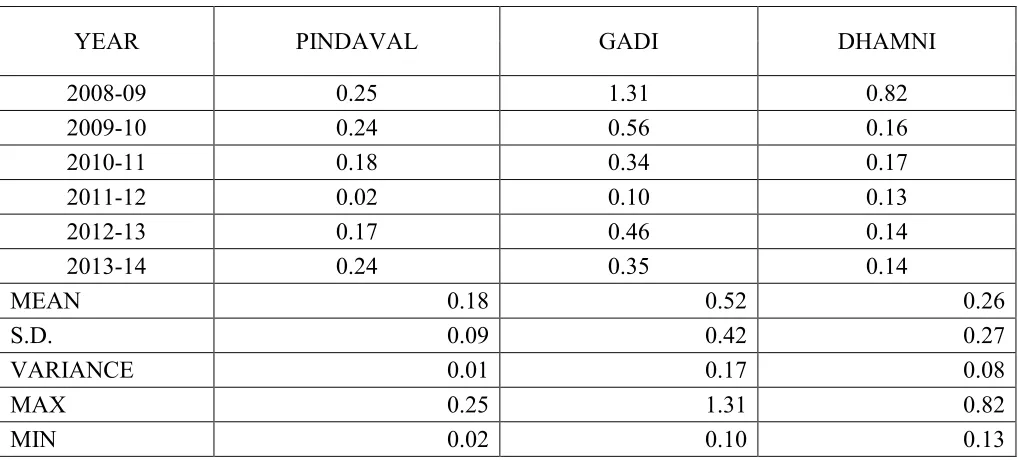
Table : 1 Debt Equity Ratio of Cashew Processing Cooperative Society in Dharampur taluka in South Gujarat
Source : Annual Report : Calculated Data
Interpretation
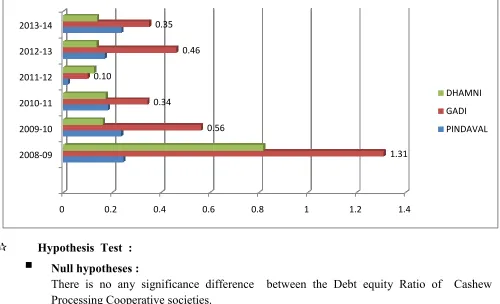
Above table debt-equity ratio of Pindaval Cashew processing Cooperative Socitiety is highest ratio was 0.25 in the year 2008-09. And lowest ratio was 0.02 in year 2011-12.and every year ratio was average. The Mean value of equity ratio was 0.18. The standard deviation was 0.09 and Variance was 0.01. Where as debt-equity ratio of Gadi cashew rocessing Cooperative society highest ratio was 1.31 in year 2008-09 and lowest ratio was 0.10in year 0.56. the mean value was 0.52 and standard devition was 0.42 and variance of the ratio was 0.17 in the study year. Debt eqity ratio of Dhamni Cashew Processing Cooperative Society highest ratio was 0.82 in year 2008-09 and lowest ratio in study period was 0.13 in 2011-12.the mean value was 0.26 and S.D. value was 0.27 and Variance of per year ratio was 0.08.
Findings
From the above it can be concluded that Cashew processing Cooperative Societies does not have maintain ratio. first year 2008-19 in highest every year in their Debt after all selected society study period was no maintaion regular ratio Equity and debt as low in Pindaval And Dhamni.The Financial position of Debt positons against to net worth better situation in Gadi.because mean value and variance was satisfied. So, we can say that the Debt Equity ratio of and long term solcvency is well on Gadi cashew Processing cooperative society.
YEAR PINDAVAL GADI DHAMNI
2008-09 0.25 1.31 0.82
2009-10 0.24 0.56 0.16
2010-11 0.18 0.34 0.17
2011-12 0.02 0.10 0.13
2012-13 0.17 0.46 0.14
2013-14 0.24 0.35 0.14
MEAN 0.18 0.52 0.26
S.D. 0.09 0.42 0.27
VARIANCE 0.01 0.17 0.08
MAX 0.25 1.31 0.82
International Journal of Research (IJR)
e-ISSN: 2348-6848, p- ISSN: 2348-795X Volume 2, Issue 05, May 2015Available at http://internationaljournalofresearch.org
Graph : 1 Debt Equity Ratio
Hypothesis Test :
Null hypotheses :There is no any significance difference between the Debt equity Ratio of Cashew Processing Cooperative societies.
Alternative Hypotheses :There is significance difference in the Debt equiry Ratio of Cashew Processing Cooperative Societies.
Table : 2 Anova Test of Debt Equity Ratio
Source of Variation
SS df MS F P-value F crit
Between Groups
0.381313369 2 0.190656685 2.233205 0.141593 3.68232
Within Groups
1.280603701 15 0.08537358
Total 1.66191707 17
Above table Indicates there is no significant difference in Debt equity ratio of Cooperative society under study because the calculated value of „F‟ (2.23) is lower than table value(3.68) So, null hypothesis is accepted and alternative hypothesis rejected. and hence it is concluded that the Debt equity ratio does not differ significantly.
0 0.2 0.4 0.6 0.8 1 1.2 1.4
2008-09 2009-10 2010-11 2011-12 2012-13 2013-14
1.31 0.56
0.34 0.10
0.46 0.35
DHAMNI
GADI
International Journal of Research (IJR)
e-ISSN: 2348-6848, p- ISSN: 2348-795X Volume 2, Issue 05, May 2015Available at http://internationaljournalofresearch.org
Table : 3 Capital Gearing Ratio of Cashew Processing Cooperative Society in Dharampur taluka in South Gujarat
Source : Annual Report- Calculated Data
Interpretation
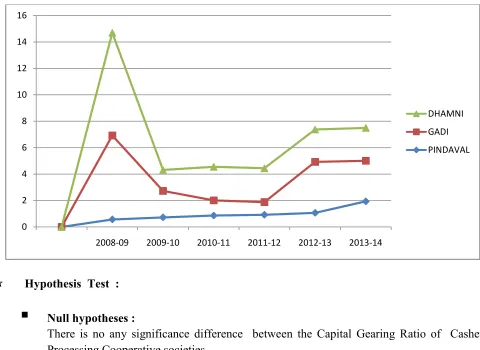
Above table Capital Gearing ratio of Pindaval Cashew processing Cooperative Socitiety is 0.57 ratio was in 2008-09. And increase all study period, Mean value was 1.01, And Variance was 0.23. and highest ratio in year 2013-14. Where as Capital Gearing ratio of Gadi cashew rocessing Cooperative society highest ratio was 6.36 in year 2008-09 and lowest ratio was 0.96 in year 2011-12. the mean value was 2.90 and standard devition was 2.03 and variance of the ratio was 4.11 in the study year. Capital Gearing ratio of Dhamni Cashew Processing Cooperative Society highest ratio was 7.77 in year 2008-09 and lowest ratio in study period was 1.58 in 2009-10.the mean value was 3.23 and S.D. value was 2.25 and Variance of per year ratio was5.08.
Findings
From the above it can be concluded that Cashew processing Cooperative Societies Capital gearing ratio is the measured of capital structure analysis and financial strength of the and is of great importance for actual and potential investors.Pindaval cooperative society was maintain every year ratio.other cooperative societies was not maintain because first year high ratio and after not average position.so, we can say that pindaval society capital ratio was satisfied and gadi and dhamni society was not satisfied and risky financial policy for all Investor and Creditors.
YEAR PINDAVAL GADI DHAMNI
2008-09 0.57 6.36 7.77
2009-10 0.72 2.01 1.58
2010-11 0.86 1.15 2.54
2011-12 0.92 0.96 2.56
2012-13 1.06 3.86 2.45
2013-14 1.93 3.07 2.49
MEAN 1.01 2.90 3.23
S.D. 0.48 2.03 2.25
VARIANCE 0.23 4.11 5.08
MAX 1.93 6.36 7.77
International Journal of Research (IJR)
e-ISSN: 2348-6848, p- ISSN: 2348-795X Volume 2, Issue 05, May 2015Available at http://internationaljournalofresearch.org
Graph : 2 Capital Gearing Ratio
Hypothesis Test :
Null hypotheses :There is no any significance difference between the Capital Gearing Ratio of Cashew Processing Cooperative societies.
Alternative Hypotheses :There is significance difference in the Capital Gearing Ratio of Cashew Processing Cooperative Societies.
Table : 4 Anova Test of Gearing Ratio
Source of Variation
SS df MS F P-value F crit
Between Groups
17.25902845 2 8.629514224 2.746358 0.096314 3.68232
Within Groups 47.13249724 15 3.142166483
Total 64.39152569 17
Above table Indicates there is no significant difference in Gearing ratio of Cooperative societies under study because the calculated value of „F‟ (2.74) is Higher than table value F ( 3.68) so,
0 2 4 6 8 10 12 14 16
2008-09 2009-10 2010-11 2011-12 2012-13 2013-14
DHAMNI
GADI
International Journal of Research (IJR)
e-ISSN: 2348-6848, p- ISSN: 2348-795X Volume 2, Issue 05, May 2015Available at http://internationaljournalofresearch.org
null hypothesis is Accepted and alternative hypothesis Rejected. concluded that no significance differ between capital Gearing Ratio of Cooperative Societies.
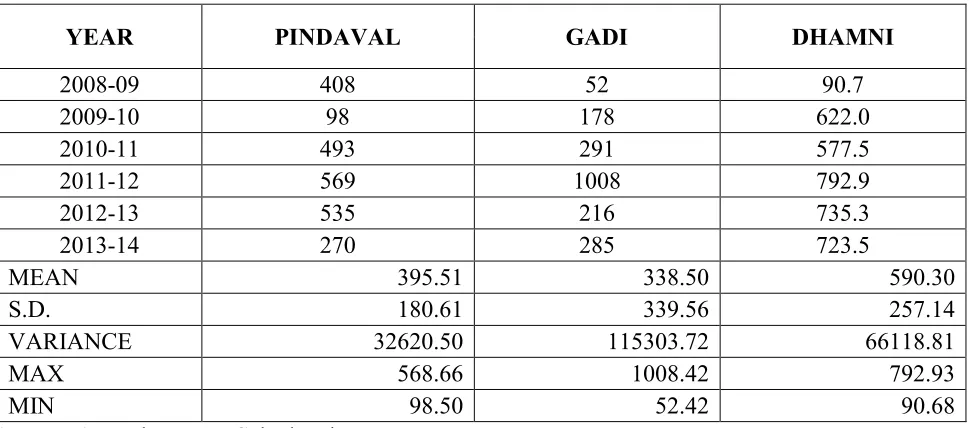
Table : 5 Properatory Ratio of Cashew Processing Cooperative Society in Dharampur taluka in South Gujarat
YEAR PINDAVAL GADI DHAMNI
2008-09 408 52 90.7
2009-10 98 178 622.0
2010-11 493 291 577.5
2011-12 569 1008 792.9
2012-13 535 216 735.3
2013-14 270 285 723.5
MEAN 395.51 338.50 590.30
S.D. 180.61 339.56 257.14
VARIANCE 32620.50 115303.72 66118.81
MAX 568.66 1008.42 792.93
MIN 98.50 52.42 90.68
Source : Annual Report- Calculated Data
Interpretation
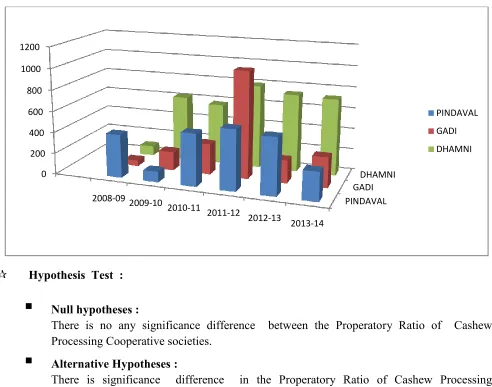
Above table Properatory ratio of Pindaval Cashew processing Cooperative Socitiety highest ratio was in 569. In 2010-11 and other year ratio was average , Mean value was 395.51, And s.d was 180.61. Whereas Preparatory ratio of Gadi cashew processing Cooperative society highest ratio was 1008.42 in year 2011-12 and lowest ratio was 52.42 in year 2008-09 . the mean value was 338.50 and standard devition was 339.56 and variance of the ratio was 115303.72 in the study year. Properatory ratio of Dhamni Cashew Processing Cooperative Society highest ratio was 792.93 in year 2011-12 and lowest ratio in study period was 90.68 in 2008-09. the mean value was 590.30 and S.D. value was 257.14 .
Findings
International Journal of Research (IJR)
e-ISSN: 2348-6848, p- ISSN: 2348-795X Volume 2, Issue 05, May 2015Available at http://internationaljournalofresearch.org
Graph : 4 Properatory Ratio
Hypothesis Test :
Null hypotheses :There is no any significance difference between the Properatory Ratio of Cashew Processing Cooperative societies.
Alternative Hypotheses :There is significance difference in the Properatory Ratio of Cashew Processing Cooperative Societies.
Table : 6 Anova test of Properatory Ratio
Source of Variation
SS df MS F P-value F crit
Between Groups
209192.1922 2 104596.0961 1.466006 0.2621 3.68232
Within Groups
1070215.124 15 71347.67495
Total 1279407.316 17
PINDAVAL GADI
DHAMNI 0
200 400 600 800 1000 1200
2008-09 2009-10 2010-11
2011-12 2012-13
2013-14
PINDAVAL
GADI
International Journal of Research (IJR)
e-ISSN: 2348-6848, p- ISSN: 2348-795X Volume 2, Issue 05, May 2015Available at http://internationaljournalofresearch.org
Above Table showed the F calculated value > F critical (at 5% significance level), the null hypothesis is accepted and alternative hypothesis is rejected and hence it is concluded that the Properatory ratio of Cooperative Societies does not differ significantly.
Table : 7 Fixed Capital and Fixed Assets Ratio of Cashew Processing Cooperative Society in Dharampur taluka in South Gujarat
YEAR PINDAVAL GADI DHAMNI
2008-09 9.87 3.35 2.34
2009-10 2.76 2.26 2.24
2010-11 12.59 1.65 1.93
2011-12 1.55 1.44 1.60
2012-13 1.58 1.12 1.54
2013-14 1.48 1.18 1.69
MEAN 4.97 1.83 1.89
S.D. 4.95 0.85 0.34
VARIANCE 24.47 0.72 0.11
MAX 12.59 3.35 2.34
MIN 1.48 1.12 1.54
Source : Annual Report- Calculated Data
Interpretation
. Above table Fixed Capital and Assets ratio of Pindaval Cashew processing Cooperative Socitiety highest ratio was in 12.59 In 2010-11 and lowest ratio was 1.48 in 2013-14 , Mean value was 4.97, And S.D. was 4.95 and Variance was 12.59. Where as Fixed Capital and Assets ratio of Gadi cashew rocessing Cooperative society highest ratio was 3.35 in year 2008-09 and lowest ratio was 1.12 in year 2012-13 . the mean value was 1.83 and standard devition was 0.85 and variance of the ratio was 0.72 in the study year. Fixed Capital and Assets ratio of Dhamni Cashew Processing Cooperative Society highest ratio was 2.34 in year 2008-09 and lowest ratio in study period was 1.54 in 2012-13. the mean value was 1.89 and S.D. value was 0.34 .
Finding :
International Journal of Research (IJR)
e-ISSN: 2348-6848, p- ISSN: 2348-795X Volume 2, Issue 05, May 2015Available at http://internationaljournalofresearch.org
Graph : 4 Fixed Capital Assets Ratio
Hypothesis Test :
Null hypotheses :There is no significance difference between the Fixed Capital Assets Ratio of Cashew Processing Cooperative societies.
Alternative Hypotheses :There is significance difference in the Fixed Capital Assets Ratio of Cashew Processing Cooperative Societies.
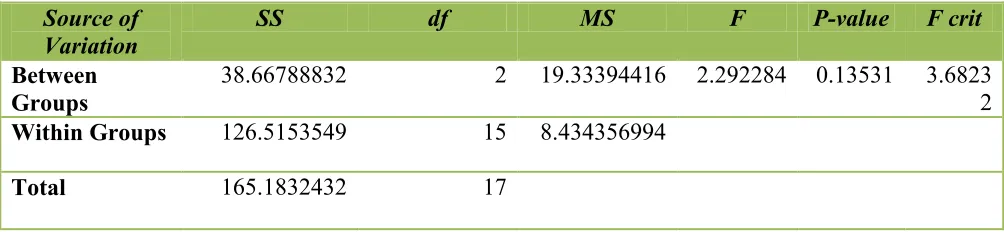
Table : 8 Anova Test of Fixed Capital Assets Ratio.
Source of Variation
SS df MS F P-value F crit
Between Groups
38.66788832 2 19.33394416 2.292284 0.13531 3.6823
2
Within Groups 126.5153549 15 8.434356994
Total 165.1832432 17
Above table Indicates there is no significant difference in Fixed Capital Assets ratio of cashew processing Cooperative societies under study because the calculated value of „F‟ (2.29) is Higher than table value F (3.68 ) So, null hypothesis is Accepted and alternative hypothesis rejected. So concluded that no any significance difference between fixed capital assets ratio cashew Cooperative Societies.
0 2 4 6 8 10 12 14
2008-09
2009-10
2010-11 2011-12
2012-13 2013-14
PINDAVAL
GADI
International Journal of Research (IJR)
e-ISSN: 2348-6848, p- ISSN: 2348-795X Volume 2, Issue 05, May 2015Available at http://internationaljournalofresearch.org
Suggestion :
In view of the Suggestion of the study, the following recommendations are suggested to analysis the Capital Structure Perfomance of Selected Cashew Cooperative society.
In order to improve the financial leveragethe management shall build equity capital by collecting shares from existing and new membership increase ; retain profits or converting cash . Members of the cooperative should increase their own capital to finance fixed assets in order to reduce leverage ratio, this can be enhanced by selling additional share capital and unproductive fixed assets.
The cooperative Societies shall allocatepart of its equity capital for current assets and working capital in order to run the business operations Slowly, attract short term creditors and minimize risks of long term investment for management.
To strengthen the financial efficiency,long-term funds have to be used to finance core current assets and a part of temporary current assets. It is better if the cooperative societies can reduce the over sized short- term loans and advances eliminates the risk arranging finance regularly.
Cooperative Society Managemnt shouldUse any methods available to increase profits, which should generate more cash with which to pay down debt.
Managemnt Should Increase the speed ofaccounts receivable collections, reduce inventory levels, and/or lengthen the days required to pay accounts payable, any of which produces cash that can be used to pay down debt
CONCLUSION :-It can be concluded from the study of Six ( 6) financial periods of Pindaval , Gadi And Dhamni Cashew Processing Cooperative society in Dharampur taluk in South Gujarat that the Financial Capital structure analysis Indicators of
position. So, all selected cooperative society Management should good planning to Increase Capital fund and better work and solve capitmal relatd problems. From the analysis by Anova ( Analysis of Variance ) clear that Financial capital structure analysis all selected ratio in Null hypothesis are accepted and Alternative hypothesis rejected. it means There is no any significance difference between capital structure ratios of selected cashew processing cooperative society.
Bibliography :o Mr. R.V. Keshwara ( 2009) Thesis
Doctor of Philosophy Saurastra University. Auther is Lecturer of Business Management Shree K.H. Madhwani college , Porbandar( Gujarat)
o T Venkatesan And Dr. S.k.
Nagrajan(2012) *Research Scholar, Bharathaiar University, Coimbatore, Tamilnadu, India. **Assistant Professor, Department of Business
Administration, Annamalai University,
Tamilnadu, India. International Journal of Marketing, Financial Services & Management Research Vol.1 Issue 10, October 2012, ISSN 2277 3622
o Mital Menapara1 and Dr. Vijay Pithadia
(000) 1 Research Scholar of Karpagam University Abhinav Journal .Com monthly reffered journal Vol.1 Isssue 11
o Robert Hogerwerf ( 2010) Faculty :
Management and Governance Finance and Accounting A thesis of University of Twente
o Agrawal N.P. ( 1981) in the book
Analysis of Financial statements”
o In publication National publishing
House,New Delhi
o Chaudhari S.B. ( 1964) in book “
Analysis of company financial statement on published throgh Asia publishing House,London
o Gupta R.L.(1980)in the book “ Financial
Statement Analysis” in publishedthrogh Sultan chand And sons,New Delhi
o Jain P.K ( 1988) in the book
International Journal of Research (IJR)
e-ISSN: 2348-6848, p- ISSN: 2348-795X Volume 2, Issue 05, May 2015Available at http://internationaljournalofresearch.org
o Guthmanan H.G. (1968) in their book “
Analysis of Financial Statement ” in published through Prentiese Hall of india Pvt.Ltd,New Delhi
o Khan And Jain ( 1987) 7th Edison their
Book name : Financial Management by publish Tata Mechgrow Hill publishing. Delhi.
Refferences[1.] Dr. M. S. Ramananda And Dr. M.
Jayaprakash ( 2012) 7 in their article “ Impact
on Vydhyanandan Committee
Recomandations of Wnagapally Primary Agricultural Cooperative Credit Society ” IJPSS Volume 2, Issue 9 ISSN: 2249-5894
[2.] Dr.Murali Vallapureddy (2013) “ People of rural India face a lot of hardships to earn livelihood ” International Journal of Contemporary Business StudiesVol: 4, No: 3. March, 2013 ISSN 2156-7506
[3.] Dr. M.S. Ramananda ( 2012) “ Ration
Analysis of Hydrabad Agricultural
Cooperative Association Operational
Functions ” International Journal of Advanced Research in Management and Social Sciences ISSN: 2278-6236
[4.] Narayana Gowd Talla , Anand Bethapudi
and Reddeppa Reddy G.( 2011) “ An Analytical study on financial performance of Dharmavaram Urban Co operative Bank, Andhra Pradesh ( India ) ” National Monthly
Reffereed Journal of Research in Commrce and Managemnt www.abhinavjournal.com, Volume No.2, Issue No.8 Issn 2277-1166
Magazine : Arth Sankalan
Gram Swaraj
Gujrat Samachar
Indian
Co.Operative Review
Rachna-Monthly
Sandesh Gujrat Daily
Sahkar-Weekly
Vikal Quarterly
Yojna Monthlhy
Author’s Introduction
PATEL DILIPKUMAR CHUNILAL
M.COM, B.ED RESEARCH SCHOLAR PACIFIC ACADEMY OF HIGHER
EDUCATION AND RESEARCH UNIVERSITY , UDAIPUR
( RAJASTHAN)