Design of Temperature Controlled Solar
Dryer
Soumendra Bagh
1, Abhijeet Shrivastava
2, Aditya Vardhan Singh
2, Ashutosh Chandra Srivastava
2, Lavi
Gupta
2Assistant professor, Dept. of EEE, Galgotia’s College of Engineering and Technology, Greater Noida, India1 Student, Dept. of EEE, Galgotia’s College of Engineering and Technology, Greater Noida, India2
ABSTRACT: For millions of years, mankind has beenstoring food materials after drying and saltinprocess of drying usually involves sun as the source. For years this process of drying is also evolving and is being innovated at every level. This process of drying in the sun now includes Solar Dryer as its major equipment and requirement.
Based on the recent innovations on the solar dryers, this paper provides the details of the fabrication and design enhancement. This paper provides the detailed design modification from the previous to meet the quality of the end product. The dryer consists of a hot black box and a translucent sheet roof.
KEYWORDS: Solar dryer, Modification, Quality product, Arduino Uno, Automation, Multi-stacking, Solar Tracking.
I.INTRODUCTION
Drying is one of the most conventional methods used for preservation and storage, which works on the basis of reduction in the water content in the product. The reduction in the water content brings about more physical as well as chemical stability in the product. Also it reduces the weight and volume of the product and hence the transportation cost also decreases. Drying improves the quality of product and reduces product loss due to moisture content. For this process of drying and dehydration of any product several techniques have been employed which solar drying, hot air, freeze drying, osmotic dehydration, etc.
Operation of drying involves both heat and mass transfer. It changes several parameters of the product during the process such as volume, density, mass, moisture content, humidity inside, product size, chemical changes along with the product quality. It is an important time and energy consuming process which lastly improves the standard of the product.
Drying of agricultural products have been one of the most ancient skill of all time and is generally employed worldwide for better market value of the agro-based products. Direct and uncontrolled sun drying is still the most common method that is being used to preserve and process agricultural products in most countries. The key advantages of sun drying are low capital investmentsand reduced complexity. The main disadvantages of open-air sun drying, mostly are contamination, theft or damage by birds, rats or insects also it fairly is slow drying and no protection from rain, dew or any storm. If not protected well from various above hazards it could reduce the market value of products. It results in reduced food quality which makes the product inedible. Therefore, drying in a closed chamber with the heat of sun will remove the damages caused in open environment. Hence, the need of a solar dryer is absolutely inevitable. Solar dryers can be classified according to the mode of heat transfer as- conduction, convection and radiation. Natural dryers do not require any fan to blow air inside the dryer. Solar drying can also be classified as direct absorption dryer, indirect absorption dryer and mixed-modes. In direct solar dryers the air heater contains the materials and solar energy passes through a transparent cover and is absorbed by the drying materials.
from a separate solar collector is passed through the drying bed and at the same time, the drying cabinet or chamber absorbs solar energy directly through the transparent walls or roof.
II. PROBLEM OVERVIEW
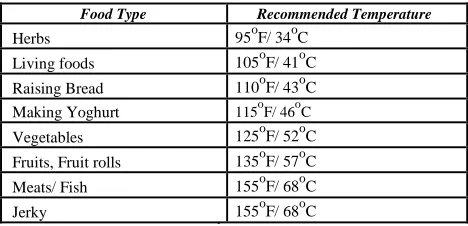
As in the given table shown
below-Food Type Recommended Temperature
Herbs 95oF/ 34oC
Living foods 105oF/ 41oC
Raising Bread 110oF/ 43oC
Making Yoghurt 115oF/ 46oC
Vegetables 125oF/ 52oC
Fruits, Fruit rolls 135oF/ 57oC
Meats/ Fish 155oF/ 68oC
Jerky 155oF/ 68oC
TABLE 1: TEMPERATURE DEMANDED BY MATERIAL.
Different food types require different temperature for drying conditions in order to maintain their nutrition value. In the basic design of SCD the problem arises for temperature control for different food types, for this problem to overcome an automated system design has been presented in this paper.
For the economic beneficiary at the end user level and the easy manufacture of the product the system is designed cost effective. For this to happen, the following materials have been
used-1. Arduino Uno 2. Dynamo fans
3. Temperature Sensor (LM35)
4. Temperature and Humidity Sensor (DHT11) 5. Light Intensity Sensor (BPW34)
6. Stepper Motor and Driver(ULN 2003A) III. THE COMPONENTS
A. Arduino Uno
Ardino Uno Characteristics
Operating 5V
Voltage
Input Voltage 7-12V
Digital I/O Pins 14 (of which 6 provide PWM output) Analog Input 6
Pins
Flash Memory 32 KB (ATmega328) of which 0.5 KB used by bootloader
Clock Speed 16 MHz
Length 68.6 mm
Width 53.4 mm
Weight 25 g
TABLE 2: DATASHEET OF ARDUINO UNO
The Arduino Uno is an ATmega 328 based microcontroller board. It has 14 digital input/output pins (of which 6 can be used as PWM outputs), 6 analog inputs, a 16 MHz ceramic resonator, a USB connection, a power jack, an ICSP header, and a reset button. It contains everything needed to support the microcontroller and the components connected; simply connect the microcontroller to a computer using a USBcable or power it using an AC-to-DC adapter or battery to get started.
Arduino Uno is the most compatible microcontroller to be used in the system. It has the ability to control different components simultaneously without any system overloading. It is also available easily available in the market which makes the production much easier and well enhanced. It is also compatible with the sensors that are to be installed on the dryer.
B. Temperature and Humidity Sensor
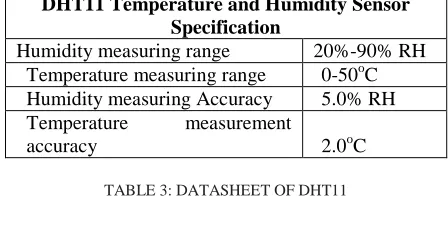
(DHT11)-The temperature and humidity sensor DHT11 is a 4pin sensor that consists of a calibrated digital signal output of the temperature and humidity. The sensor has an exclusive digital-signal-acquisition technique and a temperature and humidity sensing technology that enables this sensor with high reliability and excellent long term stability.
Thus, the accuracy and compatibility with Arduino Uno gives the advantage for humidity control alarm. But the temperature measurement range being less, the sensor cannot be used for temperature control mechanism in the system.
DHT11 Temperature and Humidity Sensor Specification
Humidity measuring range 20%-90% RH Temperature measuring range 0-50oC Humidity measuring Accuracy 5.0% RH Temperature measurement
accuracy 2.0oC
TABLE 3: DATASHEET OF DHT11
C. Temperature Sensor
make interfacing to readout or control especially easy.
As the temperature range of the DHT11 is less, the temperature sensor LM35 makes it easier for the system to work at higher temperature range and hence providing effective and efficient working of the circuitry.
LM-35 Temperature Sensor Specification
Supply Voltage +35Volts to -0.2Volts Output Voltage +6.0Votls to -1.0Volts
Output Current 10mA
Temperature Range -55oC to +150oC
TABLE 4: DATASHEET OF LM-35
D. Light Intensity Diode
(BPW-34)-The BPW34 is a high speed and high sensitive PINphotodiode in a miniature plastic package. Its top view construction makes it ideal as a low cost replacement of TO-5 devices in many applications.
The function of the light intensity sensor is to follow the sun rays and help the solar dryer to be in alignment with the sunrays. This alignment of the dryer with the sunrays provides effective heating of the contents in the dryer and hence efficient productivity.
E. Stepper Motor and Driver (ULN
2003A)-Fig. 2: Circuit of Stepper motor with driver
For the alignment with the sunrays, the dryer is installed above a stepper motor so that proper and smooth alignment can be made with the sunrays. The stepper motor is connected with the Arduino Uno using a Driver ULN 2003A. This driver helps to control the supply from the external power source as well as logical supply from the microcontroller.
The motor is controlled such that with the change in the direction of the sunrays the motor revolves the front of the dryer in accordance with the sun. This revolution is made slow and steady such that the stability of the dryer is not lost and there is no damage to the contents of the dryer as well as the dryer.
F. Dynamo
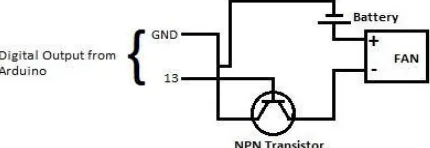
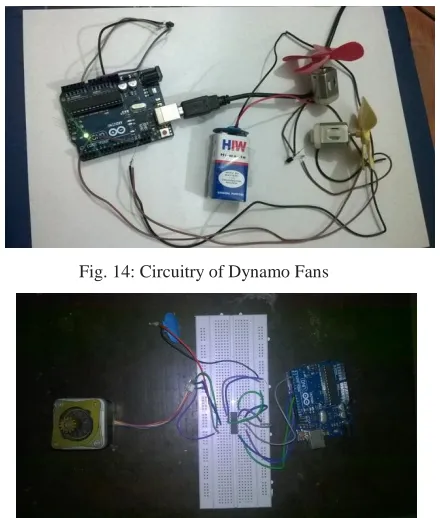
Fan-For the control of the temperature inside the dryer, the dynamo fans are installed in the front of the system. These fans are controlled through the microcontroller as per the data received by the temperature sensor LM35 installed inside the dryer.
The dynamo fans are connected to the microcontroller using a low voltage transistor BC548. This transistor controls the external supply to the dynamo on receiving logical signals at its Base. The dynamo being connected on the collector on receiving logical signal completes the circuit and hence the fan start to run and so is the temperature is controlled inside the dryer.
IV. STRUCTURAL COMPONENTS
A. Insulation-
One of the most important components involved inthe construction and successful working of the solar conduction dryer is the proper insulation of the inner lining i.e. the inner surface of the solar dryer. For this we have planned to use rubber sheets on the under surface of the model. This serves two purposes, one is the insulation of the material and the components due to heat and any type of failure, and second is the shock absorbent property of the rubber. In case solar dryer falls off the base, rubber sheets inside the model helps to protect the dryer from damage
.
Insulator- Rubber
Young’s Modulus of Elasticity 0.01-0.1 GPa Breakdown Temperature 100o-120oC
TABLE 5: DATASHEET OF INSULATION
B.Translucent sheet
For the edible materials like crops, fruits, vegetables, spices, flesh, to dry properly, they must be protected from the harmful rays emitting from the sun. In other words, harmful waves which are of higher frequency and shorter wavelength, eg. Ultraviolet waves, radio waves etc, need to be stopped from touching the edible materials. Longer wavelength i.e. shorter frequency rays like infrared rays are beneficial for the product to dry properly worthy any change in their nutritional values. Thus translucent sheet is necessary. Also translucent sheet has a property that it do not allow the trapped heat to escape from inside, due to which there will be no heat loss.
C. Inner Lining
As we know that black body is a great of heat i.e.once heat got trapped inside a black body, the rate of heat radiation is approx. to negligible. Due to this reason, we have completely painted the inner surface of the solar conduction dryer with black paint. The larger the heat trapped, the more beneficial it will be for the edible material. Thus it is very important to paint each and every surface of the inside model with black paint.
V.THE CIRCUITRY
In the circuit shown below, the components are connected according to the required programmed ports.The stepper motor requires four ports for logical output from the Arduino Uno each for different poles. As out of 14 digital ports, 6 are PWM based, the logical port are selected in such a way that PWM based ports are not selected. Hence, for stepper motor, ports – 2,4,7,8 are selected. The sensor for stepper motor, BPW 34 is connected at analog port A2.
In order to control the dynamo fans, only one digital output port is required per fan to send logical signal. The digital port 13 selected for this purpose. For the functioning of fans, the temperature sensor, LM35 is connected at port A0.
analog port A4. Hence, for complete automation this circuitry provides with effective working of the system.
Fig. 4: Complete circuitry of SCD
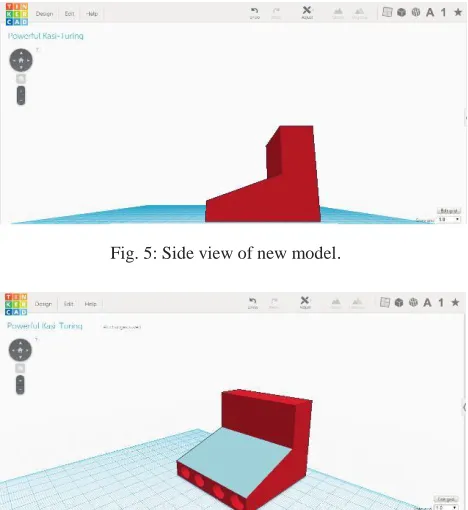
VI. NEW MODEL
Considering the basic model of SCD, there are few modifications in the previous model.
Fig. 5: Side view of new model.
Fig. 6: Isotropic view of new model.
VII. SIMULATION AND ANALYSIS
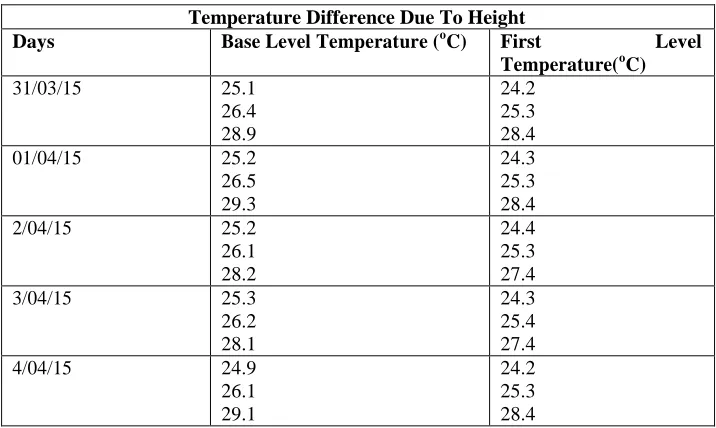
From the basic solar dryer a design innovation is also implemented for dryer multiple food products of different drying temperature in the same unit. The experiment was performed for temperature difference between at the height difference of 1 foot. The analyses is shown as-
Temperature Difference Due To Height
Days Base Level Temperature (oC) First Level Temperature(oC)
31/03/15 25.1
26.4 28.9
24.2 25.3 28.4
01/04/15 25.2
26.5 29.3
24.3 25.3 28.4
2/04/15 25.2
26.1 28.2
24.4 25.3 27.4
3/04/15 25.3
26.2 28.1
24.3 25.4 27.4
4/04/15 24.9
26.1 29.1
24.2 25.3 28.4
TABLE 6: ANALYSIS OF SCD
a.Inner Temperature Range: <35oC
<35oC
b.Outer Temperature Range:
c.Fan Status: I- OFF
II- OFF III- OFF IV- OFF
Fig. 7: Simulation (A)
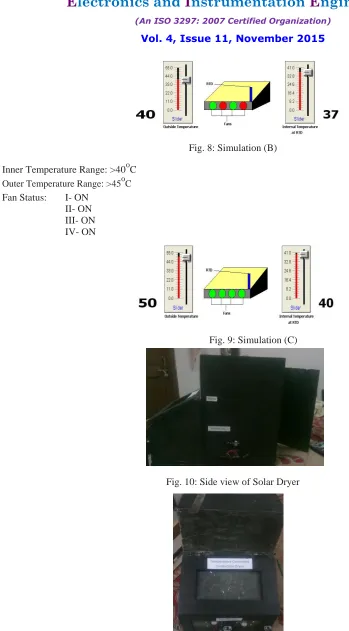
a.Inner Temperature Range: 35oC to 40oC
b.Outer Temperature Range: 35oC to 45oC
c.Fan Status: I- ON
Fig. 8: Simulation (B)
a.Inner Temperature Range: >40oC
b.Outer Temperature Range: >45oC
c.
Fan Status: I- ONII- ON III- ON IV- ON
Fig. 9: Simulation (C)
Fig. 10: Side view of Solar Dryer
Fig. 13: Side View of Solar Dyer with Arduino Uno and BPW34
Fig. 14: Circuitry of Dynamo Fans
Fig. 15: Circuitry of Stepper Motor
VIII.CONCLUSION
performed, the dryer accomplishes the temperature control at desired temperature. And as the result of multi-stacking in the unit, the multi-tasking of the system is also achieved.
REFERENCES
[1] Emad A. Almuhanna, Utilization of a Solar Greenhouse as a Solar Dryer for Drying Dates under the Climatic Conditions of the Eastern Province of Saudi Arabia. Journal of Agricultural Science, Vol. 4, pp. 3, 2012.
[2] R.J. Fuller, Solar Drying- A Technology For Sustainable Agriculture And Food Production. Solar Energy Conversion and Photoenergy
Systems.
[3] Jude O. Ozuomba, Ngozi A. Okonkwo, Bibian C. Uzor and Jude I. Uba, Fabrication and characterization of a direct absorption solar dryer.
Advances in Applied Science Research,Vol.4,pp.3,2012.
[4] D.R. Pangavhane, R.L. Sawhney, Review of research and development work on solar dryers for grape drying, Energy Conversion and
Management ,Vol.43, pp. 45-61,2002.
[5] LM35 Precision Centigrade Temperature Sensors. National Semiconductor
[6] Abdellatif, S.M., Yousef, A.T., Ghada M., & Mosad, A. , Utilization of solar tunnel greenhouse as a solar drier for drying seedless grapes,
Journal of Soil Sciences and Agricultural Engineering,Vol.4, pp.363-377,2010.
[7] Aboul-Enein, S., El-Sebaii, A. A., Ramadan, M. R. I., & El-Gohary, H. G., Parametric study of a solar air heater with and without thermal
storage for solar drying applications. Renewable Energy, Vol.21,pp. 506–22,2010.
[8] Al-Amri A. M. S., Thermal performance tests of solar dryer under hot and humid climatic conditions, AMA, Japan, Vol28(3), pp.56-60,1997.
[9] ASHREA., Handbook Fundamentals, American Society of Heating, Refrigerating and Air conditioning Engineers,2005.
[10] Bargach, M. N., Tadili, R., Dahman, A. S. & Boukallouch, M., Survey of thermal performances of a solar system usedfor heating of agricultural greenhouses in Morocco, Renewable Energy, Vol.20,pp. 415-433,2000.
[11] Dincer, I.,Environmental impacts of energy, Energy Policy, Vol.27(14), pp.845-854,1999.
[12] Duffie, J. A. & Beckman, W. A., Solar engineering of thermal processes. John Wiley and Sons,1991.
[13] Ekechukwu, O. V., & Norton, B., Review of solar-energy drying systems: an overview of solar drying technology, Energy Conversions Manage; Vol.40(6), pp.615–655,1999.
[14] G.F. Barey, A.S. Nadir, M.A. Wafaa and F.M. Elzamazmy, J. Applied Sci. Res, Vol.8(3), pp.1415-1425,2012.
[15] M.S. Dulawat, A.M. Parakhia, B.B. Kunjadia and N.S. Joshi, J. Env. Sci. Com. Sci. Eng. & Tech., Vol.1, pp.1-4,2012.
[16] A. Esper and W. Muhlbauer, Plant Res. and Development,Vol.44,Issue 4, pp.16,1996.
[17] J.A. Hernandez, G. Pavon and M.A. Garcia, Journal of Food Engineering, Vol.45, Issue 1, pp.1-10,2000.
[18] M.S. Sevda, N.S. Rathore and P. Singh, Journal of Agricultural Engineering,Vol. 41,pp. 3,2004.
[19] A.P. Vega, P. Fito, A. Andres and R. Lemus, Journal of Food Engineering, Vol.79, pp.1460-1466,2007.
[20] F. Kaymak-Ertekin, J. Food Sci.,Vol 67,Issue 1, pp.168-175,2002.