LIGHT SCATTERING BY LARGE HEXAGONAL COLUMN WITH MULTIPLE DENSELY PACKED INCLUSIONS
X. M. Sun and H. X. Ha
School of Electrical and Electronic Engineering Shandong University of Technology
ZiBo, Shandong 255049, China
Abstract—The scattering of visible light by hexagonal-shaped column containing densely packed inclusions is simulated by a combination of ray-tracing and Monte Carlo techniques. While the ray tracing program takes care of the individual reflection and refraction events at the outer boundary of the particle, the Monte Carlo routine simulates internal scattering processes. A dense-medium light-scattering theory based on the introduction of the static structure factor is used to calculate the phase function for densely packed inclusions. Numerical results of the phase function for a randomly oriented hexagonal-shaped ice crystal with multiple densely packed inclusions are evaluated.
1. INTRODUCTION
particles imbedded in ice crystals could potentially reduce the cloud albedo, thereby causing a significant indirect forcing of climate. Some researchers [12] even think it can be used to interpret the cloud absorption anomaly.
Macke [13] has studied light scattering by ice particles with multiple distinct inclusions. He assumed that the inclusions are randomly and sparsely distributed, so the multiple scattering of the inclusions is based on the independently scattering theory. However, when the density of the internal scatterers reach a limit, the spatial correlation among densely packed inclusions can substantially change their single scattering properties (such as optical cross sections and phase function [14]), thus making questionable the applicability of the independent scattering approximation in calculation of light scattering by multiple inclusions.
In this paper, we studied how the phase function is changed with the compaction state of scattering particles at first. In our calcu-lations, we use a dense-medium light-scattering theory based on in-troducing the so-called static structure factor. The main formula and
Figure 1. Sketch map of light scattering by a hexagonal-shaped ice column with multiple densely packed inclusions.
numerical results of this theory are given in the following section. Then, we present the theoretical procedure for the determination of the single scattering properties by combining ray-tracing and Monte Carlo tech-niques, and numerical results for the light scattering by a hexagonal-shaped ice column with multiple densely packed inclusions (Fig. 1) are given. The results of the paper are summa-rized in the concluding section.
2. SINGLE SCATTERING CHARACTERISTICS OF DENSELY PACKED INCLUSIONS
For sparsely distributed, independently scattering particles, the phase function is given by [15]
P(θ) = 4π Csca
dCsca
dΩ (1)
where θ is the scattering angle and dCsca/dΩ is the differential
scattering cross section [15] and Csca=
4π
dΩdCsca
is the total scattering cross section.
Densely packed particles are not independent scatterers. There-fore, the concept of the single-scattering phase function can not be used in the same sense as it is used in computations of light scattering by sparsely distributed particles. However, the concept of the single-scattering phase function can still be used with some modification to calculate the intensity of light singly scattered by a layer densely packed particles [14, 16]. The differential scattering cross section is equal to the product of the independent-scattering differential cross section and so-called static structure factorS(θ). Thus, instead of Eqs. (1)–(2), we have for densely packed particles
P(θ) = 4π Csca
dCsca
dΩ S(θ) (3)
Csca =
4π
dΩdCsca
dΩ S(θ) (4)
Note that the theory based on the introduction of the static structure factor has a rather strong physical background and is based on solving Maxwell’s equations for calculating light scattering and on statistical mechanics for describing the statistics of mutual positions of densely packed particles [16, 17]. The problem of computing the static structure factor for arbitrary particle size distribution and shape is extremely difficult, so we used two usual approximations which have been used by Mishchenko [14]. From the approximation, we assume scattering particles to be nearly spherically shaped and nearly monodisperse (the range of sizes is narrow compared with the mean particles size). The structure factor in the Percus-Yevick approximation is given by [18]
S(θ) = 1
1−nC(p) (5)
where
p= [4πsin(θ/2)]/λ (6) nis the number density of scattering particles,λis wavelength of light, and C(p) is given by
C(p) = 24f n
α+β+δ
u2 cosu−
α+β+ 4δ
u3 sinu−
2(β+ 6δ) u4
+ 2β u4 +
24δ
u5 sinu+
24δ
u6 (cosu−1)
p= 0 (7)
and
C(0) =−24f n
α 3 +
β 4 +
δ 6
where
u = 2pr0 (9)
α = (1 + 2f)
2
(1−f)4 (10)
β = −6f(1 +f /2)
2
(1−f)4 (11)
δ = αf /2 (12)
where f = 4/3πnr03 is the filling factor (i.e., the fraction of a volume occupied by he particles). Note that for sparsely distributed particles (n= 0), the structure factor is identically equal to unity [14].
An interesting question is whether the modified dense-medium phase function given by Eq. (3) can be used to calculate the multiple-scattering contribution to the reflected intensity of densely packed particles. It has been shown in [14] that it can be used to compute the full intensity for nonabsorbing or moderately absorbing particles. So the phase function can be used in our Monte Carlo simulations of the light scattering by inclusions.
In our study, the internal scatterers are considered to be ammonium sulfate aerosols ((NH4)2SO4), which is a naturally
occurring aerosol type. The shape of the particles is assumed to be spherical, and the mean radius of the inclusions is assumed to be 0.5µm. Mie theory is used to obtain the optical properties of the internal scatterers. It is well known that monodisperse Mie quantities as a function of size parameter contain a high frequency ripple which is usually suppressed in practice because, in nature, there is always
0 20 40 60 80 100 120 140 160 180 0
5 10 15 20 25 30
P
h
ase function
θ
f=0 f=0.1 f=0.3 f=0.5 f=0.7
a dispersion of grain sizes [15]. Therefore, following Wiscombe and Warren [19], we reduced the ripple by averaging the phase function over a range of sizes which was small relative to the mean grain size. The relative refractive indices of (NH4)2SO4 to ice is taken to be 1.15
[14].
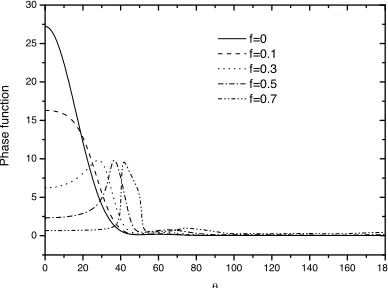
Our calculations were performed at a wavelength ofλ= 0.55µm, i.e. at the maximum of the solar irradiation. We compared the phase functions of densely packed internal scatterers and sparsely distributed ones in Fig. 2. The phase function is shown as a function of the scattering angle θ for five values of the filling factor. It is seen that increasing packing densely results in an angular redistribution of the scattered intensity. The influence of packing density is especially significant at scattering angles θ < 50◦. This agrees well with the conclusion of Mishchenko’s [14].
3. TOTAL SCATTERING SIMULATIONS WITH THE RAY-TRACING AND MONTE CARLO MODEL
The total scattering of light ray by a hexagonal ice column containing densely packed spherical inclusions is calculated by a combination of ray tracing and Monte Carlo techniques [13]. The ray tracing programs takes care of the reflection and refraction events, and the Monte Carlo methods do with the internal scattering processes.
After an incident photon is refracted into the crystal, it travels a free path lengthl given by
l=− llog[R(0,1)] (13) where l is the mean free path length between two subsequent scattering events andR(0,1) is an equally distributed random number within the interval (0,1). The number density of the inclusion n is described by the mean free path lengthlor by the volume extinction coefficient βx = 1/l. For an ensemble of N particles per volume
element whose size obey a standard gamma distribution, βx is given
by
βx=n r2
r1
βx(r)n(r)dr (14)
wheren(r) is the normalized particle size distribution function. In this paper, we choosen(r) to be equally distributed.
If the photon has not reached one of the boundaries of the medium, its previous direction is changed along the scattering angle and azimuth angle according to
θ
0
P(i)sinθdθ = R(0,1)
π
0
φ = R(0,2π) (16) where P(i)(θ) denotes the scattering phase function of the internal inclusions. The processes stated in (14) and (15) are repeated until the photon enters one of the crystal facets, where it is again subject to reflection and refraction events. The whole procedure is again repeated for internally reflected component until the photon energy falls below 10−15 times the incident energy.
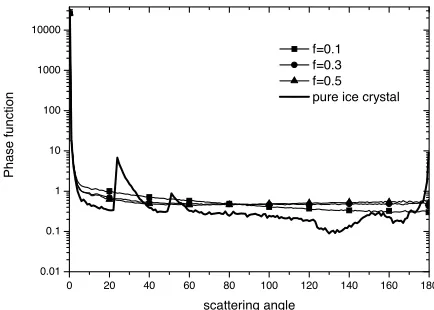
The effects of internal inclusions are studied for one hexagonal-shaped ice column, defined by a length to diameter ratio of 100µm/50µm. Fig. 3 present results of the total phase function for a random oriented ice crystal containing densely packed inclusions. Results are shown for the filling factorf = 0.1,0.3,0.5, for comparison, the phase function of pure ice crystal is also shown. It is seen from Fig. 3 that for pure ice crystal, dominant features of the phase function are enhanced scattering at angles of 22◦ and 46◦, corresponding to the so-called halos. With increasing the filling factor f, the intensity of the halos and the backscattering maximum are reduced, and the phase functions tend to more and more homogeneous except the diffraction region. These results come from the effects of the internal impurities. A photon will suffer much more scattering by the inclusions, so the scattering intensity will be homogeneous distributed in the inner of the ice crystal. The difference of the total phase function is relatively small from 0◦to 5◦, this is because that this energy comes mostly from the contribution of diffraction.
0 20 40 60 80 100 120 140 160 180 0.01
0.1 1 10 100 1000 10000
Phase funct
io
n
scattering angle f=0.1 f=0.3 f=0.5 pure ice crystal
4. CONCLUSION
In this paper, we used a combination of ray-tracing and Monte Carlo techniques to compute the single scattering phase function for a randomly oriented hexagonal ice column containing densely packed ammonium sulfate inclusions. A dense-medium light scattering theory based on introducing the static structure factor was used to consider the spatial correlation among densely packed particles, and the single scattering properties of the inclusions were calculated. A ray tracing program takes care of the individual reflection and refraction events at the outer boundary of the particle. Our calculations show that the effects of the internal impurities on the total scattering phase function is great. The total scattering phase function was smoothed relative to the pure ice crystal. This is because that a photon will suffer much more scattering by the inclusions, the scattering intensity will be homogeneous distributed in the inner of the ice crystal.
REFERENCES
1. Sun, X., Y. Han, and H.-H. Wang, “Near-infrared light scattering by ice-water mixed clouds,” Progress In Electromagnetics Research, PIER 61, 133–142, 2006.
2. Li, L. W., Y. Dan, M.-S. Leong, T.-S. Yeo, and J. A. Kong, “Plane wave scattering by an achiral multilayered sphere in an infinitely extended chiral host medium,” Progress In Electromagnetics Research, PIER 33, 261–298, 2001.
3. Li, L. W., Y. Dan, M. S. Leong, and J. A. Kong, “Electromagnetic scattering by an inhomogeneous chiral sphere of varying permittivity: A discrete analysis using multilayered model,” Progress In Electromagnetics Research, PIER 23, 239–263, 1999. 4. Censor, D., “Non-relativistic scattering in the presence of moving
objects: The Mie problem for a moving sphere,” Progress In Electromagnetics Research, PIER 46, 1–32, 2004.
5. Sun, X. M., X. W. Shi, and Y. P. Han, “Reflection of polarized light in ice-water mixed clouds,” Journal of Electromagnetic Waves and Applications, Vol. 20, No. 12, 1655–1665, 2006. 6. Zhang, Y. J. and E. P. Li, “Fast multipole accelerated scattering
7. Li, Y.-L., J. Y. Huang, M. J. Wang, and J. Zhang, “Scattering field for the ellipsoidal targets irradiated by an electromagnetic wave with arbitrary polarizing and propagating direction,”Progress In Electromagnetics Research Letters, Vol. 1, 221–235, 2008.
8. Takano, Y. and K. N. Liou, “Radiative transfer in cirrus clouds. Part III: Light scattering by irregular ice crystals,”J. Atmos. Sci., Vol. 52, 818–837, 1995.
9. Sassen, K., O. D. Starr, Mace, G. G. Poellot, et al., “The 5– 6 December 1991 FURE IFO II jet stream cirrus case study: Possoble influence of volcanic aerosols,” J. Atmos. Sci., Vol. 52, 92–123, 1994.
10. Raes, F., J. Wilson, and R. Van Dingenen, “Aerosol dynamics and its implications for the global aerosol climatology,”in Aerosol Forcing of Climate, R. Charlson and J. Heintzenberg (eds.), 153– 169, John Wiley & Sons, 1995.
11. Xu, Y. X., J. Y. Huang, and Y. L. Li, “The effect of attenuation induced by sand and dust storms on Ka-band electromagnetic wave propagation along earth-space paths,” Int. J. Infrared and Milli. Waves., Vol. 23, No. 11, 1677–1682, 2002.
12. Chen, H. B. and H. B. Sun, “On the anomalous absorption of solar radiation by water clouds and by the cloudy atmosphere,” J. Atmos. Sci., Vol. 21, 750–757, 1997 (in Chinese).
13. Macke, A., M. I. Mishchenko, and B. Cairns, “The influence of inclusions on light scattering by large ice particles,” J. Geophys. Res., Vol. 101, 23311–23316, 1996.
14. Mishchenko, M. I., “Asymmetry parameters of the phase function for densely packed scattering grains,”J. Quant. Spectrosc. Radiat. Transfer, Vol. 53, 95–110, 1994.
15. Bohren, C. F. and D. R. Huffman, Absorption and Scattering of Light by Small Particles, Wiley Press, New York, 1983.
16. Twersky, V., “Multiple scattering of waves and optical phenomena,”J. Opt. Soc. Am., Vol. 52, 145–171, 1962.
17. Tsang, L. and J. A. Kong, “Scattering of electromagnetic waves from a half space of densely distributed scatterers,” Radio. Sci., Vol. 18, No. 6, 1260–1272, 1983.
18. Balescu, R.,Equillibrium and Nonequilibrium Statistical Mechan-ics, Wiley Press, New York, 1975.