ISSN (Print) : 2320 – 3765 ISSN (Online): 2278 – 8875
I
nternational
J
ournal of
A
dvanced
R
esearch in
E
lectrical,
E
lectronics and
I
nstrumentation
E
ngineering
(A High Impact Factor, Monthly, Peer Reviewed Journal)
Website: www.ijareeie.com
Vol. 7, Issue 5, May 2018
Wireless Controlled Multipurpose
Agricultural Robot
Shubham Dhage1,Pradip Patil2, Data Kande3, Dr. Prakash Patil4
Assistant Professor, Dept. of E&TC, DYPCOE, Ambi, Pune, India4
Dept. of E&TC, DYPCOE, Ambi, Pune, India123
ABSTRACT : The paper aims on the design, development and the fabrication of the robot which can dig the soil, put the seeds, leveler to close the mud and sprayer to spray water ,these whole systems of the robot works with the battery and the solar power. More than 40% of the population in the world chooses agriculture as the primary occupation, in recent years the development of the autonomous vehicles in the agriculture has experienced increased interest. The vehicle is controlled by Relay switch through Bluetooth technology using mobile The idea of applying robotics technology in agriculture is very new. In agriculture, the opportunities for robot-enhanced productivity are immense - and the robots are appearing on farms in various guises and in increasing numbers. We can expect the robots performing agricultural operations autonomously such as ploughing, seed sowing, mud closing and water spraying.
KEYWORDS: ATMEGA16 Microcontroller, L293D, Relay, Battery, RF Module, LCD, Motors, LED, Solar panel.
I. INTRODUCTION
This project work described here is quite useful in the agricultural fields. The project aims on the design Agricultural Robot for Spraying water, seeding, Mulching and cutting operation”. More than 42% of the total population in the world has chosen agriculture as their primary occupation. In recent years, the development of autonomous vehicles in agriculture has experienced increased interest.
This development has led many researchers to start developing more rational and adaptable vehicles. In the field of agricultural autonomous vehicles, a concept is being developed to investigate if multiple small autonomous machines would be more efficient than traditional large tractors and human force.
These vehicles should be capable of working 24 hours a day all year round, in most weather conditions and have the intelligence embedded within them to behave sensibly in a semi-natural environment over long periods of time, unattended, while carrying out a useful task. There are a number of field operations that can be executed by autonomous vehicles, giving more benefits than conventional machines.
The idea of applying robotics technology in agriculture is very new. In agriculture, the opportunities for robot-enhanced productivity are immense - and the robots are appearing on farms in various guises and in increasing numbers. We can expect the robots performing agricultural operations autonomously such as ploughing, seed sowing, mud closing and water spraying. Watching the farms day & night for an effective report, allowing farmers to reduce the environmental impact, increase precision and efficiency, and manage individual plants in novel ways.
The applications of instrumental robotics are spreading every day to cover further domains, as the opportunity of replacing human operators provides effective solutions with return on investment. This is specially important when the duties, that need be performed, are potentially harmful for the safety or the health of the workers, or when more conservative issues are granted by robotics. Heavy chemicals or drugs dispensers, manure or fertilizers spreaders, etc. are activities more and more concerned by the deployment of unmanned options.
II. PROPOSED SYSTEM
ISSN (Print) : 2320 – 3765 ISSN (Online): 2278 – 8875
I
nternational
J
ournal of
A
dvanced
R
esearch in
E
lectrical,
E
lectronics and
I
nstrumentation
E
ngineering
(A High Impact Factor, Monthly, Peer Reviewed Journal)
Website: www.ijareeie.com
Vol. 7, Issue 5, May 2018
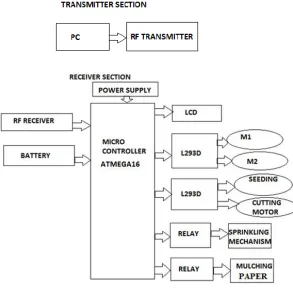
section, first is embedded section second is battery section and last one is water tank. A portable PC or smartphone, motor controllers and other control components are placed in the front cabin and a camera is fixed in front of it for capturing the front images. The rear cabin can be used for storage boxes to store some materials such as seeds, water and fertilizers. The driving devices include DC motors and wheels. According to the needs of operations and control, the driven method of the platform can be chosen.
Fig. 1: Block diagram of Proposed System
2.1 Elements of block diagram are as follows: 1 Grass cutting operation:
A grass cutter is a machine utilizing one or more revolving blades to cut a grass surface to an even height. The height of the cut grass may be fixed by the design of the mower, but generally is adjustable by the operator, typically by a single master lever, or by a lever or nut and bolt on each of the machine's wheels. The blades may be powered by muscle, with wheels mechanically connected to the cutting blades so that when the mower is pushed forward, the blades spin, or the machine may have a battery-powered or plug-in DC motor.
2 Seed sowing operation:
ISSN (Print) : 2320 – 3765 ISSN (Online): 2278 – 8875
I
nternational
J
ournal of
A
dvanced
R
esearch in
E
lectrical,
E
lectronics and
I
nstrumentation
E
ngineering
(A High Impact Factor, Monthly, Peer Reviewed Journal)
Website: www.ijareeie.com
Vol. 7, Issue 5, May 2018
3 Mud closing and leveling operation:
A Sheet metal Plate is used as mud closer and leveler. The sliding mechanism is used for leveler up & down movement. The Leveler is powered by a DC motor which is regulated by Relay switch and controlled by a remote controller. As the leveling plate moves downward to the ground level, the mud is closed in the sowed soil.
4 Cultivating operation:
A DC Motor coupled with the screw rod is used. The power for motor is regulated by relay switch. The screw rod rotates and the nut welded to the cultivator slides between the screws of the screw rod.
As the cultivator is lowered down, soil is digged up to 1.5 inches. The direction of motor rotation can be controlled by remote controller for up and down movement of the cultivator.
5 Water spraying operation:
A water container is used for water storage. A water pump is used for pumping water to the water sprayer. The water flows to the sprayer through pipe. The power for pump is regulated by a toggle switch
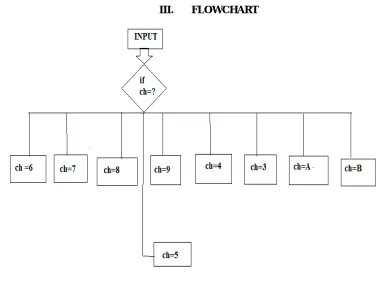
III. FLOWCHART
ISSN (Print) : 2320 – 3765 ISSN (Online): 2278 – 8875
I
nternational
J
ournal of
A
dvanced
R
esearch in
E
lectrical,
E
lectronics and
I
nstrumentation
E
ngineering
(A High Impact Factor, Monthly, Peer Reviewed Journal)
Website: www.ijareeie.com
Vol. 7, Issue 5, May 2018
IV. RESULT
4.1 Simulation result:
Fig.4.1 Simulation result
4.2 Hardware result:
Fig.4.2 Hardware result
V. ADVANTAGES
Reduce the workload on the farmer and as it is easier to operate.
The former need not spry in the hot sun, he can operate the device while standing in a cooler place.
By the development of these robots lot of manual labour will also be decreased and the farmer life will save from chemicals
VI. APPLICATIONS
ISSN (Print) : 2320 – 3765 ISSN (Online): 2278 – 8875
I
nternational
J
ournal of
A
dvanced
R
esearch in
E
lectrical,
E
lectronics and
I
nstrumentation
E
ngineering
(A High Impact Factor, Monthly, Peer Reviewed Journal)
Website: www.ijareeie.com
Vol. 7, Issue 5, May 2018
Multipurpose agriculture robot use in grass cutting in play grounds(cricket, football), For house garden, for small farms, for nursaries.
VII. CONCLUSION
The robot for agricultural purpose an robot is a concept for the near the performance and cost of the product once optimized, will prove to be work through in the agricultural spraying operations. We have been successful in developing a robot whose construction is enough to withstand the challenges of the field. We are sure that once this concept is presented in a manner suitable to Indian market, it will differently help in bringing down the 15% molality rate found in the Indian formers associated with the agricultural spraying operation
REFERENCES
Journal/Article/Paper:
[1] Prof. D.A. Mada, Sunday Mahai, “The Role of Agricultural Mechanization in the Economic Development for Small Scale Farms In Adamawa State” international journal of engineering and science (IJEC) in Agricultural Engineering & TechnologyISSN (e): 2319 – 1813 ISSN (p): 2319 – 1805 Volume 2 Issue 11, 2013 PP. 91-96
[2] V.K. Tewari, A. Ashok Kumar, Satya Prakash Kumar, Brajesh Nare “Farm mechanization status of West Bengal in India” Basic Research Journal of Agricultural Science. ISSN No- 2315-6880 PP. 139-146
[3] Kshirsagar Prashant R, Kuldip Ghotane, Pritesh Kadam, Omkar Arekar, “Modelling and Analysis of Multifunctional Agricultural Vehicle” International Journal of Research in Advent Technology (IJRAT) E-ISSN: 2321-9637, Volume 4, No.1, January 2016,
[4] P. Šařec, O. Šařec “Employment characteristics of tine cultivators at deeper soil loosening” Department of Machinery Utilization, Faculty
of Engineering, Czech University of Life Sciences Prague, Prague, Czech Republic Volume 61, issue 2015 Eng. doi: 10.17221/72/2014-RAE PP. 80-86
Book:
[1] S.R DEB, “Robotics technology and flexible automation”. [2] P.N Rao and N K TEWARI, “Computer aided manufacturing”. [3] Mikell P Groover, “Industrial Robotics”.
[4] W Bolton 2No edition “Mechatronics”.
Websites:
[1] https://ieeeprojects.com
[2] https://www.engineersgarage.com
[3] http://www.agrobot.es
[4] http://www.roboticharvesting.com