Scholarship@Western
Scholarship@Western
Electronic Thesis and Dissertation Repository
7-30-2014 12:00 AM
Statistical Summaries in Action: Evidence from the Antisaccade
Statistical Summaries in Action: Evidence from the Antisaccade
Task
Task
Caitlin Gillen
The University of Western Ontario Supervisor
Dr. Matthew Heath
The University of Western Ontario Graduate Program in Kinesiology
A thesis submitted in partial fulfillment of the requirements for the degree in Master of Science © Caitlin Gillen 2014
Follow this and additional works at: https://ir.lib.uwo.ca/etd
Part of the Motor Control Commons, and the Other Neuroscience and Neurobiology Commons
Recommended Citation Recommended Citation
Gillen, Caitlin, "Statistical Summaries in Action: Evidence from the Antisaccade Task" (2014). Electronic Thesis and Dissertation Repository. 2346.
https://ir.lib.uwo.ca/etd/2346
This Dissertation/Thesis is brought to you for free and open access by Scholarship@Western. It has been accepted for inclusion in Electronic Thesis and Dissertation Repository by an authorized administrator of
STATISTICAL SUMMARIES IN ACTION: EVIDENCE FROM THE ANTISACCADE TASK
(Thesis format: Integrated Article)
by
Caitlin Gillen
Graduate Program in Kinesiology
A thesis submitted in partial fulfillment of the requirements for the degree of
Masters of Science in Kinesiology
The School of Graduate and Postdoctoral Studies The University of Western Ontario
London, Ontario, Canada
ii
Abstract
Antisaccades require the top-down process of decoupling a stimulus and a response and
executing a saccade mirror-symmetrical to a target. Notably, research has yet to characterize the
endpoint properties of antisaccades. Experiment One had participants antisaccade in two trial
blocks that contained the same number of target eccentricities but differed in respect to their
magnitudes. Experiment Two manipulated the frequency that individual target eccentricities
were presented within a block of trials. Notably, Experiments One and Two were designed to
determine whether the top-down control of antisaccades renders the processing of target features
via a strategy of perceptual averaging. Results showed that antisaccades endpoints were biased
in the direction of the central target (i.e., the statistical summary) within a block of trials
(Experiment One), and in the direction of the most frequently presented target (Experiment
Two). Therefore, I propose that antisaccade endpoints are mediated via a perceptual averaging
strategy.
iii
Co-Authorship
The author, under the supervision and mentorship of Dr. Matthew Heath, conducted the
work in this master's thesis. Dr. Matthew Heath provided valued guidance in the experimental
design, data- collection, analysis, and interpretation, and manuscript preparation. This master's
thesis contains material from a published manuscript (Experiment One) as well as submitted
manuscript (Experiment Two). On both manuscripts, Caitlin Gillen was the first author and
Matthew Heath served as co-author. Additionally, content in the General Introduction and
General Discussion contains similar content from the Introductions and Discussions of
iv
Acknowledgments
It is my pleasure to thank the individuals and funding agencies that have made my
research possible. My research was supported by Western Graduate Research Awards from The
University of Western Ontario, as well as an Ontario Graduate Scholarship. I would like to
extend a warm thank-you to each and everyone one who participated in my experiments; your
commitment and patience during data collection is greatly appreciated.
I would like to provide a special thank-you to my graduate advisor, Dr. Matthew Heath,
who demonstrates strengths in every aspect of academia. He is a talented teacher and was
crucial to my development as a writer and researcher. He is passionate and supportive and
provides guidance and encouragement for all future endeavors. Dr. Heath provided mentorship
and support throughout my graduate degree, and I am sincerely grateful for his commitment and
dedication to my work throughout my time as a graduate student.
I would also like to thank my friends and family for their unwavering support throughout
the years. Your support always served as encouragement to continue through the obstacles that
are encountered with research. I would especially like to thank my mother, Cindy Gillen. She
always showed love and support in every aspect of my life. She believes that I can achieve and
be successful in whatever I choose and she has supported me throughout every decision I have
v
Table of Contents
CERTIFICATE OF EXAMINATION ... ii
Abstract ... iii
Co-Authorship... iv
Acknowledgements ... v
Table of Contents ... vi
List of Tables ... vii
List of Figures ... viii
List of Appendices ... ix
General Introduction ... 1
Experiment 1 ... 6
Introduction ... 6
Methods ... 10
Results ... 13
Discussion ... 22
Experiment 2 ... 28
Introduction ... 28
Methods ... 32
Results ... 36
Discussion ... 44
General Discussion ... 49
General Conclusions ... 52
References ... 53
Appendix A ... 60
vi
List of Tables
Table 1: Mean saccade amplitude for pro- and antisaccades as a function of target eccentricity in
proximal and distal blocks and t-ratios and associated p-values are presented for paired-sample
contrasts of pro- and antisaccades at each target eccentricity for Experiment One... 16
Table 2. Correlation coefficients (R) and p-values for the relationship between reaction time and
saccade amplitude for pro- and antisaccades as a function of each target eccentricity in the
proximal and distal blocks for Experiment One ... 21
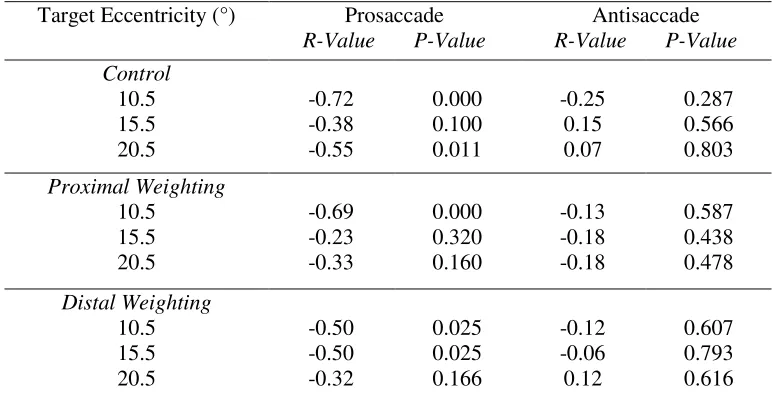
Table 3. Correlation coefficients (R) and p-values for the relationship between RT and saccade
amplitude in the control, proximal- and distal-weighting conditions for both pro- and
vii
List of Figures
Figure 1. Mean saccade amplitude for pro- and antisaccade amplitudes presented as a function
of target eccentricity for both the proximal and distal blocks for Experiment One ... 15
Figure 2. Pro- and antisaccade amplitude difference scores (°) as a function of target eccentricity
for proximal and distal blocks for Experiment One... 18
Figure 3. Mean pro- and antisaccade reaction times (ms) for proximal and distal blocks as a
function of target eccentricity for Experiment One. ... 20
Figure 4. Mean pro-and antisaccade amplitudes (°) as a function of weighting condition and
target eccentricity and their respective linear regression equations for Experiment Two. ... 37
Figure 5. Mean target eccentricity-specific differences scores (°: amplitude minus veridical
target location) for pro- and antisaccades. Also depicted are weighting-condition specific
difference scores computed separately for pro- and antisaccades for Experiment Two ... 38
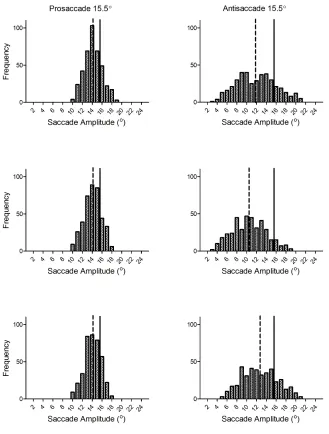
Figure 6. Frequency histograms for pro- and antisaccade amplitudes for the middle target (i.e.,
15.5°) eccentricity for each condition for Experiment Two. ... 40
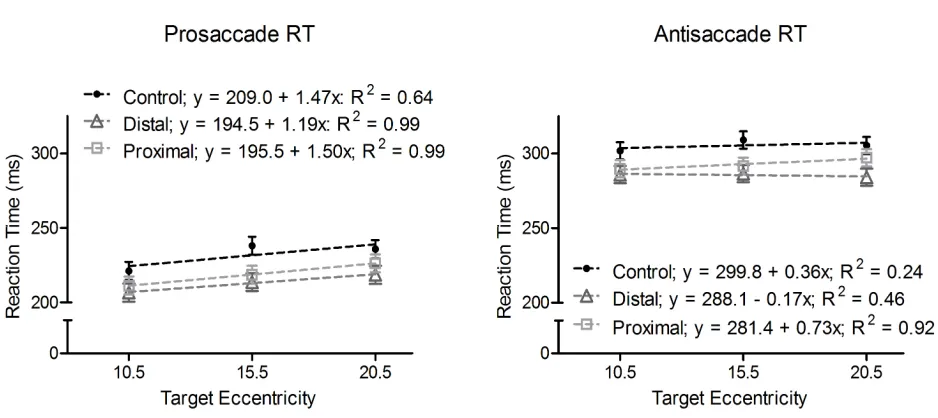
Figure 7. Mean pro-and antisaccade reaction times (ms) as a function of weighting-condition and
viii
List of Appendices
General Introduction
Everyday humans make up to 100,000 voluntary eye movements that bring a target of
interest into central vision (i.e., prosaccade) (Irwin and Carlson-Radvansky, 1996). Prosaccades
are highly effective (i.e., accurate) and efficient (i.e., fast) movements mediated via absolute
visual information in the retinotopic maps of the superior colliculus (Wurtz and Albano, 1980)
and are executed largely independent of top-down processes (Dafoe et al., 2007). For example,
the presentation of a peripheral target (e.g., 20°) activates neurons in the caudal region of the
colliculus, whereas a more central target (e.g., 3°) activates neurons in the rostral region (Munoz
and Wurtz, 1995). Notably, and although prosaccades are mediated via direct and absolute
visual information, they are characterized by an undershooting bias such that primary
prosaccades cover only 90% of veridical target amplitude (Abrams et al., 1989; Becker and
Fuchs, 1969; Gerardin et al., 2011; Gillen et al., 2013; Weber and Daroff, 1972;). Moreover, the
undershooting bias characterizes not only primary saccades but also secondary (i.e., corrective)
saccades and increases as a function of increasing target eccentricity (Abrams et al., 1989;
Gerardin et al., 2011). The basis for the undershooting bias has been linked to an invariant
control strategy that is designed to minimize saccade flight time (Harris, 1995) and/or the energy
requirements of the response (Becker, 1989; see also Oliveiria et al., 2005).
Although prosaccades predominant our day-to-day lives, individuals can volitionally
decouple the spatial relations between a stimulus and a response and saccade in a direction other
than a target stimulus (i.e., non-standard task). The study of non-standard tasks represents an
important area of inquiry because if provides a framework by which to investigate how top-down
cognitive control influences the oculomotor system. The most frequently examined non-standard
to a target. Extensive work has shown that antisaccades produce longer reaction times (RTs) and
more directional errors than their prosaccades counterparts (Hallet, 1978; Fischer and Weber,
1992). The aforementioned antisaccade behavioural ‘costs’ have been linked to the top-down
and two-component processes of inhibiting a stimulus-driven prosaccade (i.e., response
suppression) and inverting a target’s spatial coordinates (180° sensory transformation) to a
mirror-symmetrical location (for review see Munoz and Everling, 2004). More specifically,
neuroimaging and electrophysiology evidence in humans and non-human primates has linked the
evocation of an antisaccade to an increased activation of the classic saccade networks (i.e.,
frontal and supplementary eye fields, and lateral interpatietal area) and a respective increase and
decrease in the activity of collicular fixation and burst neurons (Munoz and Everling, 2004;
Munoz and Wurtz, 1993; Zhang and Barash, 2000).
As mentioned above, the two-component process of antisaccades results in longer RTs
than their prosaccade counterparts. Moreover, it is not surprising that antisaccade endpoints
differ from prosaccades. Indeed, instead of relying on a direct retinotopic mapping between
stimulus and response the top-down nature of antisaccades requires that participants evoke their
response based on a relative and perceived target location (i.e., a visual percept). Consequently,
antisaccades exhibit an eccentricity-specific endpoint bias and increased variability relative to
prosaccades (Amador et al., 1998; Bell et al., 2000; Dafoe et al., 2007; Evdokimidis et al., 2006;
Heath et al., 2010; Heath et al., 2011; Krappmann et al., 1998; Weiler and Heath, 2012). For
example, Evdokimidis et al. (2006) and Dafoe et al. (2007) employed a block of target
eccentricities that ranged from 0.5°-10.0°. Both studies reported a respective over- and
undershooting bias for the 'proximal' and 'distal' targets. In accounting for this finding,
sensorimotor transformations is governed by a range effect (Poulton 1981; see also Kapoula,
1985).
The oculmotor range effect hypothesis asserts that participants can be made to over- and
undershoot the proximal and distal targets contained within a stimulus-set (Kapoula 1985; see
also Kapoula and Robinson 1986). For example, Kapoula had participants execute prosaccades
in two blocks that included the same number of eccentricities but differed with regard to their
magnitudes. In the first block, Kapoula (1985) employed eccentricities of 2.7°, 4.4°, 6.1°, 7.8°,
and 9.5° (i.e., proximal block) and in the second block eccentricities were 7°, 10.9°, 14.7°, 18.3°,
and 21.9° (i.e., distal block). Kapoula reported an undershooting bias for the more ‘distal’ (i.e.,
7.8° and 9.5°) targets in the proximal block, whereas the ‘proximal’ targets (i.e., 7.0° and 10.9°)
in the distal block produced an overshooting bias. As such, Kapoula proposed that the
oculomotor system can be made to respectively under- or overestimate the ‘distal’ and
‘proximal’ targets contained within a stimulus-set. Notably, however, subsequent work (Gillen
et al., 2013) using a methodology similar to Kapoula's found that: (1) prosaccades undershot
veridical target location independent of the range and magnitude of the target eccentricities from
within the block of trials in which they were performed, and (2) eccentricities common to each
block elicited a reliable undershooting bias. What is more important, Kapoula employed a small
sample size of four and two participants for the proximal and distal blocks, respectively, and a(n)
(re)examination of the participant-specific data reported by Kapoula (1985: see Table 1 of that
work) revealed no statistical evidence for a range effect in prosaccade amplitudes (see Gillen et
al. 2013). Thus, Kapoula’s work does not support a range effect for prosaccade endpoints and
therefore does not provide a viable framework for understanding the endpoint properties of
As an alternative to the range effect, my thesis proposes that the visual percept governing
antisaccades renders the processing of perceived target location, in part, via a statistical summary
of the individual target eccentricities included within a stimulus-set. Such a proposal is drawn
from the perceptual averaging literature and the contention that top-down and obligatory
judgments associated with the properties (e.g., size, extent, brightness, loudness) of a range of
target stimuli are based on an averaged approximation of all the stimuli within a set (Albrecht et
al., 2012; Ariely, 2001; Chong and Treisman, 2003; Corett and Oriet, 2011; Davarpanah Jazi and
Heath, 2014). For example, Ariely (2001) showed that participants were able to accurately judge
the average circle size of an array of circles with varying diameters; however, the same
participants were unable to reliably identify an individual circle contained within the set (see also
Chong and Treisman, 2003). Similarly, Corbett and Oriet (2011) presented participants with a
sequence of circles with varying diameters. Following the sequence, participants were shown a
test circle in which they had to identify it as a set-member, distinct member (i.e., largest circle)
or as representing the mean diameter of all circles. Corbett and Oriet demonstrated that
participants were better able to identify the test circle as representing the mean diameter in a
stimulus-set. Further, Albrecht et al. (2012) reported that participants were able to report the
average pitch associated with a series of auditory tones without being able to reliably report
whether an individual tone was a member of a stimulus-set. Thus, a direct corollary from the
perceptual averaging literature is the top-down control of antisaccades is based, in part, by a
statistical summary and that such a summary influences the visual percept supporting antisaccade
endpoints (i.e., the perceptual averaging hypothesis).
The goal of my thesis project was to examine whether antisaccade endpoints are
that objective, Experiment One adopted a paradigm similar to that originally developed by
Kapoula (1985; see also Gillen et al. 2013) in which participants completed antisaccades – and
complimentary prosaccades - in separate blocks (i.e., proximal and distal) that included an equal
number of targets but differed with respect to the magnitude of their target eccentricities.
Specifically, in the proximal block target eccentricities were 3.0°, 5.5°, 8.0°, 10.5°, and 13.0°,
whereas in the distal block target eccentricities were 10.5°, 13.0°, 15.5°, 18.0°, and 20.5°. If a
range effect characterizes antisaccade endpoints, then the magnitude of eccentricities within a
block of trials is predicted to produce an over- and undershooting bias to the 'proximal' and
'distal' targets in each block. Moreover, a direct prediction of the range effect hypothesis is that
the targets common to each block (i.e., 10.5° and 13.0°) will produce an undershooting bias in
the proximal block and elicit an overshooting bias in the distal block. Alternatively, if a strategy
of perceptual averaging characterizes antisaccade endpoints then the bias associated with the
each block’s central target (i.e., 8.0° or 15.5°) is predicted to influence the magnitude and
direction of the bias associated with the other targets within each stimulus-set. For example,the
perceptual averaging hypothesis asserts that endpoint bias associated with the central target in
the distal block (i.e., 15.5°) will influence the magnitude and direction of the endpoint bias to the
other targets contained within the set (i.e., 10.5°, 13.0°, 18.0°, and 20.5°). Thus, a large
magnitude undershooting bias associated with the central target is predicted to produce an
undershooting bias across the other targets within the stimulus-set.
Experiment Two of my thesis required that participants complete antisaccades in three
separate blocks that contained identical target eccentricities (i.e., 10.5°, 15.5° and 20.5°) but
differed with respect to the frequency that individual target eccentricities were presented. The
hypothesis. Indeed, perceptual averaging contends that the manipulation of target frequency will
influence the statistical summary representing a stimulus-set and result in an endpoint bias in the
direction of the most frequently presented target. Specifically, Experiment Two employed three
weighting conditions. In the control condition, antisaccades were completed to each to target
eccentricities with equal frequency. In turn, in the proximal- and distal-weighting conditions the
‘proximal’ and ‘distal’ targets were respectively presented five times as often as the other target
eccentricities included within the set. If perceptual averaging characterizes antisaccade
endpoints, then the visual percept supporting antisaccades will be influenced by a statistical
summary that is biased in the direction of the most frequently presented target. As such, the
statistical summary would be represented by the central target (i.e., 15.5°) in the control
condition but would be biased toward the 10.5° or 20.5° target eccentricities in the proximal- and
distal-weighting conditions, respectively. More specifically, antisaccade amplitudes in the
proximal-weighting condition are predicted to undershoot more than the control condition,
whereas a decreased undershooting is predicted for the distal-weighting condition.
Experiment One
Introduction
Prosaccades are rapid eye movements that bring the fovea onto a target of interest.
Notably, the dimensional overlap between stimulus and response allows for the sensorimotor
transformation supporting prosaccades to be mediated via absolute visual information specified
by direct and retinotopically organized motor maps within the superior colliculus (Wurtz and
Albano, 1980). In spite of the direct nature of the aforementioned sensorimotor transformations,
prosaccades do not always land on the veridical location of a target; rather, prosaccades
target eccentricities (i.e., 5° through 40°) have been shown to elicit a 10% undershooting of
veridical target location (Becker and Fuchs, 1969; Deubel et al., 1986; Robinson, 1964; Weber
and Daroff, 1971). Additionally, the undershooting bias characterizes both primary and
secondary (i.e., corrective) trajectories and has been shown to increase with increasing target
eccentricity (Abrams et al., 1989; Gerardin et al., 2011; Gillen et al., 2013; Prablanc and
Jeannerod, 1975). As such, it has been proposed that prosaccades are governed by an invariant
oculomotor strategy that minimizes saccade flight time (i.e., saccade flight time hypothesis:
Harris, 1995) and/or energy expenditure (i.e., energy minimization hypothesis: Becker, 1989).
Indeed, both accounts provide a parsimonious interpretation for the undershooting bias because
each limits the possibility of an overshooting error and the temporal and/or energy costs
associated with implementing a secondary saccade in a direction opposite the primary trajectory.
Moreover, it is important to recognize that the expanse of central vision for a target in
peripersonal space (~2° through 4°) allows for the attainment of task goals even when a
prosaccade reliably undershoots target location (Robinson, 1971).
In contrast to prosaccades, antisaccades entail the intentional process of decoupling the
spatial relationship between stimulus and response and require a saccade to a target’s
mirror-symmetrical location (i.e., 180° spatial transformation). Thus, the study of antisaccades provides
insight into how top-down and cognitive control influences the nature of the visual information
supporting oculomotor planning and control mechanisms. Indeed, extensive work has shown
that antisaccades produce longer reaction times and more directional errors than their prosaccade
counterparts (e.g., Fischer and Weber, 1992; Hallett, 1978). These behavioural ‘costs’ have been
tied to a top-down and two-component process requiring the suppression of a stimulus-driven
in mirror-symmetrical space (i.e., vector inversion) (for review see Munoz and Everling, 2004).
As well, vector inversion does not allow for a target’s spatial properties (i.e., extent) to be
mediated via direct retinotopic motor maps within the superior colliculus. Rather, the
sensorimotor transformations mediating antisaccades requires the activation of an extensive
fronto-parietal network (Kimmig et al., 2001; Moon et al., 2007; Nyffeler et al., 2008; Zhang and
Barash, 2000) and the mediation of target extent via a relative target percept. Thus, it is not
surprising that antisaccades exhibit amplitudes that are distinct from their prosaccade
counterparts. Specifically, Dafoe et al. (2007) and Evdokimidis et al (2006) found that
antisaccades elicit a respective over- and undershooting bias for the ‘proximal’ and ‘distal’
targets included within a stimulus-set (Dafoe et al. = 0.5°, 1°, 2°, 4°, and 8°; Evdokimidis et al. =
2°, 3°, 4°, 5°, 6°, 7°, 8°, 9°, and 10°), whereas the central target exhibited a null endpoint bias.
One account for the eccentricity-specific bias is that the relative visual information supporting
antisaccade sensorimotor transformations may overestimate small eccentricities and
underestimate larger eccentricities within a stimulus-set (i.e., the oculomotor range effect
hypothesis: Poulton, 1981; Kapoula, 1985). Alternatively, the indirect mapping between
stimulus and response may engender increased uncertainty regarding the spatial parameters of a
target and thereby elicit a perceptual averaging strategy. Indeed, perceptual averaging is a
well-documented phenomenon wherein participants judge a target property (e.g., extent, size,
luminance) based on an abstract approximation of the averaged properties of all stimuli
contained within a set (Albrecth et al., 2012; Ariely, 2001; Corbett and Oriet, 2011; Chong and
Treisman, 2003, Davarpanah Jazi and Heath, 2014). Thus, a corollary to the perceptual
averaging hypothesis is that the magnitude and direction (i.e., under- or overshooting) of the
endpoint bias associated with the central target in a stimulus-set determines, in part, the bias
Previous studies examining antisaccade amplitudes have used a single stimulus-set (e.g.,
Dafoe et al., 2007; Evdokimidis et al., 2006) and/or have included a limited number (i.e., ≤ 2) of
target eccentricities (Heath et al., 2010; Krappmann et al., 1998; Weiler and Heath, 2012).
Moreover, the aforementioned studies were not designed to contrast the theoretical predictions of
the range effect and perceptual averaging hypotheses. To address that issue, I adopted a
paradigm developed by Kapoula (1985) wherein saccades were performed across separate blocks
involving an equal number of targets but differing with respect to the magnitude of their
eccentricities (see also Gillen et al. 2013)1. In particular, participants completed antisaccades -
and complementary prosaccades - to exogenously presented targets located left and right of a
central fixation in two blocks. In the proximal block, target eccentricities were 3.0°, 5.5°, 8.0°,
10.5° and 13.0°, whereas in the distal block targeteccentricities were 10.5°, 13.0°, 15.5°, 18.0°
and 20.5°. If a range effect characterizes antisaccade endpoints, then the magnitude of the target
eccentricities within a block of trials (and not veridical target eccentricity) should influence
endpoint bias. More specifically, the target eccentricities common to the proximal and distal
blocks (i.e., 10.5° and 13.0°) should produce a respective under- and overshooting of veridical
target location: a prediction that is drawn directly from the range effects’ assertion that small and
large target eccentricities within a stimulus-set are over- and underestimated, respectively
(Kapoula, 1985; Poulton, 1981). Alternatively, if antisaccades are governed by perceptual
averaging, then the bias associated with the individual targets contained within the proximal and
1
distal blocks should be influenced by the magnitude and direction of the under- or overshooting
bias associated with the block’s central target (i.e., the target representing the average
amplitude). For example, if the central target in the distal block (i.e., 15.5°) elicits a large
magnitude undershooting bias then a perceptual averaging strategy would result in all targets
contained within the block similarly demonstrating an undershooting bias. Last, and as
mentioned above, I included matched proximal and distal block prosaccades to contrast how
direct versus indirect spatial relations between stimulus and response and their respective use of
absolute and relative visual information influences endpoint bias.
Methods
Participants
Sixteen participants from the University of Western Ontario community volunteered for
the present study (7females and 9 males; age range = 19-31 years). Participants had normal or
corrected-to-normal vision. This research was conducted in accordance with the Declaration of
Helsinki and all participants signed a consent form approved by the Office of Research Ethics,
The University of Western Ontario.
Apparatus and Procedures
Participants were seated in a comfortable chair in front of a normal table-top (height =
770 mm) with their head placed in a head-chin rest for the duration of data collection. Visual
stimuli were presented on a 30-inch monitor (60 Hz, 8 ms response rate, 1,280 x 960 pixels; Dell
3007WFP, Round Rock, TX, USA) centred on participants midline and placed at a viewing
distance of 550 mm. The gaze location of the participant’s left eye was sampled at 360 Hz using
USA). Two monitors that were visible only to the experimenter provided real-time point of gaze
location, trial-by-trial saccade kinematics (e.g., displacement, velocity), and information related
to the accuracy of the eye tracking system (i.e., to perform a recalibration when necessary).
Computer events and the presentation of visual stimuli were controlled via MATLAB (7.8.0: The
MathWorks, Natick, MA, USA) and the Psychophysics Toolbox extensions (ver 3.0; see
Brainard, 1997). The lights in the experimental suite were extinguished throughout data
collection.
Visual stimuli were presented against a high-contrast black background. The stimuli
included a white fixation cross (1°) centered horizontally at the participant’s eye level. In
addition, yellow crosses served as targets (1°) and were presented 3.0°, 5.5°, 8.0°, 10.5°, 13.0°,
15.5°, 18.0°, and 20.5° left and right of the fixation cross and in the same horizontal plane as the
fixation cross. Each trial began with the presentation of the fixation cross which alerted the
participant to direct their gaze to its location. When a stable gaze was achieved (±1.5° for 420
ms), a randomized foreperiod (1,000 - 2,000 ms) was introduced during which time the fixation
cross remained visible. Following the foreperiod, a target stimulus was briefly (i.e., 50 ms)
presented at one of the aforementioned eccentricities and its onset served as the cue to initiate an
instructed pro- or antisaccade “as quickly and as accurately as possible”. The fixation cross
remained visible during target presentation (i.e., no-gap paradigm). Prosaccades required
saccades to the veridical target location, whereas antisaccades required saccades
mirror-symmetrical to the target location. Each participant completed his or her pro- and antisaccade
trials in separate and counterbalanced sessions that were separated by 24 hours. Prior to each
session, participants were provided written instructions as to the required task (i.e., pro- vs.
antisaccade). As indicated above, targets were presented for 50 ms. The brief presentation
completion of response planning; that is, the brief presentation required vector inversion as
opposed to a longer presentation period wherein antisaccades could be supported via
reorientation of attention from a (visible) target to a homologous region in space.
Within each pro- and antisaccade session, the different target eccentricities were arranged
into two separate blocks. The first block involved eccentricities of 3.0°, 5.5°, 8.0°, 10.5°, and
13.0° (i.e., the proximal block), whereas the second block involved eccentricities of 10.5°, 13.0°,
15.5°, 18.0°, and 20.5° (i.e., the distal block). Notably, the 10.5° and 13.0° targets served as
common eccentricities in each block. For both the proximal and distal blocks, target eccentricity
and visual field (i.e., left vs. right) were randomized, and participants completed 12 trials to each
target eccentricity and visual field combination. Thus, each participant completed 240 trials in
each of the separate pro- and antisaccade sessions for a total of 480 trials. The proximal block
was completed prior to the distal block and was done to match the methods of Kapoula (1985;
see also Gillen et al. 2013). As well, the results of a recent study show that block ordering does
not influence pro- and antisaccade amplitudes (Gillen and Heath, 2014a).
Data Reduction and Dependent Variable
Displacement data were filtered offline using a dual-pass Butterworth filter employing a
low-pass cut-off frequency of 15 Hz. Filtered displacement data were used to compute
instantaneous velocities via a five-point central finite difference algorithm. Acceleration data
were computed similarly via the velocity data. Saccade onset was marked when velocity and
acceleration values exceeded 30°/s and 8,000°/s2, respectively. Saccade offset was marked when
saccade velocity fell below a threshold value of 30°/s for 15 consecutive frames (i.e., 42 ms).
The dependent variables were saccade amplitude in the primary (i.e., horizontal) movement
interactions (p < 0.05) were decomposed via simple effects and/or power-polynomials (i.e., trend
analysis: see Pedhazur, 1997). For example, task (pro-, antisaccade) by target eccentricity
interactions were decomposed by: (1) examining the trend (i.e., linear, quadratic etc.) best
describing the scaling of pro- and antisaccades to target eccentricity, and (2) contrasting pro- and
antisaccades at matched target eccentricities via paired-samples t-tests.
Results
Pro- and antisaccade amplitudes.
My first analyses contrasted pro- and antisaccade amplitudes separately for proximal and
distal blocks via 2 (task: pro-, antisaccade) by 5 (target eccentricity: proximal block: 3.0°, 5.5°.
8.0°, 10.5° and 13.0°; distal block: 10.5°, 13.0°, 15.5°, 18.0°, and 20.5°) repeated measures
ANOVAs2. Results produced main effects for target eccentricity, Fs(4,60) = 673.12 and 484.79
for proximal and distal blocks, respectively, ps < 0.001, and task by target eccentricity
interactions, Fs(4,60) = 243.80 and 120.44 for proximal and distal blocks, respectively, ps <
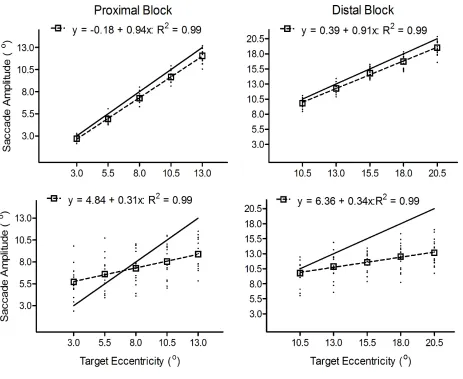
0.001. As expected, pro- and antisaccade amplitudes in proximal and distal blocks increased
with increasing target eccentricity (only linear effects significant: Fs(1,15) > 780.00, ps < 0.001).
Notably, however, the task by target eccentricity interactions revealed an eccentricity-specific
scaling of pro- and antisaccades. Results for the proximal block revealed that antisaccade
amplitudes to the 3.0° and 5.5° targets were greater than their prosaccade counterparts, whereas
the converse pattern was true for the 10.5° and 13.0° targets (a null difference was observed for
2
the 8.0° target) (Figure 1: see Table 1 for post hoc contrasts). Second, results for the distal block
showed that anti- and prosaccade amplitudes to the 10.5° target did not reliably differ, whereas
antisaccade amplitudes to the remaining targets (i.e., 13.0°, 15.5°, 18.0°, and 20.5°) were less
than their prosaccade counterparts (Table 1). Additionally, I computed participant-specific
slopes relating pro- and antisaccade amplitudes to target eccentricity for the proximal and distal
blocks and examined those data via 2 (task: pro, antisaccade) by 2 (block: proximal, distal)
repeated measures ANOVA. Results revealed a main effect of task, such that antisaccade slopes
(0.32°, CI95%= 0.12) were shallower than prosaccades (0.93°, CI95%= 0.12), F(1,15) = 493.98, p <
0.0013. However, and as can be seen in Figure 1, the results did not yield a reliable effect for
block or a task by block interaction, Fs < 1. Thus, prosaccade amplitudes scaled in relation to
veridical target amplitude to a greater extent than antisaccades: a result that was not modulated
across the proximal and distal blocks.
3
Figure 1. The top and bottom panels show pro- and antisaccade amplitudes (°), respectively, as
a function of target eccentricity in the proximal and distal blocks. For each panel, filled circles
represent the mean value for individual participants and the open squares represents the group
mean. The hatched line represents the linear regression of mean amplitude to target eccentricity
and the regression equation and associated R2 value is presented at the top of each panel. The
Target Eccentricity (°) Mean Saccade Amplitude (o) Prosaccade Antisaccade
t-ratio P-value*
Proximal 3.0 5.5 8.0 10.5 13.0 2.70 (0.20) 4.91 (0.20) 7.29 (0.20) 9.67 (0.20 12.05 (0.20) 5.74 (0.32) 6.62 (0.32) 7.28 (0.32) 8.06 (0.32) 8.90 (0.32) -7.29 -4.02 0.02 3.61 8.76 0.001 0.001 0.986 0.003 0.001 Distal 10.5 13.0 15.5 18.0 20.5 9.84 (0.24) 12.27 (0.24) 14.79 (0.24) 16.74 (0.24) 19.01 (0.24) 9.77 (0.40) 10.89 (0.40) 11.56 (0.40) 12.52 (0.40) 13.17 (0.40) 0.19 3.14 9.33 9.53 12.43 0.853 0.007 0.001 0.001 0.001
Table 1: Mean saccade amplitude (°) and 95% confidence intervals (in parentheses) for pro- and
antisaccade amplitudes as a function of target eccentricity in proximal and distal blocks.
Additionally, t-ratios and associated p-values are presented for paired-sample contrasts of pro-
and antisaccades at each target eccentricity.
Note (*): Confidence intervals were computed as per Loftus and Masson (1994) and were based
on the mean squared error for target eccentricity determined via separate ANOVAs for task and
block. As well, exact p-values are reported for non-reliable contrasts, whereas reliable effects
The preceding analyses examined the scaling of pro- and antisaccades to target
eccentricity and contrasted each task at matched target eccentricities. In the following analyses, I
sought to specifically determine whether pro- and antisaccades for each target eccentricity and
block combination elicited an under- or overshooting bias. As such, I contrasted mean pro- and
antisaccade amplitudes for each target eccentricity to veridical target location via single-sample
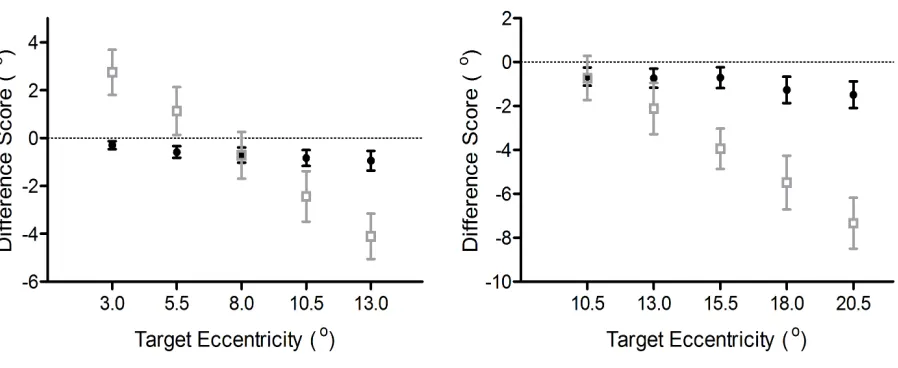
t-statistics. Figure 2 shows that prosaccade amplitudes in proximal and distal blocks undershot
veridical target location across each target eccentricity, ts(15) < -3.71, ps < 0.01. In terms of
antisaccades, results for the proximal block showed that the 3.0° and 5.5° targets overshot
veridical target location, ts(15) = 6.19 and 2.36, and ps = 0.002 and 0.03, respectively, for the
3.0° and 5.5° targets, whereas the 8.0° target did not reliably differ from veridical, t(15) = -1.58,
p = 0.14. In turn, the 10.5° and 13.0° target eccentricities undershot veridical target location
(ts(15) < -4.95, ps < 0.001). Results for distal block antisaccades showed that amplitudes for the
10.5° target did not reliably differ from veridical, t(15) = -1.53, p = 0.15, whereas the remaining
eccentricities (13.0°, 15.5°, 18.0°, and 20.5°) undershot veridical target location, ts(15) < -3.86,
Figure 2. Pro- (filled circles) and antisaccade (open squares) amplitude difference scores (°:
prosaccade [or antisaccade] minus veridical target amplitude) as a function of target eccentricity
for proximal (left) and distal (right) blocks. The error bars for difference scores represent
eccentricity-specific 95% confidence intervals (Cumming, 2013). The absence of overlap
between a confidence interval and zero provide a graphical depiction of a reliable under- or
overshooting bias, and can be interpreted independent of a test of the null hypothesis (Cumming,
Pro- and antisaccade reaction times and their relationship to saccade amplitude.
Reaction times were examined via the same ANOVA model used for saccade amplitudes.
Results for the proximal and distal blocks elicited main effects for task, Fs(1,15) = 77.56 and
91.47 for proximal and distal blocks, respectively, ps< 0.001, such that antisaccade reaction
times (proximal block = 317 ms, CI95%= 40; distal block = 286 ms, CI95%= 29) were longer than
prosaccades (proximal block = 212 ms, CI95%= 40, distal block = 204 ms, CI95%= 29)4. As well,
Figure 3 shows that the proximal block elicited a main effect for target eccentricity, Fs(1,15) =
9.75, p < 0.001, indicating that reaction times for the 3.0° target were longer than the other
eccentricities within the block (significant quadratic effect: F(1,15) = 24.20, p < 0.001).
4
Figure 3. Mean pro- (filled circles) and antisaccade (open squares) reaction times (ms) for
proximal (left) and distal (right) blocks as a function of target eccentricity. In addition, the
panels present linear regression equations for each task and block combination. Error bars
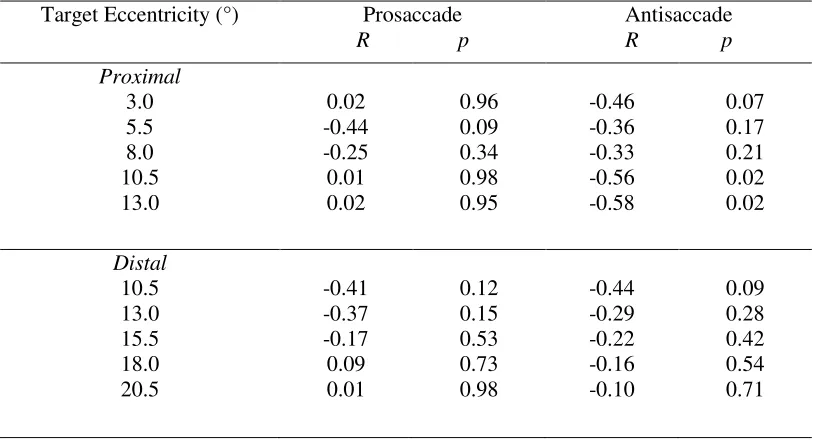
I employed correlation analyses relating reaction time and saccade amplitude to
determine if target eccentricity effects were related to a speed-accuracy trade-off. Thus, I
computed correlation coefficients based on mean participant pro- and antisaccade amplitude and
reaction time values separately for each target eccentricity within the proximal and distal blocks.
Table 2shows that prosaccades elicited a null relationship for each target eccentricity. In turn,
antisaccades elicited a null relationship for each target eccentricity with the exception that the
10.5° and 13.0° targets in the proximal block yielded a decrease in reaction times with increasing
amplitude (r = -0.56 and -0.58, for the 10.5° and 13.0° targets respectively, ps = 0.02). Thus,
findings suggest that planning times were neither consistently nor reliably related to saccade
amplitudes.
Target Eccentricity (°) Prosaccade
R p
Antisaccade
R p
Proximal 3.0 5.5 8.0 10.5 13.0 0.02 -0.44 -0.25 0.01 0.02 0.96 0.09 0.34 0.98 0.95 -0.46 -0.36 -0.33 -0.56 -0.58 0.07 0.17 0.21 0.02 0.02 Distal 10.5 13.0 15.5 18.0 20.5 -0.41 -0.37 -0.17 0.09 0.01 0.12 0.15 0.53 0.73 0.98 -0.44 -0.29 -0.22 -0.16 -0.10 0.09 0.28 0.42 0.54 0.71
Table 2. Correlation coefficients (R) and p-values for the relationship between reaction time and
saccade amplitude for pro- and antisaccades as a function of each target eccentricity in the
proximal and distal blocks.
The primary objective of this study was to determine whether a range effect or a strategy
of perceptual averaging governs the relative visual percept mediating antisaccade sensorimotor
transformations. Prior to addressing that objective, I first describe the results for pro- and
antisaccade reaction times and the general properties of prosaccade amplitudes.
Pro- and antisaccade reaction times and the effect of target eccentricity
Antisaccades produced longer reaction times than their prosaccade counterparts. This
well-documented finding has been linked to the time-consuming and top-down demands
associated with suppressing a stimulus-driven prosaccade (i.e., response suppression) and
inverting a target’s coordinate to mirror-symmetrical space (i.e., vector inversion) (for review see
Munoz and Everling, 2004). As well, the reaction time analysis showed that pro- and
antisaccades in the distal block did not vary with target eccentricity; however, the 3.0° target in
the proximal block produced longer reaction times (pro- and antisaccades) than the other target
eccentricities within the block. This result has been reported elsewhere (Bell et al., 2000; Dafoe
et al., 2007; Kalesnykas and Hallett, 1994) and has been attributed to a continuum of
saccade-related and fixation neurons across the superior colliculus’ motor map. In particular, targets
proximal to a fixation create conflicting saccade generation and fixation commands that require
additional time to resolve (Bell et al., 2000).
Prosaccades amplitudes are characterized by an invariant undershooting bias.
Prosaccades (see below for antisaccades) were completed across separate blocks that
contained an equal number of target eccentricities but differed with respect to their magnitudes.
In particular, participants completed prosaccades to targets presented in proximal (3.0°, 5.5°,
Figures 1 and 2 indicate that proximal and distal block prosaccades across each target
eccentricity elicited a reliable undershooting bias: a finding replicating earlier work by my group
(Gillen et al., 2013). These results provide no evidence to support a range effect. Indeed, had a
range effect influenced prosaccades then the target eccentricities common to each block (i.e.,
10.5° and 13.0°) would have produced an under- and overshooting bias in the proximal and distal
blocks, respectively. Further, that amplitudes were not influenced by the magnitude of the
endpoint bias for the central target in each block (i.e., proximal block = 8.0°, distal block =
15.5°) indicates that prosaccades were not influenced by a strategy of perceptual averaging.
These findings are in keeping with evidence that prosaccades operate independent of relational
target properties; that is, prosaccades are mediated via absolute visual information (i.e.,
retinotopic motor maps in superior colliculus: see Wurtz and Albano, 1980). Moreover, my
findings support the contention that prosaccades are governed by an oculomotor strategy that
minimizes movement time (Harris, 1995) and/or the energy requirements of the response
(Becker, 1989).
It is possible that online target vision and/or a putative speed-accuracy tradeoff
influenced the prosaccade undershooting bias. Indeed, because the present study entailed a brief
(i.e., 50 ms) target presentation it is possible that the undershootingbias observed here may
relate to the absence of target vision for on- or offline error reduction (Gaveau et al., 2003;
Harris and Wolpert, 1998; Heath et al., 2011). Although the design of the present study
precludes a direct examination of this issue, earlier work by my group using the same
methodology as used here demonstrated that prosaccade undershooting is independent of target
vision (Gillen et al., 2013). As well, a number of studies have shown that primary and secondary
et al., 2011). As such, evidence suggests that the prosaccade undershooting bias is independent
of concurrent target vision. In terms of a speed-accuracy trade-off, some work has shown that
response planning times are related to saccade endpoint bias (Kowler and Blaser, 1995).
Notably, however, the results presented here indicated a null relationship between reaction time
and amplitude across each target eccentricity (see also Gillen et al., 2013). In other words,
prosaccade planning times were independent of the target eccentricities within the block of trials
in which they were performed.
Antisaccades amplitudes are characterized by perceptual averaging.
Figures 1 and 2 show that proximal block antisaccades to the 3.0° and 5.5° target
eccentricities (i.e., the ‘proximal’ targets within the block) elicited an overshooting bias, whereas
the 10.5° and 13.0° target eccentricities (i.e., the ‘distal’ targets within the block) produced an
undershooting bias (the central 8.0° target did not produce a reliable bias). As outlined in the
Introduction, Dafoe et al. (2007) and Evdokimidis et al. (2006) also reported that the 'proximal'
and 'distal' targets in their stimulus-sets elicited an over- and undershooting bias, respectively,
and that their central targets did not differ from veridical. Thus, results from the proximal block
as well as previous workprovides tentative evidence that the relative and perceivedtarget
representation supporting antisaccades engenders a range effect. Of course, if a range effect
represents a systematic feature of antisaccades then the target-specific over- and undershooting
bias should similarly characterize distal block antisaccades. Notably, however, the distal block
showed that the 10.5° target eccentricity (i.e., the ‘nearest’ target in the block) did not reliably
differ from veridical target location, whereas the remaining eccentricities (i.e., 13.0°, 15.5°, 18.0°
and 20.5°) produced a systematic undershooting bias. As well, although the 10.5° target did not
Furthermore, the target eccentricities common to the proximal and distal blocks (i.e., 10.5° and
13.0°) produced an undershooting bias independent of the block in which they were performed
(see above for 10.5° target in the distal block). This represents a salient finding because it
directly counters the range effect hypothesis’ assertion that the target eccentricities common to
the proximal and distal blocks respectively under- and overshot veridical target location.
As an alternative to the range effect, perceptual averaging contends that the stimuli
contained within a set are most reliably represented as a statistical summary (Ariely, 2001: see
also Chong and Treisman, 2003; Corbett and Oriet, 2011; Davarpanah Jazi and Heath, 2014).
For example, Ariely reported that participants were unable to reliably identify the metrical
property (i.e., circle size) of individual stimuli within a set but were able to represent the average
of the set. Thus, a corollary prediction drawn from the perceptual averaging literature contends
that the relative nature of the visual information supporting antisaccades is, in part, based on a
statistical summary (i.e., the average) of the combined target percepts included in a set. In the
context of the present investigation then, perceptual averaging holds that bias associated with the
percept for the central target (i.e., the target representing the statistical summary) determines the
direction and magnitude of the bias to individual targets in the block. I believe that the
antisaccade results support perceptual averaging for three reasons. First, the proximal block
showed a null endpoint bias for the central target (i.e., 8.0°), whereas the ‘proximal’ (i.e., 3.0°
and 5.5°) and ‘distal’ (10.5° and 13.0°) targets in the block respectively over- and undershot
veridical target location. In turn, the distal block produced a reliable - and large magnitude (see
Figure 1) - undershooting bias that characterized not only the central target (15.5°) but also the
other targets (10.5°, 13.0°, 18.0° and 20.5°) within the block (see above for description of the
amplitude were shallower for antisaccades than prosaccades: a finding that was consistent across
proximal and distal blocks. Third, proximal and distal block antisaccades produced equivalent
slopes. Taken together then, results show that: (1) the scaling of response amplitudes to
perceived target eccentricity was independent of the magnitude of target eccentricities included
in a block, and (2) the direction and magnitude of endpoint bias for individual targets was
influenced by the bias (or absence thereof) associated with the central target within the block. In
other words, the sensorimotor transformation supporting antisaccades are based on a statistical
summary of the range of perceived amplitudes included in a stimulus-set.
Two issues require addressing. The first issue relates to why antisaccade amplitudes
scaled in relation to target eccentricity. Indeed, one could argue that perceptual averaging should
result in comparable amplitudes for each target eccentricity within a set. It is, however,
important to recall that although a statistical summary provides the most reliable and
predominant information to represent a set of items, perceptual averaging contends that an
individual target property can also influence (albeit to a lesser extent) the formation of a visual
percept. Certainly the modulation of antisaccade endpoints about the central target in each block
and the equivalent slopes for proximal and distal block antisaccades support such an argument.
The second issue relates to why the antisaccade undershooting bias increased with the more
distal target eccentricities contained within a block (see also Evdokimidis et al., 2006; Dafoe et
al., 2007). To begin, I note that such a finding is distinct from the theoretical prediction of the
range effect. Recall that Poulton (1981) asserted that a range effect manifests as a respective
over- and undershooting bias for the ‘proximal’ and ‘distal’ targets within a block (see also
Kapoula, 1985). In contrast, the present results require an account for the monotonic decrease in
attributed to a difficulty detecting a briefly presented peripheral target given that prosaccades did
not demonstrate a similar effect (see Prosaccades amplitudes are characterized by an invariant
undershooting bias). Instead, I propose that the visual percept mediating antisaccades is
compressed as a function of target eccentricity. In support of this view, memory-guided
prosaccades (Sheth and Shimojo, 2001), propointing (Heath, 2005; Lemay and Proteau, 2001;
Westwood et al., 2003) and walking responses (Knapp and Loomis, 2004) produce a monotonic
rise in undershooting bias with increasing target eccentricity: a finding reminiscent of
Helmholtz’s (1962) seminal report that the perceived length of a peripherally presented line is
inversely proportional to its eccentricity from a central fixation (see also Viguier et al., 2001).
Moreover, increasing target eccentricity is tied to increased noise in perceived target location
(i.e., Weber’s law: see Baird and Noma, 1978). Thus, the top-down nature of antisaccades may
have produced a compression of perceived target location that was amplified with increasing
target eccentricity. It is also worthy to note that visual compression provides parsimonious
explanation as to why antisaccades to the central target in the proximal block (8.0°) did not differ
from veridical target location, whereas the central target in the distal block (15.5°) produced an
undershooting bias. Indeed, it is proposed that the proximal block was associated with a
reduction in visual compression and thereby rendered a statistical summary that provided an
accurate percept for the central target (see also Dafoe et al., 2007; Evdokimidis et al., 2006).
A final question relates to the neural basis of perceptual averaging. To my knowledge,
neuroimaging and electrophysiological work has not examined the putative neural mechanisms
associated with the aforementioned hypothesis. It is, however, possible to derive a framework
based on the distractor literature. Indeed, it has been shown that visual and motor signals related
(Walker et al., 1997). Moreover, non-human primate work has linked the spatial averaging of
prosaccades to a spatial combination of target and distractor related visual and preparatory
signals within the superior colliculus (Dorris et al., 2007). By extension then, it is possible that
the top-down control of antisaccades drives a spatial averaging and leads to the integration of
high- and low-level signals in the production of a visual percept (Cisek, 2007). Of course, I am
aware that such a proposal awaits formal evaluation; however, it does offer a framework for
understanding how high-level plans influence the representation of a visual percept (He and
Kowler, 1989).
Conclusions
The present results show that endpoint bias for the central target in a block of
antisaccades determines the direction and magnitude of the bias associated with the perceived
location of individual targets. Based on this result, I propose that the relative and perceived
nature of the visual information supporting antisaccades results in the mediation of endpoints via
perceptual averaging.
Experiment Two
Introduction
The most frequent motor act that humans perform is an eye movement that brings the
fovea to a target of interest (i.e., prosaccade). In fact, an individual can make upwards of 100,000
prosaccades on a daily basis (Irwin and Carlson-Radvansky, 1996). Notably, the direct spatial
relations between stimulus and response permit absolute visual information to mediate
prosaccade sensorimotor transformation via retinotopically organized motor maps within the
secondary (i.e., corrective) prosaccades typically undershot veridical target location (Abrams et
al., 1989; Becker and Fuchs, 1969; Deubel et al., 1986; Gillen et al., 2013; Prablanc and
Jeannerod, 1975; Robinson, 1964; Weber and Daroff, 1971). In particular, prosaccades exhibit a
10% undershooting bias that is thought to reflect an invariant control strategy that minimizes
saccade flight time (i.e., saccadic flight time hypothesis: Harris, 1995) and/or the energy
requirements of the response (i.e., energy minimization hypothesis: Becker, 1989). Indeed,
undershooting represents an optimal strategy for prosaccades because it reduces the potential of
an overshooting error and the time-consuming and energy-demanding requirements of
implementing a corrective response in a direction opposite the primary saccade (Robinson, 1973;
see also Elliott et al., 2004).
In contrast to prosaccades, antisaccades require decoupling the spatial relations between
stimulus and response and implementing a saccade to a target’s mirror-symmetrical location (i.e.,
180° spatial transformation). As such, antisaccades provide a framework for understanding how
top-down and cognitive control influences motor output. Extensive work has shown that
antisaccades produce longer reaction times (RT) than prosaccades (Fischer and Weber, 1992;
Hallett, 1978) - a behavioural ‘cost’ that has been related to the time-consuming processes of
suppressing a stimulus-driven prosaccade (i.e., response suppression) and the visual remapping
of a target’s spatial properties (i.e., vector inversion) (for extensive review see Munoz and
Everling, 2004). Moreover, it is not surprising that antisaccades are less accurate and more
variable than prosaccades (Dafoe et al., 2007; Evdokimidis et al., 2006; Heath et al., 2011;
Krappmann et al., 1998); after all, decoupling the spatial relations between stimulus and response
does not permit sensorimotor transformation via retinotopically organized motor maps in the
sensorimotor transformations. In other words, the top-down control of antisaccades influences
the nature of the visual information supporting motor output.
As mentioned above, prosaccades exhibit an invariant undershooting bias; however,
antisaccades elicit a target-specific bias based on the range of eccentricities included within a
stimulus-set. For example, Dafoe et al. (2007) and Evdokimidis et al. (2006) reported that the
‘proximal’ and ‘distal’ targets within their stimulus-sets respectively over- and undershoot
veridical target location, whereas the central targets in their stimulus sets exhibited a null bias
(Dafoe et al. 0.5°, 1.0°, 2.0°, 4.0° and 8.0°; Evdokimidis et al. 2.0°, 3.0°, 4.0°, 5.0°, 6.0°, 7.0°,
8.0°, 9.0° and 10.0°) (see also Bell et al., 2000;Heath et al., 2011; Weiler et al., 2011). One
interpretation of this finding is that the visual percept supporting antisaccades overestimates
‘proximal’ targets and underestimates ‘distal’ targets within a stimulus-set (i.e., the range effect
hypothesis: see Poulton, 1981; Kapoula, 1985). Experiment One of my thesis sought to test the
range effect hypothesis by having participants antisaccade in separate blocks (i.e., proximal and
distal) that contained the same number of target eccentricities but differed with respect to their
magnitudes. In the proximal block, target eccentricities were 3.0°, 5.5°, 8.0°, 10.5° and 13.0°,
whereas in the distal block target eccentricities were 10.5°, 13.0°, 15.5°, 18.0° and 20.5°. In line
with Dafoe et al. and Evdokimids et al., the proximal block showed that the ‘proximal’ (i.e., 3.0°,
5.5°) and ‘distal’ (i.e., 10.5°, 13.0°) targets respectively over- and undershot veridical target
location, whereas responses to the central target (8.0°) did not reliably differ from veridical. In
contrast, the distal block showed an undershooting bias that was independent of target
eccentricity. Most notably, that the target eccentricities common to each block (i.e., 10.5° and
13.0°) produced an undershooting bias directly counters the range effect hypothesis’ assertion
veridical target location. As such, I proposed that the visual percept supporting antisaccades is
based, in part, on a statistical summary of the perceived target eccentricities included within in a
stimulus-set (e.g., perceptual averaging hypothesis). In particular, the perceptual averaging
hypothesis asserts that the properties of a stimulus-set (i.e., extent, size, luminance) are rapidly
summarized without precise information about individual targets (Albrecht et al., 2012; Ariely,
2001; Chong and Treisman, 2003; Davarpanah Jazi and Heath, 2014). For example, Ariely
reported that although participants were unable to identify whether an individual circle was a
member of a stimulus-set, they were able to accurately represent the average size of all circles
included in the set. Thus, perceptual averaging provides a parsimonious account for the findings
from the proximal and distal blocks because it contends that the percept for the central target in
each stimulus-set (i.e., the statistical summary) determines the direction and magnitude of the
endpoint bias associated with individual targets within the set.
The goal of the present investigation was to test the assertion that perceptual averaging
provides a direct account for the nature of the visual information supporting antisaccades. To
accomplish that objective, participants completed antisaccades - and complementary prosaccades
- to three target eccentricities (10.5°, 15.5°, and 20.5°) located left and right of a central fixation
in conditions that differed with regard to the frequency that individual target eccentricities were
presented. In the control condition,target eccentricities were presented with equal frequency. In
the proximal-weighting conditionthe ‘proximal’ target eccentricity (10.5°) was presented five
times as often as the other target eccentricities, whereas in the distal-weighting condition the
‘distal’ target eccentricity (20.5°) was presented five times as often as the other target
eccentricities. Of course, I am aware that previous work has shown that probabilistic information
fixation) influences pro- and antisaccade reaction times – a finding that has been linked to
improved target detection and increased pre-saccadic collicular buildup neuron firing rates in the
receptive field of the frequently presented target (Dorris and Munoz, 1998; Geng and Behrmann,
2005; Liu et al., 2010; see also Gmeindl et al. 2005). Notably, however, the current study differs
from previous work in that I was interested in determining whether the frequent presentation of a
target eccentricity influences the statistical summary used to represent individual targets within a
stimulus-set. Indeed, if the perceptual averaging hypothesis is correct, then the proximal- and
distal-weighting conditions should render statistical summaries - and associated visual percepts -
that are biased in the direction of the most frequently presented target. More specifically, it is
predicted that amplitudes for each target eccentricity in the proximal- and distal-weighting
conditions will under- and overshot, respectively, their matched target eccentricities in the
control block. Last, and as indicated above, I included prosaccades to the same target
eccentricities and conditions as used for antisaccades. Prosaccades were included to demonstrate
that responses mediated via absolute visual information are refractory to context-dependent
manipulations (i.e., frequency) of target eccentricity.
Methods
Participants
Twenty participants from the University of Western Ontario community volunteered for
the present study (11 females and 9 males; age range = 19-29 years). All participants had normal
or corrected-to-normal vision. This research was conducted in accordance with the Declaration
of Helsinki and all participants signed a consent form approved by the Office of Research Ethics,
The University of Western Ontario.
Participants sat comfortably at a normal tabletop (height = 770mm) with their head
placed in a head-chin rest for the duration of data collection. Visual stimuli were presented on a
30-inch monitor (60 Hz, 8 ms response rate, 1,280 x 960 pixels; Dell 3007WFP, Round Rock,
TX, USA) located at a viewing distance 550 mm from the participant and centered on their
midline. The gaze location of the participant's left eye was sampled at 360 Hz using a
video-based eye recording system (Eye-Trac6: Applied Sciences Laboratories, Bedford, MA, USA).
Prior to data collection, a nine-point calibration of the participant's viewing space was
completed. Two computer monitors that were visible only to the experimenter provided
real-time point of gaze information, trial-by-trial saccade kinematics (e.g., displacement, velocity),
and information related to the accuracy of the eye tracking system (i.e., to perform a recalibration
when necessary). Computer events and the presentation of visual stimuli were controlled via
MATLAB (7.8.0: The Math Works, Natick, MA, USA) and the Psychophysics Toolbox
extensions (ver 3.0; see Brainard, 1997). The lights in the experimental suite were extinguished
throughout data collection.
Visual stimuli were presented against a high-contrast black background and included a
white fixation cross (1°) and yellow target crosses (1°) presented 10.5° (i.e., ‘proximal’ target),
15.5° (‘middle’ target), and 20.5° (i.e., ‘distal’ target) left and right of fixation. Stimuli were
located on the horizontal meridian and at the participant’s eye level. Each trial began with the
presentation of the white fixation cross which alerted the participant to direct their gaze to its
location. After a stable fixation was achieved (±1.5° for 420ms), a randomized foreperiod (1,000
– 2000 ms) was introduced during which time the fixation cross remained visible. Following the
foreperiod, a target stimulus was briefly (i.e., 50 ms) presented and its onset cued participants to
concurrently extinguished (i.e., no-gap paradigm). Prosaccades required a response to veridical
target location, whereas antisaccade required a response mirror-symmetrical to the target. Prior
to each block participants received written instructions related to the nature of the task
(prosaccade, vs. antisaccade). The 50 ms target presentation was used so that the target was
unavailable throughout response planning and execution – a method requiring visual vector
inversion for antisaccades as opposed to a continuous target presentation wherein antisaccades
may be mediated via an obligatory shift of attention from the target to a homologous region in
space (Olk and Kingstone, 2003).
Pro- and antisaccades were completed across conditions that differed with respect to the
weighting of target eccentricity. In the control condition, an equal number of trials (i.e., 10)
were completed to each target eccentricity by visual space combination (i.e., 60 pro- and
antisaccade trials). In the proximal-weighting condition, the ‘proximal’ target (i.e., 10.5°) was
presented five times as often as the ‘middle’ (i.e., 15.5°) and ‘distal’ (i.e., 20.5°) target
eccentricities. Thus, 50 trials were completed to each left and right visual field ‘proximal’ target,
and 10 trials were completed to each left and right visual field ‘middle’ and ‘distal’ target. In the
distal-weighting condition, the ‘distal’ target was presented five times as often as the ‘proximal’
and ‘middle’ target eccentricities. As such, 50 trials were completed to each left and right visual
field ‘distal’ target, whereas 10 trials werecompleted to each left and right visual field
‘proximal’ and ‘middle’ target. Therefore, for each weighting condition participants performed
140 pro- and antisaccade trials.
The three weighting conditions (i.e., control, proximal-weighting, distal-weighting) were
completed in separate sessions with each separated by a minimum of 24 hours. I employed the
the control condition during the first session, whereas the ordering of the proximal- and
distal-weighting conditions was counterbalanced across the remaining sessions. The ordering of pro-
and antisaccade blocks within each session was counterbalanced, and for all blocks target
presentation (visual space by target eccentricity) was randomized.
Data Analysis
Displacement data were filtered offline using a dual-pass Butterworth filter employing a
low-pass cut-off frequency of 15 Hz. Filtered displacement data were used to compute
instantaneous velocities via a five-point central finite difference algorithm. Acceleration data
were similarly obtained from the velocity data. Saccade onset was marked when velocity and
acceleration values exceeded 30°/s and 8,000/s2, respectively. Saccade offset was marked when
saccade velocity fell below a threshold value of 30o/s for 15 consecutive frames (i.e., 42 ms).
Dependent Variables and Statistical Analyses
The dependent variables were saccade amplitude in the primary (i.e., horizontal)
movement direction and reaction time (RT: time from stimulus presentation to saccade onset).
Post hoc decompositions for pro- and antisaccades were completed via paired-samples t-tests,
whereas the decomposition of target eccentricity was computed via power polynomials (i.e.,
trend analysis: see Pedhazur, 1997). Only significant effects are reported below (p < 0.05).
Results
Pro- and antisaccade amplitudes
My first analysis examined amplitudes via 2 (task: pro-, antisaccade) by 2 (visual field:
left, right) by 3 (weighting condition: control condition, proximal-weighting, distal-weighting)
by 3 (target eccentricity: ‘proximal’ [10.5°], ‘middle’ [15.5°], ‘distal’ [20.5°]) repeated measures