Proceedings of the 9th SIGdial Workshop on Discourse and Dialogue, pages 21–28,
Learning N-Best Correction Models from Implicit User Feedback
in a Multi-Modal Local Search Application
Dan Bohus, Xiao Li, Patrick Nguyen, Geoffrey Zweig
Microsoft Research One Microsoft Way Redmond, WA, 98052
{dbohus, xiaol, panguyen, gzweig}@microsoft.com
Abstract
We describe a novel n-best correction model that can leverage implicit user feedback (in the form of clicks) to improve performance in a multi-modal speech-search application. The proposed model works in two stages. First, the n-best list generated by the speech recognizer is expanded with additional candidates, based on confusability information captured via user click statistics. In the second stage, this ex-panded list is rescored and pruned to produce a more accurate and compact n-best list. Re-sults indicate that the proposed n-best correc-tion model leads to significant improvements over the existing baseline, as well as other tra-ditional n-best rescoring approaches.
1
Introduction
Supported by years of research in speech recogni-tion and related technologies, as well as advances in mobile devices, speech-enabled mobile applica-tions are finally transitioning into day-to-day use. One example is Live Search for Windows Mobile (2008), a speech-enabled application that allows users to get access to local information by speaking a query into their device. Several other systems operating in similar domains have recently become available (TellMeByMobile, 2008; Nuance Mobile Search, 2008; V-Lingo Mobile, 2008; VoiceSignal Search, 2008.)
Traditionally, multi-modal systems leverage the additional input channels such as text or buttons to compensate for the current shortcomings of speech
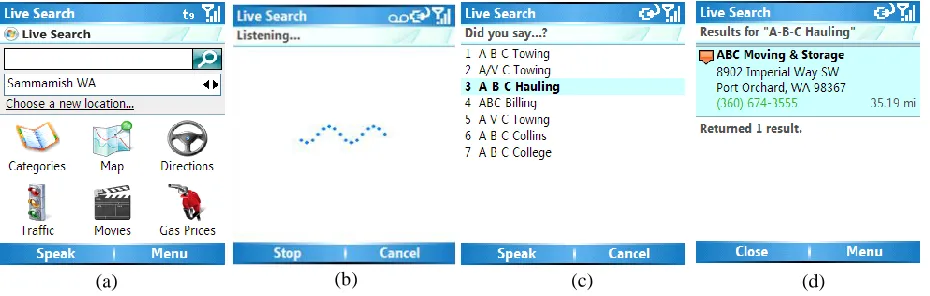
recognition technology. For instance, after the user speaks a query, the Live Search for Windows Mo-bile application displays a confirmation screen that contains the n-best recognition results. The user selects the correct hypothesis using the buttons on the device, and only then the system displays the corresponding search results (see Figure 1.)
We argue that ideally multi-modal systems could use the additional, more accurate input chan-nels not only for confirmation or immediate cor-rection, but also to learn from the interaction and improve their performance over time, without ex-plicit human supervision. For example, in the inte-raction paradigm described above, apart from providing the means for selecting the correct rec-ognition result from an n-best list, the user click on a hypothesis can provide valuable information about the errors made by system, which could be exploited to further improve performance.
Consider for instance the following numbers from an analysis of logged click data in the Live Search for Windows Mobile system. Over a certain period of time, the results Beer and Gear were dis-played together in an n-best list 122 times. Out of these cases, Beer was clicked 67% of the time, and Gear was never clicked. In 25% of the cases when Beer was selected, Gear was incorrectly presented above (i.e. higher than) Beer in the n-best list. More importantly, there are also 82 cases in which Gear appears in an n-best list, but Beer does not. A manual inspection reveals that, in 22% of these cases, the actual spoken utterance was indeed Beer. The clicks therefore indicate that the engine often misrecognizes Gear instead of Beer.
Ideally, the system should be able to take advan-tage of this information and use the clicks to create an automatic positive feedback loop. We can envi-sion several ways in which this could be accom-plished. A possible approach would be to use all the clicked results to adapt the existing language or acoustic models. Another, higher-level approach is to treat the recognition process as a black-box, and use the click feedback (perhaps also in conjunction with other high-level information) to post-process the results recognition results.
While both approaches have their merits, in this work we concentrate on the latter paradigm. We introduce a novel n-best correction model that le-verages the click data to improve performance in a speech-enabled multi-modal application. The pro-posed model works in two stages. First, the n-best list generated by the speech recognizer is expanded with additional candidates, based on results confu-sability information captured by the click statistics. For instance, in the 82 cases we mentioned above when Gear was present in the n-best list but Beer was not, Beer (as well as potentially other results) would also be added to form an expanded n-best list. The expanded list is then rescored and pruned to construct a corrected, more accurate n-best list.
The proposed approach, described in detail in Section 3, draws inspiration from earlier work in post-recognition error-correction models (Ringger and Allen, 1996; Ringger and Allen, 1997) and n-best rescoring (Chotimongkol and Rudnicky, 2001; Birkenes et al., 2007). The novelty of our approach lies in: (1) the use of user click data in a deployed multi-modal system for creating a positive feed-back loop, and (2) the development of an n-best correction model based on implicit feedback that outperforms traditional rescoring-only approaches.
Later on, in Section 5, we will discuss in more de-tail the relationship of the proposed approach to these and other works previously reported in the literature.
Before moving on to describe the n-best correc-tion model in more detail, we give a high-level overview of Live Search for Windows Mobile, the multi-modal, mobile local search application that provided the test-bed for evaluating this work.
2
Live Search for Windows Mobile
Live Search for Windows Mobile is an application that enables local web-search on mobile devices. In its current version, it allows users to find informa-tion about local businesses and restaurants, to ob-tain driving directions, explore maps, view current traffic, get movie show-times, etc. A number of screen-shots are illustrated in Figure 1.
Recently, Live Search for Windows Mobile has been extended with a speech interface (notice the
Speak button assigned to the left soft-key in Figure 1.a.) The speech-based interaction with the system proceeds as follows: the user clicks the Speak but-ton and speaks the name of a local business, for instance A-B-C Hauling, or a general category such
as Vietnamese Restaurants. The application
end-points the audio and forwards it over the data channel to a server (Figure 1.b.) Recognition is performed on the server side, and the resulting n-best list is sent back to the client application, where it is displayed to the user (Figure 1.c.) The user can select the correct item from the n-best list, re-speak the request, or abandon the interaction altogether by pressing Cancel. Once the user selects an item in the n-best list, the corresponding search results are displayed (Figure 1.d.)
(a) (b) (c) (d)
Apart from business names, the system also handles speech input for addresses, as well as compound requests, such as Shamiana Restaurant
in Kirkland, Washington. For the latter cases, a
two-tier recognition and confirmation process is used. In the first stage a location n-best list is gen-erated and sent to the client for confirmation. After the user selects the location, a second recognition stage uses a grammar tailored to that specific loca-tion to re-recognize the utterance. The client then displays the final n-best list from which the user can select the correct result.
Several details about the system architecture and the structure of the recognition process have been omitted here due to space considerations. For the interested reader, a more in-depth description of this system is available in (Acero et al., 2008).
3
Approach
We now turn our attention to the proposed n-best correction model
3.1 Overview
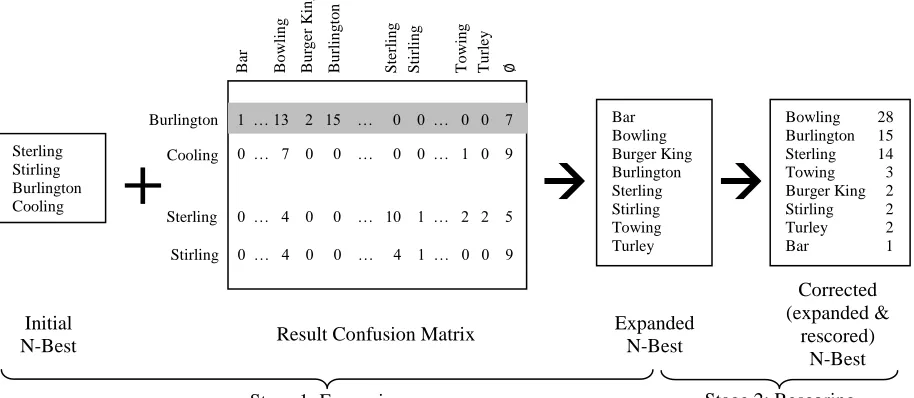
The model works in two stages, illustrated in Fig-ure 2. In the first stage the n-best list produced by the speech recognizer is expanded with several alternative hypotheses. In the second stage, the expanded n-best list is rescored to construct the final, corrected n-best list.
The n-best expansion step relies on a result
con-fusion matrix, constructed from click information. The matrix, which we will describe in more detail in the following subsection, contains information about which result was selected (clicked) by the tially, the matrix captures information about the confusability of different recognition results.
The expansion step adds to an n-best list gener-ated by the recognizer all the results that were pre-viously clicked in conjunction with any one of the items in the given n-best list. For instance, in the example from Figure 2, the n-best list contains
Sterling, Stirling, Burlington and Cooling. Based
on the confusion matrix, this list will be expanded to also include Bar, Bowling, Burger King,
Tow-ing, and Turley. In this particular case, the correct
recognition result, Bowling, is added in the ex-panded n-best list.
In the final step, the expanded list is rescored. In the previous example, for simplicity of explana-tion, a simple heuristic for re-scoring was used: add all the counts on the columns corresponding to each expanded result. As a consequence, the
cor-Figure 2. A confusion-based n-best correction model
1 … 13 2 15 … 0 0 … 0 0 7
∅
rect recognition result, Bowling, was pushed to the top of the n-best list.
We begin by formally describing the construc-tion of the results confusability matrix and the ex-pansion process in the next two sub-sections. Then, we describe three rescoring approaches. The first one is based on an error-correction model con-structed from the confusion matrix. The other two, are more traditional rescoring approaches, based on language model adaptation.
3.2 The Result Confusion Matrix
The result confusion matrix is computed in a sim-ple traversal of the click logs. The rows in the ma-trix correspond to decoded results, i.e. results that have appeared in an n-best list. The columns in the matrix correspond to clicked (or intended) results, i.e. results that the user has clicked on in the n-best list. The entries at the intersection of row 𝑑 and column 𝑐 correspond to the number of times result
𝑐 was clicked when result 𝑑 was decoded:
𝑚𝑑,𝑐 = #(𝑑𝑒𝑐𝑜𝑑𝑒𝑑 = 𝑑, 𝑐𝑙𝑖𝑐𝑘𝑒𝑑 = 𝑐).
In addition, the last column in the matrix, de-noted ∅ contains the number of times no result was clicked when result 𝑑 was displayed:
𝑚𝑑,∅= #(𝑑𝑒𝑐𝑜𝑑𝑒𝑑 = 𝑑, 𝑐𝑙𝑖𝑐𝑘𝑒𝑑 = ∅).
The rows in the matrix can therefore be used to compute the maximum likelihood estimate for the conditional probability distribution:
𝑃𝑀𝐿(𝑐|𝑑) = 𝑚𝑑,𝑐 𝑚𝑐 𝑑,𝑐 .
The full dimensions of the result confusion ma-trix can grow very large since the mama-trix is con-structed at the result level (the average number of words per displayed result is 2.01). The number of rows equals the number of previously decoded re-sults, and the number of columns equals the num-ber of previously clicked results. However, the matrix is very sparse and can be stored efficiently using a sparse matrix representation.
3.3 N-Best Expansion
The first step in the proposed n-best correction model is to expand the initial n-best list with all results that have been previously clicked in con-junction with the items in the current n-best list.
Let’s denote by 𝑁 = {𝑑𝑟}𝑟=1..𝑛 the initial n-best
list produced by the speech recognizer. Then, the expanded n-best list 𝐸𝑁 will contain all 𝑑𝑟, as well as all previously clicked results 𝑐 such that there exists 𝑟 with 𝑚𝑑𝑟,𝑐 > 0.
3.4 Confusion Matrix Based Rescoring
Ideally, we would like to rank the hypotheses in the expanded list 𝐸𝑁 according to 𝑃(𝑖|𝑎), where 𝑖 represents the intended result and 𝑎 represents the acoustics of the spoken utterance. This can be re-written as follows:
𝑃 𝑖 𝑎 = 𝑃(𝑖|𝑑) ∙ 𝑃(𝑑|𝑎)𝑑 . [1]
The first component in this model is an error-correction model 𝑃(𝑖|𝑑). This model describes the conditional probability that the correct (or in-tended) result is 𝑖 given that result 𝑑 has been de-coded. While this conditional model cannot be constructed directly, we can replace it by a proxy -
𝑃(𝑐|𝑑), which models the probability that the re-sult 𝑐 will be clicked, given that result 𝑑 was de-coded. As mentioned earlier in subsection 3.2, this conditional probability distribution can be com-puted from the result confusion matrix. In replac-ing 𝑃 𝑖 𝑑 with 𝑃(𝑐|𝑑), we are making the assumption that the clicks correspond indeed to the correct, intended results, and to nothing else1.
Notice that the result confusion matrix is gener-ally very sparse. The maximum likelihood estima-tor 𝑃𝑀𝐿(𝑐|𝑑) will therefore often be inappropriate.
To address this data sparsity issue, we linearly in-terpolate the maximum likelihood estimator with an overall model 𝑃𝑂(𝑐|𝑑):
𝑃 𝑐 𝑑 = 𝜆𝑃𝑀𝐿 𝑐 𝑑 + (1 − 𝜆)𝑃𝑂 𝑐 𝑑 .
The overall model is defined in terms of two constants, 𝛼 and 𝛽, as follows:
𝑃𝑂 𝑐 𝑑 = 𝛼, 𝑖𝑓 𝑐 = 𝑑𝛽, 𝑖𝑓 𝑐 ≠ 𝑑
where 𝛼 is the overall probability in the whole dataset of clicking on a given decoded result, and
𝛽 is computed such that 𝑃𝑂 𝑐 𝑑 normalizes to 1.
1
Finally, the 𝜆 interpolation parameter is determined empirically on the development set.
The second component in the confusion based rescoring model from equation [1] is 𝑃(𝑑|𝑎). This is the recognition score for hypothesis 𝑑. The n-best rescoring model from [1] becomes:
𝑃 𝑐 𝑎 = 𝜆𝑃𝑀𝐿 𝑐 𝑑𝑟 + (1 − 𝜆)𝑃𝑂 𝑐 𝑑𝑟 ∙ 𝑃(𝑑𝑟|𝑎) 𝑑𝑟∈𝑁
3.5 Language Model Based Rescoring
A more traditional alternative for n-best rescoring is to adapt the bigram language model used by the system in light of the user click data, and re-rank the decoded results by:
𝑃 𝑖 𝑎 ∝ 𝑃 𝑑𝑟 𝑎 ∝ 𝑃 𝑎 𝑑𝑟 𝑃(𝑑𝑟)
Here 𝑃 𝑎 𝑑𝑟 is the acoustic score assigned by the recognizer to hypothesis 𝑑𝑟, and 𝑃(𝑑𝑟) is the
adapted language model score for this hypothesis. A simple approach for adapting the system’s language model is to add the word sequences of the user-clicked results to the original training sen-tences and to re-estimate the language model 𝑃(𝑑). We will refer to this method as maximum likelih-ood (ML) estimation. A second approach, referred to as conditional maximum likelihood (CML) es-timation, is to adapt the language model such as to directly maximize the conditional likelihood of the correct result given acoustics, i.e.,
𝑃 𝑖 𝑎 = 𝑃 𝑎 𝑖 𝑃(𝑖)
𝑃 𝑎 𝑑𝑟 𝑃(𝑑𝑟) 𝑑𝑟∈𝑁
Note that this is the same objective function as the one used in Section 3.4, except that here the click data is used to estimate the language model instead of the error correction model. Again, in practice we assume that users click on correct re-sults, i.e. 𝑖 = 𝑐.
4
Experiments
We now discuss a number of experiments and the results obtained using the proposed n-best correc-tion approach.
4.1 Data
For the purposes of the experiments described be-low we extracted just over 800,000 queries from
the server logs in which the recognizer had gener-ated a simple n-best list2. For each recognition event, we collected from the system logs the n-best list, and the result clicked by the user (if the user clicked on any result).
In addition, for testing purposes, we also make use of 11529 orthographically transcribed user re-quests. The transcribed set was further divided into a development set containing 5680 utterances and a test set containing 5849 utterances.
4.2 Initial N-Best Rescoring
To tease apart the effects of expansion and rescor-ing in the proposed n-best correction model, we began by using the rescoring techniques on the initial n-best lists, without first expanding them.
Since the actual recognition confidence scores
𝑃(𝑑𝑟|𝑎) were not available in the system logs, we replaced them with an exponential probability den-sity function based on the rank of the hypothesis:
𝑃 𝑑𝑟 𝑎 = 2−𝑟
We then rescored the n-best lists from the test set according to the three rescoring models de-scribed earlier: confusion matrix, maximum like-lihood (ML), and conditional maximum likelike-lihood (CML). We computed the sentence level accuracy for the rescored n-best list, at different cutoffs. The accuracy was measured by comparing the rescored hypotheses against the available transcripts.
Note that the maximum depth of the n-best lists generated by the recognizer is 10; this is the max-imum number of hypotheses that can be displayed on the mobile device. However, the system may generate fewer than 10 hypotheses. The observed average n-best list size in the test set was 4.2.
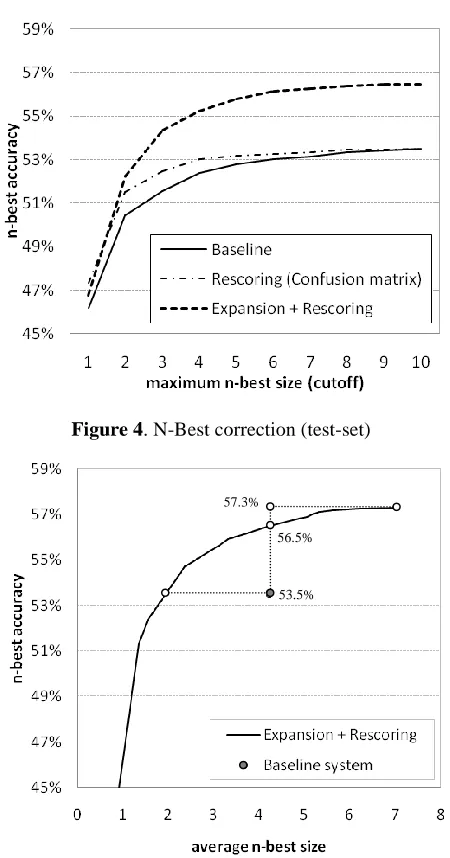
The rescoring results are illustrated in Figure 3 and reported in Table 1. The X axis in Figure 3 shows the cutoff at which the n-best accuracy was computed. For instance in the baseline system, the correct hypothesis was contained in the top result in 46.2% of cases, in the top-2 results in 50.5% of the cases and in the top-3 results in 51.5% of the cases. The results indicate that all the rescoring models improve performance relative to the
2
line. The improvement is smallest for the maxi-mum likelihood (ML) language model rescoring approach, but is still statistically significant (𝑝 = 0.008in a Wilcoxon sign-rank test.) The con-fusion-matrix based rescoring and the CML rescor-ing models perform similarly well, leadrescor-ing to a 1% absolute improvement in 1-best and 2-best sen-tence-level accuracy from the baseline (𝑝 < 10−5).
No statistically significant difference can be de-tected between these two models. At the same time, they both outperform the maximum likelih-ood rescoring model (𝑝 < 0.03).
4.3 N-Best Correction
Next, we evaluated the end-to-end n-best correc-tion approach. The n-best lists were first expanded, as described in section 3.3, and the expanded lists were ranked using the confusion matrix based res-coring model described in Section 3.4.
The expansion process enlarges the original n-best lists. Immediately after expansion, the average n-best size grows from 4.2 to 96.9. The oracle per-formance for the expanded n-best lists increases to 59.8% (versus 53.5% in the initial n-best lists.) After rescoring, we trimmed the expanded n-best lists to a maximum of 10 hypotheses: we still want to obey the mobile device display constraint. The resulting average n-best size was 7.09 (this is low-er than 10 since thlow-ere are cases when the system cannot generate enough expansion hypotheses.)
The sentence-level accuracy of the corrected n-best lists is displayed in line 4 from Table 1. A di-rect comparison with the rescoring-only models or with the baseline is however unfair, due to the larger average size of the corrected n-best lists. To create a fair comparison and to better understand the performance of the n-best correction process, we pruned the corrected n-best lists by eliminating all hypotheses with a score below a certain thre-shold. By varying this rejection threshold, we can therefore control the average depth of the resulting corrected n-best lists. At a rejection threshold of 0.004, the average corrected n-best size is 4.15, comparable to the baseline of 4.2 .
The performance for the corresponding cor-rected (and pruned) n-best lists is shown in line 5 from Table 1 and illustrated in Figure 4. In contrast to a rescoring-only approach, the expansion pro-cess allows for improved performance at higher depths in the n-best list. The maximum n-best per-formance (while keeping the average n-best size at 4.15), is 56.5%, a 3% absolute improvement over the baseline (𝑝 < 10−5).
Figure 5 provides more insight into the relation-ship between the sentence-level accuracy of the corrected (and pruned) n-best lists and the average n-best size (the plot was generated by varying the rejection threshold.) The result we discussed above can also be observed here: at the same average n-best size, the n-n-best correction model significantly outperforms the baseline. Furthermore, we can see that we can attain the same level of accuracy as the baseline system while cutting the average n-best size by more than 50%, from 4.22 to 2. In the op-posite direction, if we are less sensitive to the number of items displayed in the n-best list (except for the 10-maximum constraint we already obey), we can further increase the overall performance by another 0.8% absolute to 57.3%; this overall accu-racy is attained at an average n-best size of 7.09. Figure 3. Initial n-best rescoring (test-set)
Table 1. Test-set sentence-level n-best accuracy; (0) baseline; (1)-(3) initial n-best rescoring;
(4)-(5) expansion + rescoring
Model
1-Best Best 2- Best 3- Best
10-0 Baseline 46.2 50.5 51.5 53.5
1 ML Rescoring 46.8 50.9 52.1 53.5 2 CML Rescoring 47.4 51.4 52.6 53.5 3 Confusion Matrix Resc. 47.3 51.5 52.5 53.5 4 Expansion + Rescoring
(size=7.09) 46.8 52.3 54.5 57.3
5 Expansion + Rescoring
Finally, we also investigated rescoring the ex-panded n-best lists using the CML approach. To apply CML, an initial ranking of the expanded n-best lists is however needed. If we use the ranking produced by the confusion-matrix based model discussed above, no further performance improve-ments can be observed.
5
Related work
The n-best correction model we have described in this paper draws inspiration from earlier works on post-recognition error correction models, n-best rescoring and implicitly supervised learning. In this section we discuss some of the similarities and
differences between the proposed approach and previous work.
The idea of correcting speech recognition errors in a post-processing step has been proposed earlier by (Ringger and Allen, 1996; Ringger and Allen, 1997). The authors showed that, in the presence of transcribed data, a translation-based post-processor can be trained to correct the results of a speech recognizer, leading to a 15% relative WER im-provement in a corpus of TRAINS-95 dialogues.
The n-best correction approach described here is different in two important aspects. First, instead of making use of transcripts, the proposed error-correction model is trained using implicit user feedback obtained in a multi-modal interface (in this case user clicks in the n-best list.) This is a less costly endeavor, as the system automatically ob-tains the supervision signal directly from the inte-raction; no transcripts are necessary. Second, the approach operates on the entire n-best list, rather than only on the top hypothesis; as such, it has ad-ditional information that can be helpful in making corrections. At Figure 2 illustrates, there is a poten-tial for multiple incorrect hypotheses to point to-wards and reinforce the same correction hypothesis, leading to improved performance (in this example, Burlington, Cooling, Sterling and
Stirling were all highly confusable with Bowling,
which was the correct hypothesis).
The n-best correction model we have described includes a rescoring step. N-best rescoring ap-proaches have been investigated extensively in the speech recognition community. In the dialog community, n-best rescoring techniques that use higher-level, dialog features have also been pro-posed and evaluated (Chotimongkol and Rudnicky, 2001). Apart from using the click feedback, the novelty in our approach lies in the added expansion step and in the use of an error-correction model for rescoring. We have seen that the confusability-based n-best expansion process leads to signifi-cantly improved performance, even if we force the model to keep the same average n-best size.
Finally, the work discussed in this paper has commonalities with previous works on lightly su-pervised learning in the speech community, e.g. (Lamel and Gauvain, 2002) and leveraging implicit feedback for learning from interaction, e.g. (Baner-jee and Rudnicky, 2007; Bohus and Rudnicky, 2007). In all these cases, the goal is to minimize the need for manually-labeled data, and learn di-Figure 5. Overall n-best accuracy as a function of
the average n-best size
53.5% 56.5% 57.3%
rectly from the interaction. We believe that in the long term this family of learning techniques will play a key role towards building autonomous, self-improving systems.
6
Conclusion and future work
We have proposed and evaluated a novel n-best correction model that leverages implicit user feed-back in a multi-modal interface to create a positive feedback loop. While the experiments reported here were conducted in the context of a local search application, the approach is applicable in any multi-modal interface that elicits selection in an n-best list from the user.
The proposed n-best correction model works in two stages. First, the n-best list generated by the speech recognizer is expanded with additional hy-potheses based on confusability information cap-tured from previous user clicks. This expanded list is then rescored and pruned to create a more accu-rate and more compact n-best list. Our experiments show that the proposed n-best correction approach significantly outperforms both the baseline and other traditional n-best rescoring approaches, with-out increasing the average length of the n-best lists.
Several issues remain to be investigated. The models discussed in this paper focus on post-recognition processing. Other ways of using the click data can also be envisioned. For instance, one approach would be to add all the clicked results to the existing language model training data and create an updated recognition language model. In the future, we plan to investigate the relationship between these two approaches, and to whether they can be used in conjunction. Earlier related work (Ringger and Allen, 1997) suggests that this should indeed be the case.
Second, the click-based error-correction model we have described in section 3.4 operates at the result level. The proposed model is essentially a sentence level, memory-based translation model. In the future, we also plan to investigate word-level error-correction models, using machine trans-lation techniques like the ones discussed in (Ring-ger and Allen, 1997; Li et al., 2008).
Finally, we plan to investigate how this process of learning from implicit feedback in a multi-modal interface can be streamlined, such that the system continuously learns online, with a minimal amount of human intervention.
Acknowledgments
This work would have not been possible without the help of a number of other people. We would like to especially thank Oliver Scholz, Julian Odell, Christopher Dac, Tim Paek, Y.C. Ju, Paul Bennett, Eric Horvitz and Alex Acero for their help and for useful conversations and feedback.
References
Acero, A., N. Bernstein, et al. (2008). "Live Search for Mobile: Web Services by Voice on the Cellphone". ICASSP'08. Las Vegas, NV.
Banerjee, S. and A. Rudnicky (2007). "Segmenting Meetings into Agenda Items by Extracting Implicit Supervision from Human Note-Taking". IUI'2007. Honolulu, Hawaii.
Birkenes, O., T. Matsui, et al. (2007). "N-Best Rescor-ing for Speech Recognition usRescor-ing Penalized Logis-tic Regression Machines with Garbage Class". ICASSP'2007, Honolulu, Hawaii.
Bohus, D. and A. Rudnicky (2007). "Implicitly-supervised learning in spoken language interfaces: an application to the confidence annotation prob-lem". SIGdial 2007, Antwerp, Belgium.
Chotimongkol, A. and A. Rudnicky (2001). "N-best Speech Hypotheses Reordering Using Linear Re-gression". Eurospeech'2001, Aalborg, Denmark. Lamel, L. and J.-L. Gauvain (2002). "Lightly
Super-vised and UnsuperSuper-vised Acoustic Model Training." Computer Speech and Language 16: 115-129. Li, X., Y.-C. Ju, et al. (2008). "Language Modeling for
Voice Search: a Machine Translation Approach". ICASSP'08, Las Vegas, NV.
Live Search for Windows Mobile (2008): http://mobile.search.live.com Nuance Mobile Search (2008):
http://www.nuance.com/mobilesearch.
Ringger, E. and J. Allen (1996). "Error Correction via Post-Processor for Continuous Speech Recogni-tion". ICASSP'96, Atlanta, GA.
Ringger, E. and J. Allen (1997). "Robust Error Correc-tion of Continuous Speech RecogniCorrec-tion". ESCA-NATO Workshop on Robust Speech Recognition for Unknown Communication Channels, Pont-a-Mousson, France.
TellMeByMobile (2008):
http://www.tellme.com/products/tellmebymobile. V-Lingo Mobile. (2008):
http://www.vlingomobile.com/downloads.html. VoiceSignal Search. (2008):