A Framework for Model-based Evaluation of Spoken Dialog Systems
Sebastian M¨oller
Deutsche Telekom Laboratories Technische Universit¨at Berlin
10587 Berlin, Germany
Nigel G. Ward
Computer Science Department University of Texas at El Paso El Paso, Texas 79968, USA
Abstract
Improvements in the quality, usability and ac-ceptability of spoken dialog systems can be facilitated by better evaluation methods. To support early and efficient evaluation of dia-log systems and their components, this paper presents a tripartite framework describing the evaluation problem. One part models the be-havior of user and system during the interac-tion, the second one the perception and judg-ment processes taking place inside the user, and the third part models what matters to sys-tem designers and service providers. The pa-per reviews available approaches for some of the model parts, and indicates how anticipated improvements may serve not only developers and users but also researchers working on ad-vanced dialog functions and features.
1 Introduction
Despite the utility of many spoken dialog systems today, the user experience is seldom satisfactory. Improving this is a matter of great intellectual in-terest and practical importance. However improve-ments can be difficult to evaluate effectively, and this may be limiting the pace of innovation: today, valid and reliable evaluations still require subjective ex-periments to be carried out, and these are expensive and time-consuming. Thus, the needs of system de-velopers, of service operators, and of the final users of spoken dialog systems argue for the development of additional evaluation methods.
In this paper we focus on the prospects for an
earlyandmodel-basedevaluation of dialog systems.
Doing evaluation as early as possible in the de-sign and development process is critical for improv-ing quality, reducimprov-ing costs and fosterimprov-ing innovation. Early evaluation renders the process more efficient and less dependent on experience, hunches and intu-itions. With the help of such models predicting the outcome of user tests, the need for subjective test-ing can be reduced, restricttest-ing it to that subset of the possible systems which have already been vetted in an automatic or semi-automatic way.
Several approaches have already been presented for semi-automatic evaluation. For example, the PARADISEframework (Walker et al., 1997) predicts the effects of system changes, quantified in terms of interaction parameters, on an average user judgment. Others (Araki and Doshita, 1997; L´opez-C´ozar et al., 2003; M¨oller et al., 2006) have developed dialog simulations to aid system optimization. However the big picture has been missing: there has been no clear view of how these methods relate to each other, and how they might be improved and joined to support efficient early evaluation.
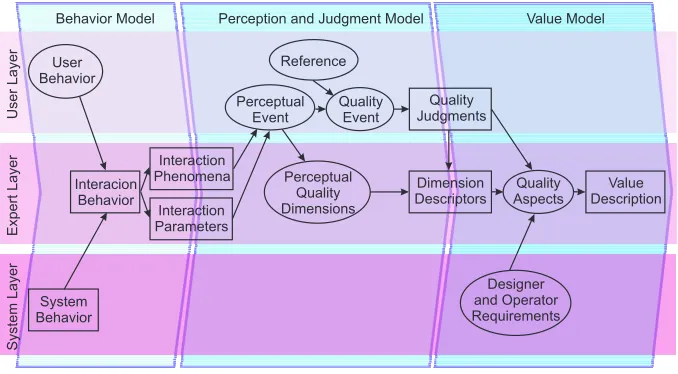
The remainder of this paper is organized as fol-lows. Section 2 gives a brief review of different evaluation purposes and terminology, and outlines a new tripartite decomposition of the evaluation prob-lem. One part of our framework models the behav-ior of user and system during the interaction, and describes the impact of system changes on the inter-action flow. The second part models the perception and judgment processes taking place inside the user, and tries to predict user ratings on various percep-tual dimensions. The third part models what mat-ters to system designers and service providers for
a specific application. Sections 3, 4, and 5 go into specifics on the three parts of the framework, dis-cussing which components are already available or conceivable. Finally, Section 6 discusses the poten-tial impact of the approach, and Section 7 lists the issues to be resolved in future work.
2 Performance, Quality, Usability and Acceptability Evaluation
Developers tend to use indices ofperformanceto as-sess their systems. The performance indicates the “ability of a system to provide the function it has been designed for” (M¨oller, 2005). The function and an appropriate measure for quantifying the de-gree of fulfillment may easily be determined for cer-tain components — e.g. word accuracy for a speech recognizer or concept error rate for a speech under-standing module — but it is harder to specify for other components, such as a dialog manager or an output generation module. However, definitive mea-sures of component quality are not always neces-sary: what matters for such a module is its contri-bution to the quality of the entire interaction, as it is perceived by the user.
We follow the definition of the term quality as introduced by Jekosch (2000) and now accepted for telephone-based spoken dialog services by the International Telecommunication Union in ITU-T Rec. P.851 (2003): “Result of judgment of the per-ceived composition of an entity with respect to its desired composition”. Quality thus involves a per-ception process and a judgment process, during which the perceiving person compares the percep-tual event with a (typically implicit) reference. It is the comparison with a reference which associates a user-specific value to the perceptual event. The per-ception and the comparison processes take place in a particular context of use. Thus, both perception and quality should be regarded as “events” which hap-pen in a particular personal, spatial, temporal and functional context.
Usability is one sub-aspect of the quality of the system. Following the definition in ISO 9241 Part 11 (1998), usability is considered as the “extent to which a product can be used by specified users to achieve specified goals with effectiveness, efficiency and satisfaction in a specified context of use”.
Us-ability is degraded when interaction problems oc-cur. Such problems influence the perceptual event of the user interacting with the system, and conse-quently the quality s/he associates with the system as a whole. This may have consequences for the
acceptabilityor the system or service, that is, how readily a customer will use the system or service. This can be quantified, for example as the ratio of the potential user population to the size of the target group.
It is the task of any evaluation to quantify as-pects of system performance, quality, usability or acceptability. The exact target depends on the pur-pose of the evaluation (Paek, 2007). For example, the system developer might be most interested in quantifying the performance of the system and its components; s/he might further need to know how the performance affects the quality perceived by the user. In contrast, the service operator might instead be most interested in the acceptability of the ser-vice. S/he might further want to know about the satisfaction of the user, influenced by the usability of the system, and also by other (e.g. hedonic) as-pects like comfort, joy-of-use, fashion, etc. Differ-ent evaluation approaches may be complemDiffer-entary, in the sense that metrics determined for one purpose may be helpful for other purposes as well. Thus, it is useful to describe the components of different eval-uation approaches in a single framework.
evalua-Behavior Model Perception and Judgment Model Value Model
User Behavior
System Behavior
Interacion Behavior
UserLayer
ExpertLayer
SystemLayer
Interaction Phenomena
Interaction Parameters
Perceptual Event
Dimension Descriptors Quality Judgments Reference
Quality Event
Quality Aspects
Value Description Perceptual
Quality Dimensions
Designer and Operator Requirements
Figure 1: Tripartite view of a model-based evaluation. Observable properties are in boxes, inferred or hidden properties are in ovals. The layers organize the properties as mostly user-related, mostly system-related, and mostly expert-related, and mostly system-related.
tion. They have further been classified as to whether they are observable (boxes) or hidden from the eval-uator (ovals).
The next three sections go through the three parts of the model left-to-right, explaining the needs, cur-rent status, and prospects.
3 Behavior Model
The behavior model translates the characteristics of the system and the user into predicted interaction be-havior. In order to be useful, the representations of this behavior must be concise.
One way to describe dialog behavior is with in-teraction parameterswhich quantify the behavior of the user and/or the system during the interaction. Such parameters may be measured instrumentally or given by expert annotation. In an attempt to sys-tematize best practice, the ITU-T has proposed a common set of interaction parameters suitable for the evaluation of telephone-based spoken dialog sys-tems in ITU-T Suppl. 24 (2005). These parameters have been developed bottom-up from a collection of evaluation reports over the last 15 years, and include metrics related to dialog and communication in gen-eral, meta-communication, cooperativity, task, and speech-input performance (M¨oller, 2005). Unfortu-nately, it as is yet unclear which of these parameters relate to quality from a user’s point-of-view. In addi-tion, some metrics are missing which address critical
aspects for the user, e.g. parameters for the quality and attractiveness of the speech output.
Another manageable way to describe system be-havior is to focus oninteraction phenomena. Sev-eral schemes have been developed for classifying such phenomena, such as system errors, user errors, points of confusion, dead time, and so on (Bernsen et al., 1998; Ward et al., 2005; Oulasvirta et al., 2006). Patterns of interaction phenomena may be reflected in interaction parameter values, and may be identi-fied on that basis. Otherwise, they have to be deter-mined by experts and/or users, by means of obser-vation, interviews, thinking-aloud, and other tech-niques from usability engineering. (Using this ter-minology we can understand the practice of usability testing as being the identification of interaction phe-nomena, also known as “usability events” or “criti-cal incidences”, and using these to estimate specific quality aspects or the overall value of the system.)
enable estimation of how a change in the system (e.g. a change in the vocabulary) might affect the interaction properties. In addition to the desired ef-fects, the side-effects of system changes are also im-portant. Predicting such side-effects will substan-tially decrease the risk and uncertainty involved in dialogue design, thereby decreasing the gap between research and commercial work on dialog system us-ability (Heisterkamp, 2003; Pieraccini and Huerta, 2005).
Whereas modeling system behavior in response to user input is clearly possible (since in the last resort it is possible to fully implement the system), user be-havior can probably not be modeled in closed form, because it unavoidably relates to the intricacies of the user and reflects the time-flow of the interaction. Thus, it seems necessary to employ a simulation of the interaction, as has been proposed by Araki and Doshita (1997) and L´opez-C´ozar et al. (2003), among others.
One embodiment of this idea is the MeMo work-bench (M¨oller et al., 2006), which is based on the idea of running models of the system and of the user in a dedicated usability testing workbench. The system model is a description of the possi-ble tasks (system task model) plus a description of the system’s interaction behavior (system interac-tion model). The user model is a descripinterac-tion of the tasks a user would want to carry out with the sys-tem (user task model) plus a description of the steps s/he would take to reach the goal when faced with the system (user interaction model). Currently the workbench uses simple attribute-value descriptions of tasks the system is able to carry out. From these, user-desired tasks may be derived, given some back-ground knowledge of the domain and possible tasks. The system interaction model is described by a state diagram which models interactions as paths through a number of dialog states. The system designer pro-vides one or several ‘intended paths’ through the in-teraction, which lead easily and/or effectively to the task goal.
The user’s interaction behavior will strongly de-pend on the system output in the previous turn. Thus, it is reasonable to build the user interaction model on top of the system interaction model: The user mainly follows the ‘intended path’, but at cer-tain points deviations from this path are generated in
a probabilistic rule-based manner. For example, the user might deviate from the intended path, because s/he does not understand a long system prompt, or because s/he is irritated by a large number of op-tions. Each deviation from the intended path has an associated probability; these are calculated from system characteristics (e.g. prompt length, number of options) and user characteristics (e.g. experience with dialog systems, command of foreign languages, assumed task and domain knowledge).
After the models have been defined, simulations of user-system interactions can be generated. These interactions are logged and annotated on different levels in order to detect interaction problems. Us-ability predictions are obtained from the (simulated) interaction problems. The simulations can also sup-port reinforcement learning or other methods for au-tomatically determining the best dialog strategy.
Building user interaction models by hand is costly. As an alternative to explicitly defining rules and probabilities, simulations can be based on data sets of actual interactions, augmented with annota-tions such as indicaannota-tions of the dialog state, current subtask, inferred user state, and interaction phenom-ena. Annotations can be generated by the dialog participants themselves, e.g. by re-listening after the fact (Ward and Tsukahara, 2003), or by top com-municators, decision-makers, trend-setters, experts in linguistics and communication, and the like. Ma-chine learning techniques can help by providing pre-dictions of how users tend to react in various situa-tions from lightly annotated data.
4 Perception and Judgment Model
Once the interaction behavior is determined, the evaluator needs to know about the impact it has on the quality perceived by the user. As pointed out in Section 2, the perception and judgments processes take place in the human user and are thus hidden from the observer. The evaluator may, however, ask the user to describe theperceptual eventand/or the
quality event, either qualitatively in an open form or quantitatively on rating scales. Provided that the ex-periment is properly planned and carried out, user
Whereas user judgments on quality will reflect the internal reference and thus depend heavily on the specific context and application, it may be assumed that the characteristics of the perceptual event are more universal. For example, it is likely that sam-ples of observers and/or users would generally agree on whether a given system could be characterized as responsive, smooth, or predictable, etc. regardless of what they feel about the importance of each such quality aspect. We may take advantage of this by defining a small set of universalperceptual quality dimensions, that together are sufficient for predict-ing system value from the user’s point-of-view.
In order to quantify the quality event and to iden-tify perceptual quality dimensions, psychometric measurement methods are needed, e.g. interaction experiments with appropriate measurement scales. Several attempts have been made to come up with a common questionnaire for user perception mea-surement related to spoken dialog systems, for ex-ample the SASSI questionnaire (Hone and Graham, 2000) for systems using speech input, and the ITU-standard augmented framework for questionnaires (ITU-T Rec. P.851, 2003) for systems with both speech-input and speech-output capabilities. Studies of the validity and the reliability of these question-naires (M¨oller et al., 2007) show that both SASSI and P.851 can cover a large number of different qual-ity and usabilqual-ity dimensions with a high validqual-ity, and mainly with adequate reliability, although the gener-alizability of these results remains to be shown.
On the basis of batteries of user judgments ob-tained with these questionnaires,dimension descrip-torsof the perceptual quality dimensions can be ex-tracted by means of factor analysis. A summary of such multidimensional analyses in M¨oller (2005b) reveals that users’ perceptions of quality and usabil-ity can be decomposed into around 5 to 8 dimen-sions. The resulting dimensions include factors such as overall acceptability, task effectiveness, speed, cognitive effort, and joy-of-use. It should be noted that most such efforts have considered task-oriented systems, where effectiveness, efficiency, and suc-cess are obviously important, however these dimen-sions may be less relevant to systems designed for other purposes, for example tutoring or “edutain-ment” (Bernsen et al., 2004), and additional factors may be needed for such applications.
In order to describe the impact of the interac-tion flow on user-perceived quality, or on some of its sub-dimensions, we would ideally model the hu-man perception and judgment processes. Such an approach has the clear advantage that the resulting model would be generic, i.e. applicable to differ-ent systems and potdiffer-entially for differdiffer-ent user groups, and also analytic, i.e. able to explain why certain in-teraction characteristics have a positive or negative impact on perceived quality. Unfortunately, the per-ception and judgment processes involved in spoken-dialog interaction are not yet well understood, as compared, for example, to those involved in listen-ing to transmitted speech samples and judglisten-ing their quality. For the latter, models are available which estimate quality with the help of peripheral audi-tory perception models and a signal-based compar-ison of representations of the perceptual event and the assumed reference (Rix et al., 2006). They are able to estimate user judgments on “overall quality” with an average correlation of around 0.93, and are widely used for planning, implementing and moni-toring telephone networks.
PARADISE-style models can be very helpful tools for system developers. For example, a recent inves-tigation showed that the model can be used to ef-fectively determine the minimum acceptable recog-nition rate for a smart-home system, leading to the same critical threshold as that obtained from user judgments (Engelbrecht and M¨oller, 2007). However, experience also shows that the PARADISE framework does not reliably give valid predictions of
individual user judgments, typically covering only around 40-50% of the variance in the data it is trained on. The generality is also limited: cross-system extrapolation works sometimes but other times has low accuracy (Walker et al., 2000; M¨oller, 2005). These limitations are easy to understand in terms of Figure 1: over-ambitious attempts to di-rectly relate interaction parameters to a measure of overall system value seem unlikely to succeed in general. Thus it seems wise to limit the scope of the perception and judgment component to the predic-tion of values on the perceptual quality dimensions. In any case, there are several ways in which such models could be improved. One issue is that a linear combination of factors is probably not generally ad-equate. For example, parameters like the number of turns required to execute a specific task will have a non-zero optimum value, at least for inexperienced users. An excessively low number of turns will be as sure a sign of interaction problems as an exces-sively large number. Such non-linear effects can-not be handled by linear models which only support relationships like “the-more-the-better” or “the-less-the-better”. Non-linear algorithms may overcome these limitations. A second issue is that of tempo-ral context: instead of using a single input vector of interaction parameters for each dialog, it may be possible to apply a sequence of feature vectors, one for each exchange (user-system utterance pair). The features may consist not only of numeric measures but also of categories encoding interaction phenom-ena. Using this input one could then perhaps use a neural network or Hidden-Markov Model to predict various user judgments at the end of the interaction.
5 Value Model
Even if a model can predict user judgments of “over-all quality” with high validity and reliability, this is
not necessarily a good indicator of the acceptability of a service. For example, systems with a sophis-ticated and smooth dialog flow may be unaccept-able for frequent users because what counts for them is effectiveness and efficiency only. Different users may focus on different quality dimensions in differ-ent contexts, and weight them according to the task, context of use, price, etc.
A first step towards addressing this problem is to define quality aspects that a system devel-oper or service devel-operator might be concerned about. There can be many such, but in usability engineer-ing they are typically categorized into “effective-ness”, “efficiency” and “satisfaction”. A more de-tailed taxonomy of quality aspects can be found in M¨oller (2005). On the basis of this or other tax-onomizations, value prediction models can be de-veloped. For example, a system enabling 5-year old girls to “talk to Barbie” might ascribe little im-portance to task completion, speech recognition ac-curacy, or efficiency, but high importance to voice quality, responsiveness, and unpredictability. The value model will derive a value description which takes such a weighting into account. A model for systems enabling police officers on patrol to obtain information over the telephone would have very dif-ferent weights.
Unfortunately, there appear to be no published de-scriptions of value prediction models, perhaps be-cause they are very specific or even proprietary, de-pending on a company’s business logic and cus-tomer base. Such models probably need not be very complex: it likely will suffice to ascribe weights to the perceptual quality dimensions, or to quality as-pects derived from system developer and/or service operator requirements. Appropriate weights may be uncovered in stakeholder workshops, where design-ers, vendors, usability experts, marketing strategists, user representatives and so on come together and discuss what they desire or expect.
6 Broader Impacts
have mainly considered the needs of system devel-opers. However, an evaluation framework that sup-ports judgments of perceived quality could provide additional benefits for users. We can imagine user-specific value models, representing what is impor-tant to specified user groups. These could be so-licited for an entire group, or inferred from each user’s own personal history of interactions and deci-sions, e.g, through a personalization database avail-able to the service operator. The models could also be used to support system selection, or to inform real-time system customization or adaptation.
Better evaluation will also support the needs of the research community. With the help of model-based evaluation, it will become easier for re-searchers not only to do evaluation more efficiently, but also to to produce more meaningful evaluation results; saying not just “this feature was useful” but also providing quantitative statements of how much the feature affects various interaction parameters, and from that how much it impacts the various qual-ity dimensions, and ultimately the value itself. This will make evaluation more meaningful and make it easy for others to determine when an innovation is worth adopting, speeding technology transfer.
One might worry that a standardized framework might only be useful for evaluating incremental im-provements, thereby discouraging work on radically different dialog design concepts. However well-designed evaluation components should enable this framework to work for systems of any type, meaning that it may be easier to explore new regions of the design space. In particular it may enable more ac-curate prediction of the value of design innovations which in isolation may not be effective, but which in combination may be.
7 Future Work
Although examples of some model components are available today, notably several interaction simula-tions and the PARADISE framework for predicting user judgments from interaction parameters, these are limited. To realize a complete and generally use-ful evaluation model will require considerable work, for example, on:
• User behavior model: Of the three compo-nents, perhaps the greatest challenges are in
the development of user behavior models. We need to develop methods which produce simu-lated behavior which is realistic (congruent to the behavior of real users), and/or which pro-duce interaction parameters and/or quality in-dicators comparable to those obtained by sub-jective interaction experiments. It is yet un-clear whether realistic user behavior can also be generated for more advanced systems and do-mains, such as computer games, collaborative problem solving systems, or educational sys-tems. We also need to develop models that ac-curately represent the behavior patterns of var-ious user groups.
• Interaction parameters: Several quality aspects are still not reflected in the current parameter sets, e.g. indices for the quality of speech out-put. Some approaches are described in M¨oller and Heimansberg (2006), but the predictive power is still too limited. In addition, many pa-rameters still have to be derived by expert an-notation. It may be possible to automatically infer values for some parameters from proper-ties of the user’s and system’s speech signals, and such analyses may be a source for new pa-rameters, covering new quality aspects.
• Perceptual and quality events and reference: These items are subject of ongoing research in related disciplines, such as speech quality as-sessment, sound quality asas-sessment, and prod-uct sound design. Ideas for better, more realis-tic modeling may be derived from cooperations with these disciplines.
• Quality judgmentsanddimension descriptors: In addition to the aspects covered by the SASSI and P.851 questionnaires, psychologists have defined methods for assessing cognitive load, affect, affinity towards technology, etc. Input from such questionnaires may provide a better basis for developing value models.
Acknowledgments
This work was supported in part by NSF Grant No. 0415150.
References
M. Araki, and S. Doshita. 1997. Automatic Evaluation Environment for Spoken Dialogue Systems.Dialogue Processing in Spoken Language Systems, ECAI’96 Workshop Proceedings, Springer Lecture Notes in Artificial Intelligence No. 1236, 183-194, Springer, Berlin.
N. O. Bernsen, H. Dybkjær, and L. Dybkjær. 1998. De-signing Interactive Speech Systems: From First Ideas to User Testing. Springer, Berlin.
N. O. Bernsen, L. Dybkjær, L., and S. Kiilerich. 2004. Evaluating Conversation with Hans Christian Ander-sen.Proc. 4th Int. Conf. on Language Resources and Evaluation (LREC 2004), 3, pp. 1011-1014, Lisbon. K.-P. Engelbrecht, and S. M¨oller. 2007. Using Linear
Re-gression Models for the Prediction of Data Distribu-tions.Proc. 8th SIGdial Workshop on Discourse and Dialogue, Antwerp, pp. 291-294.
P. Heisterkamp. 2003. “Do not attempt to light with match!”: Some Thoughts on Progress and Research Goals in Spoken Dialog Systems. Proc. 8th Europ. Conf. on Speech Communication and Technology (Eu-rospeech 2003 – Switzerland).
K. S. Hone, and R. Graham. 2000. Towards a Tool for the Subjective Assessment of Speech System Interfaces (SASSI).Natural Language Engineering, 3(3-4): 287-303.
ITU-T Rec. P.851. 2003. Subjective Quality Eval-uation of Telephone Services Based on Spoken Dialogue Systems. International Telecommunication Union, Geneva.
ITU-T Suppl. 24 to P-Series Rec. 2005. Parameters Describing the Interaction with Spoken Dialogue Systems. International Telecommunication Union, Geneva.
ISO Standard 9241 Part 11. 1998. Ergonomic Require-ments for Office Work with Visual Display Terminals (VDTs) – Part 11: Guidance on Usability. Interna-tional Organization for Standardization, Geneva. U. Jekosch. 2000. Sprache h¨oren und
beur-teilen: Ein Ansatz zur Grundlegung der
Sprachqualit¨atsbeurteilung. Habilitation thesis (unpublished), Universit¨at/Gesamthochschule, Essen. R. L´opez-C´ozar, A. De la Torre, J. Segura, and A. Rubio.
2003. Assessment of Dialog Systems by Means of a New Simulation Technique. Speech Communication, 40: 387-407.
S. M¨oller, P. Smeele, H. Boland, and J. Krebber. 2007. Evaluating Spoken Dialogue Systems According to
De-Facto Standards: A Case Study.Computer Speech and Language, 21: 26-53.
S. M¨oller, R. Englert, K.-P. Engelbrecht, V. Hafner, A. Jameson, A. Oulasvirta, A. Raake, and N. Rei-thinger. 2006. MeMo: Towards Automatic Usability Evaluation of Spoken Dialogue Services by User Er-ror Simulations.Proc. 9th Int. Conf. on Spoken Lan-guage Processing (Interspeech 2006 – ICSLP), Pitts-burgh PA, pp. 1786-1789.
S. M¨oller, and J. Heimansberg. 2006. Estimation of TTS Quality in Telephone Environments Using a Reference-free Quality Prediction Model. Proc. 2nd ISCA/DEGA Tutorial and Research Workshop on Per-ceptual Quality of Systems, Berlin, pp. 56-60.
S. M¨oller. 2005.Quality of Telephone-Based Spoken Di-alogue Systems. Springer, New York NY.
S. M¨oller. 2005b. Perceptual Quality Dimensions of Spo-ken Dialogue Systems: A Review and New Exper-imental Results. Proc. 4th European Congress on Acoustics (Forum Acusticum Budapest 2005), Bu-dapest, pp. 2681-2686.
A. Oulasvirta, S. M¨oller, K.-P. Engelbrecht, and A. Jame-son. 2006. The Relationship of User Errors to Per-ceived Usability of a Spoken Dialogue System.Proc. 2nd ISCA/DEGA Tutorial and Research Workshop on Perceptual Quality of Systems, Berlin, pp. 61-67. T. Paek. 2007. Toward Evaluation that Leads to Best
Practices: Reconciling Dialog Evaluation in Research and Industry.Bridging the Gap: Academic and Indus-trial Research in Dialog Technologies Workshop Pro-ceedings, Rochester, pp. 40-47.
R. Pieraccini, J. Huerta. 2005. Where Do We and Com-mercial Spoken Dialog Systems. Proc. 6th SIGdial Workshop on Discourse and Dialogue, Lisbon, pp. 1-10.
A. W. Rix, J. G. Beerends, D.-S. Kim, P. Kroon, and O. Ghitza. 2006. Objective Assessment of Speech and Audio Quality – Technology and Applications.IEEE Trans. Audio, Speech, Lang. Process, 14: 1890-1901. M. Walker, C. Kamm, and D. Litman. 2000. Towards
Developing General Models of Usability with PAR-ADISE.Natural Language Engineering, 6: 363-377. M. A. Walker, D. J. Litman, C. A. Kamm, and A. Abella.
1997. PARADISE: A Framework for Evaluating Spo-ken Dialogue Agents. Proc. of the ACL/EACL 35th Ann. Meeting of the Assoc. for Computational Linguis-tics, Madrid, Morgan Kaufmann, San Francisco CA, pp. 271-280.
N. Ward, A. G. Rivera, K. Ward, and D. G. Novick. 2005. Root Causes of Lost Time and User Stress in a Simple Dialog System.Proc. 9th European Conf. on Speech Communication and Technology (Interspeech 2005), Lisboa.