User Interfaces and the Applications for
Mobile Devices
Dr. G. Shankar Lingam1
Professor, Dept. of CSE, Chaitanya Institute of Technology& Science, Warangal, Telangana, India1
ABSTRACT: Mobile devices consisting of cellular phones (CPs) are essential in our each day existence. A lot of work has been achieved to handle the troubles of designing and developing of GUI and packages for CPs. In addition, we present a bug look at and categorization of androidspecific insects that suggests an essential range of android bugs. We introduce a new method for checking out GUI. The new technique attention on producing set of movements to check the user interface.
KEYWORDS: User interface, Development application,UI design
I. INTRODUCTION
Mobile devices are increasingly becoming integrated into various aspects of our daily lives. One area is in the educational sector, where mobile phones are being used as the platform for teaching and learning. However, unlike personal computers, the screen size and resolution restrict mobile phones in displaying content [1]. Learning by using specifically smartphones, is being integrated within existing education systems to support real-time communication and deliver learning materials.
For instance, smartphones are being used in many universities as a classroom tool to engage and support students in communicative, collaborative, supportive, and constructive activities. Additionally, mobile technologies enable individual learners to build data and construct understandings; in this they facilitate a change in the pattern of work activity/learning [2]. However, mobile applications used for educational purposes have a complex user interface (UI) with many hidden options. There is already a great interest in designing and developing attractive, user-friendly mobile applications to gain the acceptance of end user. Further, in order to be acceptable to a wider audience, the applications need to be both robust and of a very high quality [3].
Due to the significant diffusion of mobile technologies, most students today already own mobile devices. Hence, the technology is a strong contender to be the next “big thing” in educational platforms [4]. Mobile technology can deliver educational content in several ways. For instance, Wang et al. [5] reported that mobile phones could be used to deliver online courses to university students. In fact, the multitude of ways in which mobile technology can be used in the educational sector, prompted Prensky [6] to note that students will be able to learn “anything, if developers designed it right”.Also, the demand for learning anywhere and anytime has specified the need for a new type of electronic learning known as m-Learning to take advantage of mobile devices which are becoming increasingly popular [7]. M-learning is an education mode in which students can use mobile communication terminals to assist them in learning [8].
discussion in of all the aspects of usability: – learnability, understandability, ease of use, effectiveness, and efficiency of mobile applications [13].
Mobile devices are an increasing number of becoming integrated into various components of our everyday lives. One area is inside the instructional region, wherein mobile phones are getting used as the platform for teaching and mastering. However, in contrast to personal computer systems, the screen length and backbone restriction mobile phones in displaying content [1]. Learning via the use of specially smartphones, is being integrated within present training structures to guide actual-time communication and deliver getting to know substances.
For instance, smartphones are getting used in many universities as a school room tool to engage and aid students in communicative, collaborative, supportive, and optimistic sports. Additionally, mobiletechnology enablespeople beginners to construct expertise and construct understandings; on this they facilitate a trade in the pattern of labour activity/studying [2]. However, mobile applications used for educational purposes have a complicated person interface (UI) with many hidden options. There is already an awesome hobby in designing and developing attractive, user-interface mobile applications to advantage the recognition of conclude user. Further, in order to be perfect to a much wider target market, the packages want to be both strong and of a totally excessive exceptional [3].
Due to the enormous diffusion of mobile technology, most college students these days already personal mobile devices. Hence, the technology is a robust contender to be the following “large issue” in academic platforms [4]. Mobile era can deliver academic content material in numerous ways. For instance, Wang et al. [5] said that cell telephones can be used to deliver on line publications to university college students. In truth, the multitude of ways in which mobile technology can be used inside the academic sector, induced Prensky [6] to be aware that scholars might be able to study “anything, if builders designed it right”. Also, the demand for studying anywhere and anytime has precise the need for a new type of digital learning referred to as m-Learning to take advantage of cell devices which might be becoming increasingly more popular [7]. M-learning is an education mode in which college students can use mobilecommunication terminals to help them in gaining data of [8].
Many usability pointers are used for designing laptop applications [9][10]. However, these guidelines cannot be applied to design and increase m-learning programs, in reality due to the fact neither addresses the thing of mobility not the obvious barriers of the mobile devices, like consisting of screen size, and the need for wireless connectivity [1]. There is a singular loss of reliable usability guidelines, specially meant for designing and growing m-mastering with user-friendly interfaces. While research performed at the achievement elements of m-Learning honestly display that usability and related aspects are one the center necessities, the unique approaches wherein this can be addressed is are missing [12]. In reality, usability has been less notably covered than the technological aspects of the m-learning. Mobile learning may be a hit as an academic platform simplest when the destiny research into the region of m-Learning consists of fruitful dialogue in of all of the elements of usability: – learnability, understandability, ease of use, effectiveness, and efficiency of mobile packages [13].
II. RELATED WORK
In this section we discuss literature that offers with the usability and summarize a selection of themost relevant findings. To start, within the ISO 9241-eleven (1997) [16] standard, usability is described as“the extent to which a product can be used by specified users to achieve targeted goals witheffectiveness, performance and delight in a specific context of use”. However, ISO/IEC 9126-1 (2001) [17], states that usability is “the functionality of the software program product to be understood,discovered, used and attractive to the consumer, while used underneath certain situations.” [18], on the alternativehand, emphasize that there is an extraordinary deal of literature to be had that addresses usability, personinterface design, and associated subjects for mobiledevices. A mobile application should be developedand designed with appreciate to user technological capacity, talents, and language proficiency. Thisforces developers to be very careful with design issues that allows us to maximize the extent of usabilitywith all of its sub-traits.
smartphones. The researchers utilized a mobile lecture interaction tool toinspire students in higher schooling to participate in a class dialogue. This tool enabledmembers to ask and answer questions, in addition to rate classmate queries. The essential reasonof this survey becomes to get student remarks at the usability of the device. The comments showed thatmobiletool with a high degree of usability will truly growth their engagement indiscussions. Mobile era permits the users to talk immediately; this characteristicplays a critical role in a successful m-Learning surroundings. However, usability troubles are observed tobe critical factors within the inexperienced users’ high satisfaction stage with the cooperative getting to know availablethrough the device.
The Mobile System Analysis and Design (MOSAD) application [21] is mobile software usedas a revision device for the System Analysis and Design (SAD) path at University TechnologyPetronas. The researchers’ fundamental intention became to layout m-Learning software that lets in college students to review and read notes for the duration of their spare time, and extra importantly, to assess this application through thinking about a few layout issues that could be changed to enhance its usability.
After the utility turned into designed, a heuristic assessment became finished to degree its stage of usability. Many assessments had been carried out, and the cause of those exams changed into to get hold of remarks from individuals so the extent of usability of this utility can be decided. The results implythat adding some features to the layout will be beneficial and will improve the general usability of the utility.
III.PROPOSED ALGORITHM
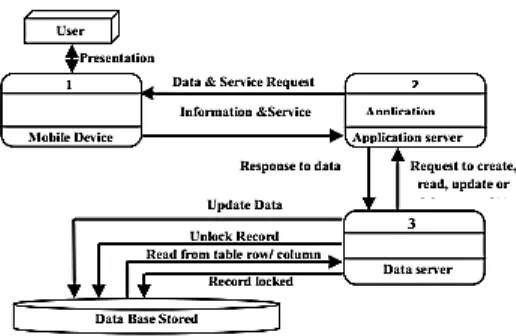
The heterogeneity of mobile devices requires that the software be customized and tailor-made for every tool [14]. Mobile device has dispensed information on account that facts and data manipulating are placed on server, software common sense positioned on server and presentation positioned on mobile devices as shown in Figure 1.The display length and the operating surroundings are two important differences amongst wireless devices. These differences require the utility to be adapted especially for eachtool. That section describes two strategies for presenting software tailoring; utility tailoring answers are neededbecause of the boom in availability and the popularity of mobile devices.
Fig. 1: Distributed Data of mobile devices and server
That segment could be offered an especially dependent Voice XML document or VXML as enter to an XSL transformation.The transformation produces J2ME source code. Java servlets are used to bring together the ensuing code and package deal it withrespect to a specific device as proven in Figure 2.This first technique works properly for users who have programmingrevel in and are relaxed with editing XML files as the following [14]:
by way of the WorldWide Web Consortium. Some of programs not the use of voicethen the shape of VXML tags are used as the muse forthe enter record that specifies the details of the mobile utility.
VXML uses tags including <prompt> tag, <item> tag and <field>tag. One Voice XML file presents asingle input for manytranslations.
Fig. 2: logical data flow of VXML solution
XSLT: mean eXtensible Stylesheet Language Transformation ofVoiceXML, XSLT translates VXML to J2ME also; XSLT canbe applied to the VXML document. XSLT is a metamorphosislanguage that consists of a fixed of rules for reworking a supplytree right into a result tree. The XSLT allows output to be directed to3 necessary translation documents, the translations needed are: onefor J2ME, one for MF report and closing for JAD record.
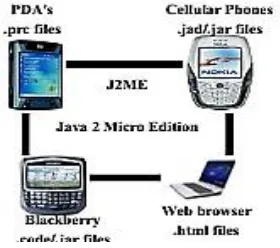
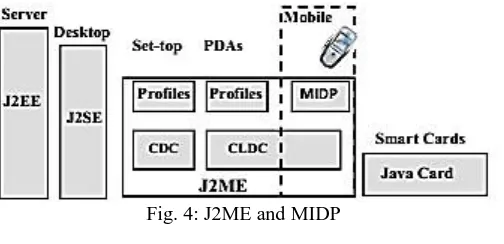
J2ME: is a collection of Java APIs for growing software program on resource limited devices including PDAs, mobile telephones anddifferent client home equipment see Figure 3. Java is remote from rest of the device to make improvement less difficult and improvessafety and it's far crucial to have digital execution surroundings [15]. J2ME solves part of the utility tailoringhassle via addressing "the desires of the working device anddisplay screen sizes" as shown in Figure 4. Screen length hassle issolved via the usage of J2ME’s high degree APIs, which allows tool topick the way to show objects inclusive of buttons and textual content onto thedisplay screen. The low degree API requires programmers to beliable for the whole thing this is displayed at the display. Highdegree APIs cast off the display screen length dilemma from theprogrammer and vicinity the responsibility on the cell device.Many cell gadgets are able to the use of J2ME, but require thecode to be packaged particularly to run in each different cellsurroundings then J2ME programs by myself are not enough forporting the code to special mobile devices [14].
Fig. 3: J2ME as part of some devices.
Fig. 4: J2ME and MIDP
IV.CONCLUSION
One of the demanding situations is to design accurately user interfacefor multiple tool. We illustrated two strategies todevelopment of the utility both of them trusted endperson and subsequently the XHTML is right manner to triumph over problemswith mobile devices and an everyday Web browser. In addition,we presented a bug have a look at and categorization of android-uniquebugs that indicates an important quantity of android bugs.
REFERENCES
[1] Wang, S. & Dey, S. (2013) “Adaptive mobile cloud computing to enable rich mobile multimedia applications”, IEEE Transactions on Multimedia, pp 1-14.
[2] Lobo, D., Kaskaloglu, K., Kim, C. & Herbert, S. (2010) “Web usability guidelines for smartphones a synergic approach”, International Journal of Information and Electronics Engineering, vol. 1, No1, pp 33-37.
[3] Black, M., & Edgar, W. (2009) “Exploring mobile devices as grid resources: Using an x86 virtual machine to run boinc on an iPhone”, In 10th IEEE/ACM International Conference on Grid Computing, Washington, DC, USA, pp 9-16,.
[4] Traxler, J. and Leach, J. (2006) “Innovative and sustainable mobile learning in Africa”, In 4th IEEE International Workshop on Wireless, Mobile and Ubiquitous Technology in Education, Los Alamitos, USA, pp 98-102.
[5] Wang, M., Shen, R., Tong, E., Yang, F., & Han, P. (2005) “Mobile learning with cellphones and pocket-PCs”. Springer-Verlag Berlin Heidelberg, New York, pp 332-339.
[6] Prensky, M. (2005) “What can you learn from a cell phone? Almost anything!”, The Innovate Gateway 1 (June/July). Available at:
http://www.innovateonline.info/index.php?view=article&id=83 (last accessed 7 July 2014).
[7] Jin, Y. (2009) “Research of one mobile learning system”, International Conference on Wireless Networks and Information Systems, Guiyang University, China, pp162-165.
[8] Han, M. (2011) “New technology of distance learning in China”, International Conference on Computer Science and Service System (CSSS), Nanjing, China, pp 517-519.
[9] Raza, A., Capretz, L.F. & Ahmed, F. (2012) “Users’ perception of open source usability: An empirical study”, Engineering with Computers, Springer, vol. 28, No 2, pp 109-121.
[10] Raza, A., Capretz, L.F. & Ahmed, F. (2012) “An open source usability maturity model (OS-UMM)”, Computers in Human Behaviour, Elsevier Science, vol. 28, No 4, pp 1109-1121.
[11] Ting, R. (2007) “The advanced mobile learning practices: learning features and implications”, the 7th IEEE International Conference on
Advanced Learning Technologies, (ICALT), Taipei, Taiwan, pp 718 -720.
[12] Chang, V. (2006) “Web service testing and usability for mobile learning”, In Networking, International Conference on Systems and International Conference on Mobile Communications and Learning Technologies (ICN/ICONS/MCL), University of Southampton, UK, pp 2-21.
[13] Parsons, D. & Ryu, H. (2006) “A framework for assessing the quality of mobile learning”, 11th International Conference for Process
Improvement, Research and Education (INSPIRE), UK, Southampton Solent University, pp 17-27.
[14] J. Karvonen, J. Warsta, Mobile Multimedia Services Development Value Chain Perspective. Third International Conference on Mobile and Ubiquitous Multimedia, 2004.
[15] M. Kontio, Designing mobile user interfaces: An architectural approach to working in mobile environments. 2004.
[16] ISO FDIS 9241-11 (1997) Ergonomic requirements for office work with visual display terminals (VDT´s), Part 11: Guidance on Usability specification and measures.
[17] ISO/IEC, ISO/IEC 9126 in practice: what do we need to know? [Online] Available at:
http://www.essi.upc.edu/~webgessi/publicacions/SMEF%2704-ISOQualityModels.pdf.
[18] Zhang, D., & Adipat, B. (2005) “Challenges, methodologies, and issues in the usability testing of mobile applications”, International Journal of Human-Computer Interaction, vol. 18, No 3, pp 293- 308.
[19] Ziefle, M., & Bay, S. (2006) “How to overcome disorientation in mobile phone menus a comparison of two different types of navigation aids”, International Journal of Human-Computer Interaction, in press, vol. 21, No 4, pp 393-433.
[21] Wahab, A. Osman, & Ismail, H. (2010) “Engaging children to science subject: a heuristic evaluation of mobile learning prototype”, 2nd International Conference on Computer Engineering and Applications (ICCEA), Shah Alam, Malaysia, pp 513-516.
BIOGRAPHY