A Performance Comparison of Edge Detection
Techniques for Printed and Handwritten
Document Images
Dr. S.Vijayarani1, A.Sakila2
Assistant Professor, Department of Computer Science, School of Computer Science and Engineering, Bharathiar
University, Coimbatore, India1
M.Phil Research Scholar, Department of Computer Science, School of Computer Science and Engineering, Bharathiar
University, Coimbatore, India 2
ABSTRACT: Document images are becoming more popular in today’s world and being made available over the internet. Information retrieval from the document images becomes a difficult task; it is a challenging problem as it compared with digital texts. Edge detection is an important task in the document image retrieval, it indicates to the process of finding and locating sharp discontinuation of characters in the document images. In this work we have compared six different types of edge detection techniques, Roberts, Sobel, Prewitt, Canny, Laplacian (Zero Cross) and Laplacian of Gussian (LOG) are used to extract edge points from different types of document images. Performance factors are analyzed in terms of processing time and accuracy on the basis of Structural Similarity (SSIM). From the experimental results, it is observed that Laplacian and Roberts edge detection technique found as best among other edge detection techniques.
KEYWORDS: Roberts, Sobel Prewitt, Canny, Laplacian (Zero Cross) and Laplaican of Gaussian (LOG).
I. INTRODUCTION
Document images are becoming more popular in today’s world and being made available over the internet, and it used for paperless offices and digital libraries. Paper documents can be converted into digital form by using digitization equipments and it is stored in document image databases. If the documents are stored in image formats, there is a need for searching strategies to find any specific information from document image. However, information retrieval from the document image database becomes a difficult task; it is a challenging problem as it compared with digital texts. Information retrieval from document images has become a growing and challenging problem. Recognition and extraction of text in document image is the aim of document image analysis. However information retrieval is concerned with content based document browsing, indexing and searching from a huge database of document images.
Edge detection is an important task to be performed in the document image retrieval, and it is the process of finding and locating sharp discontinuation of characters in the document images. Edge detection is the process of identifying and locating an edge of a digital image and fundamental tool used in most image processing applications to obtain information from the frames [4]. It is an important terminology in image processing and computer vision with wide range of applications [3]. The main aim of edge detection is to discover the information concerning shapes and the reflectance or transmittance in an image [5] [6]. An edge of an image is a significant local change in the image
intensity, generally associated with a discontinuity in either the image intensity.
1.1 Steps for Edge Detection
Edge detection contains four steps for extracting the edge points of the digital image. The four steps are Image smoothing, Enhancement, Detection and Localization. This is given in Figure 1.
Figure 1 Edge Detection steps
1. Image Smoothing: This stepinvolves filtering the image for noise reduction and improving the performance of edge detector [8].
2. Enhancement: Image enhancement techniques are mainly concerned with improving the quality of the digital image. The principal objective of enhancement techniques is to produce an image which is better and more suitable than the original image for a specific application.
3. Detection: Extracting all edge points and determines which edge pixels should be discarded as noise. Normally, thresholding provides the criterion used for detecting edge points.
4. Localization: This step is used to determine the exact location of an edge and estimated with sub-pixel resolution might be required for some applications. The edge orientation can also be estimated.
1.2 Types of Edges
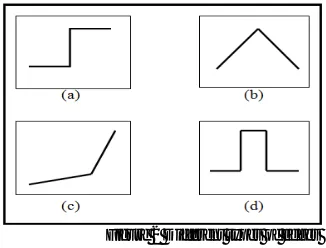
Edges are the important factor of digital images; Edges are produced by variation in the reflectance, orientation, illumination, and depth of scene surfaces [1]. Figure 2 shows different edges.
Figure 2 Different types of edges
a) Step Edge: The intensity of image abruptly varies from one value to one side of the breakage to a different value on other side.
b) Roof Edge: When intensity change is not spontaneous and appears over a finite distance usually generated by connectivity of surfaces then line edges become roof edges.
c) Ramp Edge: When the intensity change is not spontaneous and appears a limited distance then step edges are changed to ramp edges.
II. EDGE DETECTION TECHNIQUES
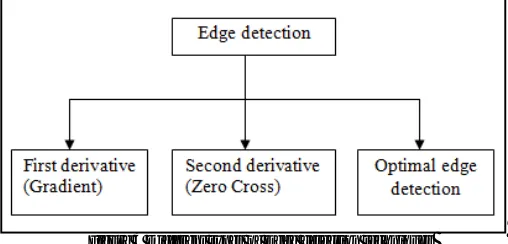
The edge detection algorithms can be classified based on the behavioural study of edges with respect to the operators [8]. Different type edge-detection approaches can be broadly classified First derivative / Gradient based edge detectors, Second derivative / Zero crossing (Laplacian) based edge detectors and optimal edge-detector [11]. Different types of Edge detection techniques are depicted in figure 3.
Figure 3 Different types of Edge detection techniques
2.1 FIRST DERIVATIVE / GRADIENT METHOD (CLASSICAL)
First Derivative/Gradient based operators are very sensitive to noise and produce thicker edges. In that context, typical examples of first derivative edge detectors are Roberts, Prewitt and Sobel. A classical based method detects the edges by looking for the maximum and minimum in the first derivative of the image [8].
The gray values of an image can be detected by using a discrete approximation to the gradient. The gradient is the two-dimensional equivalent of the first derivative and is defined as the vector
[ ( , )] =
y x
G
G
=
y
f
x
f
(1)
There are two important properties associated with the gradient: (1) the vector G[f(x, y)] points in the direction of the
maximum rate of increase of the function f(x, y) and (2) the magnitude of the gradient, given by
[ ( , )] =
G
x2 +G
y2(2) equals the maximum rate of increase of f(x, y) per unit distance in the direction G. However, to approximate the
gradient magnitude by absolute values
[ ( , )]≈
G
x +G
y (3)From vector analysis, the directionof the gradient is defined as
( , ) =
tan
1
y x
G
G
(4)
where the angle a is measured with respect to the x axis
2.1.1 Roberts
The Roberts detector is one of the first derivative based edge detectors in digital image processing [13]. It executes a simple and quick to compute, it performs 2-D spatial gradient measurement on an image. Pixel values at each point in the output represent the estimated absolute magnitude of the spatial operator. The operator consists of a pair of 2×2 masks [19]. The Roberts cross operator provides a simple approximation to the gradient magnitude
G [f[i,j]] = |f[i,j] - f[i + l,j + 1]|+ |f[i + l,j] - f[i,j + 1]| (5)
[ ( , )]=
G
x +G
y (6)The Roberts operator masks are given by (7)
Gx= 10 −01 Gy= −01 01 (7)
Where G is gradient, x and y are horizontal and vertical mask axis.
2.1.2 Sobel
The Sobel operator is one of the most widely used edge detectors [15]. It performs a 2-D spatial gradient size on an image and used to find the approximate absolute gradient magnitude at each point in an input grayscale image. The Sobel edge detector uses a pair of 3x3 convolution masks, one evaluating the gradient in the x-direction (columns) and the other evaluating the gradient in the y-direction (rows). A convolution mask is generally much smaller than the actual image [14]. The Sobel operator is the magnitude of the gradient computed [19] by
2 x
S
+S
y2 (8)Sx and Sy can be implemented using convolution masks:
Sx =
−1 0 +1
−2 0 +2
−1 0 +1
Sy =
+1 +2 +1 0 0 0
−1 −2 −1
(9)
2.1.3 Prewitt
The Prewitt edge detector is an appropriate way to estimate the magnitude and orientation of edges [15]. It is similar to sobel operator and used for detecting vertical and horizontal edges in digital images [14] is that image should contain sharp intensity transition and low noise of Poisson type is present. It is only suitable for well contrasted noiseless images. It uses 3x3 masks for finding the peak gradient magnitude. When the highest magnitude found, then it works on that direction [5], the same equations as the Sobel operator, except that the constant c = 1 [19].
Gx =
−1 0 +1
−1 0 +1
−1 0 +1
Gy =
+1 +1 +1 0 0 0
−1 −1 −1
(10)
2.2 SECOND DERIVATIVE / ZERO CROSSING (LAPLACIAN)
Second Derivative/Zero Crossing based operators are more classy methods towards automated edge detection, however, still very noise-sensitive. As differentiation amplifies noise, smoothing is suggested prior to applying the Laplacians. The laplacian method searches for zero crossings in the second derivative of the image to find edges. An edge has the 1D shape of a ramp and calculating the derivative of the image can highlight its location [8]. One nice property of zero crossings is that they provide closed paths [16]. In that context, typical examples of second derivative
edge detectors are Laplacian, Laplacian of Gaussian (LoG) (Ex:Marr-Hilldreth) and Difference of Gaussian(DoG)
(Ex: Mexican Hat). It is similar to the gradient magnitude that measures second derivatives.
∇ ∇ · =
y
x
.
y
x
(11)∇2 .f= ⎝ ⎜ ⎜ ⎛
y
x
.
y
x
⎠ ⎟ ⎟ ⎞.f (12)
2.2.1 Laplacian (Zero-Cross)
The laplacian method searches for zero crossing in the second derivative of the image to find edges and it includes laplacian operator [17]. It is having fixed characteristics in all directions and sensitive to noise, the edges determined by zero-crossing from numerous closed loops. Zero-crossing methods are of interest because of their noise reduction capabilities and potential for rugged performance [15]. The laplacian of 2-D function f (x,y) is a second derivative defined as,
∇2
.f= 2
2
x
f
+ 2
2 y
f
(13)Gx and Gy can be implemented using convolution masks:
Gx =
0 −1 0
−1 4 −1
0 −1 0
Gy =
−1 −1 −1
−1 8 −1
−1 −1 −1
(14)
2.2.2 Laplacian of Gussian (LOG)
Performance degradation in the Laplacian operator is noise in the input image, blur it. The noise effects can be minimized by smoothing the image prior to edge enhancement. Blur an image using Gaussian smoothing operator and then apply the Laplacian operator to form a single edge finding operator, it is called as Laplacian of Gaussian (LOG) due to Marr and Hilldreth [19]. The 2-D Gaussian function is
(15)
Where σ is the standard deviation, blurs the image with the degree of blurring being determined by the value of σ
[17]. The laplacian of Gussian is as follow
(16)
Masks for Laplacian of Gaussian is given in (17)
Gx =
−1 2 −1
2 −4 2
−1 2 −1
Gy =
1 1 1 1 −8 1 1 1 1
(17)
2.2.3 Difference of Gussian (DOG)
The Laplacian of a Gaussian is the derivative with respect to
2
2of a Gaussian. That is, the limit of oneGaussian minus a just smaller Gaussian [16]. The difference of two gaussian is called Difference-of-Gaussians (DoG) or the Mexican Hat Operator. The expression (18) of a DOG is given by
h (m, n) = h1(m, n) - h2(m, n ) (18)
Where h1 (m, n) and h2 (m, n) are two Gaussian functions (19), (20) which are given by
n)
(m,
h
1e
r2/212andh
(m,
n)
22 2 2/2 r
e
(19)Hence h(m, n)=
2 1 2/2
r
e
-2 2 2/2
r
e
(20)2 2 4 2 2 2 2
2
2
)
,
(
r
e
y
x
y
x
g
2 2 22
)
,
(
y
x
e
y
x
2.3 OPTIMAL EDGE DETECTION
The Canny edge detection algorithm is also known as optimal edge detector. It takes as input a gray scale image,
and produces as output an image showing the positions of tracked intensity discontinuities [12].
2.3.1 Canny
Canny edge detector is best and standard edge detectors recently in use and ensures good noise immunity and at the same time detects true edge points with minimum error [15]. It uses a multi-stage algorithm to detect a wide range
of edges. The Canny edge detection algorithm is summarized as follows. The Smoothing is computed as
I
[
i
,
j
]
todenote the
G
i
,
j
,
image has to be a Gaussian smoothing filters, where
is the spread of the Gaussian andcontrols the degree of smoothing [18]. The result of convolution of
I
[
i
,
j
]
with givesG
i
,
j
,
an array of smootheddata as:
i
j
G
i
j
I
i
j
S
,
,
,
*
,
(21)Firstly, the Gradient is calibrated for the smoothed array S[i,j] is used to produce the x and y partial derivatives P[i,j]
and Q[i,j] respectively as:
P[i,j] ≈(S[i,j+1]-S[i,j]+S[i+1,j+1]-S[i+1,j])/2
Q[i,j] ≈(S[i,j]-S[i+1,j]+S[i,j+1]-S[i+1,j+1)/2 (22)
The standard formulas for rectangular-to-polar conversion, the magnitude and orientation of the gradient can be computed as:
M[i,j]=
P
[
i
,
j
]
2
Q
[
i
,
j
]
2 (23)])
,
[
],
,
[
arctan(
]
,
[
i
j
Q
i
j
P
i
j
(24)Here the arctan(x, y) function takes two arguments and generates an angle. The Nonmaxima Suppression is evaluated using the magnitude image array.
III. EXPERIMENTAL RESULTS
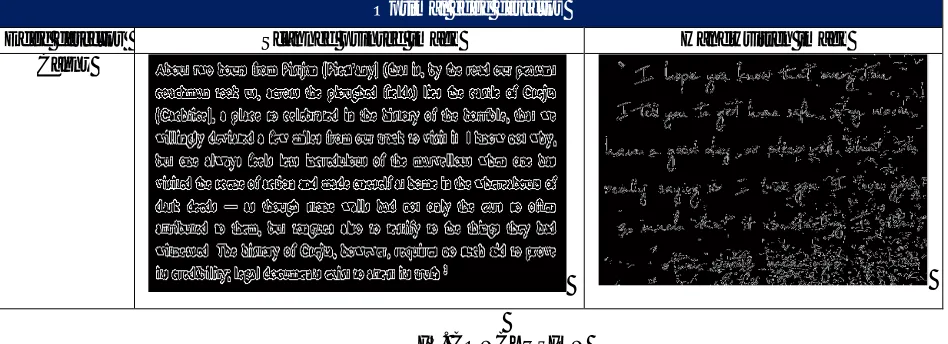
Two different types of text images (Printed text image and handwritten image) are considered as the input for applying the edge detection techniques. Here edge detection is used to extract the edge points in the characters in the text images. Six Edge detection techniques have been analyzed and compared to detect the characters in the text images. Edges of an text images detected using Roberts, Sobel, Prewitt, Laplacian, Laplacian of Gaussian (LoG) and Canny
Edge detectors. From the experimental results, the performance of Laplacian Edge detection method provides better
result than other edge detection techniques for printed text image and Roberts edge detection provides better result than other edge detection techniques for handwritten image.
This work has calculated accuracy measures using SSIM (Structural Similarity Index for Measuring), which is used for measuring the similarity between two images. SSIM designed to improve on traditional methods such as peak signal-to-noise ratio (PSNR) and mean squared error (MSE). The improved SSIM measure can be used for edge detection (Parameterization), tuning of edge map outputs and comparison of edge maps for real and synthetic images.
A. Accuracy measure and execution time for edge detectors using Printed text image
Table 1 Edge detection - Accuracy measure
Printed text image
Edge detectors SSIM
Roberts 4.5977
Sobel 5.6929
Prewitt 4.5977
Laplasian 8.8782
LOG 8.8584
Canny 6.8253
Figure 4 Accuracy measure for Edge detectors
B. Execution time for edge detectors using Printed text image
Table 2 represents time taken for different edge detectors and Figure 5 displays the time taken for different edge detectors. From the experimental results Laplacian edge detector has minimum execution time than other edge detectors.
Table 2 Edge detection - Execution time
Printed text image
Edge detectors Execution time (Milliseconds)
Roberts 569
Sobel 394
Prewitt 832
Laplasian 281
LOG 371
Canny 630
Figure 5 Execution time for Edge detectors
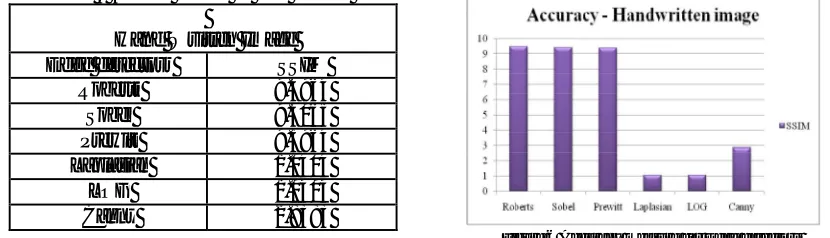
C. Accuracy measures for Edge detectors using handwritten image
Table 3 gives the Edge detection accuracy measure for Hand written image and Figure 6 displays the accuracy measure for Printed text image. From the accuracy measure, it is proved that the Roberts Edge detection method provides better result than other edge detectors with its highest accuracy.
Table 3 Accuracy measure for Edge detectors
Hand Written Image
Edge detectors SSIM
Roberts 9.4964
Sobel 9.4065
Prewitt 9.3964
Laplasian 1.0404
LOG 1.0404
Canny 2.8383
Figure 6 Accuracy measure for Edge detectors
D. Exection time for edge detectors using Hand written image
Table 4 Edge detection - Execution time
Hand Written Image Edge detectors Execution time
(Milliseconds)
Roberts 910
Sobel 962
Prewitt 950
Laplasian 1861
LOG 1872
Canny 1851
Figure 7 Execution time for edge detectors
E. Output Results
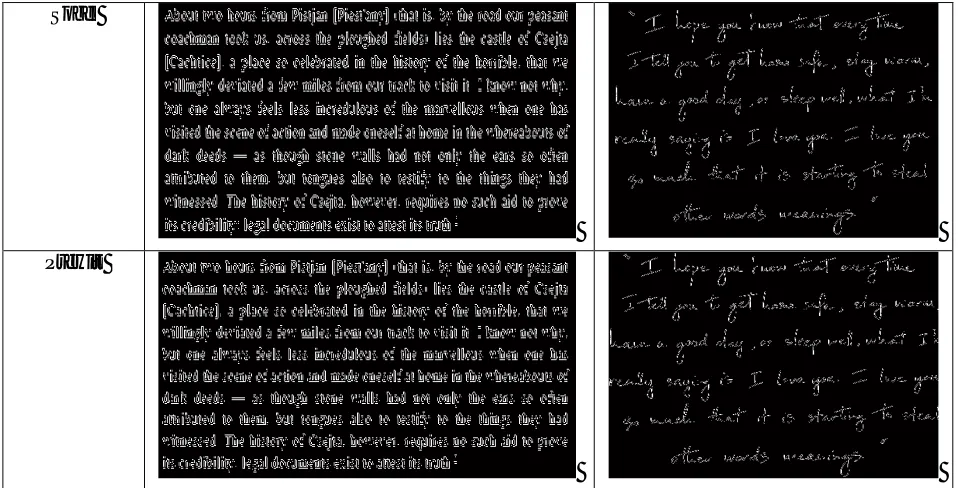
Table 5 shows the two Printed text and handwritten input images; Table 6 represents the output results for first derivative (Roberts, Sobel, Prewitt) operators. Second derivative (Laplacian, LoG) operators output results shown in Table 7. Table 8 displays the output results for Optimal (Canny) edge detection.
Table 5 Input images
Input image
Printed text image Handwritten image
Table 6 Result for first derivative (Roberts, Sobel, Prewitt) operators
First derivative operators
Edge detector Printed text image Handwritten image
Sobel
Prewitt
Table 7 Result for Second derivative (Laplacian, LoG) operators
Second derivative operators
Edge detector Printed text image Handwritten text image
Laplacian
Table 8 Result for Optimal (Canny) edge detector
Optimal edge detector
Edge detector Scanned printed image Handwritten image
Canny
IV. CONCLUSION
An edge detector is basically a high pass filter that can be applied to extract the edge points in a text images. The edge detection is the primary step in identifying an image object. This work has compared various edge detecting techniques, Edges of an text image is detected using Roberts, Sobel, Prewitt, Laplacian, LOG and Canny. Two different text images are used for experimentation. The performance of these edge detection methods are analyzed and compared. It have been observed that that the Laplacian and Roberts edge detections technique have produced higher accuracy in detection of edges and less execution time compared with other edge detection algorithms.
REFERENCES
1. Debosmit Ray, “Edge Detection in Digital Image Pro-cessing”
2. Deepika Adlakha, Devender Adlakha and Rohit Tanwar “Analytical Comparison between Sobel and Prewitt Edge Detection Techniques” International Journal of Scientific & Engineering Research, ISSN 2229-5518, Volume 7, Issue 1, January-2016
3. Dr. S.Vijayarani and M.Vinupriya, “Performance Analysis of Canny and Sobel Edge Detection Algorithms in Image Mining”, International Journal of Innovative Research in Computerand Communication Engineering, ISSN (Online): 2320-9801, ISSN (Print): 2320-9798, Vol.1, Issue 8, October 2013.
4. Juneja. Mamta , Sandhu .Parvinder Singh, “Performance Evaluation of Edge Detection Techniques for Images in Spatial Domain”, International Journal of Computer Theory and Engineering, Vol. 1, No. 5, December, 2009, 1793-8201.
5. D. Poobathy, R.Manicka Chezian, “Edge Detection Operators: Peak Signal to Noise Ratio Based Comparision”, MECS, Vol.10, pp. 55-61, October 2014.
6. Pushpajit A. Khaire and Dr. N.V.Thakur, “A Fuzzy Set Approach for Edge Detection”, International Journal of Image Processing (IJIP), Vol. 6, Issue 6, pp. 403-412, November 2012.
7. Pinaki Pratim Acharjya, Ritaban Das and Dibyendu Ghoshal, “Study and Comparison of Different Edge Detectors for Image Segmentation”, Global Journal of Computer Science and Technology Graphics & Vision, Online ISSN: 0975-4172 & Print ISSN: 0975-4350, Volume 12 Issue 13 Version 1.0 Year 2012
8. Nisha, Rajesh Mehra and Lalita Sharma “Comparative Analysis of Canny and Prewitt Edge Detection Techniques used in Image Processing”, International Journal of Engineering Trends and Technology (IJETT) – Volume 28 Number 1 - October 2015
9. H. Voorhees and T. Poggio,” Detecting textons and texture boundries in natural images” ICCV 87:250-25, 1987.
10. U.G.Sefercik, O.E.Gulegen, “Edge Detection in geologic formation extraction: Close range and remote sensing Case studies”
11. Sonam Saluja, Aradhana Kumari Singh, Sonu Aggarwal,” A Study of Edge Detection Methods”, IJARCCE, Vol.2, Issue 1, pp. 994-999, January 2013.
12. http://homepages.inf.ed.ac.uk/rbf/HIPR2/canny.htm
13. Soumyajit Sarkar and Arijit Basu, “Comparison of various Edge Detection Techniques for maximum data hiding using LSB Algorithm”, International Journal of Computer Science and Information Technologies (IJCSIT), Vol. 5 (3) , 2014, 4722-4727.
14. Millee Panigrahi, Rina Mahakud, Minu Samantaray and Sushil Kumar Mohapatra, “Comparative analysis of different Edge detection techniques for biomedical images using MATLAB” Engineering and Scientific International Journal (ESIJ), ISSN 2394 - 7179 (Print) ISSN 2394 - 7187 (Online), Volume 1, Issue 1, October - December 2014
15. Manish T. Wanjari, Keshao D. Kalaskar and Mahendra P. Dhore, “ Document Image Segmentation Using Edge Detection Method”, International Journal of Computer & Mathematical Sciences IJCMS ISSN 2347 – 8527 Volume 4, Issue 6, June 2015.
16. Bryan S. Morse, “Edge detection”, Lecture 13. 1998-2000
18. G.T. Shrivakshan and Dr.C. Chandrasekar, “A Comparison of various Edge Detection Techniques used in Image Processing”, IJCSI International Journal of Computer Science Issues, ISSN (Online): 1694-0814, Vol. 9, Issue 5, No 1, September 2012.
19. http://www.cse.usf.edu/~r1k/MachineVisionBook/MachineVision.files/MachineVision_Chapter5.pdf
20. https://books.google.co.in/books?id=PIrfdIQdcccC&pg=PA45&lpg=PA45&dq=ssim+used+for+edge+detection&source=bl&ots=SvSMAlm_ Rg&sig=Js1vMkmUru363SfgzenaxE_U3tA&hl=en&sa=X&ved=0ahUKEwi8jvOWudHMAhWMvo8KHa80BO0Q6AEIKzAC#v=onepage& q=ssim%20used%20for%20edge%20detection&f=false
BIOGRAPHY
Dr. S. Vijayarani has completed MCA, M.Phil, Ph.D in Computer Science. She is working as Assistant Professor in the School of Computer Science and Engineering, Bharathiar University, Coimbatore. Her fields of research interest are data mining, privacy and security issues in data mining and data streams. She has published papers in the international journals and presented research papers in international and national conferences.