University of Windsor University of Windsor
Scholarship at UWindsor
Scholarship at UWindsor
Electronic Theses and Dissertations Theses, Dissertations, and Major Papers
2014
Effects of Inflow Parameters and Operating Conditions on the
Effects of Inflow Parameters and Operating Conditions on the
Structural Response and Power Production of a Commercial Wind
Structural Response and Power Production of a Commercial Wind
Turbine
Turbine
Jamie C. Smith University of Windsor
Follow this and additional works at: https://scholar.uwindsor.ca/etd
Recommended Citation Recommended Citation
Smith, Jamie C., "Effects of Inflow Parameters and Operating Conditions on the Structural Response and Power Production of a Commercial Wind Turbine" (2014). Electronic Theses and Dissertations. 5143.
https://scholar.uwindsor.ca/etd/5143
This online database contains the full-text of PhD dissertations and Masters’ theses of University of Windsor students from 1954 forward. These documents are made available for personal study and research purposes only, in accordance with the Canadian Copyright Act and the Creative Commons license—CC BY-NC-ND (Attribution, Non-Commercial, No Derivative Works). Under this license, works must always be attributed to the copyright holder (original author), cannot be used for any commercial purposes, and may not be altered. Any other use would require the permission of the copyright holder. Students may inquire about withdrawing their dissertation and/or thesis from this database. For additional inquiries, please contact the repository administrator via email
Effects of Inflow Parameters and Operating Conditions on the Structural Response and Power Production of a Commercial Wind Turbine
By
Jamie C. Smith
A Thesis
Submitted to the Faculty of Graduate Studies
through the Department of Civil and Environmental Engineering in Partial Fulfillment of the Requirements for
the Degree of Master of Applied Science at the University of Windsor
Windsor, Ontario, Canada
2014
Effects of Inflow Parameters and Operating Conditions on the Structural Response and Power Production of a Commercial Wind Turbine
by
Jamie C. Smith
APPROVED BY:
______________________________________________ C. Novak
Department of Mechanical, Automotive & Materials Engineering
______________________________________________ R. Seth
Department of Civil and Environmental Engineering
______________________________________________ D. S-K. Ting, Co-Advisor
Department of Mechanical, Automotive & Materials Engineering
______________________________________________ R. Carriveau, Advisor
Department of Civil and Environmental Engineering
iii
DECLARATION OF CO-AUTHORSHIP/PREVIOUS PUBLICATIONS
I hereby declare that this thesis incorporates material that is the result of joint research, as follows:
Thesis Chapter Details
Chapter 3
This thesis also incorporates the outcome of a joint research
undertaken in collaboration with Phil McKay under the supervision of Dr. Rupp Carriveau, Dr. David S-K. Ting, and Dr. Tim Newson. In all cases, the key ideas, primary contributions, data analysis and interpretation, were performed by the author, and the contribution of the co-author was primarily through the provision of data
processing.
I am aware of the University of Windsor Senate Policy on Authorship and I certify that I have properly acknowledged the contribution of other researchers to my thesis, and have obtained written permission from each of the co-author(s) to include the above material(s) in my thesis.
I certify that, with the above qualification, this thesis, and the research to which it refers, is the product of my own work.
This thesis includes an original paper that has been previously submitted for publication in peer reviewed journals, as follows:
Thesis Chapter Publication title Publication status
Chapter 4
J. C. Smith, R. Carriveau, and D. S-K. Ting, “Inflow parameter effects on wind turbine tower cyclic loading,” Wind Engineering
Submitted
I certify that I have obtained a written permission from the copyright owner(s) to include the above submitted material(s) in my thesis. I certify that the above material describes work completed during my registration as a graduate student at the University of Windsor.
iv
that surpasses the bounds of fair dealing within the meaning of the Canada Copyright Act, I certify that I have obtained a written permission from the copyright owner(s) to include such material(s) in my thesis and have included copies of such copyright clearances to my appendix.
v ABSTRACT
Onshore wind farms can experience a wide variety of wind conditions, even in
simple or flat terrain, as a result of diurnal and seasonal changes in stability in the
atmospheric boundary layer. At a farm in Southwestern Ontario, a commercial-sized
wind turbine operates in close proximity to a meteorological mast capable of quantifying
the inflow parameters of the approaching wind profile. The turbine’s steel supporting
tower has been instrumented with an optical strain gauge array measuring longitudinal
deformation at multiple elevations. Wind conditions have been classified into two major
profile types on the basis of two key inflow parameters: vertical wind shear and
horizontal turbulence intensity. The resulting effects of changing profile on turbine power
production and tower structural response have been characterized across changing
vi DEDICATION
vii
ACKNOWLEDGEMENTS
I’d like to extend a sincere thanks to my advisor, Dr. Rupp Carriveau, and co-advisor, Dr.
David S-K Ting, for the support they’ve provided these past few years. I have truly
enjoyed working with them in the Turbulence & Energy Laboratory, and I have found
them to be accommodating and knowledgeable whenever I’ve sought their insight. I also
wish to extend thanks to the remaining members of my committee, Dr. Colin Novak and
Dr. Rajesh Seth, for offering their comments on my research, and to Dr. El Ragaby for
assisting with my defence. Acknowledgement should also be made to two previous
graduate students, Jeff Bas and Phil McKay, for the technical assistance and mentoring they’ve provided. This research would not be possible without the generous support from
our industrial partner, and I wish to thank Michael Cookson, JJ Davis, Paul Dawson, and
Jason Stoner for their efforts. This work has been supported by the Natural Sciences and
Engineering Research Council of Canada and the Ontario Ministry of Training, Colleges
viii
TABLE OF CONTENTS
Declaration of Co-authorship/Previous Publications ... iii
Abstract ...v
Dedication ... vi
Acknowledgements ... vii
List of Tables ...x
List of Figures ... xi
Chapter 1: Introduction ...1
References ...3
Chapter 2: Wind Turbine Power Production Under Changing Wind Profile ...5
2.1 Introduction ...5
2.2 Experimental Setup ...8
2.3 Results ...11
2.4 Concluding Remarks & Future Work ...19
References ...20
Chapter 3: Effects of Wind Regime and Inflow Parameters on Wind Turbine Tower Loading ...22
3.1 Introduction ...22
3.2 Experimental Setup ...24
3.3 Results ...31
3.4 Concluding Remarks & Future Work ...43
References ...44
Chapter 4: Inflow Parameter Effects on Wind Turbine Tower Cyclic Loading ...47
4.1 Introduction ...47
4.2 Experimental Setup ...49
4.4 Rainflow Counting ...52
ix
4.4 Concluding Remarks & Future Work ...63
References ...64
Chapter 5: Conclusions ...68
Appendix A: Meteorological Mast Data Output Sample ...71
x
LIST OF TABLES
Table 2.1: Wind condition classification. ... 11
Table 2.2: Characteristics of wind condition in Westerly sector over study period. ... 14
Table 3.3: Strain gauge locations and corresponding tower properties. ... 25
Table 3.4: Wind condition classification ... 26
Table 3.5: Characteristics of wind conditions in Westerly sector during study period. ... 37
Table 4.6: Strain gauge locations and corresponding tower properties at Level 3. ... 51
xi
LIST OF FIGURES
Figure 2.1: Aerial view of wind turbine under study and testing site layout. ... 8
Figure 2.2: Ground view of the testing site layout... 9
Figure 2.3: Wind rose for direction probability over study period ... 10
Figure 2.4: Wind speed distribution for Westerly sector. ... 12
Figure 2.5: Diurnal variation in wind speed and resulting power production ... 13
Figure 2.6: Diurnal variation in wind shear and turbulence. ... 14
Figure 2.7: Wind speed distribution for sheared and turbulent conditions. ... 15
Figure 2.8: Power production of turbine under differing wind condition. ... 16
Figure 2.9: Power production of turbine for selected wind speeds... 18
Figure 2.10: Power production of turbine for Southerly wind sector. ... 19
Figure 3.11: Strain signal under turbulent winds. ... 28
Figure 3.12: FFT plot under turbulent winds. ... 28
Figure 3.13: Strain signal under sheared winds. ... 29
Figure 3.14: FFT plot under sheared winds. ... 29
Figure 3.15: Average bending moment and vertical strain in the tower. ... 32
Figure 3.16: Mean base bending moment versus wind speed for Westerly winds. ... 33
Figure 3.17: Maximum base bending moment versus wind speed for Westerly winds. .. 35
Figure 3.18: Gust loading factor versus wind speed for Westerly winds. ... 35
Figure 3.19: Mean base bending moment versus wind speed, by wind condition. ... 38
Figure 3.20: Maximum base bending moment versus wind speed, by wind condition. ... 38
Figure 3.21: Base bending moment standard deviation versus wind speed. ... 39
Figure 3.22: Directional & nacelle position standard deviation versus wind speed. ... 40
Figure 3.23: GLF versus wind speed and turbulence intensity for constant shear. ... 41
Figure 3.24: GLF versus wind speed and wind shear for near constant turbulence. ... 42
Figure 4.25: Ten-minute sample of longitudinal stress for West gauge at Level 3. ... 54
Figure 4.26: Mechanically-induced loading cycle spectra for study period. ... 55
Figure 4.27: Total loading cycle amplitude and mean spectra for study period. ... 56
Figure 4.28: Loading cycle amplitude spectra. ... 57
Figure 4.29: Loading amplitude spectra for hour of operation below rated speed. ... 59
Figure 4.30: Loading amplitude spectra for hour of operation at and above rated speed. 59 Figure 4.31: Loading amplitude spectra at U80 = 6 m/s, classified by wind condition. .... 61
Figure 4.32: Loading amplitude spectra at U80 = 8 m/s, classified by wind condition. .... 61
Figure 4.33: Loading amplitude spectra at U80 = 13 m/s, classified by wind condition. .. 62
1 CHAPTER 1
Introduction
Wind conditions can be subject to significant diurnal and seasonal variation with
potential implications for the power collection and structural loading of commercial-sized
horizontal-axis wind turbines operating in onshore environments. As modern
commercially-available turbine hub heights and rotor diameters continue to increase,
blades are projected into higher reaches of the atmospheric boundary layer, causing an
increase in the complexity of the approaching wind profile across the rotor. To optimize
turbine design and reduce associated uncertainties with prospective wind farm site
assessment, a more thorough understanding of the impacts of inflow parameters on all
aspects of turbine operation must be developed.
The content of this research is a continuation of the work that has previously been
conducted by the University of Windsor through the research partnership maintained with
a commercial wind farm operator in Southwestern Ontario, which has granted access to
an individual turbine for instrumentation of the tower and to operational data from across
the farm. Mourad (2010) [1] constructed a numerical modal model and physical model
for a commercial-scale horizontal-axis wind turbine tower, and proposed a potential
instrumentation system to monitor structural response. Preliminary modal analysis was
also conducted via forced excitation of the full-sized turbine tower by an impact
sledgehammer. Through the use of discrete wavelet transform signal processing, Bassett
et al. (2010, 2011) [2, 3] analyzed the frequency content of turbine tower vibration during
varying operational states in order to assemble the healthy baseline for a structural health
2
to transient turbine operational events, such as rotor re-positioning and manual shutdown.
The fiber Bragg grating optical strain gauge array employed by Bas et al. will similarly
be used in this research study. McKay et al. (2011, 2013) [6, 7] proposed and investigated
potential impacts of the wakes of operating wind turbines and quantified the sensitivity of
wind turbine power production to varying operational parameters (2013) [8].
The purpose of this work is to utilize the wealth of data collected over a measurement
campaign spanning several months of Fall 2011 and early Winter 2012 at the
aforementioned wind farm to investigate impacts of inflow parameters and operating
conditions on the structural response and power production of a commercial-scale wind
turbine operating onshore. The three primary sources of data used to conduct this
research were as follows:
Longitudinal strain recorded by the fiber Bragg grating optical strain gauge array
affixed to the interior of the hollow cylindrical steel tower of a turbine onsite.
Wind inflow parameters recorded by a meteorological mast, in close proximity to
the instrumented turbine, outfitted with an array of wind sensors at multiple
elevations.
Turbine operational parameters recorded by the supervisory control and data
acquisition (SCADA) system in place at the farm.
The research in this study is composed of three individual papers. The first of which,
intended as a paper to be submitted at the 2014 Offshore Energy & Storage Symposium
and potentially expanded to be submitted to a peer-reviewed journal, provides a brief
3
farm site over the course of the measurement campaign, and the resulting effects of
changing wind conditions on turbine power production.
The second paper, to be submitted to the Journal of Wind Engineering & Industrial
Aerodynamics, investigates the flexural loading of a full-sized turbine tower during
varying modes of operation and under changing inflow parameters.
The third paper, now submitted to Wind Engineering journal, quantifies the cyclic
loading spectra to which the tower is subjected. A twelve-week sample of the tower
loading history is constructed using data collected over the measurement campaign, and
hour-long cyclic loading spectra are shown for varying wind condition.
REFERENCES
[1] A. Mourad, "Instrumentation and modal modeling of a commercial wind turbine," Master's Thesis, University of Windsor, 2010.
[2] K. Bassett, R. Carriveau and D. S.-K. Ting, "Vibration analysis of 2.3 MW wind
turbine operation using the discrete wavelet transform," Wind Engineering, vol. 34,
no. 4, pp. 375-388, 2010.
[3] K. Bassett, R. Carriveau and D. S.-K. Ting, "Vibration response of a 2.3 MW wind
turbine to yaw motion and shut down events," Wind Energy 14(8), pp. 939-952,
2011.
[4] J. Bas, R. Carriveau, S. Cheng and T. Newson, "Strain response of a wind turbine
tower as a function of nacelle orientation," in BIONATURE 2012 : The Third
International Conference on Bioenvironment, Biodiversity and Renewable Energies,
St. Maarten, 2012.
[5] J. Bas, J. Smith, R. Carriveau, S. Cheng, D. S.-K. Ting and T. Newson, "Structural
response of a commercial wind turbine to various stopping events," Wind
Engineering 36(5), pp. 553-569, 2012.
[6] P. McKay, R. Carriveau and D. S.-K. Ting, "Farm wide dynamics: The next critical
4
[7] P. McKay, R. Carriveau and D. S.-K. Ting, "Wake impacts on downstream wind
turbine performance and yaw alignment," Wind Energy, vol. 16, pp. 221-234, 2013.
[8] P. McKay, R. Carriveau, D. S.-K. Ting and J. L. Johrendt, "Global sensitivity
5 CHAPTER 2
Wind Turbine Power Production Under Changing Wind Profile
Jamie C. Smith, Rupp Carriveau, David S-K Ting
Turbulence and Energy Laboratory, Ed Lumley Centre for Engineering Innovation, University of Windsor, Ontario, Canada
2.1 INTRODUCTION
International standards for evaluating commercial wind turbine power performance
require only hub height wind speed and air density to be recorded as the primary inflow
parameters for the formulation of power curves [1, 2], which makes the inherent
assumption that wind speeds vary only linearly across the turbine rotor. This assumption
disregards the potential complexities in the approaching wind profile that can arise from
nonlinear vertical wind speed gradient and atmospheric turbulence, which can vary
seasonally and diurnally even in simple, flat terrain. Wagner et al. [3] observed a wide
range in expected energy flux for wind speed profiles with the same speed at hub height
and at the same location. They instead recommended that an equivalent wind speed be
used that takes the average speed at multiple heights weighted by their corresponding
portion of the swept rotor area. Through the use of LiDAR (light detection and ranging)
remote sensing technology to construct vertical wind speed profiles and resulting
equivalent wind speeds, Wagner et al. [4] demonstrated a reduction in turbine power
curve uncertainty when compared with single hub height measurements taken by a
conventional anemometer. Antoniou et al. [5] used met masts and LiDAR remote sensing
to measure wind profiles in both flat and complex terrain. They similarly noted
6
negative shear gradients at some heights leading to otherwise unexpected local maxima.
Use of LiDAR remote sensing by Frehlich & Kelley [6] also noted the potential for rapid
change in vertical profiles of wind speed and turbulent eddy size. Sumner & Masson [2]
observed a near 5% reduction in the expected annual energy production of a given wind
farm through consideration of an equivalent wind speed averaged across a rotor disk
versus the energy production predicted by hub height wind speeds alone; suggesting the
potential for single point measurements to overestimate available resources.
Wind conditions in the atmospheric boundary layer at onshore sites are subject to
significant variation driven by atmospheric stability. Atmospheric stability, or the
suppression of the vertical motion of air, is typically categorized into unstable, neutral,
and stable classes [7]. Further categorization can also be made into very unstable, slightly
unstable, very stable, etc. During daytime solar heating of the ground, air rises to produce
large-scale turbulent eddies; creating unstable, convective stability conditions
characterized by higher turbulence and relatively uniform wind speeds with increasing
elevation [8]. Overall wind speeds are also expected to be lower under unstable,
convective conditions. At night, the ground acts as a heat sink [2], and turbulent mixing is
reduced to create stable conditions characterized by lower turbulence and a highly
sheared vertical speed profile [8]. At certain sites, such stable conditions can give rise to
a nocturnal low level jet that form at elevations near the upper reaches of modern wind
turbine rotors [9]. Stability conditions defined as neutral arise in the transition between
atmospheric classes, and are characterized by relatively higher wind speeds with
moderate levels of turbulence and shear. Such neutral atmospheric stability can arise
7
parameter effects on the power production of full-sized wind turbines operating in
commercial wind farms. At a wind farm site in the US Great Plains/Midwest region,
Rareshide et al. [11] found that higher shear values coincided with greater power
production across nearly all surveyed wind speeds below rated. For a high plains wind
farm site East of the Rocky Mountains in North America, Vanderwende & Lundquist
[12] found that unstable, convective winds produced greater power production for
low-to-moderate hub height wind speeds up to 12 m/s; with stable, sheared conditions producing
modest power gains at higher speeds. Wharton & Lundquist [13], however, found that
such stable, sheared conditions consistently improved turbine power performance at a
near-coastal farm in Western North America. Sumner & Masson [2] observed higher
turbine power coefficients for more turbulent conditions at a UK farm in flat, pastoral
terrain. The overall lack of consensus on the specific impacts of differing wind profile on
expected turbine power extraction suggests that such impacts could be unique to a given
site [12]. This study will characterize these impacts at a commercial wind farm in the
Great Lakes region of Southwestern Ontario, which has become a major area of growth
for large-scale wind energy use. The province of Ontario currently has in excess of 1700
MW of installed capacity, with 3000 MW scheduled to come online by the end of 2014
[14]. A 2.3 MW turbine at the studied wind farm operates near a meteorological mast,
outfitted with a vertical array of wind speed anemometers to assess two key inflow
parameters: vertical wind shear and horizontal turbulence intensity. Such measurement
will provide a more complete description of the approaching wind profile than the single
point measurements taken by the small meteorological station positioned at the rear of the
8
observed over the six-month measurement campaign, and the power production of the
turbine will be investigated for comparable speeds under two major wind condition
classifications characterized by the wind profile measured by the meteorological mast.
2.2 EXPERIMENTAL SETUP
The turbine under study is a Siemens 2.3 MW MKII variable speed model employing
pitch control, and is one of eighty-eight others onsite at an onshore commercial wind
farm. With a rotor diameter of 93 m and hub height of 80 m, the swept rotor area of the
blades reach a minimum elevation of 34 m and a maximum elevation of 127 m above
ground level. A meteorological mast is positioned 150 m West of the wind turbine, as
pictured in Figure 2.1 with the closest turbine also shown. The wind farm is sited in a
predominantly flat agricultural setting with some surrounding tree hedges. Lake Erie is
located 3100 m South of the turbine under study.
9
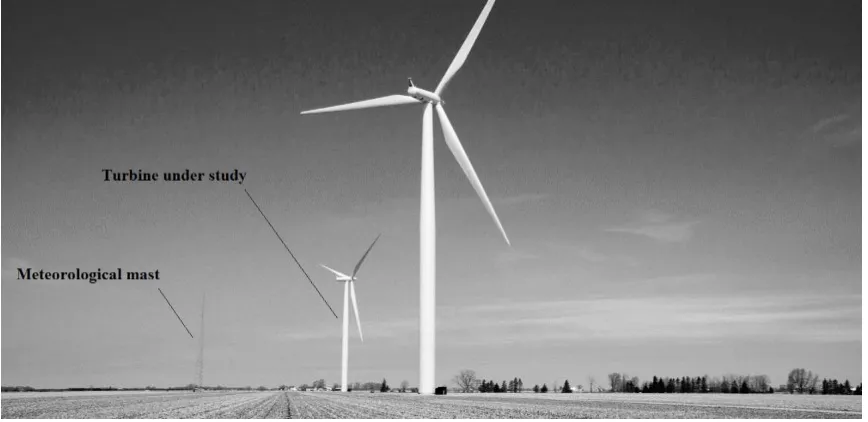
A North-facing view of the testing site is also shown in Figure 2.2, with the studied
turbine indicated in the background and the closest turbine in the foreground. The
meteorological mast is also depicted.
Figure 2.2: Ground view of the testing site layout.
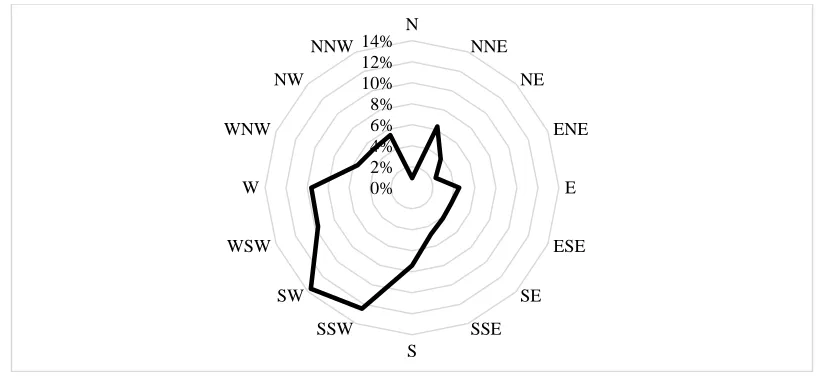
The onsite wind rose over the six-month measurement campaign is shown in Figure 2.3,
with the Southwest acting as the predominant wind direction. To assess directly the
parameters in the incoming wind profile, this research will study the land-influenced
winds from the Westerly direction (270° ± 30°). This wind sector is also clear of other
turbines operating in close proximity to the studied turbine, with none located within
10
Figure 2.3: Wind rose for direction probability over study period, as measured by meteorological mast.
The meteorological mast features five anemometers elevations spanning the bottom of
the swept rotor area to the hub height at elevations of 34, 61, 70, 77 and 80 m above
ground level. A short data sample has been included in Appendix A, showing the wind
speed data output from the mast. A wind vane is also located 77 m above ground level to
assess prevailing wind direction. Vertical wind shear is evaluated from using 10-minute
averages of the shear exponent given in the power law equation [16]:
U(z) = UR (z zR)
α (1)
where U is the mean horizontal wind speed at a given height z, and UR is the mean speed
at a given reference height zR. Turbulence levels are evaluated using the 10-minute hub
height horizontal turbulence intensity [17]:
𝐼𝑈 = 𝜎𝑢
𝑈 (2)
where σu and U are the horizontal wind speed standard deviation and mean at 80 m. Wind
conditions are categorized into two wind profile classes: turbulent and sheared.
0% 2% 4% 6% 8% 10% 12% 14%
N
NNE
NE
ENE
E
ESE
SE
SSE S
SSW SW WSW
W WNW
11
Turbulence intensity and wind shear thresholds for wind condition classifications are
given in Table 2.1, and have been adapted from thresholds used by Rareshide et al. [11].
Table 2.1: Wind condition classification.
Wind Condition Wind Shear Turbulence Intensity
Turbulent α < 0.2 Low High
IU > 11%
Sheared High
α > 0.2
Low IU < 11%
Data has been provided from the wind farm operator at a ten-minute resolution over the
measurement campaign spanning September 2011 to February 2012. The atmospheric
boundary layer conditions describing the approaching wind profile, provided by the
meteorological mast, are correlated with the turbine power output, provided by the
supervisory control and data acquisition (SCADA) system in place at the farm.
2.3 RESULTS
2.3.1 Onsite Atmospheric Conditions
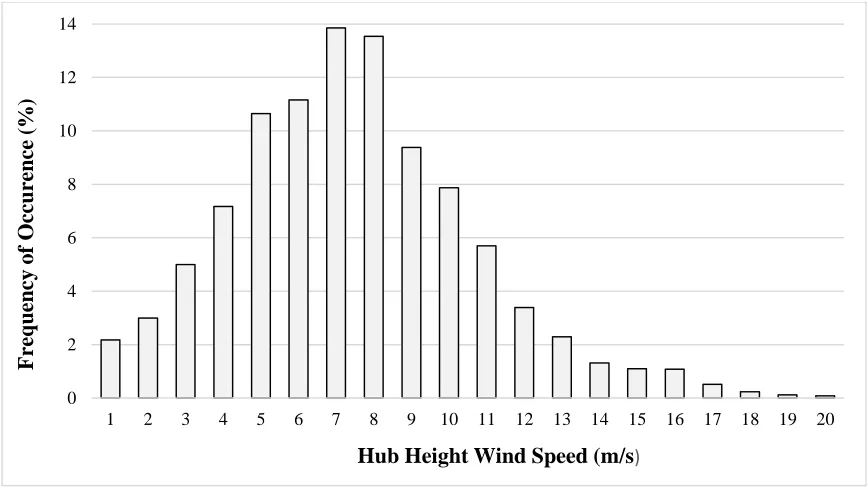
Onsite wind speed frequency distribution for winds from the Westerly sector for
September 2011 through February 2012 is shown in Figure 2.4. The preliminary
measurement campaign conducted before farm construction had classified the site as an
IEC 61400-1 [1] Class IIb site, with moderate annual average wind speeds at hub height
12
Figure 2.4: Wind speed distribution for Westerly sector.
The diurnal variation in speed measurements taken by the hub height anemometer for
winds observed in the Westerly sector is shown in Figure 2.5, averaged over the entire
six-month measurement campaign. The resulting power production for the studied
turbine is indicated as well, and normalized using turbine rated power similarly to
Wharton & Lundquist [13]:
𝑃𝑛𝑜𝑟𝑚 = 𝑃
𝑃𝑟𝑎𝑡𝑒𝑑 × 100%
where 𝑃𝑛𝑜𝑟𝑚 is the normalized active power produced by the turbine, 𝑃 is the actual
active power, and 𝑃𝑟𝑎𝑡𝑒𝑑 is the nameplate or maximum power the turbine will produce.
0 2 4 6 8 10 12 14
1 2 3 4 5 6 7 8 9 10 11 12 13 14 15 16 17 18 19 20
F
re
qu
ency
of
O
cc
urence
(
%
)
13
Figure 2.5: Diurnal variation in wind speed and resulting power production for Westerly sector.
As expected, turbine power production and onsite wind speed correlate well. Power
production reaches a maximum during the mid-to-late afternoon where neutral
atmospheric stability can be expected.
In Figure 2.6, the averaged diurnal variation in vertical wind shear and hub height
horizontal turbulence intensity are shown, and the two inflow parameters demonstrate a
degree of inverse correlation. Wind shear is highest during the early morning hours, and
turbulence intensity is shown to peak near noon. Given that the surveyed months of the
measurement campaign are among the coldest in the Southern Canadian climate, wind
shear values will be higher than site average [18]. As a result, the aforementioned
thresholds outlined for defined sheared and turbulent wind profiles will produce a lower
percentage of turbulent data points for this study.
0.0 1.0 2.0 3.0 4.0 5.0 6.0 7.0 8.0 9.0 10.0 0 10 20 30 40 50 60
12:00:00 AM 4:00:00 AM 8:00:00 AM 12:00:00 PM 4:00:00 PM 8:00:00 PM 12:00:00 AM
H ub H ei ght Wi nd Spee d (m /s ) N orm al ized A ct ive Pow er (%)
Time of Day
Power
14
Figure 2.6: Diurnal variation in wind shear and turbulence for Westerly sector.
2.3.2 Power Production Across Condition
Characteristics for the sheared and turbulent ten-minute data points observed are shown
in Table 2.2. Sheared data points greatly outnumber turbulent. Of all sheared data points,
74% occur during nighttime hours from 7:00 PM to 7:00 AM, and 76% of turbulent data
points occur during daytime hours from 7:00 AM to 7:00 PM.
Table 2.2: Characteristics of wind condition in Westerly sector over study period.
Wind Condition Number of
Data Points Mean Wind Speed (m/s) Mean Wind Shear Exponent Mean Turbulence Intensity
Turbulent 893 7.76 0.08 15.63%
Sheared 3073 7.91 0.41 7.17%
Though mean wind speeds for turbulent and sheared conditions are close, the wind speed
distribution under each condition varies considerably, as depicted in Figure 2.7.
0 2 4 6 8 10 12 14 16 0 0.1 0.2 0.3 0.4 0.5 0.6 0.7 0.8
12:00:00 AM 4:00:00 AM 8:00:00 AM 12:00:00 PM 4:00:00 PM 8:00:00 PM 12:00:00 AM
T urbu lence Int ensi ty (% ) Wi nd Sh ear E x pon enet
Time of Day
Wind Shear
15
Figure 2.7: Wind speed distribution for sheared and turbulent conditions in Westerly sector.
Turbulent conditions are shown to coincide more frequently than sheared with wind
speeds both higher and lower than onsite average. Note that the turbulent condition
thresholds defined in this study generally align with both convective and neutral
atmospheric stability vertical wind shear exponent and horizontal turbulence intensity
thresholds defined by Wharton & Lundquist [8] and van den Berg [18], whereas the
sheared condition thresholds align with stable atmospheric stability thresholds. As a
result, turbulent condition speed distribution includes both the typically low-speed
convective and high-speed neutral winds.
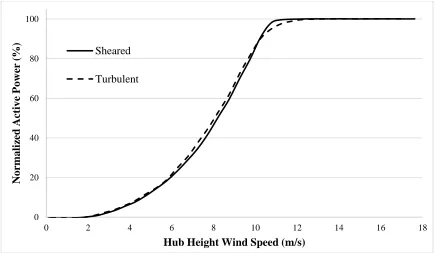
The resulting power production for the studied wind turbine is given in Figure 2.8 across
varying wind profile, where ten-minute data points have been averaged across 0.5 m/s
intervals to construct a power curve. The overall trend of the curve is typical of a
variable-speed, pitch-regulated commercial-sized wind turbine [19].
0 5 10 15 20 25 30 35
0-2 2-4 4-6 6-8 8-10 10-12 12-14 14-16 16-18 18-20 20-22
F
re
qu
ency
of
O
cc
urence
(
%
)
Hub Height Wind Speed (m/s)
Sheared
16
Figure 2.8: Power production of turbine under differing wind condition.
Turbulent conditions are shown to coincide with greater power production for hub height
wind speeds ranging from cut-in to more than 9 m/s. After which, sheared conditions are
shown to coincide with higher power production for speeds from 10 to 12 m/s, near “Region II” of the power curve where the turbine transitions into its rated speed
operational mode. Once rated power is achieved, the turbine controller increases blade
pitch to reduce rotor power coefficient and maintain steady power production. Were the aforementioned equivalent wind speed or “rotor disk-averaged” speed to be calculated
using hub height speed and wind shear exponent, it would be anticipated that turbulent
conditions would coincide with greater available energy flux in the approaching wind
profile. This could explain the phenomenon observed for hub height wind speeds up to 9
m/s. However, it is important to note that the shear exponent produced in this study only
considers wind speeds in the bottom half of the swept rotor area, and potential exists for
shear exponent to vary considerably across the rotor diameter above hub height [8] which
0 20 40 60 80 100
0 2 4 6 8 10 12 14 16 18
N
orm
al
iz
ed
A
ct
ive
P
ow
er
(
%
)
Hub Height Wind Speed (m/s) Sheared
17
would be undetectable given the currently available anemometry instrumentation at the
wind farm site. At winds speeds closer to rated, the more variable incoming wind speed
expected under turbulent conditions could adversely affect expected turbine performance
within the measured ten-minute periods. For example, for a ten-minute period having an
average wind speed near 11 m/s but with a high level of variance: higher winds within
this period will produce power no greater than rated, but lower winds within this period
will produce power less than rated. As a result, the average power the turbine will
produce over this ten-minute period will be less than if the wind speed were more
consistently near 11 m/s. A review of current literature does not produce an exact
consensus for the anticipated effects of atmospheric turbulence intensity on rotor power
coefficient, but the results suggest potential benefits to power production in the
low-to-moderate wind speed range and a detrimental effect in the higher wind speed range
before rated power is achieved, at least for this study site. The disparity in power
production across wind condition is shown in greater detail in Figure 2.9, where power
production is shown for wind speeds from 6 to 12 m/s, with a single standard deviation
18
Figure 2.9: Power production of turbine under differing wind condition for selected wind speeds.
Turbulent conditions retain a nearly 2% or more power increase over turbulent conditions
for speeds from 6 – 9 m/s. Whereas sheared conditions have a 2% increase in power
production over turbulent for speeds equal to 10 m/s, which diminishes at higher speeds.
The same comparison has been made in Figure 2.10, except the lake-influenced winds
from the Southerly wind sector (180° ± 15°) have been used instead. Wind direction
thresholds have been tightened to prevent potential wake interaction from the turbine
located nearby. Though some minor disparities exist, the same qualitative trend is
observed for sheared and turbulent winds from this sector.
0 10 20 30 40 50 60 70 80 90 100
6 7 8 9 10 11 12
N
orm
al
iz
ed
A
ct
ive
P
ow
er
(
%
)
Hub Height Wind Speed (m/s) Sheared
19
Figure 2.10: Power production of turbine under differing wind condition for Southerly wind sector.
2.4 CONCLUDING REMARKS & FUTURE WORK
At an onshore commercial wind farm site, trends in meteorological conditions and their
impacts on the power production of an individual turbine have been investigated, with the
following conclusions drawn and analyses conducted:
High-turbulence, low-shear conditions have been observed to coincide with
higher power production for low-to-moderate hub height wind speeds at the study
site.
High-shear, low-turbulence conditions have been observed to coincide with
higher power production for high hub height wind speeds below rated.
Trends in wind profile effects on power production for land-influenced winds for
the Westerly wind sector on site are qualitatively similar for lake-influenced
winds from the Southerly sector.
0 20 40 60 80 100
0 2 4 6 8 10 12 14 16 18
N
orm
al
iz
ed
A
ct
ive
P
ow
er
(
%
)
Hub Height Wind Speed (m/s) Sheared
20
Diurnal variation in atmospheric conditions were observed over the measurement
campaign, with identifiable peaks in turbulence intensity and wind shear
observed.
Future analyses could look to include data collected from the warmer months at the
studied site. Furthermore, collecting wind speed measurements at elevations in excess of
hub height could help to better explain the observed disparity in power production for
changing wind conditions. Use of remote sensing technology such as LiDAR or SoDAR
(sonic detection and ranging) could facilitate such measurements, and could be operated
at ground level without the need to construct a meteorological mast.
REFERENCES
[1] International Electrotechnical Commission, "IEC 61400-1 ed.3 Wind turbines - Part 1: Design requirements," Geneva, 2005.
[2] J. Sumner and C. Masson, "Influence of atmospheric stability on wind turbine
power performance curves," Journal of Solar Energy Engineering, vol. 128, no. 4,
pp. 531-538, 2006.
[3] R. Wagner, I. Antoniou, S. M. Pedersen, M. S. Courtney and H. E. Jørgensen, "The influence of the wind speed profile on wind turbine performance measurements,"
Wind Energy, vol. 12, no. 4, p. 348362, 2009.
[4] R. Wagner, H. E. Jørgensen, U. S. Paulsen, T. J. Larsen, I. Antoniou and L.
Thesbjerg, "Remote sensing used for power curves," in 14th Interntational
Symposium for the Advancement of Boundary Layer Remote Sensing, 2008.
[5] I. Antoniou, S. M. Pedersen and P. B. Enevoldsen, "Wind shear and uncertainties in
power curve measurement and wind resources," Wind Engineering, vol. 33, no. 5,
pp. 449-468, 2010.
[6] R. Frelich and N. Kelley, "Measurements of wind and turbulence profiles with
scanning Doppler lidar for wind energy applications," IEEE Journal of Selected
Topics in Applied Earth Observations and Remote Sensing, vol. 1, no. 1, pp. 42-47,
21
[7] F. Pasquill, “The estimation of the dispersion of windborne material,” The
Meteorological Magazine, vol. 90, no. 1063, pp. 33-49, 1961.
[8] S. Wharton and J. K. Lundquist, "Assessing atmospheric stability and its impact on
rotor-disk wind characteristics at an offshore wind farm," Wind Energy, vol. 15, no.
4,pp. 525-546, 2012.
[9] R. M. Banta, Y. L. Pichugina, N. D. Kelley, B. Jonkman and W. A. Brewer,
"Doppler lidar measurements of the Great Plains low-level jet: Applications to wind
energy," in 14th International Symposium for the Advancement of Boundary Layer
Remote Sensing, 2008.
[10] R. L. Leonard, Air Quality Permitting, Florida: CRC Press, 1997.
[11] E. Rareshide, A. Tindal, C. Johnson, A. Graves, E. Simpson, J. Bleeg, T. Harris and D. Schoborg, "Effects of complex wind regimes on turbine performance," in
Podium presentation at AWEA WINDPOWER 2009 Conference, Chicago, 2009.
[12] B. J. Vanderwende and J. K. Lundquist, "The modification of wind turbine
performance by statistically distinct atmospheric regimes," Environmental Research
Letters, vol. 7, 2012.
[13] S. Wharton and J. K. Lundquist, "Atmospheric stability affects wind turbine power
collection," Environmental Research Letters, vol. 7, 2012.
[14] Independent Electricity System Operator, "Wind Power Generation in Ontario," 2013. [Online]. Available:
https://www.ieso.ca/imoweb/siteShared/windtracker.asp?sid=ic. [Accessed 10 04 2014].
[15] Google, "Google Maps," 2013. [Online]. Available: http://maps.google.ca/. [Accessed 15 May 2013].
[16] O. G. Sutton, Atmospheric Turbulence, London: Methuen, 1949.
[17] T. Burton, D. Sharpe, N. Jenkins and E. Bossanyi, Wind Energy Handbook, Chicester: John Wiley & Sons, 2001.
[18] G. P. van den Berg, "Wind turbine power and sound in relation to atmospheric
stability," Wind Energy 11(2), pp. 151-169, 2008.
22 CHAPTER 3
Effects of Wind Regime and Inflow Parameters on Wind Turbine
Tower Loading
Jamie C. Smith1, Phillip McKay2, Rupp Carriveau1, David S-K Ting1, Tim Newson3
1Turbulence and Energy Laboratory, Ed Lumley Centre for Engineering Innovation,
University of Windsor, Ontario, Canada
2Wind Energy Institute of Canada, North Cape, Prince Edward Island, Canada
3Department of Civil and Environmental Engineering, University of Western Ontario,
London, Ontario, Canada
3.1 INTRODUCTION
Having reached their practical size limit, the conventional rigid steel lattice towers of the
previous generation of utility-scale horizontal-axis wind turbines have given way to the
flexible steel tubular towers favoured in the modern wind energy industry [1]. The
slender nature of their construction [2], along with the heavy distribution of mass
presented by the rotor-nacelle positioned at a maximum elevation, create a turbine tower
structure characterized by low natural frequencies and low structural damping. Modern
towers are often of “soft” design having first bending modes situated between the first
and second multiples of the rotational frequency of the rotor [2] and damping ratios on
the order of 1% [3]. As the rotor size and tower height of commercial turbines continue to
increase in order to maximize power production, added importance is placed on assessing
the impacts of the aerodynamic instability presented by vertical wind shear and the
gust-induced buffeting effects of horizontal turbulence intensity. Wind profile inflow
parameters such as shear and turbulence can affect power production [4 - 6], fatigue
23
This study will use physical data collected from a full-size operating wind turbine at an
onshore commercial farm in Southwestern Ontario to assess the loading impacts of
varying onsite wind conditions and their respective inflow parameters. Previous studies
conducted on this turbine have characterized the frequency content of the vibration
response to form the baseline of a structural health monitoring scheme [9, 10] as well as
the strain response of the tower to transient events such as rotor re-positioning and
manual shutdown [11, 12]. Rebelo et al. [13, 3] correlated stress magnitudes in the shell
and pre-stressed bolts of a steel turbine tower across operational wind speeds, along with
the quantification of the resulting fatigue loading spectra and characterization of the
dynamic response and modal properties of the turbine tower structure. Muto et al. [14]
investigated the effects of wind speed and turbulence levels on the tower base bending
moment of an operating turbine. Numerical modelling has previously been conducted for
the design and optimization of turbine tower structures [15 -17] and the impacts of wind
gusts and atmospheric turbulence on tower loading [18 - 20]. The purpose of this work is
to investigate the impacts of varying wind profiles and inflow parameters on the flexural
loading imparted to a conventional steel tubular wind turbine tower; including
consideration of load quasi-static mean, maxima, and variance across changing inflow
wind speed, shear, and turbulence. Such insight into loading magnitudes can assist in the
ultimate limit states design of turbine towers, as well as providing the baseline of healthy
or expected response for structural health monitoring employed by the wind farm
24 3.2 EXPERIMENTAL SETUP
3.2.1 Testing Site & Instrumented Turbine
The wind turbine under study is a Siemens 2.3 MW MKII variable-speed model with
blade pitch control. Rotor diameter and hub height measure 93 m and 80 m, respectively.
For ease of transportation and construction on-site, the hollow cylindrical steel tower
consists of three individual sections terminated by stiff flange sections that have been
bolted together. The tower measures 78.54 m in height, with an outer diameter that
measures 4220 mm at its base and 2452 mm at maximum elevation and a wall thickness
that measures 41 mm at its base and 22 mm at maximum elevation. The mass of the
tower accounts for half of the total mass of the turbine, excluding the foundation.
The studied turbine is one of eighty-eight machines at a commercial onshore wind farm
off the shores of Lake Erie, which is located more than 3000 m South of the studied
turbine. The farm is sited in an agricultural setting having predominantly flat terrain with
some surrounding tree hedges. The site has been classified as an IEC 61400-1 [21] Class
IIb site; having medium wind speeds (annual average close to 8 m/s) and relatively lower
turbulence levels. The 50-year return 3-second gust and 10-minute extreme wind speeds
at hub height have been quantified as 48 m/s and 34 m/s, respectively. Prevailing on-site
wind direction is from the Southwest, with roughly half of all wind direction
measurements falling between the Southerly and Westerly directions. No turbine is
located within twenty rotor diameters upwind of the turbine in this wind sector, which
suggests that wake interaction from other onsite turbines will be minimal in this sector.
A fiber Bragg grating (FBG) sensor array, as presented by Bas et al. [11, 12], measures
25
the tower at six different elevations. The array transmits a broadband light source through
fiber optic cables to the gauges, and the reflected light wavelength from each individual
gauge will be proportional to its strain. The vertical location of each set of strain gauges
and corresponding tower outer diameter, wall thickness, and moment of inertia are
included in Table 3.3.
Table 3.3: Strain gauge locations and corresponding tower properties.
Level Elevation (m) Diameter (mm) Wall Thickness
(mm)
Moment of Inertia (m4)
5 77.3 2452 22 0.1240
4 65.0 3071 13 0.1460
3 41.8 4200 14 0.403
2 14.46 4200 25 0.715
1 4.46 4200 31 1.123
0 0 4220 41 1.175
3.2.2 Wind Classification
The turbine is located 150 m East of a meteorological mast outfitted with a vertical array
of cup anemometers at five different elevations: 34, 61, 70, 77 and 80 m above ground
level. This spans an elevation from the bottom of the turbine rotor to hub height. A wind
vane is also located at 77 m above ground level to assess prevailing wind direction. Wind
conditions are categorized into two classes using two key inflow parameters: vertical
wind shear and horizontal (longitudinal) turbulence, which will frequently demonstrate
inverse correlation [5]. These parameters can be used to infer atmospheric stability in the
boundary layer, and commercial wind farms are more likely to have the proper
instrumentation on-site to quantify such parameters than other measures
classically-employed for stability such as vertical change in potential temperature and the Obukhov
26
referred to as “turbulent.” This condition describes the expected unstable, convective
wind profile produced by solar ground heating during the day which facilitates vertical
circulation of air masses in the atmospheric boundary layer. The second class is the “sheared” condition characterized by high-shear and low-turbulence, which describes the
expected stable wind profile expected during stratification of airflow as the ground cools
at night and vertical motion is suppressed. Thresholds for wind condition classification
are given in Table 3.4 and have been adapted from those used by Rareshide et al. [23] to
determine the impacts of shear and turbulence on power production. Wind shear is
evaluated from 34 m to 80 m using 10-minute averages of the shear exponent given in the
power law equation [24]:
U(z) = UR (z zR)
α (1)
where U is the mean horizontal wind speed at a given height z, and UR is the mean speed
at a given reference height zR, which for this study will be the hub height of 80 m.
Turbulence levels are evaluated using the 10-minute horizontal turbulence intensity [25]:
𝐼𝑈 = 𝜎𝑢 𝑈 (2)
where σu and U are the horizontal wind speed standard deviation and mean at 80 m.
Table 3.4: Wind condition classifications.
Wind Condition Wind Shear Turbulence Intensity
Turbulent High
α < 0.2
Low IU > 11%
Sheared Low
α > 0.2
27 3.2.3 Signal Analysis
A half-hour sample of the strain signal produced by the FBG array at 100 Hz for the West
interior face near tower mid-height is shown in Figure 3.11. When the sample was
recorded, winds were coming from the Westerly sector at hub height speeds having an
average near 6.5 m/s and were classified as turbulent according to previously outlined
thresholds in Table 3.4. Though mean wind speed rises over the course of the sample
study period, the effects of prolonged gusts are also evident in the signal, as seen in the
short-term rise and fall of the tower strain. Such gusts acting on the turbine cause an
increase in tower quasi-static load, followed by periods of increased vibration. Applying
a fast Fourier transform (FFT) highlights a noticeable spectral peak at 0.325 Hz, as shown
in Figure 3.12. This frequency corresponds to the expected fundamental bending mode in
the fore-aft direction of a turbine structure of this size and capacity [3, 26]. A second,
lesser spectral peak is also observed near 2.80 Hz; speculated to be the second bending
mode frequency in the fore-aft direction of the turbine. Note that gust-induced vibration
is significant for structures with eigenfrequencies less than 2 Hz, given the high spectral
28
Figure 3.11: Strain signal under turbulent winds.
Figure 3.12: FFT plot under turbulent winds.
The half-hour strain signal from the same gauge is shown in Figure 3.13, under Westerly
winds with speeds closer to 7.5 m/s. For this time period, winds were classified as
sheared according to previously outlined thresholds. FFT analysis, shown in Figure 3.14,
likewise demonstrates spectral peaks at 0.325 and 2.86 Hz. High local spectral energy is
0 50 100 150 200 250 300
0 200 400 600 800 1000 1200 1400 1600 1800
S
tr
ain
(E
-06)
Time (s)
0.5 1 1.5 2 2.5 3 3.5 4 4.5 5 0
0.5 1 1.5 2 2.5
Frequency (Hz) (b)
| Y
29
also noted at a frequency near 0.70 Hz, corresponding to near three times the rotational
frequency of the rotor (also known as the blade passing frequency for a three-bladed
turbine) at the given hub height wind speed.
Figure 3.13: Strain signal under sheared winds.
Figure 3.14: FFT plot under sheared winds.
0 50 100 150 200 250 300
0 200 400 600 800 1000 1200 1400 1600 1800
S
tr
ain
(E
-06)
Time (s)
0.5 1 1.5 2 2.5 3 3.5 4 4.5 5 0
0.5 1 1.5 2 2.5
Frequency (Hz) (b)
| Y
30 3.2.4 System Calibration
To study the wind profile directly upstream of the turbine and the windward response of
the tower, winds from the Westerly sector (having an average ten-minute wind direction
at 77 m equal to 270° ± 15°) and readings from the East and West gauges will be
considered in the analysis. A smaller wind sector than that outlined in Section 2.2 has
been used, given the dependency of tower strain on prevailing wind direction and
resulting nacelle orientation. The strain values produced by the FBG array are not
absolute, given that the system was installed after turbine construction. As a result, the
time independent compressive stress presented by the weight of the rotor-nacelle and the
self-weight of the tower are not reflected in measured values. Given that the weights of
these components are known, the resulting compressive stress at the tower base is
estimated near 5.22 MPa. Measured strain values represent a deviation from a baseline
established when hub height wind speeds were low (less than 1.5 m/s), the rotor was idle,
and the nacelle was facing the West direction. The resulting strain values will therefore
also not include the stress introduced by the eccentricity of the rotor-nacelle bearing onto
the tower [11], which has experimentally been shown to be near 3 MPa at the tower base.
Readings taken by the strain gauge array have been converted to stress, assuming linear
elastic behaviour, and then converted to flexural load using section properties as the
corresponding level of the tower, as per the fundamental equation for a beam element
subjected to flexural loading [28]:
𝜀 ∙ 𝐸 = 𝑀 ∙ 𝑦 𝐼 (4)
where 𝜀 is the longitudinal strain value produced, 𝐸 is the elastic modulus of the tower
31
neutral axis of the tower section to the horizontal position of the gauge at the interior of
the tower wall, and the 𝐼 is the moment of inertia for the tower section. These loading
values have been compiled into ten-minute mean, maximum, and standard deviation
values, and were correlated with readings taken by the meteorological mast and turbine operational values recorded by the farm’s supervisory control and data acquisition
(SCADA) system. Data has been collected over a measurement campaign conducted
from September 2011 to October 2011 and from December 2011 to February 2012.
3.3 RESULTS
3.3.1 Loading Across Wind Speed
Mean values for flexural loads and vertical deformation recorded by the installed FBG
array are shown in Figure 3.15 for average on-site wind speeds (8.0 m/s ± 0.5 m/s) from
the Westerly sector, with a single standard deviation indicated in mean value indicated.
Values have been collected from the West interior face of the tower and across its
32
Figure 3.15: Average (a) bending moment and (b) vertical strain in the tower for average wind speeds.
As expected in Figure 3.15(a), loading is at a maximum at Level 0 at the tower’s base.
Bending moment from Level 5 (77.34 m) to Level 2 (14.46 m) increases linearly with
distance away from the rotor, as the moment arm produced by axial rotor thrust increases.
An increase in this trend is observed at Level 1 (4.46 m), however, which is speculated to be the result of this gauge’s proximity to the turbine’s maintenance access door at the
base of the turbine. The opening and surrounding stiffening elements are expected to
impact the stress distribution close to the door [17]. Maximum deformation is shown to
occur at Level 3 (41.84 m) near tower mid-height. The disparity in strain levels across the
tower result from the distribution of section properties, particularly tower diameter and
wall thickness. The major disparity between the strain observed at Level 4 (65.02 m) and
Level 5 in Figure 3.15(b) is not only the result of a reduction in the moment arm, but also
the increased thickness of the tower section at Level 5 in order to prevent localized
33
deviation values for strain measured within ten-minute averaging periods are observed to
be highest for Level 3.
Mean base bending moment values at Level 0 are plotted versus wind speed measured by
the meteorological mast at 80 m above ground level in Figure 3.16. A total of 1463
ten-minute data points have been compiled over the twelve-week study period. Note that
positive values indicate tension and negative values indicate compression.
Figure 3.16: Mean base bending moment versus wind speed for Westerly winds.
Axial rotor thrust causes Westerly winds to introduce compressive and tensile loading
onto the East and West faces of the tower, respectively. Outliers exist from periods where
sudden and severe changes in wind direction caused temporary rotor misalignment.
Above cut-in speed, moment magnitudes increase proportionally with wind speeds up to
a maximum at 11 m/s, where rated power production is achieved. The average mean bending moment at rated speeds (± 0.5 m/s) is approximately 30 200 kN∙m. For speeds in
excess of rated, loading gradually reduces with increasing wind speed, while power
-40000 -30000 -20000 -10000 0 10000 20000 30000 40000
0 2 4 6 8 10 12 14 16 18 20 22
M
ean
B
en
d
in
g
M
om
en
t
(kN∙
m
)
34
production remains essentially constant. Similar phenomenon was demonstrated by
Rebelo et al. [3] and Muto et al. [14]. This observed reduction in rotor thrust is typical of
pitch-regulated wind turbines [2], and is the result of rotor blades pitching towards a
feathered position from the approximately -1° pitch angle they maintain during typical
operation, as a means of preventing turbine overload. For a hub height wind speed equal
to 20 m/s, blade pitch angle approaches 19° with loading magnitude approximately equal
to those encountered at a speed of 6.5 m/s.
Maximum base bending moment values at the West and East interior face of Level 0 are
plotted versus wind speed in Figure 3.17. Also shown is the resulting moment-based gust
loading factor for the West face in Figure 3.18. Wind speeds below cut-in have been
removed. The gust loading factor represents a ratio between the expected extreme and
mean load values, and is employed in the design of structures subjected to buffeting by
wind gusts. This factor is described using the following equation [28]:
𝐺𝑀 = 𝑀̂⁄ = 1 + 𝑔𝑀̅ 𝑀𝜎𝑀̅⁄ (5)𝑀̅
where 𝐺𝑀 is the moment-based gust factor, 𝑀̂ is the extreme base bending moment, 𝑀̅ is
the mean base bending moment, 𝑔𝑀 is the gust peak factor, and 𝜎𝑀̅ is the standard
35
Figure 3.17: Maximum base bending moment versus wind speed for Westerly winds.
Figure 3.18: Gust loading factor versus wind speed for Westerly winds.
In Figure 3.17, maximum flexural load values again increase proportionally for speeds
between cut-in and rated. The average maximum bending moment observed at rated speeds (± 0.5 m/s) is approximately 37 600 kN∙m. For speeds in excess of rated,
maximum load values will also reduce, but more gradually than corresponding mean load
-50000 -40000 -30000 -20000 -10000 0 10000 20000 30000 40000 50000
2 4 6 8 10 12 14 16 18 20 22
M ax B en d in g M om en t (kN∙ m )
Wind Speed at 80 m Above Ground Level (m/s)
West East 1 1.2 1.4 1.6 1.8 2 2.2 2.4
2 4 6 8 10 12 14 16 18 20 22
G u st L oad in g F ac tor
Wind Speed at 80 m Above Ground Level (m/s)
36
values in this wind speed region. At a hub height wind speed of 20 m/s, the maximum
loading magnitude encountered is near that of a wind speed equal to 7.5 m/s. After
manual inclusion of the compressive load introduced by turbine self-weight, as well as
the inclusion of the moment produced by the eccentricity of the rotor-nacelle bearing, the
maximum absolute stress observed over the measurement campaign from operation in a
Westerly wind is equal to a compressive stress of 497 MPa in the East interior face of the
tower. The resulting moment-based gust loading factor values are shown in Figure 3.18
to be at a minimum for rated wind speed and then increase for all greater wind speeds.
Such phenomenon was likewise demonstrated by Muto et al. [14], and is the result of the
pitch excitation type vibration that will occur after blade pitch control is activated. In this
operating condition, sudden reductions in wind speed during gusts result in a rise in axial
rotor thrust. As a result, the mean base bending moment will decrease rapidly compared
with maximum moment, and the gust loading factor will increase [14, 29]. Below rated
wind speed, higher gust factor values are observed near cut-in wind speed, which is
speculated to be the result of dynamic magnification of the asymmetrical thrust load
across the turbine rotor. The rotational speed of the rotor at cut-in wind speed is near 7
rpm, with a resulting blade passing frequency of 0.35 Hz, which is in close proximity to
the expected first bending mode frequency. Generator cut-in has also been shown to
coincide with sudden increases in strain [12]. Higher gust factor values are also observed
for wind speeds near 8 m/s, where maximum rotor rotational speed is reached, and
37 3.3.2 Loading Across Wind Condition
Diurnal ground heating is attenuated during the colder months at the testing site during
the measurement campaign, resulting in limited turbulent and frequent sheared
conditions, having high shear exponents in the land-influenced Westerly sector. Wind
conditions demonstrate diurnal correlation; with 83% of turbulent data points occurring
from 7:00 AM - 7:00 PM, and 74% of sheared data points occurring from 7:00 PM – 7:00
AM. Mean values encountered for both wind conditions are shown in Table 3.5.
Table 3.5: Characteristics of wind conditions in Westerly sector during study period.
Wind Condition Number of
Data Points
Mean Wind Speed (m/s)
Mean Wind Shear Exponent
Mean Turbulence Intensity
Turbulent 171 8.49 0.07 14.86%
Sheared 753 7.94 0.39 7.20%
Data points for the West interior face of the tower in Figure 3.16 and Figure 3.17 are
classified into their respective wind condition class in Figure 3.19 and Figure 3.20. Mean
and maximum bending moment values have been binned and averaged at intervals of 1
m/s. Note that a portion of the original 1463 data points included in Figure 3.16 did not
adhere to the inflow parameter thresholds for either wind condition class and were
therefore excluded. Aforementioned outliers have also been removed, as well as data
38
Figure 3.19: Mean base bending moment versus wind speed, classified by wind condition.
Figure 3.20: Maximum base bending moment versus wind speed, classified by wind condition.
Sheared conditions are shown to coincide with marginally higher mean base bending
moment than turbulent conditions across nearly all wind speeds. However, maximum
bending moment values for sheared and turbulent conditions remain relatively close. The
moment-based gust loading factor will therefore be increased under turbulent conditions.
0 5000 10000 15000 20000 25000 30000 35000
2 4 6 8 10 12 14 16 18
Me an B en d in g Mom en t (kN∙ m )
Wind Speed at 80 m Above Ground Level (m/s)
Sheared Turbulent 0 5000 10000 15000 20000 25000 30000 35000 40000 45000
2 4 6 8 10 12 14 16 18
M ax B en d in g M om en t (kN∙ m )
Wind Speed at 80 m Above Ground Level (m/s)
Sheared
39
Variance in base bending moment values for turbulent and sheared conditions are shown
in Figure 3.21, along with the variance in wind direction and nacelle position in Figure
3.22. Yaw systems are a critical turbine subassembly with potential for high failure rates
in variable speed wind turbines [30]. Re-positioning of the rotor moves the high eccentric
load imparted to the tower [11]. High levels of yaw activity indicate the potential for
periods of rotor misalignment with prevailing wind direction, which can introduce
increased in stresses into the tower and can damage rotor-nacelle components such as the
main shaft bearing [31]. Individual turbines at the farm yaw themselves independently
based on wind direction measurements taken by the meteorological station located at the
back of their nacelle.
Figure 3.21: Base bending moment standard deviation versus wind speed. 0
500 1000 1500 2000 2500 3000 3500 4000 4500 5000
2 4 6 8 10 12 14 16 18
B
en
d
in
g
M
om
en
t
S
tand
ar
d
D
eviat
ion
(
kN∙
m
)
Wind Speed at 80 m Above Ground Level (m/s)
Sheared
40
Figure 3.22: Directional & nacelle position standard deviation versus wind speed.
Base bending moment standard deviation values generally increase with increasing wind
speeds. For comparable speeds, turbulent conditions predominantly exhibit higher
loading variance than sheared conditions. Though this trend can partially be attributed to
higher variance in wind direction, resulting in increased yawing activity, it suggests the
potential for increased forced vibration of the tower from atmospheric turbulence. The
higher variation in wind direction under turbulent conditions translating to higher nacelle
movement would also contribute to the lower mean loads observed under such
conditions, as the West gauge would demonstrate lower loading values when rotor thrust
was not acting in line with the West direction. Note that both condition classes
demonstrate local maxima near wind speeds of 8 and 12 m/s. The first maxima, as
previously mentioned, coincides with the initiation of rotor speed control by the turbine
generator. The second maxima coincides with the initiation of pitch control to regulate
turbine power production.
0 1 2 3 4 5 6 7 8 9 10
2 4 6 8 10 12 14 16 18
S
tand
ar
d
De
viation
(
°
)
Wind Speed at 80 m Above Ground Level (m/s)
Sheared - Wind Direction at 77 m Turbulent - Wind Direction at 77 m Sheared - Nacelle Position
41 3.3.3 Effects of Inflow Parameters
To identify the de-coupled impacts of turbulence intensity and wind shear inflow
parameter, points were taken in which the wind shear exponent was restricted to average
on-site values plus or minus half a standard deviation (α = 0.3 ± 0.07) and turbulence
intensity values were binned into ranges across wind speeds. In Figure 3.23, gust loading
factor for the West interior face of the tower under Westerly winds is shown for changing
turbulence intensity and wind speed with near constant wind shear. Also included are
gust loading factor values for the South interior face of the tower under Southerly winds
coming off Lake Erie. Southerly winds account for 48% of the data points represented in
Figure 3.23.
Figure 3.23: Gust loading factor versus wind speed and turbulence intensity for near constant wind shear.
Gust loading factor is shown to be higher across all surveyed wind speeds for increased
turbulence levels. These results agree with the trend predicted by the empirical
formulation of the gust load factor by Ishihara et al. [32] for commercial-sized wind
turbines, and experimentally verified by Muto et al. [14]. Though this trend can partially
be explained as resulting from higher yawing activity under more turbulent conditions, it
1.2 1.3 1.4 1.5 1.6
4 6 8 10 12 14 16
G
u
st
L
oad
in
g
F
ac
tor
Wind Speed (m/s)
5% < TI < 10%
![Figure 2.1: Aerial view of wind turbine under study and testing site layout [15].](https://thumb-us.123doks.com/thumbv2/123dok_us/1415184.1174073/20.612.117.535.421.637/figure-aerial-view-wind-turbine-study-testing-layout.webp)