
ADVANCED ENCRYPTION STANDARD (AES) COPROCESSOR
LIM JOO SONG
ADVANCED ENCRYPTION STANDARD (AES) COPROCESSOR
LIM JOO SONG
A project report submitted in partial fulfillment of the requirements for the award of the degree of
Master of Engineering (Electrical - Computer & Microelectronic System)
Faculty of Electrical Engineering Universiti Teknologi Malaysia
iii
ABSTRACT
The purpose of this project is to design a high throughput Advanced
Encryption Standard (AES) coprocessor using SystemVerilog Hardware Description Language (HDL). AES coprocessor has been widely used to offload the compute intensive cryptography tasks from the main processor due to its efficiency and performance compare to the pure software solution. Conventional AES core design using iterative loop approach is not optimized for high throughput operation.
iv
ABSTRAK
Projek ini bertujuan mereka betuk kopemproses Advanced Encryption
Standard (AES) yang berthroughput tinggi dengan menggunakan SystemVerilog
HDL. Kopemproses AES telah digunakan secara meluas untuk mengambil alih tugas pengiraan intensif kriptogafi daripada pemproses utama kerana ia mempunyai kecekapan dan prestasi yang lebih tinggi daripada kaedah menggunakan preisian. Kebiasaanya reka bentuk AES yang menggunakan kaedah interaktif tidak dapat menghasilkan throughput yang tinggi. Justeru itu, seni bina pipeline adalah kaedah yang biasa disyorkan untuk tujuan membina reka bentuk yang dapat menghasilkan
throughput yang tinggi. Walau bagaimana pun, kebanyakan reka bentuk yang
berkemampuan tinggi biasanya bergantung kepada ciri-ciri istimewa yang ditawarkan oleh vendor tertentu untuk menjana prestasi yang tinggi. Ini
menyebabkan reka bentuk tersebut tidak generik dan mempunyai kemudahalihan yang rendah. Kaedah yang digunakan untuk mereka bentuk kopemproses dalam projek ini adalah kaedah bottom-up, dimana kopemproses AES yang tidak
berpipeline dibina dahulu untuk tujuan menjadikan reka bentuk asas. Selepas itu, berbagai jenis reka bentuk pipeline dikaji dengan terliti. Jenis kriteria yang diselidik termasuk throughput, saiz dan keupayaan peningkatan. Hasil daripada penyelidikan tersebut menunjukkan reka bina pipeline Full Outer-Round adalah lebih cekap dari segi throughput and saiz. Selain daripada itu, usaha dalam membina modal Full Outer-Round pipline telah hasilkan satu kaedah baru yang dikenali sebagai Single Datapath Dual Output (SDDO) , diman ia dapat mengandakan throughput daripada kopemproses pipeline. Keputusan simulasi menunjukkan kaedah SDDO memang dapat mengandakan throughput reka bina pipeline dengan hanya memerlukan penambahan sumber sebanyak 7% sahaja.
v
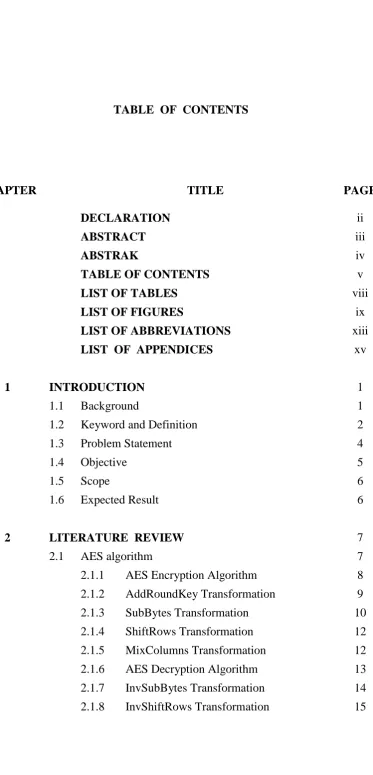
TABLE OF CONTENTS
CHAPTER TITLE PAGE
DECLARATION ii
ABSTRACT iii
ABSTRAK iv
TABLE OF CONTENTS v
LIST OF TABLES viii
LIST OF FIGURES ix
LIST OF ABBREVIATIONS xiii
LIST OF APPENDICES xv
1 INTRODUCTION 1
1.1 Background 1
1.2 Keyword and Definition 2
1.3 Problem Statement 4
1.4 Objective 5
1.5 Scope 6
1.6 Expected Result 6
2 LITERATURE REVIEW 7
2.1 AES algorithm 7
2.1.1 AES Encryption Algorithm 8
2.1.2 AddRoundKey Transformation 9
2.1.3 SubBytes Transformation 10
2.1.4 ShiftRows Transformation 12
2.1.5 MixColumns Transformation 12
2.1.6 AES Decryption Algorithm 13
vi
2.1.9 InvMixColumns Transformation 16
2.1.10 Key Expansion 16
2.2 Pipelined Architecture 18
2.2.1 Outer-Round Pipeline 20
2.2.2 Inner-Round Pipeline 21
2.2.3 Inner and Outer-Round Pipeline Combination
22
2.2.4 Loop Unrolling 24
2.3 Review of Previous Works 25
2.3.1 Previous Work 1 28
2.3.2 Previous Work 2 28
2.3.3 Previous Work 3 29
2.3.4 Previous Work 4 29
2.3.5 Previous Work 5 30
2.3.6 Previous Work 6 30
2.3.7 Previous Work 7 31
2.3.8 Previous Work 8 31
2.3.9 Previous Work 9 32
2.3.10 Previous Work 10 32
2.3.11 Previous Work 11 33
2.3.12 Summary of Previous Work Review 33
3 DESIGN AND METHODOLOGY 35
3.1 AES-128 Coprocessor Design 36
3.1.1 ShiftRows Module 37
3.1.2 MixColumns Module 39
3.1.3 SubBytes Module 42
3.1.4 AES 128 Module (non-pipelined Architecture)
46 3.1.5 Round Key Generator (KeyGen) 48
3.1.6 RTL Control Unit 51
3.1.7 Top Level Module of the Non-pipelined AES Coprocessor
55 3.1.8 Performance Analysis of the
Non-pipelined AES Coprocessor
58
3.2 Pipelined AES Architecture 60
3.2.1 Pipelined AES Core 61
3.2.2 RTL Control Unit for Pipelined AES Coprocessor
vii
3.2.3 Top Level Module of the Pipelined AES Coprocessor
67 3.2.4 Performance Analysis of the Pipelined
AES Coprocessor
69 3.3 Single Datapath Dual Output (SDDO) Architecture 72
3.3.1 SDDO Design Consideration and Limitation
74 3.3.2 Pipelined AES Coprocessor with SDDO 77 3.3.3 SDDO Modification of AES Core 78 3.3.4 SDDO Modification of RTL Control Unit 81 3.3.5 Top Level Module of the Pipelined SDDO
AES Coprocessor
83 3.3.6 Performance Analysis of the Pipelined
SDDO AES Coprocessor
85
4 BENCHMARKING 89
4.1 Benchmarking With Previous Works 89
5 CONCLUSION 92
6 SUGGESTION FOR FUTURE WORK 94
REFERENCES 95
Appendices A1 - A7 97-118
Appendices B1- B6 121-134
viii
LIST OF TABLES
TABLE NO. TITLE PAGE
1.1 Key-Block-Round Relation 4
2.1 Summary of Previous Works 25
3.1 RTL-CS Table of the Control Unit 54
3.2 Performance Summary of Non-pipelined AES Co-processor
59
3.3 Pipelined RTL-CS Table 66
3.4 Performance Summary of Pipelined AES Coprocessor 70
3.5 Pipelined SDDO RTL-CS Table 82
3.6 Performance Comparison Summary of 3 Different Architectures
87
4.1 Benchmark of Previous Work 89
ix
LIST OF FIGURES
FIGURE NO. TITLE PAGE
2.1 Input bytes, State array and Output bytes 8
2.2 AES encryption flow 9
2.3 AddRoundKey Operation 10
2.4 SubBytes Operation using S-box 11
2.5 Pipelined RTL-CS Table Pre-calculated S-box value (in hexadecimal format)
11
2.6 ShiftRow Operation 12
2.7 MixColumns Operation 12
2.8 AES decryption flow (Equivalent Inverse Cipher) 14 2.9 Pre-calculated inverse S-box value (in hexadecimal
format)
15
2.10 InvShiftRows operation 15
2.11 Encryption: forward key scheduling 17
2.12 Decryption: reverse key scheduling 17
2.13 Non-pipelined 3 stages system 18
2.14 Pipelined 3 stages system 19
2.15 Non-pipelined AES 19
2.16 Partial Outer-Round Pipeline 20
x
2.18 Inner-Round Pipeline 21
2.19 Partial Inner-Outer Round Pipeline 23
2.20 Full Inner-Outer Round Pipeline 23
2.21 Loop-unrolling Pipeline 24
2.22 Partial Loop-unrolling Pipeline 24
3.1 Methodology Flow Chart 35
3.2 Sub-module of the AES Coprocessor 36
3.3 ShiftRows operation for the Encryption 37
3.4 ShiftRows operation for the Decryption 38
3.5 Functional Block Diagram (FBD) of ShiftRows 38
3.6 Simulation Result of the ShiftRows Module 38
3.7 DFG of MixColumns Operation for One Byte 40
3.8 Functional Block Diagram of the MixColumnWord (4 bytes)
41
3.9 Functional Block Diagram of the MixColumns Block 41 3.10 Simulation Result of the MixColumns Module 42
3.11 DFG of Inverse Multiplication 43
3.12 Functional Block Diagram of the SubBytes_Bytes module (1 byte)
44
3.13 Functional Block Diagram of the full SubBytes module (16 bytes)
45
3.14 Simulation Result of the SubBytes Module 45
3.15 Functional Block Diagram of the Non-pipelined AES 128 Module
46
3.16 Simulation Result of Non-pipelined AES 128 Module 47
3.17 Reference Sample from FIPS-197 48
xi
3.19 Decryption: reverse key scheduling 49
3.20 Functional Block Diagram of the Round Key Generator (KeyGen)
50
3.21 Simulation Result of the Key Generator 51
3.22 ASM Chart of the RTL Control Unit 52
3.23 ASM Chart and RTL Codes of the Control Unit 53
3.24 Simulation Result of the Control Unit 54
3.25 Block Diagram of the non-pipelined AES Co-processor 55 3.26 Simulation Result of the Non-pipelined AES
Co-processor
57
3.27 Compilation Summary of the Non-pipelined AES Co-processor
58
3.28 Latency of the Non-pipelined AES Core 59
3.29 Outer-round Pipelined AES Core 60
3.30 Pipelined Module for Initial Round 61
3.31 Pipelined Module for 2nd to 10th Round 62
3.32 Pipelined Module for Final Round 62
3.33 Pipelined AES-128 Core Module 63
3.34 Pipelined RTL Control Algorithm 64
3.35 Pipelined ASM Chart and RTL Codes 65
3.36 Block Diagram of the Pipelined AES Coprocessor 67 3.37 Simulation Result of the Pipelined AES128
(Encryption)
68
3.38 Simulation Result of the Pipelined AES128 (Decryption)
68
3.39 Latency of the Pipelined AES Core 69
3.40 Compilation Summary of the Pipelined AES Co-processor
xii
3.41 Pipelined Architecture Speedup Chart 71
3.42 Typical CU-DU Input-Output 73
3.43 SDDO CU-DU Input-Output 73
3.44 Different between SDDO and typical Datapath 74 3.45 Undetermined load enable signal at the falling edge of
clock
75
3.46 Replay of load enable signal at the falling edge of clock 76 3.47 Implementation sample of Load Enable Delay Register 76 3.48 Output Comparison between Pipelined and SDDO 77
3.49 Pipelined SDDO Module for Initial Round 78
3.50 Pipelined SDDO Module for 2nd to 10th Round 79
3.51 Pipelined SDDO Module for Final Round 80
3.52 Pipelined SDDO ASM Chart and RTL Codes 81
3.53 Pipelined SDDO AES Coprocessor 83
3.54 Simulation Result of the SDDO AES128 Coprocessor (Encryption)
84
3.55 Simulation Result showing the input data of the SDDO AES128 Coprocessor
84
3.56 Simulation Result showing the output data of the SDDO AES128 Coprocessor
85
3.57 Compilation Summary of the Pipelined SDDO AES Coprocessor
86
3.58 Latency of the Pipelined SDDO AES Core 86
xiii
LIST OF ABBREVIATIONS
AES - Advanced Encryption Standard
NIST - National Institute of Standard and Technology
XOR - Exclusive OR operation
LUT - Look Up Table
RAM - Random Access Memory
FPGA - Field Programmable Gate Array
HDL - Hardware Description Language
Gbps - Gigabit per second
GF(x) - Galois Field of x element
SBox - Substitution-box
BRAM - Block RAM
ROM - Read-only Memory
MHz - Megahertz
DMA - Direct Memory Access
CPU - Center Processing Unit
RTL - Register Transfer Level
CLB - Configurable Logic Block
CAM - Content Addressable Memory
DFG - Data Flow Graph
xiv
DU - Datapath Unit
KeyGen - Key Generator
ASM - Algorithmic State Machines
Mop/s - Mega-operation per second
CPD - Critical Path Delay
xv
LIST OF APPENDICES
APPENDIX TITLE PAGE
A1 ShiftRows module 97
A2 MixColumns Module 99
A3 SubBytes Module 102
A4 Non-pipelined AES 128 Module 106
A5 Round Key Generator (KeyGen) Module 109
A6 RTL Control Unit Module 116
A7 Top Level Module of the Non-pipelined AES Co-processor
118
B1 Pipelined Module for Initial Round 121
B2 Pipelined Module for 2nd to 10th Round 123
B3 Pipelined Module for Final Round 125
B4 Pipelined AES 128 Module 127
B5 Pipelined RTL Control Unit 131
B6 Top Level Module of the Pipelined AES Coprocessor
134
C1 Pipelined SDDO for Initial Round 138
C2 Pipelined SDDO for 2nd to 10th Round 140
C3 Pipelined SDDO for Final Round 143
C4 Pipelined SDDO AES128 Module 146
xvi
C6 Top level module of Pipelined SDDO AES Coprocessor
1
CHAPTER 1
INTRODUCTION
1.1 Background
Advanced Encryption Standard (AES) is security encryption standard
selected by the United State National Institute of Standard and Technology (NIST) in 2001 for electronic data protection purpose [1]. The AES algorithm can be
implemented in software, firmware, hardware or combination design. However, since the AES algorithm is compute intensive, the hardware implementation is the preference design due to performance and efficiency. Study shows the hardware implementation of AES algorithm is 60 times faster than the pure software approach [2]. Therefore the AES coprocessor is being widely used to offload the compute intensive cryptography tasks from the main processor.
2
AES is a subset of the Rijndael cipher developed by by Joan Daemen and Vincent Rijmen [4]. The Rijndael cipher allows data block and cipher key length in the multiple of 32 bits with a minimum of 128 bits and maximum of 256 bits. AES limits the data block length to 128 bits only and cipher key length of 128, 192 and 256 bits. AES is symmetric block cipher where a similar key is being used to perform both encryption and decryption on a fixed length block to block basis.
1.2 Keyword and Definition
The following definitions and Keyword are used throughout the document:
AES Advanced Encryption Standard Array A collection of identical entities. Affine
Transformation
A transformation through the multiplication by a matrix and followed by the addition of a vector. Bit Binary digit having a value of 0 or 1.
Block An array of bytes in a fixed length group. In this document, the Block size is 16 bytes.
Byte A group of eight bits.
Cipher Sequence of transformations that converts a plaintext to cipher text using a Cipher Key. It is also known as Encryption process.
Cipher Key Secret key that is used to encrypt or decrypt the plain text and cipher text through the cipher process. Cipher text Result from the Cipher. Input to the Inverse Cipher. Inverse Cipher Sequence of transformations that converts cipher text
to plain text using a Cipher Key. In this document it is known as Decryption process.
3
Plain text Data input to the Cipher function. Result from the Inverse Cipher
Rijndael Cryptopgraphic algorithm developed by Joan Daemen and Vincent Rijmen.
Round Key Series of keys that are derived from the Cipher Key using the Key Expansion routine. The keys are applied during Encryption and Decryption
State Intermediate result from the Cipher. Can be presented as a rectangular array of bytes with four rows and columns.
S-box Non-linear substitution table used in bytes substitution transformations and Key Expansion routine to perform one-to-one substitution of a byte value.
Word Group of 32 bits that is treated either as a single entity consist of 4 bytes.
AddRoundKey Transformation process in which a Round Key is added to the State using XOR operation.
InvMixColumns Transformation step during the Inverse Cipher in which the process is inverse of the MixColumns.
InvShiftRows Transformation step during the Inverse Cipher in which the process is inverse of the ShiftRows.
InvSubBytes Transformation step during the Inverse Cipher in which the process is inverse of the SubBytes
MixColumns Transformation step during the Cipher in which all the columns of the State are mixed in a certain way to produce new columns.
Rcon Round constant value.
RotWord Process of performing a cyclic permutation on a 4 bytes word during Key Expansion.
ShiftRows Transformation step during the Cipher in which the last three rows of the State is cyclically shifted by different offsets.
4
the State bytes is substituted by byte value from the S-box.
SubWord Process of taking a 4 bytes input word and applies an S-box to each of the 4 bytes to produce an output word during Key Expansion.
XOR Exculsive-OR operation.
1.3 Problem Statement
During encryption and decryption, AES algorithm applies four different byte-oriented transformations: SubBytes, ShiftRows, MixColumns and AddRoundKey in one round execution of the algorithm. A complete operation consists of applying several round of execution, depending on the Cipher Key size. Key length of 128 bits is known as AES-128, 192 bits is AES-192 and 256 bits is known as AES-256. Table 1.1 below shows the number of round required by the AES specification [1].
Table 1.1: Key-Block-Round Relation [1] Key Length, Nk
(words of 4 bytes)
Block Size, Nb (words of 4 bytes)
Number of Rounds, Nr AES-128 4 (128 bits) 4 (16 bytes) 10
AES-192 6 (192 bits) 4 (16 bytes) 12 AES-256 8 (256 bits) 4 (16 bytes) 14
5
The AES decryption process is mainly applying the encryption steps in the reserve order using different set of Round Key. This seems to require two different set of process sequence to perform the decryption steps. Due to this reason, most of the high throughput designed AES core only implements the encryption sequence. However, the AES algorithm allows the implementation of the Equivalent Inverse Cipher that employs the same sequence of transformation similar to the Cipher using the inverse operation. Given the minimum hardware resource overhead required for such encryption-decryption dual function design, it is desire to have a single high throughput design which combining both encryption and decryption function.
Since the AES was introduced in 2009, there has been a lot of study on how to design and implement fast and efficient AES coprocessor, especially on the FPGA device. However, most of the design is very device and vendor specific. The
intention is to utilize the vendor specific feature such as Look-Up Table (LUT) logic and RAM Block to cut down the latency of the processing in order to improve the throughput. This has limited the portability of the design. A pure logic design will be preferable as it will avoid the re-design of the system when migrating from one vendor device to another.
1.4 Objective
6
1.5 Scope
The scope of the project is to design an AES128 coprocessor with pipelining capability. It involves re-designing the basic non-pipelined AES128 core from previous work to establish the baseline for performance evaluation, then enhancing the design with pipelined architecture to obtain a high throughput AES core. The design will be modeled with SystemVerilog HDL and simulate using Altera’s Model-Sim program. Lastly, analysis will be done on the performance of the proposed pipelined architecture in term of throughput and area.
1.6 Expected Result
95
REFERENCES
1. National Institute of Standard and Technology (NIST) Federal Information
Processing Standards Publication 197. November, 2001.
2. Hakhamaneshi, B. A hardware implementation of the Advanced Encryption
Standard (AES) algorithm using SystemVerilog. Project Report, California
State University of Sacramento; 2009.
3. Shetty, S. Cisco's VNI Forecast Projects the Internet Will Be Four Times as
Large in Four Years. Press Release, CISCO, May 2012.
4. Joan Daemen, Vincent Rijmen. "AES Rpoposal: Rijndael", Version 2, National Institute of Standard and Technology, September, 2003.
5. Biglari M. et al. Maestro: A High Performance AES Encryption/Decryption System. Proceedings of the 2013 17th CSI International Symposium on
Computer Architecture and Digital Systems (CADS). October 30-31, 2013.
Tehran, Iran: IEEE, 2013. 145-148.
6. Kshirsagar, R.V and Vyawahare, M.V. FPGA Implementation of High speed VLSI Architectures for AES Algorithm. Proceedings of the 2012 Fifth International Conference on Emerging Trends in Engineering and
Technology (ICETET). November 5-7, 2012. Himeji, Japan: IEEE, 2012.
239-242.
7. Borkar A. M. et al. FPGA Implementation of AES Algorithm. Proceedings of the 3rd International Conference on Electronics Computer Technology
(ICECT). April 8-10, 2011. Kanyakumari, India: IEEE, 2011. Vol3 401-405.
8. Zhang Y. and Wang. X. Pipelined implementation of AES encryption based on FPGA. Proceedings of the 2010 IEEE International Conference on
Information Theory and Information Security (ICITIS) . Dec 17-19, 2010.
96
9. Jyrwa, B. and Paily, R. An Area-Throughput Efficient FPGA implementation of Block Cipher AES algorithm. Proceedings of 2009 International
Conference on Advances in Computing, Control, & Telecommunication
Technologies (ACT '09). Dec 28-29, 2009. Trivandrum, India:IEEE 328-332.
10. Chih-Peng Fan et al. FPGA implementations of high throughput Sequential and Fully pipelined AES algorithm. International Journal of Electrical
Engineering, 2008. Vol 15,No 6. 447-455.
11. Kaur, Swinder and Vig, R. Efficient Implementation of AES Algorithm in FPGA Device. Proceedings of 2007 International Conference on Conference
on Computational Intelligence and Multimedia Applications. Dec 13-15,
2007. Sivakasi, Tamil Nadu: IEEE 179-187.
12. Nalini, C et al. An FPGA Based Performance Analysis of Pipelining and Unrolling of AES Algorithm. Proceedings of International Conference on
Advanced Computing and Communications (ADCOM 2006). Dec 20-23,
2006. Surathkal: IEEE 477-482.
13. Kotturi, D. et al. AES Crypto Chip Utilizing High-Speed Parallel Pipelined Architecture. Proceedings of IEEE International Symposium on Circuits and
Systems (ISCAS 2005). May 23-26, 2005. IEEE 4653-4656 Vol.5.
14. Sever, R et al. A High speed fpga Implementation of the Rijndael Algorithm. Proceedings of the EUROMICRO Systems on Digital System Design
(DSD’04). Aug 31-Sept 3, 2004:IEEE, 358-362.
15. Saqib, N. A. et al. AES Algorithm Implementation—An efficient approach for Sequential and Pipeline Architectures. Proceedings of the Fourth
Mexican International Conference on Computer Science (ENC’03). Sept
8-12, 2003:IEEE 126 – 130.
16. Sklavos, N et al. Architectures and VLSI Implementations of the
AES-Proposal Rijndael. IEEE Transactions on Computers 2002. Vol. 51, Issue 12, 1454-1459.
17. Good, T. and Benaissa, M. AES on FPGA from the fastest to the smallest. Proceedings of 7th International Workshop in Cryptographic Hardware and
Embedded Systems – CHES 2005. Aug 29 - Sept 1, 2005. 427-440.
![Table 1.1: Key-Block-Round Relation [1]](https://thumb-us.123doks.com/thumbv2/123dok_us/1361954.1169023/20.595.135.474.491.565/table-key-block-round-relation.webp)
