ISSN(Online) : 2319 - 8753
ISSN (Print) : 2347 - 6710
I
nternational
J
ournal of
I
nnovative
R
esearch in
S
cience,
E
ngineering and
T
echnology
(An ISO 3297: 2007 Certified Organization) Vol. 4, Issue 4, April 2015
An M
[X]
/G/1 Retrial G-Queue with Server
Breakdown
A.Divya
1, Dr. K. Udaya Chandrika
2Research Scholar, Department of Mathematics, Avinashilingam Institute for Home Science and Higher Education for
Women, Coimbatore, Tamilnadu, India1
Professsor, Department of Mathematics, Avinashilingam Institute for Home Science and Higher Education for Women,
Coimbatore, Tamilnadu, India2
ABSTRACT: Batch arrival retrial queue with positive and negative customers is considered. If the server is idle upon the arrival of a batch, one of the customers in the batch receives service immediately and others join the orbit. If the server is busy, all the customers join the orbit. The arrival of negative customer brings the server down and removes the customer in service from the system. The server is subject to random breakdown while it is working. Using supplementary variable technique, expected number of customers in the orbit and expected number of customers in the system are derived. Stochastic decomposition property is established. Some special cases are discussed and numerical results are presented.
KEYWORDS: Batch arrival retrial queue, G queue, Breakdown, Performance Measures, Stochastic Decomposition.
I. INTRODUCTION
Retrial queueing systems are characterized by the feature that arriving customers who cannot receive service immediately may join a virtual queue called orbit to try their request after some random time. Queueing systems with repeated attempts are found suitable for modelling the processes in telephone switching systems, digital cellular mobile networks, packet switching networks, local area networks, stock and flow etc. Review of retrial queueing literature can be found in the bibliographies of Artalejo (1999a, 1999b) and the books by Falin and Templeton (1997) and Artalejo and Gomez Corral (2008). The applications of retrial queues in science and engineering are given in Kulkarni and Liang (1997). Queue with negative arrivals called G queue was first introduced by Gelenbe (1989) with a view to modelling neural networks. Wu and Lian (2013) analysed an M/G/1 retrial G queue with priority resume, Bernoulli vacation and server breakdown. Using Lyapunov functions. Peng et al. (2013) suggested an M/G/1 retrial G- queue with preemptive resume priority and collisions under linear retrial policy. In this article batch arrival retrial G-queue with server breakdown is analysed.
II. MODEL DESCRIPTION
Consider a single server retrial queueing system with positive and negative customers. Positive customers arrive in
batches according to Poisson process with rate λ+. Negative customers arrive singly with Poisson arrival rate λ-. At
every arrival epoch, a batch of k customers arrive with probability Ck. The generating function of the sequence {Ck} is
C(z) with first two moments m1 and m2. There is no waiting space in front of the server and therefore if an arriving
batch of positive customers finds the server idle, then one of the customers receives the service and others join the retrial queue. If the server is busy, then the arriving batch enters the orbit. The retrial time of the customers is generally
distributed with distribution function A(x), density function a(x), Laplace-Stieltjes transform A*(s) and hazard rate
function
) x ( A 1
) x ( a ) x ( η
ISSN(Online) : 2319 - 8753
ISSN (Print) : 2347 - 6710
I
nternational
J
ournal of
I
nnovative
R
esearch in
S
cience,
E
ngineering and
T
echnology
(An ISO 3297: 2007 Certified Organization) Vol. 4, Issue 4, April 2015
density function b(x), Laplace-Stieltjes transform B*(s) and hazard rate function
) x ( B 1
) x ( b ) x ( μ
. The arrival of a
negative customer removes the positive customer in service from the system and causes the server breakdown. Also the server is subject to unpredictable breakdown while it is working. The life time of the server is exponentially distributed
with rate .The repair time of the failed server is generally distributed with distribution function R(x), density function
r(x) and hazard rate function
) x ( R 1
) x ( r ) x ( β
. All stochastic processes involved in the system are assumed to be
independent of each other. Throughout the rest of the paper, we denote F(x)1F(x) the tail of distribution function
F(x),
0 sx *
) x ( dF e ) s (
F and~F(s)
s ) s ( F 1 dx ) x ( F e
*
0
sx
.
III. STABILITY CONDITION
Let N(tn + ) be the number of customers in the orbit just after the time tn. Then the sequence of random variables
Yn = N(tn + ) form a Markov chain, which is the embedded Markov chain for this queueing system.
Theorem 3.1
The embedded Markov chain {Yn,
n
N
} is ergodic if and only if)) α λ ( B )) λ ( A 1 ( m 1 )( α λ ( ))) λ ( A 1 )( α λ ( m α )) α λ ( β 1 ( m λ ))( α λ ( B 1
( * 1 1 1 * 1 * *
The theorem can be proved as in Gomez-Corral (1999).
IV. STEADY STATE DISTRIBUTION
In this section, by treating elapsed service time and elapsed repair time of the server as supplementary variables, the steady state probability generating functions of the orbit size distribution are derived.
Define the states of the server as
t. at time repair under is server the if , 2
t, at time busy is server the if , 1
t, at time idle is server the if , 0 ) t ( C
For t ≥ 0, we define the random variable (t) as follows:
(i) if C(t) = 0, then
(t) represents the elapsed retrial time at time t;(ii) if C(t) = 1, then
(t) represents the elapsed service time at time t;(iii)if C(t) = 2, then
(t) represents the elapsed repair time at time t.Then, the process {X(t); t 0} = {C(t), N(t), (t), t 0} is a Markov process.
For the process{X(t); t 0}, we define the following probability densities
I0 (t) = P{C(t) = 0, N(t) = n}
In(x, t) dx = P{C(t) = 0, N(t) = n, x ≤ (t) < x + dx}, x 0, n 1
Pn(x, t) dx = P{C(t) = 1, N(t) = n, x ≤ (t) < x + dx}, x 0, n 0
Rn(x, t) dx = P{C(t) = 2, N(t) = n, x ≤ (t) < x + dx}, x 0, n 0
Let I0, In(x), Pn(x) and Rn(x) be the steady state probabilities of In(t), In(x, t), Pn(x, t) and Rn(x, t) respectively.
4.1 The steady state equations
ISSN(Online) : 2319 - 8753
ISSN (Print) : 2347 - 6710
I
nternational
J
ournal of
I
nnovative
R
esearch in
S
cience,
E
ngineering and
T
echnology
(An ISO 3297: 2007 Certified Organization) Vol. 4, Issue 4, April 2015
, (x)dx β (x) R (x)dx μ (x) P I λ
0 0 0
0
0
(1)
), x ( (x))I η λ ( ) x ( I dx
d
n
n n 1 (2)
(x), P
C λ ) x ( (x))P μ α λ λ ( ) x ( P dx
d
k -n n
1 k
k n
n
∑
n 0 (3)
(x), R C λ ) x ( R (x)) β λ ( ) x ( R dx
d
k n n
1 k
k n
n
∑
n 0 (4)
with boundary conditions
, (x)dx β (x) R (x)dx μ (x) P (0) I
0 n 0
n
n
n 1 (5)
, (x)dx η (x) I I C λ ) 0 ( P
0 1 0 1
0
(6)
, dx ) x ( I λ
(x)dx η (x) I I C λ ) 0 ( P
n 1
k 0
1 k n k 0
1 n 0 1 n
n
C
n 1 (7)
0 0 0(0) λ P (x)dx
R (8)
0 1 n 0
n
n(0) λ P (x)dx α P (x)dx,
R n 1 (9)
The normalising condition is
dx ) x ( I
I
∑
∞
1 n 0
n 0
+
∑
P (x)dx∞
0 n 0
n
+∑
R (x)dx∞
0 n 0
n
= 1 (10)Define the probability generating functions
; ) x ( I ) z , x (
I
∑
z
n∞
1 n
n
∑
∞z
n0 n
n(x) P )
z , x ( P
andR(x,z)
∑
R (x)z
n,∞
0 n
n
z
1The following theorem discusses the steady state distribution of the system.
Theorem 4.1
The stationary distribution of the process {X(t); t 0} has the following generating functions
T(z) / A(x)) (1 e ))] z ( C λ λ ( R ) z ( K z) α λ ( ) z ( C z C(z)) λ α λ λ ( [C(z)B I
λ = z)
I(x, 0 * * λx
) z ( T / )) x ( B 1 ( e
) 1 ) z ( C )( λ ( A I λ ) z , x (
P 0 * (λ λ α λC(z))x
) z ( T / )) x ( R 1 ( e
) z ( K ) 1 ) z ( C )( λ ( A I ) z α λ ( λ ) z , x (
R 0 * (λ λC(z))x
where
)) λ ( A )) z ( C 1 ( ) z ( C ))( z ( C λ λ ( R ) z ( K ) z α λ ( )) z ( C λ α λ λ ( B )) λ ( A )) z ( C 1 ( ) z ( C ( z ) z (
T * * * *
Proof
Multiplying equations (2) to (9) by zn and summing over all possible values of n, we obtain the following
ISSN(Online) : 2319 - 8753
ISSN (Print) : 2347 - 6710
I
nternational
J
ournal of
I
nnovative
R
esearch in
S
cience,
E
ngineering and
T
echnology
(An ISO 3297: 2007 Certified Organization) Vol. 4, Issue 4, April 2015
) z , x ( I )) x ( η λ ( ) z , x ( I dx
d (11)
) z , x ( P )) z ( C λ ) x ( μ α λ λ ( ) z , x ( P dx
d
(12) ) z , x ( R )) z ( C λ ) x ( β λ ( ) z , x ( R dx
d (13)
0 0 0 I λ dx ) x ( β ) z , x ( R dx ) x ( μ ) z , x ( P z) I(0,
(14)dx ) z , x ( I z ) z ( C λ dx ) x ( η ) z , x ( I z 1 I z ) z ( C λ ) z , 0 ( P 0 0
0
(15) x z)d P(x, ) z α λ ( ) z , 0 ( R 0
(16)Solving the partial differential equations (11) - (13), we get
)) x ( A 1 ( e ) z , 0 ( I ) z , x (
I λx
(17)
)) x ( B 1 ( e ) z , 0 ( P ) z , x (
P (λ λ α λC(z))x
(18)
)) x ( R 1 ( e ) z , 0 ( R ) z , x (
R (λ λC(z))x
(19)
Using equations (18) and (19) in equation (14), we get
0 *
*(λ λ α λ C(z)) (λ αz)K(z)R (λ λ C(z))] λ I B )[ z , 0 ( P ) z , 0 (
I (20)
where )) z ( C λ α λ λ ( )) z ( C λ α λ λ ( B 1 ) z ( K *
Substituting the expression of I(x, z), in equation (15) and simplifying we obtain
)) λ ( Α )) z ( C 1 ( ) z ( C ( z ) z , 0 ( I I z ) z ( C λ ) z , 0 (
P 0
(21)
Solving equations (20) and (21), we get
) z ( T / ))] z ( C λ λ ( R ) z ( K ) z α λ )( z ( C z )) z ( C λ α λ λ ( B ) z ( C [ I λ ) z , 0 (
I 0 * * (22)
) z ( T / ) 1 ) z ( C )( λ ( A I λ ) z , 0 (
P 0 *
(23) Using equations (18) and (23), equation (16) yields
) z ( T / ) z ( K ) 1 ) z ( C )( λ ( A I ) z α λ ( λ ) z , 0 (
R 0 * (24)
Substituting the expressions of I(0, z), P(0, z) and R(0, z), in equations (17), (18), and (19), we get respectively
T(z) / A(x)) (1 e ))] z ( C λ λ ( R ) z ( K z) α λ ( ) z ( C z C(z)) λ α λ λ ( [C(z)B I λ = z)
I(x, 0 * * λx
(25) ) z ( T / )) x ( B 1 ( e ) 1 ) z ( C )( λ ( A I λ ) z , x (
P 0 * (λλαλC(z))x (26)
) z ( T / )) x ( R 1 ( e ) z ( K ) 1 ) z ( C )( λ ( A I ) z α λ ( λ ) z , x (
R 0 * (λλC(z))x (27)
Theorem 4.2
The partial probability generating function of the orbit size
(i) when the server is idle (ii). when the server is busy (iii). when the server is under repair are given by
))) z ( C λ α λ λ ( B 1 )( z ( C ) z α λ ( )) z ( C λ α λ λ )( z )) z ( C λ α λ λ ( B ) z ( C ))[( λ ( A 1 ( I ) z (
ISSN(Online) : 2319 - 8753
ISSN (Print) : 2347 - 6710
I
nternational
J
ournal of
I
nnovative
R
esearch in
S
cience,
E
ngineering and
T
echnology
(An ISO 3297: 2007 Certified Organization) Vol. 4, Issue 4, April 2015
R*(λλC(z))]
/
T
1(z) (28)) z ( ))) z ( C λ α λ λ ( B 1 )( 1 ) z ( C )( λ ( A I λ ) z (
P 0 * *
/
T
1 (29)) z ( / ) 1 )) z ( C λ λ ( R )))( z ( C λ α λ λ ( B 1 )( λ ( A I ) z α λ ( ) z (
R 0 * * *
T
1
(30)
where
)) λ ( A )) z ( C 1 ( ) z ( C ( )) z ( C λ α λ λ )))( z ( C λ α λ λ ( B )) λ ( A )) z ( C 1 ( ) z ( C ( z ( ) z (
T1 * * *
(λ αz)(1 B (λ λ α λ C(z)))R (λ λ C(z))
*
*
Proof
Integrates I(x, z), P(x, z) and R(x, z) with respect to x under the limit 0 to ∞ we get the result in equations (28), (29) and (30).
Corollary 4.1
The partial probability generating function of the orbit size is )
z ( R ) z ( P ) z ( I I ) z (
Pq 0
I A (λ )[λ (z 1)(1 C(z)) (z 1)(λ αB (λ λ α λ C(z)))]/T1(z)
* *
0
(31)
Corollary 4.2
The partial probability generating function of the system size is
) z ( R ) z ( zP ) z ( I I ) z (
Ps 0
I A (λ )[λ (z 1)(1 C(z))B (λ λ α λ C(z)) (z 1)(λ αB (λ λ α λ C(z)))]/T1(z)
* *
*
0
(32)
V. PERFORMANCE MEASURES
The probability that the server is idle during retrial time is given by
) z ( I lim I
1 z
I (1 A (λ ))[(1 B (λ α))(λ m (1 β (λ α)) α m (λ α)) (λ α)(m B (λ α) 1)]/T1'(1)
* 1 1
1 1 *
*
0
(33)
The probability that the server is busy is given by
) z ( P lim P
1 z
λ m
I
A (λ )(1 B (λ α))/
T
'(1)1 *
* 0
1
(34)
The probability that the server is down is given by
) z ( R lim R
1 z
λ (λ α)m β
I
A (λ )(1 B (λ α))/
T
'(1)1 *
* 0 1
1
(35)
where
)) α λ ( B )) λ ( A 1 ( m 1 )( α λ ( ))] λ ( A 1 )( α λ ( m α )) α λ ( β 1 ( m λ )[ 1 ) α λ ( B ( ) 1 ( '
T1 * 1 1 1 * 1 * *
Thenormalising equation (10) is equivalent to I0IPR= 1
Substituting the expressions of I, P and R, we get
)) 1 ) α λ ( B ( α ) α λ )(( λ ( A
)) α λ ( B )) λ ( A 1 ( m 1 )( α λ ( ))) λ ( A 1 )( α λ ( m α )) α λ ( β 1 ( m λ )( 1 ) α λ ( B ( I
* *
* * 1 *
1 1
1 *
0
(36)
The mean number of customers in the orbit is given by
) z ( P dz
d lim
= q
1 z q
L
(37)
ISSN(Online) : 2319 - 8753
ISSN (Print) : 2347 - 6710
I
nternational
J
ournal of
I
nnovative
R
esearch in
S
cience,
E
ngineering and
T
echnology
(An ISO 3297: 2007 Certified Organization) Vol. 4, Issue 4, April 2015
2 '
" ' "
'
) 1 ( Dr 2
) 1 ( Dr ) 1 ( Nr ) 1 ( Nr ) 1 ( Dr
=
where Nr(z) and Dr(z) are the Numerator and Denominator of Pq(z)
))) α λ ( B 1 ( α ) α λ )(( λ ( A I ) 1 (
Nr' 0 * *
)] m ) m ( dx ) x ( xb e
α ( λ 2 )[ λ ( A I ) 1 (
Nr 1 1 1
0
x ) α λ ( *
0
''
) 1 ( T ) 1 (
Dr' 1'
)) λ ( A 1 ( m 2 α β m λ 2 β m λ ) α λ ( m λ )[ 1 ) α λ ( B ( ) 1 (
Dr" * 2 2 2 1 1 1 *
((λα)λm1β1α)(λα)m2(1A*(λ))]2λm1(1m1(1A*(λ))B*(λα))
(λα)m2(1A*(λ))B*(λα)2h1(λm1β1(λα)αλm1) where
dx ) x ( x e
m λ h
0
1 x ) α λ ( 1
1
b
The mean number of customers in the system is given by
) z ( dz
d lim
=
P
L
s1 z
s
= Lq+ P (38)
VI. STOCHASTIC DECOMPOSITION
The stochastic decomposition property of the system size distribution is verified. The classical stochastic decomposition property shows that the steady state system size at an arbitrary point can be represented as the sum of two independent random variables, one of which is the system size of the corresponding queueing system without server vacations and the other is the orbit size given that the server is on vacations. Stochastic decomposition has also been held for retrial queues.
Theorem 6.2
The number of customers in the system (Ls) can be expressed as the sum of two independent random
variables, one of which is the mean number of customers in batch arrival G-queue with server breakdown (L) and the
other is the mean number of customers in the orbit given that the server is idle (LI).
Proof
The probability generating function Φ(z) of the number of customers in batch arrival G-queue with server breakdown is given by
) z ( T / )))] z ( C λ α λ λ ( B α λ )( 1 z ( )) z ( C λ α λ λ ( B )) z ( C 1 )( 1 z ( λ [ I ) z (
Φ 0 * * 2
(39) where
)) z ( C λ λ ( R ) z α λ )))( z ( C λ α λ λ ( B 1 ( ))) z ( C λ α λ λ ( B z ))( z ( C λ α λ λ ( ) z (
T2 * * *
The probability generating function ψ(z) of the number of customers in the orbit given that the server is idle is given by
) 1 ( I
) z ( I ) z ( Ψ
I
I
0 0
ISSN(Online) : 2319 - 8753
ISSN (Print) : 2347 - 6710
I
nternational
J
ournal of
I
nnovative
R
esearch in
S
cience,
E
ngineering and
T
echnology
(An ISO 3297: 2007 Certified Organization) Vol. 4, Issue 4, April 2015
] )) α + λ ( m λ α m λ ( 1) ) α + λ ( (B ) α + λ )[( z (
1)] ) α + λ ( (B α ) α + λ )))][( z ( C λ λ ( R ) z α λ (
))) z ( C λ α λ λ ( B 1 ( ))) z ( C λ α λ λ ( B z ))( z ( C λ α λ λ )(( λ ( A
β
T
I
[
1 1 1
* 1
* *
* *
* 0
(40) From equations (32), (39) and (40) we get
) z ( Ψ ) z ( Φ ) z (
P
s Differentiating Ps(z) with respect to z and taking limit as z1, we get Ls = L + LI
VII. RELIABILITY ANALYSIS
Let A(t) be the system availability at time t, that is, the probability that the server is idle or working for a customer. Then under steady state condition, the availability of the server is given by
1 0 0
z
0 I(x,z)dx P(x,z)dx
A
I
lim
I0IP
(λ α) α(B (λ α) 1)
)) α λ ( m λ α )( 1 ) α λ ( B ( ) α λ (
*
1 1
*
β
(41)
The steady state failure frequency of the server is given by
P λ
W
f
) 1 ) α λ ( B ( α ) α λ (
)) α λ ( B 1 ( m λ λ
* * 1
(42)
Theorem7.1
Let τ be the time to the first failure of the server. Then the Laplace transform of reliability function ζ(t) = P(τ > t) of the server is given by
)) λ s ( A 1 ))( λ s ( ) α λ s ( B λ )[( s ( *
)) λ s ( A 1 ( ) s ( ζ
~ * *
0 *
I
~
)
α
λ
s
(
B
~
))
λ
s
(
sA
λ
(
B(s λ α)]/F(1,s)
~ ) λ s ( A ) λ s (
s *
(43)
where
) α λ s ( B )) λ s ( sA λ ( ) λ s ( ) s , 1 (
F * *
Proof
Considering failure states of the server as absorbing states, we obtain a new system with the following governing equations.
, μ(x)dx t) (x, P ) t ( I λ ) t ( I dt
d
0 0 0
0
(44)
), t , x ( (x))I η λ ( ) t , x ( I dt
d dx
d
n
n
n 1 (45)
t), (x, P C λ ) t , x ( (x))P μ α λ λ ( ) t , x ( P dt
d dx
d
k -n n
1 k
k n
n
∑
ISSN(Online) : 2319 - 8753
ISSN (Print) : 2347 - 6710
I
nternational
J
ournal of
I
nnovative
R
esearch in
S
cience,
E
ngineering and
T
echnology
(An ISO 3297: 2007 Certified Organization) Vol. 4, Issue 4, April 2015
, dx ) x ( μ ) t , x ( ) t , 0 ( 0 n n
P
I
n 1 (47)
, dx (x) η t) (x, I ) t ( I C λ ) t , 0 ( P 0 1 0 1 0
(48)
, dx ) t , x ( I C λ dx (x) η t) (x, I ) t ( I C λ ) t , 0 ( P n 1 k 0 1 k n k 0 1 n 0 1 n
n
n 1 (49)
Let the initial condition be
In (0) = δn,0, In(x,0) = 0, Pn(x,0) = 0.
Taking Laplace transforms of equations (44) to (49), we obtain
dx ) x ( μ ) s , x ( P ~ 1 ) s ( I ~ ) λ s ( 0 0 0
(50) ), s , x ( I ~ )) x ( η λ s ( ) s , x ( I ~ dx d nn n 1 (51)
), s , x ( P ~ C λ ) s , x ( P ~ )) x ( μ α λ λ s ( ) s , x ( P ~ dx d k n n 1 k k n n
n 0 (52)
, x μ(x)d s) (x, P ~ s) (0, I ~ 0 n n
n 1 (53)
dx (x) η s) (x, ) s ( C λ ) s , 0 ( P ~ 0 1 0 1
0
~
I
~
I
(54)
, dx ) s , x ( I ~ C λ dx (x) η s) (x, I ~ ) s ( C λ ) s , 0 ( P ~ n 1 k 0 1 k n k 0 1 n 0 1 n
n
~
I
n 1 (55)
Define the probability generating functions
z
n1 n
n(x,z)
I ~ ) s , x , z ( I ~
and
z
n0 n
n(x,s) P ~ ) s , x , z ( P ~
.Then equations (51) to (55) yield
) s , x , z ( I ~ dx d ) s , x , z ( I ~ )) x ( η s λ (
(56)
) s , x , z ( P ~ dx d ) ) z ( C λ (x) μ α λ λ
(s
P
~
(
z
,
x
,
s
)
(57)1 ) s ( ) λ s ( μ(x)dx s) x, (z, P ~ s) (z,0, I ~
I
~
0 0
(58)
0 00 I(z,x,s)dx
~ z ) z ( C λ dx ) x ( η s) x, (z, I ~ z 1 ) s ( z ) z ( C λ ) s , 0 , z ( P ~
I
~
(59)The solutions of the partial differential equations (56) and (57) are given by
)) x ( A 1 ( e ) s , 0 , z ( I ~ ) s , x , z ( I
~ (s λ )x
(60)
)) x ( B 1 ( e ) s , 0 , z ( P ~ ) s , x , z ( P
~ (sλ(1C(z))λα)x
(61)
Using equation (61) in equation (58), we get
1 ) s ( ) λ s ( )) z ( C λ α λ λ s ( B ) s , 0 , z ( P ~ ) s , 0 , z ( I ~
I
~
0 * ISSN(Online) : 2319 - 8753
ISSN (Print) : 2347 - 6710
I
nternational
J
ournal of
I
nnovative
R
esearch in
S
cience,
E
ngineering and
T
echnology
(An ISO 3297: 2007 Certified Organization) Vol. 4, Issue 4, April 2015
Using equation (60) in equation (59) and simplifying we obtain
)) λ s ( Α ))) z ( C 1 ( λ s ( λ ) z ( C ( ) λ s ( z ) s , 0 , z ( I ~ ) s ( z ) z ( C λ ) s , 0 , z ( P ~
I
~
0 (63)
Solving equation (62) and (63), we get
) s , z ( F / ))] λ s ( z )) z ( C λ α λ λ s ( B ) z ( C λ )( s ( I ~ z )[ λ s ( ) s , 0 , z ( I ~ *
0
(64)
) s , z ( F / )] λ s ( A ))) z ( C 1 ( λ s )( λ s )( s ( I ~ ) λ s ( A ))) z ( C 1 ( λ s ( λ ) z ( C [ ) s , 0 , z ( P ~ * 0 *
(65)
where F(z,s)z(sλ)(λC(z)(sλ(1C(z)))A*(sλ))B*(sλ λαλC(z))
Substituting the expressions of ~I(z,0,s) and ~P(z,0,s) in equations (60) and (61) we get
) s , z ( F / )) x ( A 1 ( e ))] λ s ( z )) z ( C λ α λ λ s ( B ) z ( C λ )( s ( z )[ λ s ( ) s , x , z ( I
~ * (s λ)x
0
I
~
(66) )] λ s ( A ))) z ( C 1 ( λ s )( λ s )( s ( ) λ s ( A ))) z ( C 1 ( λ s ( ) z ( C λ [ ) s , x , z ( P ~ * 0 *I
~
e (1 B(x))/F(z,s) x )) z ( C λ α λ λ s (
(67)
From equations (66) and (67) we can obtain
0 dx ) s , x , z ( I ~ ) s , z ( I ~[z (s)(λ C(z)B (s λ λ α λ C(z)) z(s λ ))](1 A (s λ ))/F(z,s)
* * 0
I
~
(68)
0 dx ) s , x , z ( P ~ ) s , z ( P ~ ) s , z ( F / )) z ( C λ α λ λ s ( B~ )] λ s ( A ))) z ( C 1 ( λ s )( λ s )( s ( ) λ s ( A ))) z ( C 1 ( λ s ( ) z ( C λ [ * 0 *I
~
(69)Now ζ~(s) is given by
) s , 1 ( P ~ ) s , 1 ( I ~ ) s ( ζ ~ ) s , 1 ( F / )) λ s ( A 1 ))]( λ s ( ) α λ s ( B λ )( s ( 1 [ ) s , 1 ( I ~ * * 0
I
~
(70) ) s , 1 ( F / ) α λ s ( B~ )] λ s ( A ) λ s ( s ) s ( ) λ s ( sA λ [ ) s , 1 ( P ~ * 0 *I
~
(71)Substituting the expressions of
~
I
(
1
,
s
)
and~
P
(
1
,
s
)
we get the result in equation (43).Corollary 7.1
The mean time to the first failure (MTTFF) of the server is given by
) ) α λ ( B 1 ( λ / )) λ ( A 1 ( 1) -) α λ ( (B λ ) 0 ( ) α λ ( B ~ λ )) λ ( A 1 (
MTTFF *
~
I
0 * * *
(72)
Proof
MTTFF = ζ(t)dt lim ~ζ(s)
0 s
0
Taking limit as s0 on both sides of equation (43) we get the result in equation (72).
VIII. SPECIAL CASES
Case (i): No negative customers (λ 0)
In this case our model reduces to Mx/G/1 retrial with server breakdown for this model,
) z ( T / ))] z ( C λ α λ ( B α ) 1 z ( )) z ( C λ α λ ( B )) z ( C 1 )( 1 z ( λ )[ λ ( A I ) z (
ISSN(Online) : 2319 - 8753
ISSN (Print) : 2347 - 6710
I
nternational
J
ournal of
I
nnovative
R
esearch in
S
cience,
E
ngineering and
T
echnology
(An ISO 3297: 2007 Certified Organization) Vol. 4, Issue 4, April 2015
)) 1 ) α ( B ( α α )( λ ( A / )) λ ( A 1 ( m α ) α ( B α ) 1 ) α ( B )( α β 1 ( m λ
I0 1 1 * * 1 * * *
where
)) λ ( A )) z ( C 1 ( ) z ( C ( z α ))) z ( C λ α λ ( B )) λ ( A )) z ( C 1 ( ) z ( C ( z ))( z ( C λ α λ ( ) z (
T3 * * *
(1 B (λ α λ C(z)))R (λ λ C(z))
*
*
Case (ii): No retrial (A*(λ+) 1)
In this case our model reduces to Mx/G/1 G-queue with server breakdown and two types of customers with
) z α λ ( ))) z ( C λ α λ λ ( B z )( α λ ( )) z ( C λ α λ λ ( B )) z ( C 1 )( 1 z ( λ [ I ) z (
Ps 0 * *
(1B*(λ λ αλC(z)))]/T2(z) and
)) 1 ) α λ ( B ( α ) α λ /(( )] α λ ( ) α )) α λ ( β 1 ( m λ )( 1 ) α λ ( B [(
I0 * 1 1 *
IX. NUMERICAL RESULTS
Numerical results are calculated by assuming the distributions of retrial time, service time and repair time as
exponential with rates , and .
For the parameters + = 1, = 0.5, = 0.7, = 6, = 3, = 40, c1 = 0.5, c2 = 0.5, the performance
measures I0-the probability that the system is empty, I-the probability that the server is idle in non-empty system, P-the
probability that the server is busy, R-the probability that the server is under repair, A-the availability of the server, F-the failure frequency of F-the server and Ls-F-the mean number of customers in F-the system are calculated and presented in tables 3.1 to 3.6 respectively for various rates of +, , , , and .
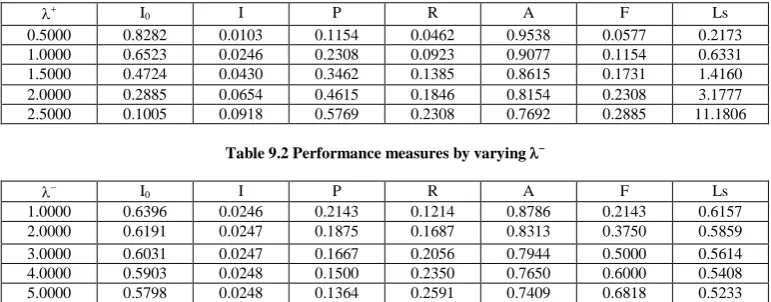
Table 3.1 reveals that I0 and A monotonically decrease and I, P, R, F and Ls increase as
+ increases. Table 3.2
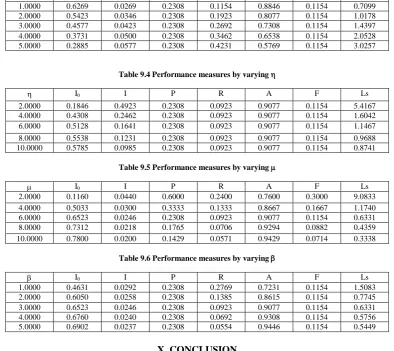
indicates that increase in decreases I0, P, A and Ls and increases other performance measures. From Table 3.3 and
3.6 we observe that the parameters α and have no effect on the performance measures P and F. For increasing values
of α, the values of I, R and Ls increase and I0 and A decrease. As increases I, R and Ls decrease I0 and A increase.
From Table 3.4 we observe that the parameter has no effect on the performance measures P, A and F. For increasing
values of , I0 increases and I and Ls decrease. Table 3.5 depicts the effect of µ on the performance measures. It is
noted that I0 and A increase and I, P, R, F and Ls decrease for increasing values of µ.
Table 9.1 Performance measures by varying +
I
0 I P R A F Ls
0.5000 0.8282 0.0103 0.1154 0.0462 0.9538 0.0577 0.2173
1.0000 0.6523 0.0246 0.2308 0.0923 0.9077 0.1154 0.6331
1.5000 0.4724 0.0430 0.3462 0.1385 0.8615 0.1731 1.4160
2.0000 0.2885 0.0654 0.4615 0.1846 0.8154 0.2308 3.1777
2.5000 0.1005 0.0918 0.5769 0.2308 0.7692 0.2885 11.1806
Table 9.2 Performance measures by varying
I
0 I P R A F Ls
1.0000 0.6396 0.0246 0.2143 0.1214 0.8786 0.2143 0.6157
2.0000 0.6191 0.0247 0.1875 0.1687 0.8313 0.3750 0.5859
3.0000 0.6031 0.0247 0.1667 0.2056 0.7944 0.5000 0.5614
4.0000 0.5903 0.0248 0.1500 0.2350 0.7650 0.6000 0.5408
ISSN(Online) : 2319 - 8753
ISSN (Print) : 2347 - 6710
I
nternational
J
ournal of
I
nnovative
R
esearch in
S
cience,
E
ngineering and
T
echnology
(An ISO 3297: 2007 Certified Organization) Vol. 4, Issue 4, April 2015
Table 9.3 Performance measures by varying
I0 I P R A F Ls
1.0000 0.6269 0.0269 0.2308 0.1154 0.8846 0.1154 0.7099
2.0000 0.5423 0.0346 0.2308 0.1923 0.8077 0.1154 1.0178
3.0000 0.4577 0.0423 0.2308 0.2692 0.7308 0.1154 1.4397
4.0000 0.3731 0.0500 0.2308 0.3462 0.6538 0.1154 2.0528
5.0000 0.2885 0.0577 0.2308 0.4231 0.5769 0.1154 3.0257
Table 9.4 Performance measures by varying
I0 I P R A F Ls
2.0000 0.1846 0.4923 0.2308 0.0923 0.9077 0.1154 5.4167
4.0000 0.4308 0.2462 0.2308 0.0923 0.9077 0.1154 1.6042
6.0000 0.5128 0.1641 0.2308 0.0923 0.9077 0.1154 1.1467
8.0000 0.5538 0.1231 0.2308 0.0923 0.9077 0.1154 0.9688
10.0000 0.5785 0.0985 0.2308 0.0923 0.9077 0.1154 0.8741
Table 9.5Performance measures by varying
I0 I P R A F Ls
2.0000 0.1160 0.0440 0.6000 0.2400 0.7600 0.3000 9.0833
4.0000 0.5033 0.0300 0.3333 0.1333 0.8667 0.1667 1.1740
6.0000 0.6523 0.0246 0.2308 0.0923 0.9077 0.1154 0.6331
8.0000 0.7312 0.0218 0.1765 0.0706 0.9294 0.0882 0.4359
10.0000 0.7800 0.0200 0.1429 0.0571 0.9429 0.0714 0.3338
Table 9.6Performance measures by varying
I0 I P R A F Ls
1.0000 0.4631 0.0292 0.2308 0.2769 0.7231 0.1154 1.5083
2.0000 0.6050 0.0258 0.2308 0.1385 0.8615 0.1154 0.7745
3.0000 0.6523 0.0246 0.2308 0.0923 0.9077 0.1154 0.6331
4.0000 0.6760 0.0240 0.2308 0.0692 0.9308 0.1154 0.5756
5.0000 0.6902 0.0237 0.2308 0.0554 0.9446 0.1154 0.5449
X. CONCLUSION
Batch arrival retrial G queue with server breakdown is analysed. The models considered are investigated using supplementary variable technique to obtain performance measures and reliability indices. Stochastic decomposition law is verified and special cases are discussed. Numerical analysis are carried out to analyse the effect of parameters on the system performance.
REFERENCES
[1] Artalejo, J.R., “A Classical Bibliography of Research on Retrial Queues : Progress in 1990-1999”, Top, vol. 7, pp. 187-211, 1999a. [2] Artalejo, J.R., “Accessible Bibliography on Retrial Queues", Mathematical and Computer Modelling, vol. 30, pp. 1-6, 1999b.
[3] Artalejo, J.R., and Gomez-Corral, A., “Retrial Queueing Systems”, Berlin, Heidel Berg, Springer, 2008.
[4] Artalejo, J.R., Joshua, V.C and Krishnamoorthy, A., “An M/G/1 Retrial Queue with Orbital Search by the Server”, Advances in Stochastic
Modelling, Notable Publications lnc., NJ, pp. 41-54, 2002.
[5] Chakravarthy, S.R., Krishnamoorthy, A., and Joshua, V.C., “Analysis of a Multi-Server Retrial Queue with Search of Customers from the
Orbit”, Performance Evaluation, vol. 63 (8), pp. 776-798, 2006.
[6] Deepak, T.G., Dudin, A.N., Joshua, V.C. and Krishnamoorthy, A., “On an MX/G/1 Retrial System with Two Types of Search of
Customers from the Orbit”, Stochastic Analysis and Applications, vol. 31 (1), pp. 92-107, 2012.
[7] Dudin, A.N., Krishnamoorthy, A., Joshua, V.C and Tsarenkov, G.V., “Analysis of the BMAP/G/1 Retrial System with Search of
Customers from the Orbit”, European Journal of Operational Research, vol. 157 (1), pp. 169-179, 2004.
[8] Falin, G.I and Templeton, J.G.C., „Retrial Queues‟, London, Chapman and Hall, 1997.
[9] Gelenbe, E., “Random Neural Networks with Negative and Positive Signals and Product Form Solution”, Neural Computation, vol. 1,
ISSN(Online) : 2319 - 8753
ISSN (Print) : 2347 - 6710
I
nternational
J
ournal of
I
nnovative
R
esearch in
S
cience,
E
ngineering and
T
echnology
(An ISO 3297: 2007 Certified Organization) Vol. 4, Issue 4, April 2015
[10] Gomez-Corral, A., “Stochastic Analysis of a Single Server Retrial Queue with General Retrial Times”, Naval Research Logistics, vol. 46, pp. 561-581, 1999.
[11] Krishnamoorthy, A., Deepak, T.G. and Joshua, V.C ., “An M/G/1 Retrial Queue with Non-Persistent Customers and Orbital Search”,
Stochastic Analysis and Applications, vol. 23, pp. 975-997, 2005.
[12] Kulkarni, V.G. and Liang, H.M., “Retrial Queues Revisited”, In Frontiers in Queueing Models and Applications in Science and
Engineering, Ed., Dshalalow, J.H., CRC Press, Boca Raton, FL, pp. 19-34, 1997.
[13] Peng, Y., Liu, Z. and Wu, J., “An M/G/1 Retrial G-Queue with Preemptive Resume Priority and Collisions Subject to the Server
Breakdowns and Delayed Repairs”, J. Appl. Math. Comput. doi. 10.1007/S 12190-013-0688-7, 2013.
[14] Sumitha, D. and Udaya Chandrika, K., “Numerical Analysis of Two Phase Bulk Arrival Retrial Queue with Orbital Search”,
International Journal of Advanced Scientific and Technical Research, vol. 2 (1), pp. 483-493, 2011 .
[15] Wu, J. and Lian, Z., “A Single Server Retrial G-Queue with Priority and Unreliable Server Under Bernoulli Vacation Schedule”,