Effectiveness of Structured Teaching
Programme on Knowledge of Women
Regarding Cancer Cervix
V.Tamizhkodi, Prof.V. Hemavathy
Associate Professor, Department of Community Health Nursing, Sree Balaji College of Nursing, Chromepet, Chennai,
India
Principal, Department of Community Health Nursing, Sree Balaji College of Nursing, Chromepet, Chennai, India
ABSTRACT: The study was conducted to evaluate effectiveness of structured Teaching Programme on knowledge of
Women regarding early detection and Prevention of Cancer Cervix
KEYWORDS: Effectiveness, Knowledge, women, Cervical cancer
I. INTRODUCTION
A great number of people are living to older age and are at greater risk to chronic disease of various kind. Out of all chronic disease,Benson Raiph (2002) reported., cancer is a Feared and dreaded disease for several reasons cancer, the very utterance of the word sends a shiverdown our spine. It spells pain, agony, despair, gloom and death.Frederickson Helen.et.al (2005) evaluated., it is the 9th most common cancer in women in Ireland, with almost 200 women on average developing the disease every year. Dutta DC (2006) revealed contrast to most other cancers, cancer of the cervix affects mainly younger women, with 60% of cases occurring in women aged 50 or younger. Holland
James.F.et.al(2003) assessed approximately 70 women in the Republic die from cervical cancer each year. However,
cervical cancer can be prevented by means of a simple test – the cervical smear test.
II. MATERIALS AND METHODS
We have chosen 60 women in between the age group of 35 to 55 years community area.The research design used for this study is Pre experimental design of one group pretest and post test design
Pre test Treatment
(STP)
Post test
Q1 X Q2
The dependent variab les is knowledge of cervical cancer among women, the independent variable is structured teaching programme.According to systems theory a system is a group of elements that interacts with one another in order to achieve the goal.The component interacts with in a boundary and filters the type and rate of exchange with the environment. Input
Throughput
In this study throughput is a process of change in knowledge and understanding about the various aspects of cancer cervix among women.
Output
Output is the out come of structured teaching programme, which is change in knowledge after structured teaching programme, which will be measured by the post test using the same questionnaire used in the pretest.
Feed Back
Feedback is the emphasis to strengthen the input and throughout it is necessary if results shows any inadequate knowledge
III. RESULTS AND DISCUSSION
The present study was conducted to evaluate the effectiveness of Structured teaching programme on cervical cancer among women in between the age group of 35 to 55 years. Pre experimental design of one group pretest and post test design was adopted. The sample was selected by using purposive sampling technique
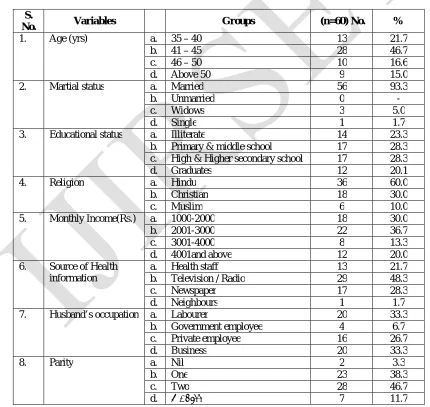
Table 1: Frequency and percentage distribution of demographic variables
S.
No. Variables Groups (n=60) No. %
1. Age (yrs) a. 35 – 40 13 21.7
b. 41 – 45 28 46.7
c. 46 – 50 10 16.6
d. Above 50 9 15.0
2. Martial status a. Married 56 93.3
b. Unmarried 0 -
c. Widows 3 5.0
d. Single 1 1.7
3. Educational status a. Illiterate 14 23.3
b. Primary & middle school 17 28.3 c. High & Higher secondary school 17 28.3
d. Graduates 12 20.1
4. Religion a. Hindu 36 60.0
b. Christian 18 30.0
c. Muslim 6 10.0
5. Monthly Income(Rs.) a. 1000-2000 18 30.0
b. 2001-3000 22 36.7
c. 3001-4000 8 13.3
d. 4001and above 12 20.0
6. Source of Health information
a. Health staff 13 21.7
b. Television / Radio 29 48.3
c. Newspaper 17 28.3
d. Neighbours 1 1.7
7. Husband’s occupation a. Labourer 20 33.3
b. Government employee 4 6.7
c. Private employee 16 26.7
d. Business 20 33.3
8. Parity a. Nil 2 3.3
b. One 23 38.3
c. Two 28 46.7
cervical cancer b. Mother 0 -
c. Sister 1 1.7
d. None 57 95.0
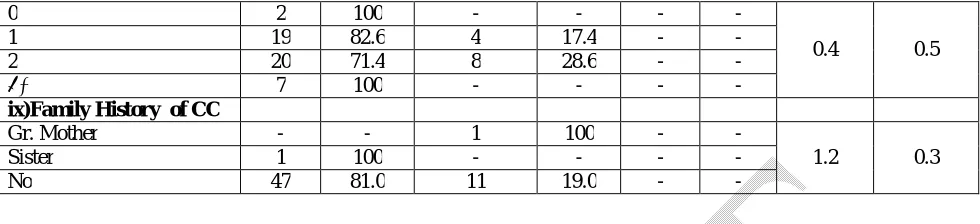
Table.2.Classification of women according to demographic variables and pre-test knowledge level
Variable
Knowledge level (N=60)
X2
(df=1) P
Low Moderate High
No. % No. % No. %
i) Age (yrs)
35-40 8 61.5 5 38.5 - -
3.5 0.6
41-45 21 75.0 7 25.0 - -
46-50 10 100 - - - -
Above 50 9 100 - - - -
ii) Martial Status
Married 45 80.4 11 19.6 - -
0.07 0.7
Widow 2 66.7 1 33.3 - -
Single 1 100 - - - -
iii) Education
Illiterate 14 100 - - - -
16.0
(S) 0.0001
Primary / Middle 17 100 - - - -
High School 17 100 - - - -
College - - 12 100 - -
iv) Religion
Hindu 32 88.9 4 11.1 - -
4.4
(S) 0.03
Christian 12 66.7 6 33.3 - -
Muslim 4 66.7 2 33.3 - -
v)Monthly Income(Rs.)
1000-2000 17 94.4 1 5.6 - -
1.9 0.2
2001-3000 17 77.3 5 22.7 - -
3001-4000 3 37.5 5 62.5 - -
>4000 11 91.7 1 8.3 - -
vi) Source of Health Information
Health staff 12 92.3 1 7.7 - -
9.6
(S) 0.002
TV / Radio 26 89.7 3 10.3 - -
News paper 10 58.8 7 41.2 - -
Neighbours - - 1 100 - -
Vii)Husband’s Occupation
Labourer 19 95.0 1 5.0 - -
3.4 0.07
Govt. job 3 75.0 1 25.0 - -
Private job 11 68.8 5 31.2 - -
Business 15 75.0 5 25.0 - -
0 2 100 - - - -
0.4 0.5
1 19 82.6 4 17.4 - -
2 20 71.4 8 28.6 - -
≥3 7 100 - - - -
ix)Family History of CC
Gr. Mother - - 1 100 - -
1.2 0.3
Sister 1 100 - - - -
No 47 81.0 11 19.0 - -
The variables which showed association with pre-test knowledge level were: Education, Religion and Source of Health Information. Dawn Os et. al. (2005) conducted a study about prevention of carcinoma on cervix with human papilloma virus vaccine based on experimental evidence stated that it is possible to prevent carcinoma of cervix with human papillomavirus vaccine.
Table 3. Comparison between pre-test and post-test knowledge level of women on early detection and prevention of cancer cervix
Knowledge level Pre-test Post-test
No % No. %
Inadequate (0-49%) 48 80.0 - -
Moderate adequate (50-74%) 12 20.0 32 53.3
Adequate (≥ 75%) - - 28 46.7
Total 60 100 60 100
Among 60 women 48(80.0%) had low level of knowledge in pre-test and no one had low level of knowledge in post-test. 12(20.0%) of women had moderate level of knowledge in pre-test and 32(53.3%) had moderate level of knowledge in post-test. No one had high level of knowledge in pre-test and 28(46.7%) had high level of knowledge in post-test. So the structured teaching programme was effective in the sample respondents.
Table 4. Mean and Standard Deviation of Pre test and post test Scores of early detection and prevention of cancer cervix
Variables
Pretest score Post test score
Paired ‘t’ test
Mean S.D Mean S.D
Knowledge 32.4 14.8 73.7 12.3 27.6***
*** P<0.001 statistically significant.
The pre test knowledge mean value with 32.4 with a standard deviation of 14.8 and the post test mean value was 73.7 with the standard deviation of 12.3 of the women on early detection and prevention of cancer cervix. The paired ‘t’ test value is 27.6*** which is highly significant at ***p<0.001 level.
IV. CONCLUSION
mortality and morbidity rate of middle aged women.
BIOGRAPHY
1) Benson Raiph C, “Handbook of Obstetrics and Gynaecology”, Marcizen Asian Edition, Lange Medical; Publications; 2002. Dawn O.S,
“Text Book of Geaecology”, Calcutta S.M. Arabi Dawn, 2005.
2) Dutta DC, “Text Book of Gynaecology”, Calcutta, New Central Book Agency (P) Ltd., 2006. 3) Frederickson Helen L. et. al., “Obstetric and Gynaecology Sectets”, New Delhi, Jaypee Brothers, 2005.
4) Holland James F. et.al., “Cancer Nusrsing”, London; Len and Febiger 2003 Park J.E. et.al. “Parks Text Book of Preventive and Social Medicine”, India, M/s Banarsidas Bhanot Publishers 2007.
5) Polit Denise F. “Nursing Research Principles and Methods”, New York Philadelphia 2002. 6) Rao Bhaskjar K, et.al., “Elinical Gynaecology”, India, Orient Longman, 2003.
7) Revathi Ramakrishnan, “Clinical Gynaecology”, Toronto, W.B. Saundars Company, 2004. 8) Shaw Robert W. et. al., “Gynaecology”, Toronto, Churchill livingstone, 2001.
9) Browne Mc Clure J.C, “Post Graduates Obstetrics and Gynaecology”, Butter worths, 1994. 10) Buckley Kathleen et.al., “High Risk Maternity Nursing Manual”, William and Wilkins, 1993. 11) Burns Narxy et, al., “The Practice of Nursing”, London, W.B. Sounders Company, 1999.
12) Clement Rogers. V, “Safe Practice in Obstetrics and Gynaecology”, New York; Longman group limited, 1994.
13) Balaji, A., Balaji, T.M., Rao, S.R., "Angiotensin II levels in gingival tissues from healthy individuals, patients with Nifedipine induced gingival overgrowth and non responders on Nifedipine", Journal of Clinical and Diagnostic Research, v-9, i-8, pp:92-94, 2015.
14) Behura, S.S., Masthan, M.K., Narayanasamy, A.B., "Oral mucosal lesions associated with smokers and chewers – A case-control study in chennai population", Journal of Clinical and Diagnostic Research, v-9, i-7, pp:17-22, 2015.
15) Solomon, P.J., Margaret, P., Rajendran, R., Ramalingam, R., Menezes, G.A., Shirley, A.S., Lee, S.J., Seong, M.-W., Park, S.S., Seol, D., Seo, S.H., "A case report and literature review of Fanconi Anemia (FA) diagnosed by genetic testing", Italian Journal of Pediatrics, v-41, i-1, pp:-, 2015.
16) Jimson, S., Sree Ranjani, S., Lenka, S., Jimson, S., "Comparative Effects of Clonidine and Adrenaline with Lignocaine During Maxillary Infiltration Anaesthesia for Dental Extraction", Journal of Clinical and Diagnostic Research, v-9, i-5, pp:85-88, 2015.
17) Renuga, S., Lakshmi, K., Chitralekha, S., Illamani, V., "Prevalence of Pseudomonas aeruginosa and its antibiotic susceptibility pattern in a Tertiary Care Hospital", International Journal of Research in Pharmaceutical Sciences, v-6, i-1, pp:27-30, 2015