International Journal of Research (IJR)
e-ISSN: 2348-6848, p- ISSN: 2348-795X Volume 2, Issue 09, September 2015 Available at http://internationaljournalofresearch.org
Particle Swarm Optimization Applied To Economic
Load Dispatch Problem
Khushboo Hardia
1; Neha Maithil
2& Manish Shah
31
MTech Scholar Department of Electrical & Electronics, VITS Indore (M.P.) India, 2
Asst Prof Department of Electrical & Electronics, VITS Indore (M.P.) India, 3
Asst Prof Department of Electrical & Electronics, VITS Indore (M.P.) India,
Email: [email protected]; [email protected]; [email protected]
Abstract
The economic load dispatch problem is one of the major optimization problems in the electric power system. The main objective of this problem is to reduce or minimize the total operational cost of the system fulfilling the load demand within the limit of constraints. In this work, a more general heuristic method known as Particle swarm optimization (PSO) is applied to solve the economic load dispatch problem in electric power system. IEEE-14 bus system for 3-unit is considered to test the algorithm with cost function. This method is simple, direct, relatively new, modern, reliable and powerful optimization method that has been empirically shown to perform well on many of these optimization problems. It is widely used to give the global optimum solution in a complex search space. The mat lab programs were developed to solve the Economic load dispatch problem for 3-unit system using PSO and conventional method i.e. Lambda iteration method. These methods are applied to solve for both the cases i.e. the problem including transmission losses and without including transmission losses. Finally, the proposed PSO method results were compared with conventional method (i.e. lambda iteration method) to show the effectiveness of PSO and were found that PSO is superior then the conventional method.
Keywords:
Economic Local Dispatch; Unit Commitment; Particle Swarm Optimization;Introduction
In modern world electric power system, there are many problems such as optimal power flow, Economic Load Dispatch (ELD), Unit Commitment (UC) etc. the economic load dispatch problem is one of the major problem in the power system. The objective is to fulfill the load demand by reducing the cost and satisfying the environmental constraints. Over the years many techniques have been applied to solve the ELD problems such as conventional methods and non-conventional technique have been used to solve the ELD problems. Conventional methods have simple mathematical models and high search speed but they are failed or unable to solve many complex problems due to local optimum solution and facing difficulties to locate the global optimal solution. Recently, the interest have been focused on the other method based on artificial intelligence to solve the economic load dispatch problem, these are Particle Swarm Optimization, Artificial Bee Colony, Genetic Algorithm, Neural Networks, Evolutionary Programming and many more.
International Journal of Research (IJR)
e-ISSN: 2348-6848, p- ISSN: 2348-795X Volume 2, Issue 09, September 2015 Available at http://internationaljournalofresearch.org
work proposes particle swarm optimization (PSO) to solve ELD in the electrical power systems, which are population, based probabilistic search optimization algorithms and can be applied to real world problem.
Problem Formulation
The main objective of ELD is to minimize the total fuel cost of unit and also reduces the transmission losses with increased output and satisfying all the constraints. The objective function of ELD is defined as:
𝑀𝑖𝑛 𝐶 = 𝑁 𝐶𝑖 𝑃𝐺𝑖 (1)
𝑖=1
= 𝛼𝑖+ 𝛽𝑖(𝑃)𝑖+ 𝛾𝑖(𝑃)𝑖2+ ⋯ 𝑁
𝑖=1
(2)
Where, 𝐶𝑖(𝑃𝐺𝑖) is cost function, αi, βi, γi is cost coefficient of i generator, Pi is the power generated by the i unit and n is the no. of generators.
The minimization subjected to the following generator constraints:
𝑃𝑝𝑚𝑖𝑛 ≤ 𝑃𝑝 ≤ 𝑃𝑝𝑚𝑎𝑥 3 Were, 𝑃𝑝𝑚𝑖𝑛 and𝑃𝑝𝑚𝑎𝑥 is the minimum and maximum power output.
The transmission loss can be calculated by using the following equation given below:
𝑃𝐿 = 𝑃𝑚𝐵𝑚𝑛𝑃𝑛
𝑛 𝑚
(4)
Were, 𝐵𝑚𝑛 is the element of loss coefficient matrix B.
Overview of Particle Swarm Optimization
Particle swarm optimization (PSO) is stated as a population based optimization technique developed by Russell Eberhat and James Kennedy in 1995, inspired by the most social behavior of birds that is the bird flocking or fish schooling. In this technique each solution is a bird in the search space we call it particle all of particles have values which are evaluated by the fitness to be optimized and have velocities which direct flying of the particle. PSO initialized with group of random particles or solution and then searches for optima by updating generations. In every iteration each particle is updated by following two best values. After finding the two best values, the particle updates its velocity and position with following equation given below:
𝑉𝑖𝑘+1 = 𝑤𝑉𝑖𝑘 + 𝐶1𝑟𝑎𝑛𝑑1× 𝑝𝑏𝑒𝑠𝑡𝑖 − 𝐶𝑖𝑘 + 𝐶2𝑟𝑎𝑛𝑑2× 𝑔𝑏𝑒𝑠𝑡𝑖 − 𝐶𝑖𝑘 (5)
Where,
𝑉𝑖𝑘+1= velocity of agent i at iteration k, 𝑉𝑖𝑘=velocity of agent 𝑖 at iteration 𝑘,𝝎 = weighting function,
International Journal of Research (IJR)
e-ISSN: 2348-6848, p- ISSN: 2348-795X Volume 2, Issue 09, September 2015 Available at http://internationaljournalofresearch.org
The weighting function is defined as which is used in equation:
𝑤 = 𝑤𝑚𝑎𝑥 − 𝑤𝑚𝑎𝑥 − 𝑤𝑚𝑖𝑛
𝑖𝑡𝑒𝑟𝑚𝑎𝑥 𝑖𝑡𝑒𝑟 (6)
Where,
𝑤𝑚𝑖𝑛=final Weight, 𝑤𝑚𝑎𝑥=initial Weight, 𝑖𝑡𝑒𝑟𝑚𝑎𝑥=maximum Iteration Number, 𝒊𝒕𝒆𝒓=current iteration number.
The current position (in the swarm) can be modified by the following equation:
𝐶𝑖𝑘+1 = 𝐶𝑖𝑘 + 𝑉𝑖𝑘 +1 (7)
Algorithm of Particle Swarm Optimization to Solve ELD Problem
Steps of Implementation Of PSO For ELD1. Initialize the fitness function.
2. Initialize the parameters of particle swarm optimization that are population size, C1, C2, inertia max and minimum value etc.
3. Input the cost function its maximum minimum limits, the total load demand and its loss coefficient matrix.
4. At the first step set of solution should be check for equality constraints and the equality constraints are checked
5. The value of fitness function is calculated and all the values obtained in iterations are compared to obtain the pbest value. After that the pbest values are comparing to get the gbest value. At every step these values are updated.
6. Update the velocity and the position of particles. 7. The value of gbest is plotted.
8. This final value of global best is the value of minimum cost and represents the optimal solution of economic load dispatch.
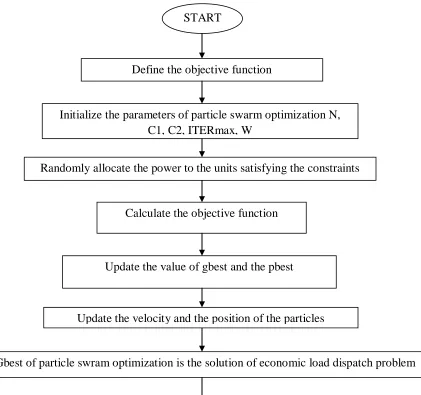
The flow chart for the proposed algorithm is given below in fig.1
Result and Discussions
To verify the feasibility and effectiveness of the particle swarm optimization three generating units system have been tested. Result of particle swarm optimization is then comparing with the conventional method. The loss matrix Bmn we have used is given below
𝐵𝑚𝑛=
𝟏. 𝟑𝟔𝟐𝟓𝟓 × 𝟏𝟎−𝟒 𝟏. 𝟕𝟓𝟑𝟎𝟎 × 𝟏𝟎 −𝟓 𝟏. 𝟖𝟑𝟗𝟒𝟎 × 𝟏𝟎 −𝟒 𝟏. 𝟕𝟓𝟒𝟎𝟎 × 𝟏𝟎−𝟓 𝟏. 𝟓𝟒𝟒𝟖𝟎 × 𝟏𝟎−𝟒 𝟐. 𝟖𝟐𝟕𝟔𝟓 × 𝟏𝟎 −𝟓
𝟏. 𝟖𝟑𝟗𝟒𝟎 × 𝟏𝟎 −𝟒 𝟐. 𝟖𝟐𝟕𝟔𝟓 × 𝟏𝟎 −𝟒 𝟏. 𝟔𝟏𝟒𝟕𝟎 × 𝟏𝟎 −𝟑
International Journal of Research (IJR)
e-ISSN: 2348-6848, p- ISSN: 2348-795X Volume 2, Issue 09, September 2015 Available at http://internationaljournalofresearch.org
The results for different load demand (190, 125, 240MW) for without considering transmission losses are given in the table (1), (2) and (3).
Fig.1 flow chart of proposed algorithm of PSO
Table 1 comparison of cost in different methods with the load demand of 190
Generated output(MW) Proposed PSO Algorithm Conventional Method
P1 50.00 143.9936
P2 5.00 11.0256
P3 135.00 34.9807
START
Define the objective function
Initialize the parameters of particle swarm optimization N, C1, C2, ITERmax, W
Randomly allocate the power to the units satisfying the constraints
Calculate the objective function
Update the value of gbest and the pbest
Update the velocity and the position of the particles
Gbest of particle swram optimization is the solution of economic load dispatch problem
International Journal of Research (IJR)
e-ISSN: 2348-6848, p- ISSN: 2348-795X Volume 2, Issue 09, September 2015 Available at http://internationaljournalofresearch.org
Fuel Cost 2051.8 2320.5021
Load Demand 190 190
Table 2 comparison of cost in different methods with the load demand of 215
Generated output(MW) Proposed PSO Algorithm Conventional Method
P1 64.5734 153.0836
P2 13.6084 18.8683
P3 136.8182 43.0481
Fuel Cost 2258.9 2576.050
Load Demand 215 215
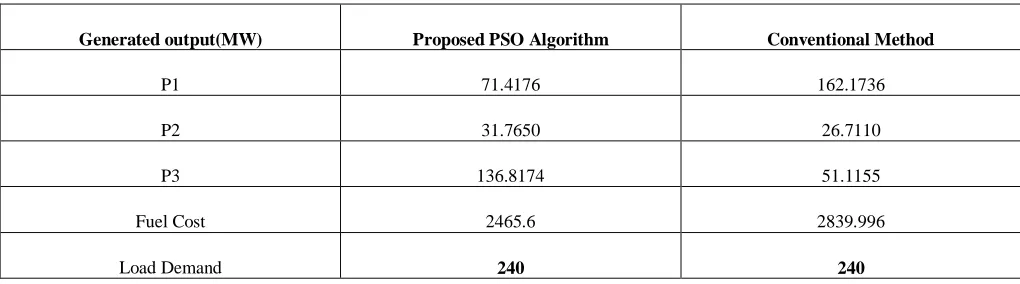
Table 3 comparison of cost in different methods with the load demand of 240
Generated output(MW) Proposed PSO Algorithm Conventional Method
P1 71.4176 162.1736
P2 31.7650 26.7110
P3 136.8174 51.1155
Fuel Cost 2465.6 2839.996
Load Demand 240 240
International Journal of Research (IJR)
e-ISSN: 2348-6848, p- ISSN: 2348-795X Volume 2, Issue 09, September 2015 Available at http://internationaljournalofresearch.org
Fig.2 minimum fitness function plot for particle swarm optimization for 190 load demand
Fig.3 minimum fitness function plot for particle swarm optimization for 215 load demand
0.00E+00 5.00E+05 1.00E+06 1.50E+06 2.00E+06 2.50E+06 3.00E+06
1 6 111621263136414651566166717681869196
min(fit) 190 withoutloss
min(fit) 190 withoutloss
1.89E+06 1.90E+06 1.91E+06 1.92E+06 1.93E+06 1.94E+06 1.95E+06 1.96E+06
1 7 131925313743495561677379859197
Min(f) 215 Without Loss
Min(f) 215 Without Loss
1.91E+06 1.91E+06 1.91E+06 1.91E+06 1.91E+06 1.91E+06 1.91E+06 1.91E+06 1.91E+06 1.91E+06
1 8 15 22 29 36 43 50 57 64 71 78 85 92 99
min(f) 240 withoutloss
International Journal of Research (IJR)
e-ISSN: 2348-6848, p- ISSN: 2348-795X Volume 2, Issue 09, September 2015 Available at http://internationaljournalofresearch.org
The comparison of both the methods that have been applied to solve the ELD problem with transmission line losses have been given in the table (4), (5) and (6) for different load demand (190, 125, 240MW).
Table5.8 comparison of particle swarm optimization method and lambda iteration method for 190 load demand
Generated output(MW) Proposed PSO Algorithm Conventional Method
P1 50.2138 143.8125
P2 6.3358 35.70524
P3 136.880 14.94276
Transmission Loss 3.3682 4.5121
Fuel Cost 2079.7 2372.5356
Load Demand 190 190
Table5.9 comparison of particle swarm optimization method and lambda iteration method for 215 load demand
Generated output(MW) Proposed PSO Algorithm Conventional Method
P1 59.9129 165.16102
P2 23.0922 40.06988
P3 136.8211 14.89231
Transmission Loss 4.8262 5.6688
Fuel Cost 2298.5 2642.6023
Load Demand 215 215
Table5.10 comparison of particle swarm optimization method and lambda iteration method for 240 load demand
Generated output(MW) Proposed PSO Algorithm Conventional Method
P1 72.9955 177.8229
P2 36.6513 53.86336
P3 136.8192 14.762
International Journal of Research (IJR)
e-ISSN: 2348-6848, p- ISSN: 2348-795X Volume 2, Issue 09, September 2015 Available at http://internationaljournalofresearch.org
Fuel Cost 2519.0 2916.7885
Load Demand 240 240
The figure (5), (6), (7) given below shows the minimum value of the optimal solution obtained by the
particle swarm optimization for considering transmission losses. The plot is plotted between the fitness
function along with number of iteration taken in the algorithm of PSO.
Fig.5 minimum fitness function plot for particle swarm optimization for 190 load demand
Fig.6 minimum fitness function plot for particle swarm optimization for 215 load demand
1.91E+06 1.91E+06 1.91E+06 1.91E+06 1.91E+06 1.91E+06 1.91E+06 1.91E+06
1 9 17 25 33 41 49 57 65 73 81 89 97
min(f) 190 withloss
min(f) 190 withloss
1.89E+06 1.90E+06 1.91E+06 1.92E+06 1.93E+06 1.94E+06 1.95E+06 1.96E+06
1 7 131925313743495561677379859197
min(f) 215 withloss
International Journal of Research (IJR)
e-ISSN: 2348-6848, p- ISSN: 2348-795X Volume 2, Issue 09, September 2015 Available at http://internationaljournalofresearch.org
Fig.7 minimum fitness function plot for particle swarm optimization for 240 load demand
Conclusion
In this work overview of economic load dispatch problems and its solution methodology is discussed. Implementation is done using the mat lab programs to solve Economic load dispatch problem for three-unit system through lambda iteration method and particle swarm optimization. From the results when compared we concluded that the particle swarm optimization technique is successful technique to solve the economic load dispatch problem.
References
[1] Turkay, B.E, Cabadag, R.I, “Optimal power flow solution using particle
swarm optimization algorithm”,
EUROCON, 2013 IEEE, 1-4 July 2013.
[2] Mahajan, M. Vadhera, S. “Economic load dispatch of different bus systems using particle swarm optimization”. Power India Conference, 2012 IEEE Fifth 19-22 Dec. 2012
[3] Jaini, A., Shah Alam, Musirin, I. Aminudin, N. Othman, M.M. “Particle swarm optimization (PSO) technique in economic power dispatch problems” Power Engineering and Optimization
Conference (PEOCO), 2010 4th
International 23-24 June 2010.
[4] Amita Mahor, Vishnu Prasad and Saroj Rangnekar “Economic Dispatch Using Particle Swarm Optimization: A Review”.
[5] Anish Ahmad, Nitin Singh and Tarun varshney “A New Approach for Solving Economic Load Dispatch Problem”, MIT International Journal of Electrical and Instrumentation Engineering, Vol.1 No.2, Aug 2011.
[6] Hardiansyah, Junaidi and Yohannes MS “Solving Economic Load Dispatch
Problem Using Particle Swarm
Optimization Technique”, I.J. Intelligent Systems and Applications, Nov 2012 in MECS. 1.91E+06 1.91E+06 1.91E+06 1.91E+06 1.92E+06 1.92E+06 1.92E+06
1 7 131925313743495561677379859197
min(f) 240 withloss
International Journal of Research (IJR)
e-ISSN: 2348-6848, p- ISSN: 2348-795X Volume 2, Issue 09, September 2015 Available at http://internationaljournalofresearch.org
[7] Shubham Tiwari, Ankit Kumar, G S Chaurasia and G S Sirohi “Economic Load Dispatch Using Particle Swarm Optimization”, International Journal of
Application or Innovation in
Engineering and Management (IJAIEM), Volume 2, Issue 4, April 2013.
[8] Rahul Dogra, Nikita Gupta and Harsha
Saroa”Economic Load Dispatch
Problem and Matlab Programming of Different Methods”, International Conference of Advance Research and Innovation (ICARI-2014).
[9] Ravinder Singh Maan, Om Prakash Mahela and Mukesh Gupta “Solution of Economic Load Dispatch Problems With Improved Computational Performance Using Particle Swarm Optimization”, International Journal of Engineering Science Invention, Vol. 2, Issue 6, June 2013.
[10] James Kennedy and Russell Eberhart “Particle Swarm Optimization”, 1995 IEEE.
[11] Russell C Eberhart and Yuhui Shi
“Particle Swarm Optimization:
Developments, Application and
Resources”, 2001 IEEE.
[12] Yamille Del Valle, Ganesh Kumar Venayagamoorthy, Salman Mohagheghi, Jean-Carlos Hernandez, and Ronald G Harley “Particle Swarm Optimization:
Basic Concepts, Variants and
Applications in Power Systems”, IEEE Transaction Evolutionary Computation, Vol.12, No. 2, April 2008.
[13] Priyanka sinha ”Particle Swarm
Optimization for Solving Economic Load Dispatch Problem”, International
Journal of Communication and
Computer Technologies, Volume
01-No.63,Issue Aug 2013.
Authors Biography:
Khushboo Hardia- Pursuring M.Tech in Power Electronics from Vindhya Institute of Technology and Science Indore, MP (INDIA). She completed B.E in 2011 from SVCE Indore. Her field of interest for research is Power Electronics, MATLAB.