Paralysis Proofs: Secure Dynamic Access Structures for
Cryptocurrency Custody and More
∗
Fan Zhang
Cornell University
Philip Daian
Cornell Tech
Iddo Bentov
Cornell University
Ian Miers
Cornell Tech
Ari Juels
Cornell Tech
ABSTRACT
The growing adoption of digital assets—including but not limited to cryptocurrencies, tokens, and even identities—calls for secure and robust digital assets custody. A common way to distribute the ownership of a digital asset is(M,N)-threshold access structures. However, traditional access structures leave users with a painful choice. SettingM=Nseems attractive as it offers maximum resis-tance to share compromise, but it also causes maximum brittleness: A single lost share renders the asset permanently frozen, inducing paralysis. LoweringMimproves availability, but degrades security. In this paper, we introduce techniques that address this impasse by making general cryptographic access structuresdynamic. The core idea is what we call Paralysis Proofs, evidence that players or shares areprovably unavailable. Using Paralysis Proofs, we show how to construct aDynamic Access Structure System(DASS), which can securely and flexibly update target access structureswithout a trusted third party. We present DASS constructions that combine a trust anchor (a trusted execution environment or smart contract) with a censorship-resistant channel in the form of a blockchain. We offer a formal framework for specifying DASS policies, and show how to achieve critical security and usability properties (safety, liveness, and paralysis-freeness) in a DASS.
To illustrate the wide range of applications, we present three use cases of DASSes for improving digital asset custody: a multi-signature scheme that can “downgrade” the threshold should play-ers become unavailable; a hybrid scheme where the centralized custodian can’t refuse service; and a smart-contract-based scheme that supports recovery from unexpected bugs.
CCS CONCEPTS
•Security and privacy→Key management;Access control.
KEYWORDS
Bitcoin, Blockchain, Trusted hardware, Access control, Digital Asset Custody, Wallet
1
INTRODUCTION
Nearly all key management and access control systems have an “always / never” requirement [65]: they should always provide
avail-ability when validly authorized, but never when not. Balancing availability against the potential for misuse is a pervasive challenge though. Consider the task of securing a single private key. Repli-cate the key broadly across geography, machine architectures, and custodians, and the risk of key compromise increases. Store the
∗
This an extended version of [83].
key in a single location and the probability of loss increases, as do barriers to timely access.
Generally, this challenging trade-off is navigated by distributing control across a small number of parties by means of anaccess structure[37]. An access structure is a policy determining which players can control a resource.(M,N)-access structures, as in, e.g., Shamir secret sharing [66], are a popular choice. They allow any
Mout ofNplayers to access a target resource, e.g., to sign a cryp-tocurrency transaction. VaryingMandNprovides flexibility on the defensibility vs. availability spectrum. Unfortunately this flexibility is often still inadequate.
For example, in the setting of a cryptocurrency custodian, despite the availability of(M,N)-multisig wallets (which requireMofN players to sign), loss and theft of cryptocurrency have been rampant for years [15,26,57,58,73]. Over 980,000 Bitcoin (currently worth about $6.4 billion) [62] have been stolen from exchanges alone. An estimated 4,000,000 Bitcoin (currently worth around $26 billion), have vanished forever due to lost keys [63].
One of the primary concerns looming over the use of(M,N) -multisig schemes is what we call a “shareholders’ dilemma”: setting
M =N is not only desirable for its maximum resilience to key compromise and collusion, but it could also be the only option to meet certain business requirements, e.g., whenNpeople want a joint-account with equal ownership. However, settingM=Nalso causes maximum brittleness: a single lost key share renders the asset permanently frozen.
Fundamentally, the problem with traditional(M,N)-access struc-tures is that they arestatic.Mcannot be lowered orNraised when funds become unavailable, so insecure choices are often made at system setup.
1.1
Our work
In this paper, we show how to achievebothgood availabilityand good security, and to do sowithouttrusted third parties (T TPs). Specifically, we show how to achieve a better trade-off than any static access structure alone can do. We accomplish this by means of access structures that aredynamic.
We introduce the idea of aDynamic Access Structure System (DASS), which allows for secureconditional downgrading, e.g., chang-ing(3,3)-multisig to a(2,3)-multisig if a player becomes unavail-able. Consequently, the full security of a(3,3)-multisig is available in the general case. A(2,3)-multisig is instantiated in the critical case that funds would otherwise be lost. (If Alice has lost her key, it’s better to run the risk of Bob and Carol absconding with funds than to lose funds with certainty forever.) In other words, a DASS
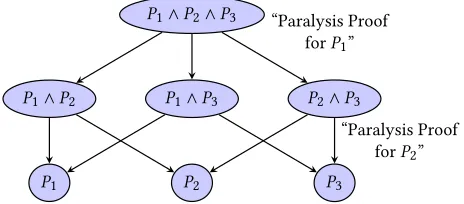
implements a policy of access-structure migrations (e.g., down-grades). Fig.1illustrates the idea by showing a three-player DASS that can withstand two key losses.
DASSes do not completely avoid security/availability trade-offs. Theydohowever introduce new and desirable points on the se-curity/availability spectrum, and thus new security management options for cryptocurrencies and a wide range of other crypto-graphic systems.
One major technical challenge in our work is ensuring that the downgrading of access structures only happens when a player is truly unavailable. Otherwise, players can cheat by simulating the disappearance of a live player. The tool we introduce for this purpose are strong proofs of player (or key-share) unavailability calledParalysis Proofs.
1.2
Approach overview and challenges
Proving that a player is available is easy: just have her sign a fresh message. Secure Paralysis Proofs, though, require that a player be able to signal liveness when other players collude and potentially try to block her network access. This is challenging even with a trusted third party (T TP).
Our constructions rely on acensorship-resistant stateful channel to detect and record the fact of an unavailable player. Such a channel has two properties:censorship-resistance, meaning players can freely send and receive messages with a bounded delay, andstatefulness, meaning messages sent through the channel are recorded and can be retrieved later. These properties are strictly stronger than those of anonymous channels (e.g., Tor [70]), which lack statefulness.
We leverage public blockchains as censorship-resistant stateful channels in our work. The basic idea is that if a player, e.g., Alice, disappears, other players can post a challenge to heron chain. If Alice tries to post a response within∆blocks (for some suitable ∆), she can do so with high probability even in the face of power-ful network adversaries and her response will be world readable. Thanks to these properties, lack of response from Alice within∆ blocks of a challenge constitutes a Paralysis Proof.
Building a DASS from Paralysis Proofs is easy given a T TP, which can simply manage all users’ keys. Again, we aim critically to avoid T TPs. Our DASS schemes thus reply on two technologies that server as trust anchors by emulating T TPs: trusted execution environment (TEEs) and smart contracts.
However, naïve combination of Paralysis Proofs with TEEs or smart contracts doesn’t yield a DASS. Verifying a Paralysis Proof requires the verifier to have an up-to-date view of the blockchain in order to determine whether a given∆is appropriate. Keeping TEEs in sync with a blockchain is undesirable and problematic, though, as TEEs are fundamentally stateless and unaware of accurate time. Attempts to work around these limitations result in larger attack surface and/or extra assumptions. As we will show shortly, our protocol does not require the TEE to have an up-to-date view of the blockchain. In fact, it does not require any view of the blockchain. Smart contracts, on the other hand, doesn’t suffer from the same limitation. Indeed, for assets controllable by smart contracts, imple-menting DASSes for them is straightforward. But for other assets smart contracts can’t be employed in general because they can’t manage secret keys. Moreover, smart contracts are known to suffer
P1∧P2∧P3
P1∧P2 P1∧P3 P2∧P3
P1 P2 P3
“Paralysis Proof forP1”
“Paralysis Proof forP2”
Figure 1: An example DASS with three players. Nodes repre-sent access structures, edges migration conditions.
unavailability induced by accidental or unexpected bugs. We ex-plore a novel scheme that allows secure recovery of smart-contract-controlled assets in face of software-induced paralysis.
To analyze and prove the security of DASSes, we provide a formal framework for specifying dynamic access structure policies (DASPs) and introduce new security definitions. Additionally, we also show how to overcome technical obstacles in securing DASSes in practice. One is to avoid placing a TEE on the critical path for ordinary transactions and risking service failures by, e.g., storing players’ keys only in the TEE. We also consider minimizing the impact of side-channel attacks on TEEs, e.g., [76].
1.3
Improved digital asset custody with DASS
We consider three use cases of Paralysis Proofs that illustrate our techniques’ wide range of application to improving digital asset custody and beyond:
Tolerate cryptocurrency key loss.We present a(M,N)-multisig wallet that can downgrade the threshold if players become unavail-able. We report on implementations for both script-based cryp-tocurrencies (e.g., Bitcoin) and smart-contract-based ones (e.g., Ethereum).
Tolerate custodian failures.Centralized custodians, e.g., Coin-base [55], help users manage keys, but are single points of failure. We present a DASS that migrates control of funds to their own-ers if and only if a custodian fails or refuses service. The “only if ” part guarantees that as long as the centralized custodian is opera-tional, leaking a user’s key won’t breach the user’s account, which is desirable.
Tolerate software-induced paralysis.Smart contract bugs can lead not just to theft, but paralyzed funds, as in the $150 million lost to the infamous (second) Parity Multisig Wallet bug [59]. We propose a continuous-integration framework that regularly applies a test suite to a smart contract to validate its correct functioning, including liveness of funds. Critical error conditions such as paral-ysis trigger an “escape hatch” [47], failover logic that refunds or moves a smart contract’s assets.
1.4
Contributions
In summary, our main contributions are as follows:
Paralysis Proofs.We introduce Paralysis Proofs, and show how to achieve them using censorship-resistant stateful channels such as
blockchains. We also introduce Dynamic Access Structure Systems (DASSes), which offer security vs. availability trade-offs unachiev-able with conventional, static access structures.
Formal definitions and framework.We formally define key properties for a DASS (liveness,safety) and its underlying migration policy (privilege-preserving,paralysis-free) (Section3). We present an ideal functionality that formally specifies security properties required for a broad range of applications (Section4).
Improved digital asset custody with DASS.We present three example applications of DASS to protect digital asset custody from: cryptocurrency key loss (Section4), cryptocurrency custody failures (Section5), and smart contract failures (Section6).
TEE compromise.We explore alternative DASS designs that pro-vide resilience to TEE compromise, such as through side-channel attacks demonstrated against SGX (Section4.4).
Implementation.We present implementations in Ethereum and Bitcoin for the first application, using smart contracts and TEEs (Intel SGX, in particular) respectively. To illustrate the limitations of pure blockchain approaches for Bitcoin, we also explore script-based schemes in AppendixD.
2
BACKGROUND
In this section we provide some basic background on Trusted Exe-cution Environments, Bitcoin, and smart contracts.
2.1
Trusted Execution Environments and SGX
A Trusted Execution Environment (TEE) is an execution environ-ment that provides confidentiality and integrity for applications running on potentially malicious hosts.
Intel Software Guard Extensions (SGX) [10,35,50] is a CP U-based TEE implementation available in recent Intel CP Us. SGX allows processes to execute in anenclave, an environment that enforces application confidentiality and integrity against even a malicious operating system and some classes of hardware attacks. SGX also enables applications to emit third-party verifiable attesta-tionsto their origin and outputs.
Limitations of TEEs.Although powerful, TEEs have fundamental security limitations. TEEs generally don’t guarantee availability. Moreover, TEEs depend upon a potentially malicious operating system for I/O. A consequence is that TEEs cannot provide trusted sources of time. In the case of SGX, although a trusted relative timer is available in an off-CP U component, the communication between enclaves and the timer can be delayed by the malicious OS [1]. Thus SGX enclaves can only ascertain a lower bound on the elapsed time. Server-grade Intel CP Us offer no support for timers at the time of writing. Moreover, unless with additional protection mechanisms (e.g., [48]), SGX doesn’t have trustworthy monotonic counters and therefore is susceptible to state rollback attack. These security limitations make Paralysis Proofs challenging even with TEE.
2.2
Bitcoin
Bitcoin is a decentralized electronic cash scheme in which transac-tions moving funds are recorded in an append-only log, ablockchain. Rather than storing funds in accounts whose balance is altered by
transactions, Bitcoin uses transactions themselves to record both ownership and balance. Transactions consist ofinputsandoutputs. An output consists of an amount and ascript_pubkeythat speci-fies how that amount can be spent. Inputs specify the transaction output which is the source of the funds and include ascript_sig showing authorization to use the funds. Thus transactions spend the outputs of previous transactions. Unconsumed outputs are known as Unspent Transaction Outputs (UTXOs). One can check if an output has been spent by seeing if it is in the set of UTXOs. By requiring that outputs can only be spent once and that the amount of money included in a transaction’s inputs is at least as much as its outputs, Bitcoin enforces the invariants of a monetary system and prevents forgery.
Bitcoin Script.When creating an output, users can specify an ac-cess control policy by embedding ascript—calledscript_pubkey— in the output. To spend an output, one must provide a witness— calledscript_sig—such that running the script with the provided witness outputstrue. For example, a typicalscript_pubkey spec-ifies the keys that must sign any transaction spending that output. This may be a single key or an arbitrary combination of keys, e.g.,
(pk1∧pk2) ∨pk3. An input consuming an output with such a script_pubkeywould then need a signature that satisfied that requirement, e.g., it would need to contain signatures under both pk1andpk2. While in principle Bitcoin Script can represent
com-plex logic, in practice limitations on supported instructions and the length of a script mean it is mainly used for simple authorization. We use(V,ϕ)to denote an UTXO ofVcoins with ascript_pubkey
ϕ. A Bitcoin transition (with the exception of coinbase transitions) consumes a set of UTXOs and creates one or more new ones. We use
⟨{Ini}ni=1 −−−−−−−−→w1, ...,wn
Outj mj=1⟩to denote a Bitcoin transaction
withninputs,moutputs, andnwitnesses, one for each input, such thatwi satisfies the script ofIni.
Time-based opcodes.An essential ingredient ofΠSGXis Bitcoin’s relative timeout script opcode, also known as CheckSequenceVerify orCSV[20]. By putting the CSV instruction with parameterτin the scriptϕof a UTXOu, we assert that the transaction that spends
umust reside in a block whose height (or timestamp) is more than
τrelative tou.
2.3
Smart contracts
Smart contracts are executable objects stored in a blockchain. Users can send transactions with input data to the blockchain to trigger the execution of a smart contract. To process a transaction, the blockchain executes the code with the provided input data and potentially alters the blockchain state.
A key differentiator between such smart contracts and script-based systems (e.g. Bitcoin)rich-statefulness[78]. In a smart contract system, all executing transactions have native access to persistent state stored across transactions, blocks, and time. Rich statefulness is particularly relevant to our system. It is Bitcoin’s lack of such that renders TEEs the only practical solution.
2.4
Censorship-resistant stateful channels
We use a blockchain to realize a censorship-resistant stateful chan-nel, i.e., messages sent to the blockchain will be delivered within ∆time, and items added to the blockchain cannot be removed. In
practice, a central goal of public blockchains such as Bitcoin is to prevent a malicious miner from dropping a user’s transactions [31]. Also thanks to the high redundancy of the underlying peer-to-peer network, as long as a user can connect tosomenetwork nodes, her transactions will be propagated and included in a block with high probability, thus offering censorship-resistant access.
Bitcoin and other public blockchains have been proposed as a means to facilitate an anonymous channel (e.g., in [4,9]). We note, however, that public blockchains are more powerful than anony-mous channels (such as Tor), because blockchain-based channels are also stateful, i.e., messages are persisted on-chain with strong availability guarantees. As statefulness is critical in Paralysis Proofs, anonymous channels such as Tor insufficient. The statefulness of blockchains is also used in [25] to enforce fairness in MPC, and in [39] to build stateful TEE execution.
3
DYNAMIC ACCESS STRUCTURE SYSTEMS
In this section, we develop formal definitions and a framework for reasoning about the security of dynamic access structures.
ADynamic Access Structure Policy(DASP) consists of a set of access structures and rules dictating migration conditions among them. For example, “this Bitcoin fund requires signatures from Alice, Bob and Carol to spend; if any of them disappears, signatures from the remaining two suffice to spend the fund” informally specifies a DASP. The access structure is the set of holders authorized to spend Bitcoin, and migration entails removing unresponsive signers.
We use the termDynamic Access Structure System(DASS) to denote a system that enforces a DASP. Essential to our DASS con-structions is the use of Paralysis Proofs to demonstrate conditions, e.g., party incapacitation, that justify migration from one access structure to another.
Motivating example.Getting dynamic access control policies right is hard and intuitive correctness often is not enough. There are subtle vulnerabilities that are missed without the formalism. For example, considers1= “at least a majority of{1,2,3,4}is required
to access”,s2= “at least a majority of{1,2,3}is required to access”.
If the current access structure iss1and player 4 goes missing, it’s
intuitive to permit migration tos2. However this isnotsecure as it
would deprive the privilege of one of the three players.
Looking forward, Definition2correctly prevents such a migra-tion becauses2<SLP({1,2,3}). (The only secure migration is to
stay ats1.) Capturing subtle vulnerabilities like this is critical and challenging, and motivates our exploration of the formal framework presented below.
3.1
Policy specification
3.1.1 Basic definitions.A Dynamic Access Structure Policy (DASP) comprises a tuple(R,S,M)that specifies theresources(R) be-ing access-controlled, a set ofaccess structures(S), and a set of migration rules(M) dictating conditions under which access-structure migrations are permitted.
Let{Pi}={Pi}Ni
=1denote the set ofNparties at beginning of
the protocol, andLtthe set oflive(i.e. not incapacitated) parties at timet. As we shall see shortly, correctly determiningLt, i.e. which parties are actually live, is the main technical challenge in enforcing a DASP. We useLt to denote the ground truth. When generally
referring to a single player, we drop the subscript and simply denote the player asP. We assume that if a party becomes incapacitated, it remains incapacitated throughout the protocol, i.e.P<Lt implies
P<Lt′for allt′>t.
In this paper, an access structuresis a functions(L) → {true,false} that determines whether a set of live partiesL⊆ {Pi}is allowed to access the managed resource. Access structures are monotonic, i.e.,
s(L)=trueandL⊆L′together imply thats(L′)=true. A migration rulems
i,sj ∈ Mis a functionms
i,sj(ω) → {true,false} that determines whether migrating fromsi tosjis permitted given
witnessω. We usesi →ω sj to denotems
i,sj(ω)=true. The exact form ofωdepends on the migration rule. An example ofωisLt, the set of live players.
For a given DASP, the set of access structuresSand the asso-ciated migration rulesMmay be represented as a directed graph
G =(S,M). Here we overloadSandMto denote respectively the sets of nodes and edges. A nodesi ∈ Sis an access structure and an enhanced edge(si,sj) ∈ Mrepresents the migration rule
msi,sj, which specifies the condition to migrate from access struc-turesi tosj. Access structuresn is said reachable froms1byω,
denoteds1⇝ω sn, if there exists a path(s1,s2, . . . ,sn)inGsuch that
si →ω si+1for alli∈ [1,n−1].
3.1.2 Security goals. A fundamental correctness requirement for any access control is that migration between access structures does not eliminate the privilege of live parties. We capture this notion by stipulating that a DASP beprivilege-preserving. To define this property, we first require two technical definitions.
Definition 1. The set of least permissiveaccess structures for
L⊂ {Pi}, denoted bySLP(L), is defined as:SLP(L)={s∈ S:s(L)= true∧ (∀L′⫋L,s(L′)=false)}.
Intuitively,SLP(L)is the set of all access structures such that if the only possible live parties are inL, thenallsuch parties must be live to access the resource. Given this, we define privilege-preserving:
Definition 2. (Privilege-preserving)LetLt be the set of live parties at timet. A DASP(R,S,M)isprivilege-preservingifLtcan never migrate to an access structure that can be satisfied with a set
L′of parties such thatL
t ⊈L′at any timet. Formally,∀s∈ Ssuch thats(Lt)=true, if there exists a witnessωsuch thats→ω s′, then
s′∈Ð
Lt⊆LSLP(L).
A DASP isparalysis-freeif, when the current access structure cannot be satisfied, switching to another satisfiable access struc-ture is permitted provided that the migration will not deprive the privilege of any live party.
Definition 3. (Paralysis-freeness)LetLtbe the set of live parties at timet. A DASP(R,S,M)isparalysis-freeif at any timet,∀s∈ S such thats(Lt)=false, it holds that:
SLP(Lt),∅ =⇒ ∃ω,s′∈SLP(Lt)s.t.s ω →s′.
Note that a paralysis-free DASP doesn’t imply the availability of the resource. What a paralysis-free policy can guarantee is thebest possible availability: if there is a access structures′that can get the system out of paralysis, then the DASP should permit a transition tos′. However, if the set of live parties is too sparse to satisfy any of
the prescribed access structures (i.e.SLP(Lt)=∅), then the desired availability cannot be achieved.
Example 1. Let’s take the example ofNshareholders who wish to retain access to the resourceRshould one party disappear. Let
P={Pi}Ni=1denote the set ofNparties, andP−i =P \ {Pi}denote the set ofN−1parties that excludesPi. LetI(·)denote an indicator function. A DASP(R,S,M)that realizes the aforementioned access control can be specified byS={si}Ni=0wheres0=IPandsi =IP−i fori∈ [N], and the conditionms0,si(ω) ∈ Moutputstrueifωis a witness toLt=P−i.
One can examine that the DASP in Example1is privilege-preserving and paralysis-free.
3.2
Security definitions for a DASS
We use the termDynamic Access Structure System(DASS) to denote a system that enforces a DASP. In this section, we define the se-curity of a DASS with a Universal Composability (UC) [23] ideal functionalityFDASS. Later in Section4we present a protocolΠSGX that UC-realizesFDASS.
3.2.1 Adversarial model. We assume an adversary that may corrupt an arbitrary number of parties. An honest party always follows the protocol, while a corrupted party controlled by the adversary may deviate arbitrarily (i.e., perform Byzantine corruption). In the real-ization ofFDASS, we assume that the adversary has complete
con-trol of the network, with the exception that a censorship-resistant stateful channel is available to all parties, i.e., anyone can send and receive messages through the channel subject to bounded latency, and messages sent through the channel are persisted and can be retrieved later.
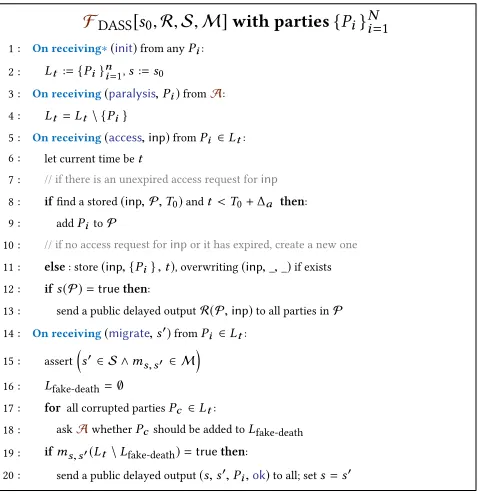
3.2.2 Ideal functionality. We specify security goals of a DASS in the ideal functionalityFDASSas defined in Fig.2.
To reduce clutter, we omit the handling of session IDs (SIDs) in
FDASSbut readers are advised that messages received and sent by FDASSare implicitly associated with an SID. WhenFDASSsends
subroutine output to parties, we use thedelayed output terminol-ogy from [23] to reflect the network adversary. Specifically, when
FDASSsends a public delayed output to partyPi, the output is first
sent toAand then forwarded toPiafterA’s acknowledgement or ∆time has past, whichever happens first.
FDASSmaintains internal states(Lt,s)for the set of live parties
and currently enforced access structure respectively. To capture the paralysis explicitly, we extend the standard corruption model [23] with special “paralysis” corruption. Upon receipt of aparalysis message fromA, a party immediately announces its paralysis and halts until the end of the protocol. In the ideal protocol,Asends
(paralysis,Pi)toFDASS, who removesPifrom the set of live parties.
To access the resource, a set of partiesPsend(access,inp), in whichinpspecifies the parameter of access, toFDASS. IfPis
per-mitted to access by the current access structure, i.e.s(P)=true,
FDASSreturns the result of accessingR. A set of parties can initiate
a migration to another access structures′by sending(migrate,s′) toFDASS. If the transition tos′is permitted by the enforced DASP,
FDASSsets the current enforced access structure tos
′ .
FDASS[s0,R,S,M]with parties{Pi}iN=1 1: On receiving∗(init)from anyPi:
2: Lt:={Pi}n
i=1,s:=s0
3: On receiving(paralysis,Pi)fromA: 4: Lt=Lt\ {Pi}
5: On receiving(access,inp)fromPi∈Lt: 6: let current time bet
7: // if there is an unexpired access request forinp
8: iffind a stored(inp,P,T0)andt<T0+∆a then: 9: addPitoP
10: // if no access request forinpor it has expired, create a new one
11: else: store(inp,{Pi},t), overwriting(inp,_,_)if exists 12: ifs(P)=truethen:
13: send a public delayed outputR(P,inp)to all parties inP
14: On receiving(migrate,s′)
fromPi∈Lt:
15: assert
s′∈ S ∧m
s,s′∈ M
16: Lfake-death=∅
17: forall corrupted partiesPc∈Lt:
18: askAwhetherPcshould be added toLfake-death
19: ifms,s′(Lt\Lfake-death)=truethen:
20: send a public delayed output(s,s′,Pi,ok)to all; sets=s′
Figure 2: The ideal functionality of a Dynamic Access Struc-ture System. The entry point marked with∗is only executed once.
3.2.3 Security properties. FDASS[s0,R,S,M]encapsulates the
fol-lowing security properties of a Dynamic Access Structure System. Letsdenote the effective access structure ofFDASS, andLt the set of live parties at timet.FDASSguarantees bothsafetyandliveness
in all statess∈ Sat any timet:
Safety: A set of partiesL⊆Ltcan accessRonly ifs(L)=true. A transition tos′,soccurs only ifms,s′(Lt)=true.
Liveness: Ifs(L) = truefor someL ⊆ Lt, thenL can access
R within∆time after interacting with the DASS honestly. If
ms,s′(Lt) = true, then a transition tos′ , soccurs within ∆ afterLtinteracts with the DASS honestly.
Examples.Consider a DASS enforcing the DASP in Example1, theSafetyproperty ensures that access is enforced by the current access structure at any time, and that the access structure can be downgraded to allow access byN−1 shareholders only if|Lt|<N, i.e., a collusion ofN−1 shareholders cannot maliciously accuse theNthshareholder of being incapacitated and thereby steal her share. TheLivenessproperty ensures that access is granted if the structure is satisfied by a set of cooperating parties. Moreover, if allowed by the policy, the Liveness property ensures that the access structure will be downgraded within a bounded time should parties submit legitimate requests. Note that the Liveness property does not stipulate that access structuresiis automatically instantiated if
|Lt|<N. This is because parties may not immediately activate an access-structure migration; in fact, if all parties are incapacitated, such migration cannot happen.
4
PARALYSIS PROOFS FOR
CRYPTOCURRENCIES
In this section, we expand on the use of Paralysis Proofs to recover from cryptocurrency key loss (and related failures, e.g., player dis-appearance).
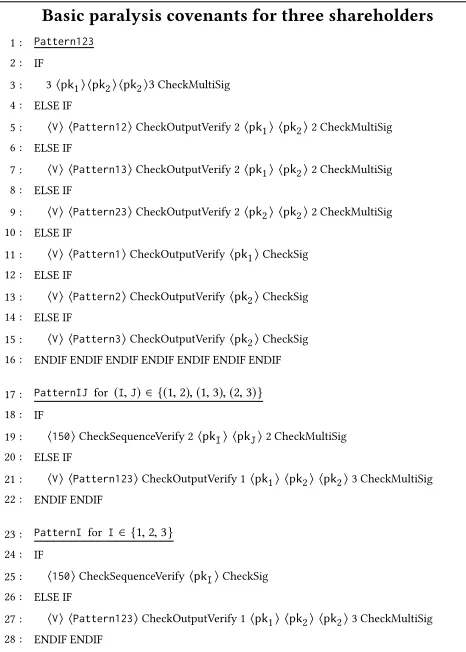
Bitcoin, the most popular cryptocurrency with a market cap of $110B at the time of writing, is an important application target for Paralysis Proofs. Implementing secure Paralysis Proofs for the cur-rent Bitcoin protocol, however, is challenging because of the limited expressiveness of Bitcoin scripts. Were a proposed enhancement called “covenants” available [53], we show in AppendixCthat Paral-ysis Proofs can be constructed, though with significantly higher complexity. Moreover, it is unclear when or whether covenants will be adopted in Bitcoin. Thus we explore an alternative approach involves the use of TEEs—specifically, Intel SGX—in this section. In AppendixDwe give a similar Paralysis Proof construction com-patible with the current Bitcoin protocol without using SGX, but it only provides a weaker security guarantee and incurs more than exponential overhead, making it impractical.
Realizing Paralysis Proofs is challenging even with TEEs, due to their inherent security limitations: they can’t maintain persistent states, their I/O can be censored by the malicious OS and they don’t have an accurate sense of time. We use the following strawman pro-tocol to illustrate why these limitations lead to design challenges. A strawman protocol.Suppose there areN players. On initial-ization, the enclave generates a key pair(sk,pk)and outputspk. Players moves the fund to the address ofpk. The enclave also initializes the access structure as an(N,N)-multisig scheme, i.e., signatures from allNplayers are required to spend the fund con-trolled bysk. To attempt to remove a playerP, the enclave sends a challenge toPand starts the timer. IfPdoesn’t respond within∆ time, the enclave removesPfrom the access structure.
This strawman protocol is insecure for three reasons. First, unless additional mechanisms (e.g., [14,48]) are employed, an SGX enclave is susceptible to state rollback. A malicious player could restore the enclave to a state before she’s removed from the access structure, defeating the basic security requirement. Second, since the enclave’s network is censored by the network adversary, she can cause a live player to be removed by delaying the response.
Note that these two problems can be solved by using a blockchain as a censorship-resistant stateful channel between players and the enclave. Nonetheless, the strawman protocol is still insecure. The issue is that the enclave—lacking a trusted timer—cannot establish an update-to-date view of the blockchain. For example, the adver-sary could present the enclave with a fork withoutP’s response. Thanks to the lack of a trusted timer—in the case of SGX, an enclave can only ascertain anlower boundon the elapsed time—even an adversary with a low computational power can mount such attacks. Solutions.Instead of patching TEEs to make the above strawman protocol work, we took a different path thatdoes not rely on TEE for keeping track of time or maintaining the current access struc-ture. It is important to emphasize that the security of our protocol doesn’t require the enclave to have an update-to-date view of the blockchain—in fact, the enclave need not any view of the blockchain state. Moreover, a challenged player does not communicate with
the enclave to signal her liveness. Finally, the enclave doesn’t main-tain any state, except for a secret key. Since the state is static, our protocol is immune from state rollback.
The high-level idea behind our solution is to use Bitcoin’s time-based opcodes to track time, and to condition the output of the enclave on the state of the blockchain that is presented to the en-clave. For example, if the TEE is presented with a forked blockchain, then the enclave output would only be valid on that fork. We achieve this using “life signal” transactions with time-based opcodes.
4.1
System model and trust assumptions
In this section we setup the formal model in which we specify the protocol, and discuss trust assumptions.
SGX and attested execution.Throughout the paper, we use SGX as a building block, although the protocol can be realized by any TEE capable of attested execution.
In our formal specification, we adopt the (local) ideal function-alityFSGXbased on Pass et al [60] to model TEEs with attested execution. Informally, a party first loads a programprog
enclinto an
SGX enclave with ainstallmessage. On aresumecall, the program is run on the given inputinp, generating an output along with an attestationσSGX=ΣSGX.Sig(skatt,(progencl,outp)), a signature
un-der the hardware keyskatt. The public keypkattis can be obtained
fromFSGX.getpk(). We refer readers to [60] for details.
An ideal blockchain.Our protocol uses an ideal blockchain de-fined in Fig.7as a censorship-resistant stateful channel.Fchain[succ] generalizes the bulletin board model because it also captures the no-tion of item validity.succ(history,item) → {0,1}is a function that specifies the criteria for a newitemto be appended tohistory. We retain the append-only property of blockchains but abstract away the inclusion of items in blocks. As reflected inFchain, we assume items are timestamped when added. In practice, block numbers can serve as such timestamps.
Trust assumptions.Our protocol relies on TEE with attestation that protects the confidentiality and integrity of computation, and an censorship-resistant stateful channel. Concretely, we assume SGX is correctly implemented and that the Bitcoin blockchain is secure and available to all parties. Let us stress that the trust as-sumptions in SGX islocal, i.e., only the parties in the protocol will be affected should SGX properties be broken. We discuss ways to minimize trust in SGX in Section4.4.
4.2
Protocol details
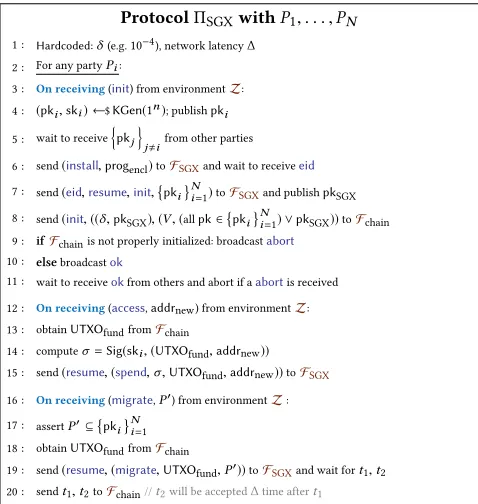
We denote our DASS for Bitcoin byΠSGX.ΠSGXis formally
spec-ified in Fig.8and Fig.9. We give text descriptions below of the steps involved inΠSGX, so formal protocol or ideal-functionality
specifications are not required for understanding.
Recall that we useNto denote the number of players at the start ofΠSGX, andPi fori∈ {1,2, . . . ,N}to denote each player. EachPi is associated with a Bitcoin public keypki, whose corresponding secret key is only known toPi. For simplicity,{Pi}is used to refer to the complete set of all players.
Initialization.To start the protocol, some honest party needs to load an SGX instance withprog
encl(Fig.9) and invoke theinit
pro-cedure. For now we assume a single SGX available to all honest
parties; thus any honest party can initiate the enclave (once ini-tialized, sequential initialization will be ignored). In Section4.4we present an expanded distributed setup procedure that avoids this assumption and provides stronger guarantees.
After the setup procedure is completed, the parties send a small fund ofδB (e.g.δ =0.00001) to a new output that can be spent bypk
SGX. Then the parties launch the protocol by sending their
unspent output ofVcoins (denotedUTXOfund) to a new output of
Vcoins with a script spendable bypki N
i=1orpkSGX.
Spending funds.There are two ways to spend the funds that are managed inΠSGX. At any time, the players can spend the money
via a Bitcoin transaction that embeds theirNsignatures (perϕallin Fig.8). Hence, even in the case that allN SGX CP Us are destroyed, the players are still able to spend the funds just as they could before the execution ofΠSGX. However, a better way to spend the funds is by sendingN requests to an enclave, letting the enclave create a Bitcoin transaction with a single signature (signed byskSGX). This reduces the on-chain complexity and the transaction fee. Migrating to another access structure.Themigrateprocedure ofΠSGXresolves system paralysis by letting the live
sharehold-ers spend the money if one or more shareholdsharehold-ers is incapacitated. Intuitively, the role of SGX is to be an arbitrator: when any share-holder alleges that the money is stuck due to an unresponsive party, SGX first gives the accused party∆time to appeal. The set of shareholders that controls the fund will be reduced only if no appeal is observed on the blockchain within this sufficiently large ∆(meaning that such an appeal did not occur, assuming censorship resistance [31] holds on the underlying blockchain).
The core idea of implementing an “appeal” in Bitcoin is to use what we calllife signals. A life signal for partyPkis a UTXO of neg-ligible Bitcoin amountεB, that can be spent either byPk—thereby signaling her liveness—or bypk
SGX, but only after a delay.ΠSGX
makes use of life signals to securely migrate to remove a party from the current access structure. Specifically, suppose the current set of shareholders isP={Pi}iN
=1, to (propose to) remove partyPkfromP,
any live players can send a message(migrate,UTXOfund,P\ {Pk}) toprog
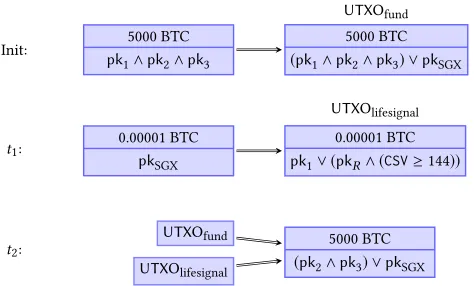
encl. Thenprogenclwill generate two signed transactions,t1
andt2(defined in Fig.9and illustrated in Fig.3), as follows:
•t1: a life signal forPk.
•t2: spends both the life signalUTXOlifesignalint1and the
es-crowed fundUTXOfundto a script that is spendable without Pk(i.e., by(pki N
i=1\
pkk ) ∨pkSGX).
The SGX enclave gives botht1andt2together as output. Ift1
is sent to the Bitcoin blockchain,Pk can cancel her removal by spendingt1. Otherwise,t2will become valid after the∆delay and
can be sent to the blockchain, thereby removingPk’s control over the fund. Fig.3demonstrates an example with three players.
Notice thatprog
encl parsesUTXOfundand obtains the list of
current shareholders, so thatprogencldoes not have to keep track of current live shareholders locally, nor does it need to have an up-to-date view of the blockchain. As we will discuss shortly, this is an important security feature.
Init:
t1:
t2:
5000 BTC
pk1∧pk2∧pk3
5000 BTC
(pk1∧pk2∧pk3) ∨pkSGX
0.00001 BTC
pkSGX
0.00001 BTC
pk1∨ (pkR∧ (CSV≥144))
5000 BTC
(pk2∧pk3) ∨pkSGX UTXOfund
UTXOlifesignal
UTXOfund
UTXOlifesignal
Figure 3: Example ofΠSGXwith three players andP1accused
of being incapacitated. Note thatpkRis a fresh ephemeral key generated for each life signal.
4.3
Security of
Π
SGXIntuitively, the security ofΠSGXstems from the use of SGX and the
relative timeout feature of Bitcoin. We discuss the security ofΠSGX informally, then present a formal proof.
4.3.1 Security arguments.The core security property ofΠSGXis
that a live party cannot be falsely removed from the access structure, no matter how many of parties are malicious. This is achieved by the use of the relative timeout feature of Bitcoin [20] in the fresh
t1, and the atomicity of the signed transactiont2.
To elaborate,t2will be valid only if the witness of both inputs
(UTXOfundandUTXOlifesignal) is correct. The witness that the SGX enclave produced for spending theUTXOfundis immediately valid, but the witness for spendingUTXOlifesignalbecomes valid only after
t1has been incorporated into a Bitcoin block that has been extended
by∆additional blocks (due to theCSVcondition). The shareholder
Pithat accusedPkof being incapacitated should therefore broadcast
t1to the Bitcoin network, wait untilt1is added to the blockchain,
then wait for the next∆blocks, and then broadcastt2to the Bitcoin network. However, while these∆blocks are being generated,Pk has the opportunity to appeal by spendingt1with the secret key
skkthat is known only to her (the script oft1does not require the CSVcondition for spending withskk).∆is set to a large enough value for two purposes: (1) to givePkenough time to respond, and (2) to ensure that it is infeasible for an attacker to create a secretive chain of∆blocks faster than the Bitcoin miners, and then broadcast this chain (in whicht2is valid) to overtake the public blockchain.
A fresh, ephemeral key pair(skR,pkR)is generated for each life signal to ensure thatt1is unique and hence does not already reside
on the blockchain (e.g.,Pkmay have failed to respond to an earlier life signal but luckily another shareholderPjwas removed at that time). The SGX enclave does not need to store ephemeral keys, as they are consumed right after generation.
4.3.2 Strawman attacks.To illustrate the security properties of ΠSGX, we discuss a few strawman attacks in whichN−1 malicious
players (collectively referred to as the attacker) attempt to remove theNth player (i.e.,PN) from the access structure and why they
are prevented byΠSGX. The attacker’s goal is to somehow gett2— the transaction that changes the access structure—included in the blockchain. Recall that we assume players can reliable connect to the blockchain (while the enclave may not.)
Withholding transactions.Clearly, withholdingt2is only to the disadvantage of the attacker. On the other hand, withholdingt1
doesn’t gain the attacker any advantage either. Due to the relative timeout int1,PNalways gets the∆blocks worth of time to respond
regardless whent1is included in the blockchain.
Manipulating the I/O of the enclave.InΠSGX, the enclave
re-ceives as input(migrate,UTXOfund,P\ {PN})and outputs signed transactions(t1,t2)as specified. The enclave doesn’t (and generally
can’t) check the validity of the input UTXO, nor does it check that the output transactions are sent to the blockchain correctly. This is, however, not a security problem.
The attacker may feed the enclave with an invalid (e.g., spent or non-existent) UTXO. However, since the output transactiont2
spendsUTXOfund, providing the enclave with an invalidUTXOfund would result in an invalidt2that can’t change the access structure,
making the attack a no-op.
The attacker may also send the output transactions to secretive forks as opposed to the main chain. Note that sincet2spendst1,
in order fort2to be valid, both must be in the same fork. If both
are sent to the main chain, thenPN would notice and respond normally. However, if both are sent to a secretive fork, the access structure would indeed be changedon that fork. Nonetheless, unless the attacker can overtake the main chain with that fork, which is at least as difficult as double spending attack assuming a large enough ∆, the fund on the main chain remains intact.
4.3.3 Security proofs.The security ofΠSGXis proven using the framework developed in Section3, as summarized in Theorem1. See AppendixBfor a proof sketch.
Theorem 1 (The Security ofΠSGX). AssumeFSGX’s attesta-tion scheme and the digital signature used inΠSGXare existentially
unforgeable under chosen message attacks (EU-CMA). ThenΠSGX
UC-realizesFDASS[sP0,R,S,M]in the(FSGX,Fchain)-hybrid model,
for static adversaries.
4.4
Minimizing trust in TEEs
We now briefly consider some ways to minimize the trust placed in the TEE employed in our protocol.
Avoiding a single point of failure.Trusted hardware in general cannot ensure availability. In the case of SGX, a malicious host can terminate enclaves, and even an honest host could lose enclaves to outages. To avoid reliance on a centralized SGX server, each party inΠSGXcan run her own SGX enclave with an identical program. This way, any individual party (or set of parties) can always use all the capabilities of the protocol without being dependent on others. Specifically, the initialization procedure ofΠSGXcan be replaced
with the following procedure that distributes the master keyskSGX across multiple hosts. First, each enclave first generates a fresh key pair(pk
SGXi,skSGXi)and outputspkSGXi while keepingskSGXi
secret. Then, each player uses her identityPi to endorsepk
SGXi,
and all the players reach agreement on the list of SGX identities
pkSGXi N i=1
. Finally, the enclaves then usepk
SGXi N i=1
to estab-lish secure channels (TLS) with each other, and create a fresh shared secret keyskSGXthat is associated with
pkSGXi N
i=1(i.e., another
invocation of the setup procedure will generate a different shared key). Given use of the secure hardware random number generator (RDRAND), secret keys generated by SGX are known only to the enclaves, not to any of the players. From now on, no inter-enclave communication is needed in the course of the protocol. Each enclave then seals its state (which mainly consists ofskSGX) by encrypting it using the hardware key (unique to each CP U) and storing the ciphertext to persistent storage. Hence, the enclave program does not have to run persistently, and each players can run the backup on-demand when needed.
Side-channel resistance.Although SGX aims to provide confi-dentiality, recent work has uncovered data leakage via side-channel attacks (e.g. [76,80]). AdmittedlyΠSGXis not side-channel-free, but it has a relatively small and controlled attack surface. The only se-cret in SGX isskSGXand only operation involvingskSGXis signature generation (besides key generation)—this makesΠSGXamenable
to software-level side-channel mitigations, such as constant-time ECDSA implementation (e.g. [28]).
A more powerful and somewhat more interesting approach is to design side-channel-free Paralysis Proofs. We claim that no side-channel-free construction of Paralysis Proofs exists given the current trust assumptions. However, if we relax the assumptions slightly, for example, by assuming a trusted relative clock in SGX (which is not available now [1]), or assuming certain stationarity properties of the blockchain (e.g. difficulty), a side-channel-free Paralysis Proofs can be constructed by establishing an up-to-date view of blockchain in SGX (e.g., using techniques in [24]). Specifi-cally, SGX will only be activated when paralysis happens (which requires an up-to-date view of the blockchain to detect), and will generate a new keyskSGXfor every newUTXOfund. Since the
en-clave secret is used only once, such a construction is side-channel-free.
Least-privileged SGX.InΠSGXand the examples above the fund can be spent bypk
SGXalone, but it’s important to note that is not
the only option. In fact, one can tune the knob between security and paralysis-tolerance to the best fit their needs. Specifically, for a desired level of paralysis-tolerance, one can design a DASP such that the SGX isleast-privileged. For example, if the three shareholders only desire to tolerate up to one missing key share, what they can do is to move the funds into 3-out-of-4 multisig wallet where the 4th share is only known to the SGX enclave. If all of the parties are alive, then they can spend without use of the SGX node. If one of them is incapacitated, the enclave will release its share upon presentation of a Paralysis Proof. Therefore, even if the secret state of the SGX node (i.e., the fourth share) is leaked via a successful side-channel attack, the attacker cannot spend the fund unless two malicious parties collude. It can be shown that the SGX in the above DASP is least-privileged, in the sense that compromise of its secret state imparts minimal capabilities to an adversary. Intuitively, since we want to retain access even one player is incapacitated, the enclave must store a credential equivalent to that of the lost player. We leave formal specification of least-privileged SGXs for future work.
0 100 200 300 400 500 0
10 20 30
Number of users
Time
(ms)
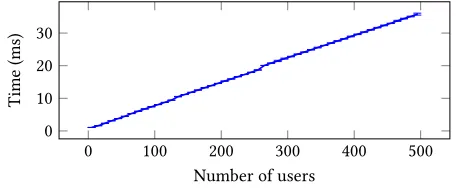
Figure 4: Execution time ofP2Wwhen accusing one user.
4.5
Implementation
4.5.1 Paralysis Proofs for Bitcoin. We implementedΠSGX as a
Paralysis-Proof Wallet (calledP2W) for Bitcoin based on Intel SGX SDK and Bitcoin Core. The source code ofP2Wis published at [2]. The same code works for Bitcoin and compatible systems, e.g., Litecoin.
To minimize the Trusted Computing Base (TCB), we ported only the necessary part of Bitcoin Core v0.14.0 to SGX, resulting in only using∼9.5% of it. The entire TCB includes 734 lines of C++ code written by us,∼9.5% of the Bitcoin Core and its Elliptic Curve library (libsecp256k1).
In the normal case,P2Wis essentially a(N,N)-multisig wal-let. Users can spend the coins by either sendNsignatures to the blockchain, or toP2Wwhich then generates a single signature. The latter method reduces the transaction size and saves transaction fees, while the former ensures the availability of the fund. When a user is suspected to be unavailable, others can accuse her using P2W, which sends transactionst1andt2(c.f. Section4.2) to the
blockchain. The accused user can appeal by spending the life signal UTXO int1(a standard P2PKH output) usingP2Wor any standard Bitcoin wallet.
We evaluatedP2W’s performance by simulatingN users and measuring the execution time of accusing one of them . As sum-marized in Fig.4,P2Wis very fast. For example, for 100 users, it only takes about 10 ms to generate accusation transactions.t1is
of constant size (224 bytes) which means the cost of a malicious accusation is about as high as dismissing it.t2is roughly(443+34N)
bytes. With a suggested fee rate of 20 Satoshi/byte1at the time of writing, the transaction fee oft2would be about $0.02N, which is a very reasonable cost for such an infrequent and security-critical operation.
We validatedP2W’s compatibility with Bitcoin by deploying it on the testnet. We set∆=144 blocks (roughly 24 hours in Bitcoin) and simulated the following two scenarios: a) a user is falsely accused, but she appeals within∆and maintains the ownership of the wallet, and b) a disappeared user is challenged and removed from the wallet after∆. Accepted Bitcoin transactions can be found at [5, 6] (for scenario A) and [7,8] (for scenario B). Note that in the
latter scenario,t2is not accepted until 24 hours aftert1is included,
enforced by theCSVopcode.
1
See, e.g.,https://statoshi.info/dashboard/db/fee- estimates
4.5.2 Paralysis Proofs for Ethereum.For assets that can be con-trolled by smart contracts, an implementation of the ideal func-tionalityFDASSis straightforward. Our reference implementation of a paralysis-free multisig wallet for Ethereum [78] consists of 156 lines of commented Solidity code. Fully tested contract code, including logic for pruning incapacitated signers and updating the signature threshold is at [3].
This implementation differs from the ideal functionality only in minor engineering changes and optimizations. There is no way to asynchronously prune keyholders that fail to respond to a challenge in time in Ethereum, where all contract calls must be initiated by some user. We instead check and prune any signers that did not respond to a challenge at the beginning of each on-chain operation that requires checking or manipulating only valid signers. This ensures that the state of unparalyzed signers is correct, reflecting
LtinFDASS, before any contract action is processed.
A final caveat is that block timestamps are used to measure time; while this can be trivially replaced with block numbers, which are less susceptible to miner manipulation (timestamps are miner set), the bounded degree of manipulation and monotonically increasing timestamp constraints on Ethereum provide some assurance that the timestamps are reasonably accurate for our purposes.
One useful property of the Ethereum-based realization is that the multisignature key holders need not necessarily run archival nodes: because a log is emitted whenever a user is accused, users can simply watch transaction receipts for an accusation against them, using any Ethereum full or lite client to respond by calling therespondfunction (guaranteed to work as long as an adversary cannot censor a user’s connection to the blockchain, given that the user accepts the relevant trust assumptions surrounding their choice of node software, hardware, and connectivity).
5
EXTENDED PARALYSIS PROOFS: THE CASE
OF CUSTODIAN PARALYSIS
5.1
Motivation
A (digital asset) custodian is acentralizedservice that secures or helps secure a user’s digital asset (or other key-controlled resource). Use of custodians is common as they offer better usability and security, compared to having end users managing secrets on their own. Coinbase recently indicated that it was holding 10% of all Bitcoin in circulation [12].
An obvious concern with centralized custodians is theft, in which a custodian (or hacker that has compromised a custodian) steals funds from users’ accounts. In addition to theft, Denial-of-Service (DoS) is another major concern. If a custodian refuses to respond to a user’s transaction requests, the user effectively loses her funds. In this section, we show how DASSes enable an interesting new architecture for digital assets custodians—ahybridcustodian—to address both concerns.
To achieve these properties, we refine the definition of paralysis. In addition to unavailability, a party (i.e., a custodian here) is con-sidered paralyzed if it exhibits a certain behavior (e.g., maliciously rejects users’ withdrawal requests). This definitionrefinesthe pre-vious ones, as it such cases, the custodian may be “available” in the sense of responding to clients, but exhibits paralysis by failing to process certain legitimate transaction requests.
In addition to realizing a new and appealing custody architecture, this example also illustrates how Paralysis Proofs can embody rich and precise conditions beyond mere unavailability. Specifically, we show that a publicly verifiable proof can be constructed if a custodian rejects valid authentication attempts. Generally, Paralysis Proofs can be a condition predicated on user and/or system secrets (passwords and/or keys for two-factor authentication), in addition to mere absence of response.
5.2
Protocol
Setup.In our hybrid custodian scheme, a user stores her funds in a(2,2)-paralysis-proof-multisig wallet (using techniques in Sec-tion4), of which one key is held by a TEE operated by the centralized custodian. The custodian is responsible for authenticating the user (e.g., via a password, SMS code, etc.) before authorizing a transac-tion. Both signatures from the user and the custodian are required to spend funds.
Such a setup has two security benefits. First, it prevents the custodian from stealing the funds, as the custodian only possesses one of the secret keys. Second, it offers the user stronger security than if she managed her own keys, given the general weakness of endpoint security and the fact that an institutional custodian is usually much better at managing and securing keys than an ordinary user is.
Dealing with malicious DoS.As mentioned, we add additional rules to basic Paralysis Proofs so that a party (i.e., the custodian) is considered paralyzed unless a predicateϕis met. In other words, when the custodian is accused (see Section4for terminology), it can only appeal ifϕis true.
Specifically,ϕ will ensure an “appeal” is issued if and only if the custodian’s TEE faithfully attempted and failed to authenticate the user (e.g., the user inputs a wrong password). In other words, the custodian is honest but the accusation is invalid. Without this predicate, a malicious custodian can always appeal to dismiss honest users’ accusations. With the predicate, however, the custodian can only appeal against invalid accusations. Thus, we reduce the case of a malicious custodian actively refusing to accept authenticated transactions to that of a simple paralyzed party who cannot appeal. Fig.5illustrates the idea of conditioning the issuance of response on the predicate of “the challenge contains valid authentication information.” The exact details of this predicate can vary depending on the authentication mechanism, as explored by example below. Example: Password-based authentication.Consider a simple scenario where the user authenticates to the custodian with a pass-word. The user submits her password (encrypted under the TEE’s public key) along with a partially signed transaction, and a signature over her full request. The custodian’s TEE verifies the signature on the request and checks if the password is correct. If so, it signs the transaction with its key. Otherwise, the request is discarded. If the signature is correct but the password is wrong, then the custodian may advance a counter which can be used to trigger rate limiting or lock the account. Here the custodian’s role would be to store a hashed version of the password securely, check it against the sub-mitted password, and rate limit password attempts. Assuming that rollback attacks against TEEs are prevented using, e.g., distributed state [48], authenticating the password request with a signature
prevents the custodian itself from submitting false authentication attempts in an effort to deny service by locking a user’s account.
If the custodian is available but refuses to accept the password, we can now enter into an on-chain dispute resolution process, as shown in Fig.5. The user posts a challenge containing the encryp-tion of her password under a key known to the custodian’s TEE. If the custodian doesn’t respond within∆, the standard Paralysis Proofs mechanism can kick in and remove the custodian from the access structure. To appeal with a response, the custodian’s TEE must decrypt the submitted password and test if it is correct. If the password is correct, the TEE refuses to issue a response, which is equivalent to the first case where no response is issued.
5.3
Extensions
For the ease of exposition the above protocol description uses simple password-based authentication. Various extensions are discussed below, including authentication via a third party (e.g., 2FA), user account recovery, and a general approach to use any interactive authentication protocol.
Third-party authentication.Another option is for the TEE to contact third parties directly to provide a primary or secondary au-thentication factor. Town Crier [82] demonstrated that it is possible to make a TLS request from an enclave to a third-party service and condition behavior on the response. Combined with input from the user via the blockchain, this can be used to directly authenticate a user, to provide a second factor via services such as Authy or Twillo, or to ensure that a user still has an account with some ser-vice. Many of these mechanisms depend on trusting a third party, but in the case of established and widely used services this may be more palatable than trusting any specific custodian. Multiple services can of course be combined to further distribute trust—with a trade-off against availability.
User account recovery.Using the same mechanisms for interac-tive protocols or authenticating via third parties, the custodian can provide a mechanism for account recovery in the case of lost creden-tials. Given a Paralysis Proof for the user, control can be transferred to a fresh multisig address. Indeed, if the custodian relies on third parties for authentication, then it inherits the account recovery mechanism automatically. This is, of course, a double-edged sword: the same mechanisms that are used for account recovery can be used to hijack the account. We are not limited, however, to simple password recovery mechanisms. If the custodian only controls one of two keys necessary to spend the funds, we can realize account recovery by requiring a Paralysis Proof against the user to migrate access control to another key.
More complex protocols.Following the techniques of [39], any interactive authentication protocol can be realized by posting en-crypted messages between the client and the custodian to the blockchain. A Paralysis Proof then is simply an on-chain execution of the protocol where messages are delivered and logged via the blockchain. Indeed, the password example is a simple one-round version of this. The same idea can be applied ton-round proto-cols through repetition and extended to, for example, integrating federated authentication protocols or challenge-response-based two-factor authentication.
U∧C U
“The custodian refuses service”
(a) The DASP in the custodian paralysis example. “U” denotes
the user, and “C” denotes the custodian.
User
Blockchain
Custodian TEE
ifXhas valid authentication infothen output an appeal toX
else output⊥ end if challenge
X =“Here is my signed
trans-action request” response
(b) Extended Paralysis Proofs: the accused party can appeal only if a predicate is met. Read Section5.2
for details.
Figure 5: An example of custodian paralysis and migration.
6
PARALYSIS WITHIN SMART CONTRACTS
6.1
Motivation
We’ve explored the use of smart contracts in Paralysis Proofs in Sec-tion4. In the broader smart contract community, it is well known that paralysis can occur within smart contracts themselves. A clas-sic example is the second of two well-publicized and related Parity multisignature vulnerabilities [18] [67] which permanently and irrevocably froze hundreds of millions of US dollars in smart con-tracts. The Parity multisignature vulnerabilities are far from the only high-profile failures that resulted in paralysis; early analysis of Ethereum smart contract vulnerabilities [22] enumerated a number of vulnerable contracts with stuck funds and DoS vulnerabilities. Some vulnerabilities are subtle, involving low-level platform details like the “gas" model for pricing computation [78].
Most smart contract vulnerabilities, despite their different mani-festations, have a fundamental commonality: in each case, a smart contract was operating as intended until some unexpected change to the state of the contract, the network, or the computation model under which the contract was operating. These changes then caused subsequent executions of previously working functionality to fail, leaving the funds in a contract potentially “paralyzed," and stuck indefinitely. This problem is so widespread and severe on Ethereum, that hard-fork-based manual remediation of affected contracts has been suggested as a major governance issue and debate [21] [34]. We find a natural way to capture to this class of failure in Paral-ysis Proofs using software engineering tradition. When integrating various system components which may potentially be faulty, devel-opers often create and run integration tests [38], often continuously as software is developed, in a process known as “continuous inte-gration" [29,69]. We can naturally extend Paralysis Proofs using continuous integration: if a full integration test suite is available, aprovabletest failure constitutes a Paralysis Proof and triggers a “downgrading of access control", authorizing transfer of funds to a
simpler recovery contract.
6.2
Protocols
Smart-contract based implementation.Two variant implemen-tations of this idea are possible. The first is smart-contract based, with a protocol specification for the smart contract given in Fig.6. (We omit user entry points from this specification.) In this protocol, there is a static, hardcoded set of testsT, with each testτi con-taining some storage locations to initialize that are required for correct operation of the test. (These locations are not necessarily comprehensive; tests can and should can pull storage variables from
Program for Smart Contract Paralysis Proofs (progci)
1: Hardcoded:T={(π1,σ1,ω1), ...,(πn,σn,ωn) }// test set 2: // testπishould run in stateσifor expected outputωi
3: whereσi=(s1,v1), ...,(sj,vj) // test setup
4: hnow// the latest height,
5: H,// mapping from block hash to height,
6: ∆,// maximum time to construct a proof, in blocks
7: C=[CP,CR]// addresses of main and recovery contract
8: On input(access,d): 9: ReturnC[0](d,msg.sender)
10: On input(migrate,(i,p=(s1,v1,p1), ...,(sk,vk,pk) )): 11: Assert{pi}are all from the block (i.e. have the same Merkle root)
12: Asserthnow−H[p1.merkle_root] ≤∆// Ensure proof is fresh
13: Σ:=∅// Initialize state (location to value map) for test to run in
14: For each(sj,vj,pj) ∈p:
15: Assert is_valid((sj,vj,pj))// Ensure Merkle proofs are valid
16: Σ[sj]=vj// Initialize storage from environment
17: For each(sj,vj) ∈σi:
18: Σ[sj]=vj// Initialize static per-test storage 19: Ifπi(Σ),ωi:// if test output differs from expected 20: C=C\C[0];T=∅
Figure 6: An example implementation of Paralysis Proofs for smart contracts.
the environment.) For example, static stateσimight contain an ini-tialization of a special testing account with some balance available to be transferred that is not present in the real token contract, with the remainder of state required for the test sourced from the global stateful environment.
If a smart contract is paralyzed, it must be failing some unit test
iat blockb. A user who notices this submits a proof by sending migrate, including Merkle proofs-of-inclusion for all state items consumed by the testfrom the environmentat blockbin the global Ethereum state trie [78]. The implementationprog
cichecks that
submitted Merkle proofs are all from the same block, that the block is recent (to prevent DoS via stale proofs), and that all proofs are valid.
For this check,prog
ciinstantiates a temporary state. First all
the validated state entries from the environment are added, then updated with the hardcoded static initialization state inσi. If ob-served test output differs from expected, paralysis is detected and progcimigrates anyaccessto a recovery contract that returns user