Journal of
Volume 8, Number 5 September, 1955RANGE
MANAGEMENT
What Is Range Management?
E. J. DYKSTERHUISRa#m,p Conservatiomist, LT. S. Dept. of Agriculture, Soil Conservation Service, Room 604, 134 South 12, Lincolrt 8, Xeb raska
The title of this article was given me. Wags may place it under the name of our journal, with startling results. However, probably no one will become alarmed by the pos- sible implication that we do not know what we are about. The topic, I believe, should remain ap- propriate always. Range manage- ment means something different as we learn more.
Concepts Have
Changed From the beginning, range man- agement has meant that, at least, there was some limit on removal of the growth of plants. But the limit for acceptable management before 1900 was different by 1920, and the 1920 limit is not acceptable today. The following quotation, taken from a USDA bulletin written for western ranchers shortly before 1900, gives some indication of what could pass departmental edi- tors on this subject at that time :“It is rarely if ever the case that even the close grazing of grass injures it, so long as the roots are not disturbed, but during the long droughts stock frequently pull up grass by the roots and in that way p e r m a n e n t 1 y injure the range.”
By 1920, and for some years thereafter, the most widely held opinion among professional range- men was: that on short-grass plains at least 15 percent of the available crop of palatable herbage should be left unused at end of the grazing season and, that on mountain bunchgrass ranges 20-25
percent of the current year’s growth should be left on the more palatable species. Today the rec- ommendation is more commonly to leave 50 percent or more if graz- ing is duriug the growing season. This seems necessary to obtain maximum and long sustained pro- duction from any group of range grasses. Such changes correspond with advances in plant physiology aud the increasing knowledge of the dynamics of plant communi- ties.
Proper degree of use, though perhaps the most important, is but one facet of range management. Other interesting changes from earlier conceptions have occurred. There has, quite generally, been change :
(1)
(2)
(3)
From general condemnation of range burning, to recog- nition that there are in- stances where it can be beu- eficial.
From listing the invasion and increase of ungrazable plants as a cause of range depletion, to listing poor range management as a common cause for their in- crease and invasion, and From managing ranges for species with highest nutri- ent content in percent, to managing ranges for spe- cies producing the most nutrients in pounds per acre -with seasonal feeding of concentrates in many cases.
Need to Inventory
Current Meaning
More changes might be listed but
193
these examples are enough to show . that whatever is range manage- ment today may not be range man- agement t 0 m 0 r r 0 w. Moreover, there probably is no written defi- nition that would be acceptable throughout the profession, even for today. However, there is need to inventory what may be included and what must be excluded. Those concerned with college curricula, whether st,udent or dean, are con- cerned with this problem. As a technician, I have been almost continuously confronted with it ; particularly when work& with technicians of other disciplines.
The problem becomes acute when dealing jointly with problems of land use and treatmeut on large areas such as watersheds, and in mixed farming and ranching coun- try. There, the question of “What is range management ?” must usu- ally be preceded by an answer to “What is range?” And that an- swer m u s t satisfy economists, agronomists aud foresters as well as rangemen. I admit that profes- sionals in other disciplines have partially forced me to my current definition of range, and that the science of ecology has contributed the foundation for an answer.
194 E. J. DYKSTERHUIS
generalizations of range, it has seemed necessary to so extensively qualify most prescribed actions, that the whole became confusing rather than enlightening.
_ Most Spanish language refer- ences concerning South American ranges do not mention range, but use their term most nearly equiva- lent to our word “range”, namely, 10s pastos rzatwales. Literally that is “the pastures natural”, or nat- ural pasture. The term “natural pasture” is an acceptable briefing of the definition given above. This specificness has been found very helpful. By contrast, results from using the term “range” in the Eng- lish dictionary sense commonly lead to misunderstandings and trouble.
Distinguishing Range for Agronomists Rangemen and agronomists have much in common. Yet agronomic terminology has at times perplexed me. As an example, there is the occasional recording and publiciz- ing of all established seedings of introduced and domesticated pas- ture species as “improved pas- tures”. This might cause no trou- ble deep in a forest climate. But in a grassland climate where we were working together, a part of the public was inadvertently led to believe that all natural pastures were unimproved, and therefore quite undesirable. Actually, on the natural forest sites nearby, all native pastures were undesirable if compared with tame pastures. However, in the same general area were many native pastures on nat- ural grassland sites that had been much improved by management of grazing alone. These were not “ex- tensive” pastures in terms of area, nor “open” in the sense of lacking fences and occasional trees. From the standpoint of cost to produce a pound of beef, some were far bet- ter pastures with their native pe- rennial bluestems than the adja- cent so-called “improved pastures” with their exotic self-sowing an- nuals and short-lived perennials. But the agronomists were no more to blame for this confusion than
myself, because I had not provided alternative concepts with a specific terminology.
For a time I even preferred to believe there was little difference between range management and agronomic management of pasture land. Hence, it appeared that their concepts and terms should amply serve us both and that what was applicable on tame pastures, in general, also should be applic- able on native pastures. But I learned that the heritage of liter- ature, training and experience in agronomy is overwhelmingly from climates and soils where produc- tion of cultivated crops is possible ; and that solutions to problems are taught and thought in terms of seeds, machines and fertilizers. This background points toward destroying plants that volunteer, limiting or preventing competition between plants, harvesting what is harvestable each year, correcting undesirable composition of plant cover by seeding desirable kinds and fertilization to increase pro- duction, The likelihood of this leading to conflicts with ordinary procedures in range management will be apparent to all range tech- nicians and ranchers.
Agronomic literature on man- agement of grazing refers more frequently to maintenance of plants in succulent condition by mowing or periodic close cropping than it does to maintenance of root reserves and ground cover to pro- mote infiltration. Rest from graz- ing to permit pasture improvement through plant succession is, of course, wholly foreign to agron- omy. Natural plant succession de- stroys tame pastures. Loss of strand on perennial tame pastures because of close grazing is rarely men- tioned, probably because most tame pastures are planted to later be plowed up, in order to increase production on a cultivated crop. Where the pasture is not in a crop rotation, loss of stand by grazing is still no catastrophe as it might be on steep arid range land, be- cause the agronomist’s pasture is generally on arable land and in a
climate where each year brings enough moisture to establish pas- ture. Moreover, close grazing dur- ing the final years of a tame pas- ture provides forage of higher pro- tein content than the moderate grazing necessary to prolong life of the stand.
Extensive seedings in range coun- try of introduced or domesticated native species, in pure stands or simple mixtures, are now becoming quite common. Let us examine the result of calling such seedings “range” rather than tame pasture. The grazier, and even the techni- cian unspecialized in range ecol- ogy, is thereby led to believe that the management of the new seed- ing will have something, if not everything, in common with the surrounding natural pasture. Yet natural plant succession operates as certainly to destroy this tame pasture seeding as it does to im- prove natural pasture and all true range seedings.
In the matter of viewpoint on proper land use, too, I commonly have had experiences that were revealing. An agronomist, when viewing the abandonment of culti- vation in a grassland area, such as the Dust Bowl, is likely to sug- gest that such “submarginal land” should be “retired” to grass. To the range man this is not retire- ment of land. It is putting land back into production. Moreover, although the land may be submar- ginal for cultivated crops, it usu- ally is choice range land.
WHAT IS RANGE MANAGEMENT? 195
enough spring moisture to provide grazing that year. Meanwhile, the control pasture, which was still na- tive perennial range, continued to carry its regular number without cost of fertilization or reseeding. If measured by accepted standards for tame pastures in humid cli- mates, the experiment had run long enough and change in species composition could be ignored. But this was native pasture on a prairie site, in other words a kind of range.
Distinguishing l3mge for Foresters Range management, as now most commonly understood in North America, grew oft of forestry; specifically, forestry of the U. S. Forest Service on the National Forests. This is not intended to belittle the pioneering range work of others; notably that of Jared G. Smith, some colleges and univer- sities, and of individual stockmen. Nonetheless, it is believed that without the documented experi- ence of the U. S. Forest Service and the demand for professional rangemen, which they originated, range management would not now be established as a separate pro- fessional discipline. The offshoot may have developed to have more in common with agronomy and ecology than with its parent, but such situations are not new. A parallel situation is found in the origin of botany from medicine; two fields that now have little in common.
Evidently we have inherited the term “forest range” from this par- enthood. Forest grazing is a re- ality ; and range forestry, as in shelterbelts, is a reality. Moreover, there is National Forest range, and there is grazing on the Na- tional Forests. But the term “forest range” has led to misunderstand- ings ; while reference to “forest grazing” has improved understand- ing only when it was made clear that it applied to grazing on forest sites.
The term “forest range” appears to mean a certain kind of range, but it usually includes an un-
THE ANNUAL STUDENT ISSUE
This number of the Journal rep- resents the sixth Annual Student Issue in which attention is di- rected to education in range man- agement. Education in range management, whether for the rancher, the student, or the pro- fessional wolrker, is and will con- tinule to be one of the important tools in the achievements of the objective of the Society to foster advancement in the science and art of grazing land management.
This Student Issue, assembled under the direction of Prof. Gene F. Payne and Dr. Farrel A. Rran- son of the Department of Animal Industry and Range Management at Montana State College, is wit- ness to the growing interest and progress in range management education at both high school and college levels.
A notable feature of this year’s issue is the emphasis, placed on range youth education at the high school level. Two contributed pa- pers feature the recent develop- ment of judging contests in range and pasture management as teaching methods for 4-H, FFA and other youth organizations. Awakened interest among youth in the proper utilization and man- agement of our range resources is exemplified by the prize-win- ning essay by a Utah high school student presented on page 203.
Ten student articles and editor- ials contributed for this issue and a Range Student Roundup of ac- tivities at nine co’lleges offering special training in range manage- ment provide an excellent per- spective of current teaching and research.
assorted mixture of natural forest land and natural pasture land. Where there is volunteer pastur- age on forest land I have found it misleading to refer to such pas- turage as range along with that from natural pasture lands. The transitory nature of grazing on forest sites should be clearly dis- tinguished from grazing on range sites because the latter alone is to be regarded as a permanent graz- ing resource. To include both types of sites in a general area desig- nated for multiple use has not adequately met the problem on private lands. Where there is some grazing land within a gener- ally forested area on which the climax is natural pasture, rather than forest, it has been best to designate that portion as “range” and to add any grazing available from forest sites as “forest graz- ing”.
Range obviously cannot encom- pass both forest sites and natural pasture sites, and still have unique and universal principles of man- agement. It was to make this dis- tinction with native pasture on forest land that range Was defined as occurring on natural grazing land, as well as being native pas- ture.
Distinguishing Range for Economists
Economics, of course, enters strongly into whether or not ar- able natural grazing land can best be used for native pasture, tame pasture or cultivated crops (in- cluding tree crops which, inci- dentally, also must be cultivated if successfully grown on natural grazing land). Economics also enters into problems of the degree to which the grazing resources of non-arable range lands should be shared between livestock, wildlife, recreation and watershed interests. But such economics are aside from the main topic.
196
regarded as range. There is indeed some land so arid, so rocky, so saline, so steep, or otherwise in- herently so unproductive that al- though it does naturally provide some native pasturage, the quan- tity is so small that to term it “range” is misleading. To graze it with domestic livestock may be quite uneconomic. And from a stockman’s viewpoint it may bet- ter be called waste land than range land. I have found no way to satisfactorily incorporate this economic concept in a definition of range because this lower limit fluctuates with economic condi- tions and also varies with the type of ranching operation.
A
Definition of Range ManagementWith List
of Elements
With this clarification of what has been included as range, and what excluded, and why, it should be possible briefly to define range management as : Economic im- provement or maintenance of nat- ural pastures for the production of animals and animal products. This does not preclude wildlife. man- agement, or watershed manage- ment, or application of some for- estry practices on range areas. Rather, other disciplines, which may be practiced on range, are thus also left some autonomy in developing their principles.
The ecologist Frederic E. Clem- ents listed the main factors in range improvement in a 1920 pub- lication of the Carnegie Institu- tion. They seem equally appropri- ate today, and each can be reconciled with use of the term range as previously described. The
E. J. DYKSTERHUIS
essential factors were presented as seven processes, namely :
(1) Proper stock+ng; to be de- termined by actual trial accom- panied by measurement of the re- sult,
(2) Rotation or deferred grax- kg; under which Clements in- cluded all methods of alternate grazing and rest, whether both oc- curred in one year or more,
(3) Control of rodents, poison- ous plants, weeds, etc.; and here the importance of natural succes- sion is stressed, along with direct measures by man,
(4) Manipulation of the range; including use of fire, irrigation, fertilization, cultivation, cutting, sowing and planting,
(5) Development of feed and forage for droughts and winter; to permit better utilization of the range and against the chance that weather may be abnormal.
(6) Development of water; to permit more even utilization of the range, and
(7) Herd management; under which is included all features which relate to the handling of livestock such as fencing or herd- ing methods that can contribute to the improvement or prevent de- terioration of the range.
Since maintenance is prevention of deterioration, little more need be said about it except that range improvement should continue at least until abnormal losses of soil and water have been halted at which time maintenance may be considered range management.
Range Management Versus Range Work Since the foregoing may in total seem to unduly circumscribe what
8 Q Q
may be range management, a con- joined viewpoint should be that range managers and range tech- nicians must know much more than just range management. A forage chemist Drofits by knowl- edge of animal nutrition and a rangeman profits by knowl- edge of animal husbandry. But chemistry does not include animal nutrition nor does range manage- ment include animal husbandry. In areas of range where wildlife management, or watershed man- agement, or forest management, or production of cultivated feed and forage crops is especially impor- tant, the rangeman should be es- pecially well informed in the importantly related field or fields. It is believed that range man- agement, as described here, can de- velop as a science; but that the work of the range manager and the range technician will remain an art, using many sciences. We are in need of a word to describe this broader field of a rangeman’s training, knowledge and work. The foresters have the word “forestry” to use in the broad sense for the art, as contrasted with the science of “forest management”. Since we rangemen now evidently lack an appropriate word for our art, I have used the inadequate term “range work”.
Definitions of both range and range management have been of- fered, primarily to aid in pointed discussion. The definitions appear satisfactory viewed from my ex- perience. Whether or not they are acceptable in light of yours, the discussions may be regarded as an attempt to orient and clarify the question of “What is range man- agement ?”
Teaching Tomorrow’s Ranchers Today
DICK WILSON
Agriculttiral Writer, Division of Public Informa&on, Okla- homa A & M College, Stillwater, Oklahoma
The old question of which came first-the hen or the egg-is still open to conjecture, but it is not hard to determine whether the cow or the grass came first. The dif- ficult problem is to teach which grass came first-and why. These are the words of Clarence Bunch, Oklahoma Extension Range Spe- cialist. who says the pioneer prac- tice of taking everything away and returning nothing is still common in many areas and has been just as prevalent on ranches as on cul- tivated land in this state. As a result, millions of acres of virgin prairie support only a small per- cent of the livestock they once did. In Okla.homa, subclimax grasses and undesirable weeds have ap- peared on more and more ranges, until now, less than half a century after statehood, it is unusual to find properly managed grasslands.
Oklahoma extension specialists early recognized these facts and set about to develop an educational program of range management that would have practical applica- tion on farms and ranches as well as in the classroom. After review- ing extension range work in sev- eral states and incorporating ideas gleaned from previous experience, the specialists designed a scientific met,hod of teaching practical pas- ture and range management.
Based on the contest method of stimulating learning by competi- tion, it utilizes fundamental knowl- edge of land capability classes, native grasses and range manage- ment practices. The contests, simi- lar to livestock judging in that classes consisting of four fields or pastures are used for comparison, have been especially successful in rural youth training.
They have greatly simplified teaching of grassland conservation
for county agents and vocational agriculture instructors in this state. The average Oklahoma 4-H member is only 13 years old, and even though the score cards alone are effective teaching aids, added interest generated by competition cannot be duplicated in classroom teaching for youths this age.
Originators of pasture and range judging were looking forward to the time that 4-H and FFA club members of today would be the custodians of our agricultural re- sources. Recognizing that knowl- edge of pot’ential production of the land and different range plants are basic to understanding good range management, they developed score cards based on those factors.
Range and Pasture Judging The first step in pasture and range judging is to know the pas- ture and range plants in your lo- cality. Participants in Oklahoma contests must identify different range plants as they view them in a display or out on the range. After identifying the plant, the contestant must know whether it is a perennial or annual, cool or warm season grass, native or in- troduced plant, and if it is a cli- max, increaser or invader species. No contestant can successfully complete this card without a thor- ough understanding of the habits and .characteristics of pasture and range plants in his area.
Next, the range judge must com- plete score card No. 3, while ap- praising an average sample of pas- ture or range, usually a circular area about 40 feet in diameter. Here, the judge must determine the kind of range site, how hard it has been used, its condition, and what conservation treatments are needed to protect and improve it.
Most farm youth readily recog- nize differences in productivity and crop adaptation of cultivated land, but few of them are aware that differences are just as great in range production. Similarly, they know that fertilizing, and using improved varieties and prop- er methods of pest control pay off on cultivated crops. Many, how- ever, are not aware of the advan- tages of proper stocking, pasture rotation, brush eradication, de- ferred grazing and other money- making range management prac- tices.
Research results at Oklahoma A. & M. College and the Red Plains Conservation Station at Guthrie, Oklahoma, indicate that brush re- moval will increase grass produc- tion as much as 300 percent in some cases.
Steers on rotated pastures at the Great Plains Field Station at Woodward, Oklahoma, made 5E pounds gain per head greater than those on continuous grazed range, and gain on reseeded native grasses was nearly 13/d times more per acre than on average native range. The simple operation of mowing sagebrush each June dou- bled grazing returns in a four- year test at the station.
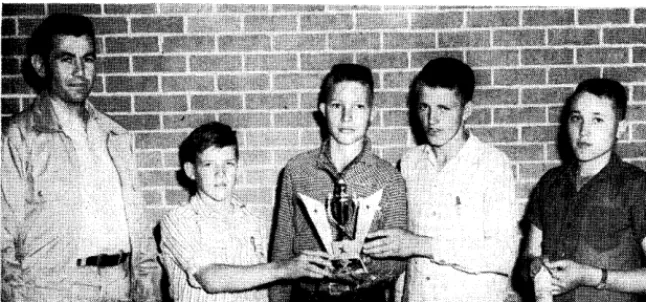
Harold A. Murnan, assistant farm agent of Pawnee county, Ok- lahoma, has successfully used the contest method of training to teach 4-H members the importance of these range practices. His boys learned well because they won championship honors at the na- tional pasture and range judging contest this year. David Sharp stood third nationally, and Wayne Garner was seventh. Other team members were Dwayne Edwards and Grover Wayne Adams.
198
DICK WILSONPasture Judging Involves “Land judging
In the Oklahoma program, sep- arate score cards are used for land, pasture and range judging. Mur- nan believes that all of them are necessary to do a good job of teaching range management in this region. This is significant be- cause Pawnee County is in the fabulous Osage grazing country, nationally known for its fine na- tive grass. Yet he pointed out that the pasture judging card which incorporates land judging as a bas- ic factor in grassland establish- ment and management made the transition from land judging to range judging much easier for the 4-H judges.
Developed primarily for culti- vated fields that should be re- turned to grass, the pasture judg- ing card consists of two divisions. In the first, the judge must deter- mine the land class, and in the second he must choose one or more of the listed treatments.
Land class factors include tex- ture, permeability, depth, slope, erosion and drainage. A multiple choice selection is made under each heading. For instance, under slope, the judge may choose one of the following classifications : nearly level ; gently sloping ; moderately sloping ; strongly sloping ; steep, and very steep.
The Pawnee County team mem- bers w e r e familiar with these
terms, all of them having been ac- tive in land judging in prior years. Sharp and Garner were on the second place team at the 1954 na- tional land judging contest, and Edwards was a member of the first place district land judging team in both 1954 and 1955.
As a result, Murnan concen- trated this year on the second di- vision of the card. Main headings in this section include mechanical practices needed, such as brush control or sloping gullies; kind of plants to be reseeded;’ seedbed preparation and planting meth- ods ; fertilization ; and manage- ment, which covers deferred graz- ing, brush and weed control, rotation grazing and similar prac- tices.
His boys were first introduced to this phase of range judging at a summer camp in 1954. They continued their studies informally during the following months, then
.
really concentrated on studying all range management practices on the score cards when Soil Conser- vation District Supervisors offered prize money for winners in the county contest in March, 1955. Soil Conservation Service, Indian Serv- ice and other agencies cooperated with the students in their quest for additional knowledge. An expense- paid trip was provided for team members going to the national contest.
Murnan held training sessions on Saturdays. Each time, he set up a contest and reviewed the score cards with the farm youths. It is significant that the 4-H mem- bers were interested enough in these contests to sacrifice their free Saturdays. And it is here that the values of range judging contests are really demonstrated, according to Murnan, who said, “before the contest was devised it was almost impossible to interest youngsters in any phase of range manage- ment .”
More encouraging to farm youth educators is the fact that interest is comparable in nearly all sections of the state. Take the case of John Smith, 13-year-old eighth-grader from Hammon, a small town lo- cated in the Rolling Red Plains of Western Oklahoma. He and two other classmates, Billy Don Jor- don and Lloyd Murdock, gave up many an afternoon this spring to roam pastures in that area with Billy Don’s dad, Henry Jordon, a local Soil Conservation Service specialist particularly interested in farm youth education.
FIGURE 2. A typical judging contest. Boys must identify plants, determine whether they are perennial or annual, cool or warm season and native or introduced. On a sepa*rate card they decide on management practices or treatments needed to
TEACHING TOMORROW’S RANGERS 199
They studied grass identification religiously and after participating in two county schools they came to the national contest. Their prepa- ration paid off, because Smith placed first, and the team placed seventh. Can anyone question their remembering these grassland conservation principles, or Smith’s retention of the well-learned range management practices when he takes over part of his father’s 2,200 acre ranch or gets a place of his own? You wouldn’t, if you had seen how impressed they were about winning. When Smith was asked how he won, he said, “I just listened real close to everything that was said and studied the score cards.” He added with all sincerity that the team intended to place first next year.
Whether the contest method is a result or partly the cause of the wave of interest in “grassland farming” the past few years is in- consequential. The important points are : first, general recogni- tion that with proper management some land will produce more profit when used for pasture or range rather than with one of the more traditional feed or cash crops ; and second, that grassland farming contributes not only to soil and water conservation but also to im- proved soil structure and fertility.
Rapid Development of Contest Method
The increase in use of the con- test method of range management training has been almost phenom- enal since the first experimental judging contest and school was held in 1952 at Norman, Oklahoma. Approximately 20,000 Oklahoma 4-H clubbers and FFA members participated in pasture and range judging events this year in prep- aration for the first national eon- test which was held in late April at Oklahoma City. Several states now have their own range conser- vation training program. Accord- ing to Dr. L. I. Jones, former fed- eral extension pasture specialist,
and now extension field represen- tative, it is one of the few pro- grams that has the backing of e v e r y agricultural organization both in and out of government. Many foreign visitors have come to the state to study the training method.
Value of the program to the na- tional economy is recognized by civic clubs, chambers of commerce and industrial leaders who are con- tributing m e d a 1 s, plaques and awards to contest winners.
Radio station WKY and tele- vision station WKY-TV furnished trophies and some $1,250 in cash prizes in contests this year, and sponsored the national pasture and range judging event in conjunc- tion with the fourth national land judging contest. The Kansas-Okla- homa section of the American So- ciety of Range Management pro- vided ribbons for winners in the national judging events and all state contests.
Much of this popularity has been due to the practicality and versatility of the range judging score cards which were developed for use on our western ranges,
tame pastures or on cultivated fields being returned to grass. Al- though designed primarily for Ok- lahoma conditions, the cards are adaptable to almost any area in the U. S. with minor changes. ’ Clarence Bunch believes that a
new era has dawned in grassland conservation and management ed- ucation, but he still has ideas on improving the cards. For one thing, he would like to see a sec- tion of the range judging score card devoted to the stocking rate of each area. The misuse and over- grazing of natural grasslands has been one of the most powerful agents in soil destruction down through history. Grasses and le- gumes must be considered a crop that requires as careful manage- ment as does a cultivated crop.
More than one-half the land area of the United States is in pasture and grazing land. He believes these areas still represent the greatest undeveloped agricultural resource in this country.
Montana Future Farmers and
Range Management
DON RYERSON
.x”nf”n$
The fonndation
of the Montana
livestock industry
is based on the
thonsanas
of acres of land not
suited for cultivation.
The future
of this industry
depends upon the
proper use to be made of this land.
What arr Montana Future Farm-
ers doing to insure the future
of
the lirrstock
industry
and their
own future ?
Grass yield, measured in terms
of livestock products, is it subject
of wry high interest to Montana
Future
Farmers.
They
&lize
their fotnre
success in the ranch-
ing business is closely correlated
with the range which they will eon-
trol.
Nontana
Future
Farmers
are striring
to establish range im-
provement practices on their home
ranch
and in their
community.
They
realize
this
will improve
their connnunity.
They realize this
will improve their heritage.
Range Mnnagement
is &II inte-
gral part of the Vocational Agri-
cultural
Course of Study and in
the program of work of the Mon-
tana FFA
Chapters.
Practically
all chapters are doing some work
in range; but the greater emphasis
on range improvement
is in the
range-l&stock
areas of the state.
The study of range management is
spreading
to the more diversified
crop areas of the state. Since the
agricultural
needs and demands
are becoming n~ore intensified, the
farm oprrators
in the diversified
areas are beginning to realize the
value
alla
inrportanee
of the foot-
hill and fringe
range areas SUI‘.
ronnding the land used for inten-
sive crop production.
Increased Interest
In Range Management
The change in the outlook and
attitudes of the farmers and ranch-
ers of the state is dne in a large
degree to
the efforts of the wrions
agricultural
organizations.
These
organizations
are responsible
for
promoting
and developing H need
for greater conservation
end utili-
zation of the resources which na-
ture has provided.
The organiza-
tions which have taken the lead in
range promotion are the Soil Con-
nervetion
Service, For&
Serrice,
County
Extension
Service, Coca-
tional Agricultural
Tearhers
As-
soeirttion, banks and industry.
The
personnel
of these orpitnizations
have foreseen the value of promot-
ing and stimulating
o range
eau-
&ion
program
for ranch
oper-
ators and youth groups who are.
and will be, the owners
and man- agersof Montana’s
grratrnt
re-
source-GRASS.
Progrens in range education
at
college and high school level has
been slow in developing
in oom-
parison to other phases of agrieul-
tore in Montana.
Montana
State
College offered only one course in
pitatore
ana range mnnapement to
its agricultural
stuaents
prior to
1942.
Since
that
time,
an ex-
panded basic range course has been
required
for
most
agricultural
undergraduates.
This course has
awakened
them to the fact that
range management
is a phase of
agriculture
that
has been neg-
idea.
In an attempt to alleviate
this situation,
some Montnna Vo-
Ag teachers
attempted
to teach
range management
to their high
school students.
The program w&s
not too effective because the tech-
ers were not equipped
with the
necessary tools to accomplish
the
task.
The majority
of the infor-
mation available w&s highly teeh-
nieal, and many of the teachers
were not &ware of the resource
people available to help them.
Mr. Turner, formerly of the Soil
Conservation
Service
at Dillon,
Montana, was contacted in 1951, to
lenrn if teaching aids were avail-
able through
the American
Soci-
ety of Range Management.
With
Mr. Turner’s
assistance,
the aid
offered by this organization
was
placed on a regional basis and the
Montana
Vo-Ag
Teachers
were
supplied
with B list of Society
members in the state.
The instructors at the lS51 Sum-
lner Vo-Ag Conference
discussed
the problem
of teaching
range
management
to Vo-Ag classes in
high school. The teachers expremed
the neea for & range management
course to be offered at the 1952
summer school session at Montana
state College.
Range Course Developed
for Vo-Ag Teachers
MONTANA FUTURE FARMERS
members a basic understanding of range management problems and practices. This traching aid bas- ically covered plant physiology and morphology, plant ecology, range plant recognition, range con- dition, range improvement and range conservation. A similar range course was again offered during the 1953 sommw school session and five Nontana Vo-Ag teachers en- rolled. These two ~ommrr sessions spark-plug& range management activities in the Montana FFA Chapters whose advisors had been enrolled in the range courses.
The range course developed by this group of Vo-Ag teachers in 1952 n+s made available to all Ag teachers in the state. Jnstructors who had not attended summer school found this publication gavr them a basis for organizing a prae- tieal unit of instruction in range. In man:- CRSPS, four to six arrks were devoted to teaching range practices. Additional instruction is offered by the Extension Service to their organized 4-H Range Clubs. Since rural youths me often members of both organiza- tions, the over-all objectives of the program are emphasized.
Progress in FFA Chapters Approximately 45 of Montana’s 62 FFA Chapters have, or will
have, an established range im- provement program included in their chapter activities by the fall of 1955.
The progress made in range management training is exempli- fied by the activities of the Beavrr- head Chapter in Dillon, Montana. Prior to 1952, range management received minor emphasis in this chapter. During the fall of 1952, the Beaverhead Chapter, with the help of the Beaverhead Soil Con-
201
servation District technicians, ini- tiated an organized range man- agement program for the all-day elam?s and chapter activities.
The primary purpose of the program was to acquaint the chap- ter members rith existing range renditions on their home ranch and to establish range projects as au integral part of their wper- vised farming program.
The success of the program re- (loired the assistance of the Soil Conservation Service, the County Agent, the Extension Range Spe- cialist, the Forest Service, the lo- cal ranchers, and the parents of the chapter members. The coop- eration received from these organ- izations and individuals was ex- cellent. The chapter mrmbers had the opportunity to observe water development programs, grazing systems, and other improvement practices in operation by ranchws in the Beaverhead area.
Vo-Ag Training
202
learn the plants as they grow in the field rather than from mounted specimens. Trips were also taken to acquaint the students with var- ious range conditions and to ob- serve the effects of various man- agement practices.
Ag II, or sophomore, students concentrated on 1 e a r n i n g the plants that were of major impor- tance to grazing livestock in terms of forage produced, plant relation- ships, factors associated with plant growth, range readiness, range site determinations, and plant associa- tions found on various ranges.
Ag III students were taught to determine range condition, the fac- tors involved causing various range conditions, and ways and means to improve the range. Dif- ferent grazing systems used by local ranchers were studied in the field to emphasize the value of using desirable management prac- tices.
To insure the application of the training received in range man- agement, the seniors in Ag IV sur- veyed the home, farm of one chap- ter member. The class was di- vided into teams of four to analyze the range and develop a manage- ment plan for the ranch. From this, each student with the coop- eration of his parents and others . who could assist, developed a man-
agement plan for his own ranch. The majority of the field work done in this program was in co- operation with the technicians of the Beaverhead Soil Conservation District. Particular credit should be given to Ben Slanger and Michael Britton for their fine co-
DON RYERSON
operation in making the program a success. These two men con- ducted group field trips for the agricultural classes. Emphasis was placed on field observation of range plabts, plant communities, range conditions, range condition surveys, and practices in use throughout the county. Ag IV stu- dents had the opportunity to work in teams of two for a full day on range management planning in the field with Soil Conservation Serv- ice personnel.
To stimulate interest in the pro- gram, the chapter received a guest subscription to the Journal of Range Management. Further in- terest was developed by sending three chapter officers to the Range Society meeting in Idaho in 1954. The chapter members displayed plant collections and have had window displays on range man- agement at the local fairs. Other activities by chapter members in- cluded the establishment of range enclosures, range reseeding to pro- vide early spring grazing, sage- brush control, water spreading and development, and deferred grazing systems. Special projects for the improvement of the range were developed by each student for use on his own ranch.
Rlange
Judging Contests
For the past two years the eleven schools in the Southwestern FFA District indicated their in- terest in promoting range pro- grams by including a Land Use and Appreciation Judging Con- test. Present indications are that the six remaining FFA Districts in Montana will inaugurate some
form of range and land apprecia- tion contest in the very near fu- ture.
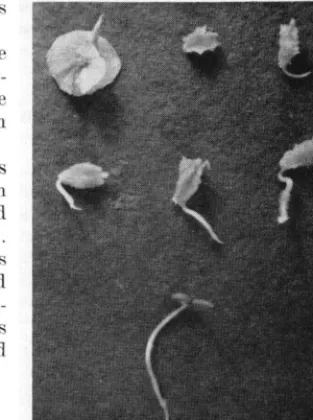
The 1955 State FFA Conven- tion initiated a range condition judging contest as one of the com- petitive events at this affair. Ap- proximately 156 FFA members from 53 FFA Chapters partici- pated in the contest. The range contest was in two parts. The first was the identification of mounted range plant specimens in which the contestant gave the com- mon name of the plant, indicated whether the plant was native or introduced, the forage value of the plant, and whether or not the plant was poisonous (Fig. 1). The sec- ond part of the contest consisted of four plots of sods with their nat- ural vegetational cover placed in two foot by two foot pans (Fig. 2). The contestants scored and placed each of the four plots into the proper condition classes. This activity received many favorable comments from the FFA members and their advisors. The enthusi- astic response indicates that range condition judging will become a permanent part of the competitive events at the Montana FFA Con- vention.
Montana Future Farmers rec- ognize that the stabilization of the livestock industry is dependent upon maintaining and improving Montana’s range resource. With youth groups as a trained nucleus, the coming years will show estab- lishment of a permanently pro- gressive range management pro- gram as the rule rather than the exception.
Conservation of Range Lands for
Future Generations
THOMAS REEVE BOX 34, Hurricme
Soil erosion is not a new process. It is old; old as the hills. It started with the first winds and the first rains and has been going on ever since. Erosion was not great. at first and nature had a way of taking care of it. But along came man and upset nature. Man moved into the mountains with herds of livestock. He over- stocked the range, overgrazed the land, and left it to erode by wind and rain.
The rancher is not the only one to cause damage to our range lands. The early pioneers that set- tled in the valleys had to go to the mountains to cut timber for houses, fences and corrals. The trails of the wagons provided a chance for t,he water to start cut- ting into the thick carpet of soil. Some pioneers stayed in the moun- tains and cut timber to be sold. They, too, like the rancher, knew nothing about erosion. They cut the timber down, burned the un- derbrush and left the ground un- protected. It didn’t take long aft- er that to wash away the soil.
It was many years later before the rancher realized that some- thing was happening to the soil of his range land. The government was also aroused by the washing away of range lands. Steps were taken to try to prevent further losses. On some overgrazed lands, the soil was too depleted to be brought back into production. That was t,he time that ranchers and many ot,her men came to real- ize how important grass is to the United States. The evidence is in this statement by John J. Ingalls : “Should its harvest fail for a sin- gle season famine would depopu- late the earth.”
The Soil Conservation Service, Utah
Forest Service, and many other organizations were developed to work with the rancher against soil erosion. The conservation men and ranchers began to study the prob- lems.
The original theme by Thomas Reeve of Hurricane, Ut’ah, on which t,his article is based, won first plac,e in the annual range theme contest sponsored by the Range Management Department at Utah State Agricultural Col- lege. This contest, open to all high school seniors in Utah, car- ries as first prize a free scholar- ship to study at the College.
The major factor was how to graze the range and not to over- stock it. The problem was to de- termine the grazing capability of range land. Many experiments were tried, but most of them were unsatisfactory. The grazing ca- pacity of range land cannot be pinpointed, since there are differ- ences in climate, kinds of grasses, and kinds of animals that are raised on the land. As time passed and experiments added to the knowledge of man, improved graz- ing methods w e r e established. These are still being perfected ev- ery day.
The rancher thinks of himself principally as a producer of live- stock. He is also concerned with the range land and the plants that grow on it. He recognizes the truth in this statement: “Take care of the range and it will take
care of the stock.” The quality of animal produced depends on the quality of grass grown. Range management moves in a cycle. The grass needs the soil to provide food for its growth, while the rancher needs the grass to stop soil erosion and to furnish the proper feed for his animals.
It took a long time for range management to be appreciated. At first the ranchers and other citi- zens didn’t want any part in range management. Most people had the idea that it belonged only to the farmers and the government. The ranchers just wouldn’t open their minds to it. Now these things have changed. Everyone is realiz- ing the importance of range man- agement. The reason for this change is not certain but factors such as increasing water shortages have contributed. Wider educa- tion also helps.
The way range lands are treated has its effect on everyone-even the citizens in the cities who claim to have no direct interest in the problem. About the only time they really think of range management is in the summertime when the water supply is low. Towns, com- munities, and citizens worry plenty when they are short in their water supply, but as soon as the supply is back to normal they forget all about the water shortage. Range management is the key to conserv- ing water. When the snow melts in the springtime, the soil and grass hold the water on the ranges.
Instead of running off and being lost to the ranchers, farmers, and the surrounding communities, it is held in the mountains for use in the summertime.
Range Conservation and Season-long Grazing
CARLTON H. HERBEL
Conservation of range land is basically EL matter of grazing man- agement but the rancher is also concerned with other practices such as fencing, water develop- ment, salting, and weed eradica- tion. Though many factors arr involved, the most important are correct numbers of livratoek, in- cluding good distribution, and grazing during the proper season. These are two of the most difficult and important problems clue to the fact that (a) various range units involve many forage species, many having different values and different growth habits, (b) quan- titative analysis of the forage cover on various range units is difficult, (c) the effect of various intensities and ~ensons of use upon the physiological well-being of forage plants is little understood, and (d) fluctuations in weather, especially precipitation, 0 c c u r from season to season and from year to year, accompanied by a confusing complexity of variations in forage yields and development- al behavior. Despite those diffi- culties, accurate drtwminations of the grazing capacity must be made if the range is to be handled prop- erly.
Continued failure to evaluate correctly the capacity of range land is certain to result in failure of the livestock enterprise- and in impaired land vnlues. Grazing land vnlues generally are propor- tionate to the expected annual re- turns in the form of livestock prod- ucts. When continuous overuti- lization is allowed to take place, the forage cover is reduwd and livestock production declines, thus reducing the capital value of the land.
Roth quantity and quality of range vegetation are reduced as
range condition (or state of health) goes from excellent to poor. This is indicated in Table I from the work of Allred (1950) in Texas.
A further look at what has hap- pened in Texas will illustrate the folly of continwd overgrazing. T?xns has 116 million awes of native grazing land. There are about seven million eattlr, sewn million shrep, 2.4 million goats, and three million horses and mules. Also, each year about 13 million pounds of drpssrd meat comes from deer, small game ani- mals, and pamr birds, most of which live all or part of the year on grasslands. Yet, Allrrd (1950)
estimated that this produces only l/z to l/i of what it could be if the range had not been continuously overgrazed. Range land in Texas is being occupied by waste trees and brush faster than it can be cleared. There now are 80 to 90 million acres of range land so occupied.
Overgrazing on a range is not dependent, alone, upon the nnm- her of animals, hence all the re- sults attendant to overstocking can be realized locally, even under proper stocking rates, if stock are not distributed properly. Animals naturally congrryntr at certain points.
The most accessible areas such as valley bottoms, lox saddles be- tween drainages, areas around water holes, and level mrsas, are the first to be utilized. Steep areas and those far from water usually arc utilized less and may even remain unutilized, hence only part of the range is correctly grazed. The consequences of poor distribution are (a) excrnsive use of most accessible areas or (b) a reduction in the number of stock that can be grazed on the ranyr unit a8 a whole. The adoption of one or more of the following practices may help alleviate these local conditions: salting, fencing, herding, trail building, vater de- veloping, and changing the kind of livestock (Stoddart and Smith, 1943).
RANGE CONSERVATlON AND SEASON-LONG GRAZING 205
usually accompanied by a decrease in forage production. Savage (1937) reported that, on the Great Plains, the drought of 1933- 34 caused a decline of 65 percent in the basal area of major grass species on ungrazed plots. Upson and McGinnies (1939) have shown that in southern New Mexico, forage production in the best years was four times that in the poorest. On the Snake River plains of southern Idaho, Pech- anec et al. (1937) found that be- tween 1932 and 1935, total vegeta- tion on ungrazed areas decreased to 84 percent of the 1932 ground cover, grasses alone decreasing to only 48 percent of the 1932 cover. This marked reduction in forage yield resulting from poor growing conditions alone makes it evident that no plans for grazing should be made without allowing for variation in production attribu- table to weather conditions.
Grazing Management Systems Proper range management is not merely a matter of grazing the correct number of animals and of grazing during the correct sea- son. It also involves various live- stock management programs nec- essary to realize the greatest for- age yield consistent with mainte- nance of the range. Under ordi- nary range usage, animals are placed on the range and allowed to remain yearlong. On seasonal ranges, they are put on at the time of range readiness and allowed to remain until the grazing season is closed, this being known as con- tinuous or season-long grazing. By this method, animals have free access to all parts of the range, and range use follows the same plan each year. Contrasted to continuous grazing are the spe- cialized systems, deferred grazing, rotation grazing, and deferred-
rotation grazing. Experiments under continuous grazing usually are designed to study the effects of rate of grazing on forage com- position and yield and on live- stock produced.
McIlvain et al. (1954) reported on a ten-year study at Woodward, Oklahoma, in which three rates of grazing were compared. The steer gains per head per season were 400 pounds for the lightly grazed pasture, 384 pounds for the moderately grazed pasture, and 361 pounds for the heavily grazed pasture. There was a slight depletion in the quality of forage on the heavily grazed pas- ture over the ten years, but not as yet very serious.
Kessler et al. (1951) reported on investigations started at the Fort Hays branch of the Kansas Agricultural Experiment Station in the spring of 1946 to determine the effects of different grazing intensities on beef production. The average gain per head for a sea- son (180 days) was 122 pounds in the overgrazed p a st ur e, 172 pounds in the moderately grazed pasture, and 192 pounds in the undergrazed pasture. It should be noted that the overgrazed pas- ture was beginning to show some effects of over use, such as some erosion which took place following a heavy rain. No erosion took place in the moderately or lightly grazed pastures.
McConnell (1945) showed on depleted range in Texas, that re- duction of the stocking rate by one-half increased total beef pro- duction substantially. The in- creased grass production raised the average weight of the breeding herd, increased the percentage of the calf crop, increased the mar- ket weight of the calves, and stopped cow and calf losses from
malnutrition. At the same time, range condition was improved with a resultant decrease in soil erosion. It is evident that deple- tion (reduction in range condi- tion) is bound to occur eventually on overstocked pastures. Often the depletion is so severe that the total yield of animal products is reduced even though large num- bers of animals are carried. Brush encroachment and increas- ing soil erosion may accompany depletion. When this occurs, sec- ondary succession of native veg- etation often must be assisted by costly brush eradication, pasture reseeding, and soil conservation measures.
LITEUTURE CITED
BLLRED, B. W. 1950. What should Texas expect from rauge coiiservation? Tex. Jour. Sci. 2: 7-14.
KESSLER, F. B., L. C. AICHER AND F. E. MEXNEN. 1951. Grass utilizatiou aud pasture management iuvestiga- tions for 1946-50. Kansas Agr. Expt.
Sta. Cir. 276.
MCCONNELL, MNK. 194.5. Overgrazing does not pay. Cattleman 31( 10) :
22-23.
MCILVAIN, E. H., A. L. BAKER SND ti. R. KNEEBONE. 1954. 18-year sum- mary of rauge improvement studies. U. S. Southern Gr. Plaius Field Sta., Woodward, Okla.
PECHANEC, J. F., G. D. PICKFORD AND G. STEWART. 1937. Effects of the 1934 drought on native vegetation of the Upper Snake River Plains, Idaho. Ecology 18: 490-505. SAVAGE, D. A. 1937. Drought survival of
uative grass species in the Ceutral aud Southern Great Plains, 193.5. U. S. Dept. Agr. Tech. Bull. 549. STODDART, L. A. AND A. D. SJIITH. 1943.
Rauge Ma.nagemeu t. McGraw-Hill Book Co., New York.
Needle-and-Thread Grass- Know It and Use It
NORMAN D. PATERSON
Xenior Student, Range Management, University of IVyo- ming, Laramie, Wyoming
The story of the western range written as a chapter in the history of the land areas in the United States would be a dark and tragic tale.
Known at first chiefly as a wide and desolate obstacle to the gold fields, the “Great American Des- ert” became suddenly the source of other great wealth-livestock. Efforts to ca.pitalize on the nat- ural vegetation of the Great Plains area resulted in wide- spread range depletion.
The gloomy, historical view of the poor management practices once accepted procedure on the western range is shot through with bright rays of good range man- agement practices that have brought abolit the rehabilitation of some areas and the protection of others.
Grass problems of the western ranges have been investigated by those of scientific inclination or interest. IIowever, many of the findings of these investigators are not common knowledge to those who face the problems in their everyday living. To prove effec- tive, these results must be broad- cast to all people concerned with the range and the animals that graze it. It is important for those who make their home as well as their living on the range to know I the kinds of grasses present, their growth habits and their manage- ment.
With the lack of knowledge about individual range plants there exists considerable misun- derstanding about the values of some species. One grass usually discussed in violent pro and con terms is needle-and-thread (St@a cow&a) or, more c 0 mm 0 nly, needlegrass.
Needle-and-thread holds the du- bious honor of probably being “the grass most likely to be in bad
repute.” Kesentment of stockmen is at a peak during the seed-ma- turing season when the needle- like barbs of the seed spear any- thing within reach. The seed-ma- turing period lasts only two or three weeks during the early sum- mer after which the seeds drop to the ground where they cause little trouble.
Xheepmen are those most con- cerned with the piercing ability of the seeds of needle-and-thread. The barbs not only pierce the eyes of sheep and blind them, but work their way through the fleece of the animal and penetrate the skin, often destroying the skin’s useful- ness and making necessary consid- erable trimming of the carcass. Buyers impose price reductions on lambs suffering injuries from needle-and-thread. Even though economic loss is not apparent. barbs that have penetrated map
prevent the lamb from putting on normal gains on the range or in the feed lot. Accurate statistics are lacking, but claims of heavy sheep loss are thought to be ex- aggerated.
The only practical solution seems to be to keep sheep off range abundant in needle-and- thread during the seed-maturing period, just as one would keep stock from grazing certain poison- ous plant areas at the time when their effect may be disastrous.
Needle -and- thread is f o u n d throughout the Great Plains area and is known to extend as far north as the Yukon and south into Mexico. It is a true native of the Great Plains, and not, as some- times thought, an immigrant from another region. Fossil specimens show that the species has inhabited the Great Plains since the Ter- tiary geological epoch - or for about 25 million years. Present-day needle-and-thread is found to bear striking resemblance to its age-old ancestor. The grass has been recog- nized as a climatic dominant over wide areas of the Great Plains.