Available online: https://edupediapublications.org/journals/index.php/IJR/ P a g e | 523
MINING USER BEHAVIORS IN MOBILE ENVIRONMENTS
1
Sowmya Koneru
1Assistant professor, Dhanekula Institute of Engineering and Technology, Ganguru, Vijayawada,
Andhra Pradesh, India [email protected]
Abstract. Mining client practices in portable
situations is a developing and imperative theme in information mining fields. Past inquires about have consolidated moving ways and buy exchanges to discover versatile consecutive examples. Be that as it may, these examples can't reflect real benefits of things in exchange databases. In this work, we investigate another issue of mining high utility versatile consecutive examples by coordinating portable information mining with utility mining. To the best of our insight, this is the primary work that joins versatility designs with high utility examples to discover high utility portable consecutive examples, which are portable successive examples with their utilities. Two tree-based strategies are proposed for mining high utility versatile successive examples. A progression of investigations on the execution of the two calculations are led through trial assessments. The outcomes demonstrate that the proposed calculations convey preferred execution over the cutting edge one under different conditions.
Keywords: High utility mobile sequential
pattern; utility mining; mobilitypattern mining; mobile environment
1 Introduction
With the quick advancement of media transmission innovations, cell phones and remote applications turn out to be progressively famous. One's present position can be gained by means of a cell phone with GPS benefit. With a progression of clients' moving logs, we can know the moving ways of portable clients. Also, a more prominent number of individuals are utilizing cell phones to buy versatile administrations online by Visas. Joining moving logs and installment records, portable exchange
arrangements, which are the groupings of moving ways with exchanges, are gotten. Yun et al. [14] first proposed a structure for finding versatile consecutive examples, i.e., the successive examples with their moving ways in portable exchange arrangement databases. Versatile consecutive examples can be connected in numerous applications, for example, course arranging in portable business condition and keeping up site structures of internet shopping sites.
Available online: https://edupediapublications.org/journals/index.php/IJR/ P a g e | 524
pivotal in numerous areas, for example, discovering important examples in portable business situations, metropolitan arranging and keeping up the structure and planning advancements for web based shopping sites.
In perspective of the above issues, we go for incorporating portability design mining with utility mining to discover high utility versatile consecutive examples in this examination. The proposed design must be high utility as well as incessant. At the end of the day, it is made out of both high utility buying design and regular moving way. This is on the grounds that applying just utility mining to the versatile situations is lacking. A moving way with high utility however low recurrence is eccentric. Clients might be mistaken for some of these repetitive examples. By this thought, the proposed design is more valuable than the examples that apply just utility mining or incessant example mining to the portable situations.
In this paper, we propose two tree-based techniques, specifically UMSPDFG (mining high Utility Mobile Sequential Patterns with a tree-based Depth First Generation procedure) and UMSPBFG (mining high Utility Mobile Sequential Patterns with a tree-based Breadth First Generation system). The fundamental distinction of the two calculations is the strategy for producing the length 2 designs amid the mining procedure, which is the bottleneck of example mining. Both of the calculations utilize a tree structure MTS-Tree (Mobile Transaction Sequence Tree) to abridge the data about areas, things, ways and utilities in versatile exchange databases. To the best of our insight, this is the main work that investigates the coordination of versatility design mining and utility mining. The test comes about demonstrate that UMSPBFG has preferred execution over UMSPDFG. Also, the execution of the two proposed tree-based techniques outflanks the looked at level-wise calculation which is enhanced by the condition of-theart portable consecutive example calculation [14].
2 Related Work
Broad investigations have been proposed for finding incessant examples in exchange databases [1, 2, 5, 10]. Visit itemset mining [1, 5] is the most prominent subject among them. Apriori [1] is the pioneer for mining continuous itemsets from exchange databases by a level-wise competitor age and-test strategy. Tree-based continuous itemset mining calculations, for example, FP-Growth [5] were proposed a short time later. FP-Growth enhances the proficiency of incessant itemset mining since it doesn't need to create applicant itemsets amid the mining procedure and it just outputs the database twice.
A short time later, successive example mining [2, 10] is proposed for discovering client practices in exchange databases. As an expansion strategy for Apriori, AprioriAll [2] likewise utilize a level-wise system to discover consecutive examples. Actually, PrefixSpan [10] finds successive examples straightforwardly from anticipated databases without producing any hopeful example. Therefore, the execution can be more moved forward.
Available online: https://edupediapublications.org/journals/index.php/IJR/ P a g e | 525
benefits of things are not considered yet. In exchange databases, things have diverse benefits. Utility mining [3, 4, 7, 8, 12, 13] is proposed to overcome this issue. Among these examines, Liu et al. [8] proposed Two-Phase calculation which uses the exchange weighted descending conclusion property to keep up the descending conclusion property in the procedures of utility mining. Then again, Ahmed et al. [3] utilized a tree structure, named IHUP-Tree, to keep up fundamental data about utility mining. Not quite the same as Two-Phase, it abstains from filtering database different circumstances and producing hopeful examples. In spite of the fact that IHUPTree accomplishes a superior execution than Two-Phase, despite everything it delivers an excessive number of high exchange weighted usage itemsets. In this manner, Tseng et al. proposed UP-Growth [12], which applies four techniques for diminishing the assessed utilities amid the mining forms. By these methodologies, the quantity of conceivable high utility itemsets is adequately lessened and the execution of utility mining is additionally made strides.
By the above writing surveys, in spite of the fact that there are numerous explores about portability design mining and utility mining, there is no exploration about the mix of the two points. This paper is the main work which incorporates the two subjects to discover high utility examples with visit moving ways in versatile conditions.
3 Problem Definition
In this area, we characterize fundamental documentations for mining high utility versatile successive examples in portable conditions in detail.
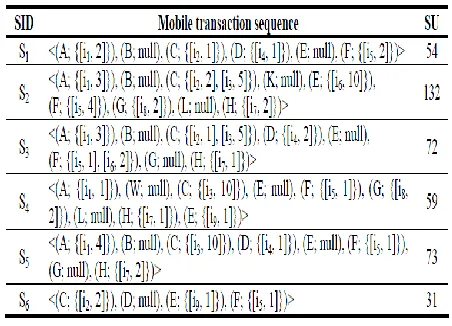
Table 1.Mobile transaction sequence database
DB
Table 2.Utility table
Problem Statement.Given a portable exchange
succession database, a pre-characterized utility table, a base utility edge and a base help limit, the issue of mining high utility versatile consecutive examples from the versatile exchange grouping database is to find all high utility portable successive examples whose backings and utilities are bigger than or equivalent to the two edges in this database. 4 Proposed Methods
4.1 Algorithm UMSPDFG
Available online: https://edupediapublications.org/journals/index.php/IJR/ P a g e | 526
database in Table 1 and the utility table in Table 2 for instance. Accept the base help limit is 2 and the base utility edge is 100. In the initial step, WULIs whose backings and SWUs are bigger than or equivalent to the two edges are produced by the procedures like [8]. For this situation, eight WULIs appeared in Table 3 are created. Note that they are likewise 1-WULPs. At that point the 1-WULPs are mapped consecutively into a mapping table as appeared in Table 3.
4.1.1 The construction of MTS-Tree
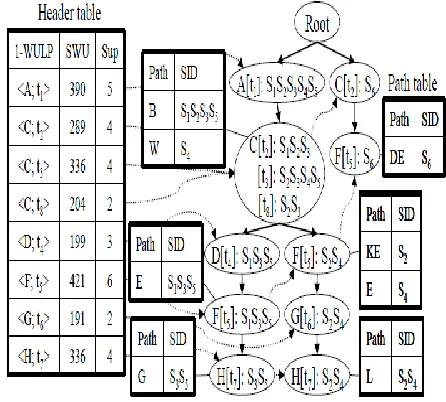
The methodology of MTS-Tree development are appeared in Figure 2. The development of MTS-Tree is finished after one sweep of the first database. Without loss of simplification, we give a formal definition for MTS-Tree first.
Fig. 1.The framework of the proposed algorithm
UMSPDFG.
4.1.2 Generating WUMSPs from MTS-Tree In the wake of developing MTS-Tree, now we demonstrate the stage 3 of UMSPDFG. The motivation behind this progression is creating WUMSPs from MTS-Tree by the profundity original system. The strategies are appeared in Figure 4. To start with, WULPs and their restrictive MTS-Trees are produced by following the connections of the passages in the header table of the MTS-Tree. At that point the WULPs are embedded into a WUMSP-Tree (high grouping Weighted Utilization Mobile Sequential Pattern Tree), which is utilized for putting away the WUMSPs. At that point the ways of the WULPs in the WUMSP-Tree are
followed in the first MTSTree and the WUMSPs are produced.
Fig. 3.An Example of MTS-Tree.
4.1.3 Finding high utility mobile sequential patterns
After generating all WUMSPs, an additional database scan will be performed to findUMSPs from the set of WUMSPs. The WUMSPs whose utilities are larger than orequal to the minimum utility threshold will be regarded as UMSPs. Moreover, sincethe WUMSPs in WUMSP-Tree include SIDs, instead of checking all mobiletransaction sequences, they will just check the specified sequences. By applying thisprocess, the mining performance will become better.
4.2 An Improved Tree-based Method: UMSPBFG
Available online: https://edupediapublications.org/journals/index.php/IJR/ P a g e | 527
an essential issue. To overcome this issue, we propose an enhanced tree-based calculation UMSPBFG (high Utility Mobile Sequential Pattern mining with a tree-based Breadth First Generation system). The contrast between the two calculations is that UMSPBFG utilize an expansiveness original system for creating 2-WUMSPs. Inside the procedure, a conceivable succeeding hub checking method is connected. By this method, the span of the restrictive MTS-Trees will be littler, and the 2-moving examples which can't be 2-WUMSPs will be pruned ahead of time. Rather than creating a 2-WULP by consolidating the last passage with the 1-WULP of a restrictive MTS-Tree, in the expansiveness original system, 2-WULPs are produced by joining every one of the 1-WULPs in the header table with the 1-WULP of the contingent MTS-Tree. Subsequent to creating the 2-WULPs, their ways, backings and SWUs are checked ahead of time. The legitimate ways will be put away in the relating hubs of WUMSP-Tree. While creating 2-WULPs, UMSPBFG applies a conceivable succeeding hub checking procedure for pruning pointless 2-WULPs, which is tended to as takes after.
IV. RESULTS AND DISCUSSION
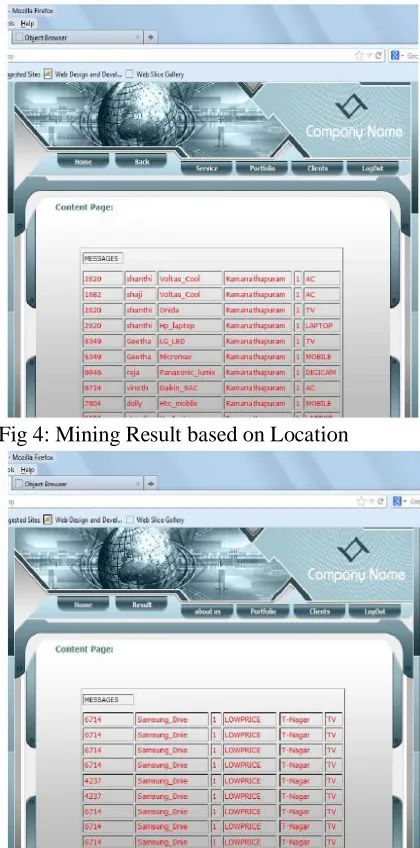
This section deals with the cluster based results in each stage and how mining is performed in each stagefor online shopping application dataset. Initially clusters are formed based on location, then mining is donebased on service feature and finally results are produced based on given service request by the user. Once theuser purchases the product then count will be automatically updated. The results generated from segmentation ofGA are given in Fig. 4.
Fig 4: Mining Result based on Location
Available online: https://edupediapublications.org/journals/index.php/IJR/ P a g e | 528
Fig 6: Nearest Shop Information
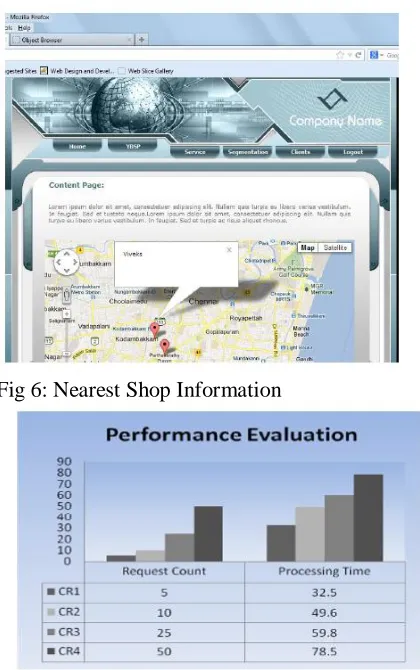
Fig 7: Performance Evaluation based on request count
Conclusions
In this examination, we proposed a novel information mining issue about mining high utility versatile consecutive examples in portable business situations. This paper is the main research work about the blend of versatility design mining and utility mining. Two calculations created by various techniques, i.e., profundity original and broadness original, are proposed for productively mining high utility versatile consecutive examples. The exploratory outcomes demonstrate that the proposed calculations beat the cutting edge portable successive example calculation. For future work, extra analyses under more states of portable business conditions will be directed for additionally assessing the calculations. Also, new calculations which enhance the mining execution will be planned.
References
1. R. Agrawal and R. Srikant, “Fast Algorithms for Mining Association Rules,” Proc. of the20th Int'l.Conf. on Very Large Data Bases, pp. 487-499, 1994.
2. R. Agrawal and R. Srikant, “Mining Sequential Patterns,” Proc. of 11th Int'l.Conf. on DataMining, pp. 3-14, 1995.
3. C. F. Ahmed, S. K. Tanbeer, B.-S. Jeong, Y.-K. Lee, “Efficient Tree Structures for HighUtility Pattern Mining in Incremental Databases,” IEEE Trans. on Knowledge and DataEngineering, vol. 21, issue 12, pp. 1708-1721, 2009.
4. R. Chan, Q. Yang, and Y. Shen, “Mining High Utility Itemsets,” Proc. of Third IEEE Int'lConf. on Data Mining, pp. 19-26, Nov., 2003.
5. J. Han, J. Pei, and Y. Yin, “Mining Frequent Patterns without Candidate Generation,” Proc.of the ACM-SIGMOD International Conference on Management of Data, pp. 1-12, 2000.
6. S. C. Lee, J. Paik, J. Ok, I. Song and U. M. Kim, “Efficient Mining of User Behaviors byTemporal Mobile Access Patterns,” Int'l. Journal of Computer Science Security, vol. 7, no.2, pp. 285-291, 2007.
7. Y.-C. Li, J.-S.Yeh, and C.-C. Chang, “Isolated Items Discarding Strategy for DiscoveringHigh Utility Itemsets,” Data & Knowledge Engineering, vol.64, issue 1, pp.198-217, 2008. 8. Y. Liu, W.-K.Liao and A. Choudhary, “A Fast High Utility Itemsets Mining Algorithm,”Proc. of Utility-Based Data Mining, 2005.
9. E. H.-C. Lu, and V. S. Tseng, “Mining Cluster-based Mobile Sequential Patterns inLocation-based Service Environments,” Proc. of IEEE Int'l.Conf. on Mobile DataManagement, 2009.
10. J. Pei, J. Han, B. Mortazavi-Asl, H. Pinto, Q. Chen, U. Dayal, M. C. Hsu, “MiningSequential Patterns by Pattern-Growth: The PrefixSpan Approach,” IEEE Transactions onKnowledge and Data Engineering, vol. 16, no. 10, Oct. 2004.
Available online: https://edupediapublications.org/journals/index.php/IJR/ P a g e | 529
Networkingand Applications, pp. 867-871, Taipei, Taiwan, 2005.
12. V. S. Tseng, C. W. Wu, B.-E.Shie, and P. S. Yu, “UP-Growth: An Efficient Algorithm forHigh Utility Itemsets Mining,” Proc. of the
16th ACM SIGKDD Conference on
KnowledgeDiscovery and Data Mining (KDD 2010), Washington, DC, USA, Jul. 2010.