Skills Task Force
Research Paper 3
Management Skills
Steven Johnson
Middlesex University Business School The Burroughs
London NW4 4BT
Telephone: 0181 362 5460 &
Jonathan Winterton 14 Stonehill
Eldwick Bingley BD16 3DS
Telephone: 0131 455 6033
Skills Task Force Research Group Foreword
The Secretary of State for Education and Employment established the Skills Task Force to assist him in developing a National Skills Agenda. The Task Force has been asked to provide advice on the nature, extent and pattern of skill needs and shortages (together with associated recruitment difficulties), how these are likely to change in the future and what can be done to ease such problems. The Task Force is due to present its final report in Spring 2000.
The Task Force has taken several initiatives to provide evidence which can inform its deliberations on these issues. This has included commissioning a substantial programme of new research, holding consultation events, inviting presentations to the Task Force and setting up an academic group comprising leading academics and researchers in the field of labour market studies. Members of this group were commissioned to produce papers which review and evaluate the existing literature in a number of skills-related areas. The papers were peer-reviewed by the whole group before being considered by members of the Task Force, and others, at appropriate events.
This paper is one of the series which have been commissioned. The Task Force welcomes the paper as a useful contribution to the evidence which it has been possible to consider and is pleased to publish it as part of its overall commitment to making evidence widely available.
Introduction
1. The Skills Task Force (STF) was established by the Secretary of State for
Employment to help in the creation of a National Skills Agenda by advising on the main skill gaps in the labour force and recommending how these might be
addressed (STF, 1998: 4). The Skills Task Force Research Group (STFRG) was formed in July 1998 by the Secretariat of the STF within the Department for Education and Employment (DfEE) in order to provide access to ongoing research that might inform discussion within the STF.
2. Since management skills are among the areas of perceived shortages, this paper was commissioned to review the evidence as to whether the UK does indeed have a management skills problem and, if so, the scale and nature of that
problem. In particular, the STFRG was asked to consider the management levels at which there are skills deficiencies, the types of managers and firms most affected and the skills needed. The remit was also concerned to identify reasons why any skills gap is not being met and to consider the implications for policy.
3. The paper is organised into four sections as follows:
the changing context of management;
management skills and competences;
managerial skill shortages;
policy implications.
4. In section 2, the key challenges facing UK managers are outlined in order to illustrate the changing context and the associated new skills demanded of managers. In section 3 the nature of management skills and competences are discussed, along with the difficulties in defining what skills managers need in order to operate effectively. Section 4 deals with the demand projections for managers, skills shortages as demonstrated through
The changing context of management
5. Managers are facing new challenges as a result of the rapidity, magnitude and pervasiveness of changes in the external environment and as a
consequence of the responses developed within organizations to cope with these changes. The external changes include increasing competitive pressures as a result of economic policies to promote liberalization and deregulation; product markets which have become both more fragmented and global; and technological transformations arising from developments in microelectronics. While the various competing meta-theories which have been advanced to analyse and explain these changes (Lipietz, 1982; Piore and Sabel, 1984; Taylor and Thrift, 1986; Dicken, 1992; Monks and Minnow, 1995) have probably had little impact on managerial activities, they serve to demonstrate the complexity of the issues facing managers.
6. Organizational responses, which are by definition the result of strategies developed by senior managers, can all be considered as aspects of restructuring designed to enable the organization to achieve the critical success factors dictated by the external environment. Such restructuring is an inherent part of economic development representing consciously planned responses by the managers of companies to modernize and raise efficiency as well as to develop new capacity in growth sectors (Bradbury, 1985). While a continuous process, restructuring is also episodic in nature and accelerated through the 1980s and 1990s following the oil shocks of the 1970s and the convergence of information and communications technologies (Womack, Jones and Roos, 1990)
7. The strategies which managers develop and implement in response to, and sometimes in anticipation of, changes in the external environment include a wide range of actions which may be grouped into five dimensions of
individual sectors and enterprises, there have been profound changes during the past two decades.
8. Extensive financial restructuring has resulted from globalization, product market fragmentation and changes in ownership. While the privatization programme of the Conservative governments represented the most dramatic capital restructuring (Beesley, 1992), simultaneously there was a merger boom stimulated by European integration and substantial new capital
formation through the growth of small and medium-sized enterprises (SMEs). The industrial restructuring of the past two decades has been equally
significant, both in terms of the inter-industrial shift from manufacturing to services and in terms of the intra-industrial operational restructuring through rationalization, relocation and the development of new capacity (Tailby and Whitson, 1989). Institutional restructuring has in some cases involved reconstructing labour relations around high-trust relationships and in others de-constructing the established institutions of collective bargaining, most notably in some of the recently-privatised enterprises (Pendleton and Winterton, 1993). Technological restructuring following the development of flexible microelectronics-based innovations has been phenomenal and pervasive (Freeman and Soete, 1994). At the organizational level, restructuring is manifest as business process re-engineering, where an organization is typically restructured around business units, de-layering, where an organization is redesigned into a ‘flatter’ structure, and a wide range of work organization initiatives such as autonomous cross-functional teams (Mullen, 1992).
9. While the different dimensions of restructuring are analytically distinct, in practice they are invariably inter-related. Morgan (1996), for example, associates the major organisational trends of the past decade: outsourcing, downsizing, decentralisation and delocalisation, with the development of information and communications technologies, but also notes the difficulty in disentangling the technological effects from the wider corporate strategies in which technology is embedded. Several restructuring strategies may
firms facing similar challenges within a single sector (Winterton and Taplin, 1997).
10. The importance of the changing context, and the consequent need for managers to become equipped with new skills, has been recognised in reviews of management education and training in the UK (Handy et al, 1987; Constable and McCormick, 1987; Cannon et al, 1994; Taylor et al, 1994).
11. The Taylor Working Party was established to recommend policies for the period 1994-2000, taking into account the key issues expected to affect organizations in that period in the view of practising managers. The Taylor Report (1994) noted several ambiguities in the views of senior managers interviewed in the study undertaken for the Working Party by Ashridge Management Research Group. Managers expected in the remainder of the 1990s to consolidate the evolving practices they had already begun to implement, a philosophical approach which the authors felt inappropriate for millennium thinking:
In the chaotic and ambiguous world painted for us by the opinion formers, a search for clarity, certainty and solutions may be misguided. The challenge for organizations will lie in having to manage issues that are divergent, incongruent, and on occasions inherently contradictory at one and the same time.
(Taylor et al. 1994: 3)
12. The Ashridge survey confirmed the extent of organizational changes
underway, and established that UK managers thought the biggest challenges for the year 2001 to be contracting out, de-layering and empowerment. Other key issues of concern were persistent high levels of structural unemployment, increasing competitive pressures from low-wage economies, rapid
technological change and standards in education which are inappropriate to the needs of employers (Taylor et al. 1994: 26).
can be seen as a positive experience.’ Respondents in the survey anticipated key challenges which would present new demands on MD, including:
contracting out, both in the sense of out-sourcing and the adoption of flexible firm strategies, leading to new measures of outcomes and frameworks for managing new working arrangements (ibid: 44);
empowerment, in terms of increased delegation of responsibility throughout the workforce, and ‘drawing on the brainpower of all employees’ (ibid: 34), requiring management to earn authority and to demonstrate ability (ibid: 45);
de-layering will increase the need for generalist managers ‘aware of the totality of operations conducted by the organization’ (ibid: 39) and necessitate teamworking and multi-skilling of managers paralleling that of other empowered employees (ibid:36).
14. However defined, business success depends upon the organization achieving certain critical success factors. The attainment of these factors, in turn, depends upon the organization’s capacity to maintain and develop core competences, those activities and collective skills which give the organization its competitive advantage. Through developing core competence to attain critical success factors, management development can contribute to
identifiable improvements in business performance (Winterton and Winterton, 1999).
Management Skills and Competences
15. Early management theorists like Fayol (1949) and Barnard (1938) criticised the lack of management education, the absence of management theory and the inadequate understanding of management practice. As with Taylor’s (1911) approach, management was portrayed in terms of rational, systematic, scientific processes like planning, coordination and control. The recognition of a gap between the rhetoric of academic management thought and the reality of management practice is relatively recent (Ashton et al, 1975;
do, the role was seen to be far removed from rational actions in a predictive environment.
16. Others, equally, have emphasised the complexities and contradictions of managerial work, and the enormous variations in the tasks, roles and
contexts of management which make generalization of the management role so elusive (Hales, 1986; Hirsh and Bevan, 1988; Whitely, 1989; Knights, 1992). Nevertheless, it is necessary to identify the skills and competences which are required of managers before attempting to assess skill shortages and skill gaps.
Defining skills and competences
17. Despite the vast range and variety of activities in which managers are
involved and the fragmented nature of a ‘typical’ manager’s day, it is possible to identify managerial roles and the skills associated with these. Mintzberg (1980), for example, includes such roles as leadership, handling resources and negotiation in his definition of management activities. Since few individuals can aspire to peak performance in all of these diverse roles, Belbin (1981) argued that managerial teams comprising individuals with complementary strengths should be constructed.
18. In identifying the factors contributing to the execution of a particular
management role, a distinction should be drawn between skill, knowledge and understanding. Skill was defined by Hans Renold in 1928 as ‘any
combination, useful to industry, of mental and physical qualities which require considerable training to acquire’ (More, 1980: 15). Proctor and Dutta (1995: 30), who provide an authoritative text on skill and performance, note that ‘a defining property of skill is that it develops over time, with practice.’ Like Renold, Proctor and Dutta include perceptual and problem-solving skills as well motor skills. Thus skill encompasses both manual facilities, including dexterity, and conceptual ones, including relevant knowledge and
understanding. Knowledge includes underpinning theory and concepts relevant to an area of activity, as well as tacit knowledge gained as a result of the experience of performing tasks. Knowledge may therefore be gained through formal or informal learning, or, typically, through both routes.
and may be distinguished as know-why, as opposed know-how (skill and competence) or know-that (knowledge). Collin (1997: 297) cites Gardner’s association of know-how with tacit knowledge and know-that with
propositional knowledge.
19. The competence-based approach adopted in the UK since 1986 is concerned with the practical demonstration of skills, knowledge and understanding in a work setting, and therefore relates to job performance: ‘the ability to put skills and knowledge into action’ (Day, 1988). Since the assessment of
competence is undertaken in the work context, and the standards adopted are those expected in employment, the issue of transfer of training to the workplace becomes unproblematic (Miller, 1991). Hirsh and Strebler (1994: 83) identify three ‘recurring features’ in the notion of competences:
a competence is seen in the context of a particular job or job role and the organization in which that job exists;
competences are positively associated with superior performance;
competences can be described in terms of specific behaviours which can be observed in the job.
area should be able to do ... [and] able to demonstrate’ (Training Agency, 1988: 5; 1989; Employment Department and NCVQ, 1991).
21. In everyday language, if an individual is ‘competent’, they can perform the task or job in question, but are not necessarily demonstrating any particular skill in executing that role. As Tate (1995: 82) notes, ‘the word “competent” suffers from the connotation of bare sufficiency or adequacy, as opposed to expertise’. Moreover, the UK notion of threshold competence may be contrasted with the US approach where competence is against the yardstick of the best performers. The term ‘incompetent’ is usually applied to a person who is inept at the tasks they perform, and likely to remain so, whereas ‘not yet competent’ implies that the individual is expected to attain competence as a result of further development and training. Burgoyne (1988b) questions the use of generic managerial
competences in MD, as well as the dichotomous nature of competence in the NVQ approach: competent/not competent. It is perhaps more realistic to imagine a continuum of degrees of competence, with a threshold of competence where the individual meets the defined standards, but has scope for developing further skills, knowledge and understanding. Such an approach is more consistent with an organization’s ‘continuous improvement’ strategies and the notion of individual career progression through MD.
The Management Standards
22. The Handy Report (Handy et al, 1987) recommended that a group of top companies form a Charter Group and establish a Charter of good practice for MD (Constable, 1991). Among the standards proposed for the Charter were:
a corporate development plan;
a minimum of 5 days off-the-job development per year for every manager;
a personal development plan for every manager;
reimbursement of tuition fees for education.
Education and Development and by the end of 1991 had the support of over 800 companies.
24. Following the adoption of a competence-based approach to vocational
training in the UK, the MCI was recognised as the lead body for management and developed a generic set of occupational standards relating to areas of activity in managers need to be competent (Miller, 1991). Standards were developed for supervisory management (level 3), first line management (level 4) and middle management (level 5). The ‘Winning’ Report identified the importance of innovation, leadership and empowerment, and the
Management Standards incorporate many of these elements. The M3 standards for senior managers, first drafted by MCI in February 1995, focus on strategic issues, and similarly include such elements as leadership. The fnal version of the M3 standards is expected to be available for use before the end of 1998. In July 1998 MCI officially became a National Training Organization, with the mission ‘to shape and promote management
development, particularly competence-based management development for the benefit of organisations and individuals.’.
25. As with other occupational standards, functional analysis was used to produce a framework of management competences, from which the occupational standards for managers were developed. The Management Standards were mapped to NVQ criteria to fit the new framework of vocational qualifications and equate to the following levels:
M1S Supervisory Management = NVQ level 3
M1 First Line Management = NVQ level 4
M2 Middle Management = NVQ level 5
M3 Senior Management.
26. Like all occupational standards, the Management Standards identified key roles, and in the case of the M1 standards, for example, there were four key management roles:
manage finance
manage people
manage information.
27. Each key role was broken down into a number of units of competence; the ‘manage people’ role, for example, comprised four units:
contribute to the recruitment and selection of personnel
develop teams, individuals and self to enhance performance
plan, allocate and evaluate work carried out by teams, individuals and self
create, maintain and enhance effective working relationships.
28. Each unit was in turn further sub-divided into elements of competence; the second of the above units, for example, was broken down into three
elements:
develop and improve teams through planning and activities
identify, review and improve development activities for individuals
develop oneself with the job role.
29. For each element of competence, performance criteria were defined which form the basis of assessment and range indicators were provided for guidance. In the case of the first element above, examples of performance criteria were:
the strengths and weaknesses of the team are identified against current and anticipated work requirements
any unproductive friction between team members is minimised
30. Examples of range indicators relevant to these performance criteria are:
development objectives and activities cover all areas in which the teams are expected to produce results and meet quality standards
development activities include specifically designed work activities, formal training and informal training.
31. The Management Standards were reviewed in 1996 and as a result revised Standards were published in 1997 (Boutall, 1997). Firstly, there have been significant linguistic changes in the new Standards, which were re-written in a more appropriate and accessible language free from jargon.
32. Secondly, there are now two sets of Standards: the Vocational Qualifications Version relates to individuals as before, while the Business User Version relates to organizations. The two versions constitute an integrated whole in order to promote complementarity between individual and organizational needs for development. A system of core units and options has also been introduced in order to make the Standards more flexible and easier to apply in different organizational contexts.
33. Thirdly, in place of the four key roles, there are now seven:
manage activities
manage resources
manage people
manage information
manage energy
manage quality
manage projects.
34. The Management Standards offer a comprehensive framework of
management competences. Noting their value for strategic coherence, Iles (1993: 79) demonstrated how competence-based personnel strategies can assist in the internal integration of the HR system, providing consistency and coherence in all HR aactivities. Equally, the Standards can be used to structure MD activities by providing a means for basing HRD systems and processes on a common, coherent integrated set of competence statements. This in turn should facilitate the development of management competences which support organizational strategy and lead to improvements in individual, team and organizational performance. To the extent that the Standards are being adopted, therefore, organizations should be developing more robust HRD frameworks linking management development with organizational strategy.
35. The Harbridge Consulting Group (1993) found that by 1992, 10 per cent of organizations had adopted ‘competency based assessment’. A survey undertaken by MCI in the same year estimated that 11 per cent of
organizations were using the Management Standards (King, 1993). Among organizations having a formal system for MD, 20 per cent were already MCI users and a further 18 per cent were planning to apply the Standards in the near future. Among the 20 per cent of organizations using the MCI
Standards, almost half had contextualized them within the organization (MCI 1993). The 1997 Survey (MCI, 1997) found 30 per cent of organizations were aware of the Management Standards and 15 per cent were using them. By the third quarter of 1997 the cumulative number of Management NVQ registrations (levels 3-5) was in excess of 100,000.
36. In the management context, competence has been defined as ‘the ability to perform effectively functions associated with management in a work-related situation’, yet the Cannon Report found ‘few employers have any real
37. The MCI approach appears to have had less impact on academic provision (Cannon et al, 1994: 48, 51). Academic concerns appear to be that a competence-based approach may lead to a neglect of underpinning
knowledge and theory, the same criticisms which have been raised by some employers about NVQs in general (Toye and Vigor, 1994; Winterton and Winterton, 1995). In the light of this, the Cannon Report (1994: 50)
recommended a programme of research ‘to bring out the distinct, specific and complementary roles of competence, knowledge, understanding and skill based management education and training.’
38. Hirsh and Strebler (1994: 91) noted that many employers had already developed their own competence frameworks or adopted other generic models instead of the MCI Standards. Iles (1993: 68) distinguished the generic (MCI) competence models from organization-specific competence models, but regarded both as having considerable potential. Mathewman (1995) claimed that organizations prefer to use behavioural competencies rather than the competences embodied in the Management Standards, as was the case with Natwest Bank (Cockerill, 1989).
39. The Safeways supermarket chain developed competence-based HRD systems and processes before the MCI Standards. A strategy was developed in the 1980s ‘to ensure that employees and prospective
employees are matched against specific competence-based specifications for each job’ (Stringfellow, 1994: 293). The twelve ‘management dimensions’ identified were later termed ‘competences’:
problem analysis
problem solving
planning and organization
delegation
management control
human relations skills
personal effectiveness
verbal communication
oral communication
stress tolerance.
40. Once the competence-based approach was established, it was adopted throughout the company in selection, training and appraisal. In the selection interview, for example, questions were introduced which were designed to identify the candidates’ ‘competence traits and behavioural indicators’ for comparison against the ‘established competence profile bands’ (p.296). The competence-based training programme involves in-store assessment by trained observers as well as written and oral assessment. The appraisal review ‘focuses on the behaviours under the various job competences, and matches them against stated performance criteria’ (p.297). Significantly, operating results are considered separately from the appraisal, thereby emphasising the developmental purpose of the review. Once MCI published the Management Standards, the Safeway competences were linked to these and the company was involved in piloting the M1 standards.
Skill shortages
41. In their first report, the STF contrasted skill shortages with skill gaps. A skill shortage was defined as ‘a genuine shortage in the accessible labour market of the type of skill being sought and which leads to a difficulty in recruitment’ (STF, 1998: 5). A skill gap was defined as ‘where a deficiency in the skills of existing employees or new recruits reduces business performance rather than being manifested in a current recruitment difficulty’ (STF, 1998: 6). This distinction is maintained in the following analysis, which first considers the demand for managers and concludes with a discussion of the types of skills most needed by managers in the future.
42. The annual Review of the Economy and Employment, undertaken by the Institute for Employment Research (IER), predicted job growth to the end of the Millennium by broad industrial sector and by broad occupational category. Subsequent projections reported in Labour Market and Skills Trends (LMST) were undertaken by Business Strategies Limited. These projections form a useful starting point to predicting fuure demand for managerial skills. Table 1 shows the job growth projections by broad industrial sector since 1992.
Table 1 Major areas of predicted job growth by broad industrial sector (millions)
Projection year 1992 1993 1994 1995 1996 1997
Period covered 1991-2000 1991-2000 1993-2001 1994-2001 1996-2006 1997-2007 Business and
miscellaneous services
1.3 0.86 1.1 1.1 0.75 0.75
Distribution, transport and communications
0.25 zero 0.37 0.59 0.75 0.42
Public services
and distribution 0.09 0.46 0.50 0.13 0.80 0.95
Source: DfEE, Labour Market and Skills Trends from data produced by Institute for Employment Research and Business Strategies Limited.
43. Table 1 shows that for the most part the major predicted growth in jobs is expected to be in Business and Miscellaneous Services, followed by Public Services and Distribution, Transport and Communication. In the 1992 Review, the IER predicted that the major growth would be in Miscellaneous Services (0.9 million jobs) and Finance and Business Services (0.4 million), producing an overall increase of 1.3 million jobs in the combined Business and Miscellaneous Services sector. In the 1993 Review, the IER revised their employment growth projections of the previous year downwards, but the major jobs growth to the year 2000 was still expected to be in Business and Miscellaneous Services (with 0.86 million additional jobs) and in Pubic Services (with 0.32 million additional jobs).
44. In LMST 1994-95, it was noted that employment in Business and
term, it was expected that these losses would be outweighed by a growth of 310,000 jobs between 1995 and 2000 (ED, 1993: 17). Subsequent editions of LMST predicted that employment in Business and Miscellaneous Services would rise 2.6 per cent per annum compared with 0.8 across the economy (ED, 1994: 19), later revised to 2.9 per cent per annum compared with 0.9 per cent (DfEE, 1996: 15). While such a rate of increase was significantly less than that during the 1980s, by 2001 this sector was expected to
represent 23 per cent of all employment compared with 10 per cent in 1971.
45. Between 1981 and 1991 employment in Financial and Business Services and Mainly Public Services increased by almost 2.4 million (DfEE, 1997: 10), and the fastest employment growth of the ten broad industrial sectors between 1981-1997 was in Financial and Business Services, with an average annual rate of increase in employment of almost 4 per cent per annum (DfEE, 1998: 6). Employment growth was particularly strong in Business Services,
whereas Financial Services, which had experienced fast growth in the 1980s, was affected by recession, deregulation and mergers in the early 1990s, which led to downsizing in many companies. Business Services is expected to experience employment growth of 2.5 per cent per year, Financial Services is forecast to experience a fall in employment, while the largest absolute increase in employment is expected to be in Mainly Public Services (DfEE, 1998: 7). Together, Financial and Business Services are expected to show the fastest proportionate growth over the period 1997-2007, with a growth rate of 1.5 per cent per annum.
manual and low skilled occupations towards professional, managerial and technical occupations was linked with the rise of the service sector (DfEE, 1998:10). Nevertheless, all of the IER projections have recognised that gains or losses in different industries will not be spread evenly across all
occupations, so that even within declining industries such as Manufacturing, the numbers of high-level occupations is expected to increase.
47. In LMST 1994-95, it was noted that between 1971 and 1991 ‘higher level occupations have seen substantial increases in employment of more than 2 per cent per annum’ (ED, 1993: 24). Much of the increase occurred in the 1980s, because between 1981 and 1991 Managers and Administrators increased at a rate of 3.4 per cent per annum, Professionals by 1.8 per cent and Associate Professionals by 2.7 per cent (DfEE, 1996: 41).
48. The growth of higher level occupations between 1981 and 1996 affected all three broad occupational groups. ‘Managers and Administrators increased their share of total employment from 13.1 per cent to 16.5 per cent,
Professional occupations from 8.4 per cent to 9.5 per cent and Associate Professional and Technical occupations from 7.2 per cent to 9.9 per cent.’ (DfEE, 1997: 36). In 1991 Managers accounted for 15 per cent of all
employment, Professionals for over 10 per cent and Associate Professionals for over 9 per cent (ED, 1993: 14). Taken together, these higher level
occupations accounted for about 35 per cent of total employment in 1991, and 36 per cent in 1994, compared with 27 per cent in 1981 (DfEE, 1996: 3, 42). Between 1981 and 1997, Managers and Administrators increased as a proportion of total employees from 13 per cent to 17 per cent, while Associate Professional and Technical occupations increased from 7 per cent to 11 per cent (DfEE, 1998: 10).
49. While total employment was expected to increase by only 2 per cent between 1991 and 2000, Managerial and Administrative occupations were expected to increase by 20 per cent, with the main growth occuring in Corporate
Managers and Administrators. The greatest growth of employment of Managers and Administrators was expected to be in Business and
leading to an increase of 770,000 (19 per cent) in the number of Managers and Administrators (ED, 1994: 43, 46). The greatest growth was still expected to be in the Business and Miscellaneous sector, with an extra 330,00 jobs (a 35 per cent increase on the 1993 employment level). Subsequent projections reinforced the expectation of a continuing and substantial shift of employment towards the higher-level occupations (DfEE, 1997: 38; 1998: 10). In 1996, when employment across the whole economy was predicted to grow at an annual average rate of 0.9 per cent between 1994 and 2001, faster growth rates were projected for Professional
occupations (2.4 per cent), Managers and Administrators (2.0 per cent) and Associate and Technical grades (1.9 per cent) (DfEE, 1996: 41). In 1997, with a lower economy wide employment growth rate projection of 0.6 per cent between 1996 and 2006, Professional occupations were predicted to increase by 1.3 per cent per year, Managers and Administrators by 1 per cent and Associate and Professional by 1.4 per cent (DfEE, 1997: 37).
50. As a result of these projected trends, the proportion of high-level occupations was expected in 1993 to rise to 41 per cent by 2000, with the fastest increases among Corporate Managers and Administrators, Science and Engineering Professionals, and Other Professionals (ED, 1993: 25). This projection was revised marginally
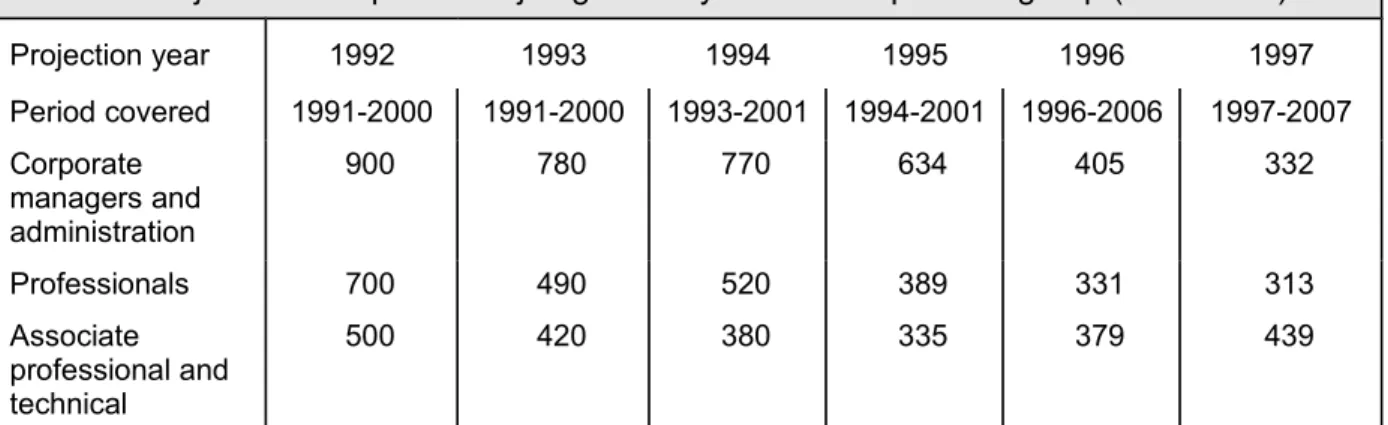
downwards in 1996 to 39 per cent by 2001 (DfEE, 1996: 42), but subsequent projections put the proportion of high-level occupations at about 40 per cent of all jobs within a few years of the new Millennium (DfEE, 1997: 38). Moreover, by 2001, 40 per cent of managerial posts are expected to be held by women (ED, 1994: 46). Table 2 shows the job growth projections by broad occupational group since 1992.
Table 2 Major areas of predicted job growth by broad occupational group (thousands)
Projection year 1992 1993 1994 1995 1996 1997
Period covered 1991-2000 1991-2000 1993-2001 1994-2001 1996-2006 1997-2007 Corporate
managers and administration
900 780 770 634 405 332
Professionals 700 490 520 389 331 313
Associate professional and technical
500 420 380 335 379 439
Skill shortages and recruitment difficulties
51. The annual Skill Needs in Britain (SNIB) survey undertaken on behalf of the DfEE, explores recent and current recruitment difficulties rather than
expected skill shortages, and as such the term ‘skill’ incorporates not only occupational competences but also personal and behavioural characteristics (Parsons and Marshall, 1995). While a causal link between employers’ recruitment difficulties and apparent deficiencies in skills supply cannot always be assumed (Bosworth, Dutton and Lewis, 1992), the trends are thought to provide some indication of current skill shortages as reflected in recruitment for higher level occupations, where other reasons for recruitment difficulties, such as poor terms and conditions, are less relevant.
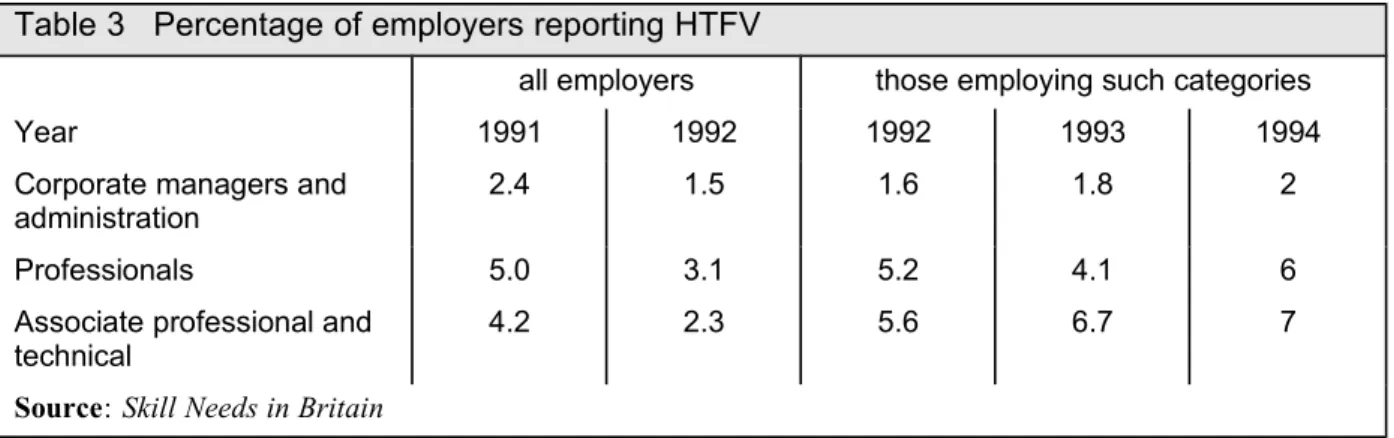
52. In the earlier years of SNIB, employers were asked whether they had experienced hard-to-fill vacancies (HTFV) in a range of occupational areas over the past 12 months, and whether they expected to experience such difficulties over the coming year. Table 3 shows the percentage of employers reporting HTFV in the high-level occupations.
Table 3 Percentage of employers reporting HTFV
all employers those employing such categories
Year 1991 1992 1992 1993 1994
Corporate managers and administration
2.4 1.5 1.6 1.8 2
Professionals 5.0 3.1 5.2 4.1 6
Associate professional and technical
4.2 2.3 5.6 6.7 7
Source: Skill Needs in Britain
53. Between 1991 and 1992, the proportion of employers reporting HTFV in managerially-related occupations appeared to fall, but these statistics
employers employing each broad occupational category, which is more meaningful, and on that basis HTFV were increasingly reported between 1992 and 1994 in managerially-related occupations. This statistic was excluded from subsequent surveys.
54. Employers were also asked in which occupational categories they expected to encounter HTFV in the coming 12 months. Table 4 shows the percentage of employers anticipating HTFV in the managerially-related occupations.
Table 4 Percentage of employers anticipating HTFV
1992 1992 1993 1994
Corporate managers and
administration 0.9 1.1 0.7 1.0
Professionals 2.3 1.5 2.0 1.0
Associate professional and
technical 2.1 1.7 2.3 2.0
Source: Skill Needs in Britain
55. The expectation of skill shortages remained fairly constant over the period 1992-95, with about 1 per cent of employers anticipating HTFV in
management and administrative occupations and 2 per cent expecting difficulties with the other two high-level occupations. These statistics reflect employers’ perceptions and it was claimed that ‘many employers tend to predict recruitment difficulties that do not in the event occur’ (IFF, 1993: 61). This claim is not supported by the evidence, as can be seen by comparing Tables 4.3 and 4.4. For managers and administrators in 1992, 0.9 per cent of employers anticipated HTFV in the coming 12 months, while 1.8 per cent reported having experienced such difficulties in 1993. Similarly, 1.1 per cent expected recruitement difficulties in 1993 and 2 per cent reported HTFV in 1994. The same relationship is apparent with the other high-level
56. The early SNIB surveys also attempted to identify skill shortages from the duration of longest-standing vacancies (LSV) in broad occupational
categories. In 1992, the average duration of LSV for all occupational categories was 24 weeks, while the comparable figure for managerial and administrative occupations was 18 weeks and for professional occupations was 36 weeks (IFF, 1992). The average of LSV was therefore higher for professional occupations and lower for managerial and administrative
occupations then the average for all categories. In the 1991 survey, the three managerially-related occupational categories had the highest averages of LSV, but this was thought to reflect the length of notice requirements and the fact that such high-level vacancies are rarely filled from the ranks of the unemployed (IFF, 1991). In any case, the duration of LSV is uninformative because the statistical distribution of time to fill vacancies is inevitably very heavy-tailed, making the mean time to fill vacancies a more useful measure.
57. For the years when the SNIB survey was conducted by IFF, specific occupations were also identified in terms of recruitement difficulties.
Managerially-related occupations frequently featured among the most difficult to recruit specific occupations. Table 5 shows the high-level occupations ranking among the 25 most difficult to recruit between 1991 and 1997.
Table 5 Most difficult to recruit high-level occupations
1991 1992 1993 1994 1997
Specialist managers 13 10 10 11
Managers of services 14 10
Business and finance
associated professionals 25 14 14 20
Teaching professionals 6 6
Miscellaneous managers and
administrators 13 8
Miscellaneous associated professionals
14 13
Health associated professionals 3
Health and related 5
Production managers 18
58. Table 5 shows that specialist managers, along with business and finance associated professionals, have been relatively difficult to recruit during the 1990s. Recruitment difficulties have also been apparent among
miscellaneous managers and administrators, associated professionals, teaching professionals and health-related professionals.
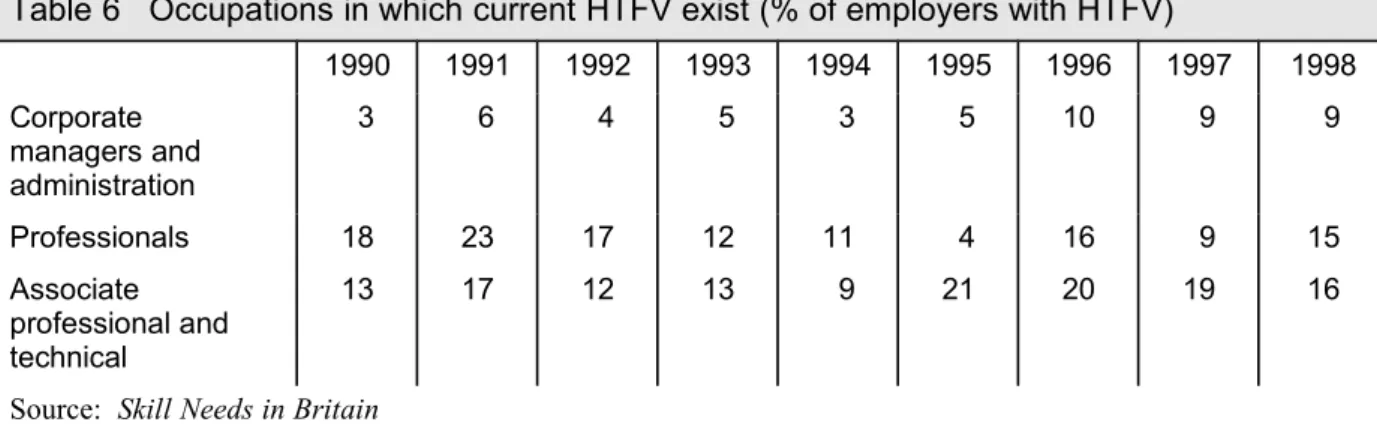
59. The SNIB survey also provides an analysis by broad occupational category of reported HTFV based on the number of vacancies. Table 6 shows the
percentage of all employers with current HTFV reporting difficulties with managerially-related occupations.
Table 6 Occupations in which current HTFV exist (% of employers with HTFV)
1990 1991 1992 1993 1994 1995 1996 1997 1998
Corporate managers and administration
3 6 4 5 3 5 10 9 9
Professionals 18 23 17 12 11 4 16 9 15
Associate professional and technical
13 17 12 13 9 21 20 19 16
Source: Skill Needs in Britain
60. The 1997 SNIB report commented on a ‘noticeable downturn since 1996 in the proportion of employers experiencing hard-to-fill vacancies with
professional occupations’ (IFF, 1997). While the trend through the 1990s appears to be a steady reduction in professional skill shortages, it is important to recognise the variability in the proportion reporting HTFV among
Skill gaps and qualifications
61. It is a recurrent theme that UK managers are inadequately trained and qualified in comparison with those of competitor nations. As post-war demand for trained managers increased (Clements, 1958: 158), British industry was seen to be handicapped by a shortage of suitably qualified managers (McGivering, Matthews and Scott, 1960: 79). The general lack of qualifications among UK managers was repeatedly noted over the years (Legatt, 1972) and held to account for the residual productivity lag in
comparison with competitor nations not accounted for by other factors (STF, 1998: 31). The CBI (1989) noted that while 24 per cent of top UK managers were graduates, in France and Germany the percentage was more than twice that, and in Japan and the US, 85 per cent of top managers had degree-level qualifications. In 1985, some 54 per cent of management board members in the top 100 German companies were qualified to doctorate level
(Randlesome, 1990: 48).
62. In LMST 1993-94, it was anticipated that an increase in higher-level
qualifications would be required among those in managerial and professional roles to match predicted occupational changes. While most individuals working at these levels in the public sector have HE qualifications, ‘in the private sector less than one third of (large) corporate managers and administrators held HE qualifications.’ (ED, 1992: 21). Quoting the EIR survey, the 1994-95 LMST noted that the proportion of managers and
administrators without qualifications had fallen from 47 per cent in 1979 to 27 per cent in 1989, while the proportion qualified to degree level had increased from 15 per cent to 18 per cent.
management, ‘managers and proprietors are still twice as likely to be without qualifications as managers and administrators.’ (ED, 1993: 26).
64. In LMST 1996-97, it was noted that ‘just over half of the 1993 first degree graduates entered employment within six months after graduation, generally entering professional, managerial and higher technical occupations. A further 11 per cent were believed to be unemployed. The remaining graduates were either not active in the labour market, or were overseas graduates leaving the UK.’ (DfEE, 1996: 67). The LMST 1997-98 reported that ‘graduate numbers have increased in virtually all subject areas since the 1980s. The most rapid growth among major subjects includes business and financial studies (from 9,000 graduates in 1988/9 to 22,000 in 1994/5)’ (DfEE, 1997: 59). Some 57 per cent of first degree graduates in 1995 entered employment within six months of graduation, generally entering professional, managerial and higher technical operations.
65. Using data from Skills Audit, the STF also commented on the considerable improvement in the supply of higher level skills, with 23 per cent of new entrants to the labour market and 19 per cent of the total working population qualified to the equivalent of VQ 4 or above in 1994 (STF, 1998: 27). The percentage of new entrants with higher level skills is equivalent to the USA, while the proportion of the total population qualified to that level is higher than in France or Germany. Some 40 per cent of corporate managers and
administrators are now thought to have qualifications above A level and only 4 per cent lack any formal qualifications (STF, 1998: 31).
66. Constable and McCormick (1987) had estimated that there were 2.5-3 million managers in the UK, excluding those in very small enterprises (<20
employees) and the self employed. The Cannon Report (1994) calculated that the number had shrunk to 2-2.25 million due to the recession of the 1990s. With the addition of an estimated 2.9 million self employed and 1.6 million managers of very small firms, the total managerial labour pool is between 6.5 and 6.75 million.
important as the supply of graduates. Management development is
especially significant as further demands are placed on managers to cope, for example, with new technologies and the organizational changes outlined in section 2 above. As a consequence of these challenges and changes,
managers will be operating in organizations which are constantly evolving, so will have to be more flexible and undertake ‘continuous learning rather than periodic training’ (Taylor, 1994: 37). The comments of the Taylor Working Party are consistent with the IPD Code of Practice on continuous
development (IPM, 1984) and with the recommendation of Constable and McCormick (1987) that management development should be seen as a career-long process involving in-company training and external education.
68. Despite this, there is also evidence that the low level of qualification among UK managers has been exacerbated by an inadequate volume of training and development. Mangham and Silver (1986), for example, reported that over half of all UK companies made no formal provision for training managers. The Constable Report (1987) reiterated this and found the problem was especially pronounced in companies with 20-99 employees. Although no estimate was made of MD in firms of <20 employees, the situation can be assumed to be even more serious given their lesser resources and even more acute job demands. Hussey (1988: 65), claimed that the estimate that ‘most managers receive no training at all is by no means restricted to managers in the smaller companies.’
69. According to MCI (1992), the situation improved slightly from 1987, with 80 per cent of larger organizations (>500 employees) reporting that they had a formal management training programme, but still only 50 per cent of all organizations and half that proportion of smaller firms (<100 employees) having similar arrangements. Thomson et al (1997: 22) confirmed this improvement, finding that organizations were giving increasingly higher priority to management development than 10 years previously and predicting a continued increase in management development. Only 4 per cent of larger companies and 20 per cent of smaller companies reported doing no training.
training per year in 1996, whereas 10 years previously the average was 3.1 days and in the future it was predicted to rise to 7.3 days (Thomson et al, 1997: 30). Among smaller companies, average formal training amounted to 4.6 days per manager per year. While there is robust evidence that only a very small minority of larger companies still provide no management
development and training, it is not clear that it is possible to extrapolate from this to conclude that ‘most UK managers in large companies now receive some sort of formal management training’ (STF, 1998: 31), because only a small proportion of managers might be involved in some organizations.
Management skills for the future
71. The attraction of a generic core of management competences, such as provided by the Management Standards, is self-evident in relation to
designing training, development and assessment. Equally, such an approach is essential to ensure transferable skills and portable qualifications. Some commentators, however, believe that for the environment in which managers now operate, the ‘nanosecond nineties’ as Peters (1992) puts it,
organizations need more than managerial competence. Noting the radical changes in the UK financial sector, for example, Higgs (1988) argued that in addition to traditional technical competence, managers in that sector needed attributes like flexibility, tolerance of ambiguity and ability to learn. Brown (1994) similarly argues that without prerequisite ‘managerial capacities’, like judgement and intuition, any demonstration of competence is meaningless.
72. In contrast with the job-related concept of competence (and competences), Boyatzis (1982) defines managerial competency (and competencies) in terms of the attributes of an individual which are ‘causally related to effective or superior performance in a job’. Burgoyne (1988a) similarly distinguishes ‘being competent’ (meeting the job demands) from ‘having competencies’ (possessing the necessary attributes to perform competently).
occupational standards sense, but use ‘competencies’ in the plural. Some authors consistently use ‘competency’ when meaning competence (Boam and Sparrow, 1992; Mitrani et al, 1992; Smith, B., 1993; Hendry et al, 1995) or treat the two as synonymous (McBeath 1990; Brown 1993; 1994; Doyle 1997). Dale and Iles (1992) distinguish occupational skills from psycho-social characteristics, but use competence and competency to describe both in discussing their role in assessing managerial skills.
74. Spencer (1995: 144) offers a typical North American definition of competency as a ‘relatively enduring characteristic of a person causally related to effective or superior performance in a job’, but also refers to this as competence (Spencer and Spencer, 1993). Similarly, the Hay/McBer definition of
competency as ‘a characteristic of an individual that has been shown to drive superior job performance’ includes both visible ‘competencies’ of ‘knowledge and skills’ and ‘underlying elements of competencies’, like ‘traits and motives’ (Hartle, 1995: 107). Elkin’s (1990) association of competences with micro-level job performance and competencies with higher management attributes is unconvincing.
75. Boak (1991) argues that ‘competency’ in the American sense complements ‘competence’ as used in the UK occupational standards. Woodruffe (1991) offers the clearest statement, contrasting areas of competence, defined as aspects of the job which an individual can perform, with competency, referring to a person’s behaviour underpinning competent performance. Woodruffe’s definition is endorsed by Tate (1995b: 86) who warns against confusing ‘input competencies with output competences.’
76. The policy reviews on management education and recent management literature share the view that whatever competences are required today, tomorrow’s managers will need more than these to cope with the challenges and uncertainties of the future. The management attributes emphasised in much of this debate invariably include competencies as well as new skills and competences. Constable (1988) identified personal qualities such as
without hierarchy across traditional functional boundaries. In defining ‘managerial competencies for the future’, Cockerill (1989) combines output competences, like effective presentation skills, with input competencies such as self-confidence. Likewise for Burgoyne (1989a; 1989b) tomorrow’s
managers need higher-order abilities such as ‘learning to learn’, forecasting and analysis, as well as personal competencies, including diligence, tenacity and integrity. The common theme with such lists of ‘meta-competences’ (Brown, 1993) are that they relate to the cognitive aspects of management concerned with reflection and ability to cope with uncertainty (Burgoyne and Stewart, 1976; Kolb et al, 1986).
Management Skills in SMEs
77. Much of the literature discussed in the foregoing sections relates to larger organisations operating in the private and the public sector. While there exists no fully agreed definition of large or small businesses, it is generally accepted that organisations employing around 200 or fewer staff can be described as small or medium sized enterprises (SMEs). The British
Chambers of Commerce (1998) suggests the following breakdown, which we feel to be sensible in relation to management skills and training issues:
Micro firms: up to 10 employees;
Small firms: 11-50 employees;
Medium firms: 51-250 employees.
owner-managers, their use (or otherwise) of management training or development programmes, shortages of SME management skills and skill gaps among owner-managers.
The significance of the SME sector
79. A large number of studies over the past two decades have documented the growing relative importance of the SME sector to the UK economy, a trend that has been mirrored in many other countries throughout the world (Storey and Johnson, 1987; European Observatory, 1997). Despite improvements in data availability, it is still difficult to provide a reliable estimate of the numbers of SMEs in the UK economy, but DTI estimates suggest that there were around 3.7 million SMEs in 1996, accounting for approximately one third of employees. According to figures on registrations and deregistrations for VAT, there was a secular increase in the number of businesses in operation up to 1992, and a slight decline thereafter. Self employment has undergone similar trends, with a rapid increase during most of the 1980s, and a slowdown through the 1990s. Not all self-employed people can be described as running a business; increased sub-contracting and the ‘flexible firm’ have given rise to a large (but unquantifiable) number of labour-only subcontractors or freelance workers. Nonetheless, the evidence suggests that there has been a
considerable increase over the past 20 years in the number of businesses in operation in the UK and, by implication, in the number of people who are owning and/or managing SMEs. This trend has important implications for the nature of the skills required by the growing number of SME owner/managers.
The Nature of SME Management
81. As noted above, a small business is not simply a scaled down version of a large enterprise. This statement has clear implications for the skills required of the person who owns and/or manages the small business. There are a number of key distinctions between small and large organisations that have significant implications for management skills and management development issues:
The vast majority of SMEs are owned and managed by one person, or by two people working in partnership (often family businesses);
Only a very small minority of SMEs can be said to be ‘team-managed’ - the scope for specialisation within the SME management ‘team’ is very limited. The corollary of this is that SME owner/managers are likely to need to deal with a range of managerial issues, and cannot be expected to be specialists;
Most SME owner/managers are heavily involved with the day-to-day activities of the business, as well as having overall managerial responsibility;
The SME owner/manager generally has a significant financial stake in the business. Evidence suggests that the majority of new businesses are started primarily with the founder’s own funds or funds provided by friends or family;
Most SMEs are operating in highly competitive markets, and failure rates are high. Studies suggest that 40% of newly-established businesses cease trading within 3 years of starting;
By the very nature of their size, SMEs cannot offer a highly structured internal labour market, with the consequence that the prospects for the movement of supervisory or ‘lower managerial’ staff into senior
There exists no clear, structured or active external labour market for SME managers, to the extent that SMEs that wish to grow may find it difficult to recruit managerial staff (Wynarcyck et al, 1993);
Until very recently, there existed no clear occupational standards and no national qualification framework for SME management.
82. The above characteristics have a number of implications for the skills required of SME owner/managers and for the way in which these skills are acquired and developed. Most obviously, the situation of the SME
owner/manager mitigates very heavily against the type of structured
programme of largely off-the-job training and development which is typical of programmes based in HE institutions, run by private sector training providers or delivered internally by large organisations. The SME owner-manager has a strong financial incentive to spend as much time as possible working in the business, and in most cases finds it hard to spare the time to attend courses or programmes. Moreover, SME managers typically need to have a limited knowledge of a wide range of issues, while the managerial employee large organisation tends to specialise in one functional area (e.g. finance,
marketing, production, human resources).
Skill Requirements of SME Owner Managers
83. Given the growing significance of SMEs for employment growth, and in the light of the growth of programmes by central government and others
designed to improve the skills of SME managers, there has been surprisingly little research undertaken into the skills that are required for the management of SMEs. Recent reviews of the issue (Atherton and Philpot, 1997; Smith and Whittaker, 1998) have focused upon the development of occupational
standards relating to the NVQ framework. A set of standards have now been produced by the Small Firms Lead Body (SFLB), and are being promoted by the Management and Enterprise Training Organisation (METO).
interviews with small business owner/managers, training organisations and strategic bodies such as MCI, regional organisations and TECs. Conclusions drawn from this review include:
It is important to link the provision of training and development and associated standards for SME owner/managers with the development of the individual business. Training and development needs will vary according to the stage of development reached by the business, firm start up through to survival and growth.
While most owner/managers could see some value in the competence-based approach, there is relatively little interest in qualifications per se, and a desire for a flexible interpretation of the standards and flexible delivery of training/development to reach the standards.
SME owner/managers need to see that the use of standards, and associated development activities, will have a clear benefit in terms of business performance and will help him or her to tackle immediate and specific issues.
The MCI/SFLB standards are seen as a useful framework for the training of non-owner/managers within the firm to move into managerial roles.
Skill shortages and skill gaps
85. The concept of ‘skill shortages’ in the context of the SME sector is a
problematic one. As we have already stated, recruitment of managerial staff by SMEs is a relatively rare event and, as Wynarcyck et al (1993) have demonstrated, is restricted largely to businesses experiencing rapid growth. Such businesses, however defined, are a very small minority of the SME sector, perhaps around 5% of all businesses (Storey and Johnson, 1987; BCC, 1998).
is difficult to conceive of, let alone measure, skill shortages in the area of new business formation.
87. On the other hand, the concept of a ‘skills gap’ - defined as a lack of the skills necessary to effectively manage and develop an SME - is an important one in the context of SME management. Various commentators (e.g. Storey,1994) have pointed out that, although the rate of new business formation in the UK is now relatively high by international standards, there is some reason to believe that the SME sector is under-performing. In particular:
High failure rates, and in particular the 60% 3-year survival rate, may be attributed to the lack of managerial skill among the owner/managers of the business. There are alternative explanations, of course - such as the inflexibility of banks, late payment by large organisations and so on - but poor management remains one of the most popular
explanations;
On the other side of the coin, it is believed - although the empirical evidence is sparse - that the UK does not produce enough small businesses that grow into medium or large businesses. The size of the Mittlestand in Germany is cited as evidence of the superior
managerial abilities of SME managers in that country. This apparently limited growth potential among British SMEs has been one of the main rationales for the introduction of state-funded programmes to promote management training and development in SMEs.
88. We can conclude, therefore, that the evidence regarding skills shortages and/ or skills gaps among managers in the SME sector, is unclear. On the one hand there have been, until recently, no clear benchmarks or standards against which we can measure the skills of SME owner/managers. Even now there is no real consensus about the validity of the current MCI/METO
standards. On the other hand, the evidence which suggests that British SMEs have performed relatively poorly because of limited management skills is limited and mainly circumstantial.
the view that increased management training in SMEs will automatically result in improved business performance. This view has subsequently been
questioned, for example by Cushion (1996), but the overall conclusion is that there is no compelling evidence to support the view that the performance of UK SMEs can be improved significantly through increased levels of
management training.
Management Training and Development in SMEs
90. A number of recent studies have examined the process by which SME owner/ managers improve their skills and acquire new ones. These studies include those conducted by Curran et al (1996), Gray (1997), the Cambridge Small Business Centre (Cosh, Duncan and Hughes, 1998) and Blackburn and Kitching (1997). The last mentioned study is the only international
comparative study that we are aware of, although the European Observatory for SMEs (1996) has provided an overview of SME management issues in the EU countries. In addition to the published studies, a number of organisations – TECs in particular – have undertaken research into the training and/or support needs of SMEs in their local areas. One of the current authors has been involved in a number of such studies, some of which have resulted in publications (Johnson and Gubbins, 1993; Johnson, Smallbone and Froud, 1998).
91. The methodologies and definitions applied in these studies vary, but there are a number of conclusions that can be drawn:
The vast majority of SME owner/managers do not hold formal management qualifications; many have undergone no management training prior to starting their business and a smaller proportion have had no prior managerial experience;
Many SME owner/managers recognise the potential value of management development activity for the performance of their business. Most have difficulty, however, in identifying their specific needs, and how they might best be met;
When a broad definition is used, most SME owner/mangers have undertaken some form of management training or development in the recent past. The survey conducted by Curran et al (1996) found that 78% of managers had undertaken some form of management training during the previous 12 months;
Informal on-the-job training tends to be preferred to more formal externally-provided courses, particularly for the smallest enterprises (Curran et al, 1996);
The amount of management training and development increases with firm size, as does the formality of the training/development received (Gray, 1997; Curran et al, 1996);
Owner-manager training activities cover a wide range of business functions. Curran et al. found that health and safety, ‘product knowledge’, ‘working methods’ and computing/IT are the most important, with personnel, communication skills and exporting being the least important.
Owners use a variety of institutions and individuals to provide management development support, but in a large number of cases (47% according to the Curran study), they rely on themselves or other members of the firm (supported by technical literature etc.).
Equipment suppliers (37%), private training companies (32%) and trade bodies (15%) are also important sources. Owner/managers make very little use of public sector bodies, TECs, Business Links or educational institutions for management development support.
92. It is difficult to draw unambiguous conclusions from the available research evidence, given its limited nature and the heterogeneity of the SME sector. However, it is reasonable to conclude that concern does exist among a range of individuals and organisations throughout the country, that there is
considerable need scope for the improvement of management skills in British SMEs. This need looks likely to increase as more and more SMEs are drawn into the global economy, either directly, or indirectly through their links with larger organisations.
Policy implications
93. The first report of the STF noted three aspects of management skills that could be significant:
their level of general education;
their training in specific management skills;
the technical skills they have which are relevant to the particular activities they manage (STF, 1998: 31).
94. These three aspects of management skills must be taken into account when considering the policy implications of the analysis of skill gaps and skill shortages discussed in section 4. The first aspect is concerned with the supply of graduates (or those with equivalent high-level qualifications) and their entry into the labour market into higher-level occupations, and especially management-related occupations. The second aspect is concerned with both specific management skills that must be developed by those in managerial posts, whether because formal education does not equip graduates with generic management skills or because managers are having to up-date their skills in line with technological and organizational changes. The third aspect can involve both formal education and on-the-job development and is
distinguished by its technical specificity.
behind other industrialised nations in terms of its formal management education, and the belief that developing managers would improve the competitive advantage of UK industries (Handy et al, 1987; Constable and McCormick, 1987). An increase in the amount of management development is widely viewed as neccesary to remedy these deficiencies and has been linked with the attainment of competitive advantage in recent public policy documents. The Cannon and Taylor Working Party Reports (IoM, 1994) arising out of the 1992 Institute of Management review of management development, confirmed the need for the effective development of existing managers in order to raise the competitiveness of British industry.
96. These reports noted that the challenges of organizational changes, especially contracting out, de-layering and empowerment, make the need for
management development particularly acute. The situation was seen to be exacerbated by persistent structural unemployment, competitive pressures from low-wage economies, rapid technological change and standards in education which are inappropriate to the needs of employers. In LMST 1994-95, the need for managers who ‘appreciate the potential of technology and its implications for human resources’ was emphasised: ‘Managers will need a better awareness of the scope to use the technology to improve products and processes and implement the organisational changes that may be needed to get the full benefits.’ (ED, 1993: 30). The recognition in European
Commission White Papers (1994) that skills must be raised at all levels if European enterprises are to compete in global markets, re-surfaced in successive Competitiveness White Papers in the UK (DTI, 1994; 1995).
97. Recent evidence suggests considerable improvement in both the number of new entrants to the labour market with higher-level qualifications and an increase in the volume of management development. Nevertheless, the projected expansion of management and otgher higher-level occupations is still expected to create shortages of Managers and Administrators; recent years have seen increasing evidence in the form of HTFV in this broad occupational group.
98. The UK’s favourable position in relation to higher level skills, reflecting the doubling of the numbers particpating in higher education since 1979, contrasts markedly with the situation at intermediate skills levels, and
especially with those qualified to VQ level 3 or equivalent. A series of studies from the NIESR has suggested that the proportion of people trained to
intermediate skill levels in the UK is inadequate (see Lloyd and Steedman, 1999). On the basis of the Skills Audit data used by the STF, 11 per cent of the total working population in the UK are qualified at VQ level 3, compared with 14 per cent in France, 29 per cent in the USA and 40 per cent in
Germany (STF, 1998: 28). In the case of new entrants to the labour market, 13 per cent are at VQ level 3 in the UK compared with 15 per cent in France, 32 per cent in the USA and 52 per cent in Germany.
99. This difference in VQ level 3 qualification may have serious implications for the effective utilisation of those with higher level skills in the UK, since a higher proportion of managers are likely to be engaged in tasks which in other countries would be undertaken by those with intermediate level skills. In LMST 1994-95, it was suggested that ‘as a result, graduates may be used to cover technician posts...So the skills of qualified workers are not fully utilised.’ (ED, 1993: 24). Not only are graduate skills under-utilized through managers ‘working down’, but also managerial skill shortages are
exacerbated so that the development of skills at intermediate level may be a more effective route to reducing apparent management skill shortages.
Critiques of competence-based management development
100. There has been considerable criticism of competence-based management development, some of which is concerned with aspects of the process which are common the competence-based approach to vocational education and training in general, and some which relate specifically to the management function.
for management tasks: ‘the disaggregative approach of functional analysis has had no empirical verification. For this, the MCI would have to show that managers who are judged to be competent on each element are also judged to be competent overall, using independent criteria.’ (Holmes and Joyce 1993: 43)
102. The assessment associated with the competence-based approach and the use of the Management Standards for qualifications has also been criticised for being bureaucratic (Canning 1990; Currie and Darby 1995). For small employers especially, the framework was seen as too complex and the language too rigid (Hirsh and Strebler 1994: 91). The dichotomy of ‘competent’ or ‘not yet competent’ is seen as too simplistic in failing to differentiate levels of competence and therefore not taking into account continuous improvement (Stewart and Hamblin, 1992b), while the developmental steps in the MCI approach have been viewed as too hierarchical, neglecting the possibility of strategic thinking at lower levels (Wille, 1990). Moreover, in an empirical study of the introduction of level 3 and 4 Management NVQs using APL, Currie and Darby (1995) criticised the scheme for not being developmental. These issues are common to the NVQ/ SVQ approach in general and we found them to act as serious barriers to take-up by individuals at all levels (Winterton and Winterton, 1995).
Nevertheless, problems in the operation of vocational qualifications should suggest a need to streamline the system, not abandon the competence-based approach.