
Engineering of IT Management Automation along Task
Analysis, Loops, Function Allocation, Machine Capabilities
Dissertation
an der
Fakult¨at f¨ur Mathematik, Informatik und Statistik der
Ludwig-Maximilians-Universit¨at M¨unchen
vorgelegt von
Ralf K¨onig
Engineering of IT Management Automation along Task
Analysis, Loops, Function Allocation, Machine Capabilities
Dissertation
an der
Fakult¨at f¨ur Mathematik, Informatik und Statistik der
Ludwig-Maximilians-Universit¨at M¨unchen
vorgelegt von
Ralf K¨onig
Tag der Einreichung: 12. April 2010 Tag des Rigorosums: 26. April 2010
Abstract
This thesis deals with the problem, that IT management automation projects are all tackled in a different manner with a different general approach and different resulting system architecture.
It is a relevant problem for at least two reasons: 1) more and more IT resources with built-in or asso-ciated IT management automation systems are built today. It is inefficient to try to solve each on their own. And 2) doing so, reuse of knowledge between IT management automation systems, as well as reuse of knowledge from other domains is severely limited. While this worked with simple stand-alone remote monitoring and remote control facilities, automation of cognitive tasks will more and more profit from existing knowledge in domains such as artificial intelligence, statistics, control theory, and automated planning. A common structure also would ease integration and coupling of such systems, delegating cognitive partial tasks, and switching between commonly defined levels of automation. So far, this problem is only partly solved. Prior work on approaching systems design includes systems engineering with its steps task analysis and function allocation. But so far systems engineering has not yet been widely applied to IT management automation systems, in contrast to technical application domains such as automotive or aerospace engineering.
The state of the art in IT management automation itself on the technical side includes IBM’s Auto-nomic Computing Initiative, proposing a structure of feedback loops for autoAuto-nomic systems. On the organizational side, a certain standardization of IT service management processes has been reached with the introduction of process management standardization work like the IT infrastructure library (ITIL), which is a collection of best practices in IT service management, and ISO 20.000, a standard derived from ITIL V2. So far, the mentioned developments all stand each on their own.
The idea of this thesis is now to combine this prior knowledge to create a universal approach to the design of IT management automation systems in four steps:
Step 1: Task analysis in the IT management automation scenario, with an implicit goal to associate the identified tasks with a subset of the ITIL reference processes (see Chapter 3).
Step 2: Reformulation of the tasks into feedback loops of a common structure for cognitive loops (see Chapter 4).
Step 3: Function allocation of the loop steps to either performed by humans or machine components (see Chapter 5).
Step 4: Identification of a set of relevant machine capabilities in a catalog structured along the previous three steps (see Chapter 6).
Each of the steps 1–3 is the result of combining existing knowledge in systems engineering and existing knowledge in IT management automation.
domain-specific method for engineered IT management automation (EIMA).
The EIMA method is intended to be used in the analysis and design of IT management automation sys-tems. Its purpose is to first align the structure of the automation problem to EIMA and then to quickly identify automation potential enabled by existing mathematical methods and machine capabilities. In an application example (see Chapter 7), it is shown how an existing complex proposal for partial automation in a wide area network scenario is analyzed, and a new proposal is derived that improves automation along known concepts of control systems, and at the same time simplifies the organiza-tional structure. It does so by decomposing the overall problem into a set of smaller problems that can be solved by domain experts in economics, graph theory, network configuration management. A comparison shows that while the previous proposal has created a UML-based draft model for a pro-tocol that eases information exchange, the new proposal actually includes the cognitive tasks that had been left to system administrators in the first proposal. A variable level of automation leaves enough influence by network operators on the automation routine, and therefore provides the basis for better acceptance.
This work differs from related work in not focusing on single automation scenario instances (regarded as point solutions), but instead proposing a general method applicable to all such problems and bringing a benefit by its association with existing concepts in systems engineering and IT management. As the method is partly rooted in systems engineering, we can build on the experience that has been gathered there in the design of control systems like autopilots and driver assistance systems.
The main benefit of EIMA for system designers is a uniform way of describing and decomposing IT management automation problems even of high complexity at a high level of abstraction. Only after this high-level decomposition, system designers and domain specialists will take care of the details by further refining the tasks and implementing system components. This top-down approach makes even complex IT management automation systems comprehensible and concise in their description. Also for system administrators this is a clear benefit.
To achieve this simplicity, EIMA also must leave certain aspects unconsidered. Due to its universality, we can hardly include scenario-specific aspects: EIMA makes no advice on the “best” automation. Instead, it leaves out scenario-specific cost benefit analysis or return-on-investment analysis as this depends on external policies as well. EIMA also does not give detailed cookbook-like advice on which machine capabilities to use for what task. In this point it must rely on the experience, background knowledge and creativity of a user of the EIMA method, all of which is supported by EIMA, but not guided along a single path of cause effect relationships to one particular systems design.
Zusammenfassung
Diese Dissertation besch¨aftigt sich mit dem Problem, dass Projekte zur IT-Management-Automati-sierung jedes f¨ur sich anders angegangen werden und daraus unterschiedliche Systemarchitekturen entstehen.
Die entstehende Heterogenit¨at ist aus mindestens zwei Gr¨unden problematisch: 1) Immer mehr IT-Systeme mit eingebauten oder gekoppelten IT-Management-Automatisierungsfunktionen werden heute entworfen. 2) Dabei wird nur in sehr begrenztem Maße auf vorhandenes Wissen aus anderen IT-Management-Automatisierungsystemen oder verwandten Wissensfeldern zur¨uckgegriffen. W¨ahrend der bestehende Ansatz f¨ur einfache ¨Uberwachungssysteme und Fernsteuersysteme noch ausreichte, w¨urde die Automatisierung der kognitiven Aufgaben immer mehr von Methoden aus den Gebieten K¨unstliche Intelligenz, Statistik, Steuer- und Regelungstechnik, Automatisiertes Planen profitieren. Eine einheitliche Struktur von IT-Management-Automatisierungssystemen w¨urde auch die Integration und Kopplung solcher Systeme vereinfachen, sowie die Delegation von kognitiven Teilaufgaben und das Umschalten zwischen einheitlich definierten Automatisierungsgraden.
Bisher ist dieses Problem nur teilweise gel¨ost. Ein umfassender Ansatz zu Systemanalyse und Sys-tementwurf wird im Systems Engineering beschrieben mit den Teilschritten T¨atigkeitsanalyse (task analysis) und Funktionszuordnung (function allocation). Im Gegensatz zu Anwendungsdom¨anen wie der Automobiltechnik und der Luft- und Raumfahrttechnik wird ein vergleichbarer Ansatz bisher aber kaum auf Management-Automatisierungssysteme angewendet. Der aktuelle Wissensstand in der IT-Management-Automati-sierung an sich beinhaltet auf der technischen Seite unter anderem IBM’s Au-tonomic Computing Initiative, die f¨ur “auAu-tonomic systems” eine Struktur aus R¨uckkopplungsschleifen vorschl¨agt. Auf der organisatorischen Seite hat die Arbeit in der Standardisierung des IT-Prozess-Management, unter anderem durch ITIL und ISO 20.000, Verbreitung gefunden. Bisher jedoch stehen diese Entwicklungen jeweils f¨ur sich.
Die Idee der hier vorgelegten Arbeit ist, dieses vorhandene Wissen zu kombinieren. Damit wird ein universeller Ansatz geschaffen, mit dem man IT-Management-Automatisierungssysteme in vier Schrit-ten entwerfen kann:
Schritt 1: T¨atigkeitsanalyse (task analysis) des IT-Management-Automatisierungs-Szenarios mit dem impliziten Ziel, die gefundenen Aufgaben einem Prozess aus einer Untermenge der ITIL-Prozesse zuzuordnen (siehe Kapitel 3).
Schritt 2: Umstrukturierung der Aufgaben in ein Schema aus R¨uckkopplungsschleifen mit einheitlicher Struktur f¨ur kognitive Schleifen (siehe Kapitel 4).
Schritt 3: Funktionszuordnung (function allocation) der Schritte in den Schleifen zu Rollen, die entweder von Menschen oder Maschinenkomponenten ausgef¨ullt werden (siehe Kapitel 5). Schritt 4: Identifikation einer Menge von maschinellen F¨ahigkeiten in einem Katalog, der anhand der
Schritte 1–3 gegliedert ist (siehe Kapitel 6).
Jeder der Schritte 1–3 ist dabei das Ergebnis einer Verschmelzung von vorhandenem Wissen im Sys-tems Engineering mit vorhandenem Wissen aus dem IT-Management.
“MAPDEK-vorgeschlagene Katalog geht deutlich in Umfang und Struktur ¨uber ¨ahnliche Ans¨atze (z.B. Fitt’s Liste “Men are better at, machines are better at”, 1951) hinaus und ist bewusst dom¨anenspezifisch f¨ur IT-Management-Automatisierung angelegt. Andere Konzepte werden bei der Verschmelzung nach Pr¨ufung unver¨andert ¨ubernommen, wie z.B. Vorschl¨age von Sheridan (2000) zur Strukturierung und Beschreibung von Aufgaben (tasks) oder Automatisierungsgraden (levels of automation). Insgesamt erhalten wir eine dom¨anenspezifische Methode namens “EIMA” (Engineered IT Management Automa-tion) f¨ur IT-Management-Automatisierung nach ingenieurwissenschaftlichen Grunds¨atzen.
Die beschriebene Methode EIMA soll bei der Analyse und dem Entwurf von IT-Management-Automa-tisierungssystemen eingesetzt werden. Ihr Zweck ist dabei, vorhandene Szenarien an der neuen Struk-tur auszurichten und dann vorhandenes Automatisierungspotenzial schnell zu erkennen, das durch vorhandene mathematische Methoden oder Maschinenf¨ahigkeiten genutzt werden kann.
In einem Anwendungsbeispiel (siehe Kapitel 7) wird exemplarisch gezeigt, wie ein vorhandener kom-plexer Vorschlag f¨ur die Teil-Automatisierung in einem Weitverkehrsnetz-Szenario erst analysiert und dann ein neuer Vorschlag abgeleitet wird, der entlang bekannter Prinzipien die Automatisierung erh¨oht und die organisatorische Struktur vereinfacht. Dies wird erreicht, indem man das Gesamtproblem in kleinere Probleme zerlegt, die dann von Dom¨anenexperten in Betriebswirtschaft, Graphentheorie und dem Konfigurationsmanagement von WAN-Komponenten jeweils einfach gel¨ost werden k¨onnen. Ein Vergleich der beiden Vorschl¨age vor/nach EIMA zeigt, dass der erste Vorschlag zwar den Information-saustausch mit einem in UML modellierten Protokollentwurf automatisiert hat, aber der EIMA-basierte Vorschlag die Automatisierung der kognitiven Aufgaben einschließt, die im ersten Fall den beteiligten Menschen ¨uberlassen blieb. Um die gew¨unschten Einflussm¨oglichkeiten durch die Partner des WAN-Verbundes zu behalten, wird ein variabler Automatisierungsgrad vorgesehen.
Diese Arbeit unterscheidet sich von verwandten Arbeiten, indem sie nicht auf ein bestimmtes Punkt-Szenario abzielt, das zu automatisieren ist. Stattdessen wird hier eine allgemeine Methode angegeben, die sich f¨ur viele IT-Management-Automatisierungsszenarien eignet, mit dem Vorteil existierende Kon-zepte aus Systems Engineering und IT Management in sich zu vereinigen. So kann auch auf Erfahrun-gen aufgebaut werden, die im Zusammenhang mit Steuerungssystemen wie Autopiloten oder Fahreras-sistenzsystemen gesammelt wurden.
Der Hauptvorteil von EIMA f¨ur Systemdesigner ist eine eine einheitliche Art der Beschreibung und Zerlegung von selbst komplexen IT-Management-Automatisierungsproblemen auf einer hohen Ab-straktionsebene. Erst nachdem man diese Zerlegung gemacht hat, w¨urden Systemdesigner wie Fach-leute die Detailfragestellungen angehen, in dem die Aufgaben weiter verfeinert werden und Sys-temmodule implementiert. Dieser Ansatz der hierarchischen Dekomposition von oben nach unten erm¨oglicht es, selbst komplexe IT-Management-Automatisierungssystems verst¨andlich und knapp zu beschreiben. Auch f¨ur Systemadministratoren ist dies ein deutlicher Vorteil.
Um diese Vereinfachung zu erreichen, muss EIMA aber auch bestimmte Aspekte unber¨ucksichtigt lassen. So k¨onnen wegen der Universalit¨at bestimmte szenariospezifischen Fragen kaum ber¨ucksichtigt werden: EIMA gibt damit also keinen Rat zur “bestm¨oglichen” Automatisierung. Da diese Bewertung auch von den ¨außeren Rahmenbedingungen abh¨angt, bleiben eine Kosten-Nutzen-Analyse oder eine Amortisationsrechnung außen vor. EIMA macht auch keine punktgenauen Vorgaben, welche Maschi-nenf¨ahigkeiten f¨ur welche Aufgaben herzunehmen sind. In diesem Punkt muss es auf die Erfahrung, das Hintergrundwissen, sowie die Kreativit¨at des Systemdesigners vertrauen, die zwar von EIMA mit Vorschl¨agen unterst¨utzt werden, aber wo “die L¨osung” nicht entlang eines einzig m¨oglichen Pfades aus Ursache-Wirkung-Beziehungen hergeleitet wird.
Contents
1 Introduction 1
1.1 A simple model for IT management . . . 1
1.2 Problems in current IT management automation . . . 4
1.2.1 Problem 1: IT management complexity as opponent of efficiency and effectivity 4 1.2.2 Problem 2: Ad hoc management and ad hoc automation . . . 5
1.2.3 Problem 3: Insufficient communication between systems management and sys-tems design/development . . . 6
1.3 Potential solutions to these problems . . . 8
1.4 Problem statement . . . 12
1.5 Current related work . . . 12
1.6 Idea: Engineered IT Management Automation (EIMA) . . . 14
1.7 Approach . . . 15
1.8 Vision: A tool-set for the engineering of IT management automation . . . 17
2 Requirements and detailed approach on a method for engineered IT manage-ment automation 21 2.1 The scope of an IT systems automation engineer . . . 21
2.2 Requirements on a method that improves IT management automation by engineering . 24 2.2.1 Constraints on the input of the method . . . 25
2.2.2 Requirements on the output of the method . . . 26
2.2.3 Non-requirements on the method . . . 28
2.3 Preconsiderations on the steps of the method . . . 29
2.3.1 The automation problem . . . 29
2.3.2 Trivial approach: Direct association of tasks and implementation methods . . . 30
2.3.3 Related work on automation methods in IT management and systems engineering 31 2.4 Idea: A four-step approach reduces complexity of mapping . . . 38
2.4.1 Refinement of tasks . . . 38
2.4.2 Reformatting of tasks/sub-tasks to a standard loop . . . 39
2.4.3 Allocation of the loop steps to humans/machines . . . 40
2.4.4 Choosing machine capabilities from a catalog . . . 42
2.5 Conclusion . . . 44
3 Step 1: Task analysis and task modeling 45 3.1 Motivation and current examples of task analysis . . . 46
3.2 Requirements on task analysis in EIMA . . . 51
3.2.1 R1.1 Common automation-oriented IT management task structure . . . 51
3.2.2 R1.2 Task decomposition and control hierarchies . . . 51
3.2.3 R1.3 Automation-oriented task descriptions . . . 51
3.3 Terms . . . 52
3.4 Existing knowledge and concepts from current IT management automation . . . 53
3.4.1 R1.1 Common task structure of resource-related tasks in IT management. . . . 53
3.4.2 R1.2 Task decomposition and control hierarchies . . . 60
3.4.4 Summary . . . 64
3.5 Existing knowledge and concepts from other domains . . . 65
3.5.1 Introduction to the domains . . . 65
3.5.2 R1.1 Common task structure of resource-related tasks in their domain. . . 67
3.5.3 R1.2 Task decomposition and control hierarchies . . . 70
3.5.4 R1.3 Automation-oriented task descriptions . . . 74
3.6 Proposal on task analysis in EIMA . . . 80
3.6.1 Example Scenario . . . 80
3.6.2 R1.1 Automation-oriented IT management task structure in EIMA . . . 80
3.6.3 R1.2 Automation-oriented task decomposition and control hierarchies in EIMA 81 3.6.4 R1.3 Automation-oriented task descriptions in EIMA . . . 86
3.7 Conclusion . . . 88
4 Step 2: Loop composition from tasks 91 4.1 Motivation and current examples . . . 92
4.1.1 Necessity of a structuring element in the task decomposition tree . . . 92
4.1.2 Necessity of a common structure . . . 93
4.1.3 Necessity of machine-interpretable loop modeling . . . 93
4.2 Requirements on Loops in EIMA . . . 94
4.2.1 R2.1 Loops must be usable at multiple levels of abstraction . . . 94
4.2.2 R2.2 Commonly structured base loop . . . 94
4.2.3 R2.3 Machine-interpretable loop modeling and linking back to the tasks in task analysis . . . 95
4.3 Existing knowledge about loops in current IT Management automation . . . 96
4.3.1 Improvement cycles in ITSM frameworks . . . 96
4.3.2 Cognitive loop in FOCALE architecture . . . 96
4.3.3 MAPEK loop of the ACI . . . 96
4.3.4 Triggered application of event, condition, action (ECA) rules . . . 99
4.3.5 Cyclic application of fix-point operators . . . 100
4.3.6 Schedule-based automated procedures . . . 100
4.3.7 Feedback control loops . . . 101
4.4 Existing knowledge about loops in related domains . . . 103
4.4.1 Quality management . . . 103
4.4.2 Business management . . . 103
4.4.3 Human Factors Engineering . . . 104
4.4.4 Medical science . . . 106
4.4.5 Systems engineering . . . 106
4.5 Requirements Check . . . 111
4.5.1 Regarding R2.1 Loops must be usable at multiple levels of abstraction . . . 111
4.5.2 Regarding R2.2 Commonly structured base loop . . . 115
4.5.3 Regarding R2.3 Machine-interpretable loop modeling and linking back to the tasks in task analysis . . . 117
4.6 Proposal on modeling MAPDEK loops in EIMA . . . 119
4.6.1 Regarding R2.1 Loops must be usable at multiple levels of abstraction . . . 119
4.6.2 Regarding R2.2 Commonly structured base loop . . . 121
4.6.3 Regarding R2.3 Machine-interpretable loop modeling and linking back to the tasks in task analysis . . . 122
4.6.4 Example . . . 124
Contents
5 Step 3: Function allocation to humans/machines 131
5.1 Motivation and current examples . . . 132
5.1.1 Allocating functions to humans or machines . . . 132
5.1.2 Automation and Self-Management . . . 133
5.1.3 Intended effects . . . 133
5.1.4 Kinds of management automation systems . . . 134
5.1.5 Function allocation in the examples . . . 135
5.2 Requirements on function allocation in EIMA . . . 137
5.2.1 R3.1 Static binary function allocation concepts . . . 137
5.2.2 R3.2 Automation levels and standards . . . 138
5.2.3 R3.3 “Good/best” automation for a task . . . 138
5.2.4 R3.4 Dynamic function allocation at operation phase . . . 140
5.2.5 R3.5 Computer-aided modeling of function allocation . . . 142
5.3 Existing knowledge and concepts from IT management automation . . . 142
5.3.1 R3.1 Static function allocation concepts . . . 142
5.3.2 R3.2 Automation levels and standards . . . 149
5.3.3 R3.3 “Good/best” automation for a task . . . 153
5.3.4 R3.4 Dynamic function allocation at operation phase . . . 154
5.3.5 R3.5 Computer-aided modeling of function allocation . . . 156
5.3.6 Summary . . . 156
5.4 Existing knowledge and concepts from Systems Engineering . . . 157
5.4.1 R3.1 Static binary function allocation concepts . . . 158
5.4.2 R3.2 Automation levels and standards . . . 161
5.4.3 R3.3 “Good/best” automation for a task . . . 164
5.4.4 R3.4 Dynamic function allocation at operation phase . . . 169
5.4.5 R3.5 Computer-aided modeling of function allocation . . . 170
5.4.6 Summary . . . 172
5.5 Proposal to deal with function allocation in EIMA . . . 172
5.5.1 R3.1 Static binary function allocation concepts . . . 172
5.5.2 R3.2 Automation levels and standards . . . 174
5.5.3 R3.3 “Good/best” automation for a task . . . 184
5.5.4 R3.4 Dynamic function allocation at operation phase . . . 186
5.5.5 R3.5 Computer-aided modeling of function allocation . . . 192
5.5.6 Summary . . . 201
5.6 Conclusion . . . 202
6 Step 4: Matching tasks aligned to the EIMA scheme with machine capabilities 203 6.1 Motivation for a catalog of machine capabilities . . . 204
6.2 Requirements and non-requirements . . . 210
6.3 Proposal to use the catalog in EIMA . . . 212
6.3.1 Applicability to IT management scenarios . . . 212
6.3.2 Step-by-step application of the catalog in function allocation of management automation systems . . . 213
6.3.3 Application example on “ChangeControl” workflow from Chapter 2 . . . 216
6.3.4 Conclusion . . . 220
6.4 Related work and comparison . . . 221
6.4.1 Comparison with current literature . . . 221
6.4.2 Comparison with current IT management tools . . . 223
6.5.2 Machine capabilities in Auto Service level / performance management . . . 231
6.5.3 Machine capabilities in Auto Availability management . . . 232
6.5.4 Machine capabilities in Auto Capacity management . . . 235
6.5.5 Machine capabilities in Auto Incident management . . . 236
6.5.6 Machine capabilities in Auto Problem management . . . 237
6.5.7 Machine capabilities in Auto Change Management . . . 238
6.5.8 Machine capabilities in Auto Release management . . . 239
6.5.9 Machine capabilities in Auto Configuration management . . . 241
6.5.10 Machine capabilities in Auto Security management . . . 243
6.6 Catalog of Machine Capabilities Part 2: Loop-level machine capabilities . . . 245
6.6.1 Loop architecture . . . 245
6.6.2 Example list of loop functions . . . 246
6.7 Catalog of Machine Capabilities Part 3: Loop-step (MAPDEK) level machine capabil-ities . . . 251
6.7.1 Overview . . . 251
6.7.2 Management Interface (MI) . . . 254
6.7.3 Monitoring (M) . . . 256
6.7.4 Analysis (A) . . . 258
6.7.5 Planning (P) . . . 261
6.7.6 Decide (D) . . . 263
6.7.7 Execution (E) . . . 264
6.7.8 Knowledge (K) . . . 266
6.7.9 Communication bus (CB) . . . 268
6.7.10 Resource Interface (RI) . . . 269
6.8 Conclusion . . . 271
7 Application Example: Automation potential in End-to-end links with Quality of Service for a WAN 273 7.1 Selection of Scenarios . . . 273
7.2 The automation scenario “Automated E2E QoS links for a WAN across providers” . . 275
7.3 Automation analysis and general improved system design proposal . . . 277
7.4 Step 1: EIMA task analysis concepts for analysis and redesign of tasks . . . 279
7.5 Step 2: EIMA MAPDEK loops for analyis and loop design . . . 283
7.6 Step 3 and 4: EIMA function allocation and machine capabilities . . . 286
7.7 Resulting partial projects . . . 288
7.8 Conclusion for this scenario . . . 289
7.9 Discussion of the alternate proposed solution . . . 289
7.10 Other scenario: Automated update management . . . 292
8 Conclusion, future work and vision 299 8.1 Engineered IT management automation as a method . . . 299
8.2 Requirements check . . . 300
8.3 Improvements by this approach . . . 300
8.4 Applications of the EIMA method . . . 305
8.5 Potential follow-up work . . . 306
List of Figures 309
Contents
Bibliography 317
1 Introduction
Contents
1.1 A simple model for IT management . . . 1
1.2 Problems in current IT management automation . . . 4
1.2.1 Problem 1: IT management complexity as opponent of efficiency and effec-tivity . . . 4
1.2.2 Problem 2: Ad hoc management and ad hoc automation . . . 5
1.2.3 Problem 3: Insufficient communication between systems management and systems design/development . . . 6
1.3 Potential solutions to these problems . . . 8
1.4 Problem statement . . . 12
1.5 Current related work . . . 12
1.6 Idea: Engineered IT Management Automation (EIMA) . . . 14
1.7 Approach . . . 15
1.8 Vision: A tool-set for the engineering of IT management automation . . . 17
To make the line of argument of this thesis better comprehensible to readers, this chapter opens with a simple model of IT management, that shows how organizational and technical aspects work together to manage changing IT environments. Along these lines, problems in current IT management automation are identified, of which one was chosen as the topic of this work: the anticipation of future management operations for a certain resource at design time, and the improvement of automation of resource-related IT management procedures by adding self-management capabilities closely associated with the man-aged resource. This shall significantly reduce ad hoc IT management automation happening in IT data centers today with all its consequences.
After giving an overview on related work regarding the chosen problem, the idea of a method named “Engineered IT management automation” (EIMA) is presented, that aims to take over knowledge from systems engineering and industrial process control and automation to IT management automation. This method’s structure of task analysis, loop modeling, function allocation and task implementation also determines the structure of this work. The steps of this method are later elaborated in a separate chapter each, followed by a proof of concept along the example of life-cycle management automation for an IT solution.
This introduction closes with a vision statement of a development system that allows to model IT environments from components and to simulate the interaction of human IT managers and machine management subsystems, similar to existing systems that combine construction and simulation in me-chanical/electrical engineering but with the new property to incorporate, model, simulate and improve the associated systems management processes at design time as well.
1.1 A simple model for IT management
Layers in IT management The following definition from [HAN99] describes well the general
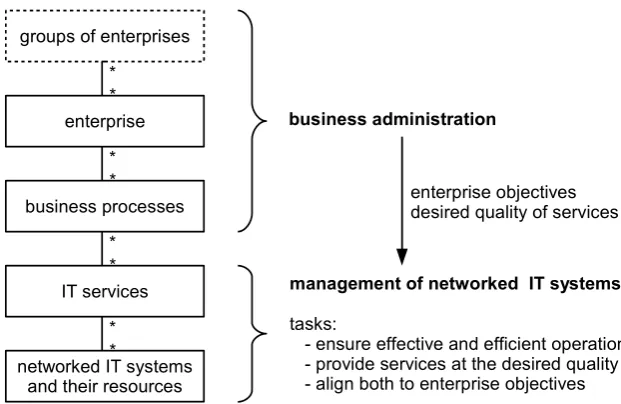
The management of networked IT systems in its broadest sense includes all tasks, that ensure an effective and efficient operation of systems and their resources, aligned to enter-prise objectives. It serves to provide services and applications of the networked systems at the desired quality and to ensure their availability.
Starting from this definition and adding business processes and cross-enterprise relationships, this def-inition can be transformed into Figure 1.1.
networked IT systems and their resources
IT services business processes
enterprise groups of enterprises
* *
* *
* *
* *
business administration
management of networked IT systems
tasks:
- ensure effective and efficient operation - provide services at the desired quality - align both to enterprise objectives
enterprise objectives desired quality of services
Figure 1.1: IT management and business administration, a layer model
The layers of resources and services are typically associated with IT management, while the layers on top are generally associated with business administration. This simple model of hierarchical manage-ment assumes that the managed entities depend on each other in n:m relationships.
managed system managing system
management instructions: management tasks and objectives reporting:
status information and alerts
Figure 1.2: Simple model for a basic management interaction
Basic management interaction A basic management interaction is shown in Figure 1.2. In
1.1 A simple model for IT management
Cascaded management interaction The basic management interaction shown in Figure 1.2 can
be cascaded to form multiple hierarchical management layers. A common combination of a technical managed system, a technical management system and a human manager system is shown in Figure 1.3.
managed system mgmt system
management instructions status information
and alerts
human manager
management instructions: management tasks and objectives reporting:
status information and alerts
“direct” instructions “direct” reporting
Figure 1.3: Common management hierarchy: A management system supports a human manager By delegating tasks to the management system, the management system supports or assists the human manager in certain tasks. Special attention should be paid to the “side-channels” of management, that can occur in management hierarchies: In certain circumstances the in-between management system is bypassed and the human manager directly interacts with the managed system.
Composed model All of the statements on management systems up to here apply for human to
human management, human to machine management as well as machine to machine management. Therefore the model of a cascaded management system can be combined with the layer hierarchy of dependent managed entities to form Figure 1.4.
resource mgmt system/
systems mgmt system resource manager/system admins networked IT systems
and their resources IT services business processes
enterprise
IT service
mgmt system process managersIT service business process
mgmt system business processmanager enterprise mgmt
system board of managers
business mgmt
IT management
1.2 Problems in current IT management automation
In this section, three problems are introduced: 1) the problem of rising complexity in IT management, 2) the problem of automation glue code written in an ad hoc manner, and 3) insufficient communication between systems management and systems development.
This thesis provides a partial solution to all three of them: 1) by proposing a method along which system administrators and system developers can map their respective knowledge to the other party’s level of abstraction, 2) by moving automation from the individual customer owning a set of resources to the resource vendor, and 3) reducing heterogeneity and scale by vendors offering resource bundles of managed systems and management systems, preconfigured for a certain application scenario.
1.2.1 Problem 1: IT management complexity as opponent of efficiency and effectivity
As it can be seen in the definition of IT management, ensuring effective and efficient operation is a major objective in IT management. This is partly contradictory to the other two objectives: providing services at the desired quality and to align IT management with enterprise objectives.
Both, a high desired quality of services as well as the alignment with (changes in) enterprise objectives increase management complexity. To these business-related causes, increasing scale and heterogeneity add technology-related causes of increasing IT management complexity. In turn, this increasing com-plexity of IT management is a major opponent of efficiency and effectivity mainly because most of this complexity is immediately perceived by people working in IT management.
In an intuitive approach to qualify complexity of IT management, the following statements reflect the essence of the author’s perception on the causes of the rising complexity in IT management, that are illustrated in Figure 1.5.
heterogeneity (#types of managed entities)
m
g
mt
c
om
pl
ex
ity
scale (#instances of managed entities
per type)
mg
mt
co
mp
le
xit
y
instability (#changes)
mg
mt
co
mp
le
xit
y
m
gm
t c
om
ple
xit
y
guaranteed availability (number of 9's and
max. downtime)
Figure 1.5: Influence factors on (IT) management complexity
1. IT management complexity grows considerably, when thenumber of changesgrows.
Several kinds of influences and changes can be identified in business, people and technology around IT management (see Figure 1.6). They all are potential reasons for change. Along this line of thought, IT management serves to align changes in information technology and changes in the business.
2. IT management complexity grows considerably, when a business more and more depends on IT operations and therefore the required level ofguaranteed quality of servicesincreases.
pro-1.2 Problems in current IT management automation
Changes in Business - changing markets
- changing partnerships with other businesses by mergers, acquisitions or strategic considerations - changing competitors, suppliers, service providers - changing customers and their requirements - changing management policies
Changes in People
- changing organizational structures - changing staff
Changes in Technology
Static IT resources
- changing availability of resources, e.g. servers, network nodes, network links due to faults or maintenance work
- changing risks and outside attacks - changing versions of IT resources - changing resource demands
- changing availability of power: power outages
- changing budgets
- changing offers and offered services - changing demand and supply and therefore changing prices of services and resources - changing government regulations on businesses (e.g. Sarbanes-Oxley-Act, BASEL II,
Teledienste-Gesetz, telco data retention)
- changing moods and cultures - changing skills and knowledge
Mobile IT resources
- changing network connectivity
- changing close objects to communicate with locally
- changing environment (location, ground, situation, light, sound)
- limited availability of reliable mobile power 11
1
Figure 1.6: Changes influencing IT management
cedures, risk analysis. In addition, we are facing the conflict of increasing IT dependency de-manding improved quality of IT services, while increasing awareness of IT controlling demands reduced expenditures. IT management will have to live with this fact and needs to prepare for even stronger requirements in the future.
3. IT management complexity grows considerably, when the heterogeneity of managed entities grows.
The more heterogeneous an IT landscape becomes, the more different aspects, procedures, com-mands an operator has to remember. When considering binary or higher relations between het-erogeneous resources (e.g. on compatibility) this number grows potentially over the number of types of managed entities.
4. IT management complexity grows slightly, when thescale/number of managed entitiesgrows. The more managed objects there are, the more time it will take to manage them all, as the number of potential changes and faults increases.
1.2.2 Problem 2: Ad hoc management and ad hoc automation
Ad hoc management A certain culture of ad hoc management has developed and still can be
witnessed in IT management, being a young discipline, and less “scientifically mature” than most engineering domains with less standardized education/training of staff. For a long time, proactive prediction of most likely next events did not take place, instead system administrators reactively took care of upcoming incidents and problems. There hardly existed established, documented processes in resource and service management and responsibilities were rarely assigned to roles, especially for cases of emergency.
Ad hoc automation Unfortunately, administrators have been getting little support from ment systems so far. Currently, their “toolbox” consists of a) general purpose integrated manage-ment systems, b) resource-specific managemanage-ment tools and c) scripting facilities typically with a set of command-line tools.
General purpose IT management systems by third parties are available, which promise a certain level of integration when managing heterogeneous IT infrastructures. These tools are typically designed in an open-loop fashion with a main focus on monitoring and visualizing the state of certain parts of an IT infrastructure, as well as offering basic control elements to send management instructions to the managed systems. In between, human operators analyze the monitored data, plan changes, and decide about their execution. In effect, the overall level of achievable management automation of these tools is generally low. In addition, general purpose management systems have limited abilities in allowing system administrators to manage all aspects of the heterogeneous infrastructure.
Resource-specific management tools typically well cover the set of manageable properties of a man-aged system. However, with the administrators having to learn about all those tools, they are rather applicable to special tasks instead of every-day use.
Resource-related IT management tasks like fixing faults in managed entities or performance tuning are usually carried out by a trial-and-error based progress of system administrators learning about the managed entities and then—still with a limited knowledge about the internal working of the managed resources—implementing an ad hoc “works, at least well enough, at least for this case, at least for me” style automation routine, usually in form of a script. These point solutions lack standardization, documentation, testing, in general terms: excellence in software engineering. Typically, scripts are written in interpreted languages in a text editor with very limited checking at development time by development tools.
This current practice can be compared to the goal of effective and efficient IT management demanded at the start of this chapter:
• Regarding effectivity, modeling the management task is done ad hoc as well, simulation hardly takes place, let alone verification. Testing is reduced to the minimum with a few typical test cases, but not exhaustively. As a result of such ad hoc automation, critical management actions being triggered automatically with a certain periodicity without any safety precautions impose a high risk to fail or even to influence parts of the infrastructure in an unexpected manner.
• Regarding efficiency, even though the set of managed resources is often similar to many other IT departments in the world, many custom scripts are written. This way of developing automation glue code lacks excellence in system development as well as leveraging an economy of scale. In-stead, point solutions are created which can a) considerably increase the heterogeneity of overall IT management and b) cause a negative attitude towards automation in general as the effects of ad hoc automation can be much worse than the effects of not automating a task at all.
1.2.3 Problem 3: Insufficient communication between systems management and systems design/development
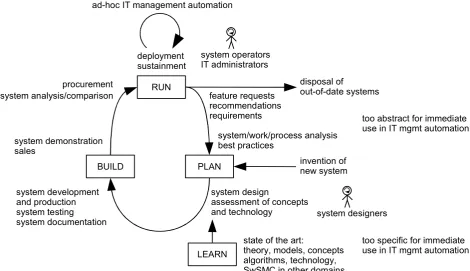
So far, system development and system management are not considered as parts of a common life-cycle of a managed resource, but as a matter of fact, all developed resources will be used in operations and all resources in operations must have been developed. Figure 1.7 shows the PLAN-BUILD-RUN cycle, that links system development and system management.
1.2 Problems in current IT management automation
RUN
PLAN BUILD
deployment sustainment
system analysis/comparison
disposal of out-of-date systems procurement
system development and production system testing system documentation
system design
assessment of concepts and technology
system demonstration sales
LEARN
state of the art:
theory, models, concepts algorithms, technology, SwSMC in other domains system/work/process analysis best practices
feature requests recommendations
requirements too abstract for immediate
use in IT mgmt automation
too specific for immediate use in IT mgmt automation invention of
new system ad-hoc IT management automation
system operators IT administrators
system designers
words system developers rarely run and manage the developed systems in every-day life and system operators typically do not develop the resources they run. The split view can be described in the following manner: in the same ways as system developers of managed resources have not well enough predicted the necessary management tasks and its associated effort and therefore cost, system operators have rarely given feedback to developers about the necessary management work. In general, system operators have hardly been involved into the redesign process. They were not asked to, and for various reasons they did not insist to be involved. Systems designers and operators hardly get in touch with each other. The overall interaction between these groups is mostly unclear, mainly because of their different focus.
The reason for this split focus lays in the domain-centric view that many researchers, education insti-tutes, and publishers apply. Design, build and test processes are typically regarded to be associated with systems/software development. Theory, models and formal methods are typically regarded to be domain-specific, e.g. with engineering domains, or mainly independent from applications such as artificial intelligence.
Today, requirements are regarded the typical information either given to designers by a particular cus-tomer, or as general requirements sensed by market research for commodity products. Requirements alone in turn do not solve the problem for the following reasons: 1) operators are rarely involved into the requirements specification for a new system, and 2) customers hardly know about the consequences of their requirements. 3) Systems designers can hardly anticipate, whether the set of requirements is up-to-date and complete, as well as the potential compromises a customer would make if some of the stated requirements were changed or left out.
1.3 Potential solutions to these problems
Enterprises can choose to tackle the problems mentioned before with improvements in a) people, b) processes and/or c) technology. Improvements in people, processes and technology each address dif-ferent contributors to complexity mentioned before.
Improvements in staff/people
Today’s IT resource and service infrastructures have grown beyond a state where human administrators can understand, memorize, and communicate all the details and management-related properties of the large number of heterogeneous resources and services in an IT landscape.
Upper management can improve operators’ education and knowledge of the managed systems by hiring qualified staff and specialists, finally getting better workers. Training can be established, improved and checked on a regular basis, to make sure, that operators are knowledgeable and have enough practical expertise. Self-management of operators can be improved, e.g. with courses on time management, knowledge management and team-work.
1.3 Potential solutions to these problems
copied/multiplied. While in-house education and collaboration among staff may work well, knowledge transfer between people is a slow process.
All in all, improvement in people will be necessary, but improvement in people alone does not appear to be sufficient to address all four factors that contribute to complexity and the problems stated above. Improvement in staff will not be a central topic of this work.
Improvements in processes
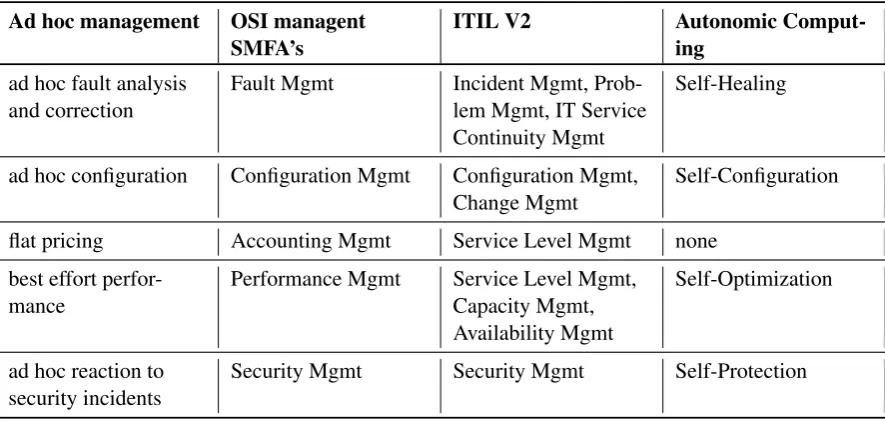
Only with increasing awareness of the criticality of IT infrastructures and proper IT management for a whole enterprise, attempts of process orientation have been made. There is much potential in defining, streamlining and continuously improving processes, defining performance metrics, measuring results, all of which had classically been a task of IT management controlling. Done the right way, the increased level of bureaucracy will have a positive impact on business agility and flexibility, not a negative one. In an effort to structure resource management tasks, the OSI management architecture defined a man-agement functions model which lists five systems manman-agement functional areas, commonly known as FCAPS. Process management frameworks such as ITIL and eTOM fight ad hoc management by defining IT service management processes that combine human actors (people) with tools for process and service management to manage the IT services of a service provider, which in turn are based on resources that need to be managed as well. Finally, CobiT proposes standard actions in IT controlling. See Table 1.1 for a rough comparison of ad hoc management, FCAPS and ITIL V2.
Table 1.1: Alignment of tasks in Ad hoc management, OSI FCAPS and ITIL V2 ad hoc management OSI managent SMFA’s ITIL V2
ad hoc fault analysis and cor-rection
Fault Mgmt Incident Mgmt, Problem
Mgmt, IT Service Continuity Mgmt
ad hoc configuration Configuration Mgmt Configuration Mgmt, Change Mgmt
flat pricing Accounting Mgmt Service Level Mgmt
best effort performance Performance Mgmt Service Level Mgmt, Capacity Mgmt, Availability Mgmt ad hoc reaction to security
inci-dents
Security Mgmt Security Mgmt
In addition to these frameworks, a shift in resource management from resources being managed by local administrators to a combination of local management by humans and machines, and remote man-agement by humans and machines, can be seen as well (outsourcing). This development can reduce the complexity perceived by the operator of the IT resources.
of people and management systems can increase overall costs. Improvement in processes will not be a central topic of this work, as well.
Improvements in management systems (technology)
Improvements in people and processes address mainly business-related types of change but do hardly address resource-related changes, as well as heterogeneity and scale of resources. In contrast, stan-dardization and automation in resources does not directly cover business-related aspects but deals well with change in technology, as well as heterogeneity and scale.
Automation shifts IT management tasks Looking back at Figure 1.4, it can be said, that
re-source management systems are relatively established, but many enterprises have only started to install and use management systems for the enterprise, business processes and IT services. While enterprise resource planning software is widely established, there are hardly links to IT management.
When estimating intensity of the communication relationships in this figure, most of the coordination and cooperation between business and IT management is done viahuman to humanmanagement and communication (right-most column in the figure). Done initially via voice, phone, mail, and e-mail, recently collaboration tools like workflow tools and groupware speed up and add structure to human to human communication.
There is also much communication frommachines to humanmanagers, mainly as result of monitoring systems. In fact, administrators’ mailboxes are often so full of mails sent automatically by machines, that it is hard to keep track which of them needs what kind of reaction. With the cautious attitude to “never touch a running system” actual management instructions in form of adjustments fromhumans to machinesare relatively rare.
Only a small part of the overall communication and coordination among managed entities is done in an automatedmachine to machinecommunication without human intervention.
Projected into Figure 1.4, automation in IT management would lead to two major shifts in the distribu-tion of tasks:
1. In each layer, a left to right shift: Many tasks will shift from management interaction between a human manager and a managed entity or a human manager and a management system to manage-ment interaction between a managemanage-ment system and the managed entity with little intervention of human managers. (see Figure 1.8)
2. Across layers, many tasks will shift from the top to the bottom layer. In the end, the majority of tasks in IT management incorporate the configuration of the actual resources. So, everything that can be done at the resource management layer should be done there with minimal intervention of the other layers.
When these two directions are combined, they show a trend towards better resources and resource management systems as the main contributors in IT management automation. However, automation in IT management will need to be prepared by a) identifying suitable tasks for automation and b) reducing heterogeneity to increase the number of resources of the same type.
1.3 Potential solutions to these problems
Enabling automation by reducing heterogeneity To improve the applicability of automation,
relatively uniform environments are favorable, which can be achieved for example by standardization efforts and procurement policies. System vendors have the task to reduce heterogeneity with modeling and standardization, both of which being a key issue in coping with complexity. Once modeling, abstraction and standardization tackle the issue of heterogeneity, i.e. reduce the number of types of managed entities, automation can tackle the growing scale of management entities and management interactions, e.g. with scalability as major requirement in systems design.
Progressive transition to systems with management atuomation routines Operators can
be given assistant systems (management systems), that they can delegate tasks or parts of tasks to, in order to free them from repetitive tasks and to increase accessibility of information. Self-management capabilities or remote-management can be programmed into devices and software, so operators no longer have to deal with the problems as the systems are programmed to take care of problems based on policies.
system with self-mgmt capabilities mgmt system human manager
mgmt system
sensors effectors
A set of mgmt tasks is closer associated with the managed system.
Figure 1.8: In systems with self-management capabilities certain tasks move from an external mgmt system to a mgmt system tied with the resource
To put the delegation of tasks from human managers to management systems into practice, the follow-ing improvements in management systems are necessary:
1. Increasing the depth of automation, i.o.w. the level of autonomy of the management system. Today, management systems are widely used mainly for monitoring of managed entities and execution of management commands. Analysis, planning and decisions are mostly associated with human managers, future mgmt systems will need to support managers here and – depending on the circumstances – take over analysis, planning and decision making, thus forming a closed feedback loop.
2. Improved management systems must give human managers less reason for direct interaction with the managed entities, bypassing the management system. They should handle direct management correctly though, as well as concurrent interaction with multiple human managers.
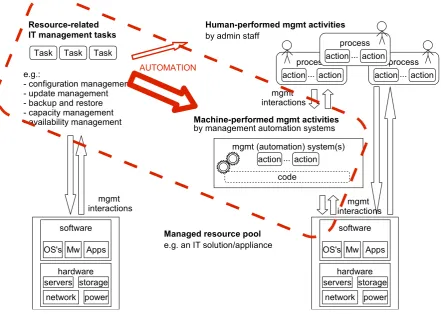
This list of features becomes realistic when tying all the resource-related management tasks more closely with the resource. This way, a part of former tasks of the management system moves into the managed system, forming amanagement automation systems, see Figure 1.8.
While administrators already use a wide spectrum of management tools, the focus has always been on raising the level of abstraction. In other words: future IT management will be more diverse and spread all over the IT landscape from devices with self-management capabilities to management systems with various functions at the different levels.
1.4 Problem statement
For upcoming systems with self-management capabilities among other issues two major remaining problems can be identified: a) to be designed efficiently and effectively by using available knowledge by theoreticians and systems designers and b) to be accepted and trusted by system operators. Both of these problems can be traced to insufficient communication between operators and designers, as well as lack of structure and content of documentation, once at design time, once at operation time. Ideally, system developers and system operators together would predict frequent management tasks at design time and associate automated management routines with the managed system. This way, developers would learn about management tasks and operators would learn about the implementation.
Instead, system managers and system developers have a different focus in current practice and as a result there is limited communication between these groups. Current knowledge with theoreticians includes methods from artificial intelligence, graph and control theory in text books, knowledge of software engineers like design patterns, both of which system operators cannot align to their daily work, to apply them to automate their routine tasks. The other way around, theoreticians and soft-ware engineers find it difficult to understand the current practice in IT management to find the right spots where existing or new algorithms may fit. We would therefore profit from additional layers of abstraction that associate implementation methods (designer view) with management tasks (operator view).
The problem can be stated like this:
How can IT management tasks be mapped to an implementation where human op-erators are supported by machine managers which are closely associated with the managed resources? (direction from IT management tasks to implementation in terms of systems with self-management capabilities)
A kind of reverse question is: Once new algorithms and methods come up or are used successfully in other domains, how can they be leveraged in the automation of IT management? (direction from implementation to applicable use in IT management au-tomation)
To address this problem, we need a method, which is generic enough to cover many use cases, but specific enough to give actual value in a certain application scenario.
1.5 Current related work
1.5 Current related work
introduced on a case-by-case basis without any visible method. They are accompanied by protocols that support operators in certain network management tasks: routing and spanning tree protocols to route around failed network components, DHCP for dynamic address configuration, and “plug and play” technologies taking care of low-level tasks, like hardware compatibility and configuration. In addition to these technical developments, there is a trend towards standardization of organizational aspects like IT management processes, with ISO 20000, ITIL and eTOM being prominent examples. In compliance with these standards, there are efforts to certify staff and organizations independent from a specific vendor or platform. With respect to the problem statement, with ITIL V3 there is a certain trend to link service management and service development, but the implementation in practice and resources remains unclear. eTOM with the NGOSS specification in turn applies well to telecom industry but does not cover most other IT management tasks.
System engineering tells us, that fixing flaws in a system in the operational phase is e.g. a thousand times more costly than fixing/taking care of things in the design phase. In a back-of-an-envelope style estimation, a 10% improvement in management will therefore lead to a reduction from 1000 to 900 units of effort. Instead when we spend the same effort of 100 in system development, then every fixed error/automated routine will give us a return of 1000. This way, 100 saved effort units (improving systems management) is opposing a potential saving of 100.000 effort units (when improving systems development). This rough calculation makes it more than plausible, that an approach in systems man-agement alone will hardly bring the same return as a combined investigation of systems development and management. In essence: An approach that combines improvements in systems management and systems development looks by far more promising than an approach for improvements in IT manage-ment alone.
Engineering domains have experienced similar problems decades ago and come up with systems to assist, support or take over management tasks carried out by human operators. To name a few examples, autopilots and fly-by-wire systems have been introduced into aircrafts, driver assistance systems into cars, industrial robots into factory buildings. In space and aeronautics, where remote control faces serious limitations, unmanned systems have achieved a high level of automatic local control. The typical results are control systems in many different artifacts like planes, cars, rockets, robots, military systems, industrial machines, power plants, building technology. So far, IT systems have only been in their scope as far as they have been associated with the mentioned artifacts.
These demanding results need demanding development processes. Because of the often high risks and high costs of the final artifacts, engineering domains have been forced by principals to high stan-dards in system development. Judging from the artifacts like the Mars robot, the Airbus A380, modern fighter jets, or autonomously acting vehicles, communication between designers and operators must have worked in engineering! Indeed, remarkable knowledge has been gathered in the design, testing and operation of SwSMC. Across the individual engineering disciplines, system engineering, systems analysis and systems design have been established, as in the different engineering domains the same issues came up again and again. In addition to domain-specific theory (e.g. in mechanical and elec-trical engineering), modeling systems in Computer Aided Design (CAD) tools and doing simulations are common-place in these domains. This way, SwSMC in engineering can be associated with math-ematical foundations, formal methods and - in advanced systems - algorithms that are associated with artificial intelligence to implement analysis and planning.
managed system mgmt system/ control system
mgmt instructions human manager
reporting: status information and alerts
System with self-management capabilities
air plane elements (rudders, engine, brakes)
flight ctrl system pilot
data center elements (network, storage, servers)
IT mgmt system IT administrator
Figure 1.9: Systems with self-management capabilities are managed systems that are tightly connected to management systems. Example systems can be found in typical artifacts from engineer-ing domains. By learnengineer-ing from these domains we can transfer knowledge to the design of IT systems with self-management capabilities.
of knowledge transfer (see Figure 1.9) can be anticipated. To automate a certain IT management task, we can refer to the implementation methods associated with the respective engineering sub-domain. To approach solutions to the problem stated above, modeling, simulation and visualization are key to predict and virtually test automatic routines for periodic management tasks. They would be an ideal environment for system developers and system operators to jointly develop a new system that incorporates automated management routines. While there are a few simulation tools, they cover either resources or processes/workflows. Not one could be found, that allows to graphically link changes in a model of managed resources with advancements in a certain process/workflow. Typical theoretical and generic simulation frameworks on the basis of discrete event simulation, petri networks are far to abstract to be of practical use.
All in all, with few exceptions, advanced self-management capabilities (SMC) are a vision for most IT systems, not current reality.
1.6 Idea: Engineered IT Management Automation (EIMA)
This thesis coins the term of “Engineered IT Management Automation” (abbreviated as EIMA) which is intended to be understood as a scientific way to automate routine management tasks in contrast to the term of “ad hoc IT management automation”.
Unlike existing process frameworks, it is not independent from technology by design, but instead aims to link resource-associated management tasks with a potential implementation which is mainly driven by technology with a minimal intervention of human operators.
1.7 Approach
abstraction in management interactions. In contrast to ad hoc automation, these automation efforts typically happen at the vendor/producer side of managed systems not at the operator side or being done by third parties.
This work addresses both systems management and systems development. It aims at finding a way how these two groups can find a better level of abstraction to communicate about systems, which is a necessary prerequisite for better IT management automation. The central idea is to take over concepts from systems engineering and process control automation which have successfully applied automation in artifacts like industrial plants, aircraft and space vehicles, and cars, to name just a few.
Based on these domains, we can enable cooperation of systems management and systems development along a common level of abstraction in terms of well-engineered automation patterns. The concept of abstract patterns can improve communication, as operators as well as developers can understand them and map them into their particular view: Operators can associate a pattern with a certain behavior and derive instructions about what an operator still has to/is allowed to take care of, while designers may have a tool-kit to map patterns to solutions/methods to enable the intended behavior. Patterns also ease the process of system managers giving input to system developers/designers. In the same way, systems designers can associate certain automated management tasks to certain functional units in a system.
1.7 Approach
Re-stating the problem of this thesis, a mapping of resource-related IT management tasks to an im-plementation in terms of automated management routines needs to be found. A major obstacle in cross-domain knowledge transfer is that the descriptions of engineering artifacts are typically targeted at domain experts. Aspects that would be applicable in other domains are often hidden between loads of domain-specific information. Instead, the system function needs to be abstracted while focusing on the system’s internal and external management. Therefore, for the automation approach itself, we can refer to results from systems engineering.
Reviewing related work in systems engineering—Sheridan, Humans and Automation [She02] with the author having a background in aviation and space applications—suggests the steps task analysis, breaking down tasks to functions, then function allocation to either humans or machines or collabora-tion of both. In task analysis he proposes to use the stepsacquire, analyze, decide, implement. This proven method for existing automation scenarios in Engineering has been adopted to be applied to IT management automation.
The following four concepts are a combination of automation concepts described in [She02] (1. and 3.) and own work (2. and 4.). The method of Engineered IT Management Automation argues to model, design, and describe SwSMC along the patterns of:
1. Task analysisis applied to break down these tasks to individual steps and to find relationships among them in terms of control/management layers. The known concept of IT management processes is replaced by IT management tasks to match Sheridan’s model.
Ch 1: Motivation and Problem Statement
Ch 2: Approach
Ch 7: Proof of Concept: Applying engineered automation to
a real-world problem
Ch 8: Conclusion and future work
Automation in Systems Engineering Current Automation
in IT mgmt
Engineered Automation in IT mgmt
Ch 3: Task Analysis
Ch 4: Loops
Ch 5: Function Allocation
Ch 6: Machine Cap's
descriptive
descriptive prescriptive
The need for automation in IT management (=self-management) is obvious. This automation creates systems with self-management capabilities: systems with built-in or closely attached management systems specific to a
certain set of resources. Current automation in IT management is often done ad hoc by system operators lacking
excellence in architecture, documentation, knowledge reuse, testing. In the same way, system designers only rarely predict the impact on IT operations, which can lead to limited acceptance. This split view has many negative effects.
How to improve IT mgmt automation?
Idea: Make use of knowledge from systems engineering! They have created good artifacts based on
good methods. Using their methods may bring improvements to our application domain. Support the IT management automation process with a method adapted from SE to IT management automation.
Goal: “engineered” automation in IT mgmt along task analysis, loops, function allocation, machine cap's.
Real-world problem scenario from a large WAN provider
Automation potential in End-to-end links with Quality of Service for a WAN
Future work: support this method with tools, support/automate the automation process pool/catalog of methods for common functions, incl. analysis and planning
summarize method scenario description tasks, loops, roles and task allocation, machine capabilities
(models, simulation) Task analysis Task model Task samples
Common base loop loops are similar reduce to superset: MAPDEK
loop properties high-level: PDCA (ITIL)
low-level: MAPEK (ACI) but no link between them
We have done it like this until now with deficits ...
They have done it like
that and used the aspects We should do it better like this ...
Levels of Abstraction Common base loop Loop model Loop samples
focus on monitoring and execution, limited analysis and planning, easy access to sensors and effectors
roles: ITIL (mostly focus on human roles), we need to deal with machine roles, limited allocation
mostly machine roles, limited focus on operator,
good work on allocation adjustable autonomy
automation manager,
levels of automation, move automation decisions to operator “manageable automation” collaboration of system designers and operators trigger an automation process for new mgmt tasks
apply task analysis from SE
Manageable task allocation Levels of automation Task allocation model Task allocation samples
clos e to m in ds et of s yste m d esi g n er cl os e to m ind se t o f sy ste m o p erato r
Functions in MAPDEK Catalog of machine capabilities
Ch 3-6 describe a general automation approach: For each of these steps, structure existing knowledge, add own observations. And describe patterns to make adoption of the method easier, because a sys designer can later choose from alternative ways in most concerns of automation
Describe effects on affected human roles (system operators and system designers).
Ch7: Use of the results: (top-down and bottom-up, for system analysis and design). Related work and benefits of my work to SOTA: Automation method that is adapted to IT management, integration of knowledge from system operations and design.
1) ad hoc automation 2) process frameworks (ITIL, eTOM), BPEL/BPMN 3) self-mgmt, but hardly targeted at good automation Sheridan 2002 bri dgi ng co n cep ts machine-interpretable design knowledge, hints on use of methods many loops, some contain
a “decide” step
1.8 Vision: A tool-set for the engineering of IT management automation
3. Then, Sheridan’s proposal is followed toallocate task steps/functions to humans/machines. Additionally, levels of automation summarize findings on function allocation in IT management automation.
4. Finally, individualmachine steps are associated with algorithms/methodsto implement them. For each of the concepts in Chapter 3 to 6, requirements are named and a review of existing contri-butions in Systems Engineering (yellow column) as well as current IT management automation (red column) is performed. The author then combines the existing knowledge and adds own concepts to form the respective step in EIMA (green column). While the work is presented in a top-down manner from IT management tasks to implementation, the resulting structure of knowledge can also be used in the opposite direction to find applicable spots for new methods in IT management automation. The four steps represent information at a level of abstraction that educated system operators and system developers can make use of, understand and memorize. They have been carefully chosen to combine features of behavior (mainly relevant to operators to assess their remaining influence) and architecture (mainly relevant to developers to assess implementation).
In Chapter 7, the EIMA method is then summarized and applied to a real-world scenario in a proof-of-concept style.
The thesis closes with a Chapter 8 on a conclusion of the results and a list of potential follow-up work. This work concentrates on IT management automation at the technology level, even though new tech-nology may influence processes and the work of people. Model-based automation routines closely associated with a resource are a promising idea to reduce the visible level of complexity, if these sys-tems with self-management capabilities leave just the right level of control to human operators and work as intended by their designers at least as reliable, effective and efficient as the (human) activities they support or replace. Better model-based tools which automate more and more steps, that had been carried out manually before, make CEOs want leaner IT departments with fewer people, on the other hand. Social consequences are however out of the scope of this work.
The following sections appear in sequential order along the top-down view of the approach, illustrated in Figure 1.10. A more detailed description of the approach can be found in Chapter 2.
1.8 Vision: A tool-set for the engineering of IT management automation
In IT management automation, the basic overall scenario is to specify, design, and build a SwSMC from scratch or to add SMC to an existing legacy system. As argued before, it is beneficial to start IT management automation during the design phase of systems. In a similar situation, CAD/CAM soft-ware has been the basis for enormous progress in engineering, enabled by computer support. Modern systems like Autodesk Inventor add basic simulation of the mechanical movement of parts. In a similar but less commonly used manner than CAD tools, CASE tools provide an aid in software engineer-ing. The vision therefore is to have a similar development framework for IT management automation solutions.
This integrated development platform—a sketch of a potential user interface is shown in Figure1.11— would allow to:
• model and design SwSMC
1.8 Vision: A tool-set for the engineering of IT management automation
– construct IT systems with management capabilities from functional components, self-management components, and human-ecxecuted actions.
– associate resource-related IT management tasks with different ways of implementation along multiple levels of abstraction.
• allow systems analysis
– forecast of system properties (e.g. total cost of ownership, availability, cooperation of system components, management activities)
– comparison of models/design alternatives
– computer-aided task analysis and function allocation
• simulate the behavior and visualize the steps of the executed actions of collaboration between machine and human managers.
• iteratively improve the design of the system and the related human management processes. It is important that the system and its associated human management tasks are constructed concur-rently.


![Figure 3.3: This illustration on the “Autonomic Computing reference architecture” (see [IBM06])�����������������������������������������������shows ACI’s understanding of task control hierarchy and task decomposition.](https://thumb-us.123doks.com/thumbv2/123dok_us/8133669.1355578/77.595.68.516.207.548/illustration-autonomic-computing-reference-architecture-understanding-hierarchy-decomposition.webp)
