Article
A real-time BOD estimation method in wastewater
treatment process based on an optimized extreme
learning machine
Ping Yu 1,2,3,4, Jie Cao 1,3,4, Veeriah Jegatheesan 2,* and Xianjun Du 1,2
1 College of Electrical and Information Engineering, Lanzhou University of Technology, Lanzhou 730050, China; [email protected] (P.Y.); [email protected] (J.C.); [email protected] (X.D.)
2 School of Engineering, RMIT University, Melbourne 3000, Australia; [email protected] (V.J.) 3 Key Laboratory of Gansu Advanced Control for Industrial Processes, Lanzhou University of Technology,
Lanzhou 730050, China
4 National Demonstration Center for Experimental Electrical and Control Engineering Education, Lanzhou University of Technology, Lanzhou 730050, China
* Correspondence: [email protected]; Tel.: +61-3-9925-0810
Abstract: It is difficult to capture the real-time online measurement data for biochemical oxygen demand (BOD) in wastewater treatment processes. An optimized extreme learning machine (ELM) based on an improved cuckoo search algorithm (ICS) is proposed in this paper for the design of soft BOD measurement model. In ICS-ELM, the input weights matrices of the extreme learning machine (ELM) and the threshold of the hidden layer are encoded as the cuckoo's nest locations. The best input weights matrices and threshold are obtained by using the strong global search ability of improved cuckoo search (ICS) algorithm. The optimal results can be used to improve the precision of forecasting based on less number of neurons of the hidden layer in ELM. Simulation results show that the soft sensor model has good real-time performance, high prediction accuracy and stronger generalization performance for BOD measurement of the effluent quality compared to other modeling methods such as back propagation (BP) network in most cases.
Keywords: Biochemical oxygen demand (BOD); Cuckoo search algorithm (CSA); Extreme learning machine (ELM); Soft sensor; Wastewater treatment process
1. Introduction
The awareness of environmental protection in the society has been gradually improving due to better education on sustainability, and wastewater treatment has become one of the important research topics in the field of environmental protection. Biochemical oxygen demand (BOD) is one of the major parameters of effluent quality indices of wastewater treatment processes. Real-time and accurate monitoring of BOD is the key factor to improve the automatic control of the performance of wastewater treatment processes. However, due to the strong nonlinear and time-varying characteristics of wastewater treatment processes as well as the capacity of current detection methods [1] and measurement accuracies of the sensors and instruments, it is difficult to achieve accurate real-time and on-line measurement of BOD data; this limits the application of closed-loop control in wastewater treatment processes [2]. Hence, there is a great need on how to measure BOD rapidly and accurately to control the wastewater treatment processes.
Recently, the development of soft sensing technology provides a new way of measuring variables which are not measurable on-line in real-time. Especially, researchers have applied soft sensing technology to model the wastewater treatment processes and have achieved good results. Zhang et al [3] considered the inflow(Q) as well as the chemical oxygen demand (COD) , pH, the suspended solids (SS) and the total nitrogen (TN) of the influent as the auxiliary variables to model a feed-forward three-layer multiple inputs and single output (MISO) neural network, called adaptive growing and pruning (AGP) network. The parameters of the neural network were trained by back
propagation (BP) algorithm. This soft sensor model was used to predict the BOD concentration of effluent in their simulation study. Simple learning algorithm has the greatest advantage as it can speed up the measurement, but unfortunately the prediction accuracy is not sufficient for it to be applied in real-time. Qiao et al [4] proposed a soft sensor method for the measurement of BOD based on a self-organizing neural network with random weights (SNNRW). It used the output weight vector to calculate the sensitivity of the hidden layer nodes to the residual. Based on the sensitivity analysis, it could remove less sensitive nodes of the hidden layer by itself according to the level of the sensitivity. It can achieve higher prediction accuracy while performing much more complex calculations. Liu [5] proposed an online soft BOD measurement method based on an echo sound network (ESN) algorithm. The weights of the ESN are trained and obtained by online learning method. The range of learning rate of ESN network is analyzed and determined by Lyapunov theory, which ensured the convergence of the algorithm. This algorithm improved the accuracy of prediction and the adaptability of the model, but with high computation load.
The ELM is a new feed-forward neural network learning algorithm which was originally proposed by Professor Huang Guangbin of Nanyang Technological University [6]. It has the advantages of simple training process, higher training speed and strong anti-interference ability [7]. The training time is greatly reduced compared to other networks, as ELM only needs to set the number of hidden layer nodes, and the randomly generated input weights and hidden layer thresholds are no longer adjusted in the training process. Through experiments, Han et al [8] demonstrated that ELM has higher training speed and better generalization ability than BP neural network and support vector machine (SVM). Therefore, soft sensor technology based on ELM learning algorithm has been widely applied in industrial process measurement [9,10].
Compared to BP neural network learning algorithm, ELM can avoid issues such as easy to get local optimum solution [11], poor performance indices and low learning rate. However, ELM algorithm itself has some shortcomings, such as the random selection of the input weights and hidden layer threshold which in general would lead to a poor stability of the network. In order to improve the prediction accuracy of the algorithm, it is necessary to increase the number of the hidden layer nodes [6], and the increase will inevitably reduce the computing speed of the ELM learning algorithm. Thus, the application of ELM has to overcome this contradicting pair of operational needs. Researchers have studied and improved the above problems of ELM in recent years. Zhu et al [12] introduced differential evolution (DE) algorithm into ELM to obtain the optimal connecting weights between the input layer and hidden layer, and the optimal threshold of hidden layer. These optimal parameters can improve the stability of the network. Yan et al [13] proposed a regularized extreme learning machine (algorithm) based on discriminative information (called IELM), which can significantly improve the classification performance and generalization ability of ELM. Kassani et al [14] proposed an incremental method for sparsifying the ELM using a newly devised indicator driven by the condition number in the ELM design matrix, called sparse pseudoinverse incremental-ELM (SPI-ELM), which exhibits better generalization performance and lower run-time complexity compared to ELM. Although they improved the computational speed, training accuracy and generalization performance of ELM algorithm, the least squares-based ELM algorithm still has the problem of randomness of the parameters, which will affect the stability of the network.
Based on the above evaluation of algorithms that exist, a BOD soft sensor based on an improved extreme learning machine is proposed in this paper. Adverse effects of randomness of extreme learning parameters on prediction results and stability of the network are considered while proposing such soft sensor. The parameters of ELM are coded as the cuckoo nest locations, with the corresponding fitness values of the root mean square error (RMSE) between the actual value and the prediction value, to obtain the optimal parameters of the ELM by using an improved cuckoo search (ICS) algorithm [15]. Fuzzy rough monotone dependence (FRMD) algorithm proposed by Liang et al [16] to reduce the dimensionality of the data from the BSM1 simulation model [17,18] is used in Matlab simulation. The reduction data is used as the input of the soft sensor and effluent BOD is used as the output of it.
2.1 Extreme learning machine (ELM)
For N arbitrarily distinct samples of data ( , ) n m i i
x t R R , where
1, 2, ,
T n i = xi xi xin
x R ,
1, 2, ,
T m i= t ti i tim
t R , and an infinitely differentiable activation function of any finite interval,
:
g R→R, standard single hidden layer feed-forward networks (SLFNs) with L hidden nodes are mathematically modeled as
1
( ) ( ) , 1, 2, ,
L
j i j i i j i
y g b j N
=
=
+ = =x x w o (1)
where wi =
w wi1, i2, ,win
T is the connecting weight matrices of the ith hidden node and the inputnodes;
i=
i1, i2, ,
in
Tis the connecting weight matrices of the ith hidden node and the outputnodes; and bi is the threshold of the ith hidden node. xjwiis the inner product of xj andwi. The
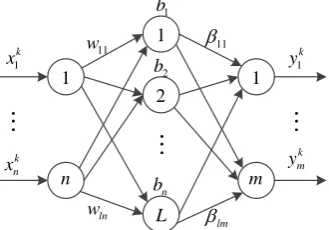
network topology with linear output nodes is shown in Figure 1.
lm 1 k y 11 k m y 2 b n b ln w 11 w 1 k x k n x 1 m L 1 2 1 n 1 b
Figure 1. Network topology of a standard single hidden layer feed-forward network (SLFN)
Using the initialized random assignment weights wiRn and the thresholds biR , the
standard SLFNs can approximate these N samples with zero error means that 1 0 N j j j= − =
o t , i.e., there exist βi, wiand bi , such that1
( ) ( ) , 1, 2, ,
L
j i j i i j i
h g b j N
=
=
+ = =x x w t (2) Compact form of Equation (2) can be expressed in matrices as follows:
=H T (3) where,
( )
( )
1 1 1 1
1 1
1 ( ) ( )
( ) ( )
L L
N N L L
N L N
g b g b
g b
h
h g b
+ + = + + x H x
x w x w
x w x w
= (4)
T 1
T 2
T
L L m
= (5)
and T 1 T 2 T
N N m
t t T t
= (6)
If the activation function g is infinitely differentiable and the nodes with parameters of hidden layers can be randomly generated, then there is [6]
Theorem 1. Given an small positive value (>0), an activation function g: R→R which is infinitely differentiable in any interval and, N arbitrary distinct samples( , )x ti i RnRm, there exists LN for any parameters of the network{( , )} 1
L i bi i=
w , according to any continuous probability distribution, then with probability one, HN L
L m −TN m
.From the point of view of interpolation, the largest number of hidden layer nodes L should be less than the number of training samples N. In fact, when L is equal to N, the training error will be zero. According to Theorem 1, when L is less than N, SLFNs will approach the training samples with very little training error, and the matrix H is a non-square matrix, there existswˆ , ,i bˆ ˆi
, so that equation (7) can be established.1 1 1 1
, ,
ˆ ˆ ˆ
ˆ ˆ
( , , , , ) min ( , , , , , )
i i
L L L L
b
b b b b
− = −
w
H w w T H w w T (7)
Unlike the traditional function approximation theories, the input weights wi and the hidden
layer biases bi are in fact not necessarily tuned and the hidden layer output matrix H can actually
remain unchanged once random values have been assigned to these parameters in the beginning of learning, and this makes Equation (7) is considerate as a linear system. The training for SLFNs is simply equivalent to finding the least squares solution
ˆ of the linear equations H = T, that is1 1 ˆ 1 1
( , , L, ,b bL) min ( , , L, ,b ,bL)
− = −
H w w T H w w T (8)
The smallest norm least squares solution of the weights of the above linear system is unique, which is
ˆ
= +H T (9) where H+ is the Moore-Penrose generalized inverse of the matrix H [20,21].
Thus, the main steps of ELM's learning algorithm can be summarized as follows:
With the given training set( , )x ti i RnRm, i=1,…,N, the activation function g(x)and the number of the hidden nodes L,
Step1: Assign input weight, wi and bias of hidden layer, bi, randomly (where i=1,…,L);
Step2: Calculate the hidden layer output matrix, H; Step3: Calculate the output weight,
ˆ.2.2 Improved cuckoo search algorithm-based ELM (ICS-ELM) 2.2.1 Improved cuckoo search (ICS) algorithm
Cuckoo search (CS) algorithm is approved as an efficient optimization method [22,23]. The principle of CS algorithm is how a cuckoo can find an optimal nest to hatch the eggs by free search based on the obligate brood parasitism and Lévy flights mechanism which is unique in nature. An important advantage of this algorithm is its simplicity. In fact, comparing with other population- or agent-based metaheuristic algorithms such as particle swarm optimization (PSO) and harmony search, there is essentially only a single parameter pa, which represents the probability to be found by the host, in CS (apart from the population size n). Therefore, it is very easy to implement.
,max ,min 2
( ) cos
a a a
p t p t p
T
= +
(10)
min
1 max
exp
p i
m t
S k S
bestX− t
= − +
(11) Where, in equation (10), T is the cycle of the periodic operator; t is the evolution generation of the current iteration; pa,max and pa,min are the dynamic control parameters of pa which are equal to 0.75 and 0.1 respectively. In equation (11), m(0,1)is a regulatory factor; bestXi-1 is the optimal nest position of the last generation groups; k[0,1]is the limiting factor; t and tmax are the current iteration number and the maximum iteration number; Smin is the minimum search step; p is an integer from 1 to 30.
Based on the above analysis and improvements, the improved cuckoo search (ICS) algorithm steps can be described as follows:
Step1: Set the objective function and initialization function; generate initial population of n host nests xi (i = 1, 2, ..., n); set the size of population, the dimension of independent variables, the
maximum iteration number, the maximum and minimum probability of being detected. Step2: Calculate the current optimal nest position by putting xi into the objective function.
Step3: Record the location of the nest, and use equation (11) to calculate the current step size S, then use equation (12) to update the location of the nest.
1
, 1, 2, ,
t t i i
x+ =x + S i= n (12) where, the product of is a kind of calculation means entrywise multiplications; α>0 is a step size control factor.
Step4: Compare the current value of the objective function with the last value; Update the value if the function value is better than the previous one; otherwise, keep it unchanged.
Step5: After updating the nest location, choose a random number
[0,1], which obeys auniform distribution; if ε > pa, randomly change the value of xit+1; otherwise leave as it is. Keep the optimal nest position at last.
Step6: Return to Step2 if the iteration number has not reached the maximum iteration number; otherwise, continue to the next step.
Step7: Output the optimal nest location.
You can find more details of the ICS algorithm in Du et al [15].
2.2.2 ICS-based ELM
When the structure of ELM has been fixed, the network needs to be trained offline first before using the soft sensor online. To improve the prediction accuracy, the input weights wi and the hidden
layer biases bi should be optimized through the training process by ICS algorithm.
The root mean square error (RMSE) of the actual value and the predicted value is taken as the fitness value of the nest of each group, shows in equation (13).
( )
(
)
train
2 2 1 1
train
|| ||
N m
i i j i j
j i
i
g b
f
mN
= =
+ −
=
w x t
(13)
Where, Ntrain is the number of training samples; m is the number of the hidden nodes; f is the fitness function.
2.3 Experimental data processing
2.3.1 Acquisition of experimental data from BSM1
was used as the simulation input for the experimental process. The data represented four conditions namely steady state as well as dry, rainy and stormy weathers. The plant consists of 5 bioreactors and a ten-layer secondary settler which is shown in Figure 2.
Wastewater
Anoxic zone Aerated zone Internal recycle
External recycle Wastage To river Unit 1 Unit 2 Unit 3 Unit 4 Unit 5
Biological reactors Secondary settler
Figure 2. Schematic representation of the benchmark simulation model No.1 (BSM1)
The initial conditions of the operating parameters of the main executor in BSM1 are set as follows:
Table 1. Parameters of BSM1
Parameters Values Units Descriptions
KLa3, KLa4 240 mg/day Oxygen transfer coefficient of the 3rd and 4th bioreactors KLa5 83 mg/day Oxygen transfer coefficient of the 5th bioreactor
Qint 55338 m3/day Internal recirculation flow rate Qr 18446 m3/day Returned sludge flow rate Qw 385 m3/day Waste sludge flow rate Steps to obtain the experimental data:
Step1: Run a 100-day steady state simulation and repeat until the system achieves steady stability;
Step2: Run a 14-day simulation with the input data representing dry weather conditions and repeat until the system achieves dynamic stability;
Step3: Simulate BSM1 to obtain experimental data using the influent data mentioned above. The 2-week data (1344 groups in total with a sampling time of 15 minutes, 4 groups 24 hours 14 days = 1344 groups ), of the wastewater treatment process was finally obtained. The compositions of wastewater are shown in Table 2.
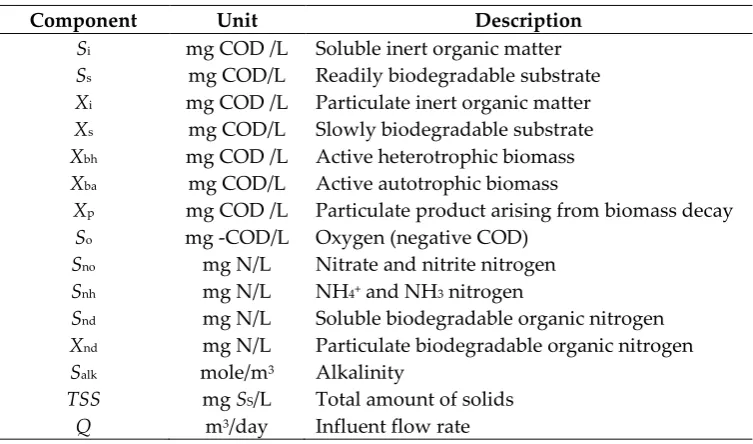
Table 2. Components of wastewater
Component Unit Description
Si mg COD /L Soluble inert organic matter Ss mg COD/L Readily biodegradable substrate Xi mg COD /L Particulate inert organic matter Xs mg COD/L Slowly biodegradable substrate Xbh mg COD /L Active heterotrophic biomass Xba mg COD/L Active autotrophic biomass
Xp mg COD /L Particulate product arising from biomass decay So mg -COD/L Oxygen (negative COD)
Sno mg N/L Nitrate and nitrite nitrogen Snh mg N/L NH4+ and NH3 nitrogen
Snd mg N/L Soluble biodegradable organic nitrogen Xnd mg N/L Particulate biodegradable organic nitrogen Salk mole/m3 Alkalinity
TSS mg SS/L Total amount of solids Q m3/day Influent flow rate
Obviously, the reaction mechanisms of activated sludge process is very complex, and the process parameters involved are numerous, and therefore the dimension of the obtained wastewater data is too high. This will not only lead to the occurrence of over fitting, but also cause the dimension disaster. In order to avoid these problems and not to affect the accuracy of model prediction, it is necessary to find out the parameters which have great influence on the BOD of the effluent. Therefore, the fuzzy rough monotone dependence (FRMD) [16,24] algorithm is used for processing the data to reduce the attribute.
It can be shown that there is a monotonic dependence between conditional attributes and decision attributes. Based on the FRMD algorithm, the steps of attribute reduction for wastewater data are as follows:
Step1: Define and initialize a two-dimensional array D[n,m] for the decision table, where the mth column is the decision attribute (that is, the data of effluent water quality), and 1st to the (m-1)th columns are the conditional attributes (that is, the data of the wastewater influent);
Step2: Arrange the decision attribute values in ascending order, and exchange the rows of the conditional attributes corresponding to the ordered decision attribute;
Step3: Make a circular study of the fuzzy rough monotone dependence relation between each condition attribute value and decision attribute value; Obtain the membership function values;
Step4: If the membership degree function in the set is monotonically increasing, output is the maximum value of them; otherwise, output is 0.
After the attribute reduction, if the membership degree is 0, the conditional attribute will be discarded. The remaining conditional attributes are considered as influential to the BOD, and will be used as the input of the soft sensor to predict BOD.
3. Results and discussion
3.1 Data attribute reduction
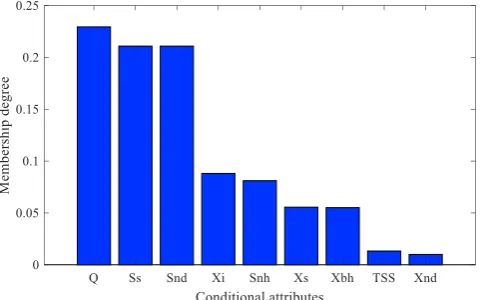
Using fuzzy rough monotone dependence (FRMD) algorithm to do the data attribute reduction process, BOD is taken as the decision attribute, and components in Table 2 are taken as the conditional attributes. The membership function degrees of each conditional attribute to the BOD are shown in Figure 2. Among them, conditional attributes whose membership degrees are equal to 0 have been discarded.
Figure 3. Membership degrees of each conditional attribute to BOD
Figure 3 shows the membership degrees between BOD and the components parameters; the conditional attributes which have zero degree are not shown in Figure 3. Nine attributes are shown in Figure 3, but we can clearly see that the degrees of Xnd and TSS are much closer to zero than others. Therefore, for reducing the complexity of the system, those two attributes were not taken into account in the next simulation. The remaining seven attributes were taken as the inputs of the ELM soft sensor.
The effectiveness of the ICS-based ELM BOD soft sensing model was verified based on the data attribute reduction results; Ss, Xi, Xs, Xbh, Snh and Snd of the influent and the flow rate Q are used as the auxiliary variables for the network input, so the ICS-based ELM network structure had 7 input nodes, 40 hidden nodes and one output node (7-40-1). The 1344 groups of data are randomly divided into training datasets (500 groups), verifying datasets (460 groups) and testing datasets (384 groups) for the simulation. The training accuracy and prediction accuracy of the soft sensor model are represented by mean square error (MSE).
2
1 1
( ( ) ( ))
N i
MSE Y i Y i
N
=
=
− (14)Where, Y(n) is the predicted output of the model; Y*(n) is the actual measured value; N is the sample size number.
Parameters are set as follows: For the ICS algorithm, the population size n is 25,the maximum and the minimum probability to be discovered by the host bird are 0.75 and 0.1 respectively; for the adaptive step length control parameters m = 0.8, k = 0.2, p = 25, Smin = 0.01.
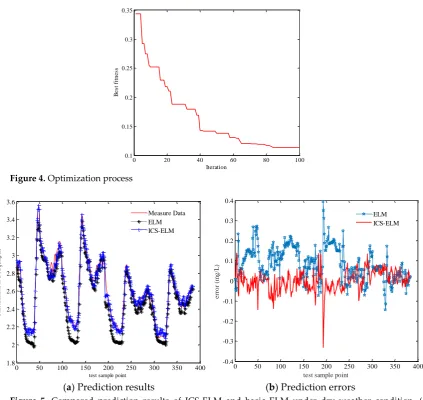
When the number of iterations t = 100, the iteration will be terminated; the curve of the optimization process is shown in Figure 4. The prediction results and errors of ICS-based ELM soft sensor for effluent BOD are shown in Figure 5.
Figure 4. Optimization process
(a) Prediction results (b) Prediction errors
Figure 5. Compared prediction results of ICS-ELM and basic ELM under dry weather condition, (a) Effluent BOD concentration, (b) Error in predicting the measured effluent BOD
It can be seen from the results, the ICS-based ELM has a better prediction accuracy than the basic ELM. To verify the advantage of the ICS-based ELM, a comparison studies are simulated with the other five models, which are extreme learning machine (ELM), cuckoo search (CS)-based ELM,
0 20 40 60 80 100 0.1
0.15 0.2 0.25 0.3 0.35
Iteration
B
e
st
f
it
n
e
ss
0 50 100 150 200 250 300 350 400 1.8
2 2.2 2.4 2.6 2.8 3 3.2 3.4 3.6
test sample point
C
onc
ent
ra
ti
on
of
B
O
D5
(m
g/
L
)
Measure Data ELM ICS-ELM
0 50 100 150 200 250 300 350 400 -0.4
-0.3 -0.2 -0.1 0 0.1 0.2 0.3 0.4
test sample point
e
rr
o
r
(m
g
/L
)
relevance vector machine (RVM), back-propagation (BP) neural network and least squares support vector machines (LS-SVM), with the same influent data under dry weather condition. The MSE results are shown in Table 3, and the prediction results are shown in Figure 5. Clearly, the MSE from ICS-based ELM are much smaller than the other five models. But the training process will take a slightly longer computer time than for the basic ELM because of the optimization process of the input weights wi and the hidden layer biases bi.
Table 3. Prediction results of the six soft sensor models
model MSE Hidden nodes Training time (sec)
ELM 1.3011 40 1.78
CS-ELM 0.0640 15 76.67
RVM1 0.0513 - -
BP1 0.0909 25 -
LS-SVM1 0.0865 - -
ICS-ELM 0.0254 40 61.4
(a) Prediction results (b) Prediction errors
Figure 6. Prediction of effluent BOD under dry weather condition using five soft sensors, (a) Effluent BOD concentration, (b) Error in predicting the measured effluent BOD
To further verify the anti-interference ability of the ICS-based ELM prediction model, rainy and stormy weather conditions are considered as the disturbances of the system to simulate the BOD as shown in Figure 7 and Figure 8.
(a) Prediction results (b) Prediction errors
Figure 7. Prediction of effluent BOD concentration under rainy condition, (a) Effluent BOD concentration, (b) Error in predicting the measured effluent BOD
1 The blanks in the table mean that they are not mentioned in Xu et al (2014).
0 50 100 150 200 250 300 350 400
2 2.5 3 3.5
test sample point
C o n c e n tr a ti o n o f B O D5 (m g /L ) Measure Data BP LS-SVM ELM CS-ELM ICS-ELM
0 50 100 150 200 250 300 350 400
-0.5 -0.4 -0.3 -0.2 -0.1 0 0.1 0.2 0.3 0.4
test sample point
e rr o r( m g /L ) BP LS-SVM ELM CS-ELM ICS-ELM
0 50 100 150 200 250 300 350 400
1.5 2 2.5 3 3.5 4 4.5 5
test sample point
C o n c e n tr a ti o n o f B O D5 (m g /L ) Measured Value BP LS-SVM ELM CS-ELM ICS-ELM
0 50 100 150 200 250 300 350 400
-2 -1.5 -1 -0.5 0 0.5 1 1.5
test sample point
(a) Prediction results (b) Prediction errors
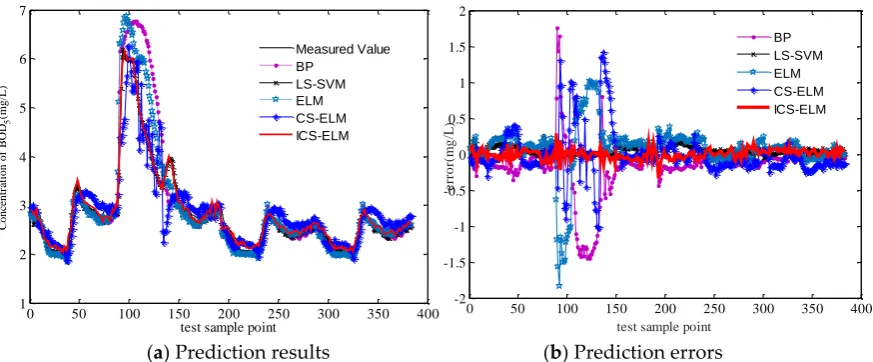
Figure 8. Prediction of effluent BOD under stormy weather condition with a storm event, (a) Effluent BOD concentration, (b) error in predicting the measured effluent BOD
As can be seen from the results shown in Figure 7 and Figure 8, no matter how the weather condition changes, a well-trained ICS-based ELM still can predict the effluent BOD with smaller errors compared to other five models considered in this paper.
4. Conclusions
In this paper, an ICS-based ELM is applied to BOD soft sensing modeling to predict the effluent water quality. It overcomes low prediction accuracy and poor stability of basic ELM algorithm with an improved cuckoo search algorithm. The input weights and the hidden layer biases of ELM are optimized with an offline training process. Results show that ICS-based ELM BOD soft sensing model can improve the accuracy of the prediction with better anti-interference and generalization abilities than basic ELM algorithm. Because of the accurately prediction of the BOD in the process, it would be helpful to the energy saving in the aeration operation in the future research.
Author Contributions: conceptualization, P.Y., J.C., V.J. and X.D.; methodology, X.D.; software, P.Y.; validation, P.Y., J.C., V.J. and X.D.; formal analysis, P.Y. and X.D.; investigation, X.D.; resources, P.Y.; data curation, J.C.; writing—original draft preparation, P.Y. and X.D.; writing—review and editing, V.J.; visualization, P.Y.; supervision, J.C. and V.J.; project administration, X.D.; funding acquisition, J.C. and X.D.
Funding: This research was funded by the National Natural Science Foundation of China, grant number (No. 61563032), the Natural Science Foundation of Gansu Province (No. 1506RJZA104, No. 2017GS10945), University Scientific Research Project of Gansu Province (No. 2015B-030), and the Excellent Young Teacher Project of Lanzhou University of Technology (No. Q201408).
Conflicts of Interest: The authors declare no conflict of interest.
References
1. Dellana SA, West D. Predictive modeling for wastewater applications: Linear and nonlinear approaches. Environmental Modelling & Software, 2009, 24(1): 96-106.
2. Wang J, Zhang Y. Research advances in biosensor for rapid measurement of biochemical oxygen demand (BOD). Acta Scientiae Circumstantiae, 2007, 27(7): 1066-1082.
3. Zhang M, Han H, Qiao J. Research on dynamic feed-forward neural network structure based on growing and pruning methods. CAAI Transactions on Intelligent Systems, 2011, 6(2): 101-106.
4. Qiao J, Ju Y, Han H. BOD soft-sensing based on SONNRW. Journal of Beijing University of Technology, 2016, 42(10): 1451-1460.
5. Liu W. Online biochemical oxygen demand soft measurement based on echo state network. Computer Measurement & Control, 2014, 22(5): 1351-1354.
6. Huang GB, Zhu QY, Siew CK. Extreme learning machine: Theory and applications. Neurocomputing, 2006, 70(1): 489-501.
0 50 100 150 200 250 300 350 400
1 2 3 4 5 6 7
test sample point
C
onc
ent
ra
ti
on
of
B
O
D5
(m
g/
L
)
Measured Value BP
LS-SVM ELM CS-ELM ICS-ELM
0 50 100 150 200 250 300 350 400
-2 -1.5 -1 -0.5 0 0.5 1 1.5 2
test sample point
e
rr
o
r(
m
g
/L
)
7. Huang GB, Zhou H, Ding X, Zhang R. Extreme learning machine for regression and multiclass classification. IEEE Transactions on Systems Man & Cybernetics Part B, 2012, 42(2): 513-529.
8. Han F, Huang DS. Improved extreme learning machine for function approximation by encoding a priori information. Neurocomputing, 2006, 69(16): 2369-2373.
9. Deng C, Huang G, Xu J, Tang J. Extreme learning machines: New trends and applications. Science China Information Sciences, 2015, 58(2): 1-16.
10. Wang Y, Di K, Zhang S. Melt index prediction of polypropylene based on DBN-ELM. CIESC Jorunal, 2016, 67(12): 5163-5168.
11. Li R, Wang L. Soft Measurement modeling and chemical application based on ISOMAP-ELM neural network. Acta Metrologica Sinica, 2016, 37(5): 548-552.
12. Zhu QY, Qin AK, Suganthan PN, Huang, GB, Patcog J. Evolutionary extreme learning machine. Pattern Recognition, 2005, 38(10): 1759-1763.
13. Yan D, Chu Y, Zhang H, Liu D. Information discriminative extreme learning machine. Soft Computing, 2018, 22: 677-689.
14. Kassani PH, Teoh A, Kim E. Sparse pseudoinverse incremental extreme learning machine. Neurocomputing, 2018, 287: 128-142.
15. Du X, Wang J, Jegatheesan V, Shi G. Parameter estimation of activated sludge process based on an improved cuckoo search algorithm. Bioresource Technology, 2018, 249: 249-447.
16. Liang J, Luo F, Xu Y. Fuzzy rough monotone dependence algorithm based on decision table and its application. Journal of South China University of Technology (Natural Science Edition), 2011, 39(7): 7-12. 17. Alex J, Benedetti L, Copp J. Benchmark Simulation Model no. 1 (BSM1). Technical report of Lund
University, Sweden, 2008.
18. Jeppsson U, Pons MN. The COST benchmark simulation model - current state and future perspective. Control Engineering Practice, 2004, 12(3): 299-304.
19. Huang GB. Learning capability and storage capacity of two hidden layer feedforward networks. IEEE Trans. Neural Networks, 2003, 14(2): 274-281.
20. Rao CR, Mitra SK. Generalized inverse of matrices and its applications. Wiley, New York, 1971. 21. Serre D. Matrices: Theory and applications. Springer, New York, 2002.
22. Yang X, Deb S. Cuckoo search via Lévy flights. In: Proceeding of World Congress on Nature & Biologically Inspired Computing, Coimbatore, India, 09-11 December, 2009.
23. Tao T, Zhang J, Xin K, Li S. Optimal valve control in water distribution systems based on cuckoo search. Journal of Tongji University (Natural Science), 2016, 44(4): 106-110.
24. Xu Y, Cao T, Luo F. Wastewater effluent quality prediction model based on relevance vector machine. Journal of South China University of Technology (Natural Science Edition), 2014, 42(5): 103-108.