Randomized, controlled trial of
cannabis-based medicine in central pain in
multiple sclerosis
David J. Rog, BMBS; Turo J. Nurmikko, PhD; Tim Friede, PhD; and Carolyn A. Young, MD
Abstract—Background: Central pain in multiple sclerosis (MS) is common and often refractory to treatment.Methods:
We conducted a single-center, 5-week (1-week run-in, 4-week treatment), randomized, double-blind, placebo-controlled, parallel-group trial in 66 patients with MS and central pain states (59 dysesthetic, seven painful spasms) of a whole-plant cannabis-based medicine (CBM), containing delta-9-tetrahydrocannabinol:cannabidiol (THC:CBD) delivered via an oromu-cosal spray, as adjunctive analgesic treatment. Each spray delivered 2.7 mg of THC and 2.5 of CBD, and patients could gradually self-titrate to a maximum of 48 sprays in 24 hours.Results: Sixty-four patients (97%) completed the trial, 34 received CBM. In week 4, the mean number of daily sprays taken of CBM (n⫽32) was 9.6 (range 2 to 25, SD⫽6.0) and of placebo (n ⫽31) was 19.1 (range 1 to 47, SD⫽ 12.9). Pain and sleep disturbance were recorded daily on an 11-point numerical rating scale. CBM was superior to placebo in reducing the mean intensity of pain (CBM mean change⫺2.7, 95% CI:⫺3.4 to⫺2.0, placebo –1.4 95% CI:⫺2.0 to⫺0.8, comparison between groups,p⫽0.005) and sleep disturbance (CBM mean change –2.5, 95% CI: ⫺3.4 to⫺1.7, placebo – 0.8, 95% CI: ⫺1.5 to ⫺0.1, comparison between groups,p⫽0.003). CBM was generally well tolerated, although more patients on CBM than placebo reported dizziness, dry mouth, and somnolence. Cognitive side effects were limited to long-term memory storage. Conclusions:Cannabis-based medicine is effective in reducing pain and sleep disturbance in patients with multiple sclerosis related central neuropathic pain and is mostly well tolerated.
NEUROLOGY 2005;65:812–819
Central pain, i.e., pain initiated or caused by a
pri-mary lesion or dysfunction of the CNS,
1is estimated
to occur in between 17% and 52% of people with
multiple sclerosis (MS).
2As many as 32% of patients
with MS regard pain among their most severe
symp-toms,
3confirming it as a “frequent, disabling and
inadequately managed symptom.”
4The most
com-mon form of central pain in MS is nonparoxysmal
extremity pain, which shows large interindividual
variation and may manifest with several, typically
dysesthetic, qualities such as burning, aching,
prick-ing, stabbprick-ing, or squeezing.
2Painful extremity
spasms have also been classed as central pain.
5In the past decade, cannabinoids and the
endocan-nabinoid system have come under intense scrutiny
following the discovery of CB1 and CB2 receptors
and development of specific cannabinoid receptor
ag-onist and antagag-onist ligands.
6The rationale for
per-forming a randomized, controlled trial (RCT) of
cannabis-based medicine (CBM) in MS-related
neu-ropathic pain is based on encouraging results using
cannabinoid receptor agonists in relieving symptoms
of experimental allergic encephalomyelitis
7and
pre-liminary studies demonstrating modest positive
ef-fects of a synthetic cannabinoid analogue on
neuropathic pain of mixed etiologies and of whole
plant– derived CBM on neurogenic symptoms,
in-cluding pain, in patients with MS.
8,9A systematic
review of trials of cannabinoids in pain management
concluded that cannabinoids may relieve
neuro-pathic pain, but some authors have questioned the
appropriateness of trials of cannabinoids using oral
Additional material related to this article can be found on theNeurologyWeb site. Go to www.neurology.org. and scroll down the Table of Con-tents for the September 27 issue to find the link for this article.
From the Walton Centre for Neurology and Neurosurgery (Drs. Rog and Young), Liverpool, University of Liverpool (Drs. Rog, Nurmikko, and Young); Pain Research Institute (Dr. Nurmikko), Liverpool; Medical Statistics Unit (Dr. Friede), Lancaster University, Lancaster, United Kingdom.
Disclosure: David J. Rog, BMBS, Carolyn A. Young, MD, and Turo J. Nurmikko, PhD, contributed to the conception and design of this study and the drafting and revision of the paper. Drs. Rog and Young participated in the acquisition of trial data. Dr. Friede independently analyzed the study data and contributed to the drafting and revision of the paper. Dr. Rog has accepted travel and accommodation expenses from GW Pharma to attend an Investigator’s Meeting (less than $10,000) and his salary was paid from a research fund to which GW Pharma contributed (in excess of $10,000). Dr. Friede has no conflicts of interest; he is currently employed by Novartis Pharma, Basle, Switzerland. Drs. Young and Nurmikko have both received funding for research (in excess of $10,000) from GW Pharma and Dr. Nurmikko has also received an honorarium (less than $10,000) for speaking from GW Pharma.
GW Pharmaceuticals sponsored the trial, contributed to study design, provided trial medication and matching placebo and collected the data. GW Pharma Ltd. has contracted data handling and analysis to a contract research organization. The authors have received full access to the data and conducted an independent analysis. GW and Bayer Pharmaceuticals have had the opportunity to review the manuscript of the paper, but decision to publish rests with the authors.
Received January 15, 2005. Accepted in final form June 9, 2005.
administration due to the variability in their
gastro-intestinal absorption and crossover designs because
of their long half-lives.
10,11This study was designed to evaluate the effect of
oromucosal CBM in central pain associated with MS.
CBM is derived from cannabis plant chemovars,
de-veloped to produce high and reproducible yields of
specified cannabinoids and formulated to produce a
CBM. Oromucosal administration is efficient and
convenient in achieving accurate self-titration to
overcome the wide variability of interindividual
re-sponse known to occur with cannabis and
cannabi-noids. The study preparation contained a mixture of
two principal ingredients of cannabis
(delta-9-tetrahydrocannabinol [THC] and cannabidiol [CBD])
in approximately a 1:1 ratio, with small amounts
(
⬍
10%) of other cannabis-based compounds,
deliv-ered via an oromucosal spray. We sought to compare
the efficacy, safety, and tolerability of CBM THC:
CBD with placebo in relieving central neuropathic
pain in patients with MS.
Methods. Adult patients with central neuropathic pain syn-dromes due to MS were invited to participate in this 5-week, four-visit, randomized, double-blind, placebo-controlled, parallel-group study conducted at the Walton Centre Clinical Trials Unit, Liverpool, U.K. Patients were identified predominantly from a previous study validating the Neuropathic Pain Scale12(NPS) in
MS central pain13 and also from the regional MS clinic or by
specialist referral. After written informed consent, eligible pa-tients with MS diagnosed at least 6 months previously (Poser criteria14) were included. Central pain for which a nociceptive
cause appeared unlikely was required to be of at least 3 months’ duration and expected to remain otherwise stable during the study. As there is no gold standard for central pain, the diagnosis was made based on pain description and clinical examination that had to be compatible with a central mechanism and by exclusion.2
Patients with dysesthetic pain perceived as an unpleasant abnor-mal sensation spontaneously occurring or evoked and often de-scribed using terms such as burning, aching, pricking, stabbing, and squeezing,2which is the most common form of chronic
neuro-pathic pain associated with MS, were included as were those with painful tonic spasms. Those with chronic visceral pain, headache, spasticity-associated aching pain, secondary entrapment syn-dromes, or acute MS-related pains, e.g., optic neuritis or positive Lhermitte sign alone, were not included. Patients with dysesthetic pain described it predominantly in their legs and feet. Patients were excluded if their sensations were not subjectively deemed painful or if they had spasticity or painless spasms alone or an-other noncentral pain mechanism was considered more likely, e.g., musculoskeletal pain from postural changes or peripheral neuro-pathic pain from nerve entrapment. Patients taking amitriptyline or other tricyclic antidepressants were required to reduce to or maintain a maximum dose of 75 mg/day. A stable neuropathic pain medication regimen was maintained during the 2 weeks im-mediately before screening and throughout the study. Changes in medications or procedures expected to affect central MS pain were prohibited.
No cannabinoid use (cannabis, Marinol, or Nabilone) at least 7 days before screening or during the study was permitted. Patients consented to their details being notified to the British Home Office and agreed not to travel outside the United Kingdom or donate blood during the study.
Patients were ineligible if they had a history of major psychiat-ric disorder other than depression associated with their underly-ing condition; severe concomitant illness, seizures, history or suspicion of substance abuse; concomitant severe nonneuropathic pain or the presence of illness such as diabetes mellitus that could cause peripheral neuropathic pain; or scheduled procedures re-quiring general anesthesia during the study. Patients were also excluded if they were pregnant, lactating, taking levodopa therapy
within 7 days of study entry or had known or suspected hypersen-sitivity to cannabinoids.
The Local Research Ethics Committee approved the study and stipulated that patients should not drive during the study. Partic-ipants underwent assessment including calculation of Expanded Disability Status Scale15 (EDSS) score. Patients localized their
pains using a body map. A pain history and bedside examination was undertaken to establish whether the pain or pains were likely to be of central origin, based on their location, quality or qualities, and associated sensory abnormalities such as hypoesthesia, allo-dynia, and hyperpathia. The patients’ most troublesome central neuropathic pain was thus identified, and they then estimated at what time of day this was expected to be at its maximum severity. An 11-point numerical rating scale (NRS-11) (in which 0 ⫽ no pain and 10 ⫽worst possible pain) was completed daily for the identified pain at the identified time for the 7- to 10-day baseline screening period and throughout the study. A daily NRS-11 scale recording sleep disturbance due to neuropathic pain rating (in which 0⫽did not disrupt sleep and 10⫽completely disrupts unable to sleep due to pain) was also completed. The NPS was completed at the same time as the pain NRS-11 for three consecutive days in both the run-in week and the final week of treatment.
The following items were examined before first dosing and at study completion or withdrawal: cognitive function (Brief Repeat-able Battery of Neuropsychological Tests16), mood (Hospital
Anxi-ety and Depression Scale17 [HADS]), and MS-related disability
(Guy’s Neurological Disability Scale18). At the end of the study, a
Patient’s Global Impression of Change19(PGIC), a 7-point rating
scale of a patient’s overall change in status since commencing study medication, was applied.
Patients were randomized using a predetermined randomiza-tion code drawn up by a statistician who remained unknown to study personnel throughout the duration of the trial. Treatment allocation was made using randomized permuted blocks of four (two active drug, two placebo), with treatments sequentially as-signed to either a whole-plant CBM (CBM ⫽ GW 1000-02, Sa-tivex) containing THC:CBD delivered via oromucosal spray or placebo. Each spray delivered 2.7 mg of THC and 2.5 mg of CBD or placebo. Placebo was designed to match the appearance, smell, and taste of the active formulation but contained no active compo-nents, in ethanol:propylene glycol (50:50) excipient. To facilitate blinding, patients completed pain and sleep assessments at home, the physician examined patients, gave dosing advice, and assessed them for adverse events (AEs); trials nurses completed all other secondary outcome assessments; and a trials pharmacist dis-pensed the study medication. The identity of study medication assigned to patients, to which all study personnel remained blinded, was contained in individually sealed envelopes retained in the hospital 24-hour pharmacy and with the sponsor’s Pharma-covigilance Department.
Sample size calculation. No large-scale, RCTs of MS central pain treatments existed to provide data for power calculations. From peripheral neuropathic pain studies of gabapentin,19,20the
SD for the change from baseline in the NRS-11 pain score was 2.1. For a difference of 1.75 on the NRS between the two treatment groups and a significance level of 5% (two sided), a sample size of 54 patients ensures a power of 85% in a balanced design. Assum-ing withdrawals or serious protocol violations of around 15%, ap-proximately 64 patients were to be randomized (32 patients in each treatment group).
maxi-mum tolerated dose was thus established, it was only exceeded with caution.
During telephone follow-up, patients were advised to optimize dosing when suboptimal benefit had been achieved. Those pa-tients who satisfactorily completed the trial were offered the op-portunity to participate in an open-label extension study, which will be reported separately.
Data analysis. The intention-to-treat (ITT) population was used for all efficacy analyses and was defined as all patients who entered the study, were randomized, received at least one dose of study medication, and had on-treatment efficacy data. For all efficacy scores including pain NRS-11 as the primary endpoint, the change in scores from baseline to end of treatment (completion or withdrawal) was compared between treatment groups using analysis of covariance with the baseline score as covariate. For the NRS-11 scales, the mean score of the 7 days before the first dose was given served as baseline and the mean score of the last 7 (3 in the event of withdrawal) days before the final intake of test med-ication was used as final score. For the NPS, the average of the three replications in the run-in week served as the baseline score and in the final week of treatment as the final score. The PGIC was analyzed by comparing the proportions of patients rating themselves as “much” or “very much improved” using Fisher’s exact test. Additionally, the PGIC in the two treatment groups were compared using the cumulative logit model with treatment group as the only independent variable. The heart rates during the first dosing were modeled by a linear mixed model with fixed effects for treatment group means and slopes and individual pa-tient random effects for means and slopes. For all binary variables apart from the dichotomized PGIC, we used2tests. All CIs for proportions or differences of proportions are approximate CIs. No adjustments for multiple testing were carried out. All analyses were performed using SAS version 8.2.
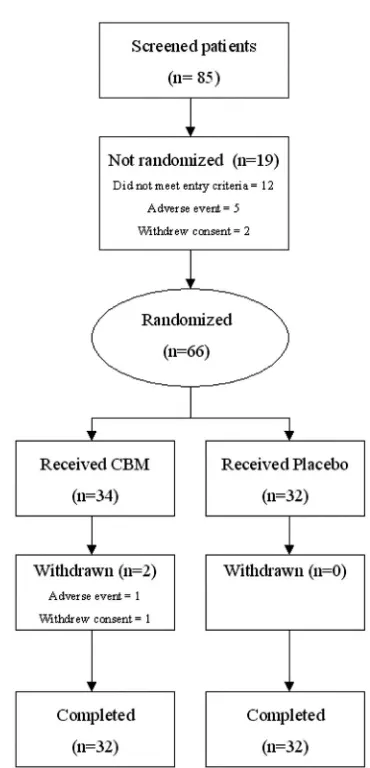
Results. Study population. Recruitment from the re-gional MS clinic and referrals from consultant neurologists and pain specialists took place between March and July 2002, and patients attended the Trials Unit on four occa-sions over 5 weeks. Eighty-five patients were screened, of whom 66 were randomized (fig 1), 34 to CBM and 32 to placebo; 64 patients (96.9%) completed the study. Two women patients withdrew, both on CBM. One developed an AE of agitation with tachycardia and hypertension after four sprays, which settled with conservative management within 3 hours. She declined further study medication and withdrew 7 days later without completing further scores. The second patient developed paranoid ideation and was withdrawn from study medication at the investigator’s dis-cretion in the second treatment week but subsequently completed all study diaries and assessments. Two patients violated the protocol, one patient’s concomitant pain medi-cation changed in the run in period, and another patient commenced interferon treatment 3 days after commencing the study. Both patients were in the active treatment group and were included in the ITT analysis.
Of the 66 patients randomized, nine had primary pro-gressive, 33 secondary propro-gressive, 23 relapsing remitting and one benign MS. The treatment groups were well bal-anced in terms of gender, age, duration of MS since diag-nosis, and baseline NRS-11 pain score (table 1). At baseline, the NPS items Intense, Unpleasant, and Deep were experienced by more than 80% of patients with mean severities of greater than four of ten. Conversely, less than 25% of patients experienced Cold and Itchy components with a similar magnitude and about 45% of patients did not experience these pain qualities at all.
Forty-three patients (65%) required support to walk or were wheelchair bound. Patients were taking a mean of about two other medications for pain, spasms, or
spastic-ity. Forty-seven percent of patients had previous experi-ence of using cannabis medicinally and 16.7% recreationally. Only four patients randomized to CBM and eight to placebo had taken cannabis within 3 months of study entry. The proportion of patients with any previous exposure to cannabis was not different between CBM and placebo (CBM 15/34, placebo 21/32; CBM-placebo ⫺0.22, 95% CI: ⫺0.45 to 0.02, p ⫽ 0.08). The mean number of daily sprays taken in week 4 was 9.6 of CBM (n ⫽ 32) (range 2 to 25, SD ⫽6.1), equivalent to 25.9 mg THC:24 mg CBD and 19.1 of placebo (n⫽31) (range 1 to 47, SD⫽ 12.9) (CBM-placebo –9.5, 95% CI: ⫺14.6 to ⫺4.4, p ⫽
0.0004).
Efficacy measures. NRS-11 and NPS total pain scores. Significant mean reductions favoring CBM were found for the primary outcome NRS-11 of pain and the secondary outcome NPS (table 2 and figures 2 and 3). Of the total 65 patients included in the ITT analysis, 59 (89%) had dyses-thetic pain and seven (11%) had painful spasms. Post hoc analysis demonstrated that the seven patients with pain-ful spasms had higher baseline NRS-11 pain intensities than the patients with dysesthetic pain (dysesthetic pain 6.3 [SE⫽1.6]; painful spasms 7.3 [SE⫽1.5]; difference in means ⫽ 1.3, 95% CI: 0.1 to 2.6, p ⫽ 0.04) and that the changes from baseline to week 4 tended to be greater in
patients with painful spasms. In the patients with dyses-thetic pain, the mean changes were⫺2.4 (SD⫽1.5, n ⫽ 30) for CBM and ⫺1.3 (SD ⫽ 1.7, n ⫽ 28) for placebo, whereas these changes were ⫺5.7 (SD ⫽ 3.5, n⫽ 3) and ⫺2.1 (SD⫽1.6, n⫽4) in the patients with spasm. In an analysis including only the patients with dysesthetic pain, the NRS-11 pain treatment effect was 1.1 (SE⫽0.4,p⫽
0.012). An interaction between treatment and type of pain was not found on a 5% level (p⫽0.07).
Post hoc analysis of individual NPS items demonstrated treatment effects for all 10 items in favor of CBM that reach significance for Intense (treatment effect estimate –1.31, 95% CI: ⫺2.21 to ⫺0.40, p ⫽ 0.0054), Dull (treat-ment effect estimate –1.04, 95% CI: ⫺2.05 to ⫺0.03, p⫽
0.0433) and Sensitive (treatment effect estimate –1.01, 95% CI:⫺2.02 to⫺0.01,p⫽0.0484).
Pain-related sleep disturbance. The reductions in pain were reflected in similar reductions in mean daily pain-related sleep disturbance with a mean treatment differ-ence favoring CBM (table 2, figure 4).
PGIC. The proportion of patients rating themselves as “much” or “very much improved” in the CBM group (9/ 34) was not greater than those receiving placebo (4/32) (treatment difference 14% points, 95% CI: ⫺4.8 to 32.7,
p ⫽ 0.218). No patient felt “much worse” or “very much worse” (see table E-1 on the NeurologyWeb site at www. neurology.org). On the 7-point PGIC, those treated with CBM were 3.9 times more likely to rate themselves in any Table 1Baseline demographic details
All patients CBM Placebo
Randomized 66 34 32
M:F 14:52 6:28 8:24
Mean age, y (range, SD) 49.2 (26.9–71.4, 8.3) 50.3 (37.6–63.9, 6.7) 48.1 (26.9–71.4, 9.7)
Mean duration of MS since diagnosis, y, (range, SD) 11.6 (1.6–36, 7.7) 10.4 (1.0–28.0, 7.3) 12.8 (2.0–36, 8.1)
Mean EDSS at study entry, (range, SD) 5.9 (2.0–8.5,⫾1.3) 6.0 (3.0– 8.0,⫾1.1) 5.8 (2.0–8.5,⫾1.5)
0–3.5 unlimited 3 1 2
4.0–5.5 limited 20 8 12
6.0–6.5 walking aids 26 17 9
7.0–9.5 wheelchair 17 8 9
No. of concomitant analgesics, mean, (range, SD) 1.8 (0–5, 1.2) 1.8 (0–5, 1.2) 1.8 (0–4, 1.3)
Acetaminophen 8 4 4
Tricyclic antidepressant 18 13 5
Anesthetic 1 1 0
Anticonvulsant 13 8 5
Benzodiazepine 3 2 1
Evening primrose oil 1 0 1
Combination opioid 22 9 13
Opioid 5 2 3
Strong opioid 3 3 0
NSAID (oral) 17 5 12
NSAID (topical) 2 0 2
Skeletal muscle relaxant 25 14 11
Total 118 61 57
Previous medicinal cannabis use 31 (47%) 14 (41.2%) 17 (53.1%)
Previous recreational cannabis use 11 (16.7%) 3 (8.8%) 8 (25%)
Location of pain
Upper limb unilateral 6 5 1
Upper limb bilateral 4 2 2
Lower limb unilateral 11 7 4
Lower limb bilateral 36 17 19
Ipsilateral upper/lower limbs 2 0 2
Lower limb spasms 7 3 4
Mean baseline NRS-11 pain score (range, SD) 6.5 (3–10, 1.6) 6.5 (3–10, 1.6) 6.4 (4–10, 1.7)
improved category than those receiving placebo (95% CI: 1.51 to 10.09,p⫽0.005).
AEs. Thirty patients (88.2%) on CBM developed at least one AE, compared with 22 patients (68.8%) on pla-cebo (CBM-plapla-cebo 0.19, 95% CI: 0.00 to 0.39,p⫽0.053). Common AEs are summarized in table 3; in addition, con-fusion, crying, low mood, disorientation, paranoia, halluci-nation, and logorrhea all occurred once in the CBM group. Fifty-three percent of the patients in the CBM group expe-rienced dizziness at least once compared to 16% in the placebo group (CBM-placebo 0.37, 95% CI: 0.16 to 0.58,
p⫽0.002). Some of the psychiatric AEs occurred in the same patient. No serious AEs, i.e., fatal, life-threatening, or result-ing in persistent or major disability/incapacity or prolongresult-ing hospitalization, occurred. However, two women patients in the CBM arm experienced AEs severe enough to warrant trial withdrawal (see “Study Population” section).
No significant changes were seen in either group in blood pressure, weight, temperature, hematology, or blood chemistry. During the first dosing, there was an increase in mean heart rate in 1 hour in the cannabis-based medi-cine group by 3.2 beats per minute (95% CI: 2.3 to 4.1) compared with a mean of 1.6 beats per minute (95% CI: 0.8 to 2.5) in the placebo group,p⫽0.016.
Neuropsychological outcomes. No significant differ-ences between mean changes on each treatment were found in the 10/36 Spatial Recall Test, Symbol Digit Mo-dalities Test, Paced Auditory Serial Addition Test, or Word Generation List between treatment groups on neuropsy-chological testing. In the long-term component of the Selec-tive Reminding Test (SRT), a difference was found because of a mean improvement in the placebo group (n ⫽ 32) of 5.7 (95% CI: ⫺19 to 26) not matched in the CBM group (n ⫽ 33) of – 0.9 (95% CI: ⫺20 to 23) mean treatment difference⫺6.95 (95% CI:⫺12.12 to⫺1.77),p⫽0.009 (see table E-2).
Other secondary outcomes. No differences between mean changes on each treatment were found between treatment groups in the other secondary measures of HADS anxiety and depression and Guy’s Neurological Dis-ability Scale (see table E-3).
Discussion.
This randomized, placebo-controlled
trial demonstrates a beneficial effect of CBM both in
the relief of central pain associated with MS and
pain-related sleep disturbance. Although our study’s
inclusion criteria allowed for any type of MS-related
Table 2Changes in pain and sleep by treatment (CBM⫽33, placebo⫽32)Mean NRS-11 pain (95% CI) Mean NPS total (95% CI)
Mean NRS-11 sleep disturbance (95% CI)
CBM Placebo CBM Placebo CBM Placebo
Baseline week 6.58 (6.00–7.15) 6.37 (5.77–6.97) 46.90 (41.74–52.07) 45.79 (40.23–51.36) 5.26 (4.35–6.18) 4.47 (3.52–5.42)
Final treatment week
3.85 (3.13–4.58) 4.96 (4.19–5.72) 31.90 (26.56–37.25) 37.73 (31.40–44.06) 2.69 (1.99–3.39) 3.64 (2.73–4.55)
Mean treatment difference CBM – placebo (95% CI)
⫺1.25 (⫺2.11 to⫺0.39)p⫽0.005 ⫺6.58 (⫺12.97 to⫺0.19)p⫽0.044 ⫺1.39 (⫺2.27 to⫺0.50)p⫽0.003
The mean treatment differences are adjusted for baseline measurements.
CBM⫽cannabis-based medicine; NRS-11⫽11-point numerical rating scale; NPS⫽neuropathic pain scale.
Figure 2. Mean 11-point numerical rating scale (NRS-11) pain scores (⫾SEM) for the cannabis-based medicine (CBM) (n⫽33) and placebo group (n⫽32). Week 0 refers to the run-in week. The patients were on test medication in weeks 1 to 4.
Figure 3. Mean neuropathic pain scale (NPS) scores (⫾standard error of mean) for the cannabis-based medi-cine (CBM) (n⫽33) and placebo group (n⫽32) at base-line (Visit 1) and end of treatment (Withdrawal/
central pain of greater than 3 months’ duration, the
predominance of dysesthetic extremity pain in this
study (59 patients [89%]) is in agreement with
previ-ous series.
2,5The definition of and conditions
encom-passing “neuropathic” pain remain controversial.
22No universally accepted validated clinical diagnostic
criteria for neuropathic pain exist,
22and assessment
of patients based on clinical examination and
bed-side tests to decide what is and what is not
neuro-pathic is difficult, even for experts.
23Some authors view spasm-related pain in MS as
being neuropathic,
5whereas others do not.
21A
cross-over trial of dronabinol in MS central pain
specifi-cally excluded patients with spasm-related pain.
21Painful spasms in MS feature sudden-onset, either
unilateral or bilateral, dystonic posturing with a
ste-reotyped pattern in the same patient. They are
thought to be caused by “a transversely spreading
ephaptic activation of axons within a partially
demy-elinated lesion.”
24,25No study to date has linked
pain-ful spasms to dysfunction in either the motor or
somatosensory system exclusively, and whether
there is any advantage in separating the two for
therapeutic purposes is uncertain. Although patients
with MS and painful spasm must have a CNS lesion,
the key question is whether the pain is generated
primarily in the spasmodic muscles or the CNS. In
this study, patients with painful spasms responded
similarly to those with predominantly dysesthetic
pain, suggesting that dichotomizing patients based
on putative differences in central mechanisms of the
two groups may be superfluous.
Patients in our study were taking, on average, two
other medications, with limited efficacy given
base-line NRS-11 pain scores of 6.5. Therefore, as
adjunc-tive analgesic treatment, CBM had a significant
treatment effect of
⫺
1.25, in the NRS-11, in excess of
the
⫺
0.6 achieved by oral dronabinol in an MS study
in which concomitant analgesia was restricted to
paracetamol
21and comparable to treatment effects of
approximately 0.9 and 1.25 to 1.45 in RCTs of
pe-ripheral neuropathic pain using tramadol and
pre-gabalin.
26,27The treatment difference for the NRS-11
did not reach that for which the study was powered,
although this calculation was based on peripheral
neuropathic pain studies.
19,20A meta-analysis of
more than 2,700 patients with various painful
condi-tions suggested approximately a 30% or 2-point
NRS-11 score reduction in pain as being clinically
significant
28but notably did not include patients
with central neuropathic pain, in which “relatively
small decreases in pain intensity are often highly
valued by the patients.”
2Figure 4. Mean sleep disturbance 11-point numerical rat-ing scale (NRS-11) scores (⫾SEM) for the cannabis-based medicine (CBM) (n⫽33) and placebo group (n⫽32). Week 0 refers to the run-in week. The patients were on test medication in weeks 1 to 4.
Table 3Summary of common adverse events during parallel group treatment
Adverse event and category
No. experiencing on CBM,
n⫽34
No. experiencing on placebo,
n⫽32
Nervous system
Dizziness 18 5
Somnolence 3 0
Disturbance in attention 2 0
Headache 1 3
Psychiatric
Dissociation 3 0
Euphoria 2 0
Gastrointestinal
Dry mouth 4 0
Nausea 3 2
Diarrhea 2 0
Glossodynia 1 3
Mouth ulceration 1 0
Vomiting 1 0
Dyspepsia 0 1
Oral pain 0 3
General and administration site conditions
Falls 3 2
Weakness 3 0
Fatigue 2 2
Feeling abnormal 1 0
Feeling drunk 1 1
Thirst 1 0
Application site burning 0 1
Chest discomfort 0 1
Respiratory
Pharyngitis 2 1
Hoarseness 1 0
Throat irritation 1 0
In our study, the numbers needed to treat
29to
achieve a 50% reduction in central pain in at least
one patient was 3.7 (95% CI: 2.2 to 13.0), similar to
that obtained in the dronabinol trial of 3.5 (95% CI:
1.9 to 24.8).
21Numbers needed to harm
29(NNH) is
calculated as 1/risk difference, and for the
probabili-ties of at least one AE, this is 1/0.19
⫽
5.13.
Specifi-cally, for CBM to cause dizziness, the NNH was
1/0.37
⫽
2.68. Current options for treating central
pain conditions remain limited and are based mostly
on the use of CNS drugs with known problems of
tolerability.
30,31CBM was well tolerated overall,
de-spite a population including 25 of 34 patients (73.5%)
in the treatment group requiring some walking aid
and eight (24%) being wheelchair bound.
A systematic review identified that, until 2001,
RCTs of cannabinoids were largely confined to
single-dose trials.
10In this trial, patients could
ti-trate to a maximum of THC 130 mg:CBD 120 mg.
The mean dose achieved of 25.9 mg THC, and
partic-ularly 24 mg CBD, is in excess of that used in other
cannabinoid RCTs.
21,32,33CBD is thought to modulate
the effects of THC and also to have analgesic
proper-ties of its own. These factors may contribute to the
positive outcomes in this trial. To place these
reduc-tions in patient’s pain in context, a quality-of-life
instrument would have been beneficial, however,
with a relatively short 3-week fixed treatment
pe-riod. This was omitted from our study; however, an
odds ratio of 3.9 favoring an improved global
impres-sion of change with CBM, without a corresponding
significant change in mood, suggests that patients
felt a benefit from reduction in pain, sleep
improve-ment, or both and contrasts with a previous RCT
using orally administered THC and whole-plant
can-nabis extract, which significantly reduced PGIC.
32The Cannabinoids in Multiple Sclerosis (CAMS) trial
using orally administered cannabinoid capsule
for-mulations identified no objective change in Ashworth
scores but did note subjective improvements in pain
and sleep, which concurs with our results, as well as
in spasms and spasticity.
33In our study, the NPS 10-item total
responsive-ness also shows a significant treatment difference
favoring CBM of
⫺
6.58 on a 100-point scale,
demon-strating convergence with the traditionally accepted
NRS-11 outcome. Post hoc analysis demonstrated
significant treatment effects favoring CBM in the
Intense, Dull, and Sensitive NPS items, suggesting
that further studies should examine whether more
sophisticated methods of analyzing the NPS are
required.
Although unusual in neuropathic pain trials, some
RCTs involving cannabinoids have included a
ques-tion to formally assess the degree of blinding and
demonstrated an element of unblinding in patients
receiving cannabinoids.
32,33Our study did not include
a blinding question. However, despite a number of
our patients having previous exposure to cannabis,
our placebo group experienced both a large reduction
in pain and number of AEs, suggesting a degree of
blinding was preserved.
CBM does not appear to have significant effects on
MS-related disability, mood, or on four of the five
neuropsychological outcomes measured. No
correc-tions for multiple comparisons were applied to
sec-ondary outcomes. The significant treatment
effect-favoring placebo in the long-term storage component
of the SRT, perhaps reflects a learning effect not
matched in the CBM group. Analyses of the
consis-tent long-term retrieval score and delayed recall at
11 minutes were not defined a priori for analysis in
our study. The neuropsychological outcomes of
chronic (10.2 to 24 years) recreational marijuana
us-ers and general population controls have been
com-pared.
34On the Rey Auditory Verbal Learning Test,
a significantly less steep learning curve and
gener-ally recall of fewer words were observed in long-term
(mean 24 years) users of cannabis than in short-term
(mean 10.2 years) users or controls. Long-term users
also recalled fewer words than short-term users or
controls. The preliminary results of the psychological
substudy of the CAMS trial found a significant
re-duction in the Californian Adult Verbal Learning
Test in those receiving cannabis extracts compared
with placebo.
35These results require further analysis
and incorporation of psychological outcomes in
fu-ture cannabinoid trials.
Acknowledgment
The authors thank all patients who took part in the study. They acknowledge the assistance of the staff of the Clinical Trials Unit at the Walton Centre for Neurology and Neurosurgery who helped in the conduct of the study and application of many of the second-ary outcome measures, especially Lynne Owen, Dot Marshall, Dave Watling, Lynne Pickering, C. Saminaden, Linda Moss, and Ann Dennis (pharmacist).
References
1. Mersky H, Bogduk N. Classification of chronic pain. Seattle: IASP Press, 1994.
2. Biovie J. Central pain. In: Wall, PD, Melzack R, eds. Textbook of pain, 4th ed. Hong Kong: Harcourt, 1999:879–914.
3. Stenager E, Knudsen L, Jensen K. Acute and chronic pain syndromes in multiple sclerosis. Acta Neurol Scand 1991;84:197–200.
4. Thompson AJ. Symptomatic treatment in multiple sclerosis. Curr Opin Neurol 1998;11:305–309.
5. Bonica JJ. Introduction: semantic, epidemiologic, and educational is-sues. In: Casey, KL, eds. Pain and central nervous system disease: the central pain syndromes. New York: Raven Press, 1991:21.
6. Pertwee RG. Cannabinoid receptors and pain. Prog Neurobiol 2001;63: 569–611.
7. Lyman WD, Sonett JR, Brosnan CF. Delta 9 tetrahydrocannabinol: a novel treatment for experimental autoimmune encephalomyelitis. J Neuroimmunol 1989;23:73–81.
8. Karst M, Salim K, Burstein CI, Hoy L, Schneider U. Analgesic effect of the synthetic cannabinoid CT-3 on chronic neuropathic pain. A random-ized controlled trial. JAMA 2003;290:1757–1762.
9. Wade DT, Robson P, House H, Makela P, Aram J. A preliminary con-trolled study to determine whether whole- plant cannabis extracts can improve intractable neurogenic symptoms. Clin Rehabil 2003;17:21–29. 10. Campbell FA, Tramer MR, Carroll D, Reynolds DJM, Moore RA, Mc-Quay HJ. Are cannabinoids an effective and safe treatment option in the management of pain? A qualitative systematic review. BMJ 2001; 323:13–16.
11. Pertwee RG. Prescribing cannabinoids for multiple sclerosis: current issues. CNS Drugs 1999;11:327–334.
12. Galer BS, Jensen MP. Development and preliminary validation of a pain measure specific to neuropathic pain: the Neuropathic Pain Scale. Neurology 1997;48:332–338.
14. Poser CM, Paty DW, Scheinberg L, et al. New diagnostic criteria for multiple sclerosis: guidelines for research protocols. Ann Neurol 1983; 13:227–231.
15. Kurtzke JF. Rating neurologic impairment in multiple sclerosis: an expanded disability scale. Neurology 1983;33:1444–1452.
16. Rao SM. Cognitive Function Study Group. National Multiple Sclerosis Society. A manual for the brief repeatable battery of neuropsychological tests in multiple sclerosis. New York: National Multiple Sclerosis Soci-ety, 1990.
17. Zigmond AS, Snaith RP. The Hospital Anxiety and Depression Scale. Acta Psychiatr Scand 1983;67:361–370.
18. Sharrack B, Hughes RAC. Guy’s Neurological Disability Scale (GNDS): a new disability measure for multiple sclerosis. Mult Scler 1999;5:223–233. 19. Rowbotham M, Harden N, Stacey B, Bernstein P, Magnus-Miller L.
Gabapentin for the treatment of postherpetic neuralgia. JAMA 1998; 280:1837–1842.
20. Backonja M, Beydoun A, Edwards KR, et al. Gabapentin for the symp-tomatic treatment of painful neuropathy in patients with diabetes mel-litus. JAMA 1998;280:1831–1836.
21. Svendsen KB, Jensen TS, Bach FW. Does the cannabinoid dronabinol reduce central pain in multiple sclerosis? Randomised double blind placebo controlled crossover trial. BMJ 2004;329:253–258.
22. Attal N, Bouhassira D. Can pain be more or less neuropathic? Pain 2004;110:510–511.
23. Rasmussen PV, Sindrup SH, Jensen TS, Bach FW. Symptoms and signs in patients with suspected neuropathic pain. Pain 2004;110:461–469. 24. Spissu A, Cannas A, Ferrigno P, Pelaghi AE, Spissu M. Anatomic
correlates of painful tonic spasms in multiple sclerosis. Mov Disord 1999;14:331–335.
25. Osterman PO, Westerberg CE. Paroxysmal attacks in multiple sclero-sis. Brain 1975;98:189–202.
26. Boureau F, Legallicier P, Kabir-Ahmadi M. Tramadol in post-herpetic neuralgia: a randomized, placebo-controlled trial. Pain 2003;104:323– 331.
27. Lesser H, Sharma U, LaMoreaux L, Poole RM. Pregabalin relieves symptoms of painful diabetic neuropathy. A randomized controlled trial. Neurology 2004;63:2104–2110.
28. Farrar JT, Young JP, LaMoreaux L, Werth JL, Poole RM. Clinical importance of changes in chronic pain intensity measured on an 11-point numerical pain rating scale. Pain 2001;94:149–158.
29. Sindrup SH, Jensen TS. Efficacy of pharmacological treatments of neu-ropathic pain: an update and effect related to mechanism of drug ac-tion. Pain 1999;83:389–400.
30. Houtchens MK, Richert JR, Sami A, Rose JW. Open label gabapentin treatment for pain in multiple sclerosis. Mult Scler 1997;3:250–253. 31. Ramsaransing G, Zwanikken C, De Keyser J. Drug points: worsening of
symptoms of multiple sclerosis associated with carbamazepine. BMJ 2000;320:1113.
32. Killestein J, Hoogervorst EL, Reif M, et al. Safety, tolerability and efficacy of orally administered cannabinoids in MS. Neurology 2002;58: 1404–1437.
33. Zajicek J, Fox P, Sanders H, et al. Cannabinoids for treatment of spasticity and other symptoms related to multiple sclerosis (CAMS study): multicentre randomised placebo-controlled trial. Lancet 2003; 362:1517–1526.
34. Solowij N, Stephens RS, Roffmen RA, et al. Cognitive functioning of long-term heavy cannabis users seeking treatment. JAMA 2002;287: 1123–1131.
35. Langdon DW, Thompson AJ, Johnson KP, et al. The psychological ef-fects of cannabis in MS: impact on cognition, pain, mood and fatigue. Mult Scler ECTRIMS 2003;9:S27. Abstract.
Corrections
Posterior thalamic hemorrhage induces “pusher syndrome”
In the article “Posterior thalamic hemorrhage induces ‘pusher’ ’’ syndrome (Neurology 2005;64:1014 –1019) by Karnath et al., the observed overall percentage of patients with pushing behavior following a thalamic stroke has been erroneously stated as 28%. The correct percentage is 35%, which should have been stated on page 1016, left column, paragraph 1 of Results and on the same page, right column, paragraph 1 of Discussion. The authors apologize for this error.
Familial hemiplegic migraine: More than just a headache