Available online: https://edupediapublications.org/journals/index.php/IJR/ P a g e | 1529
Iot Based Voice and Sms Update Notification
System Using Raspberry Pi
SURESH BALLALA1, K. VARALAKSHMI2, K.RAGHAVENDRA3, DR. I. SATYANARAYANA4
1
Dept of Electronic and communication engineering, Sri Indu Institute of Engineering & Technology, Hyderabad, TS, India,
2
Dept of Electronic and communication engineering, Sri Indu Institute of Engineering & Technology, Hyderabad, TS, India
3
Dept of Electronic and communication engineering, Sri Indu Institute of Engineering & Technology, Hyderabad, TS, India
4
Dept of Electronic and communication engineering, Sri Indu Institute of Engineering & Technology, Hyderabad, TS, India
Abstract:
This paper explains a Raspberry Pi
controlled SMS-Update-Notification
(SUN) system. Raspberry Pi is a credit card sized single board computer with ARM11 microprocessor. Short Message Service (SMS) is one of the cheapest and best ways for sending a message from mobile. Basic idea of SUN system is to notify updates to the people in a working environment from authorized persons at anywhere just by SMS. This task is accomplished by conjunction of GSM module with Raspberry Pi. Working procedure of this SUN system is only the authorized person can send SMS from anywhere to the SIM in GSM module. This message will be read by voice and displayed through a website on monitor by Raspberry Pi
Keywords:
surveillance system, Raspberry PI3, GSM.1.Introduction
At present, notification systems are
using either microprocessors or
computers to display the messages.
Using microprocessors,
micro-controllers notifications can be
displayed on led displays. But to interface a monitor screen using micro-controller is complex. Micro- micro-controller cannot run multiple programs at a time.
To overcome these problems, computer can be used to display notices on many monitors at a time. But, using a computer for this purpose is very expensive. Raspberry being a single board computer can be used here to solve these problems. Using Raspberry Pi multiple programs can be run at a time. Comparing to a computer, this is cost effective and very less power consuming. As this board is having inbuilt HDMI port interfacing with all kinds of monitors is simple. With this board, external devices can be interfaced using USB ports. Raspberry Pi can be used for multiple purposes according to our requirement. SUN system is a new type of notification system where Short Message Service (SMS) is used to send the notification to be displayed. Allowed authority will send SMS from their mobile; this will be updated on the monitor as a new notification.
Literature survey:
Available online: https://edupediapublications.org/journals/index.php/IJR/ P a g e | 1530 [1] Dharmendra Kumar Sharma, Vineet
Tiwari#, Krishan Kumar, B. A. Botre, S.A. Akbar, “Small and Medium Range Wireless Electronic Notice Board using Bluetooth and ZigBee”
paper introduces a low cost, handheld, wireless electronic notice board by using Atmel’s ATmega32 microcontroller and different wireless technologies (Bluetooth and ZigBee) and their performance analysis based on the parameter such as range, BER (bit error rate). The notice board receives serial data from wireless module receiver and displays it on the graphical liquid crystal display. They have used KS0108 based 128x64 graphical LCD as display element. Here the display used for notice board is too small to consider as notice board display and can’t be viewed from far distance.
[2] Yash Teckchandani, G. Siva Perumal, Radhika Mujumdar, Sridhar Lokanathan, “Large Screen Wireless Notice Display System”
paper proposes a method in which large screens like computer monitors or televisions can be used for displaying notices sent as text messages from a mobile phone. The proposed method uses HyperText Markup Language (HTML) to present the
output since it offers many
customization options. To give high resolution output, the credit-card sized computer Raspberry pi has been used. Here in this project the author used large screen displays to display the notices but have to reach to the display to view it where it is placed.
[3] Sarthak Jain, Anant Vaibhav, Lovely Goyal, “Raspberry Pi based Interactive
Home Automation System through E-mail”
paper aims at designing a basic
home automation application on
Raspberry Pi through reading the subject of E-mail and the algorithm for the same has been developed in python environment which is the default programming environment provided by Raspberry Pi. In this paper, they are receiving the mail on raspberry pi device for the automation of home electrical appliances, which shows that the email can be received and read automatically on Raspberry pi.
A. Raspberry Pi
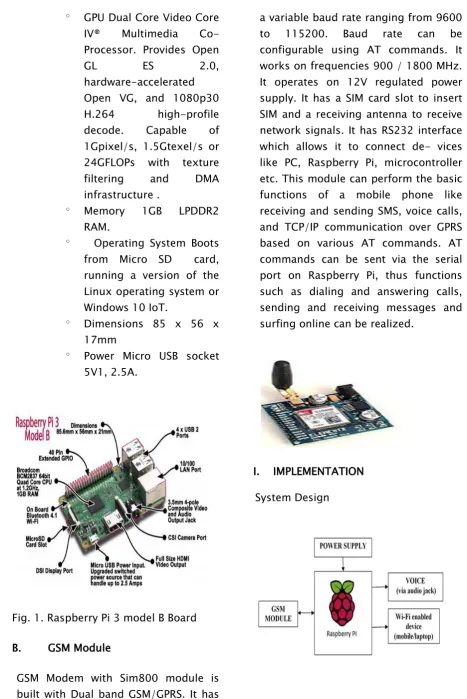
The Raspberry Pi 3 Model B is the third generation Raspberry Pi. This powerful credit-card sized single board computer can be used for many applications and supersedes the original Raspberry Pi Model B+ and Raspberry Pi 2 Model B. Whilst maintaining the popular board format the Raspberry Pi 3 Model B brings you a more powerful processer, 10x faster than the first generation Raspberry Pi. Additionally it adds wireless LAN & Bluetooth connectivity making it the ideal solution for powerful connected designs
Specifications:
o Processor Broadcom
BCM2387 chipset. 1.2GHz Quad-Core ARM Cortex-A53.
o 802.11 b/g/n Wireless
Available online: https://edupediapublications.org/journals/index.php/IJR/ P a g e | 1531
o GPU Dual Core Video Core
IV® Multimedia
Co-Processor. Provides Open
GL ES 2.0,
hardware-accelerated Open VG, and 1080p30
H.264 high-profile
decode. Capable of
1Gpixel/s, 1.5Gtexel/s or 24GFLOPs with texture
filtering and DMA
infrastructure .
o Memory 1GB LPDDR2
RAM.
o Operating System Boots
from Micro SD card, running a version of the Linux operating system or Windows 10 IoT.
o Dimensions 85 x 56 x
17mm
o Power Micro USB socket
5V1, 2.5A.
Fig. 1. Raspberry Pi 3 model B Board
B. GSM Module
GSM Modem with Sim800 module is built with Dual band GSM/GPRS. It has
a variable baud rate ranging from 9600 to 115200. Baud rate can be configurable using AT commands. It works on frequencies 900 / 1800 MHz. It operates on 12V regulated power supply. It has a SIM card slot to insert SIM and a receiving antenna to receive network signals. It has RS232 interface which allows it to connect de- vices like PC, Raspberry Pi, microcontroller etc. This module can perform the basic functions of a mobile phone like receiving and sending SMS, voice calls, and TCP/IP communication over GPRS based on various AT commands. AT commands can be sent via the serial port on Raspberry Pi, thus functions such as dialing and answering calls, sending and receiving messages and surfing online can be realized.
I. IMPLEMENTATION
System Design
Available online: https://edupediapublications.org/journals/index.php/IJR/ P a g e | 1532 The basic aim of this system design is
that the allowed user will send SMS from his mobile phone to GSM module, this message is the notification to be inserted in the website database To receive the message a SIM card is placed in GSM module and this is connected to Raspberry Pi through RS232 serial port . A website is created to display the message received on monitor. The web server will run itself on Raspberry Pi. A program is written for reading the messages from GSM module and to insert them in to website database. Raspberry Pi will use this program to read the messages using GSM module only from allowed users. And it inserts them to database of the website which will be displayed on the monitor connected through HDMI port. Thus, Raspberry Pi will act as central
authority of the whole system
controlling the website and the GSM module as well. By using HDMI port LCD / LED monitors can be connected. By using a HDMI extension switch, message can be displayed on several monitors at a time. This system is applicable to display messages / notices that need to be regularly updated in industrial areas / college notice boards.
Software
Raspbian OS :
Raspbian Jessie is a free operating system based on Debian optimized for the Raspberry Pi hardware. An operating system is the set of basic programs and utilities that make your Raspberry Pi run. However, Raspbian provides more than a pure OS:
it comes with over 35,000 packages, pre-compiled software bundled in a nice format for easy installation on your Raspberry Pi.The initial build of over 35,000 Raspbian packages, optimized for best performance on the Raspberry Pi, was completed in June of 2012. However, Raspbian is still under active development with an emphasis on improving the stability and performance of as many Debian packages as possible.
Python language: Python is a
wonderful and
powerful programming
language that's easy to use (easy to read and write) and with Raspberry Pi lets you connect your project to the real world. Python syntax is very clean, with an emphasis on readability and uses standard English keywords. Start by opening IDLE from the desktop
Sd formatter (4.0): used to
foramat all sd cards.
Win 32 disk imager :
Available online: https://edupediapublications.org/journals/index.php/IJR/ P a g e | 1533
removable drives like USB drives, SD Memory card
II. ALGORITHM
Raspberry Pi operating system is Linux-kernel based, it supports all programming languages like Python, C etc. Python programming is used in SUN system as it is easy to communicate with serial port and easy to connect databases using My SQL db, a python module.GSM module accepts only certain commands through serial communication and responds to them. These commands are called "AT Commands", AT means attention. There are a set of AT commands to perform different functions, every command starting with 'AT'. In Raspberry Pi, a
program is written in python
programming language to read the messages from GSM Module through serial connection to link it with website and displays it on the monitor connected.
Algorithm of the code is as follows: By following the below steps the SUN system IS implemented.
First import all the required
modules for serial
communication & database
connection
Create a directory for allowed
users and their phone numbers
Initialize serial port for
communicating with GSM module
Connect to the created database
Communicate with GSM module
by AT Commands to read the newly arrived messages
Check whether the message
sender is in allowed directory or not
If message is from allowed user,
insert it in to the database and delete message from SIM in GSM module to make space for new messages
If message sender is not in
allowed directory, delete the message
Continue this operation infinitely
checking for new messages
Create a website to display newly
arrived messages which are inserted in database.
Create a connection to the
database in which messages are inserted
Retrieve the messages from
database and display the latest messages first
Check for new messages
continuously in database
III. FLOWCHART
IV. APPLICATIONS
Available online: https://edupediapublications.org/journals/index.php/IJR/ P a g e | 1534 it in the server system where all
database is maintained. Another way of doing this is to login as admin in another computer in to the website. But every time admin may not be at the server system / may not be in access with a computer. This problem can be solved by applying this SUN system. Web server may be any computer at any far away distance, if we connect a GSM module to the server system and use SUN system algorithm and coding used earlier we can directly insert a message into the website without using another computer / internet. Here instead of Raspberry Pi acting as a server system, a normal computer will be acting as a server to accommodate all server features like user login, databases etc. Except this change, program coding and system design remains same. Admin will send a message from his mobile phone to GSM module, which is connected to the server system. Server computer will read the message using the program based on SUN system algorithm and inserts the message in to website database and displays it on the website as a new notification.
V. CONCLUSION
This SUN system can be used in wide areas like industries & colleges. A direct application of SUN system i.e., maintenance of local websites is explained in the application section. This SUN system highlights one of the applications by using just a few features of Raspberry Pi. Raspberry Pi with its wide features can be used for multi purposes and have much scope for future work. This work can be extended in future for advertising in public places not just limiting to notification systems.
VI. RESULTS
IOT Based Voice and SMS Updated notification system is practically tested
and the results are obtained
successfully
Results of SUN system are as follows:
VII. REFERENCES
[1] Sarthak Jain, Anant Vaibhav and Lovely
Goyal, “Raspberry Pi based Interactive Home
Automation System through E-mail”,
International Conference on Reliability,
Optimization and Information Technology-ICROIT 2014, India, Feb6-8 2014.
[2]Nicholas D., Darrell B., Somsak S., “Home Automation using Cloud Network and Mobile
Devices,” IEEE Southeastcon 2012,
Proceedings of IEEE.
[3]Laur, I., “Microcontroller based home
automation system with security,” International Journal of Advanced Computer Science and Applications, vol. 1, no. 6, pp. 60-65, 2010.
[4]Matt Richardson and Shawn Wallace, Getting
Started with RaspberryPi. United States of
America: O’Reilly Media, 2013.
[5]Peter Membrey and David Hows, Learn
Raspberry Pi with Linux. New York City:
Available online: https://edupediapublications.org/journals/index.php/IJR/ P a g e | 1535
[6]SIM900_AT Command Manual_V1.03,
Shanghai SIMCom Wireless Solutions Ltd.2010.
[7]Eben Upton and Gareth Halfacree, Raspberry
Pi User Guide. A John Wiley and Sons Ltd.,
2012.
[8]Python Software Foundation[US],
https://pypi.python.org/pypi
[9]Raspberry Pi Fou dation, http://www.raspberry.org
X. AUTHOR PROFILES
Mr. Suresh Ballala
Department of Electronics &Communication Engineering , Sri Indu Institute of Engineering & Technology, Hyderabad, India.
K.Varalakshmi
Department of electronics and communication engineering ,Sri Indu Institute Of Engineering & Technology, Hyderabad, India.
Mr. K.Raghavendra
Department of electronics and communication engineering ,Sri Indu Institute Of Engineering & Technology, Hyderabad, India.
Dr. I. Satyanarayana