IMPROVED ADAPTIVE BACTERIA FORAGING ALGORITHM IN OPTIMIZATION OF ANTENNA ARRAY FOR FASTER CONVERGENCE
T. Datta and I. S. Misra
Electronics and Telecommunication Engineering Jadavpur University
Kolkata-700032, India B. B. Mangaraj
University College of Engineering Burla, Sambalpur-768018, India S. Imtiaj
Electronics and Telecommunication Engineering Jadavpur University
Kolkata-700032, India
Abstract—This paper proposes an improved adaptive approach involving Bacterial Foraging Algorithm (BFA) to optimize both the amplitude and phase of the weights of a linear array of antennas for maximum array factor at any desired direction and nulls in specific directions. The Bacteria Foraging Algorithm is made adaptive using principle of adaptive delta modulation. To show the improvement in making the algorithm adaptive, results for both adaptive and non-adaptive algorithms are given. It is found that Adaptive Bacteria Foraging Algorithm (ABFA) is capable of improving the speed of convergence as well as the precision in the desired result.
1. INTRODUCTION
radiating system may have its maximum radiation in any direction depending on the relative positions of dipoles (or antenna elements). The requirement is to find suitable excitation weights of antenna elements in space to achieve maximum radiation in any specified direction. The radiated field pattern is very much depended on the excitation to each antenna element. To obtain a desired radiation pattern in a specified direction, it is required the pattern synthesis that determines the parameters of an antenna array. In this age of mobile wireless communication, there are many source of noises to pollute the desired radiation. It is a tremendous challenge to the communication system engineers to provide the radiation beam in the direction of interest nullifying the interference effect thus maximizing signal to noise interference ratio. Null steering is the very common and extensively studied methods for array antenna problem [2–9, 32] controlling either amplitude or phase or both together i.e., complex weights of the antenna excitation.
Soft computing tools like Genetic algorithm (GA) [10–14] and Simulated Annealing [15] have become standard procedures for designing optimized antennas where analytical optimization becomes tough and does not provide satisfactory result. GA ruled several years for antenna optimization problems. But search for new computationally efficient algorithms to handle computationally large and complex problems are continuing. Apart from the modification of GA [16–18, 33], new paradigms have been developed. These are Particle Swarm Optimization (PSO) [19–21, 34, 35], Ant Colony Optimization [22] and Bacteria Foraging Algorithm (BFA) [23–28]. Among them, BFA being the latest trend that is efficient in optimizing parameters of the structures. Nowadays Bacteria Foraging technique is gaining importance in the optimization problems. Because
• Philosophy says, Biology provides highly automated, robust and effective organism
• Search strategy of bacteria is salutary (like common fish) in nature
• Bacteria can sense, decide and act so adopts social foraging (foraging in groups)
Above all Search and optimal foraging decision-making of animals can be used for solving engineering problems. To perform social foraging an animal needs communication capabilities and it gains advantages that can exploit essentially the sensing capabilities of the group, so that the group can gang-up on larger prey, individuals can obtain protection from predators while in a group, and in a certain sense the group can forage a type of collective intelligence.
to many engineering problems including antenna arrays [24–30]. In paper [28], authors have shown the BFA is better than Particle Swarm Algorithm in terms of convergence, robustness and precision. In [29], proposed a hybrid approach involving GA and BFA to tune PID controller (proportional-integral-derivative controller) of an automatic voltage regulator and has shown the efficiency of this approach for global optimization problems. Paper [30] has illustrated the faster settling time and higher robustness with BFA-PID controller. The array antenna optimization technique is used in paper [26] using BFA. This paper also discusses the usefulness of BFA and possible implementation strategy.
In this paper, we have developed an improved Adaptive BFA (ABFA) that shows the faster convergence compared to normal BFA. 2. BRIEF REVIEW OF BACTERIA FORAGING
OPTIMIZATION TECHNIQUE
The E. coli bacteria that are present in our intestines have a foraging strategy governed by four processes, namely, chemotaxis, swarming, reproduction, and elimination and dispersal [25].
Chemotaxis: This process is achieved through swimming and tumbling. Depending upon the rotation of the flagella in each bacterium, it decides whether it should move in a predefined direction (swimming) or an altogether different direction (tumbling), in the entire lifetime of the bacterium. To represent a tumble, a unit length random direction,φ(j) say, is generated; this will be used to define the direction of movement after a tumble. In particular,
θi(j+ 1, k, l) =θi(j, k, l) +C(i)φ(j) (1)
where θi(j, k, l) represents the ith bacterium at jth chemotactic kth
reproductive, and lth elimination and dispersal step. C(i) is the size of the step taken in the random direction specified by the tumble. “C” is termed as the “run length unit”.
Swarming: It is always desired that the bacterium that has searched the optimum path of food should try to attract other bacteria so that they reach the desired place more rapidly. Swarming makes the bacteria congregate into groups and hence move as concentric patterns of groups with high bacterial density. Mathematically, swarming can be represented by
JCC =
S
i=1
JCCi
θ, θi(j, k, l) = S i=1
−dattractexp
−ωattract p
m=1
θm−θim
2 + S i=1
hrepellentexp
−ωrepellent p
m=1
θm−θmi
2
(2)
where Jcc (θ, P(j, k, l)) is the cost function value to be added to the
actual cost function to be minimized to present a time varying cost function. “S” is the total number of bacteria. “p” is the number of parameters to be optimized that are present in each bacterium. dattract,
ωattract,hrepelent, andωrepelent are different coefficients that are to be
chosen judiciously.
Reproduction: The least healthy bacteria die, and the other healthiest bacteria each split into two bacteria, which are placed in the same location. This makes the population of bacteria constant.
gradually by consumption of nutrients or suddenly due to some other influence. Events can kill or disperse all the bacteria in a region. They have the effect of possibly destroying the chemotactic progress, but in contrast, they also assist it, since dispersal may place bacteria near good food sources. Elimination and dispersal helps in reducing the behavior of stagnation (i.e., being trapped in a premature solution point or local optima).
3. ADAPTIVE BACTERIA FORAGING ALGORITHM: OUR CONTRIBUTION
Bacteria foraging with fixed step size C(i) suffers from two main problems.
i. If step size is very high then the precision gets low although the bacterium reaches the vicinity of optimum point quickly. It moves around the maxima for the remaining chemotactic steps.
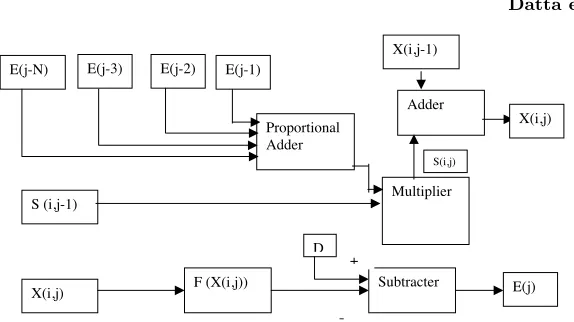
ii. If the step size is very small then it takes many chemotactic steps to reach the optimum point. So the rate of convergence decreases. For small number of iterations it may not reach optimum position. Hence the step size of each bacterium is the main determining factor for both the speed of convergence and error in final output. So it is desired to control the step size depending on how far the bacteria is from the optimum point. If deviation is very high then the step size must be increased and if the deviation is small in which case the bacterium is close to the optimum point the step size is to be reduced. Here, we have used the principle of adaptive delta modulation [31] to control the step size. In adaptive delta modulation the error or the deviation between the actual signal and the modulated signal is integrated and the output of the integrator is fed in a voltage controller that controls the step size. The algorithm we have used in the BFA is shown in the following block diagram (Figure 1).
Here, X is the parameter to be optimized to obtain the desired value D. F(X(i, j)) denote the cost function of X of ith bacterium injth chemotactic step. E(j) denotes the deviation from the desired value. S(i, j) is the step size which is modified in each chemotactic step depending on the deviations in the previous steps. The multiplier increases or reduces the step size accordingly. Parameter X for next step is obtained by adding the step size with the previous value.
Proportional Adder
E(j-3) E(j-2) E(j-1)
E(j-N)
S (i,j-1)
Adder
S(i,j)
X(i,j-1)
X(i,j)
X(i,j) F (X(i,j)) Subtracter
D
E(j) Multiplier
+
-Figure 1. Block diagram for adaptive bacteria foraging algorithm.
We have applied this ABFA in optimizing the antenna array for its maximum value in desired direction and nulls in the directions of undesired signals. For comparison, results for both BFA and ABFA have been provided.
4. PROBLEM STATEMENT
The problem is to optimize the weights of receiving antennas placed 0.5λ apart to obtain array factor maxima in desired direction and placing nulls in the directions of undesired signals as depicted in Figure 2.
θ
W(1) W(2) W(3) W(n)
Adder Y(t)
Figure 2. Receiving antenna system in noisy environment.
are the two directions from where interfering signals are arriving. In our desired normalized array factor at θdis 1 and at θn1 and θn2 is 0.
So,
AF(θd)−AF(θn1)−AF(θn2) = 1 (3)
We takeAF(θd)−AF(θn1)−AF(θn2) as our cost function which is to
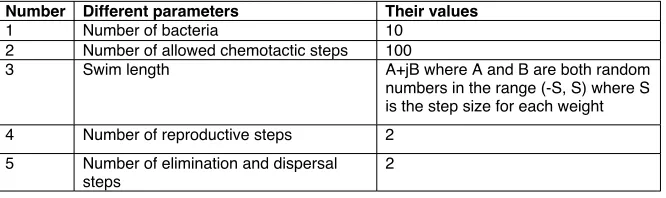
be maximized to 1 (as the maximum value for normalized array factor need to be 1 in the desired direction and zero value for the undesired direction) in which case we can completely eliminate interfering signal. Here both amplitude and phase of weights are optimized to maximize cost function. Table 1 shows the equivalent terms mapped into BF and Array Antenna and Table 2 is the parameter value for simulation.
Table 1. Equivalent terms used in the bacteria foraging and space antenna array.
Number Terms in case of bacteria foraging Equivalent term used in this application
1 Search plane For each weight complex plane
2 Placement of bacteria in search plane W(i) for i=1(1)N
3 Food concentration and scarcity of noxious elements (the greater the better)
Array factor for the given weights ( the closer to desired the better)
4 Tumble choosing of random complex number for each weight
5 Swim Addition of previous weight with step size
6 Chemotactic step Change in weights of antennas
Table 2. Numerical values for simulation.
Number Different parameters Their values
1 Number of bacteria 10
2 Number of allowed chemotactic steps 100
3 Swim length A+jB where A and B are both random numbers in the range (-S, S) where S is the step size for each weight
4 Number of reproductive steps 2
5 Number of elimination and dispersal steps
2
5. NUMERICAL RESULTS
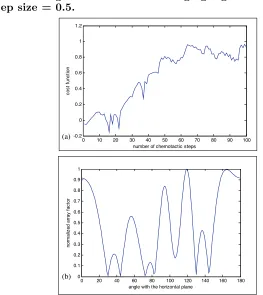
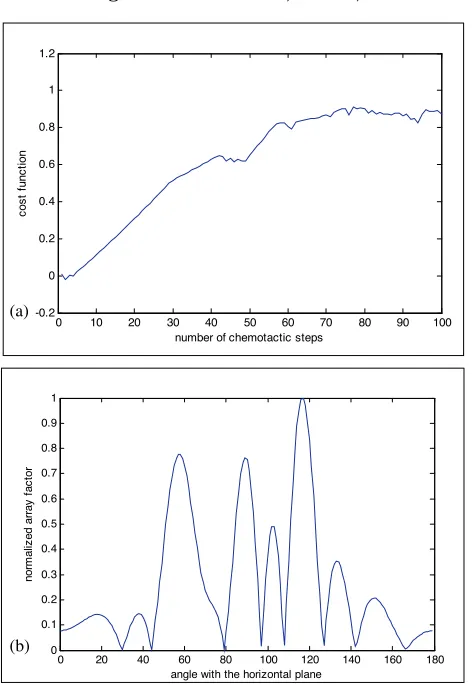
45 degree and 30 degree angle. The array factor is controlled by the weights (both amplitude and phase) to have a maxima in 120 degree and nulls in 30 and 45 degrees using the BFA. Results are presented in this section. Our objective is to get maximum cost function according to Equation (1). The chemotactic steps required to reach the goal is plotted in Figure 3(a) and the array factor after optimization is given in Figure 3(b) when considering the normal BFA [27] having fixed step size = 0.5. Figure 4 is the same representation for step size = 0.1.
A. Using normal Bacteria Foraging algorithm with fixed step size = 0.5.
0 10 20 30 40 50 60 70 80 90 100 -0.2
0 0.2 0.4 0.6 0.8 1 1.2
number of chemotactic steps
c
o
st fu
n
c
ti
o
n
(a)
0 20 40 60 80 100 120 140 160 180 0
0.1 0.2 0.3 0.4 0.5 0.6 0.7 0.8 0.9 1
angle with the horizontal plane
n
o
rm
a
liz
e
d
a
rr
a
y fa
cto
r
(b)
Figure 3. (a) Change in cost function with number of chemotactic steps, (b) normalized array factor with step size 0.5. Obtained cost function = 0.9656.
0 10 20 30 40 50 60 70 80 90 100 -0.2
0 0.2 0.4 0.6 0.8 1 1.2
number of chemotactic steps
co
st fu
n
c
ti
o
n
(a)
0 20 40 60 80 100 120 140 160 180
0 0.1 0.2 0.3 0.4 0.5 0.6 0.7 0.8 0.9 1
angle with the horizontal plane
norm
a
liz
ed
a
rray
fac
to
r
(b)
Figure 4. (a) Change in cost function with number of chemotactic steps, (b) normalized array factor with step size 0.1. Obtained cost function = 0.8724.
C. Using proposed adaptive Bacteria Foraging algorithm with varying step size
From Figure 5, it is clearly observed that ABFA shows faster convergence compared to normal BFA. In this particular case, ABFA is almost 5 times faster. Also it can efficiently provide desired result.
D. Adaptive BFA with 3 interfering signals coming from 30 degree, 45 degree and 150 degree with desired signal from 120 degree
0 10 20 30 40 50 60 70 80 90 100 -0.6
-0.4 -0.2 0 0.2 0.4 0.6 0.8 1
number of chemotactic steps
co
st f
u
n
c
ti
o
n
0 20 40 60 80 100 120 140 160 180
0 0.1 0.2 0.3 0.4 0.5 0.6 0.7 0.8 0.9 1
angle with the horizontal plane
no
rm
a
liz
ed
a
rray
fac
to
r
(b) (a)
Figure 5. (a) Change in cost function with number of chemotactic steps, (b) normalized array factor with variable step size. Obtained cost function = 0.9954.
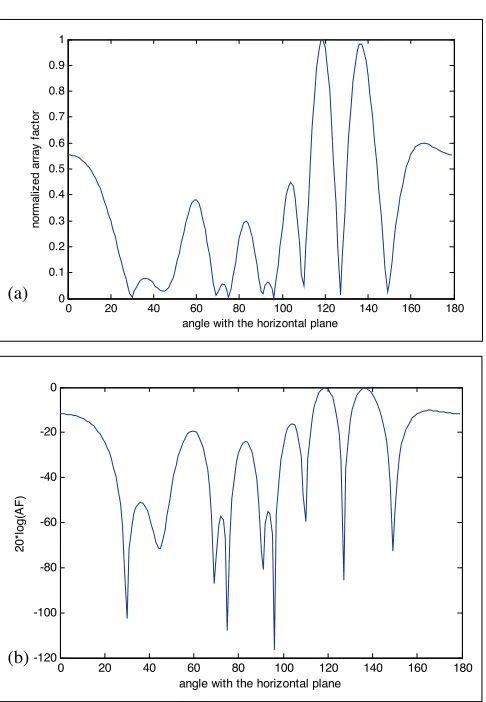
the nulls at 30 and 45 degrees, one additional null at 150-degree occurs. E. Adaptive BFA with four interfering signals at 30, 45, 150 and 60 degrees
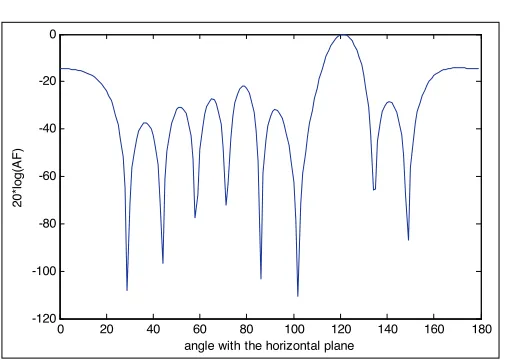
Figure 7 is the plot for array factor in dB. The presence of additional null at 60 degree proves that adaptive BFA is efficient enough to nullify nulls in the undesired nulls.
0 20 40 60 80 100 120 140 160 180 0
0.1 0.2 0.3 0.4 0.5 0.6 0.7 0.8 0.9 1
angle with the horizontal plane
norm
a
li
z
e
d
arra
y
fa
c
tor
0 20 40 60 80 100 120 140 160 180
-120 -100 -80 -60 -40 -20 0
angle with the horizontal plane
20*
log(
A
F
)
(a)
(b)
Figure 6. (a) Normalized array factor, (b) array factor expressed in dB for 3 interfering noise signal obtained cost function = 0.9268.
40 dB higher than undesired signal direction. So significant elimination of interfering signals can be achieved even in a very noisy situation. In this optimization we have not considered the condition for side lobe suppression in other direction. That is why in Figure 6 the presence of side lobe near 140◦ is observed. This could be eliminated by imposing extra constraints on the side lobe suppression.
0 20 40 60 80 100 120 140 160 180 -120
-100 -80 -60 -40 -20 0
angle with the horizontal plane
20*
log(A
F
)
Figure 7. Normalized array factor expressed in dB for four interfering noise signals. Obtained cost function = 0.9008.
So this algorithm can be used less number of chemotactic steps that makes it faster.
6. CONCLUSION
In this paper, null steering in radiation pattern is done using improved Bacteria Foraging Algorithm by controlling both the amplitude and phase of weights. The BFA is made adaptive using the principle of adaptive delta modulation. The results are obtained for 6 element linear array. Results show that the weights are successfully optimized to obtain desired array factor. The proposed ABFA also capable of synthesizing patterns with multiple nulls at any desired direction. This method is very simple and thus can be used in other optimizing problems also. The proposed adaptive BFA may provide faster solution when problem space is large.
REFERENCES
1. Balanis, C. A.,Antenna Theory Analysis and Design, 2nd edition, John Wiley & Sons, Inc., 2001.
3. Shore, R. A., “Nulling at symmetric pattern location with phase only weight control,” IEEE Trans. Antennas Propagat., Vol. 32, 530–533, 1984.
4. Haupt, R. L., “Phase-only adaptive nulling with a genetic algorithm,”IEEE Trans. Antennas Propagat., Vol. 45, 1009–1015, 1997.
5. Ismail, T. H. and M. M. Dawoud, “Null steering in phased arrays by controlling the element positions,” IEEE Trans. Antennas
Propagat., Vol. 39, 1561–1566, 1991.
6. Tennant, A., M. M. Dawoud, and A. P. Anderson, “Array pattern nulling by element position perturbations using a genetic algorithm,”Electronics Letters, Vol. 30, 174–176, 1994.
7. Liao, W. P. and F. L. Chu, “Array pattern nulling by phase and position perturbations with the use of the genetic algorithm,”
Microwave and Optical Technology Letters, Vol. 15, 251–256, 1997.
8. Abu-Al-Nadi, D. I., T. H. Ismail, and M. J. Mismar, “Interference suppression by element position control of phased arrays using LM algorithm,”Int. J. Electron. Commun., Vol. 60, 151–158, 2006. 9. Hejres, J. A., “Null steering in phased arrays by controlling the
positions of selected elements,”IEEE Trans. Antennas Propagat., Vol. 52, 2891–2895, 2004.
10. Haupt, R. L., “Thinned arrays using genetic algorithms,” IEEE
Trans. Antennas Propagat., Vol. 42, No. 7, 993–999, July 1994.
11. Johnson, J. M. and Y. Rahmat-Samii, “Genetic algorithms in engineering electromagnetics,” IEEE Antennas and Propagation
Magazine, Vol. 39, No. 4, 7–20, Aug. 1997.
12. Rahamat-Samii, Y. and E. Michielssen (eds), Electromagnetic
Optimization by Genetic Algorithms, John Wiely & Sons, New
York, 1999.
13. Chung, Y. C. and R. L. Haupt, “Amplitude and phase adaptive nulling with a genetic algorithm,” Journal of Electromagnetic
Waves and Applications, Vol. 14, 631–649, 2000.
14. Mouhamadou, M. P. and M. Rammal, “Smart antenna array patterns synthesis: Null steering and multi-user beamforming by phase control,” Progress In Electromagnetics Research, PIER 60, 95–106, 2006.
15. Kirkpatrick, S., C. D. Gellat, and M. P. Vecchi, “Optimization by simulated annealing,”Science, Vol. 220, 671–679, 1983.
16. Krishnakumar, K., “Micro-genetic algorithms for stationary and nonstationary function optimization,” Intelligent Control and
17. Haouari, M. and J. C. Sinha, “A hybrid lagrangian genetic algorithm for the prize collecting steiner tree problem,”Computers
and Operation Research 33, Vol. 5, 1274–1288, 2006.
18. Mahanti, G. K., A. Chakrabarty, and S. Das, “Phase-only and amplitude-phase only synthesis of dual-beam pattern linear antenna arrays using floating-point genetic algorithms,”Progress
In Electromagnetics Research, PIER 68, 247–259, 2007.
19. Robinson, J. and Y. Rahmat-Samii, “Particle swarm optimization in electromagnetics,” IEEE Transaction on Antennas and
Propagation, Vol. 52, No. 3, 771–779, 2004.
20. Gies, D. and Y. Rahmat-Samii, “Particle swarm optimization for reconfigurable phase-differentiated array design,”Microwave and
Optical Technology Letters, Vol. 38, 168–175, 2003.
21. Mahmoud, K. R., K. R. M. El-Adawy, S. M. M. Ibrahem, R. Bansal, and S. H. Zainud-Deen, “A comparison between circular and hexagonal array geometries for smart antenna systems using particle swarm optimization algorithm,” Progress
In electromagnetic Research, PIER 72, 75–90, 2007.
22. Hosseini, S. A. and Z. Atlasbaf, “Optimization of side lobe level and fixing quasi-nulls in both of the sum and difference patterns by using continuous ant colony optimization (ACO) method,”
Progress In Electromagnetics Research, PIER 79, 321–337, 2008.
23. Passino, K. M., “Biomimicry of bacterial foraging for distributed optimization and control,” IEEE Control Systems Magazine, Vol. 22, No. 3, 52–67, June 2002.
24. Tripathy, M. and S. Mishra, “Bacteria foraging-based solution to optimize both real power loss and voltage stability limit,” IEEE
Transactions on Power Systems, Vol. 22, No. 1, February 2007.
25. Mishra, S., “A hybrid least square-fuzzy bacteria foraging strategy for harmonic estimation,” IEEE Trans. Evol. Comput., Vol. 9, No. 1, 61–73, Feb. 2005.
26. Guney, K. and S. Basbug, “Interference suppression of linear antenna arrays by amplitude-only control using a bacterial foraging algorithm,” Progress In Electromagnetics Research, PIER 79, 475–497, 2008.
27. Mangaraj, B. B., I. S. Misra, and A. K. Barisal, “Optimizing included angle of symmetrical V-dipole for higher directivity using bacteria foraging algorithm,” Progress In Electromagnetic
Research B, Vol. 3, 295–314, USA, 2008.
2006.
29. Kim, D. H., A. Abraham, and J. H. Cho, “A hybrid genetic algorithm and bacterial foraging approach for global optimization,”Information Sciences, Vol. 177, 3918–3937, 2007. 30. Niu, B., Y. Zhu, X. He, and X. Zeng, “Optimum design of PID
controllers using only a germ of intelligence,”6th World Congress
on Intelligent Control and Automation, 3584–3588, Dalian, China,
June 2006.
31. Lathi, B. P.,Modern Digital and Analog Communication Systems, 3rd edition, Oxford University Press, 1998.
32. Vescovo, R., “Beam scanning with null and excitation constraints for linear arrays of antennas,” Journal of Electromagnetic Waves
and Applications, Vol. 21, No. 2, 267–277, 2007.
33. Zhai, Y.-W., X.-W. Shi, and Y.-J. Zhao, “Optimized design of ideal and actual transformer based on improved micro-genetic algorithm,” Journal of Electromagnetic Waves and Applications, Vol. 21, No. 13, 1761–1771, 2007.
34. Lee, K.-C., C.-W. Huang, and Y.-H. Chen, “Analysis of nonlinear microwave circuits by particle swarm algorithm,” Journal of
Electromagnetic Waves and Applications, Vol. 21, No. 10, 1353–
1365, 2007.