Scholarship@Western
Scholarship@Western
Electronic Thesis and Dissertation Repository
August 2010
The Development and Validation of an Expertise Development
The Development and Validation of an Expertise Development
Model for Sport Coaches
Model for Sport Coaches
Melissa L. WimanUniversity of Western Ontario
Supervisor Dr. Alan Salmoni
The University of Western Ontario Graduate Program in Kinesiology
A thesis submitted in partial fulfillment of the requirements for the degree in Doctor of Philosophy
© Melissa L. Wiman 2010
Follow this and additional works at: https://ir.lib.uwo.ca/etd
Part of the Other Psychology Commons
Recommended Citation Recommended Citation
Wiman, Melissa L., "The Development and Validation of an Expertise Development Model for Sport Coaches" (2010). Electronic Thesis and Dissertation Repository. 8.
https://ir.lib.uwo.ca/etd/8
This Dissertation/Thesis is brought to you for free and open access by Scholarship@Western. It has been accepted for inclusion in Electronic Thesis and Dissertation Repository by an authorized administrator of
MODEL FOR SPORT COACHES
(Spine title: Coaching Expertise Development)
(Thesis format: Integrated-Article)
By
Melissa Lynette Wiman
Graduate Program in Kinesiology
A thesis submitted in partial fulfillment
of the requirements for the degree of
Doctor of Philosophy
The School of Graduate and Postdoctoral Studies
The University of Western Ontario
London, Ontario, Canada
ii
THE UNIVERSITY OF WESTERN ONTARIO School of Graduate and Postdoctoral Studies
CERTIFICATE OF EXAMINATION
Supervisor
______________________________ Dr. Alan Salmoni
Supervisory Committee
______________________________ Dr. Craig Hall
Examiners
______________________________ Dr. Philip Sullivan
______________________________ Dr. Alan Edmunds
______________________________ Dr. Volker Nolte
______________________________ Dr. Karen Danylchuk
The thesis by
Melissa Lynette Wiman
entitled:
The Development and Validation of a Coaching Expertise
Development Model for Sport Coaches
is accepted in partial fulfillment of the requirements for the degree of
Doctor of Philosophy
iii
Abstract
The objective of this dissertation was to develop and validate a model for coaching
expertise development using semi-structured interviews. The aim of Study One was twofold:
first, to examine how coaching expertise is defined and second, to investigate how this
expertise develops over time. Interviews were completed with elite athletes and elite coaches
and were done in the tradition of grounded theory. Results suggested that there is a need to
go beyond identifying a coach as an expert based on the performance of his/her athletes.
Some of the additional criteria suggested included: be recognized by peers (other coaches) as
experts; be recognized by athletes as experts, and have successful athletes/teams at any level
of competition. The intention of Study Two was to describe, in more detail, mechanisms for
coaching expertise development identified in a previous study (Wiman, Salmoni & Hall,
2010). Seven varsity coaches were interviewed. It was found that open-mindedness seemed
to be an essential learned characteristic in supporting the development of expertise. Coaches
discussed using both internal and external feedback mechanisms and indicated a variety of
ways in which they used this feedback to continually better themselves. Central to this
process, coaches assessed the needs of athletes as a basis for their evaluation of their own
strengths and weaknesses as a coach. A major source of information used to develop
expertise is introspection. Coaches reported using introspection primarily for self-evaluation
and to gain self-awareness. Mentoring other coaches and being mentored were also
discussed. Finally, a model to place these ideas into a developmental process was proposed.
The aim of the third and final study was to validate a model for the development of coaching
expertise presented by Wiman, Salmoni and Hall in studies one and two. Five novice and
iv
both implicitly and explicitly by the interviewees. Feedback provided by the participants
suggested that motivation needed to be added as an explicit component within the model.
Some other suggestions on how to facilitate the self-adaptation process described by the
v
Keywords
Coaching Development
Expertise
Expert Coaching
Learning
vi
Co-Authorship Statement
The author, under the supervision and mentorship of Dr. Alan Salmoni, conducted the
work in this doctoral dissertation. This encompasses the experimental conception, design,
and implementation; data collection, analysis and interpretation; and manuscript preparation.
This doctoral dissertation contains material that has been accepted for publication. The work
contained in chapter 2, 3 and 4 was co-authored by Alan W. Salmoni and Craig R. Hall.
vii
Acknowledgments
I would like to thank my funding agencies for making this research possible: The
Coaching Association of Canada and the University of Western Ontario (Graduate Thesis
Research Awards).
My PhD advisor, Dr. Alan Salmoni has provided me with unlimited guidance. He is
a caring teacher and wonderful role model. He is to be commended on his ability to
supervise students in a wide spectrum of research areas with such ease.
Dr. Craig Hall has been a friendly face since my first day at Western. I am lucky to
have had the opportunity to work with Craig. Thank you for your guidance and support.
Thank you to my study participants. Your dedication is greatly appreciated and I
think you have all made a special contribution to the world of coaching education.
viii
Table of Contents
CERTIFICATE OF EXAMINATION ... ii
Abstract ... iii
Keywords………..v
Co-Authorship Statement..………..vi
Acknowledgments……….……….vii
Table of Contents... viii
List of Tables ... xi
List of Figures ... xii
List of Appendices ... xiii
List of Abbreviations ... xiv
Chapter 1 General Introduction ... 1
The Definition of an Expert Coach ...Error! Bookmark not defined. Characteristics of Expert Coaches ... 4
The Development of Coaching Expertise and Coach Learning………..5
Thesis Objectives………...9
References ... 10
Chapter 1 An Examination of the Definition and Development of Expert Coaching ... 13
Introduction ... 14
Methodology ... 19
Results ... 23
Discussion ... 31
Conclusions ... 39
ix
Chapter 3 Open-Mindedness, Feedback, Introspection and Mentoring Their Role in Coaching
Expertise Development………..45
Introduction ... 46
Methodology ... 50
Results ... 53
Discussion ... 63
Conclusion ... 68
References ... 69
Chapter 4 Validation of a Proposed Model for Coaching Expertise Development with Canadian Rowing Coaches………73
Introduction ... 74
Methodology ... 76
Results ... 79
Discussion ... 88
Conclusion ... 93
References ... 94
Chapter 5 General Discussion………95
Summary of Thesis Studies... 96
Comparison of Findings to the Deliberate Practice Framework ... 101
Suggestions from Study Participants ... 103
Suggestions for Coaching Development... 104
Limitations ... 112
Future Studies ... 113
Conclusions ... 114
x
Appendices ... 117
Appendix A ... 118
Appendix B ... 127
Appendix C ... 142
xi
List of Tables
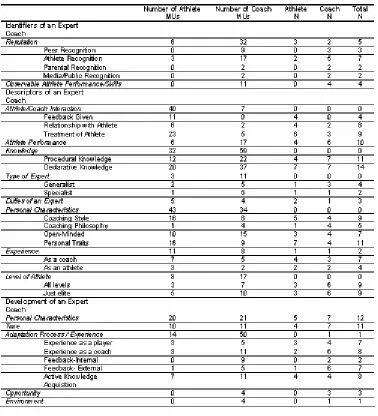
2.1 Number of Meaning Units for Each Category and Number of Participant
Contributions to Each Category 24
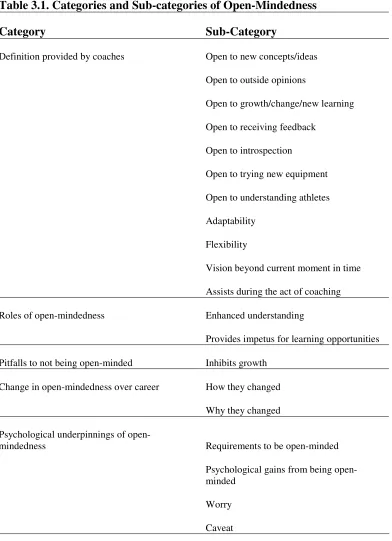
3.1 Categories and Sub-Categories of Open-Mindedness 55
3.2 Categories and Sub-Categories of Introspection 58
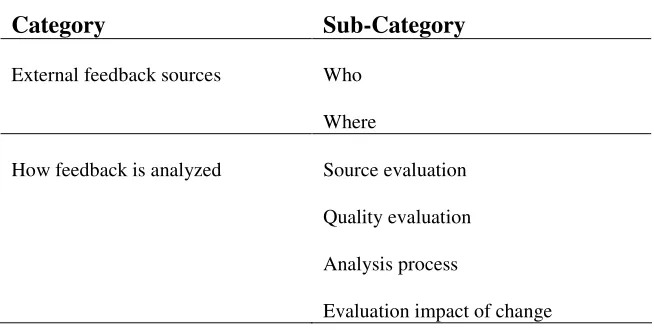
3.3 Categories and Sub-Categories of External Feedback 59
3.4 Categories and Sub-Categories of
Identification of Strengths and Weaknesses 61
3.5 Categories and Sub-Categories of Mentor Coaching 63
xii
List of Figures
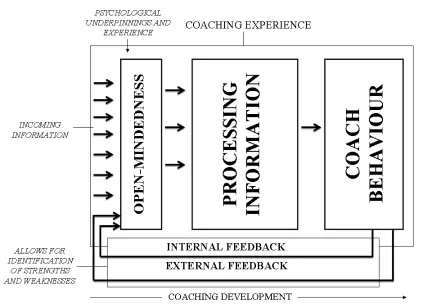
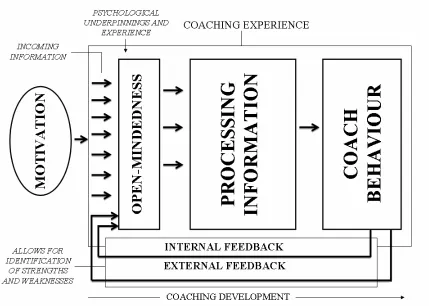
3.1 Proposed Model for Coaching Expertise Development 67
3.2 Modified Model for the Self-Adaptive Coaching Expertise
xiii
List of Appendices
A Ethics Approval Forms 118
B Expanded Results Tables for Chapter 3 127
C Permission from the Publisher of the International Journal of Coaching Science for
xiv
List of Abbreviations
NCAA- National Collegiate Athletic Association
NCCP- National Coaching Certification Program
CHAPTER 1
Our knowledge of how coaches develop expertise is meager compared to the
knowledge we have about the same process for athletes, and thus, more studies are
needed to enhance our understanding of this process. Bloom (1986) has highlighted the
importance of quality coaching in developing athletes so it is imperative that we, as a
research community, understand the process of coaching expertise development. A better
understanding of this process will be useful in developing effective coaching education
initiatives that could lead to better coaches.
Expertise development in athletes has been widely studied (i.e., Hodges, Kerr,
Starkes, Weir & Nananidou, 2004; Baker, Côté & Abernethy, 2003; Ward & Williams,
2003). Ericsson, Krampe and Tesch-Römer (1993) proposed a theory of expertise
development that has provided the theoretical framework for much of the recent expertise
research, particularly in sport. The group identified one factor that contributes to expert
performance- deliberate practice over the course of a minimum of ten years (or 10,000
hours). Deliberate practice is a type of practice that requires a large amount of effort
(either physical or mental or both), is relevant to improving performance and is not
inherently enjoyable. It must be noted, however, that Hodges et al. (2004) have shown
that in sport, athletes deemed practice enjoyable. Deliberate practice is also highly
structured. Another tenet of this theory is that the performer must receive valid,
immediate feedback on his or her performance in order to improve. Ford, Coughlin and
Williams (2009) have suggested that deliberate practice in coaching could be defined by
a coach’s intention to improve while engaging in any coaching-related activity.
However, because of the relative scarcity of coaching development research, it is not
known whether the deliberate practice model that has evolved for athlete development
holds for the development of expertise in coaches. The purpose of the present research
was to explore the developmental processes, as described by elite coaches, which
underpin their development of coaching expertise. A clarification of the structure of these
developmental processes should provide knowledge that can be used to facilitate the
The Definition of an Expert Coach
There are several issues surrounding the study of coaching expertise that need to
be addressed. One pressing issue is how we define expert coaching performance.
According to Ericsson and Charness (1994), expert performers must demonstrate superior
performance, not merely be perceived to be an expert, although, many researchers have
used the perception of others or membership in a group to identify the experts to be
studied. For example, Baker et al. (2003) selected expert decision makers in ball sports
(netball, field hockey and basketball) by allowing their national team coaches to choose
them based on their status as the best decision makers in their respective sports. Various
other criteria have been used to identify experts in given domains. Ste-Marie (1999)
deemed a gymnastics judge with the following resume to be an expert: 10 or more years
of experience, ability to judge at the National or International level and be a Level V
provincial judge. Ward and Williams (2003) identified expert soccer players on the basis
of national team membership while novice players were defined by their status as
recreational team athletes.
In coaching, the current research practice is to define coaches as expert based
primarily on the performance of their athletes and years of experience. For instance,
Horton, Baker and Deakin (2005) observed coaching behaviours of expert coaches and
these coaches were considered experts based on their status as National Team coaches.
Côté, Salmela, Trudel, Baria and Russell (1995) defined an expert gymnastics coach
using the following criteria: the coach must have had at least 10 years of coaching
experience, the minimal level the person must coach at was provincial, the coach must
have developed at least one international athlete or two national athletes and was
recognized by the national association as a coach who develops elite athletes. Hardin
(2000) defined expert high-school level coaches as: having a minimum of 5 years of
coaching experience, having a win/loss record of at least 70% or higher, having two or
more playoff titles, peer recognition as an outstanding coach, and had leadership roles via
coach training or leading sporting clinics. Côté and Sedgwick (2003) provided a
definition of both coaches and athletes in the sport of rowing. The coaches in the study
have had a minimum of 10 years of experience, developed several international-level
athletes, and been recognized by their peers. The elite rower had to be an international
competitor and have competed at one or more of the following: Commonwealth Games,
World Championships or Olympic Games. Similarly, Nash and Sproule (2009) identified
expert coaches for their study based on four criteria: 10 or more years of coaching
experience, coaching athletes at a representative level (district or national), continual
development of national performers, and holding the highest available coaching award
from their national governing body.
As evidenced by the previous examples, there is no consistent definition an expert
coach. Abraham, Collins and Martindale (2006) have suggested that there is a need to
explicitly define expert coaching performance so that the criteria identified can be used in
future research. Nash and Sproule (2009) made the same suggestion by making it known
that one should question the criteria they have used in their study. Recently, Côté and
Gilbert (2009) provided a proposed integrative definition of coaching effectiveness and
expertise that included coaches’ intrapersonal knowledge (i.e., ability for introspection
and understanding of oneself), interpersonal knowledge (i.e., interaction with others), and
professional knowledge (i.e., declarative knowledge of sport science, the sport itself and
pedagogy). Moreover, they argued that in order to be considered an expert, a coach
needs to attain extensive knowledge and demonstrate coaching effectiveness over a
prolonged period. The process by which a coach attains interpersonal, intrapersonal and
professional knowledge is a focus of the current study.
Characteristics of Expert Coaches
Several concrete characteristics of coaches can be easily quantified (e.g., win/loss
record, years of experience, certification level [in Canada, NCCP level], number of titles
won by athletes). Are there other common characteristics of expert coaches that can be
seen or measured that can contribute to one being identified as an expert? Hardin (2000)
investigated characteristics of expert high school coaches. Three themes emerged from
the analysis of their interviews, documents and field observations. The coaches reported
considered this necessary for their improvement. The coaches also cited experience in
their sport as a player as an important facet in their coaching ability. Only one coach in
this study reported that experience as a coach was important. Horton, Baker and Deakin
(2005) observed five expert national team coaches of team sports during practice sessions
and rated the coaches’ behaviour using the Revised Coaching Behaviour Recording Form
(RCBRF) (Bloom, Crumpton, & Anderson, 1999; revised by Horton et al., 2005). They
also interviewed the coaches and some of their athletes. Results indicated that expert
coaches emphasized tactical instruction, followed by general instruction and then
technical instruction, as measured by frequency and duration of these behaviours during
practice. Praise and encouragement was also used quite frequently, although of a shorter
duration. Scolds, criticism/re-instruction and nonverbal punishment were the least
frequent behaviours of the coaches. The qualitative interviews with the coaches and
athletes provided support for the results from the RCBRF as the participants in the study
created a vision of a supportive coach that demands effort and intensity during training.
In another study on characteristics of expert coaches, Côté and Sedgwick (2003)
identified seven major categories of expert (rowing) coaching behaviour. In this study,
both expert coaches and elite athletes were interviewed. It is rare that athletes are
participants in expert coaching studies. This is curious since the athlete’s success is
partly due to the ability of the coach. According to the results, expert rowing coaches
plan proactively for training and competition, create a positive training environment,
facilitate the athletes’ goal setting, build the athletes’ confidence, teach technical, and
physical skills effectively (instruction and feedback was included in this category),
recognize individual differences in the athletes and establish positive personal
relationships with each athlete. Although the information emanating from the
aforementioned studies is useful, it does not provide us with a detailed description of the
process that underpins the development of coaching expertise.
The Development of Coaching Expertise and Coach Learning
Although the above studies have provided information about expert coaches’
characteristics and behaviours while coaching, there is much less known about how these
becoming an expert. Salmela (1995) studied the development of expertise in expert team
sport coaches. Commonalities amongst these coaches were involvement in several sports
as young athletes, working with and learning from more experienced coaches early in
their coaching careers, consulting with and learning from other expert coaches, learning
from experiences and continuing education (formal training included). In another study
on coaching expertise, Fleurance and Cotteau (1999) identified seven major themes in
how coaches develop: formal education, experience as a player in the sport, coaching
experience, working with mentors, interaction with high level athletes, ongoing education
and a personal commitment to coaching. Knowledge of the experiences necessary for
becoming an expert is essential but does not provide a description of the expertise
development process as a whole.
In a different approach to the study of expert coaching, Gilbert, Côté and Mallett
(2006) studied the developmental paths and activities of successful high school,
community college and college level coaches in three different sports. All of the coaches
in the study had extensive involvement in various sports as athletes. In fact, the
researchers reported that a minimum of several thousand hours of playing participation
was common amongst the coaches in this study over an average of 13 years. The more
elite coaches in the group (Division 1 NCAA) specialized in fewer sports as youths than
the lower level coaches (high school). The college coaches also spent more time per year
participating in activities that promoted their coaching development. All coaches spent
only a small amount of time participating in formal coach training. The results suggested
differences across sport and level of competition; therefore, the authors proposed that the
study of coaching developmental pathways must be coaching-context specific.
Young, Jemcyzyk, Brophy and Côté (2009) sought to identify learning
experiences that discriminated four groups of Canadian track and field coaches: local
club, senior club, provincial and national level. The national level coaches had been
coaching the longest, spent the most time (in hours) interacting with athletes, attended
more championship events, had more mentors over the course of their careers and had
Erickson, Côté and Fraser-Thomas (2007) sought to discover what experiences
are necessary for one to become a high-performance coach. The participants were 19
coaches of elite athletes (both team and individual sports). Retrospective interviews
provided the data for analysis. Commonalities amongst the coaches were: experience as
an athlete within the sport they currently coach and some formal training or mentoring.
Coaches in this study also had extensive coaching experience prior to becoming high
performance coaches. The team sport coaches had the common thread of prior leadership
experience (e.g., being a team captain as an athlete). Nash and Sproule (2009)
interviewed nine expert coaches to determine if this group of coaches was able to explain
how they became expert coaches. Experience, knowledge, personal characteristics,
networking, and philosophy were themes that emerged in the coaches’ explanations for
how they developed into experts. Therefore, while experience as a coach has been a
commonly identified factor supporting coaching development, little is known about the
specific details of this (developmental) experience. While criteria for identifying expert
coaches have often been studied, how personal characteristics might relate to coaching
skill development has received much less attention. Indeed, there may be characteristics
of a coach critical to the development of expertise that are not as important once a coach
becomes an expert. The present research focuses on whether or not there are certain
personal characteristics that are integral to the expertise development process.
Although the above studies have given us valuable information that helps us
understand expert coaching, they tell us much less about the specific developmental
processes supporting the accrual of expertise. Another group of studies aimed to provide
a theoretical framework for this process. Werthner and Trudel (2006) presented Moon’s
(1999, 2004) generic view of learning as a method for how coaches learn to coach. This
framework identified three types of learning situations: mediated, unmediated and
internal. Mediated learning situations are externally driven, unmediated learning
situations are internally driven by the coach and internal learning situations are
essentially episodes of self-reflection. An example of a mediated learning situation would
be formal coach training clinics and an unmediated learning situation would be when a
coach decides to seek out a mentor coach for advice. Internal learning situations occur
base. All three situations were identified as valuable sources of knowledge acquisition.
Werthner and Trudel suggested that coaches will create their own learning situations and
are reflective in the interest of learning.
Nelson, Cushion and Potrac (2006) discussed formal, non-formal and informal
coach learning employing Coombs and Ahmed’s (1974) model. According to this model
formal learning would include coach training and formal education. Non-formal learning
includes attending conferences, seminars and coaching clinics. The term informal
learning is used interchangeably with self-directed learning and includes such things as
experiences accrued as a player, coaching experience, informal mentoring and interaction
with peers and athletes. Other learning ventures such as reading books, visiting websites
and watching videos fall into this category. Although these models are informative they
lack specific detail, particularly the temporal component of the lived experiences
supporting a developmental process.
Werthner and Trudel (2009) interviewed 15 Canadian Olympic coaches in a
variety of sports: athletics, canoe/kayak, figure skating, freestyle ski, gymnastics, ice
hockey, Paralympic athletics, soccer, speed skating, rowing, and wrestling to further
elucidate the idiosyncratic nature of a coach’s learning path. The results suggested that
there were commonalties amongst the group of coaches such as former athletic
experience in the sport they coach (although one coach did not have such experience), the
use of mentors, formal education and a devotion to development. Most importantly, it
was found that the coaches were active participants in their learning process.
Abraham, Collins and Martindale (2006) presented and validated a model in the
form of a schematic that reflects the coaching process. In terms of coaching
development, the authors suggested that coaching development is not a structured process
and occurs through serendipitous methods. These methods included coaching courses,
academic ventures, playing and coaching experience and reading, amongst other
activities. The coaches in their study exhibited an interest in learning and improving.
A common thread between some of the studies previously mentioned is the
(Abraham et al, 2006) and is idiosyncratic (Werthner and Trudel, 2009). The
aforementioned literature has highlighted certain learning experiences and activities that
coaches have engaged in to become expert or elite but none of these studies has
delineated a model that explains the underlying process of coaching expertise
development that is based on empirical evidence.
Thesis Objectives
The goal of the current line of research was to develop and validate a model that
describes the processes and structures that underpin the development of coaching
expertise. Using a grounded theory protocol, the objective of Study One was twofold.
The first goal was to find out how elite coaches and athletes describe coaching expertise
and the second objective was to explore the descriptions of the processes underlying their
own developmental trajectories. The goal for Study Two was to expand the description
and improve the clarity of the components of the developmental model described by
coaches in Study One. Study Three was done to validate and refine the proposed model.
Abraham, Collins and Martindale (2006) argued that further research was needed on how
coaches develop in order to build programs that effectively foster coach development.
The greater goal of this dissertation was to provide sound suggestions for coaching
References
Abraham, A., Collins D. & Martindale, R. (2006). The coaching schematic: Validation
through expert coach consensus. Journal of Sports Sciences, 24(6), 549-564.
Baker, J., Côté, J. & Abernethy, B. (2003). Sport-specific practice and the development
of expert decision-making in team ball sports. Journal of Applied Sport
Psychology, 15(1), 12-25.
Bloom. B.S. (1986). Developing Talent in Young People. New York: Ballantine.
Bloom, G.A., Crumpton, R. & Anderson, J.E. (1999). A systematic observation study of
the teaching behaviors of an expert basketball coach. TheSport Psychologist,
13, 157-170.
Coombs, P.H., & Ahmed, M. (1974). Attacking rural poverty: how nonformal education
canhelp. Johns Hopkins University Press:Baltimore., cited in: Nelson, L.J.,
Cushion, C.J. & Potrac, P. (2006). Formal, nonformal and informal coach
learning: a holistic conceptualization. International Journal of Sports Science &
Coaching, 1(3), 247-259.
Côté, J. & Gilbert, W. (2009). An integrative definition of coaching effectiveness and
expertise. International Journal of Sports Science & Coaching, 4(3), 307-323.
Côté, J., Salmela, J., Trudel, P., Baria, A. & Russell, S. (1995). The coaching model: A
grounded assessment of expert gymnastic coaches’ knowledge. Journal of
Sport and Exercise Psychology, 17(1), 1-17.
Côté, J. & Sedgwick, W.A. (2003). Effective behaviours of expert rowing coaches: A
qualitative investigation of Canadian athletes and coaches. International Sports
Journal, 7(1), 62-77.
Erickson, K., Côté, J. & Fraser-Thomas, J. (2007). The sport experiences, milestones, and
coaches. The Sport Psychologist, 21, 302-316.
Ericsson, K.A. & Charness, N. (1994). Expert Performance: Its Structure and
Acquisition. American Psychologist, 49(8), 725-747.
Ericsson, K.A., Krampe, R.T., & Tesch-Römer, C. (1993). The role of deliberate
practice in the acquisition of expert performance. Psychological Review, 100(3),
363-406.
Fleurance, P. & Cotteau, V. (1999). Construction de l’expertise chez les entraîneurs
sportifs d’athlètes de haut-niveau français. Avante, 5(2), 54-68, cited in,
Wright, T., Trudel, P. & Culver, D. (2007). Learning how to coach: The different
learning situations reported by youth ice hockey coaches. Physical Education
and Sport Pedagogy, 12(2), 127-144.
Ford, P., Coughlan, E. & Williams, M. (2009). The expert-performance approach as a
framework for understanding and enhancing coaching performance, expertise and
learning. International Journal of Sports Science & Coaching, 4(3), 451-463.
Gilbert, W., Côté, J. & Mallett, C. (2006). Developmental paths and activities of
successful sport coaches. International Journal of Sports Science & Coaching,
1(1), 69-76.
Hardin, B. (2000). Coaching expertise in high school athletics: Characteristics of expert
high school coaches. Applied Research in Coaching and Athletics Annual, 15,
24-38.
Hodges, N.J., Kerr, T., Starkes, J.L., Weir, P.L. & Nananidou, A. (2004). Predicting
performance times from deliberate practice hours for triathletes and swimmers:
what, when, and where is practice important? Journal of Experimental Psychology:
Applied. 10(4), 219-237.
Horton, S., Baker, J. & Deakin, J. (2005). Expert in action: A systematic observation of 5
national team coaches. International Journal of Sport Psychology, 36(4),
Moon, J.A. (1999). Reflection in learning and professional development: Theory and
practice. London: Kogan Page.
Moon, J.A. (2004). A handbook of reflective and experiential learning: Theory and
practice. London: Routledge Falmer.
Nash, C.S. & Sproule, J. (2009). Career development of expert coaches. International
Journal of Sports Science & Coaching, 4(1), 121-138.
Nelson, L.J., Cushion, C.J. & Potrac, P. (2006). Formal, nonformal and informal coach
learning: a holistic conceptualization. International Journal of Sports Science &
Coaching, 1(3), 247-259.
Salmela, J.H. (1995). Learning from the development of expert coaches. Coaching and
Sport Science Journal,1(2), 3-13.
Ste. Marie, D.M. (1999). Expert-novice differences in gymnastic judging: An
information-processing perspective. Applied Cognitive Psychology, 13(3),
269-281.
Ward, P. & Williams, M.A. (2003). Perceptual and cognitive skill development in
soccer: The multidimensional nature of expert performance. Journal of Sport &
Exercise Psychology, 25, 1, 93-111.
Werthner, P. & Trudel, P. (2006). A new theoretical perspective for understanding
how coaches learn to coach. The Sport Psychologist, 20, 198-212.
Werthner, P. & Trudel, P. (2009). Investigation the idiosyncratic learning paths of elite
Canadian coaches. International Journal of Sports Science & Coaching, 4(3),
433-449.
Young , B., Jemczyk, K., Brophy, K. and Côté. J. (2009). Discriminating skilled
coaching groups: quantitative examination of developmental experiences and
CHAPTER 2
An Examination of the Definition and Development of Expert Coaching
A version of this chapter has been accepted for publication:
Wiman, M., Salmoni, A.W. and Hall, C.R. (2010). An Examination of the Definition and
Development of Expert Coaching. International Journal of Coaching Science.
Introduction
It is important that we understand how coaches develop expertise so we can
provide the best training possible. Bloom (1986) highlighted the importance of quality
coaching in developing athletes so it is surprising that more studies have not been
undertaken on coaching development. Our knowledge, as a research community, of how
coaches develop expertise is meager, and more studies are needed to enhance our
understanding of this process. There are several issues surrounding the study of coaching
expertise that need to be addressed, including how we define an expert coach. Our study
aims to enhance understanding in this area.
The Definition of an Expert Coach
According to Ericsson and Charness (1994), expert performers must demonstrate
superior performance to be perceived as an expert. Researchers have used the perceptions
of others or membership in a group to identify the experts to be studied. For instance,
Baker, Côté and Abernethy (2003) selected expert decision-makers in ball sports
(netball, field hockey and basketball) by allowing their national team coaches to choose
them based on their status as the best decision makers in their respective sports.
Alternatively, Ste. Marie (1999) deemed a gymnastics judge with the following resume to
be an expert: 10 or more years of experience, ability to judge at the National or
International level and be a Level V provincial judge. Ward and Williams (2003)
identified expert soccer players on the basis of national team membership while novice
players were defined by their status as recreational team athletes. The lack of consistency
in how experts have been identified in previous studies provides justification for the basis
of our current study.
In coaching, the current research practice is to define coaches as expert based
primarily on the performance of their athletes and years of experience. For instance,
Horton, Baker and Deakin (2005) observed coaching behaviours of expert coaches in the
sports of basketball (n=2), soccer (n=2) and wheelchair basketball (n=1). These coaches
were considered experts based on their status as National Team coaches. Côté, Salmela,
criteria: coach must have at least ten years of coaching experience, the minimal level the
person must coach at was provincial, the coach must have developed at least one
international athlete or two national athletes and be recognized by the national association
as a coach who develops elite athletes. Hardin (2000) defined expert high-school level
coaches as: having a minimum of five years of coaching experience, having a win/loss
record of at least 70% or higher, having two or more playoff titles, peer recognition as an
outstanding coach, and has had leadership roles via coach training or leading sporting
clinics.
Côté and Sedgwick (2003) provided a definition of both coaches and athletes in
the sport of rowing. The coaches in the study were considered experts while the athletes
were deemed elite. The rowing coaches must have had a minimum of ten years of
experience, developed several international-level athletes, and been recognized by their
peers. The elite rower had to be an international competitor and have competed at one or
more of the following: Commonwealth Games, World Championships or Olympic
Games. Nash and Sproule (2009) identified expert coaches for their study based on four
criteria: ten or more years of coaching experience, coaching athletes at a “representative
level” (district or national), continual development of national performers, and the
coaches held the highest available coaching award from their national governing body.
As evidenced by the previous examples, there is no cohesive definition of what an
expert coach is. Abraham, Collins and Martindale (2006) have suggested that there is a
need to explicitly define expert coaching performance so that the criteria identified can be
used in future research. Nash and Sproule (2009) have gone on to make this suggestion
again; specifically by making it known that one should question the criteria they have
used in their study. One purpose of the present research was to provide suggestions for
definitional criteria that should be used in future studies on expert coaching.
Characteristics of Expert Coaches
Several concrete characteristics of coaches can be easily quantified (e.g., win/loss
record, years of experience, certification level (in Canada, NCCP level), number of titles
characteristics of expert coaches that can be seen or measured that can contribute to one
being identified as an expert. Hardin (2000) investigated characteristics of expert high
school coaches. Three themes emerged from the analysis of the interviews, documents
and field observations. The coaches reported spending a significant amount of time
planning and continuing their education and considered this necessary for their
improvement as coaches. The coaches also cited experience in sport as a player as an
important facet in their coaching ability but only one coach in this study reported that
experience as a coach was important.
Horton et al. (2005) observed five expert national team coaches of team sports
during practice sessions and rated the coaches’ behaviour using the Revised Coaching
Behaviour Recording Form (RCBRF) (developed by Bloom, Crumpton,& Anderson,
(1999); revised by Horton et al.). The group also interviewed all five of the coaches and
some of their athletes (exact number of athletes not given). Results indicated that expert
coaches emphasized tactical instruction, followed by general instruction, then technical
instruction, as measured by frequency and duration of these behaviours during practice.
Praise and encouragement was also used quite frequently, although of a shorter duration.
Scolds, criticism/re-instruction and nonverbal punishment were the least frequent
behaviours of the coaches. The qualitative interviews with the coaches and athletes
provided support for the results from the RCBRF as the participants in the study created a
vision of a supportive coach that demands effort and intensity during training.
In another study on the characteristics of expert coaches, Côté and Sedgwick
(2003) identified seven major categories of expert (rowing) coaching behaviour. In this
study, both expert coaches and elite athletes were interviewed. This point has been
highlighted since it is rare that athletes are participants in expert coaching studies. This is
curious since the athlete’s success is partly due to the ability of the coach. According to
the study participants, expert rowing coaches: plan proactively for training and
competition, create a positive training environment, facilitate the athletes’ goal setting,
build the athletes’ confidence, teach technical and physical skills effectively (instruction
and feedback was included in this category), recognize individual differences in the
aforementioned studies have gleaned the broadness of the findings of studies on coaching
characteristics and highlight the importance of more work in this area.
The Development of Coaching Expertise
Although the above studies have provided information about expert coaches’
characteristics and behaviours, there is much less known about how these characteristics
and behaviours actually develop and how they contribute to the coach becoming an
expert. Schempp, McCullick and Mason (2006) discussed the development of expert
coaching. The group highlighted the findings of Ericsson and Charness (2004) that it
takes ten years of deliberate practice for one to become an expert in a given domain.
Schempp et al. suggest that anyone can increase one’s coaching expertise if he/she
invests the time and seeks out the correct type of practice for skills specific to coaching.
Salmela (1995) studied the development of expertise in expert team sport coaches
of four sports: basketball, ice hockey, volleyball and field hockey. Commonalities in the
expertise development process amongst these coaches were: involvement in several
sports as young athletes, working with and learning from more experienced coaches early
in their coaching careers, consulting with and learning from other expert coaches,
learning from experiences and continuing education (formal training included). In
another study on coaching expertise, Fleurance and Cotteau (1999) identified seven major
themes in how coaches develop expertise: formal coaching education, experience as a
player in the sport, coaching experience, working with and learning from mentors,
interaction with high level athletes, ongoing coaching education and a personal
commitment to coaching. The common findings in these two studies indicate that
mentoring, experience as an athlete and formal training are important factors in the
expertise development process, but the differences in findings provide support our
assertion that more research is needed in this area.
In a different approach to the study of expert coaching, Gilbert, Côté and Mallett
(2006) studied the developmental paths and activities related to coaching development of
successful high school, community college and college level coaches in three different
athletes. In fact, the researchers reported that a minimum of several thousand hours of
playing participation was common amongst the coaches in this study over an average of
thirteen years. The more elite coaches in the group (Division 1 NCAA) specialized in
fewer sports as youths than the lower level coaches (high school). Both college level
groups of coaches spent more time per year participating in activities that promoted their
coaching expertise development. All groups spent only a small amount of time
participating in formal coach training (meaning through a national sporting organization).
The results suggested that the development paths varied across different sports and levels
of competition; therefore, the authors suggested that the study of coaching developmental
pathways must be coaching-context specific.
Erickson, Côté and Fraser-Thomas (2007) sought to discover what experiences
were necessary for one to become a high-performance coach. The participants were
nineteen coaches of elite athletes (both team and individual sports). Retrospective
interviews provided the data for analysis. Commonalities amongst the coaches were:
experience as an athlete within the sport they currently coach and some formal training or
mentoring. Coaches in this study also had many hours of coaching experience prior to
becoming high performance coaches. The team sport coaches had the common thread of
prior leadership experience (e.g., being a team captain as an athlete).
Nash and Sproule (2009) interviewed nine expert coaches to explain how they
became expert coaches. The themes that emerged in the coaches’ explanation for how
they developed into experts included experience, knowledge, personal characteristics,
networking and philosophy. Although experience as a coach has been a commonly
identified factor supporting coaching development, little is known about the specific
details of this (developmental) experience. In fact, criteria for identifying expert coaches
have often been studied, yet how personal characteristics might relate to coaching skill
development has received much less attention. Indeed, there may be characteristics of a
coach critical to the development of expertise that are not as important once a coach
Abraham et al. (2006) argued that further research is needed in relation to how
coaches develop their expertise. This is necessary to build programs that effectively
foster coach development (Abraham et al.). The present study investigates how coaching
expertise develops, as viewed by a group of elite coaches and athletes. In summary, the
purpose of the current study was to elucidate definitions of expertise and to explore the
developmental process involved in becoming an expert coach.
Methodology
The qualitative research approach used was in the tradition of grounded theory
(Glaser & Strauss, 1967). Grounded theory research seeks to discover a theory that is
“grounded” or emerges from the data (Glaser & Strauss). The current study lent itself to
such an analysis since literature on the development of coaching expertise requires more
exploration.
Participants
To provide richness of data, purposeful sampling was utilized to select study
participants (Patton, 1990). The participants in this study were eight Canadian, university
level or higher coaches (representing both team and individual sports) and seven
Canadian, university level or higher competitive athletes (both team and individual), all
from an Ontario university. All of the coaching participants were head coaches. It was
decided to interview elite athletes along with coaches since it was felt that the athletes
would provide a unique (and informed) insight into coaching expertise. University-level
coaches were selected because they exhibit the characteristics of expert coaches that have
been used in previous coaching studies (e.g., have coached for 10 or more years, have
lead athletes to national level or higher) (e.g., Horton et al., 2005; Côté et al., 1995; Côté
& Sedgwick, 2003) and they represented a diversity of sports, as well as representing
male and female teams.
The coaches had a mean of 26.8 years of experience as coaches. They came from
rowing (n=2), football (n=2), wrestling (n=1), cross-country running (n=1), ice hockey
Program (NCCP) Level 5 certified, five coaches were Level 4 certified, one coach was
Level 3 certified and one coach did not provide his NCCP level since he did not feel that
NCCP qualifications were important. The NCCP is the coaching certification program in
Canada. Five of the coaches have coached international competitors (one has coached
Olympic and World Champions, one had coached World Champions and Olympic
medallists), two of the coaches had coached professional athletes and one had coached
National university champions. The coaches had a mean of 13.3 years of experience as
athletes in the sport they currently coach (experience accrued prior to commencing
coaching). Their athletic experience ranged from Olympic competitor to Professional
athlete to NCAA participant. Seven of the coaching participants were male and one was
female. These coaches were strategically chosen because of the background
understanding they would have for the development of expertise in coaching and their
lengthy educational and academic experiences.
The athletes came from a variety of sports (rowing, (n=2); synchronized
swimming, (n=1); rugby, (n=1); wrestling, (n=1); cross-country running, (n=1); and
swimming, (n=1)) and had accumulated a mean of 10.0 years of experience in their sport.
All of the athlete participants had competed at the international level and had had a mean
of 9.1 coaches in their careers. This number is important since the experience that the
athlete participants have had with coaches provided a rich context on which to base their
comments. Six of the athlete participants were female and one was male. The coaches
represented six sports: rowing, n=2; football, n=2; ice hockey, n=1; cross-country
running, n=1; wrestling, n=1; and rugby, n=1.
The gender breakdown was not something of concern as there was no a priori
sense that gender made a difference in expertise development. I interviewed the coaches
at my disposal. At the time of the interviews there were only two female head coaches of
any varsity team at the university.
Procedure
In-depth, semi-structured interviews were utilized to elucidate the qualities of an
coaches were recruited via email by the research team. The coaches email addresses
were accessible by the research team on the university website. The athletes were also
recruited via email. Since all of the athletes were students at the time of the interview,
their email addresses were found on the university website. Some of the athletes were
recommended by the coach participants in the study. Others were sought out due to their
elite status and past athletic success. Once recruited to participate in the study, the
participants completed a short demographic questionnaire to provide background
information on his/her involvement in sport. A different questionnaire was used for
coaches and athletes. The participants were sent the interview guide via email so that
they could consider their answers prior to arriving to the interview. Upon arrival at the
interview, the participant was briefed on the purpose of the study. At this time, the
participants read the letter of information on the study (if they had not read it prior to
arriving) and signed a consent form. The interviews lasted approximately fifteen to sixty
minutes (the coach interviews typically lasted longer than the athlete interviews) and
were recorded with a Sony Voice Recorder. Interviews were later transcribed verbatim.
Ethical approval for the study was obtained through the University of Western Ontario
ethics board.
Interview
The main interview questions were as follows: How would you define an expert
coach? Can someone who coaches development level athletes be considered an expert
coach? How can we identify an expert coach? What does it take to become an expert
coach? Probes and follow-up questions were utilized to ensure richness of the data. A
commonly used probe question that was directed to the coaches was: How do you think
you became an expert coach? Other common probes consisted of: Can you give any
specific examples of a coach that you think is an expert? Can you think of any skills that
an expert would have or any attributes or characteristics that could someone could
identify? Athletes were often asked to compare coaches who they perceived to be an
expert versus a less skilled coach they had during the course of their career and asked to
Analysis
The interviews were analyzed inductively, ensuring that the categories that
emerged came from the data. The inductive analysis process began with open coding to
identify meaning units (Glaser, 1992). A meaning unit has been defined by Tesch (1990)
as “a segment of text that is comprehensible by itself and contains one idea, episode or
piece of information” (pg. 116). The transcripts were read several times and each
meaning unit was highlighted in the text. The following excerpt from the interview
transcript of a coaching participant in the current study illustrates how the coding process
began. The paragraph from the transcript is as follows: ‘My quiet time when I do this is
when I’m driving my car to the, to a workout….it’s about a 15 minute drive. Um, I’ll
visualize or think about things that may come up, incidents or things like that and then I
think about how I’ll react to it...and that’s in my mind, part of being an expert coach’.
The research team extracted the following: ‘I’ll visualize or think about things that may
come up, incidents or things like that and then I think about how I’ll react to it’ since it
was a separate thought. The extracted text was copied to another word document and
compared to other bits of extracted text to determine sub-categories and categories. This
particular meaning unit contributed to the sub-category of visualization in the internal
feedback category of feedback under the topic coaching development. This process is
referred to as the constant comparative method. Two researchers read four interview
transcripts and independently developed a preliminary coding scheme that identified
meaning units through open coding (based on line-by-line analysis of the interview
transcripts; Glaser, 1992). The researchers discussed any disagreements in the coding
scheme and made changes where necessary. The first author then inductively analyzed
the remaining interview transcripts and revised the preliminary coding scheme as new
categories emerged. She discussed these changes with the second author as they arose.
The same coding scheme was utilized for both the coach and athlete data.
The interview transcriptions were prepared with Microsoft Word and saved. The
meaning units were highlighted and moved to a separate document where they were
arranged into sub-categories and categories. A copy of the transcripts including each
Steps to Ensure Trustworthiness of Data Analysis
The first author of the study had 12 years of coaching experience at the time the
study was undertaken. It is possible that this could have affected the researcher’s
analysis of the data since she may have assumptions and biases regarding the coaching
process and coaching development. For this reason, it was important that reflexivity
(also known as self-awareness or self-reflection) was used throughout the analysis. A
method of doing this is by analyzing and discussing the data frequently as a research
team (Morrow, 2005). A further step taken, as reported above, was to seek the feedback
of the participants of the study. This is referred to member (or participant) checking
(Morrow). Member checking was done in two ways. The interview transcripts were sent
to all of the participants. They were told that they could make changes to their answers if
they felt that their intended responses to the interview questions were not apparent. They
were also sent a copy of the results and asked to provide feedback. None of the
participants made changes to their interview transcripts, nor did any provide feedback
that resulted in a change in the analysis of results. Three of the participants changed the
wording of the quotes that were selected from their transcripts to be used in this
manuscript. A final step taken was to utilize the responses of both coaches and athletes.
This is a method of triangulation. Agreement between coaches and athletes gives more
validity to the responses of both groups.
Results
The total number of meaning units identified in the interview transcripts was 469.
The athletes provided 198 meaning units and the coaches provided 271 meaning units.
The analysis of the data revealed three main topics: descriptors of expert coaches,
identifiers of expert coaches, and development of coaching expertise.
Descriptors of expert coaches elicited eight categories: athlete/coach interaction,
athlete performance, knowledge, type of expert, duties of an expert, personal
characteristics of the coach, experience, and level of athlete the expert coach coaches.
Two main categories of identifiers of an expert coach emerged: reputation and observable
main categories: personal characteristics, time, adaptation process/experience,
environment and opportunity. Quotes are included to give insight into the participants’
responses. Coach quotes are identified with a “C” and the participant number; athletes
are identified with an “A” and the participant number.
Table 2.1. Number of Meaning Units for Each Category and Number of Participant
Since several of the categories of identifiers and descriptors have been stated in
previous research, only novel findings, or findings that are conducive to a research
definition of an expert coach without use of tests or various other measures, are detailed
in the results section below. Further research is needed to investigate how we can devise
objective measures to identify expert coaches. Table 2.1 includes each category and
sub-category that emerged from the inductive analysis of the interview transcripts. The
number of meaning units for both coaches and athletes are reported, as well as the
number of coaches and athletes (N) whom contributed to each category and sub-category.
Descriptors and Identifiers of an Expert Coach
Two main categories of identifiers of an expert coach emerged: reputation and
observable athlete performance/skills. Descriptors of expert coaches elicited eight
categories: athlete/coach interaction, athlete performance, knowledge, type of expert,
duties of an expert, personal characteristics of the coach, experience, and level of athlete
the expert coach coaches.
Reputation
The reputation of the coach amongst various groups emerged as a method of
identifying an expert coach. The finding among the elite group of coaches and athletes
interviewed in this study is that peer (i.e., other coaches) and athlete recognition are
integral in deciding whether or not one is an expert coach. As the following quote
illustrates, one of the coaches in this study indicated that as athletes have direct contact
with coaches, they would have valid opinions as to whether or not the coach is an expert:
I would take into account that athlete’s perception of that coach because the
coach is working directly with that athlete and only truly the athlete would
know if they are getting what they need in a way out of the coach because
you have to be in a position to know what you need (C5).
To a lesser degree, the parents of youth athletes could be used to verify a coach’s
reputation: “probably with younger athletes, feedback from parents would be suitable”
Athlete Performance
Athlete performance indicators are a typical criterion used in coaching expertise
studies. These indicators, as described by our study participants, include: success,
win/loss record, winning National or International events, consistency of good results,
record breaking performances, number of athletes on a National team or Olympic team,
good results in more than one environment (i.e., at different universities or different
training sites), and the number of “good” athletes in the program. As Coach 4 indicated,
“you can’t be an expert unless you have consistency of good results”.
Type of Expert
An interesting finding is that most of the coaches who participated in this study
identified a generalist and specialist as two possible expert coaching descriptors. Both
types can be considered an expert coach but they have different knowledge bases and
skill sets. A generalist is good at a variety of tasks: “There are some coaches who I
would call expert coaches who are more generalists…so they’re good in a lot of areas”
(C1). A specialist is an expert in a particular area of coaching:
You can be an expert in learning, in teaching someone the sport, the
technique of the sport and you can be an expert in bringing someone up and
you can be the expert in national teams and you can actually be the expert in
individual counseling (C2).
Experience
With the distinction of expert comes some required coaching experiences: has
extensive coaching experience with a variety of age groups and levels (“I think you have
to have taught a lot of different levels because I don’t think you can only have taught 30
year olds and be able to say I’m a good teacher” C7) and has coached high level athletes.
Experience as an athlete was also identified as integral. The finding was that the coach
should have participated in the sport at a high level but not necessarily the most elite level
(“I believe that an expert coach has to have played at a high level as the higher level
Level of Athletes the Coach Coaches
The level of athletes the coach coaches reflects the notion that an expert can coach
athletes at a variety of different levels in sport. Several of the participants indicated that
an expert coach does not necessarily have to coach the highest level of athlete. The
sentiment is that if one does an outstanding job at a lower level, one can still be
considered an expert. For example, Coach 3 responded as follows: “I think that there are
some people who work with lower levels who probably are expert coaches but they
probably haven’t been given the recognition or notoriety that usually goes hand in hand
with being acknowledged as an expert”. The results indicated that there were ideas
counter to this response. Some participants feel that one must coach elite athletes to be
considered an expert. One athlete recommended that:
I think you’re not really an expert until you’re working with the top so I
think I’d say they are probably a good coach but not an expert if they are
working with elite athletes who are not at the top of their game (A3).
Development of Expert Coaches
One purpose of this study was to begin to create a model that describes how
coaches develop their expertise. The development of coaching expertise elicited five
main categories: personal characteristics, time, adaptation process/experience,
environment and opportunity. The components that emerged will first be explained and
then the model will be described in terms of linkages between the components in the
discussion section.
Personal Characteristics Supporting Development
It can be seen in Table 2.1 that a list of personal characteristics of the coach
emerged both in identifying coaches whom are already expert coaches as distinct from
those characteristics deemed necessary to support coaching expertise development. The
The participants suggested that drive and passion are necessary for one to develop
into an expert coach. The following quote illustrates this example:
I think an underlying drive and passion to become the best…I think if you
want to be an expert coach you want to have the drive to win just as an
athlete does and the underlying passion to always become better and the
drive to be disappointed when your team doesn’t win. (A2)
Dedication and commitment were also identified as necessary personal
characteristics for the development of coaching expertise. Athlete 3 illustrated the
importance of dedication in expert coaching: “somebody who’s obsessively dedicated to
their sport”. It was suggested that being empathetic to athletes and being a people-person
helps a coach develop into an expert. Open-mindedness was mentioned several times as
a necessary characteristic to facilitate coaching development:
I think you have to always keep an open mind for change, whether it’s
changing technical things or the game’s changing, changing rules over the
last number of years, certainly the equipment has changed and the players
change and so if you don’t keep up with the innovations or the technologies
that are coming along then certainly I think some of the coaches who don’t
keep with the game see the game sort of pass them by (C7).
Open-mindedness was defined by the study participants as: a willingness to learn,
willingness to accept criticism, willingness to listen to others, willingness to advance with
the changing times, willingness to recruit resources to assist him/her in areas where
he/she is weak and being a good listener.
Time
The participants in this study highlighted the importance of time in the
development of coaching expertise (“you can’t do it in a New York minute” C3). The
notion is that coaching needs to be a full-time occupation if the coach aspires to become a
true expert (“it has to be an avocation, I think, which is harder, obviously for someone
athletes. However, a timeline was not given; our participants did not suggest a minimal
amount of time necessary to become an expert.
Adaptation Process/Experience
This category has four sub-categories: experience as a player, experience as a
coach, feedback (external and internal) and active knowledge acquisition. Experience as
a player includes: experiences with past coaches and basic knowledge gained about the
sport as a player:
I saw a lot of things in my own experiences as a player, things I didn’t want
to be, the way I didn’t want to coach as examples from people who I had
and yet there were many positive examples that I tried to emulate and
incorporate into my own coaching (C8).
Experience as a coach includes: experience with different levels and age groups,
trial and error, and learning from experiences in order to improve as a coach. The
following quote represents what experience can do for a coach:
I notice with a lot of older coaches, they are often in tense situations or
under scrutiny and they act very calmly and they seem to have a ready
answer. I watch them and I think they’ve done this so many times before
they’ve probably already answered that question or a similar question. They
are almost like a computer, they process a perfect answer” (C1).
Feedback comes from both external and internal sources. External feedback is
received or sought from mentor coaches, athletes and other sources. For example, A6
said: “The willingness to get feedback from other people to be able to improve yourself,
never being satisfied with your level of knowledge and constantly working to improve
it”. Mentoring was identified as an important tool in becoming an expert as C5
indicated: “Becoming an expert in anything, you have to have some coaching in doing
Internal feedback (or introspection) is achieved through a coach’s self-analysis
and visualizations of situations (“If I think about myself, what I do, is I constantly
self-analyze…I’ll visualize or think about things that may come up, incidents or challenges
and then I think about how I’ll react to them” C1). With this type of feedback a coach
will look within to identify his/her own strengths and weaknesses and ponder what he/she
needs to do to improve (“dealing with the objectives that you have as a coach and
constantly re-assessing and re-evaluating those things and philosophically adjusting and
moving forward” C3).
Knowledge acquisition includes on-going education (e.g., attending conferences,
upgrading certifications, talking to other coaches and reading) and deliberate expertise
development (i.e., coaches deliberately seek learning experiences in order to improve).
This category also includes observational learning (“…for example when I was young I
was way too careful. I learned by observing other coaches’ programs and you can
actually push much harder, so this is what I learned” C2). Self-teaching (“I think a lot of
the top coaches are more self-taught than anything. You can’t really teach an expert
coach in a classroom” A3) and learning characteristics that are of value to the coach are
also a part of knowledge acquisition (“…and you have to also learn to become a leader”
C2).
Opportunity and Environment
It was suggested that being given certain opportunities can assist one in becoming
an expert: “it’s just luck that for example, I was given an opportunity here to coach and I
had very little coaching background” (C5).
One participant suggested that the proper environment is necessary to become an
expert: “You have to be in an environment that is conducive to producing athletes” (C6).
The aforementioned categories contributed to the preliminary conceptual model
of coaching expertise development. How these categories interact and form a model will