A REVIEW ON VARIOUS APPROACHES OF FACE
RECOGNITION BASED ON SHAPE AND TEXTURE
FEATURES
Saurabh
1, Sonika Jindal
21,2
Computer Science, Shaheed Bhagat Singh State Technical Campus, Ferozepur
ABSTRACT
Face recognition has been an area of research from last two decades, due to changes in human faces and
effects of lightening and age on face images appropriate approaches must be presented that provides better
accuracy. In this paper various approaches of face recognition has been discussed. These approaches have
been used for face recognition under the area of appearance and texture based recognition process. In this
paper various effects that degrade performance of the previous approaches have been discussed and
techniques that overcome these effects of face recognition have been illustrated.
Keywords: Biometric, Face, Finger, Iris, Palm, PCA, EULBP
.
I. INTRODUCTION
1.1 Biometrics
A brief establishment of biometric and biometric security structures will give a more conspicuous cognizance of the thought of framework security. Biometrics is portrayed as the exceptional (individual) physical/wise properties or attributes of human body. These qualities and attributes are used to perceive each human. Any purposes of enthusiasm of the human body which changes from one human to other will be used as remarkable biometric data to serve as that individual's momentous (ID, for instance, retinal, iris, interesting finger impression, and palm print and DNA. Biometric structures will accumulate and store this data with a particular deciding objective to use it for checking individual identity. The mix of biometric data systems and biometrics affirmation/ ID advances makes the biometric security structures. Biometric security system is a lock and catch framework to control access to specific data. To get to the biometric security system, an individual will need to give their phenomenal qualities or properties which will be composed to a database in the structure.
1.2 Biometric Modalities
Biometric modality refers to a system built to recognize a particular biometric trait. Face, fingerprint, hand geometry, palm print, iris, voice, signature, gait, and keystroke dynamics are examples of commonly used biometric traits.
1.2.1 Face
1.2.2 Fingerprint
the patterns of ridges and valleys on the ―friction ridge‖ surfaces of fingers—have been used in forensic applications for over a century. Friction ridges are formed in utero during fatal development, and even identical twins do not have the same fingerprints. The recognition performance of currently available fingerprint-based recognition systems using prints from multiple fingers is quite good. One factor in recognition accuracy is whether a single print is used or whether multiple or ten prints are used.
1.2.3 Palm print Identification System
Palm print based individual check has immediately entered the biometric family because of its simplicity of obtaining, high client acknowledgement and unwavering quality. Palmprint not just has the interesting data accessible as on the unique finger impression yet has significantly more measure of subtle elements regarding main lines, wrinkles and creases.
1.2.4 Iris
We are living in the age, in which the demand on security is increasing greatly. Consequently, biometric recognition, which is a safe, reliable and convenient technology for personal recognition, appears. Iris recognition is the procedure of perceiving an individual by dissecting the irregular example of the iris. The computerized system for iris recognition is generally youthful, existing in patent since just 1994. The iris is a muscle inside the eye that directs the extent of the student, controlling the measure of light that enters the eye. 1.2.5 Speech
Speech is a combination of both physical and behavioral biometrics traits. The features of an individual’s
voice are based on the shape and size of the appendages (e.g., vocal tracts, mouth, nasal cavities, and lips) that are used in the synthesis of the sound. Physical characteristics of behavior part of speech change with the age, because of some medical conditions such as cold etc. A text-dependent voice recognition system is based on the utterance of a fixed predetermined phrase i.e. password.
II. REVIEW OF LITERATURE
Changxing Ding, et al [1] explained that to perform unconstrained face recognition robust to variations in illumination, pose and expression, this paper presents a new scheme to extract ―Multi-Directional Multi-Level
Dual-Cross Patterns‖ (MDML-DCPs) from face images. Specifically, the MDML-DCPs scheme exploits the
first derivative of Gaussian operator to reduce the impact of differences in illumination and then computes the
DCP feature at both the holistic and component levels.
components of the feature space. This can be called Eigen space projection. Eigen space is calculated by identifying the eigenvectors of the covariance matrix derived from a set of facial images (vectors).
Pong C. Yuen, J.H. Lai [3] proposed the problem of face recognition using independent component analysis
(ICA). More speci1cally, we are going to address two issues on face representation using ICA. First, as the independent components (ICs) are independent but not orthogonal, images outside a training set cannot be projected into these basis functions directly. In this paper, we propose a least-squares solution method using Householder Transformation to 1nda new representation. Second, we demonstrate that not all ICs are useful for recognition. Along this direction, we design and develop an IC selection algorithm to 1nda subset of ICs for recognition. Three public available databases, namely, MIT AI Laboratory, Yale University and Olivette Research Laboratory, are selected to evaluate the performance and the results are encouraging.
JianYang, David Zhang, Alejandro F. Frangi, and Jing-yu Yang [4] proposed a new technique 2DPCA for
image representation. Opposed to PCA, 2DPCA is based on 2D image matrices rather than 1D vector so the image matrix does not need to be transformed into vector prior to feature extraction. A covariance matrix is constructed directly using the original image matrices and its eigenvectors are derived for image feature extraction .the 2DPCA techniques is applied on the ORL, AR and YALE databases. It shows the recognition rate and recognition accuracy is always higher than that of the PCA .there is one drawback with respect to PCA that is it need more coefficients for image representation.2DPCA approach is suitable for the small sample size problems.
Timo Ahomen, Abdenour Hadid and Matti Pietikainen [5] proposed a new approach for image representation by using the LBP (local binary pattern). The face image is divided into several regions from which the LBP feature distribution are extracted and concatenated into an enhanced feature vector to be used as face descriptor .the performance of proposed method is assessed in the face recognition problem under the different challenges.
Niloofar Amani1, AsadollahShahbahrami and Manoochehr Nahvi1 [6] proposed a new approach to
improve the face recognition accuracy. This approach is based on the contrast enhancement using high-frequency emphasize filtering and histogram. In this method image contrast and the global (or local) visualization are enhanced using digital filtering and equalizing the histogram of the pixel values over entire image. For this, first the face images are transformed into a high-frequency domain and then the global thresholding technique, by Otsu method, is applied to the image. Then, the values lower than threshold has only been considered. For dimension reduction and also feature extraction purpose the linear method such as two dimensional principle component analysis (2DPCA) and two dimensional linear discriminate analysis (2DLDA) are adopted. In the last stage of the algorithm, the simple minimum distance method is exploited for the classification.
III. APPROACHES USED
3.1 Principal Component Analysis (PCA)
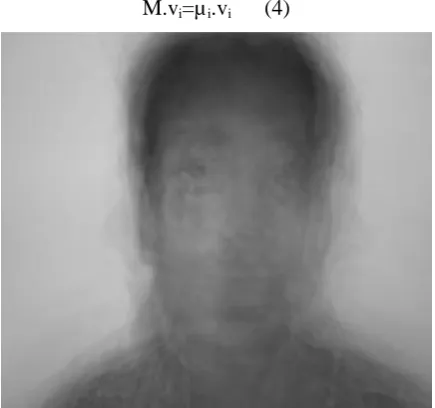
N*N covariance image of facial part. Each face image is a linear combination of different face images in Eigen sub space. Eigen face cosmists mean of all the images that are available in the dataset images that has been used for matching process. Eigen values of query image have been matched with dataset Eigen values for recognition process.
In this process of Eigen face mean image has been computed from all the images available in the dataset that has been represented by X1, X2……….Xn.
(1)
After computation of mean image dataset images subtracted image has been reconstituted for the images that has been used for development of covariance matrix.
(2)
Eq. (2) represents subtracted image the group of images have been used for reconstructions of facial images covariance matrix
M=A.A
T(3)
Fig. 3 training dataset images
After this process the Eigen features and the Eigen values for the face image was computed The Eigen value µi
and Eigen vector vi has been computed on the basis different equations that are represented as.
M.v
i=µ
i.v
i(4)
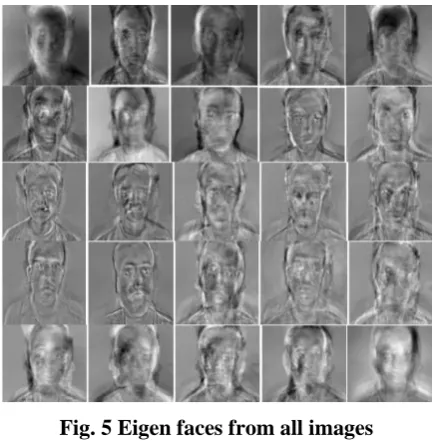
By using the Eigen values and Eigen vectors Eigen face matrix has been generated that is used as features for matching purposes.
Fig. 5 Eigen faces from all images
After the generation of Eigen space, the matrix is computed by using different face samples. The database features has been stored. These feature sub spaces have been used for recognition purpose using distance classifier represented in eq. (5)
(5)
3.2 Independent Component Analysis
ICA is very closely related to the method called blind source separation (BSS) or blind signal separation. A ―source‖ means here an original signal, i.e. independent component, like the speaker in a cocktail party problem. ―Blind‖ means that knows very little, if anything, on the mixing matrix, and makes little assumptions on the source signals. ICA is one method, perhaps the most widely used, for performing blind source separation. In many applications, it would be more realistic to assume that there is some noise in the measurements which would mean adding a noise term in the model. For simplicity, we omit any noise terms, since the estimation of the noise-free model is difficult enough in itself, and seems to be sufficient for many applications.
Discrete Cosine Transform: A discrete cosine transform (DCT) expresses a finite sequence of data points in terms of a sum of cosine functions oscillating at different frequencies. DCTs are important to numerous applications in science and engineering, from lossy compression of audio and images to spectral methods for the numerical solution of partial differential equations. The use of cosine rather than sine functions is critical for compression, since it turns out that fewer cosine functions are needed to approximate a typical signal, whereas for differential equations the cosines express a particular choice of boundary conditions.
3.3 EULBP
which is more resistant to noise. In LTP, ternary code is developed and they are divided into upper binary and lower binary pattern. LTP include pre-processing, thresholding, local histograms.
IV.
CONCLUSION
In this paper various approaches of face recognition has been studied that has been used for face detection and recognition process. Face plays an important role in human identification as well as matching process. In this paper various approaches that are texture based, Eigen value based and transformation based. On the basis of analysis of different approaches that has been used for biometric identification process EULBP consist of lower feature dimensions that cause less time complexity and provides better accuracy, whereas in texture based face recognition EULBP is much better than other approaches because prone to noise, and uniform regions.
REFRENCES
1. Changxing Ding, ―Multi-Directional Multi-Level Dual-Cross Patterns for Robust Face Recognition‖, IEEE
TRANSACTIONS ON PATTERN ANALYSIS AND MACHINE INTELLIGENCE,, 2016, PP 200-217.
2. Anil K. Jain, Fellow, IEEE, Arun Ross, Member, IEEE, and SalilPrabhakar, Member, IEEE-An Introduction to Biometric Recognition. IEEE journal January 2004.
3. Kyungnam Kim ―Face Recognition by using Principal Component Analysis‖ International Journal of Security and Its Applications
4. Pong C. Yuen, J.H. Lai ―Face representation using independent component analysis‖ the journal of Pattern Recognition society, Pattern Recognition volume 35 (2002) Page No.1247–1257.
5. Jian Yang, Davis Zhang, Alejandro F. Frangi and Jing Ju Yang ―Two-Dimensional PCA:A New Approach to Appearance-Based Face Representation and Recognition‖ IEEE Transactions On Pattern Analysis And Machine Intelligence, Vol. 26, No. 1, January 2004
6. TimoAhonen, AbdenourHadid, and MattiPietikainen ―Face Description with Local Binary Patterns: Application to Face Recognition‖ IEEE Transactions on Pattern Analysis and Machine Intelligence, Vol. 28, No. 12, December 2006.
7. Niloofar Amani1, Asadollah Shahbahrami2 and Manoochehr Nahvi1 ―A new approach for face image enhancement and recognition‖, International Journal of Advanced Science and Technology Vol. 52, March, 2013.
8. Dong-Ju Kim, Sang-Heon Lee and Myoung-KyuSohn ―Face Recognition with Local Directional Patterns‖ International Journal of Security and Its Applications Vol. 7, No. 2, March, 2013
9. Jian Yang ,Yong Xu and Jing-yu Yang ―Bi-2DPCA: A Fast Face Coding Method for Recognition‖ 10. O. Deniz , M. Castrill_on, M. Hernandez: ―Face recognition using independent component analysis and
support vector machines‖
11. Alessandro L. Koerich, Luiz E. S. de Oliveira ― Face Recognition Using Selected 2DPCA Coefficients‖ IWSSIP 2010 - 17th International Conference on Systems, Signals and Image Processing
12. Yue ZENG, Dazheng FENG, Li XIONG ―An Algorithm of Face Recognition Based on the Variation of 2DPCA‖ Journal of Computational Information Systems 7:1 (2011) 303-310.