A review on status, opportunities and future scope of
Augmented Reality
Lalita Bisht
1, Anand Kumar
2 1,2Contractual Faculty, Department of Computer Science D.S. B. Campus,
Kumaun University, Nainital, Uttarakhand (India)
ABSTRACT
Augmented Reality, A technology by which we can embed a computer generated objects on the user’s view of real world. It in an interactive way by which computer generated information i.e. graphics, texts, audio as well as virtual elements became part of this world. With the advancement of technology it is not just limited to desktop or mobile devices. Augmented reality is not a new topic but the recent advances in smartphone devices (in terms of hardware and software) make this technology got hype. Further AR is an interesting and emerging topic among researcher and students. AR has vast potential and has to be explored. This paper surveys the history, current status, opportunities and future scope of Augmented Reality. The basic comparison between Augmented versus Virtual Reality and how technical limitations affect augmented reality. Moreover, it also explains different application areas, related to that and the future aspects of augmented reality as well.Thus, the present study will be helpful.
Keywords: Augmented reality, AR, Virtual Reality, VR, Smartphone, HMD.
I. INTRODUCTION
The evolution of AR over few decades has brought a revolution in the computer interface design as well as user friendly smart phones design. In the present review article, authors compared AR to VR and analysed its importance in present era and its future impact. This information will provide some major insight into the present status of this emerging technology, which will ultimately help in drawing appropriate strategies for
innovations and improvement in associated applications. Further survey work is required to determine whether
or not this technology is undergoing any uplift or downfall, or is encountering any fluctuations.
II.DEFINITION
A computer system that allows the user to view the real world, with virtual objects superimposed thus supplementing reality rather than replacing it is defined as Augmented Reality (Azuma 1997, [2]). It facilitates the user being simultaneously present in a virtual and a real environment using special display systems i.e. semi-transparent head-mounted displays and interaction devices sensing the user’s physical movements (Feiner et al. 1999, [3]). Moreover, it allows the user to visualize objects and phenomena which are otherwise invisible to the human eye such as hidden construct or entity in the dark or fictitious characters in a computer game embedded into the physical surroundings. Since it’s initiation in the early 90’s Augmented Reality (AR) has come a long way. According to Milgram and Kishino (1994), AR can be defined as a technology in which an otherwise real environment is ―augmented‖ by means of virtual objects contrary to Virtual Reality (VR) in which the users
while involved cannot see the real world.
In addition, Paul Milgram and Fumio Kishino defined Milgram’s Reality-Virtuality Continuum in 1994 (Figure
1) (Abrar & Mahummad, 2013). The continuum that spans from the real environment to a pure virtual environment through Augmented Reality (closer to the real environment) and Augmented Virtuality (is closer to the virtual environment).On this continuum, the two evolving technologies studied are positioned as below.
Mobility and immersion can be described as extremes of a linear continuum from the real to the virtual environment (Milgram and Colquhoun 1999, [4]).
It was with the release of Pokémon Go, a widely successful game that Augmented Reality probably launched a wave of mobility. The game played a vital role in bringing the concept of AR in forefront of customer awareness.
then be able to Engage with the areas of their choice and receive offers, see videos or contact personally through the application. Immersion has similar characteristics as Google Glass, but is much easily accessible through smart phone devices.
Ingeniously AR can be summarised as:
―The insight of digital information, usually visual interpretation synchronized with objects, environment and places in the physical world in which the user resides‖
AR types : ( Atanas Boev, 2012) Relative to Modality:
• Visual AR – overlay of visual objects • Audio AR – overlay of audio sounds
• Haptic AR – for example, shock absorbers under the driver’s seat. In some cars - the steering wheel vibrates to give the driver ―Sense‖ of slippery road.
• Inter-modality – signals of one modality are transfer to another one. Audio AR for the blind.
Relative to Display:
• HMD-based - Image is projected using head-mounted display. • Projector-based - Image is projected on real surfaces.
• Monitor-based - Image is shown on desktop or mobile displays.
Relative to Portability
• Mobile AR
• Spatial AR (projector-based
Relative to Means of augmentation
• Optical – AR images are optically fused, shown as overlay of the real world. Ex- Eyes see the real world (no
delay)
Ex- Eyes do not see the real word (visual delay), Analogous case in audio AR – noise cancellation headphones.
History of augmented reality (Atanas Boev, 2012) Ivan Sutherland (1968)
• Invented first HMD (Head mounted display) (―Sword of Damocles‖). • Invented one of the first CAD programs (―Sketchpad‖).
• Invented first VR/AR system.
Tom Caudel (1990)
• Invented the term augmented reality.
• Boeing AR – for guiding the factory workers. • Wiring instructions.
ISMAR (1998)
• First AR dedicated conference.
Fig: In the 1990s Spatial and Mobile AR flavours emerge
History of AR research and development can be divided into four phases (Billinghurst
et al.,
2014, [5]):
1) Pre-80’s:- Experimentation: Early experimentation that helps defining the concept of Augmented Reality and show the types of technology required.
2) 1980’s - mid-90’s:- Basic Research: Research into enabling technologies such as tracking, displays, and input
devices.
3) Mid 1990’s - 2007: -Tools/Applications: Using AR enabling technologies to develop early applied and
4) 2007 - present day: - Commercial Applications: Widespread AR available in a number of application areas such as gaming, medicine, mobile and marketing.
Fig: History of augmented Reality
III. CURRENT TRENDS IN AR: [6]
By 2020 AR revenue is projected to reach $90 billion .This is an inspiring message that there is a lot to look forward in this field. Here is a list of 15 augmented reality trends for 2017 that is believed to drive where the smart money goes, and where development will occur.
1. AR Buy-Ins and Buyouts management:
Apple has acquired AR start-up Metaio, motion-capture technology company Faceshift, artificial intelligence
start-up Emotient, and Google Tango app developer Fly by Media. On the other hand, AR display maker Lumus
Ltd. has risen over $90 million in R&D funding — a portion of that from HTC. Both Apple and Google will
continue to acquire technology start-ups, while smaller companies will continue investing in them. Hence,
2017 can definitely be seen as a year of opportunity for the innovative developer with truly unique intellectual
qualities.
2. AR Product Support
The new trend in 2017 for customer support has become the AR based product support. By using information masking, AR enables product makers to provide a new dimension to how they support their customers. AR-assisted auto repair will soon be the new way of product support.
3. Apple seizing AR market:
4. Google to Focus on AR Smart phones :
Succeeding Google’s development of its advanced mobile AR platform Tango, Lenovo partnered with Google to develop the first Tango-enabled Smartphone, the Lenovo Phab2 Pro.
(Lenovo Phab2 Pro with Augmented Reality. Source: phonearena.com)
Tango shows Google’s seriousness about mobile AR and 2017 is ready to see further developments in the Tango
research and development.
5. AR Smartphone
Lenovo’s Phab2 Pro Smartphone, designed around AR architecture, proves that AR is merging into a native Smartphone feature. Taiwanese cell phone manufacturer Asus is also targeting to release its own Tango-enabled Smartphone in 2017. AR-centric smart phones are on the way of becoming the part of our routine lives.
6. Automotive HUD Displays
Luxury vehicles have facilitated the users with heads-up displays that project speed, compass direction, alerts related information directly onto the windshield, HUDs may soon be available for all common smart phone users with the rise of AR-centric smart phones covering the market.
Head-Up Display with Augmented Reality. Source: bmwblog.com
Companies like Hudway are already on the way of experimenting with Smartphone-based HUD technology. Infotainment systems can be managed by the power of smart phones. With telematics platforms and HUD displays with power to spare, vendors can be expected to provide dedicated HUD displays, rather than relying on the mobile device display.
7. AR Chipsets
Along with the AR mobile device revolution, comes the hardware to power it. As we move through 2017, it is expected to not only see AR-centric mobile devices, but AR-centric chipsets, such as the
Qualcomm Snapdragon.
8. Mixed Realities
Microsoft, too, is investing heavily in mixed reality. Developers are invited to purchase the Holo Lens
Development Edition goggles, which they can use with Microsoft's software development kit (SDK) to innovate in the mixed reality space.
9. Next AR Headsets
Although emergence of AR-centric smart phones is on a high, still smartglasses and AR headsets maintain their existence in anyway. Snapchat Spectacles have just hit the market and Eversight is set to release the heads-up product for bike riders, Raptor AR smart glasses.
Cast AR - augmented reality headset. Source: roadtovr.com 10. AR to Overtake VR
Although VR arrived with the hardware, including Oculus Rift, HTC Vive, and Play station VR, AR captured the headlines with a software application, Pokémon Go. The result of that simple AR game was that we leave 2016 with millions of people around the world having personally experienced AR.
Trends suggest VR will have the advantage in gaming, and in certain industries. AR, however, will be the technology for the masses — at least till VR has its Pokémon Go moment.
IV. VIRTUAL REALITY ([7])
Jaron Lanier in 1985 gave the term virtual reality. Virtual Reality can be defined as ―the combination of computer system and human-computer interfaces to fabricate the effect of a three-dimensional space which consist of interactive objects with a powerful sense of three-dimensional presence‖ (Bryson 1996). In comparison to desktop computer systems, virtual reality supports a high level of immersion into virtual space. This is facilitated by means of special display systems that cover a large portion of the user’s range of view and
interaction devices with sensors used for sensing user’s physical movements. Virtual reality support applications which facilitate user to experience the real world situations such as simulations of under construction building, visualization of microscopic objects and phenomena such as molecules and airflow.
AR VERSUS VR:
Virtual reality Augmented reality
How it works
Virtual reality technology facilitates the creation of real-life simulations, and creates an artificial environment that makes them feel like they are actually on the real world.
The gear to watch
out for
Oculus Rift, Samsung Gear VR, Google
Cardboard, HTC Vive, Sony
Project Morpheus
Google Glass 2, Microsoft HoloLens, Sony SmartEyeglass, Recon Jet, Magic Leap, Vuzix M100, ODG R-7
Privacy
Virtual reality is private. Augmented reality designed to be used in public.
Main benefits
Creates realistic world user can interact and explore the world. Makes education interesting and easy. With Low cost of gadgets like VR glasses with smart phone everyone can experience virtual reality.
In gaming User can have lifelike experience eg. Pokémon go. Use to increase knowledge. By using Glasses Wearer remains engaged in the real world and keeps hands free.
Main hurdles
Making simulated environment and apps. Hardware is expensive. Content files are too big and the bandwidth is low.
AR related hardware is very expensive. Augmented reality content (lesser apps for AG) lesser exposure to the audience. Small field of view.
Biggest deals
Facebook paid $2 billion (£1.3 billion) for Oculus VR in 2014.
Magic Leap raised $542 million (£346 million) from Google, Qualcomm and others in 2014.
Uses
It is best suited for video games and other leisure options.
It is best suited for training, marketing, advertising, education, modeling etc.
It has more commercial success.
Applications of Augmented Reality (Abrar & Mahummad, 2013, [8]).
With the passage of time Applications or the uses of augmented reality are increasing day by day. Whether it is medical, education, entertainment or other areas, we use augmented reality unknowingly. So here we are summarizing the prior research on application of augmented reality.
V. MEDICAL
5.1 Medical Education
Fig 1
5.2
Medical Training
AR has had vast role in the medical industry. It is considered very beneficial in the field of healthcare training. For example, by using augmented reality healthcare professionals visualize human anatomical structure to train perfectly.
AR technology acts as a supportive teaching method for anatomy education but it depends on how it is implemented. Strong points are the visualization capabilities including the 3D rendering of anatomical imagery. AR provides real-time manipulation of these visualizations and direct interaction to students so that they can visualize like actual scenario. Some other popular medical Training programs using augmented reality are-
a) Visualizing 3D lung dynamics (Fig.2) b) Training laparoscopy skills.
c) Vein visualization.
Fig2
VI. EDUCATION
In the field of education AR plays an important role. AR is very useful for children as well as elder to gain knowledge for a particular topic. There are several AR applications by which one can get the desired information. Some examples are-E-book (these books depicts and provide the virtual view of mostly all the content in an interesting manner) Children Education There are several AR application which can help to educate the children in an effective manner.
Some apps for children are-
combining games, puzzles and 3D augmented reality! Shape Quest challenges kids ages 6-9 to use geometry and spatial reasoning to hone their problem solving skills.)
B-Powerful Plants (The Powerful Plants augmented reality experience provides a fun new way to learn about plants and their importance to the human condition)
C- Chromville (Educational game app based on augmented reality)
D- Live coloring and Quiver 3D Augmented Reality coloring apps are some coloring apps
Fig 3
VIII. COMMERCE
7.1
Demos of products and know the details
.By using augmented reality we can get the details of product and know the internal detail of that product.
7.2
Clothing Shopping
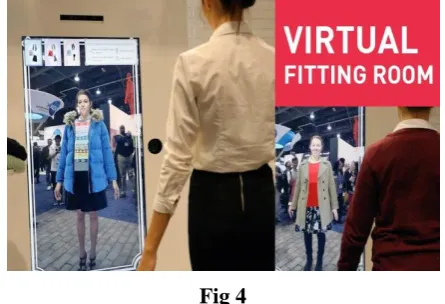
E-commerce is considered as one of the most beneficial market of the AR application, specifically, when one uses online system to shop clothes. The user isn’t sure if the dress will be of perfect fit or not. Hence, AR connects the virtual object (clothes) to the real world, making the online shopping a user friendly procedure. (Fig 4)
Fig 4
7.3
Products Shopping
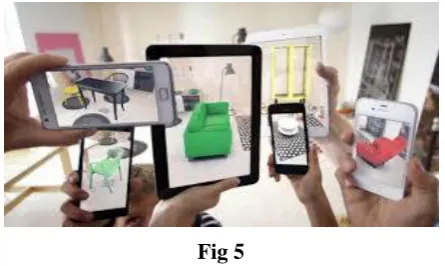
app user can get the relevant information related to the product so that now user can buy the required after comparing the item. (Fig 5)
Fig 5
Select product by users Reviews
Mostly all the buyers are influenced by web based reviews and web-based social content. So by using AR application user can superimpose the feedback, review and other digital information to the real world by using mobile etc.
VII.
ADVERTISING
Using AR the advertisements gives a magical experience that grabs user’s attention in a way that makes it easy to draw attention to the marketing message. The HIT Lab NZ created one of the world first mobile AR campaigns in 2007 where they worked with Saatchi and Saatchi to show virtual animals appearing over a printed newspaper advertisement for a local zoo since then hundreds of mobile campaigns have been created for companies such as Nike, Coke, Ford and others. (Fig 6).There is some more interesting AR campaign which is–
a) Pepsi Max Bus Shelter Augmented Reality
b) Sochi 2014 Augmented Reality with Olympic mascots c) NO AD: NYC Application
d) The Walking Dead Cinematic Augmented Reality Experience e) Vespa Magazine Augmented Reality
f) INDE AppshakerShowreel 2015
g) Google Glass Augmented Reality Makes Model Come to Life h) UVPH &Appshaker Demo at AdTech San Francisco
i) Lexus Augmented Reality Brings Magazine to Life.
F
ig 6
VIII. ENTERTAINMENT
There is a lot of games and other medium related to AR which provide an entertaining atmosphere to the user. A well-known game Pokémon go is very popular among all ages. Sightseeing guidance, visualizing virtual environment, virtual gallery etc are the examples of augmented reality in the field of entertainment.(Fig 7).
Fig 7
IX. DESIGNING IN AUGMENTED REALITY
9.1
Machine Design
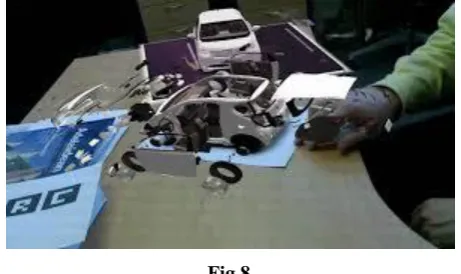
The machine design is use to enhancing product design. By using augmented reality one can design and redesign the machine for better implementation of the finalized machine. Some fields related to this is robotics and defense. (Fig 8)
Fig 8
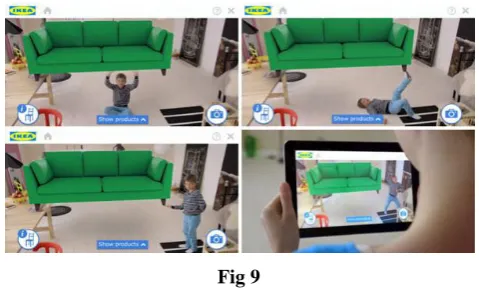
furniture in real time. With the AR application, you can easily see the real like view of the new furniture in the sitting room and you can also change the color of the furniture according to the color of your wall. Here AR is an amazing technology which can easily deliver virtual furniture into our houses. Also, this application can arrange the new furniture in your house on screen in real time. (Fig 9)
Fig 9
X. ROBOTICS AND TELEROBOTICS
Robotics and Telerobotics are the fields of science and research so the prototype making and other testing is done by augmented reality. A Telerobotics operator uses a visual image of the remote workspace to guide the robot.
If the operator is attempting a motion it could be practiced in a virtual robot that is visualized as an augmentation to the real scene. The operator can decide to proceed with the motion after seeing the results. The robot motion could then be executed directly which in a tele-robotics application would eliminate any oscillations caused bylong delays to the remote site. Another use of robotics and AR is on remote medical operation (Silva, J. C. Oliveira, G. A. Giraldi, [9])
XI. MILITARY TRAINING.
The military has been using HMD which is a form of augmented reality display. The display equipped soldier could see a virtual helicopter rising and then take action accordingly. There are many participants in the training. (Fig.10)
New Applications
The many applications have been explored but many of them are still not widely used due to technological limitations such as accuracy and portability, and social reluctance. At the same time, some new areas have proven to have a tremendous potential in use of AR technology. These are discussed as follows.
1. Collaboration: A major potential benefit of AR is having multiple people view, discuss, and interact with 3D models simultaneously. Collaborative environments allow integration with existing tools and practices and enhance practice by supporting distributed, remote and collocated activities that would otherwise be impossible. Employees of the same company located in offices that are continents apart could interact with each other in the same virtual environment. Collaborative AR systems can use both see-through handheld displays (as seen in Magic Book) and see through head-worn displays (as in Studiers tube).
2. Navigation: Rekimoto (2000,[10]) presented NaviCam for indoor use that augmented a video stream from a hand held camera using fiducially markers for position tracking. (Starner et al., 1998 ,[10]) considered applications and limitations of AR for wearable computers, including problems of finger tracking and facial recognition.(Narzt et al). discussed navigation paradigms for pedestrians and cars that overlay routes, highway exits, follow-me cars, dangers, fuel prices, etc. They prototyped video see through PDAs and mobile phones and envision eventual use in car windshield heads-up displays.
3. Tourism: AR applications can augment a user's experience when traveling by providing real time information on displays regarding a location and its attributes, including reviews and comments made by previous visitors of the site which might be helpful to tourists. AR applications allow tourists to experience simulations of histori cal events, places and objects by overlaying them onto their current view of a site. (Vlahakis et al.) Presented the Archeo Guide project that reconstructs a cultural heritage site in Olympia, Greece. Using this system, visitors can view as well as learn ancient architecture and customs. AR applications may also present location information using audio, for example by announcing features of interest at a particular site as they come into the user’s field of view.
Future Scope: Augmented reality in 2020 ([11])
Screen-less future may become a reality as wearable become ubiquitous; any flat surface will double up as
a screen.
3-D visualization and mapping potential in combination with AR technology help navigate places with
updated situational awareness.
Visualization of data will become seamless as users can access centralized data on the go through
wearable technologies; it finds application in law enforcement, emergency response and human services. Gestural interfaces—ways for humans to use body language and actions to control technology—begin to
redefine the human-technology relationship, ushering in a sort of omnipresent ―sixth sense.‖
Haptic (tactile) technologies redefine training in key government mission areas including defence, law
enforcement and health care.
Limitations:
in AR displays that are caused by the nature of AR technology or displays. Work has been done in visualizing the registration errors, avoiding hiding critical data due to density problems and at the same time not cluttering the screen with excessive information. However, before AR becomes accepted as part of the user’s everyday life, issues regarding intuitive interfaces, cost, weight, power usage, ergonomics, and appearance must also be addressed. Some of the major problems are discussed below.
a) Portability and Outdoor Use: Most mobile AR systems are bulky and cumbersome, requiring a heavy backpack to carry the PC, sensors, display, batteries, and other components. Connections between all the devices must be able to withstand outdoor use, including weather and shock. Optical and video see-through displays are usually not suited for outdoor use due to low brightness, contrast, resolution, and field of view. However, laser-powered displays offer a new alternative to overcome this problem.
b) Tracking and Calibration: Tracking in unprepared/outdoor environments remains a challenge but hybrid approaches are becoming small enough to be added to mobile devices. Calibration of these devices is still complicated and extensive, but it may be solved through calibration-free or auto calibrating approaches that minimize set-up requirements.
c) Latency: A major source of dynamic registration errors are system delays. Techniques like pre calculation, temporal stream matching and prediction of future viewpoints may solve some delay. Through careful system design, system latency can be scheduled to reduce errors and pre-rendered images can be shifted at the last instant to compensate for pan-tilt motions. Likewise, image warping may correct delays in 6DOF motion (both translation and rotation).
d) Depth Perception: Problems such as accommodation-vergence conflicts or low resolution and dim displays cause object to appear further away than they really are. Correct occlusion ameliorates some depth problems, as does consistent registration for different eye point locations. In an experiment by Biocca and Rolland (1998), subjects exhibit a large overshoot in a depth pointing task after removing the HMD. e) Data Density: If the real world is augmented with a large amount of virtual information, the display may
become cluttered and overpopulated with unnecessary data. The distribution of data in screen space varies depending on the user’s viewpoint in the real world. The user interface must follow some guidelines as not
to overload the user with information and at the same time must prevent the user from overly relying on the AR system such that important cues from the environment are missed.
f) Social Acceptance: Making AR a part of everyday life may be more challenging than expected, as many factors play a role in social acceptance of AR ranging from unobtrusive fashionable appearance (gloves, helmets, etc.) to privacy concerns. For example, Accenture’s Assistant blinks a light when it records for the
sole purpose of alerting the person who is being recorded. These issues must be addressed before AR is widely accepted.
XII. CONCLUSION
Augmented reality is very useful for visualizing virtual objects into real world. It is extremely helpful in location based services. Starting from the 1950 the technology of augmented reality is changing rapidly and the advancement took it into a brighter side. As we know that the hardware of AR was quite expensive during the early 90s but nowadays a well-equipped mobile phone with basic sensors necessary to run location based services can run augmented reality related application seamlessly. Along with augmented reality, virtual reality is also a useful technology to transform the real world into virtual view for the user. Augmented reality is useful in location based services like Google maps or any other GPS based services like mapmyindia or Nokia navi or Motonavi etc. All the application whether it is based on augmented reality or based on virtual reality the outcome of their product works tremendously. By making mixed reality application, combination of VR and AR application makes new level of freedom.
It is quite evident that both virtual reality and augmented reality are similar in the goal of giving illusion of the virtual object to the user but in different way. By the recent hype of both technologies they are becoming cheaper. Both technologies are good but AR is successful commercially and recent advancements show that virtual reality is also emerging rapidly. Smart phone evolution in recent years makes AR and VR technologies simply good and affordable. In the future we may expect more from both the technologies in the field of production, education, science, modeling, training gaming and advertisements etc.
REFERENCES
[1] Wendy E. Mackay. (1998). Augmented reality: linking real and virtual worlds: a new paradigm for interacting with computers. In proceedings AVI '98 Proceedings of the working conference on Advanced visual interfaces. NewYork, ACM press. pp 13 – 21.
[2] Azuma R. (1997) A Survey of Augmented Reality. In Presence: Teleoperators and Virtual Environments.
6 (4): 355-385.
[3] Feiner S., MacIntyre B. and T. Hollerer. (1999). Wearing It Out: First Steps Toward Mobile Augmented Real-ity Systems. In Ohata Y. and Tamura H. (1999) Mixed Reality: Merging Real and Virtual Worlds. To-kyo, Ohmsha Ltd.
[4] Milgram P. and Colquhoun Jr. H. (1999) A Taxonomy of Real and Virtual World Display Integration. In Ohata Y. and Tamura H. (eds.) (1999) Mixed Reality: Merging Real and Virtual Worlds. Tokyo, Ohmsha Ltd.
[5] Billinghurst M., Clark A. and G. Lee. (2014). A Survey of Augmented Reality, Foundations and Trends® in Human-Computer Interaction.8 (2-3): 73–272.
[6] (https://www.vrroom.buzz/vr-news/trends/top-15-augmented-reality-trends-2017)
[7] (https://www.raconteur.net/technology/what-is-the-difference-between-augmented-and-virtual-reality) [8] Abrar O. Alkhamisi and Muhammad M. Monowar.(2013). Rise of Augmented Reality: Current and
[9] R. Silva, J. C. Oliveira, G. A. Giraldi.Introduction to Augmented Reality.National Laboratory for Scientific Computation,Av. Getulio Vargas, 333 - Quitandinha - Petropolis-RJ Brazilrodrigo,jauvane,[email protected]
[10] Van Krevelen, D. W. F., and R. Poelman. "A survey of augmented reality technologies, applications and limitations."International Journal of Virtual Reality 9.2(2010): 1.
[11] (http://government2020.dupress.com/driver/augmented-reality/):
[12] Chavan, Sagar. R .ISSN: 2278 – 1323 International Journal of Advanced Research in Computer Engineering & Technology (IJARCET) Volume 5, Issue 6, June 2016
[13] https://www.dprism.com/virtual-reality-three-opportunities-three-hurdles/
[14] https://www.raconteur.net/technology/what-is-the-difference-between-augmented-and-virtual-reality [15]
http://www.networkworld.com/article/3174804/mobile-wireless/the-3-biggest-challenges-facing-augmented-reality.html
[16] https://globenewswire.com/news-release/2014/04/04/624616/10075463/en/Engage-Mobility-Launches-immersion-Augmented-Reality-Platform.html.
[17] http://government-2020.dupress.com/driver/augmented-reality.