PARAMUTATION AND SOMATIC MOSAICISM IN MAIZE’
G. R. K. SASTRY, H. B. COOPER, JR.,? AND R. A. BRINK
Department of Genetics, University of Wisconsin, Madison
Received April 23: 1965
ARAMUTATION at the R locus in maize is known to occur in vegetative cells ‘(MCWIIIRTER and BRINK 1963). Evidence to be presented here shows that the course of R change is irregular as plant development proceeds, so that an indi- vidual tends to become a mosaic in terms of anthocyanin forming potential. No R allele has been found, however, the paramutation of which leads to an im- mediate and readily detectable alteration in shoot phenotype. The somatic varia- tion, therefore, is concealed. Diversity in level of R potential within an individual is brought to light by sampling separately the pollen formed in different tassels of a plant or in the several branches of a single tassel. The seed phenotypes re- sulting from testcrosses on rr females of pollen so collected show that in heterozy- gotes of appropriate kinds readily detectable R sectoring is frequent.
Structure of the maize plant and the cryptic nature of the somatic mosaicism (or sectoring) for level of R potential restrict what can be deduced directly from the present data. The results gain in meaning, however, when considered in con- junction with corresponding evidence from certain other species and with the data bearing on other aspects of R paramutation.
Zonal boundaries would be phenotypically recognizable in a somatic mosaic system well suited to genetic analysis, and all genotypes present would be po- tentially verifiable by progeny test. These conditions are far from being met in the R maize material. Heritability tests can be conveniently made only of sectors that extend into the tassel, and then blindly, in terms of number and distribution of genotypes, because of the hidden zonal boundaries. Only by chance would a given pollen sample be homogeneous under these conditions. Should multiple changes in R potential occur in a tassel branch, pollen from even a short segment often would be drawn from more than one R zone. Rarely could the character of mixed plant tissue be inferred from the heterogeneous array of kernels resulting from testcrosses on rr females of pollen from tassel branches of this kind. Further- more, restriction of tissue sampling to the tassel, at the apex of the plant, means that the time course of paramutation as development of the individual proceeds can not be measured.
The evidence for R mosaicism in maize, although restricted, is adequate to link the case to more patent examples of the phenomenon. A few instances of para- mutation in other species have been reported earlier under designations such as mass mutation” or “somatic conversion,” in which mosaicism was both overt “
Paper No. 1022 from the Department of Genetics, Agricultural Experiment Station, University of Wisconsin, h1adison.
? Present address: U. S. Cotton Research Station, Shafter, California.
408 G . R. K . SASTRY et al.
and genetically verifiable (refs. in
BRINK
1960,1964). When the data from these sources also are considered it becomes apparent that somatic mosaicism probably is a general characteristic of paramutation. Maize has proved especially produc- tive of evidence on certain other aspects of paramutation, the understanding ofwhich becomes clearer when the additional fact of variable genetic change dur- ing plant development is taken into account.
MATERIALS A N D M E T HOD S
The general procedures used in these studies and the precautions taken to minimize the effect of extraneous genetic variation in aleurone color have been described elsewhere (BRINK 1964). Aleurone color grade was evaluated by visually matching each kernel in a sample (usually
50) from the middle portion of a testcross ear against a graded set of standard kernels ranging from colorless to fully colored. The mean color grade was then computed and used to represent the sample. Two unlike sets of standard kernels were employed a t different times. One set con- sisted of six kernels, defining seven color classes. The other set represented 1 1 grades of pigmen- tation. The accuracy achieved in the respective means probably differed little. Variation in the character of the distributions on which the means were based was better reflected, however, when the finer classification was used.
The usual procedure in testing a plant for mosaicism was to collect pollen separately from a few lateral branches disposed spirally from the base upward in a tassel, and then to apply the pollen samoles to the silks of inbred W22 r g r g individuals in duplicate. A few testcrosses were made on W23 rgrg females. Pollen also was collected in some cases from the central spike at the apex of the tassel. The notation used in identifying the several pollen samples taken from a single plant is exemplified by the expression (52-18)-10-2. The term (52-18) refers to the family concerned, based on a single seed-ear, 10 is the plant number, and 2 is the particular tassel branch in question. In each case, the lowest tassel branch sampled was numbered 1, the next highest was designated 2, and so on. The different pollen samples taken from a given plant were collected in close succession on the same day.
The W22 inbred strain, into which all the R alleles used were incorporated, is typically single stalked. Occasionally, however, a basal branch (tiller) is formed which also eventually produces pollen. In the latter case, pollen from the tassels surmounting the two stems may be readily sampled separately for evidence of sectoring within the plant.
E X P E R I M E N T A L RESULTS
Evidence of mosaicism for level of R action was obtained in the first experi- ment designed to test systematically for occurrence of the phenomenon. W22 plants heterozygous for standard R', which is sensitive to paramutation, and R;;?, a mutant from stippled (R") known from previous tests to be paramuta- genic at a n average level somewhat below that of the parent allele, were grown imder especially favorable soil fertility and moisture conditions in an attempt to induce tillering. Eleven tillered plants were obtained in this way from which pollen samples representing three or more branches each in the respective main shoot and tiller tassel eventually were successfully used in testcrosses on W23
r g r g females. Pollen was collected separately in each case from the terminal spike
and also from four lateral branches starting at the base and proceeding upward by successive quarter turns.
P A R A M U T A T I O N A N D MOSAICISM 409
produced one fertile tiller each, were thus tested for mosaicism. The R' factor in these R'R' plants is not subject, of course, to change in level of action during de- velopment in response to the action of a paramutagenic allele like
R",",,.
The detailed results of the tests for mosaicism in the R'R,";? and control R'R'
plants have been presented by COOPER (1964). I n summary, COOPER'S findings were as follows: (1) The effect of the paramutagenic R;Y7 allele in R'R:;, plants was to lower aleurone pigment producing action of R' about one class interval on the 1-7 scale. The mean score for the R'rgrg kernels from all r g r g female X R'R' male testcrosses was 5.1 1. The corresponding value for the R"rgrg kernels (R" =
paramutant form of R') from all r g r g female X RrRSclll male matings was 4.05.
(2) The R'R' plants tested gave no evidence of mosaicism for level of R' action. Mean color scores for the kernels based on main shoot and tiller pollen samples were alike, within sampling limits, in the two comparisons of this kind that could be made. Furthermore, in each instance, the within tassel variation mean score was statistically insignificant. That is to say, the pollen from different branches within an R'R' tassel were indistinguishable in terms of Rr pigment producing potential. (3) All 11 R'R8;,"17 plants tested, on the other hand, proved to be hetero- geneous in terms of level of R" action. The aleurone color score for the Rr'rgrg
kernels based on tiller pollen significantly exceeded that for kernels resulting from the application to erg females of main shoot pollen in each instance. Also statistically significant differences in mean aleurone color score were found for different branches within single tassels in seven of the 11 plants examined.
Evidence that the heterogeneity in level of Rr' action reflected by the data from
RrR::7 plants rests upon sectoring within the individual is presented in Table 1 .
The testcross results shown are based on pollen samples taken separately from four lateral branches (1-4) and the terminal spike ( 5 ) in the main and also the tiller tassel of plant 41-106-5M.
TABLE 1
Frequency distributions for aleurone color score of Rr' rgre testcross kernels based on pollen samples from different parts of the main and tiller tassels of RI'RSCIli plant 41-106-5M
Aleurone color class
Sample No. 1 2 3 4 5 6 7 Mean score
Main tassel
1
2 3 4 5
Tiller tassel
1 2 3 4 5
42 16 22
3 6 7 8 2
56 18 6
4 59 12 5
54 19 7
27 23 30
36 33 11
8 34 38
28 8 38 4 2
1 51 19 9
3.76 3.1 1
3.38 3.23 3.42
410 G . R . K. SASTRY et al.
TABLE 2
Mean color scores for the Rr' r g r g (or Rg' rgrg) testcross kernels representing separate pollen samples from three lateral tassel branches on a series of RrRSt (or RgRSt) plants
carrying R alleles of diuerse geographical origin and also for the
Rr'rg (or Rg'rg) progeny corresponding to these branches
Allele and family No
~ Argentina R" RrRst parent
(52-6)-1 Rr'rg progeny
Turkey 13 R" RrRSt parent (52-7)-4 RT'rg progeny
Ethiopia 30 Rr RrRst parent (52-8) -6 Rr'rg progeny
India 6 R r R'RSt parent (52-11)-1 RrW progeny
Turkey 18 Rr RrRsl parent (52-12)-I Rv'rg progeny
Turkey 18 Rr RrRSt parent (52-1 2) -8 Rr'rg progeny
Standard R' R'RSt parent (52-9)-8 Rrrrg progeny
Standard Rr RrRst parent (52-9)-I1 Rr'rg progeny
Turkey 8 Rg RgRSt parent (52-1 0) -6 Rg'l.9 progeny
Mean aleurone color score by tassel branch
1 e 3
5.33 4.10 3.69 6.27 5.79 6.49
3.69 7.93 3.99 6.68 8.27 6.46
5.26 2.93 5.01 9.56 5.98 7.49
6.54 3.04. 5.96 4.01 8.73
9.10 5.02 7.04 10.55 9.37 10.05
7.81 5.09 2.14 9.88 9.30 4.30
3.53 3.84 8.62 6.52 10.50
4.15 5.66 2.44 6.08 7.06 4.66
4.54 7.87 3.47 6.72 9.22 6.03
Significance of difference
* * * * * * * * * * * t ** * * * * * * * * * * * * * * * * * * ~~ _ _ ~~
-.05>P>.01. * * - -P<.Ol. * -
P r o y e n y tests for mosaicism with R' and Rg alleles of diverse geographic origin:
G a e t i c variation during plant development appears to characterize the response of all overtly paramutable R factors to a paramutagenic allele. This conclusion is suuported by the results of tests in R S t heterozygotes of six R' and one RQ allele of diverse geographic origin, as listed in Table 2, and known from previous experi- ments to be sensitive to paramutation.
Pollen from three separately sampled, lateral branches in five to ten R s t hetero- zygotes carrying the respective R' and Rg factors was used in duplicate testcrosses on W22 r g r g females. The resulting Rr'rgrg (or Rg'rgfl) kernels were then scored for aleurone color on the 1-11 scale. The mean scores, by individual tassel branches, are entered in Table 2 for the particular plants within the total number sampled in which evidence of mosaicism was found and for which the results of
PARAMUTATION A N D MOSAICISM 41 1
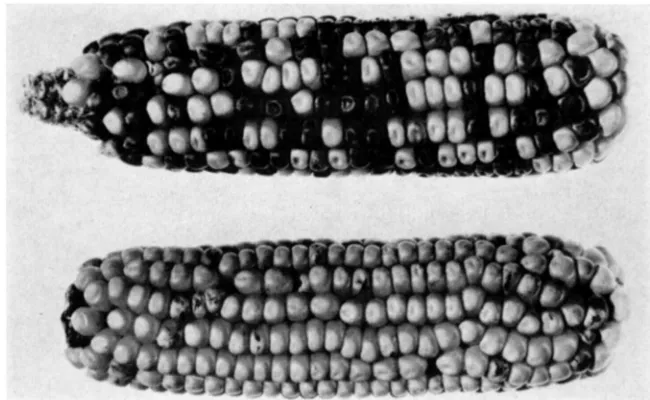
F~cunr: 1 .--Ears resulting from matirigs on r v i g fwn.ilr.s with pollrn collectecl from lower. micldle. and top tcissel hranctic-s of a Turkey 8 NOR*' plant ( (5%10)-f)). Half the kernels on each ear are of the finely spotted. stippled phenotype. Many Rg'flrg kernels on the middle ear are very darkly p i p e n t e d . showing that the level of R9 action has hern little altered in the cor- responding RPR" tessd branch (average score = 7.87). In contrast. many of the Rg'r9t-g kernels on the right hand ear. repwanting a top tassel branch. are rolorless. or nearly so (average scow = 3.47. The R9'r9r9 testcross kernels cn the remaining ear on the left. corresponding to a loweer tassel branch. are variable hut. on the average, nre pip;mented at a n intermediate level (average score = 4.54).
Progeny testcrosses on W22 rprp females were made using the Rr'P (or Rs'r9)
offspring of each of the R'RI' (or RgR"') plants in question. Pollen from 8 to 12
R r ' e (or R g ' f l ) plants each, collected separately but without reference to indi-
vidual tassel branches, was used in these matings. Mean scores for the progeny are entered in Table 2 just beneath the corresponding parent values.
41 2 G. R . K. SASTRY et
al.
I;IC;~JRE 2.-Rrprrsrntativr i w r s froiii tvstcrosst-s o n r g r ~ f i w i i i l v \ of p l i i r i t s in two R ' r g faniilirs drrivrd from hranrhrs 3 and 2. rrqwctivrly. of a n India 0 R'/R*' individual f , 2 - l l ) - l ) . Thr darkly colornl R"rur9 krrnrls on thr rar a h o w show that littlr r h a n p in R' piKnirnting pntrntinl orrurrrd in oni- hranrh. Thr many rolorlrsc and nciir-rolorlrss R"rqr9 licrnrls on thr rar hrlow tlcmonstratr that thr alrumnr pignirntinp: potrntial of R' was stmngly rrclurrtl in annthrr tnssrl hranrh on thr siriir R'R" plant.
T h e Table 2 data refer only to the R'R"' and RqH" plants tested that g a ~
evidence of mosaicism and on which a progeny test also was completed. Addi- tional individuals representing each R' and I f 9 allele also were t e s t 4 from which.
however, progeny data were not obtained. Addition of these plants to those in- cluded in Table 2 gave ii tot-il of 186. of which 49 in all showed statistically significant differences between branches within tassels. On this basis. the pro- portion of obviously sectored R'R"' and R9R"' plants encountercd was about one quarter of those tested.
Additional evidence for mosaicism but without confirming progeny data. \vas
ohtaincul in tests with standard R' when carried in a K l O chromosome. T h e latter contains a large heterochromatic knob distal to the R I(H.US the effect of
which is to reduce sensitivity of R r t o paramutation ( B R I N K and Wr:~r.ns 1 QhO 1.
T,ikcwisc, scctoring \viis proved to occur in R9R"' plants carrying a n R9 allele
extracted from the Black Mexican sweet corn variety and known to hc highly para mi i t a ble.
Dirwrsity in
R
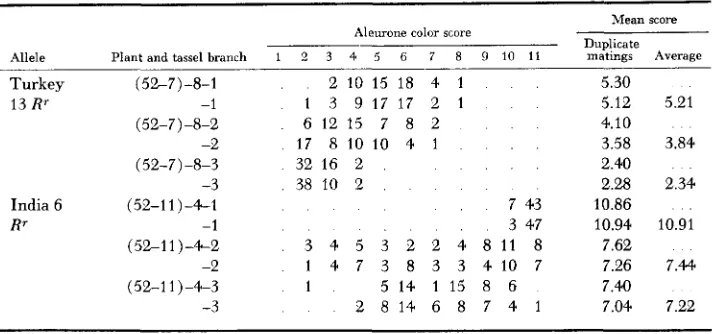
p t e n t i n l nithin n $ingle tnssd: T h e diversity of exprcssion en- countered in tests for R mosaicism is illustrated in greater detail by the data in Table 3, which relate t o te4tcrosses with a Turkey 1 3 R r / R a t and an India 6 R r / P 'P A R A M U T A T I O N A N D MOSAICISM 413
TABLE 3
Frequency distributions for aleurone score in tests of different tassel branches within two RSt
heterozygotes carrying paramutrrble Rr alleles of different geographic origin
Mean score
Aleurone color score
______
DuplicateAllele Plant and tassel branch 1 2 3 4 5 6 7 8 9 10 1 1 matings Average
Turkey (52-7) -8-1 2 10 15 18 4 1 5.30
13 Rr -1 1 3 9 1 7 1 7 2 1 5.12 5.21
(52-7)-8-2 6 1 2 1 5 7 8 2 4.10
-2 17 8 10 10 4 1 3.58 3.84
-3 38 10 2 2.28 2 3 4
India 6 (52-11)-4-1 7 43 10.86
R T -1 3 47 10.94 10.91
(52-1 1 ) -4-2 3 4 5 3 2 2 4 8 1 1 8 7.62
-2 1 4 7 3 8 3 3 4 1 0 7 7.26 7.44
-3 2 8 1 4 6 8 7 4 1 7.04 7.22
(52-7)-8-3 32 16 2 2.4.0
(52-11)-4-3 1 5 1 4 1 1 5 8 6 7.40
Zones may occur in which the level of €3 potential is either not reduced at all, or only very slightly, as illustrated by the (52-1 1 ) 4 1 entry in Table 3. At the other extreme are zones, such as that represented by entry (52-7)-8-3, in which R potential is uniformly depressed to a low value.
The extreme diversity in kernel phenotype that may result when pollen from a single branch within a tassel is tested is illustrated by the (52-1 1)-4-2 arrays in Table 3. The distribution of kernels in this instance extends rather evenly over ten pigmentation grades. The cause of such high local variability is un- known, but a likely explanation is that the pollen involved was produced in two or more nearby, but unlike, zones.
The occurrence of pronounced genetic heterogeneity within the pollen collected from a single tassel branch is further illustrated by the data presented in Table
4.
Each of these cases was selected as showing an unusually wide spread in kernel phenotype among distributions most of which were much less variable. The
R’rg testcross kernels were partitioned, rather arbitrarily in certain instances, into two classes, light and dark, with the boundary set between grades 6 and 7. Plants representing the two seed groups were grown out, and ten of each group were then testcrossed on r g r g females. It is evident from the respective parent and progeny means scores, shown in Table 4, that the R“ (or Rg’) alleles correspond- ing to kernels in the upper and lower parts of the distribution, on the average, are significantly different from each other in level of action. Other data, not presented here, show that the original plants represented in this test (52-8)-4,
(52-10)-5, and (52-1 1)-I, were mosaics. The present, more detailed analysis
demonstrates that zones so recognized may themselves be heterogeneous for level of R potential.
Mosaicism in Rr’rg plants:
R’
alleles in R‘r plants derived directly from rr414 G . R. K . SASTRY et al.
4
s
s
P A R A M U T A T I O N A N D MOSAICISM 41 5 TABLE 5
Mean scores for testcross kernels from rgrg female x R' r g male matings in which the testing of pollen samples from three different tassel branches showed that
the R' rg plant in question was sectored for level of R' action
Mean aleurone score by tassel branch
Statistical
Genotype Plant No. 1 2 3 significance
Argentina Rr'/r.u
India 6 Rr'/r3
India 6 R''/rg
Standard Rr'/rg
Standard R''/rg
Standard Rr'/rg
Standard Rr'/rg
Turkey 8 Rg'/rg
R35-1 R185-6 R186-2 R66-5 R109-1 R127-1 R183-1 R138-1
6.19 5.69 4.31 8.82 7.40 4.35 2.93 5.54 4.11 10.21 6.80 10.24 5.70 7.50 6.68 8.65 8.54 5.96 4.95 4.48 6.90 8.26 10.92 9.72
** * * * * * * * * * * * * *
.
-.@5>P>.Ol. ~- * * - -P<.@i.istic of R in standard form (KERMICLE 1963). The data in Table
5
show that such partial reversion may proceed to varying levels within a single plant.In all, 86 R'rg plants representing
R
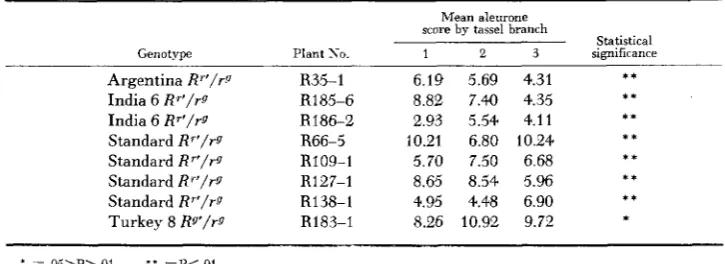
alleles of four geographic origins were tested f o r mosaicism by separately sampling the pollen either from branches within a tassel or from the main shoot and tiller. Ten plants were found in this group that clearly were mosaic for level of R action. The data for eight of these individuals in which pollen samples were taken from three lateral tassel branches are summarized in Table 5. In each of these cases differences in mean testcross score, statistically significant at the 1% level, were found between branches within tassels. Corresponding differences were observed in the two remaining plants in which the pollen samples were based on main stalk and tiller tassels(Figure 3 ) .
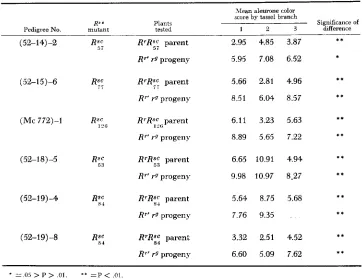
Effect of diflerent paramutagenic alleles on mosaicism: The data summarized in Table 6 show that mosaicism occurs in heterozygous plants carrying a common R' factor but varying in the paramutagenic allele present. RtF
,
R f ;,
andR;iI(
are strongly paramutagenic mutants from RSt, whereas R:: andRii
are mutants from the same source that are paramutagenic at a somewhat lower level (MCWHIRTER and BRINK 1962).Seventeen plants carrying standard R' and one or another of the strongly paramutagenic Rsc factors were tested for mosaicism by sampling the pollen in three lateral tassel branches separately. Three definitely sectored individuals were identified in this group. Similarly, among 14 plants heterozygous for stand- ard
R'
and either Rii or Ri,", three mosaic individuals were found. These cases of sectoring were verified by progeny tests the results of which also are assembled in Table 6.41 6 G. R. K. SASTRY et at.
FIGURE 3.-Differentiiil w w r s i o i i i n a n Argentina R r ' / r " plant. The (aars shown rrsultrd from testcrosses on rpr9 frmalcs using pollen collected from the ninin shoot (left) and tiller (right) of a single Rr'r9 individual derived from an r g r p female x Argentina R'/R"' male mating. Thr unlike levels of Rr' action in the R"rgr9 kernels on the two ears shows that the paramutant H"
allele in this Rrr9 individual underwent different amounts of reversion in main shoot and tiller.
If
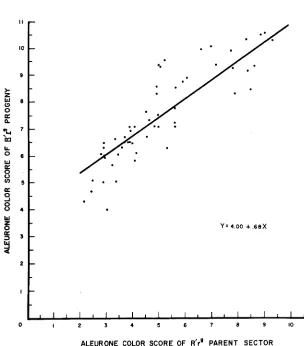
a comparison is made by inspection between mean scores for parent zones and progenies (Tables 2 and 6) a general correspondence in ranking will be evident. Correlation and regression analyses were carried out to confirm this correspondence and to express the relationship quantitatively. A highly signifi- cant correlation (0.80) between scores for the parental zones and the progenies was found. The confirmatory results of the regression analysis are presented in Figure 4. Both the correlation (- .18) and regression values (- .64*
.48) for the differences between duplicate pollinations and the differences between their progenies, on the other hand, are nonsignificant, showing that the small initial differences observed between the testcross ears obtained by pollinating different female parents (TPr-9) with the same sample of pollen are not heritable.Distribution of zones within the tassel: Three lateral branches taken in ascend- ing order around the central axis of the tassel were sampled in collecting pollen from most of the plants tested for mosaicism. If paramutation occurs progressively during plant development, it is conceivable that the most distal tassel branch in the set of three would give a lower aleurone color score, on the average, than the proximal one. A tabulation of the data on this basis, however. disclosed no regular relation between aleurone testcross score and branch order.
This result should not be construed as evidence that excludes the progressive occurrence of paramutation during plant development. The sampling method employed probably was much too coarse, relative to the small differences in stage of development represented by three such tassel parts, to provide critical evidence on the point.
PARAMUTATION A N D MOSAICISM
41
7TABLE 6
Mean scores for the R"' rgr: testcrass kernels representing separate pollen samples from three lateral tassel branches from each of a series of R' heterozygotes carrying
different paramutagenic Rsc mutants from Rst, and also the Rr'rg
progeny corresponding to these plants
R a e
Pedigree No. mutant
( 52-14) -2 R E a1
(52-15)-6 R;;
R S C
1 2 6
(Mc 772)-1
R s c
53 (52-1 8) -5
Rsc
84 (52-1 9) -4
R::
(52-19)-8
hfean aleumne color score by tassel branch
Significance of Plants
tested 1 2 3 difference
~ _ _ _
2.95 4.85 3.87 **
RrR;; parent
Rr' rg progeny 5.95 7.08 6.52 *
5.66 2.81 4.96 * *
8.51 6.04 8.57 I *
RrRSC_ parent
Rr' rg progeny
' 1
6.11 3.23 5.63 * *
8.89 5.65 7.22 * *
RrRY2G parent
Rr' rg progeny
6.65 10.91 4.94 * *
RrRsc parent
Rr' rg progeny 9.98 10.97 8.27 53
* *
R'R;; parent 5.64 8.75 5.68 * *
* *
Rr' r g progeny 7.76 9.35
RrR;: parent 3.32 2.51 4.52 * *
**
Rr' rg progeny 6.60 5.09 7.62
* _ -.05 > P > .01. * * = P < .01
may be asked whether the observed variation in Rr'rgrg aleurone color following testcrosses with pollen from different tassel branches of a mosaic individual reflect changes in sensitivity of R' to paramutation during plant development or are the result merely of different amounts of Rr change without alteration in inherent sensitivity.
An earlier study by BROWN (1963) disclosed no evidence that the R' allele in gametes from RrRst plants that gave rise to unusually dark kernel phenotypes in the initial testcross on an r g r g female had acquired insensitivity to paramu- tation. The R' factors carried by such darkly pigmented seed when retested in
RrR"t heterozygotes displayed the usual sensitivity to paramutation. Additional
evidence pointing to the same conclusion was obtained in the present study. Frequency distributions for kernel color score following duplicate testcrosses on r g r g females using pollen collected separately from three lateral tassel branches on plant (52-18)-5, heterozygous for standard R' and the paramutagenic allele
R:: are shoiwn in Table 7. It is evident that this plant was mosaic for level of
418 e. R. K. SASTRY et
al.
W a
m s
8
s
8 4
KW
z
0
5 3
r
2
I
' .
.
0
ALEURONE COLOR SCORE OF R'l' PARENT SECTOR
FIGURE 4.-Regression of R'rg progeny mean score (Y) on R ' r g parent sector score (X).
TABLE 7
Frequency distributions for aleurone color score following duplicate rgrg female
x
RrRscmale testcrosses in which the pollen was collected separately from three laieral tassel branches in plant (52-18)-5
53
Aleurone color class Mean score
Pollen sample 1 2 3 4 5 6 7 8 9 1 0 1 1 Single Average
5S-18-5-1 5 2 2 1 1 5 4 3 6.80
5%18-5-2 6 44 10.88
52-1 8-5-3 3 8 5 9 1 3 7 1 4 5.32
-1 5 2 5 1 5 2 1 2 6.50 6.65
-2 3 47 10.94 10.91
P A R A M U T A T I O N A N D MOSAICISM 419
coloi- scale, and is much higher than those for branches 1 and 3, namely. 6.65
and 4.94. Little or no change in level of R' action has occurred in branch 2,
since 90% of the testcross kernels fall in the highest pigmentation class. Has the
R' allele in this case become insensitive to paramutation? An additional test provided the answer to this question.
RStRSt and R;i6 R;i6 individuals were pollinated by the plants grown from
R"rg kernels resulting from the testcrosses of branches 1 and 2. The respective
RrR8t and R'R;i6 heterozygotes were then grown out and testcrossed on rr females.
Five groups of R ' P t plants representing branches 1 and 2 gave average testcross scores of 2.48 and 4.57. respectively. The corresponding values for the R'R;,", testcrosses, based on three parent plants each, were 1.82 and 1.98. Thus both retests of R' derived from branch 2 resulted in reduced scores. The latter, in fact. were below the levels shown by branches 1 and 3 in the first rgrg female x RrRst
male matin.gs. These results show that failure to undergo reduction in level of action in this case is not attributable to an inherent incapability of the R factor in question to undergo such change.
DISCUSSION
The foregoing evidence on mosaicism was obtained under the experimental disadvantage that change in level of R action in maize is not reflected at once in plant phenotype. This limitation does not apply to certain earlier described ex- amples of paramutation in other species. Progressive morphological changes in these cases appeared along a growing axis. The changes could be shown to be gametically transmissible if flowers were present. Genotypic and phenotypic alterations in somatic tissues went hand in hand. Plants developed that were overtly mosaic for the character in question. Three examples will be mentioned here of paramutation expressed in this way. They are significant for the light thrown on progressive change during plant development, an aspect of somatic mosaicism on which the maize data are relatively uninstructive.
In considering the examples from other species now to be cited of progressive paramutation during ontogeny, the fact should be borne in mind that, whereas parallel evidence has not been obtained from maize, it has been demonstrated that change is level of action at the R locus in the latter species is progressive in successive sexual generations ( cf. BRINK 1964)
.
The rabbit ear rogue, which appears occasionally as a mutant in various garden pea varieties, involves a pronounced narrowing of stipules and leaflets. BATESON
and PELLEW (1916, 1920) observed that rogues selfed gave only rogues, and that
when rogues and normal plants were crossed, and the hybrids were allowed to self-pollinate, most of the offspring, and sometimes all of them, were rogues.
420 G . R . K. SASTRY et al.
borne at successively higher nodes. BATESON (1926) later reported that as the stem of a heterozygous plant was ascended the proportion of gametes transmitting the rogue characteristic increased more rapidly for sperm than for eggs.
Several points are noteworthy when the observations on rogues in peas are considered in relation to R mosaicism in maize. In F, rogue-type pea plants, the genetic change that occurs is highly directed, as it is in F, RrRst maize. The shift in the pea is from type toward rogue, and in RrRst maize it is regularly from a higher to a lower level of R action. Secondly, at maturity in both kinds of plants most, o r all, gametes carrying the allele subject to change have been changed, in fact, in one degree or another. There is visual evidence in the pea, confirmed by progeny tests, that paramutation is progressive as plant development advances. Sectoring for level of R action in maize shows that the somatic tissues become heterogeneous in this species also, but the data obtained do not reveal the relation between amount of change and growth stage.
It is significant that the anisogamy which BATESON (1926) reported in rogue pea heterozygotes has a counterpart in maize also. KERMICLE (1963) has proved that the paramutant Rr’ allele derived from RTRst plants regularly is transmitted at a potentially lower level of pigmenting action through male than through female gametophytes. The basis of this extraordinary manifestation of mosaicism is quite unknown, but the parallel between pea and maize in this respect is remarkable.
LILIENFELD (1929) has described an example of paramutation in Malua
paruiflora in which concomitant alterations in genotype and phenotype within plants also occurred. A mutant with deeply incised leaves, termed laciniata, was found to breed true when homozygous. Laciniata, however, was unstable, and gave rise to several mutants, one of which, called normal-2, conditioned non- incised leaves, like the wild-type allele. F, hybrids between laciniata and normal-2 were intermediate between the two parental forms as seedlings, but changed progressively during growth in the direction of normal-2. Progeny tests, using seed from separate branches on such plants, showed that the progressive phenotypic changes reflected gametically transmissible differences.
The last example to be mentioned here of visible changes in form within a developing plant that resulted directly from local genetic changes is the cruciata character in Oenothera. RENNER (1937, 1959) found that the cruciata locus is highly unstable in certain heterozygotes. Normal plants selfed or crossed with each other yielded only cruciata progeny, but of varying grades depending on the parents. Heterozygotes between normal and cruciata individuals of whatever source, however, invariably were inconstant. Such plants frequently were ob- viously mosaic. RENNER demonstrated, as he notes DE VRIES had done previously, that the distribution of offspring of a mosaic plant was correlated with the form of the flower that produced the seed, namely, narrowly cross-shaped (cruciata), intermediate, or normal.
P A R A M U T A T I O N A N D MOSAICISM 421
sampling is limited to the tassel at the apex of the plant and, in any case, R
mosaicism is not directly expressed in vegetative tissues of the sporophyte in the W22 strain used. The latter difference, however, is superficial, and depends merely on the character with which the particular locus is associated. It might be supposed that at least a rough test for progressive change in level of R action in maize during plant development could be made by comparing the pigment producing potential of R gametes from pollen (tassel) and ovule (ear shoot). This procedure, however, would not yield uncomplicated evidence on the ques- tion. As pointed out earlier, there is regularly a difference in paramutant maize in the potential of R from these two sources (anisogamy) that seemingly has no relation to ordinary vegetative growth of the plant.
Mosaicism for level of R action in maize was observed in one or more individ- uals in each group of plants tested that were heterozygous for a paramutable and a paramutagenic allele. It was not found when R'R' plants from W22 stock cultures were tested. One might conclude from this difference that mosaicism with reference to the action of a paramutable R allele is not autonomous but occurs only when such an R factor is subject to paramutation by virtue of the presence in the homologous chromosome of a paramutagenic allele. Such an inference. however, would be mistaken. Positive evidence for mosaicism was obtained for Rr'rQ plants also, accompanying the partial reversion toward the level of action of standard R' which R", as a primary paramutant, undergoes in such individuals. KERMICLE (1963) demonstrated that partial reversion of a n R' ' allele occurs even in hemizygotes (R"/R-deficient)
,
that is, in the absence of any R partner. This independent reversion reflects a metastable condition of R". Evidently mosaicism for level of R action can arise from the same cause.These facts are understandable if it assumed that the primary consideration in R paramutation is an inherent instability of R (STYLES 1965) and its para- mutant derivatives. The effect on R of a paramutagenic partner in the homolo- gous chromosome in a heterozygote on this view is to increase the likelihood that R will change rather than to direct that such change shall occur in a given instance. Whether change occurs at a particular somatic mitosis and the amount of change are both indeterminate. Mosaicism is a consequence of this indeter- minacy; it rests primarily upon the metastability of R' and Rr', in RrRst or R"rg plants.
422 G. R . K. SASTRY et
al.
Testing the pollen from different tassel branches of an R' heterozygote discloses, of course, only the terminal states of R'. Information is not forthcoming by this procedure concerning either the number or the distribution during plant develop- ment of the intermediate states through which a given R' as tested in the pollen will have passed in somatic cells. MCWHIRTER and BRINK (1962) showed that the pigment producing potential of standard R' could be reduced to any one of a wide range of levels by passing the allele through appropriate Rxc heterozy- gotes. The possible courses of R' change during plant development, therefore, are very large. Probably every plant in which R paramutation occurs is a mosaic of greater or lesser complexity. Reduction of standard R' in an R'Rst individual to a relatively low level of pigmenting potential in a given cell lineage could involve a succession of small changes, a few widely separated large ones, or various combinations between these extremes.
It also appears likely that considerable variability in level of R action in RrRSt
plants, for example, is extinguished during the course of development. Such net reduction would result if R' were reduced ultimately to a given low level in all of several cell lineages within an individual, but at a different average rate in each lineage. The relative uniformity in level of paramutant R' action often observed in testcross ears from certain classes of matings could be accounted for in this way.
BRINK ( 1964) postulated that paramutation involves a heterochromatic seg-
ment at or near the R locus consisting of varying numbers of repeating units, termed P,, the effect of which is to repress R gene action. Degree of repression was assumed to be proportional to the multiplicity of P, units making up the heterochromatic segment. It was further postulated that the essential feature of paramutation was change in number of PA units. An R gene accompanied by many PA units was only weakly expressed, whereas few Pa units permitted strong gene action.
Somatic mosaicism may be explained in terms of a model of this kind. The main postulates may be outlined as follows: ( 1 ) Genetic diversity originates at a mitosis in which change occurs in number of PA units in the heterochromatic segment adjacent to the R gene. (For convenience the heterochromatic segment in question will be termed "Repressor," and a PA unit will be called a "meta- mere.") (2) Change in number of metameres results from misreplication of Repressor during a somatic mitosis. Copying of given metameres more than once in a mitotic cycle leads to an increase, and failure to copy some of them results in a decrease, in total metamere number. (3) One of the conceivable ways in which an overtly paramutagenic allele, like RSt in an RrRSt heterozygote, could function would be to prolong the period within a mitotic cycle during which Repressor replicates, and so favor excess copying of metameres associated with the paramutable R r allele in the homologous chromosome. A corresponding reduction in level of R' action would ensue. Recessive r in an R'r, or R"r, plant could have the opposite effect on replication time, thus causing undercopying of Repressor and a rise in#level of Rr(or R") action. (4) Since, as KERMICLE (1963)
P A R A M U T A T I O N A N D M O S A I C I S M 423 form occurs in Rr'/R-deficient plants it must be postulated also that in a highly repressed R" the number of metameres may decline autonomously, that is, in the absence of any allele in the homologous chromosome.
Replication of Repressor, according to this point of view, is subject to regula- tion in definite ways. Certain conditions at the R locus, either in the same or in the homologous, chromosome in a heterozygote, or both, favor overcopying. whereas other local conditions promote undercopying of metameres. These con- ditions underlie the directed nature of paramutation.
The evidence on somatic mosaicism, however, shows that an important addi- tional variable is involved in paramutation. This variable underlies the amount of change in level of R action at a mitosis as distinguished from direction of change. The direction of change in a given kind of heterozygote is determinate. The amount of change, on the other hand, is indeterminate. It is this indeter- minacy that leads to R mosaicism during plant development.
It was pointed out earlier that only the terminal states of a paramutable R in the cell lineages extending into the tassel are measurable by the procedures followed in the present study. The terminal state reflects the sum of the changes that have occurred in this cell lineage between fertilization and maturity of the plant but tells nothing about the size and distribution of the single items entering into the total. If, within a given tassel, however, more than one terminal state of R is found this is evidence, ipso facto, for occurrence within the plant of at least one mitosis at which R paramutation has occurred and from which a differ- ent R cell lineage was derived.
The chance factor in paramutation is clearly exemplified by the occasional occurrence of tassel zones in plants heterozygous for a paramutable and para- mutagenic R allele in which no change in the paramutable member of the pair is demonstrable in testcrosses. Illustrative cases are the distributions in Tables 1.
3, and 7 in which all the entries fall in the upper classes. No change in level of R action has occurred at any mitosis in the long succession which these lineages represent. Tests show that the unaltered R alleles remain sensitive to paramuta- genic action. Failure to change in these rare cases is attributable to chance escape from paramutation at each successive somatic mitosis within the lineage through- out plant development. The commonly observed effect of paramutation within plants of a given genotype is a variety of levels of potential R action. The shift is in a common direction but to varying degrees. Seemingly numerous factors operating at random control the amount of a change that is otherwise determinate.
This study was aided by grants from the Research Committee of the Graduate School, Uni- versity of Wisconsin, of funds supplied by the Wisconsin Alumni Research Foundation. by grants from the National Science Foundation and by the Atomic Energy Commission under Con- tract No. AT(11-1)-1300.
S U M M A R Y
424 G. R . K. SASTRY et al.
nificantly in mean aleurone pigmentation. Such mosaicism was found to char- acterize plants carrying paramutable R' or Rg alleles of various geographic origins and one or another paramutagenic allele. It was observed that somatic mosaicism also occurred in R"rO plants, in which the
R"
factor undergoes partial reversion toward the standard R' level of pigmenting action. The R system in maize is unsuitable for determining i n detail the nature of the somatic mosaicism here encountered. Others have shown, however, that mosaicism associated with para- mutation also occurs in Pisum, Malva, and Oenothera. The evidence from all sources suggests that progressive genetic change during development is a common attribute of paramutation and that the amount of change frequently varies in different cell lineages within the individual. An hypothesis is offered to account for mosaicism in maize that postulates misreplication during somatic mitosis within an assumed heterochromatic segment near the R locus. It is suggested that this segment consists of repeating elements, and that R action is repressed accord- ing to multiplicity of these elements.L I T E R A T U R E C I T E D
BATESON, W., 1926
BATESON, W., and C. PELLEW, 1916
Segregation. J. Genet. 16: 201-235.
Note on the orderly dissimilarity in inheritance from different parts of a plant. Proc. Roy. Soc. London B 89: 174-175. 1920 The ge- netics of "rogues" among culinary peas (Pisum satiuum) . Proc. Roy. Soc. London B 91 : 186-195.
Paramutation and chromosome organization. Quart. Rev. Biol. 35: 120-
137.
-
1964 Genetic repression of R action in maize. Symp. Soc. Study Develop. Growth 23: 183-230.Effect of an abnormal knob-carrying chromosome 10 on paramutation of R' in maize. Genetics 45: 1445-1455.
Paramutability of Rg and rr mutants from the standard R' allele in maize. Ph.D. thesis, University of Wisconsin Library, Madison, and unpublished material.
COOPER, H. B., 1964 Paramutation and reversion of the R' allele in maize. Ph.D. thesis, Uni- versity of Wisconsin Library, Madison.
KERMICLE, J. L., 1963 Metastability of paramutant forms of the R gene in maize. Ph.D. thesis, University of Wisconsin Library, Madison, Wisconsin.
LILIENFELD, F. A., 1929 Vererbungsversuche mit schlitzblattrigen Sippen von Malua parui-
flora. I. Die laciniata Sippe. Bibliotheca Genet. 13: 1-214.
MCWHIRTER, K. S., and R. A. BRINK, 1962 Continuous variation in level of paramutation at the R locus in maize. Genetics 47: 1053-1074.
-
1963 Paramutation in maize dur- ing endosperm development. Genetics 48 : 189-203.Uber Oenothra atrouirens Sh. et Bartl. und iiber somatische Konversion im Erbgang des cruciata-Merkmals der Oenotheren. Z. Ind. Abst. Vererb. 74: 91-124.
-
1959 Somatic conversion in the heredity of the cruciata character in Oenothera. Heredity13: 283-288.
The metastable nature of paramutable R alleles. Maize Genet. Coop. News
-
BRINK, R. A., 1960
BRINK, R. A., and W. H. WEYERS, 1960 BROWN, D. F., 1963
RENNW, G., 1937